


4 Types of Blockchain and How to choose the Right One for your Business
Understanding the different types of blockchain is essential as businesses and governments worldwide adopt distributed ledger technology to enhance transparency, security, and efficiency. Each blockchain model—public, private, consortium, and hybrid—offers distinct advantages and limitations designed to address specific use cases. In this blog, we – Newwave Solutions – are going to provide a clear guide to these four main blockchain types, their real-world applications, and how to choose the right model for your business needs. Follow the article till the end if you are still ambiguous on which model to choose for your blockchain business.
What is Blockchain Technology?
To explain in short what is Blockchain Technology, it is a type of distributed ledger, which means it records transactions across many computers, ensuring that no single entity controls or manipulates the data. Imagine a shared spreadsheet that updates in real time for all participants and cannot be altered secretly—every entry is visible, secure, and verifiable. This design fosters trust and immutability, which is why blockchain is increasingly used to support secure and tamper-proof digital systems.
Not all applications require the same level of transparency, participation, or control. That’s why different types of blockchain—public, private, consortium, and hybrid—exist: each structure serves specific needs, such as open accessibility, enterprise governance, or a mix of transparency and privacy. According to recent Deloitte research, 84% of global executives believe blockchain adoption is inevitable, with nearly half planning significant investments in 2025.
4 Main Types of Blockchain Technology
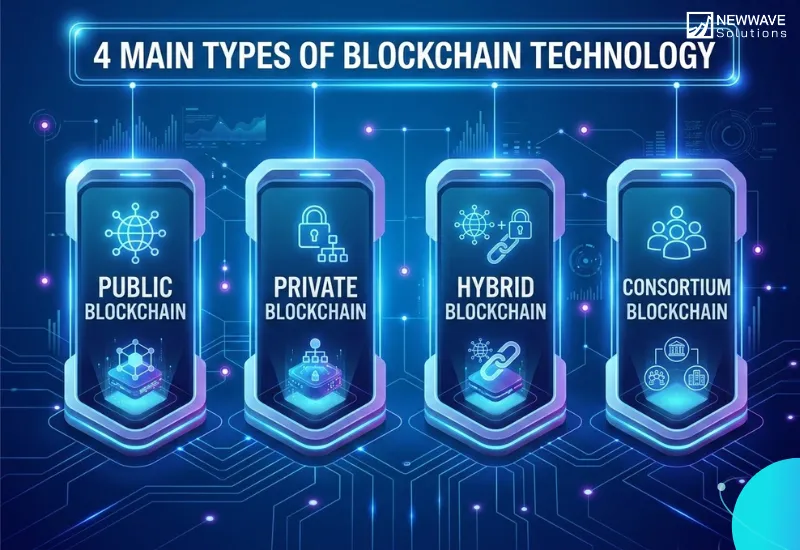
When people ask what are the 4 different types of blockchain technology, they are usually referring to public, private, consortium, and hybrid blockchains. These 4 types of blockchain networks were designed to solve different challenges—ranging from openness and transparency to privacy, efficiency, and governance.
In this section, we will explore each type in detail, outlining their definitions, core features, advantages, disadvantages, real-world examples, and the situations in which they are most useful. By the end, you will clearly understand how each blockchain model operates and which may align best with your business objectives.
1. Public Blockchain
A public blockchain is fully decentralized, meaning anyone can join the network, validate transactions, and view records. It operates on a trustless model, secured by consensus mechanisms such as Proof of Work or Proof of Stake.
Main Features
- Open participation for anyone worldwide
- No central authority controls the network
- High transparency of all transactions
Pros & Cons
- Pros: Maximum security, transparency, global accessibility
- Cons: Slower transaction speeds, high energy usage, scalability challenges
Example
Bitcoin and Ethereum are the most well-known public blockchains, supporting cryptocurrencies and decentralized applications (dApps).
Use Cases
- Cryptocurrencies (Bitcoin, Ethereum)
- Decentralized Finance (DeFi) platforms
- Digital voting systems
2. Private Blockchain
A private blockchain is a permissioned network governed by a single organization. Unlike public blockchains, only authorized users can access, read, or write data.
Main Features
- Controlled access and permissions
- High transaction speed due to fewer participants
- Governance managed by one central authority
Pros & Cons
- Pros: Faster, scalable, efficient, controlled governance
- Cons: Less transparent, higher risk of centralization, trust depends on the authority
Example
Hyperledger Fabric and R3 Corda are leading private blockchain frameworks used in enterprises.
Use Cases
- Supply chain tracking
- Secure healthcare data management
- Enterprise financial settlements
3. Hybrid Blockchain
A hybrid blockchain combines elements of both public and private models. Organizations can keep sensitive data private while still allowing public verification where necessary.
Main Features
- Mix of public openness and private control
- Flexible transparency settings
- Capable of integrating with existing enterprise systems
Pros & Cons
- Pros: Flexible, scalable, ensures privacy with public accountability
- Cons: Governance complexity, limited adoption compared to public/private models
Example
XinFin (XDC Network) and Dragonchain are well-known hybrid blockchains used in enterprise and government collaborations.
Use Cases
- Government data sharing
- Retail and e-commerce ecosystems
- Internet of Things (IoT) applications
4. Consortium Blockchain
A consortium blockchain, also known as a federated blockchain, is managed by a group of organizations instead of a single authority. It provides a balance between decentralization and efficiency.
Main Features
- Shared control across multiple stakeholders
- More efficient than public blockchains
- Semi-transparent, with selected participants having access
Pros & Cons
- Pros: Collaborative governance, improved efficiency, shared infrastructure
- Cons: Governance disputes possible, less transparent than public chains
Example
IBM Food Trust is a consortium blockchain where multiple companies collaborate to enhance supply chain transparency.
Use Cases
- Banking and financial consortia
- Healthcare collaborations
- Logistics and supply chain networks
In order to help you quickly grasp the crucial details of each model, we have summarized the information in the table below:
| Metric | Public Blockchain | Private Blockchain | Consortium Blockchain | Hybrid Blockchain |
| Access Control | Open to anyone | Controlled by a single organization | Shared control among a group of organizations | A combination of public and private rules |
| Transparency | Fully transparent | Limited transparency | Semi-transparent | Flexible transparency |
| Speed | Slower due to decentralization | Faster transactions | Moderate speed | Moderate to fast |
| Security | Very high, trustless environment | High but dependent on the central authority | Strong, with shared responsibility | Strong, flexible mix |
| Scalability | Limited scalability | Highly scalable | More scalable than public | Scalable, adaptable |
| Cost | Higher energy and resource costs | Lower infrastructure costs | Shared costs among participants | Variable, depending on design |
| Use Cases | Cryptocurrency, DeFi, voting systems | Supply chain tracking, healthcare, and finance | Banking consortia, logistics, industry networks | Government data, IoT, enterprise cooperation |
How to Choose the Right Blockchain Type for Your Business?
Choosing the right model among the different types of blockchain is a critical step for enterprises seeking to balance transparency, security, efficiency, and cost. The decision depends not only on technical strengths but also on industry needs, regulatory requirements, and long-term business objectives. By analyzing the following factors, executives can make informed choices that align blockchain adoption with strategic goals.
1 – Define Your Business Objectives
The first step in selecting the most suitable blockchain model is to clarify what your business aims to achieve. For instance, if transparency and decentralization are priorities, a public blockchain might be ideal. Conversely, if the goal is operational efficiency and controlled access, private or consortium blockchains could provide a better fit. A clear definition of objectives ensures that the chosen technology supports both immediate outcomes and long-term strategies.
2 – Understand Industry Requirements
Different industries face unique challenges and regulations, which directly influence the choice of blockchain. In finance and healthcare, compliance and data security are paramount, making private or consortium models more suitable. In contrast, industries like retail or government voting systems benefit from the openness of public blockchains. Aligning your choice with sector-specific standards ensures smooth adoption and regulatory approval.
Example: Walmart has adopted the IBM Food Trust consortium blockchain to improve food traceability across its supply chain. This model allows multiple stakeholders to collaborate securely while maintaining industry-specific compliance.
3 – Evaluate Scalability and Performance Needs
Scalability remains one of the biggest considerations when comparing the types of blockchain. Public blockchains often face transaction bottlenecks, while private and hybrid models offer higher throughput suitable for large-scale enterprise operations. Businesses that expect rapid growth must evaluate not only current performance but also the scalability of the blockchain infrastructure to avoid future limitations.
4 – Assess Security and Privacy Priorities
Security is a fundamental promise of blockchain, but privacy requirements vary. Public blockchains offer high security through decentralization, yet data visibility may not be acceptable for sensitive business operations. Private and hybrid blockchains allow for greater privacy while still benefiting from cryptographic safeguards. Enterprises must balance openness and confidentiality to ensure compliance with both internal policies and external regulations.
Example: The global banking consortium R3 uses its Corda private blockchain to ensure secure and private financial transactions between institutions. This model enables banks to share data only with authorized participants while maintaining high levels of trust and compliance.
5 – Consider Cost and Resource Allocation
Implementing blockchain requires investments not only in technology but also in skilled talent and ongoing maintenance. Public blockchains may involve higher energy and transaction costs, while private and consortium models reduce infrastructure expenses but require governance frameworks. Evaluating total cost of ownership—including development, integration, and long-term operations—helps businesses allocate resources more effectively.
Refer to Newwave Solutions to build your Blockchain business from scratch
For enterprises that are new to blockchain, the journey from concept to implementation can be complex and resource-intensive. Choosing among the different types of blockchain, ensuring scalability, and maintaining compliance all require specialized expertise. That is why many organizations turn to trusted partners instead of navigating the process alone.
By outsourcing or hiring a reliable blockchain development service, businesses can accelerate adoption, reduce risks, and focus on their core strategy while experts handle the technical challenges. At Newwave Solutions, we guide clients through the essential steps to start blockchain development, from assessing business objectives and selecting the right blockchain model to building, testing, and scaling secure, high-performance solutions tailored to enterprise needs.
Here are some main features of our Blockchain Development Services to help businesses build their blockchain ventures:
Blockchain Consulting: We meticulously assess project feasibility and identify compelling blockchain use cases, guiding businesses to define their roadmap for blockchain adoption. We offer specialized Blockchain Consulting to determine if blockchain is suitable for specific industries or use cases like FinTech, Supply Chain, Healthcare, Real Estate, Gaming, and Digital Identity, tailored for your unique needs.
Custom Blockchain Development Services: We design and build bespoke blockchain protocols, including Layer 1/2 solutions, by tailoring consensus mechanisms and network architectures. This also extends to Enterprise Blockchain Solutions, where we implement private, permissioned blockchain networks such as Hyperledger Fabric and R3 Corda for secure data sharing and improved supply chains.
Our comprehensive services guide enterprises from concept to impactful launch with secure, transparent, and innovative distributed ledger technology (DLT) solutions.
Decentralized Application (dApp) Development:
We create secure, scalable, and user-friendly dApps for diverse Web3 ecosystems. This encompasses specialized areas such as Non-Fungible Token (NFT) Development, where we develop unique, verifiable NFTs for digital assets, art, gaming, or real-world use, and also build custom NFT marketplaces.
We also offer Decentralized Finance (DeFi) Solutions, developing platforms for decentralized lending/borrowing, Decentralized Exchanges (DEXs), yield farming, and liquidity pools. Furthermore, we engineer robust and secure crypto wallets for multiple currencies and high-performing centralized/decentralized crypto exchange platforms.
Smart Contract Development & Audit:
We build, deploy, and thoroughly audit smart contracts, ensuring secure, efficient, and unchangeable agreements. Our specialized smart contract audits aim to eliminate vulnerabilities and ensure system robustness, which is fundamental to most blockchain applications.
Blockchain Integration Services and Ongoing Support & Maintenance:
We smoothly integrate blockchain technology into your current business systems, like CRM, ERP, and IoT devices. Following deployment, we provide ongoing support, including proactive monitoring, crucial security audits, and performance improvements for your blockchain solutions after launch.
Our dedicated maintenance and support services extend well beyond the initial launch, providing essential security patches and strategic feature enhancements for sustained operation and evolution.
FAQs
Which blockchain type is most secure?
Public blockchains aregenerally considered the most secure due to their decentralized nature and large number of participants validating transactions. However, security also depends on the consensus mechanism and implementation.
Canprivateblockchains be hacked?
While private blockchains have strong cryptographic protections, they are more vulnerable to insider threats since control rests with a single organization. Implementing strict access management and auditing reduces this risk.
Why do enterprises prefer consortium blockchains?
Enterprises choose consortium blockchains because they balance efficiency with shared governance. This model allows multiple organizations to collaborate securely without the inefficiencies of a fully public blockchain.
Is hybrid blockchain the future of Web3?
Hybrid blockchains are increasingly seen as a bridge to Web3, combining public transparency with private control. Their flexibility makes them attractive for governments, enterprises, and industries requiring both openness and confidentiality
How are industries currentlyapplyingeach blockchain type?
- Public blockchains: powering cryptocurrencies and DeFi platforms.
- Private blockchains: managing supply chains and healthcare records.
- Consortium blockchains: streamlining banking and logistics networks.
- Hybrid blockchains: enabling government data sharing and IoT ecosystems.
Conclusion
The four main types of blockchain—public, private, consortium, and hybrid—each serve different purposes, offering distinct balances of transparency, scalability, and control. There is no universal best option; the right choice depends on your business objectives, industry needs, and long-term growth strategy.
For enterprises seeking expert guidance and seamless execution, Newwave Solutions provides end-to-end blockchain development services to help you design, build, and scale solutions with confidence.
To Quang Duy is the CEO of Newwave Solutions, a leading Vietnamese software company. He is recognized as a standout technology consultant. Connect with him on LinkedIn and Twitter.



Read More Guides
Get stories in your inbox twice a month.
Let’s Connect
Let us know what you need, and out professionals will collaborate with you to find a solution that enables growth.
Leave a Reply