


What Is Oracle Database? Understanding the Core of Enterprise Data
Are you generating a river of data—sales, customer interactions, logistics, every day? The challenge isn’t just storing it; it’s making it instantly reliable, secure, and actionable. This is where Oracle Database comes in. It’s the enterprise-grade engine that transforms raw data into a strategic asset, powering everything from your local bank’s transactions to global supply chains. If your operations depend on data you can absolutely trust, you need to understand what is Oracle Database, and why it remains one of the leading standards for mission-critical systems.
What is Oracle Database?
Oracle Database is a multi-model relational database management system (RDBMS) that stores, organizes, and retrieves data for applications and users. At its core, it’s designed to handle complex, high-volume transactional workloads while maintaining data consistency and availability across distributed environments.
Oracle Corporation introduced its first commercial SQL relational database in 1979, making it the first company to market with this revolutionary approach to data management. What started as a project initially named after a CIA codename ‘Oracle’ has evolved into one of the most widely deployed enterprise database platforms. The journey from a startup’s ambitious vision to becoming the backbone of global commerce represents one of technology’s most significant success stories, driven by continuous innovation and an unwavering focus on enterprise needs.
Oracle Database distinguishes itself through several fundamental characteristics that set it apart in the database landscape:
- Cross-Platform: Oracle Database runs reliably on major enterprise operating systems such as Windows, Linux, Solaris, IBM AIX, and HP-UX, offering high deployment flexibility. (MacOS is available only for limited developer/test editions and is not officially supported for production environments).
- Networking (Oracle Net Services): Facilitates secure and efficient communication between clients and databases across distributed networks, making a globally distributed database system behave like a local one.
- ACID-Compliant: Strictly adheres to Atomicity, Consistency, Isolation, and Durability principles. This guarantees that all transactions are processed reliably, ensuring data integrity even in cases of system failures or power outages.
- Commitment to Open Technologies: While a commercial product, it supports open standards like SQL, Java, and XML, preventing vendor lock-in for application development and ensuring interoperability.
How Does Oracle Database Work?
Oracle Database operates on a sophisticated architecture that separates logical data organization from physical storage, enabling both flexibility and performance optimization. The system’s foundation rests on two critical components working in harmony.
Core Architecture Components:
- Database Instance: Running processes and memory structures managing data access, including the System Global Area (SGA) that serves as shared memory for frequently accessed data.
- Physical Storage: Datafiles, control files, and redo log files, maintaining data persistence and automated recovery capabilities.
- Background Processes: Multiple specialized processes orchestrating everything from memory management to automatic performance optimization.
The key lies in how Oracle processes your requests. When you submit a SQL query, Oracle’s cost-based optimizer analyzes multiple execution paths and selects the most efficient approach based on current data statistics, available indexes, and system resources. This intelligent optimization means that as your data grows and changes, Oracle continuously adapts its performance strategies without requiring manual intervention.
Oracle’s multi-version concurrency control ensures that readers never block writers and writers never block readers, enabling high-concurrency environments where thousands of users can simultaneously access and modify data without performance degradation. This approach proves particularly crucial for applications requiring both real-time reporting and continuous transactional processing.
What Are the Compelling Benefits of Oracle Database?
While powerful, the true value of Oracle Database is revealed in the tangible advantages it delivers to an organization’s bottom line and operational stability. Its benefits are not merely a list of features but an interconnected system of capabilities that create a whole far greater than the sum of its parts.
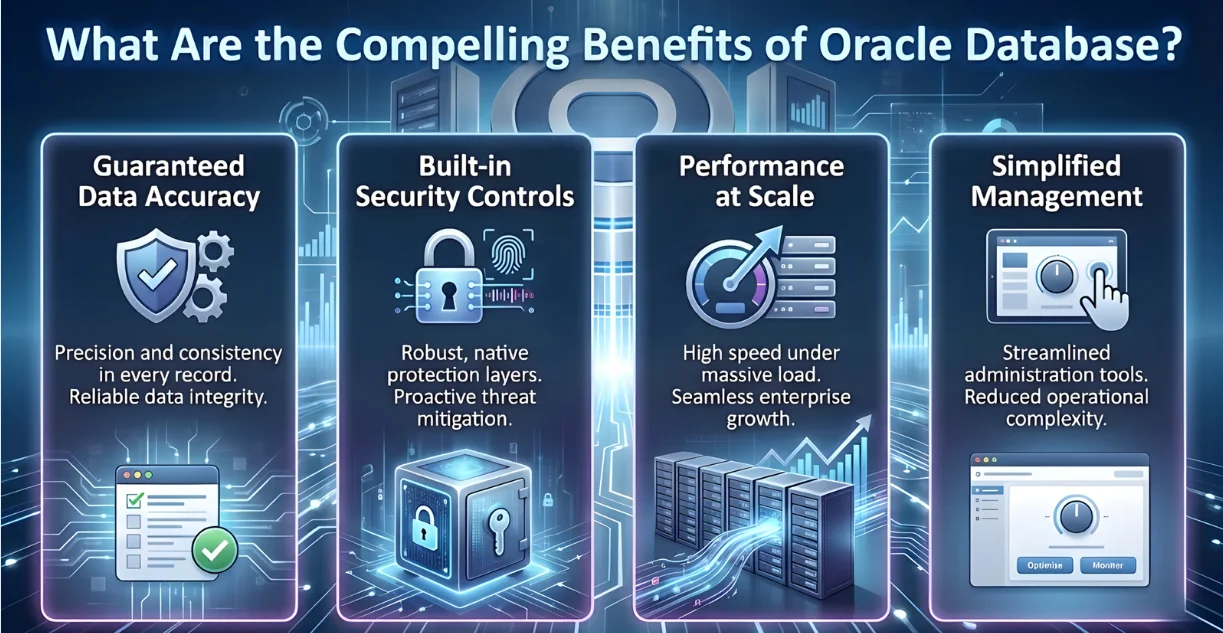
1. Guaranteed Data Accuracy
At its core, Oracle Database is engineered for one non-negotiable principle: trust in your data. This is achieved through its strict adherence to ACID properties (Atomicity, Consistency, Isolation, Durability). But what does this mean in practice?
- Atomicity ensures a transaction is an “all-or-nothing” unit. For example, in a funds transfer, both the debit from one account and the credit to another must be completed. If a system failure occurs mid-transaction, Oracle’s rollback mechanism will undo any partial changes, preventing financial discrepancies that could take weeks to reconcile.
- Durability is guaranteed through its redo log architecture. Once a transaction is committed, it is first written to a sequential redo log file before being written to the main data files. This means even a complete power loss the millisecond after.
“Transaction Complete” message appears will not result in data loss; upon restart, the database replays the redo log to reconstruct the committed transaction.
This isn’t just about preventing errors; it’s about enabling business at scale and speed. Financial institutions, e-commerce platforms, and healthcare providers can process millions of transactions daily with the absolute certainty that each one is processed correctly and permanently. This reliability is the bedrock upon which customer trust and regulatory compliance are built.
2. Built-in Security Controls
Oracle approaches security not as a set of add-ons, but as a fundamental design principle woven into the fabric of the database. This layered defense strategy protects data from external attacks, internal threats, and human error.
- Prevention: Transparent Data Encryption (TDE) encrypts data both at rest (in storage and backups) and in motion (over the network), rendering stolen files or intercepted network packets useless without the encryption keys.
- Access Control: Beyond basic username/password authentication, Oracle employs sophisticated privilege analysis and roles. Most critically, Oracle Database Vault can enforce separation of duties, preventing even powerful system administrators (“superusers”) from accessing sensitive application data they are not authorized to see. This directly mitigates the risk of insider threats.
- Detection and Masking: Data Redaction dynamically masks sensitive data (like credit card numbers) in real-time for application users based on predefined policies, ensuring that a support agent sees only the last four digits. Unified Auditing provides a high-performance, detailed trail of who did what, when, and how, which is crucial for forensic analysis and compliance reporting (e.g., for SOX, GDPR, HIPAA).
Oracle’s built-in security framework shifts the paradigm from reactive compliance to proactive protection, significantly reducing the organization’s attack surface and simplifying the path to passing stringent audits.
3. Performance at Scale
Oracle doesn’t just handle large datasets; it is designed to make them performant through a combination of in-memory processing, parallelism, and intelligent optimization.
- The Cost-Based Optimizer (CBO): This is the brain of the database. For every SQL query, the CBO evaluates thousands of potential execution paths based on collected statistics about the data (e.g., table size, data distribution). It chooses the most efficient path, often one a human DBA would not conceive, to retrieve results in the shortest time possible.
- In-Memory Caching: The System Global Area (SGA), particularly the database buffer cache, keeps frequently accessed data blocks in ultra-fast server memory. This dramatically reduces the need for slow physical disk I/O, which is the primary bottleneck in database performance. Oracle’s algorithms are sophisticated in determining what to keep in cache for maximum hit rates.
- Massive Scalability: Features like Real Application Clusters (RAC) allow a single database to run across a cluster of interconnected servers. This provides both horizontal scalability (add more servers to handle increased load) and continuous availability (if one server node fails, others seamlessly take over).
This translates directly to user satisfaction and operational efficiency. Applications remain responsive during peak usage periods, complex reports that once took hours run in minutes, and the infrastructure can scale elastically to support business growth without costly, disruptive forklift upgrades.
4. Simplified Management
A common misconception is that Oracle is operationally complex. While its depth requires expertise, its modern features are designed to automate routine tasks and consolidate infrastructure, thereby lowering the total cost of ownership.
- The Multitenant Architecture: This is a game-changer for manageability. It allows you to host hundreds of pluggable databases (PDBs) within a single container database (CDB). Instead of managing hundreds of individual databases, DBAs can perform actions like patching, upgrades, and backups at the CDB level, accomplishing in minutes what used to take days.
- Automated Management: Tools like Oracle Enterprise Manager provide a unified console for monitoring performance, allocating resources, and implementing lifecycle management policies automatically. Features like Automatic Workload Repository (AWR) and Automatic Database Diagnostic Monitor (ADDM) continuously collect performance data and proactively identify bottlenecks, often suggesting solutions.
This allows a smaller team of DBAs to manage a vastly larger and more complex data estate. It reduces human error, accelerates provisioning for development teams, and slashes the server and storage costs associated with maintaining siloed databases. It transforms the DBA’s role from fire-fighting to strategic planning and optimization.
What Are the Key Challenges of Oracle Database?
Adopting this powerful technology is not without its hurdles. A clear-eyed view of the challenges is essential for making an informed decision.
1. Significant Financial Investment
The most frequently cited challenge is cost. So, is Oracle Database free? There is a free version (Oracle Database XE), but it is limited in terms of CPU, memory, and storage, making it suitable only for learning and small-scale projects. The full-featured enterprise edition is licensed based on a complex model, often per processor core or named user, and can run into hundreds of thousands of dollars for large deployments. This includes hefty annual support fees. This means a substantial CapEx and OpEx investment that must be rigorously justified by the value it provides.
2. Operational Complexity
The sheer power and feature set of Oracle Database come with a steep learning curve. Performance tuning, configuring RAC, and implementing advanced security require highly specialized DBAs. The question “how do I start Oracle Database?” has a simple answer, but “how do I optimize it for a 99.999% uptime SLA?” requires deep expertise. This complexity can lead to a reliance on expensive specialist contractors or a need for extensive internal training, adding to the total cost of ownership.
3. Perceived Vendor Lock-In and Agility
The proprietary nature of many Oracle extensions, alongside the significant investment in licensing and skills, can create a form of vendor lock-in. Migrating away from Oracle to an open-source alternative like PostgreSQL can be a complex, costly, and risky project. Furthermore, in the modern DevOps era, the perception of Oracle databases as being less “agile” or harder to integrate into CI/CD pipelines can be a challenge for organizations aiming for extreme operational speed.
What is Oracle Database Used For?
Oracle Database powers critical operations across industries, but understanding its practical applications helps you recognize where this platform creates the most value for your organization. Let’s examine how leading organizations leverage Oracle’s capabilities to solve complex business challenges:
1. Financial Services Transformation
Major banks process credit card transactions where milliseconds matter, and accuracy remains non-negotiable. Each card swipe triggers sophisticated fraud detection algorithms analyzing spending patterns, merchant risk profiles, and user behavior in real-time. Oracle’s ACID compliance ensures approved transactions complete successfully while suspicious activity gets flagged immediately, all while processing thousands of transactions per second.
If you’re considering launching secure digital payment solutions, our E-Wallet App Development service leverages Oracle’s proven financial-grade security and performance to create competitive mobile payment platforms that users trust.
2. Healthcare System Reliability
Electronic health records systems maintain comprehensive patient histories while enabling instant access during emergencies. When unconscious patients arrive at emergency rooms, doctors need immediate access to medication allergies, previous diagnoses, and current prescriptions—Oracle’s reliability ensures this life-critical information stays available while security features protect sensitive medical data according to HIPAA requirements.
Building healthcare applications that can handle such critical scenarios requires both deep technical expertise and understanding of healthcare workflows – our Healthcare Software Development service combines Oracle’s enterprise-grade capabilities with specialized healthcare domain knowledge to create systems that protect patient lives while streamlining clinical operations.
3. Manufacturing Networks
The manufacturing sector demonstrates Oracle’s analytical power through supply chain optimization that directly impacts profitability:
- Predictive Planning: Complex algorithms analyze supplier relationships, production schedules, inventory levels, and customer demands to prevent disruptions
- Real-Time Adaptation: Systems adjust production schedules and inventory levels in response to changing market conditions
During global supply chain disruptions, companies with Oracle-powered planning systems adapted faster than competitors using simpler solutions
FAQs
What is the fundamental difference between SQL Server and Oracle Database?
While both are enterprise RDBMS, key differences exist. Oracle runs on a wide variety of OS platforms, while SQL Server is primarily on Windows. Oracle uses a “serializable” isolation level as its foundation, while SQL Server defaults to “read committed.” Oracle’s write process involves writing to the redo log first, whereas SQL Server writes directly to the data file with a write-ahead log. Oracle’s licensing is traditionally more expensive and complex. The choice often comes down to platform preference, existing IT ecosystem, and specific feature requirements.
What ongoing maintenance and administration effort should we expect?
Oracle Database requires regular maintenance, including backup verification, performance monitoring, security patching, and capacity planning. Organizations typically need dedicated database administrators for production environments, though smaller deployments might manage with part-time attention. Automated features reduce routine tasks, but critical decisions about indexing, partitioning, and performance tuning still require human expertise.
How does Oracle Database performance scale with increasing data volumes?
Oracle Database uses advanced techniques like partitioning, indexing strategies, and parallel processing to maintain performance as data volumes grow. Proper database design becomes crucial for scalability, with partitioning strategies and index optimization playing key roles. The platform can handle multi-terabyte databases effectively, though performance depends on query patterns, hardware resources, and optimization efforts.
Final Thoughts
Oracle Database is far more than a piece of software; it is a strategic commitment to data integrity, security, and scalability. It is the correct, though considerable, investment for organizations whose operations are synonymous with their data’s reliability. The decision to adopt it is not one to be taken lightly, weighing against its significant capabilities and its equally high costs and complexities. It is the engine for enterprises that cannot afford to stall.
Ready to explore how Oracle Database can transform your organization’s data capabilities? The experts at Newwave Solutions bring deep Oracle expertise to help you navigate the complexities and maximize the benefits of this powerful platform. Contact us for more details on this collaboration.
To Quang Duy is the CEO of Newwave Solutions, a leading Vietnamese software company. He is recognized as a standout technology consultant. Connect with him on LinkedIn and Twitter.



Read More Guides
Get stories in your inbox twice a month.
Let’s Connect
Let us know what you need, and out professionals will collaborate with you to find a solution that enables growth.
Leave a Reply