


What Is React Native? Mastering Facebook’s Mobile Framework
Launched by Facebook in 2015, React Native has become one of the most popular frameworks for building mobile applications, powering apps like Instagram, Facebook, and Walmart. It enables developers to create high-performing apps for iOS and Android from a single codebase, saving time and resources while reaching millions of users. In this Newwave Solutions blog, we explain what is React Native, why React Native matters, its key features and benefits, and how you can start using it from scratch.
What is React Native?
React Native is an open-source framework created by Meta (formerly Facebook) that allows developers to build mobile apps for multiple platforms using a single codebase. Instead of writing separate code for Android and iOS like in native app development, React Native uses JavaScript and React to deliver apps that look and feel like native mobile apps. This makes it possible to save time and resources while still providing a smooth user experience across devices.
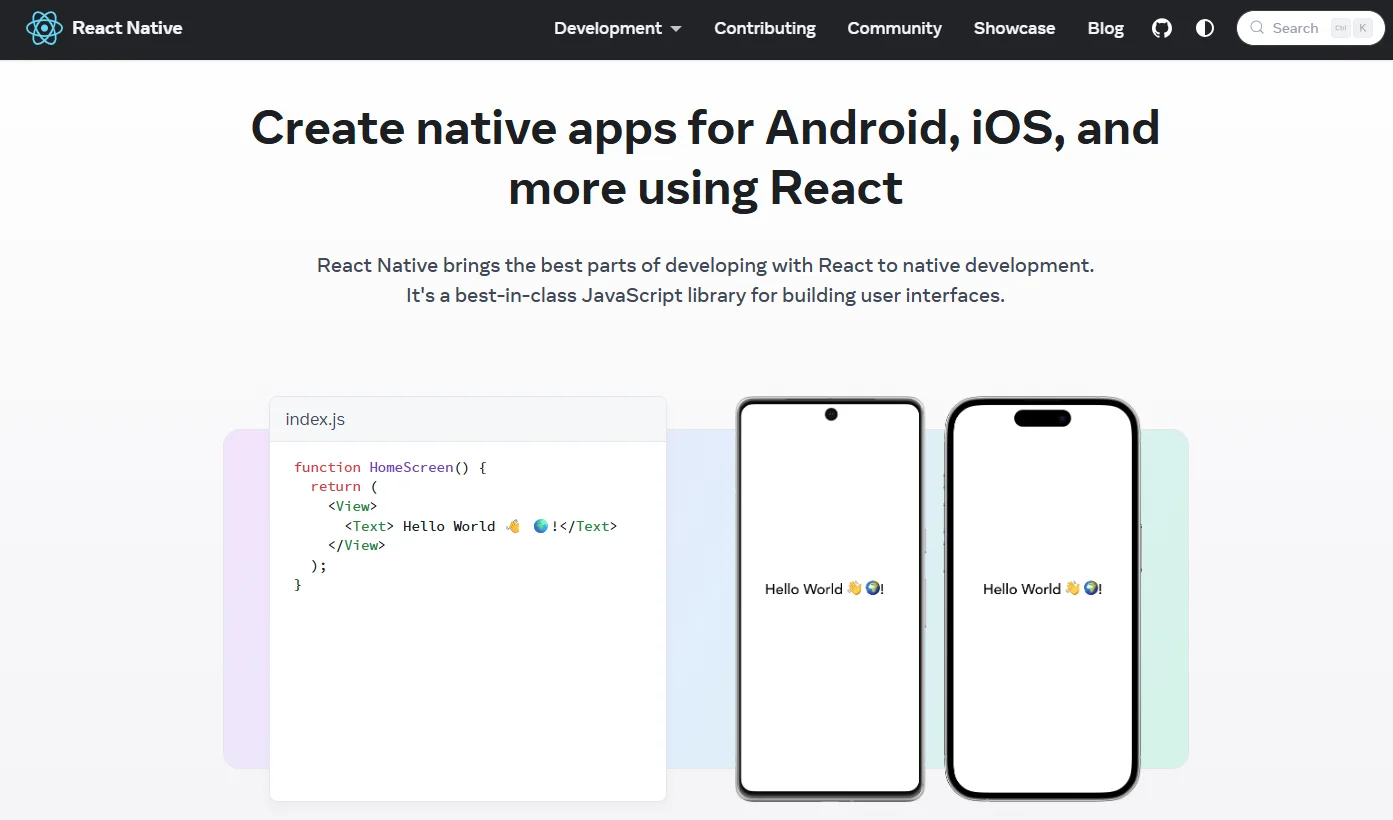
To understand this better, think about what are native applications such as WhatsApp or Spotify, which are built directly for one platform (iOS or Android). React Native takes a different approach by letting developers create apps with one set of code that still runs almost like native applications, combining flexibility with near-native performance.
A well-known example is Instagram, which uses React Native to power parts of its app, ensuring fast updates and consistent features across both iOS and Android.
How Does React Native Work
The idea behind how React Native works is simple: it acts as a bridge between JavaScript code and the native components of each mobile platform. Developers write the app in JavaScript using the React framework, and React Native translates those instructions into native code for Android and iOS.
In practice, this means:
- The app’s logic is written in JavaScript.
- React Native uses a bridge to communicate with native APIs.
- The output is a real mobile app that behaves very similarly to what native mobile apps are built directly in Swift or Kotlin.
This flow allows businesses to enjoy faster development without giving up too much of the performance and experience that native applications usually provide.
8 Key features of React Native
To fully understand how React Native stands out, it helps to look at the features that make this framework unique. Unlike building separate versions in what is native app development, React Native combines efficiency with near-native performance through a powerful set of tools and capabilities. Below are the key features that explain why it has become a preferred choice for many businesses.
- Cross-Platform Development: React Native allows developers to write one codebase and deploy it across iOS and Android, which greatly reduces development time and costs. This makes it easier for businesses to reach a wider audience without building two separate apps.
- JavaScript and React: The framework is built on JavaScript and React, making it accessible to developers who already know these common web technologies. This lowers the learning curve and speeds up the adoption of the framework.
- Native Components: React Native renders real native UI components instead of relying on web views. This ensures that applications look and perform like native mobile apps, giving users a smoother experience.
- Component-Based Architecture: By using a component-based approach, React Native encourages reusability and modularity in development. This makes apps easier to maintain and scale over time.
- Hot Reloading: Hot reloading allows developers to instantly see changes in the code reflected in the app without restarting it. This feature speeds up testing and boosts productivity during development.
- Large Ecosystem and Community Support: React Native benefits from a vast ecosystem of libraries, plugins, and tools maintained by an active community. This support makes it easier to find solutions, integrate features, and keep projects updated.
- Access to Native APIs: The framework provides direct access to device features like the camera, GPS, and push notifications. This allows developers to create apps that feel close to what are native applications in terms of functionality.
- Performance Optimization: While cross-platform, React Native offers near-native performance by efficiently bridging JavaScript code with native APIs. This balance makes it suitable for many business apps that need speed and responsiveness.
Pros & Cons of React Native
Before adopting any technology, it is important to weigh its strengths and weaknesses. From my own experience experimenting with the framework in real-world projects, I’ve seen both the benefits of React Native—such as faster development and broader reach—and its limitations, like performance gaps in complex apps. By understanding these React Native pros and cons, you can decide whether the advantage of React Native aligns with your business needs.
| Pros of React Native |
Cons of React Native |
| Cross-platform development – One codebase works for both iOS and Android, reducing time and effort compared to building two separate apps. | Performance limitations – Apps may run slightly slower than fully native apps, especially for graphics-heavy or real-time use cases. |
| Cost efficiency – Lower development costs since fewer resources are needed to cover multiple platforms. | Limited access to advanced features – Some device-specific capabilities may require extra workarounds or native modules. |
| Reusable components – The component-based structure improves code reusability and speeds up updates. | Third-party dependency – Heavy reliance on external libraries can affect long-term stability and support. |
| Strong community support – A large developer ecosystem offers tools, solutions, and resources for faster problem-solving. | Complex debugging – The bridge between JavaScript and native code can make debugging more time-consuming. |
| Faster iteration with hot reload – Developers can see changes instantly without restarting the app, improving productivity. | UI inconsistencies – Apps may not always perfectly match platform-specific design guidelines. |
Top 5 Popular Apps built with React Native
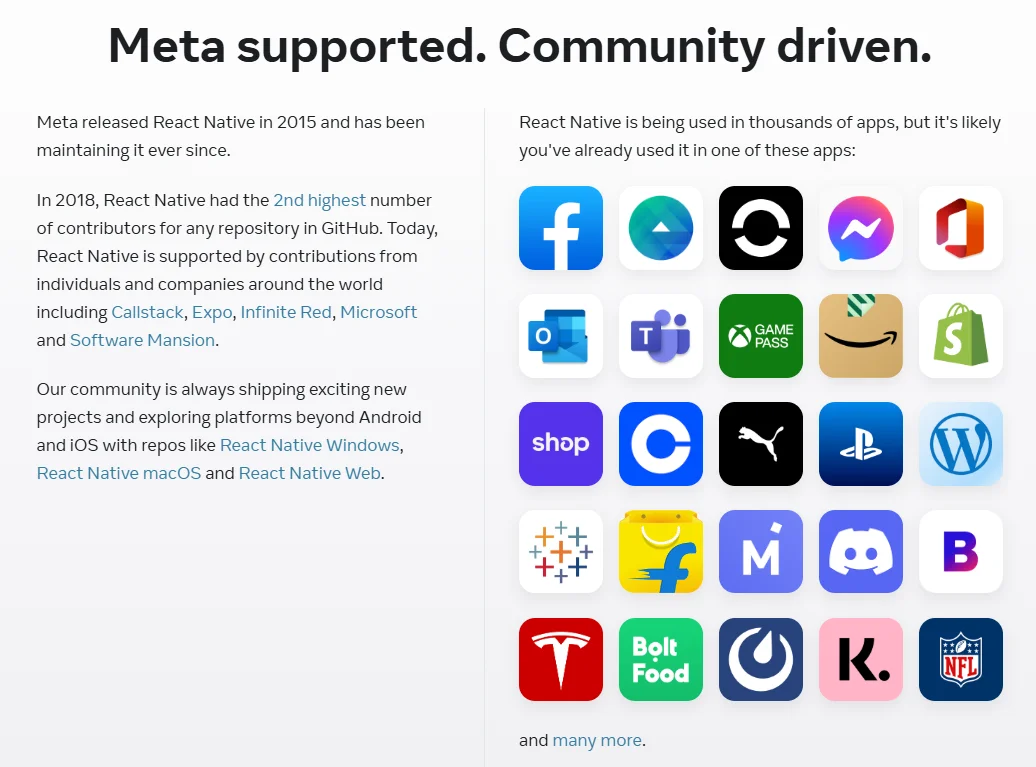
Many businesses across industries have integrated React Native into their mobile strategies and achieved measurable success. From global social platforms to retail giants, the framework has enabled faster development, cost efficiency, and consistent user experiences. Below are five outstanding examples that show how React Native works in practice.
1. Facebook
Facebook, the creator of React Native, uses the framework within its own mobile app to improve performance and development speed. The platform serves billions of users worldwide and needs frequent updates across devices. React Native was introduced to handle dynamic features and ensure consistency between iOS and Android.
Results:
- Reduced development time by sharing code across platforms.
- Improved app performance on key features such as Groups.
- Enabled faster iteration and testing cycles.
2. Instagram
Instagram adopted React Native to streamline its mobile app development and improve feature rollout. The platform, with over 2 billion active users, needed a way to push updates simultaneously across iOS and Android. React Native was first tested on the “Push Notifications” feature and gradually expanded to other areas.
Results:
- Faster delivery of updates across both platforms.
- Improved developer productivity with shared code.
- Seamless user experience maintained during feature expansion.
3. Walmart
Walmart, one of the world’s largest retail companies, embraced React Native to enhance its mobile shopping app. With millions of users depending on quick access to products and services, the company sought a cost-effective, scalable solution. React Native helped them unify development efforts while keeping the app responsive and user-friendly.
Results:
- Shared 95% of the codebase between iOS and Android.
- Improved app performance and speed.
- Reduced overall development costs significantly.
4. Bloomberg
Bloomberg introduced React Native in its consumer mobile app, which provides news, market data, and portfolio tracking. The goal was to deliver a streamlined, interactive experience while shortening the development cycle. React Native allowed Bloomberg’s team to build powerful new features for both platforms simultaneously.
Results:
- Faster launch of a redesigned app with rich media features.
- Consistent user experience across iOS and Android.
- Reduced development time compared to native builds.
5. Pinterest
Pinterest, a global visual discovery engine, explored React Native to accelerate its mobile development process. The platform serves millions of users who expect smooth browsing and regular updates. By using React Native, Pinterest aimed to test cross-platform efficiency while maintaining high performance.
Results:
- Reduced engineering effort when building similar features for both platforms.
- Faster rollout of experimental features.
- Maintained quality user experience without performance loss.
5 Best Use Cases for React Native
React Native is not a one-size-fits-all solution, but it proves highly effective in certain business contexts. Below are some circumstances and industries where the framework delivers strong value.
1. Startups and MVP Development
Startups often face tight budgets and strict deadlines, making React Native ideal for building Minimum Viable Products (MVP development services). With a single codebase, they can launch apps on both iOS and Android up to 30–40% faster than native development. This speed allows startups to test their ideas in the market quickly and reduce the risk of wasted investment.
2. E-Commerce Platforms
React Native helps e-commerce web development services release feature-rich apps with seamless user experiences across devices. According to Statista, mobile e-commerce sales are projected to surpass $2.9 trillion in 2025, making speed-to-market critical. With reusable components and hot reloading, businesses can rapidly roll out updates like seasonal promotions or new payment options.
3. Social Media and Lifestyle Apps
Apps that focus on content sharing, communities, or lifestyle services benefit from React Native’s cross-platform consistency. Companies like Instagram and Facebook use it to deliver unified experiences across millions of devices. The framework’s ability to push frequent updates without compromising usability makes it especially valuable in this fast-evolving segment.
4. Enterprise Applications
Large organizations leverage React Native to streamline internal applications and employee tools. Walmart, for example, used React Native to improve its mobile app performance while reducing costs. Enterprises benefit from consistent design across platforms, simplified maintenance, and easier scaling of business-critical apps.
5. Education and Learning Apps
With the global e-learning market expected to grow at a 14% CAGR between 2023 and 2032, education providers need scalable, cost-efficient platforms. React Native supports interactive interfaces, multimedia content, and push notifications, enabling schools and EdTech solutions/ firms to provide engaging mobile learning experiences to both iOS and Android users.
How to Get Started with React Native
If your business needs to ship mobile features faster, reduce costs, and reach both iOS and Android users at once, React Native is a practical path to better performance and ROI. Even if you’re new to mobile, you can follow a simple, structured process to build a quality cross-platform app. Feel free to utilize the steps below to go from zero to a working prototype—no deep engineering background required.
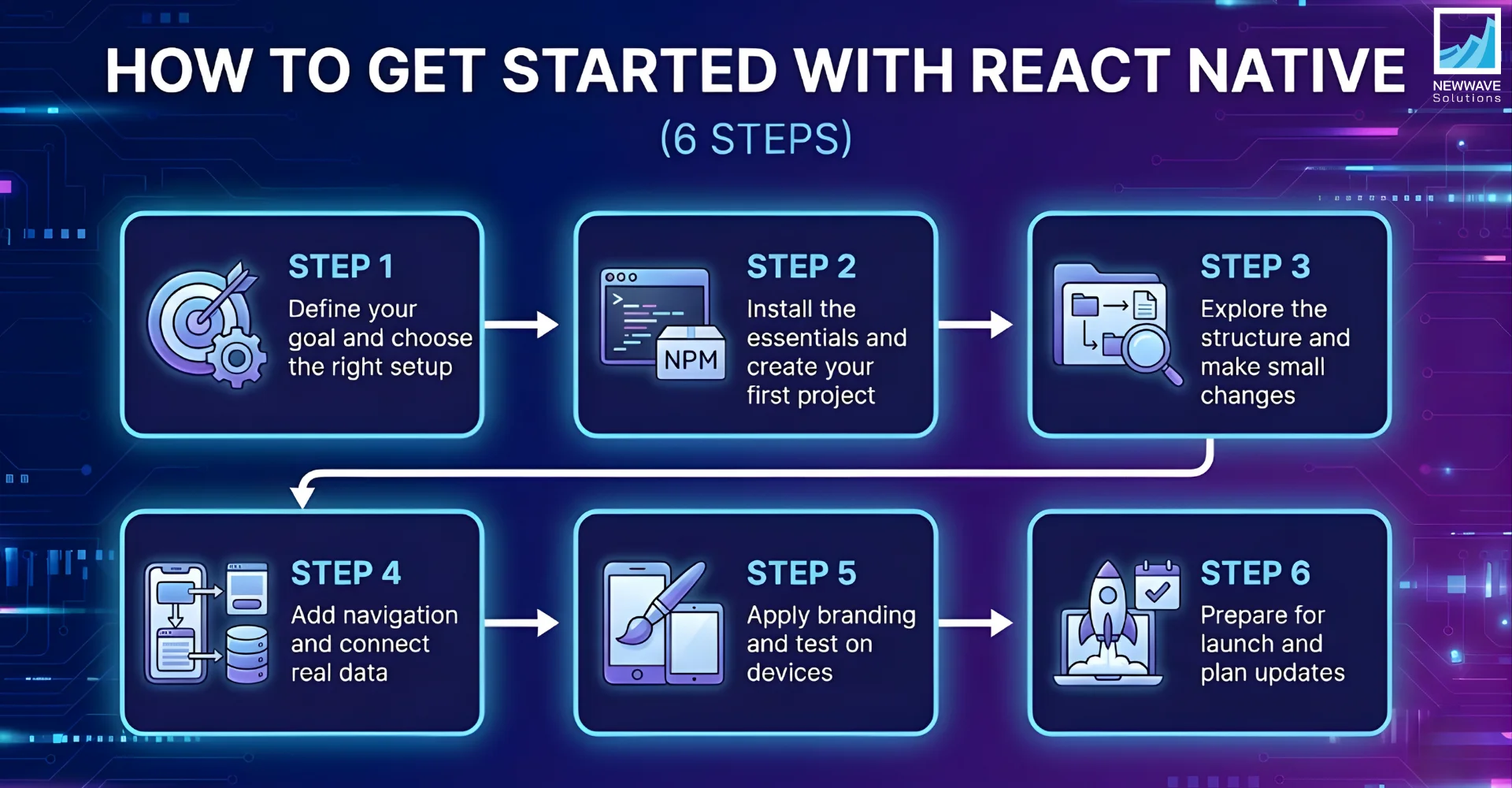
Step 1: Define your goal and choose the right setup
Begin by clarifying what you want your app to achieve, such as increasing customer engagement or streamlining sales. Once you know the goal, decide between Expo (best for beginners and faster setup) or the React Native CLI (better if you have developers familiar with native tools). From my experience, starting with Expo often gives non-technical teams more confidence before scaling to a full custom setup.
Step 2: Install the essentials and create your first project
Install Node.js, a code editor like VS Code, and then create your project with a simple command (npx create-expo-app MyApp). Within minutes, you’ll have a working app you can preview on your phone with the Expo Go app, which is one of the most satisfying first wins in the process.
Step 3: Explore the structure and make small changes
Open the main file (App.js) and try editing the welcome text to see it update instantly on your phone. This “hot reload” feature is one of the biggest productivity boosters—I’ve seen teams get excited when they realize they can adjust UI and test results in real time without long waits.
Step 4: Add navigation and connect real data
Set up a navigation library to create screens like Home, Products, or Cart, and then connect your app to a simple API to display live data. In my projects, showing real content early always helps business teams validate ideas faster and feel more confident in the direction.
Step 5: Apply branding and test on devices
Add your company’s colors, fonts, and spacing to give the app a professional look, then test it on both iOS and Android devices. This step often uncovers small differences between platforms, but fixing them early ensures users get a smooth, consistent experience.
Step 6: Prepare for launch and plan updates
Finally, connect analytics and crash reporting tools, then build your app for release through Expo or the app stores. Plan for small, frequent updates rather than big, risky releases; in my experience, this approach keeps users happier and makes the app easier to maintain over time.
Choose Newwave Solutions if you do not have experience with React Native yet
If you don’t have prior experience with React Native or lack an in-house development team, the safest way to build quality apps is to outsource to a trusted technology partner. Reliable providers like Newwave Solutions bring proven expertise, advanced tools, and full lifecycle support to turn your app vision into reality with less risk and better results.
What can Newwave Solutions deliver?
Outsourcing to Newwave Solutions means gaining access to a highly skilled team that understands both native and cross-platform technologies. We combine technical mastery with frameworks like React Native, Flutter, Swift, and Kotlin, ensuring your app performs smoothly while delivering a native-like experience. Our experts focus on intuitive UI/UX design services, optimized performance, and strict security standards, all supported by ISO-certified quality assurance.
Beyond technical capabilities, our React Native App Development services provide flexible engagement models that fit any budget and timeline, from startups needing fast MVPs to enterprises requiring scalable, secure apps. With comprehensive services—ranging from consulting and design to development, testing, and ongoing maintenance—we become your end-to-end partner.
FAQs
1. Is React Native good for large-scale apps?
Yes, many large companies like Facebook, Walmart, and Instagram use it. With proper optimization, React Native can handle enterprise-level apps.
2. Can React Native match native app performance?
For most business apps, yes—it feels close to native. But in very demanding apps like 3D games, fully native still performs better.
3. Is React Native still relevant?
Absolutely. It’s one of the most popular frameworks, supported by Meta and a huge community, and widely used in new projects.
4. How does React Native differ from ReactJS?
ReactJS is for building web apps, while React Native is for building mobile apps that run on iOS and Android. They share similar concepts but target different platforms.
5. Is React Native free to use?
Yes, it’s open-source and completely free. Businesses only need to cover development and deployment costs.
Conclusion
Understanding what is React Native helps businesses see why it has become one of the most widely used frameworks for mobile app development. It is best suited for companies that want faster development, reduced costs, and apps that work across iOS and Android, while highly complex or performance-heavy apps may still benefit more from fully native development. By matching your business goals with the right approach, you can maximize both efficiency and user satisfaction.
For businesses seeking a reliable IT outsourcing partner, working with a trusted provider such as Newwave Solutions enables access to experienced and dedicated React Native developers with proven expertise in applying modern frameworks across real-world IT projects.
Together, we can help you implement React Native effectively and deliver high-quality mobile applications that align with your technical goals and business expectations.
To Quang Duy is the CEO of Newwave Solutions, a leading Vietnamese software company. He is recognized as a standout technology consultant. Connect with him on LinkedIn and Twitter.



Read More Guides

Get stories in your inbox twice a month.
Let’s Connect
Let us know what you need, and out professionals will collaborate with you to find a solution that enables growth.
Leave a Reply