


What is SQL? The Foundational Language of Data Explained
Every second, over 500,000 database transactions happen worldwide, and 95% of them rely on one language: SQL. Whether you’re checking your bank balance, booking a flight, or scrolling through social media, SQL queries are working behind the scenes to retrieve, update, and manage the data that powers your digital life. So, what is SQL, and why does it remain the unshakable foundation of our data-driven economy? Let’s dive deep into this blog.
What is SQL?
SQL (Structured Query Language) is a standardized programming language specifically designed for managing and manipulating relational databases. It enables you to communicate with databases to store, retrieve, update, and delete data through structured commands. Think of SQL as the universal translator between humans and databases—you write queries in a syntax that resembles plain English, and the database management system executes your instructions to perform operations on structured data.
The story of SQL begins in the 1970s at IBM, where researchers Donald D. Chamberlin and Raymond F. Boyce developed a language initially called SEQUEL. Their goal was to create a user-friendly way to manage large sets of data stored in IBM’s new relational database model. The language was so effective that it became the standard, adopted by countless other companies and formalized by the American National Standards Institute (ANSI) in 1986. This long history is a testament to its foundational power; while technologies around it have evolved at a dizzying pace, SQL has remained the constant, universal dialect for data.
So, how does it work? At its core, SQL operates on a straightforward principle: you issue a command or a “query,” and the database management system interprets and executes it.
The language is built around a few key types of commands, often categorized by their function:
Data Query Language (DQL): Used to retrieve data. The SELECT statement is the workhorse here, allowing you to fetch specific data from one or multiple tables.
Data Manipulation Language (DML): Handles the changing of data within the database. This includes:
- INSERT: Adds new rows of data.
- UPDATE: Modifies existing data.
- DELETE: Removes data.
Data Definition Language (DDL): Defines and modifies the structure of the database itself—the “shelves” and “filing system.”
- CREATE: Builds new databases, tables, or views.
- ALTER: Changes the structure of an existing table.
- DROP: Deletes entire tables or databases.
Data Control Language (DCL): Manages permissions and access, ensuring data security.
- GRANT: Gives user specific permissions.
- REVOKE: Takes permissions away.
Today, SQL manages over 80% of the world’s structured data, processing trillions of queries daily across industries. Major tech companies like Google, Amazon, and Microsoft rely on SQL databases to handle billions of transactions. This dominance persists not from legacy momentum, but because SQL continues evolving—modern implementations now support JSON documents, real-time analytics, and distributed computing while maintaining the reliability that made SQL the foundation of digital business.
What Are the Benefits of SQL for Your Business?
Understanding what SQL databases bring to the table reveals why this technology has dominated the data landscape for over four decades. The advantages aren’t merely technical—they translate directly into business outcomes, operational efficiency, and competitive advantages that affect your bottom line.
Universal Accessibility Without Programming Barriers
SQL’s syntax reads almost like natural language, making it accessible to professionals beyond the traditional developer role. When you write “SELECT customer_name FROM customers WHERE city = ‘New York'”, the logic is immediately clear even without deep programming knowledge. This accessibility emerges from SQL’s declarative nature—you specify what data you want, not how to retrieve it, which removes the complexity of memory management, loop structures, and algorithmic thinking that traditional programming languages require.
The impact ripples through organizations in tangible ways:
- Business analysts can query data directly without waiting for IT support, turning days-long request cycles into minutes
- Marketing teams segment customers based on behavioral patterns, enabling targeted campaigns without technical dependencies
- Finance departments generate custom reports on demand, adapting analysis to changing business questions in real-time
- Product managers extract user behavior insights independently, accelerating decision-making cycles
This democratization of data access reduces bottlenecks and empowers teams to answer their own questions rather than submitting tickets and waiting days for insights.
Data Integrity Through ACID Compliance
What is SQL’s secret to maintaining data accuracy in high-stakes environments like banking and healthcare? ACID properties (Atomicity, Consistency, Isolation, Durability) form the foundation. These aren’t just theoretical concepts—they’re the reason you trust that your online purchases won’t double-charge you, your medical records remain accurate, and your inventory counts reflect reality.
Here’s how each property protects your business operations:
- Atomicity ensures that transactions either complete entirely or not at all—when you transfer money between accounts, both the debit and credit must succeed together, or the entire transaction rolls back
- Consistency guarantees that every transaction moves the database from one valid state to another, preventing invalid data from corrupting your records
- Isolation means concurrent transactions don’t interfere with each other, so multiple users can work simultaneously without creating conflicts or seeing partially completed operations
- Durability promises that once a transaction commits, it survives system crashes and power failures, ensuring no data loss even during unexpected shutdowns
Traditional file systems or spreadsheets simply cannot provide these guarantees, which explains why SQL databases remain the gold standard for mission-critical data.
Scalability That Grows With Your Ambitions
SQL databases scale both vertically and horizontally to handle growing data volumes and user loads. Vertical scaling means adding more power to existing servers—more RAM, faster CPUs, additional storage—which works well for small to medium growth. Horizontal scaling distributes data across multiple servers, enabling you to handle billions of records and thousands of concurrent users.
Modern SQL server implementations support partitioning (splitting large tables across multiple storage locations), replication (copying data to multiple servers for redundancy and load balancing), and clustering (grouping servers to work as a single system). This scalability means you don’t need to abandon your SQL database as your startup grows into an enterprise.
Companies like PayPal process millions of daily transactions, Salesforce manages customer data for hundreds of thousands of businesses, and LinkedIn tracks billions of professional connections—all using SQL databases at their core.
What Challenges Should You Anticipate With SQL?
Despite its strengths, SQL presents genuine challenges that can impact project timelines, budgets, and team productivity. Recognizing these obstacles early helps you plan realistic strategies and allocate resources appropriately.
Managing Performance at Scale
As a company grows, so does its data. A query that runs in milliseconds on a thousand records might take minutes on a billion, bringing reports and applications to a grinding halt. The challenge isn’t that SQL is slow, but that inefficient SQL queries can expose bottlenecks. A query without a proper filter (a WHERE clause) might force the database to perform a “full table scan,” reading every single row—an incredibly resource-intensive operation.
Tuning SQL performance is a deliberate practice, centered on methods like:
- Indexing: Creating indexes on frequently searched columns is like adding a book’s index, allowing the database to find data instantly without scanning every page.
- Query Optimization: Using tools like a SQL formatter can help write cleaner code, but true optimization involves analyzing a query’s “execution plan” to see how the database is retrieving the data and restructuring the query for efficiency.
- Advanced Techniques: Using constructs like a SQL CTE (Common Table Expression) can break down monstrously complex queries into simpler, reusable parts, improving both performance and readability.
The Ever-Present Threat of SQL Injection
What is SQL injection? It is one of the most critical and pervasive security vulnerabilities in web applications. It occurs when an attacker is able to insert or “inject” malicious SQL coding into a query by manipulating user input fields, like a login form or a search box. If the application blindly concatenates user input into a query string, an attacker could trick the database into revealing, modifying, or even deleting all its data.
The solution is straightforward and non-negotiable: use parameterized queries. This technique ensures that user input is always treated as data, never as executable code. This, combined with the principle of “least privilege” (where database accounts used by applications have only the bare minimum permissions needed), effectively neutralizes the threat of SQL injection. Any discussion of application security must include this as a foundational element.
Complexity in Mastering Advanced Concepts
While basic SELECT statements are easy to learn, mastering the full power of SQL for complex business intelligence requires deep expertise. Writing efficient queries involving multiple SQL join types (INNER, LEFT, RIGHT, FULL), subqueries, and window functions is a specialized skill. A poorly crafted query by an inexperienced SQL developer can not only be slow but can also return incorrect results, leading to flawed business decisions.
This is addressed through a combination of training, mentorship, and establishing coding standards within the organization. Encouraging team members to pursue a SQL certification can provide structured learning. Furthermore, leveraging tools like SQL Server Management Studio for Microsoft environments provides a powerful interface that can help visualize queries and their results, making complex data relationships easier to understand.
What is SQL Used For?
The theoretical power of SQL is best understood through its practical, everyday applications that drive decision-making across industries. It is the bridge between inert data and actionable insight.
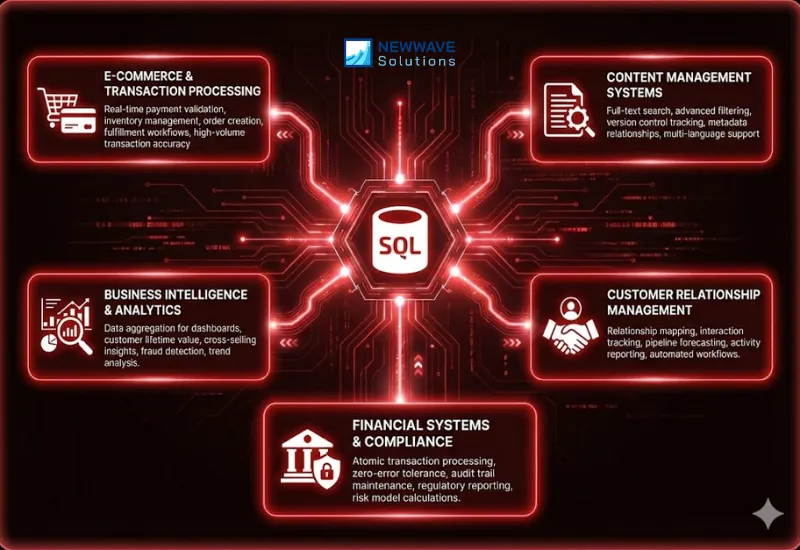
E-commerce and Transaction Processing
When you add items to an online shopping cart, SQL databases work behind the scenes to track your selections, calculate totals, and maintain inventory counts. The checkout process involves dozens of coordinated database operations that must execute flawlessly.
Every e-commerce transaction relies on SQL to handle:
- Validating payment information and processing authorization requests in real-time
- Decrementing stock quantities while preventing overselling through transaction locks
- Creating order records that link customers, products, shipping addresses, and payment methods
- Generating invoices and triggering fulfillment workflows across warehouse systems
- Maintaining accurate inventory counts even when thousands of customers simultaneously purchase the same items
Amazon processes approximately 4,000 transactions per second during peak shopping periods, each requiring multiple SQL queries executed with perfect accuracy. The challenge isn’t just handling volume—it’s maintaining consistency when thousands of customers simultaneously purchase limited inventory items. SQL’s ACID properties prevent overselling locking records during transaction processing, ensuring that when inventory shows zero, no additional orders can proceed.
If you’re building or scaling an e-commerce platform and need expert guidance on SQL database architecture that handles transaction complexity while maintaining performance, our eCommerce Development Service specializes in creating robust, SQL-powered solutions that grow with you.
Business Intelligence and Analytics
Your marketing team wants to understand which customer segments generate the most revenue, which products frequently sell together, and how seasonal patterns affect demand. These questions require SQL joins across customer tables, transaction tables, product tables, and date dimension tables.
SQL powers business intelligence through sophisticated data analysis:
- Aggregating millions of transaction records into executive dashboards showing key performance indicators
- Calculating customer lifetime value by joining purchase history with demographic data and engagement metrics
- Identifying cross-selling opportunities by analyzing which products frequently appear together in orders
- Detecting fraud patterns by analyzing transaction velocities, geographical anomalies, and behavioral deviations
- Correlating treatment effectiveness with patient outcomes in healthcare research
What is SQL data transformation in this context? It’s the process of converting raw transactional records into meaningful business metrics—taking individual $50 purchases and calculating monthly recurring revenue, customer acquisition cost, and lifetime value. Tools like Tableau, Power BI, and Looker all use SQL as their underlying query language, translating visual drag-and-drop interfaces into optimized SQL statements.
Content Management Systems
WordPress, the platform powering over 40% of all websites, stores articles, pages, comments, user profiles, and media metadata in a SQL database. When you visit a blog, SQL queries retrieve the post content, author information, related articles, and reader comments—often from multiple tables joined together.
Enterprise content management leverages SQL for complex operations:
- Full-text search capabilities that enable finding documents by keyword across millions of articles
- Advanced filtering that allows content managers to locate unpublished drafts or items pending review
- Version control tracking every modification with timestamps and user attribution for compliance
- Metadata relationships that connect articles to authors, categories, tags, and related content
- Multi-language support that serves appropriate content based on user location and preferences
Media companies like The New York Times manage decades of archived articles, multimedia assets, and metadata relationships entirely through SQL databases, demonstrating the language’s capability for complex information architecture.
Customer Relationship Management
When a sales representative updates a deal’s status, SQL updates cascade through related records—activity logs, email sequences, pipeline reports, and forecasting dashboards. The power lies in relationship mapping that creates a complete picture of your business interactions.
SQL enables comprehensive CRM functionality through interconnected data:
- Connecting contacts to accounts, accounts to opportunities, opportunities to quotes, and quotes to contracts
- Tracking every customer interaction including emails, calls, meetings, and support tickets in chronological order
- Automatically updating pipeline forecasts when deals change stage, helping managers predict quarterly revenue
- Generating activity reports showing which sales representatives engage most effectively with prospects
- Triggering automated workflows when specific conditions are met, such as sending follow-up emails after demos
Salesforce’s early architecture was built on Oracle databases, processing billions of SQL queries daily as millions of users manage their customer relationships. What is SQL server reporting services in this ecosystem? It’s Microsoft’s platform for creating and delivering operational reports—sales teams generate quarterly performance summaries, managers receive pipeline forecasts, and executives view company-wide metrics, all powered by SQL queries running against transaction databases.
If you’re planning to build or optimize a CRM system with robust SQL database architecture tailored to your sales workflows and reporting requirements, our CRM Development Service specializes in creating scalable, SQL-powered solutions that grow with your business relationships.
Financial Systems and Compliance
Banking applications process deposits, withdrawals, transfers, loan payments, and investment transactions—each requiring atomic database operations that either complete fully or roll back entirely. Regulatory requirements mandate maintaining detailed audit trails showing who accessed what data when, and SQL triggers automatically capture this information for every database modification.
Financial institutions depend on SQL for mission-critical operations:
- Processing millions of daily transactions with zero tolerance for errors or data loss
- Calculating insurance premiums by querying risk models against historical claims data
- Generating balance sheets and income statements by aggregating general ledger entries through complex joins
- Retrieving tax deduction rules and calculating obligations by joining user financial data with regulatory tables
- Maintaining complete audit trails for regulatory compliance, showing every database modification with user attribution
The financial industry has invested billions in SQL infrastructure because the alternative—data inconsistency or loss—is simply unacceptable. SQL’s transaction guarantees provide the foundation for trusted financial operations where accuracy directly impacts customer trust and regulatory compliance.
FAQs
What is the difference between SQL and SQL Server?
SQL is the standardized language for interacting with relational databases, while SQL Server is Microsoft’s specific database management system implementation. Think of SQL as the language itself and SQL Server as one platform that uses that language. Other popular implementations include MySQL, PostgreSQL, Oracle Database, and SQLite
How does SQL coding differ from programming languages like Python or Java?
SQL is declarative—you describe what results you want, and the database determines how to retrieve that data efficiently. Python and Java software development are imperative languages where you specify exactly how to accomplish tasks through detailed step-by-step instructions. SQL operates on entire sets of data at once, while imperative languages typically process data one record at a time. Modern applications often combine both: Python or Java handles application logic and user interfaces, while SQL manages data persistence and retrieval.
How does modern application development integrate with SQL databases?
In modern development, applications rarely write raw SQL directly. Instead, they use Object-Relational Mappers (ORMs) like Entity Framework or Hibernate. These frameworks allow developers to interact with the database using their preferred programming language (e.g., C# or Java) while the ORM automatically generates and executes the underlying SQL coding. This boosts developer productivity but makes understanding SQL even more critical for debugging and optimizing performance.
Final Thought
SQL remains the most essential language for understanding, shaping, and leveraging data in the modern digital world. It turns raw information into actionable intelligence, enabling teams to analyze patterns, optimize operations, and make decisions backed by clarity rather than assumptions. In a business environment where data drives every competitive move, SQL is not just a technical skill — it is a core enabler of strategic growth.
To unlock the full value of your data, you need more than SQL proficiency. You need systems, applications, and architectures built to capture, store, query, and activate information effectively. That is where Newwave Solutions can help. With an experienced development team based in Vietnam, we deliver end to end software development services, IT outsourcing solutions, SQL powered application development, database optimization, and scalable system design for global clients.
If you’re ready to transform your data into real business advantage, Newwave Solutions is here to build and support the digital foundation you need. Let’s turn your SQL capabilities into measurable growth.
To Quang Duy is the CEO of Newwave Solutions, a leading Vietnamese software company. He is recognized as a standout technology consultant. Connect with him on LinkedIn and Twitter.



Read More Guides
Get stories in your inbox twice a month.
Let’s Connect
Let us know what you need, and out professionals will collaborate with you to find a solution that enables growth.
Leave a Reply