


What is Symfony? The Best PHP Framework for Scalable Projects
In the world of PHP frameworks, Laravel is known for speed and Yii for performance, but when enterprises need stability, scalability, and long-term support, they turn to Symfony. So, what is Symfony? It’s an enterprise-grade PHP framework trusted by companies like Spotify, BlaBlaCar, and Trivago to power mission-critical systems. As the foundation behind platforms like Laravel and Drupal, Symfony has become the gold standard for complex software development services. This guide explores why Symfony is the framework of choice for businesses building secure, scalable, and future-ready applications.
What is Symfony?
Symfony is a free, open-source PHP framework designed for building high-performance, enterprise-level web applications following the Model-View-Controller (MVC) architectural pattern. More than just a framework, Symfony is actually a set of reusable PHP components that can be used independently or together as a full-stack solution. Created by French agency SensioLabs in 2005, Symfony has evolved into one of the most stable and professional PHP frameworks available, serving as the foundation for many other popular platforms, including Laravel and Drupal.
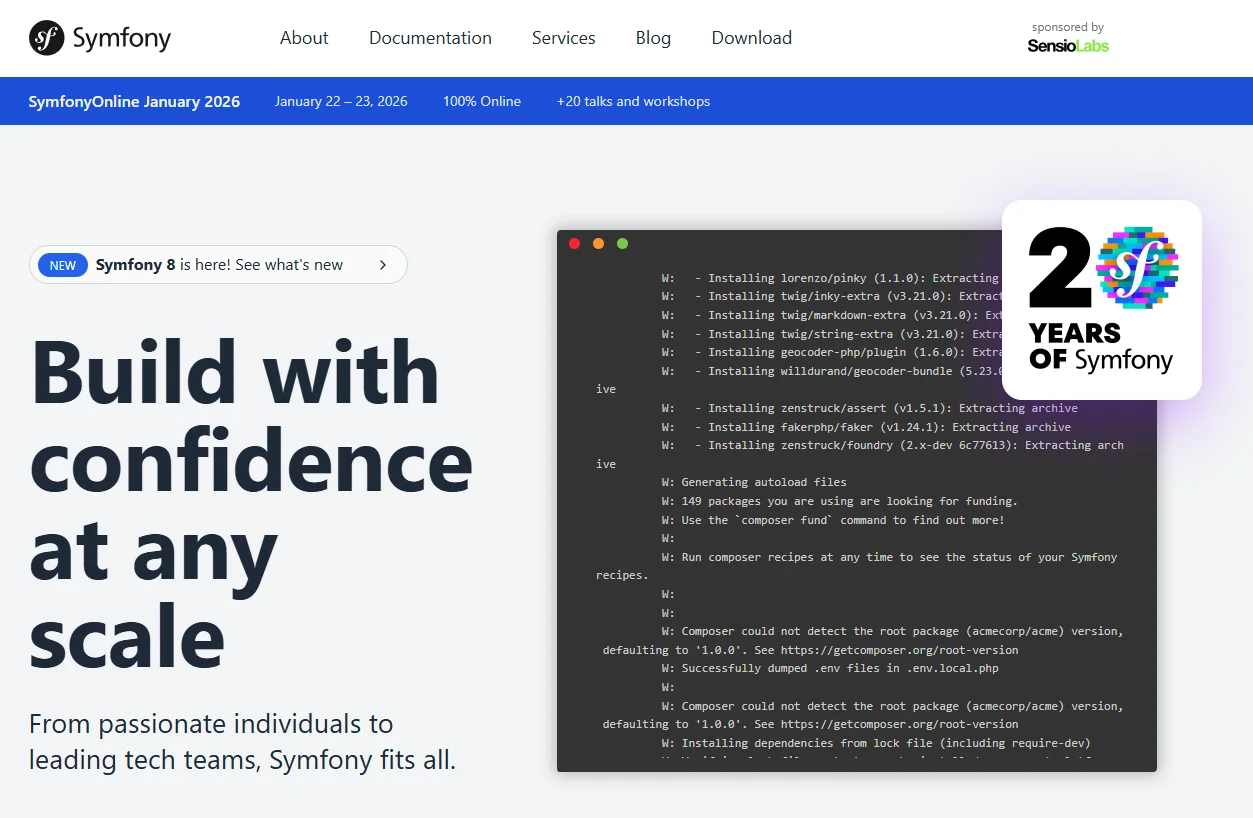
So, what is PHP Symfony in practical terms? It’s a development ecosystem that emphasizes best practices, reusable components, and long-term maintainability. Unlike frameworks that focus primarily on developer convenience, Symfony prioritizes architectural integrity and scalability, making it particularly valuable for banking software development services and other regulated industries where stability and security are paramount.
Key Characteristics of Symfony:
- Component-Based Architecture: 50+ decoupled components usable independently
- Enterprise-First Design: Built for complex, large-scale applications
- Long-Term Support (LTS): Professional release cycle with extended support
- Standards Compliance: Strict adherence to PHP-FIG PSR standards
Why Choose Symfony?
You should choose Symfony if you’re developing enterprise-level applications that require maximum stability, architectural integrity, and long-term maintainability. While other frameworks like Laravel prioritize developer experience, and the Yii framework focuses on performance, Symfony excels in environments where reliability and professional workflows are non-negotiable.
1. Enterprise-Grade Stability and LTS
Symfony’s Long-Term Support (LTS) versions receive security updates for 3 years and bug fixes for 4 years, providing unparalleled stability for enterprise applications. This predictable release cycle is crucial for banking software development services and medtech development solutions, where regulatory compliance and system stability are critical requirements that cannot be compromised.
2. Professional Development Workflow
The framework is designed by and for professional developers, with built-in tools for testing, debugging, and dependency injection. Symfony encourages practices that result in clean, maintainable code, making it ideal for teams practicing rigorous SDLC methodologies and for organizations that need to hire PHP developer services for long-term project maintenance.
3. Reusable Component Architecture
Symfony’s component-based approach allows developers to use individual pieces without adopting the entire framework. This flexibility is perfect for web app development service projects that need specific functionality or must integrate with existing systems. Many components are so well-designed that they’ve been adopted by other frameworks, including Laravel.
4. Superior Performance and Scalability
While Symfony has a reputation for being heavier than frameworks like Yii framework, its performance is exceptional when properly configured and cached. The framework’s architecture is designed to handle high-traffic enterprise applications, making it suitable for ecommerce web development services serving millions of users.
Who Uses Symfony?
Symfony is used primarily by large enterprises, financial institutions, and organizations building complex, mission-critical web applications that require enterprise-level stability, security, and scalability, including:
- Financial Technology: Companies building fintech solutions and banking software development services
- Healthcare Technology: Organizations developing medtech development solutions requiring compliance and security
- Education Technology: Platforms for edtech software development services needing scalable architectures
- Large E-commerce: Enterprise ecommerce web development services requiring robust performance
- Content Management: Major CMS platforms like Drupal and eZ Publish
In summary:
- For enterprises, it’s the most stable PHP framework available
- For regulated industries, it provides the security and compliance needed
- For large teams, it enables professional development workflows
- For long-term projects, it offers unmatched maintainability
What is Symfony Used For?
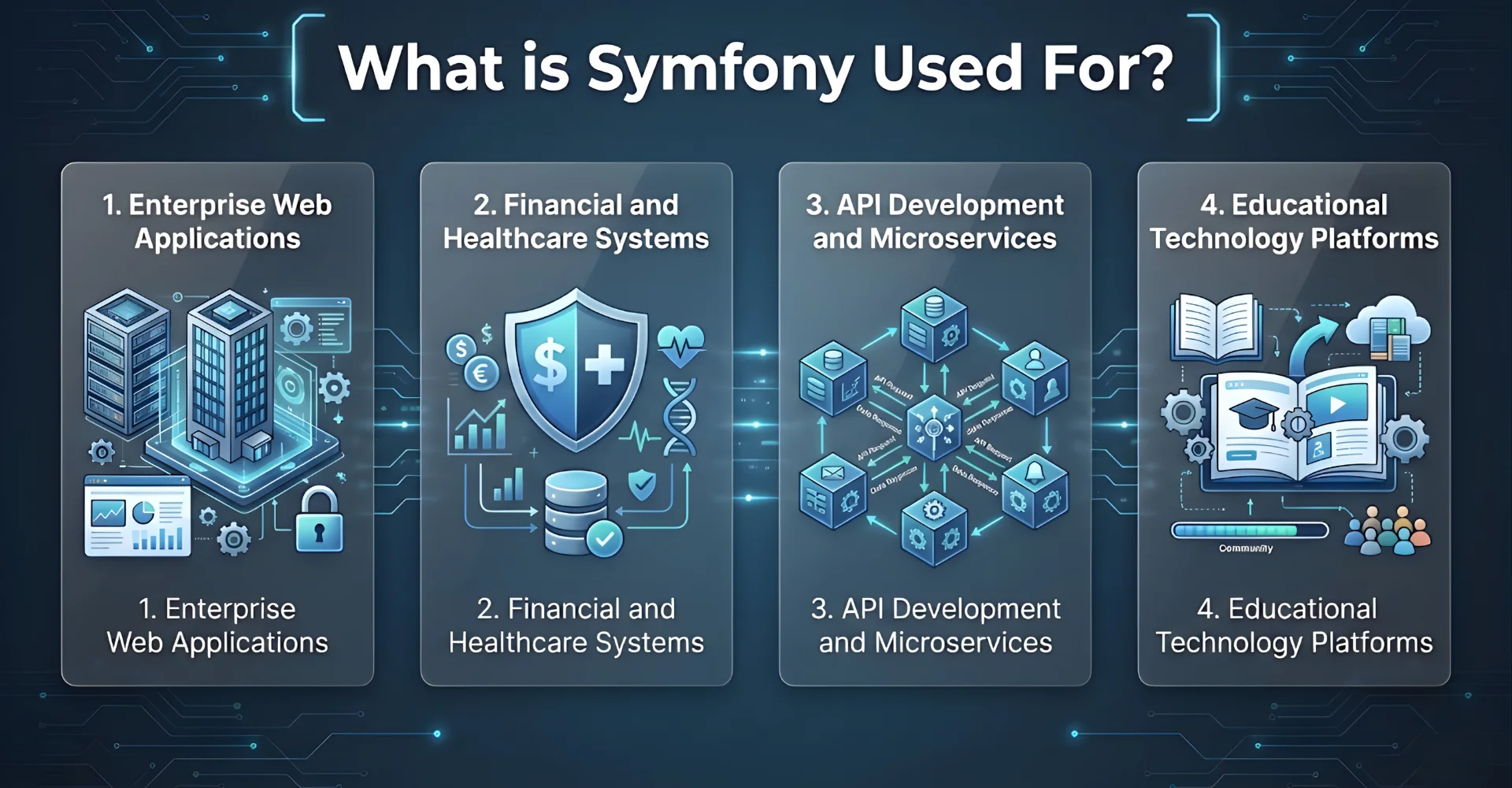
Symfony is used for building enterprise-level web applications, APIs, and complex business systems where stability, security, and maintainability are critical requirements.
1. Enterprise Web Applications
Large organizations use Symfony to build complex internal systems, customer portals, and business applications that require rock-solid stability. The framework’s architecture makes it ideal for web app development service projects that need to scale with organizational growth while maintaining performance and security standards.
Example: Trivago uses Symfony components to handle high-traffic travel searches and customer interactions.
2. Financial and Healthcare Systems
The framework’s stability and security features make it well-suited for fintech solutions and medtech development solutions. Industries with strict regulatory requirements benefit from Symfony’s predictable release cycle, comprehensive testing tools, and security features that help maintain compliance.
Example: European banks and healthcare providers rely on Symfony to meet GDPR/HIPAA compliance while managing sensitive financial and patient data.
3. API Development and Microservices
Symfony’s component-based architecture is perfect for API development services and microservices implementations. The framework’s HTTP foundation and support for modern standards make it excellent for building RESTful APIs that serve web applications, mobile apps, and third-party integrations in enterprise environments.
Example: Spotify leverages Symfony components to support its API-driven architecture, connecting apps, devices, and third-party integrations.
4. Educational Technology Platforms
For edtech software development services, Symfony provides the scalability needed to handle large numbers of concurrent users while maintaining system stability. The framework’s long-term support ensures that educational institutions can rely on their systems for years without major disruptions.
Example: Universities and LMS providers in Europe build learning platforms on Symfony to support thousands of concurrent users.
How Symfony Works?
Understanding how Symfony works is essential for appreciating its value in enterprise environments. The framework follows a sophisticated architecture built around reusable components and professional development patterns.
Component-Based Architecture
Unlike monolithic frameworks, Symfony is built as a collection of independent components. Each component solves a specific problem and can be used alone or in combination with others. This architecture allows developers to create tailored solutions for specific web development service needs without unnecessary complexity.
Professional MVC Implementation
The framework implements the Model-View-Controller pattern with enterprise-grade features:
- Models handle business logic with Doctrine ORM integration
- Views use the Twig templating engine for secure, maintainable templates
- Controllers follow dependency injection principles for testable code
This separation makes applications easier to test, maintain, and scale – crucial considerations for enterprise software development services.
Request Handling Process
When a request arrives at a Symfony application:
- The HTTP request is processed through the kernel
- Routing determines the appropriate controller
- A dependency injection container manages service dependencies
- Controller processes business logic and returns a response
- Response is optimized and delivered to the client
This structured approach ensures consistent application behavior and makes complex applications more manageable.
Symfony Tutorial – Building an Enterprise Application
This comprehensive tutorial will guide you through the process of building an enterprise application with Symfony, focusing on professional development practices rather than code snippets.
1. Project Planning and Architecture Design
Enterprise applications require thorough planning before development begins. Start by defining the business domain, identifying stakeholders, and mapping out functional requirements. For Symfony projects, this includes planning the bundle structure, database architecture, and service organization. This planning phase is crucial for successful SDLC implementation in software development services.
2. Development Environment Configuration
Professional Symfony development begins with a properly configured environment. Set up version control with Git, establish coding standards, and configure development tools like PHPStan for static analysis. Configure Docker containers for consistent development environments across your team, especially when working with remote developers through hire PHP developer services.
3. Domain-Driven Design Implementation
Symfony excels with domain-driven design approaches. Structure your application around business domains rather than technical concerns. Implement rich domain models using Doctrine entities, create service layers for business logic, and use value objects for type safety. This approach is particularly valuable for complex domains like fintech and medtech development solutions.
4. Security and Authentication Setup
Enterprise applications demand robust security. Configure Symfony’s security component with role-based access control, implement proper authentication flows, and set up security voters for complex authorization logic. For banking software development services, additional security measures like two-factor authentication and audit logging are essential.
5. Testing Strategy Implementation
Symfony provides excellent testing tools. Implement a comprehensive testing strategy including unit tests for business logic, functional tests for controllers, and end-to-end tests for critical user journeys. Continuous integration pipelines ensure tests run automatically, maintaining code quality throughout the development process.
6. Performance Optimization
Configure Symfony for optimal performance in production environments. Set up OPcache, configure Doctrine second-level caching, implement HTTP caching with Varnish or CDN, and optimize asset delivery. For ecommerce web development services, performance optimization directly impacts conversion rates and user experience.
Advantages and Disadvantages
Symfony offers enterprise-grade stability and professional development workflows, but requires significant expertise and may be complex for smaller projects.
Advantages
- Unmatched Stability: LTS versions provide years of security updates and bug fixes
- Professional Architecture: Encourages best practices and maintainable code
- Component Flexibility: Use only the components you need for each project
- Enterprise Ecosystem: Professional support, tools, and community resources
- Future-Proof: Regular updates and strong backward compatibility
Disadvantages
- Steep Learning Curve: Requires understanding of advanced PHP concepts
- Development Overhead: More configuration and setup than simpler frameworks
- Performance Considerations: Requires optimization for high-traffic scenarios
- Complexity: Can be overwhelming for simple applications or beginner developers
Why Partner with a Professional Symfony Development Agency?
Building enterprise applications with Symfony requires specialized expertise that goes beyond basic PHP development. Partnering with a professional agency ensures your project benefits from enterprise best practices and architectural excellence.
Core benefits when choosing Professional Symfony Services:
- Architectural Excellence: Experts design scalable application structures using Symfony best practices
- Security Implementation: Professional setup of enterprise-grade security measures
- Performance Optimization: Database optimization, caching strategies, and infrastructure setup
- Ongoing Maintenance: Comprehensive software maintenance services for long-term reliability
At Newwave Solutions, we deliver all these capabilities through our comprehensive software development services. Whether you need to accelerate an MVP, streamline your SDLC, or scale mission-critical web app development services and ecommerce web development services, our Symfony experts provide tailored solutions that align with your business goals. Partner with us today and turn your Symfony project into a secure, high-performance enterprise platform built for long-term success!
FAQs
What is the difference between Symfony and Laravel?
While both are PHP frameworks, Symfony prioritizes stability and architectural integrity, while Laravel focuses on developer experience and rapid development. Symfony is often chosen for enterprise applications, while Laravel is popular for rapid prototyping and smaller projects.
How long does it take to learn Symfony?
Learning Symfony typically takes longer than other PHP frameworks due to its comprehensive nature and emphasis on professional patterns. Developers with strong PHP fundamentals may require 3-6 months to become proficient.
Is Symfony suitable for small projects?
While Symfony can be used for small projects, its power and complexity are best utilized for medium to large applications. For small projects, simpler frameworks might be more appropriate.
What kind of support is available for Symfony?
Support is available through the extensive community documentation, professional support from SensioLabs, and specialized software development services that focus on Symfony development.
How does Symfony compare to Zend Framework?
Both are enterprise-focused, but Symfony has a larger community and a more modern development approach. Symfony’s component system and bundle architecture provide more flexibility than Zend Framework‘s more monolithic structure.
Conclusion
This guide has explained what is Symfony and why it continues to be the leading choice for enterprise PHP development. We’ve seen what Symfony is used for—from large-scale fintech platforms to complex medtech and banking applications—where stability, security, and long-term maintainability are non-negotiable.
Symfony’s component-based architecture, emphasis on standards, and professional development workflow make it the go-to framework for ambitious web development services projects. While its learning curve may be steeper than Laravel or Yii, the payoff is significant: cleaner architecture, stronger testing practices, and applications built to scale and evolve.
If you are considering Symfony for your projects, partnering with experienced IT outsourcing companies like Newwave Solutions can help ensure that your application leverages the framework’s full potential while following enterprise best practices. From building end-to-end software to hire developers services in various model, we have all for your own solutions.
Let’s discuss this collaboration together and boost your Symfony projects effectively!
To Quang Duy is the CEO of Newwave Solutions, a leading Vietnamese software company. He is recognized as a standout technology consultant. Connect with him on LinkedIn and Twitter.



Read More Guides
Get stories in your inbox twice a month.
Let’s Connect
Let us know what you need, and out professionals will collaborate with you to find a solution that enables growth.
Leave a Reply