


WCF Windows Communication Foundation: Features, Uses, and Benefits

WCF Windows Communication Foundation stands as a powerful framework for building service-oriented applications. But what is it, and why do enterprises continue to rely on this robust technology for their most critical business systems? Understanding WCF is essential for organizations building distributed applications that require secure, reliable communication across different platforms and protocols. As a unified programming model from Microsoft, WCF provides the foundation for creating interconnected systems that power everything from banking software development services to complex custom ERP development solutions. This comprehensive guide explores WCF’s capabilities, benefits, and practical applications in modern enterprise environments.
What is WCF Windows Communication Foundation?
WCF Windows Communication Foundation is a unified framework for building service-oriented applications that enables secure, reliable communication across different transport protocols and platforms. Developed by Microsoft as part of the .NET Framework, WCF provides a comprehensive model for building distributed applications that can communicate over various protocols, including HTTP, TCP, MSMQ, and named pipes.
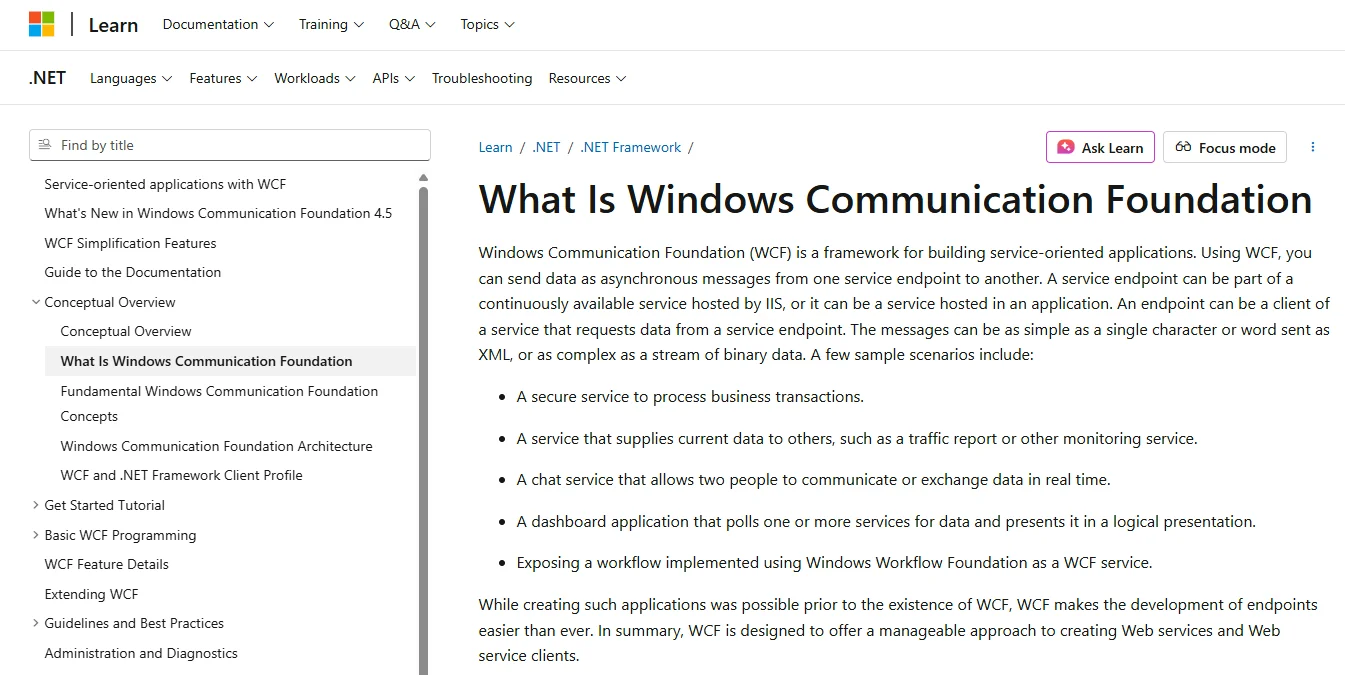
So, what are WCF services in practical terms? They are programmable entities that expose functionality to client applications through well-defined endpoints, supporting multiple communication patterns and security models. This makes WCF particularly valuable for software development services that need to create interoperable systems connecting diverse technologies and platforms while maintaining enterprise-grade security and reliability.
Key Characteristics of WCF:
- Unified Communication Model: Single programming model for multiple communication protocols
- Service-Oriented Architecture: Built around SOA principles for loose coupling
- Interoperability: Supports communication with non-Microsoft platforms
- Security and Reliability: Built-in support for enterprise security and transaction management
- Extensible Architecture: Customizable through behaviors and extensions
What are WCF Services?
WCF services are the fundamental building blocks of the Windows Communication Foundation framework, representing reusable components that expose functionality through standardized endpoints to enable seamless communication between distributed applications.
1. Service Contracts
Service contracts define the operations that a WCF service can perform, acting as a formal agreement between the service and its clients. Think of service contracts as a restaurant menu that clearly lists all available dishes – clients know exactly what they can order and what to expect. In technical terms, service contracts are defined using interfaces decorated with [ServiceContract] attributes, with each method marked as an [OperationContract]. This approach is crucial for custom CRM development services where multiple client applications need to interact with the same business logic through well-defined interfaces.
2. Data Contracts
Data contracts specify the data structures that can be exchanged between services and clients, ensuring that both parties understand the format and meaning of the information being transmitted. Imagine data contracts as international shipping labels that standardize how packages are labeled and handled across different countries. In WCF, classes are marked with [DataContract] attributes, and their properties with [DataMember] attributes. This standardization is particularly important for fintech solutions where complex financial data must be accurately transmitted between different systems and institutions.
3. Message Contracts
Message contracts give developers precise control over the structure of SOAP messages sent and received by WCF services, allowing customization of headers and body elements. Consider message contracts as custom packaging instructions for valuable shipments where specific placement of documents and items matters. This level of control is essential for banking software development services that must comply with industry-specific messaging standards and security requirements for financial transactions.
4. Fault Contracts
Fault contracts define the types of errors that a service operation might return, enabling structured error handling and communication between services and clients. Think of fault contracts as standardized error codes in elevator systems that tell maintenance exactly what went wrong and how to fix it. By defining fault contracts, WCF services provide clients with meaningful error information rather than generic failure messages, which is vital for custom ERP development solutions where different types of business rule violations require specific handling procedures.
5. Operation Contracts
Operation contracts define the specific methods exposed by a WCF service, including their parameters, return types, and behavioral characteristics. Imagine operation contracts as the specific functions available on an ATM machine – each button performs a distinct operation with defined inputs and outputs. These contracts support various patterns like request-reply, one-way, and duplex communication, making them suitable for diverse scenarios in real estate development solutions where different types of interactions are needed between property management systems and client applications.
Why Choose WCF Windows Communication Foundation?
You should choose WCF when building enterprise applications that require secure, reliable communication across multiple protocols, platforms, and security boundaries while maintaining a unified development model.
1. Unified Programming Model
WCF consolidates multiple Microsoft communication technologies into a single framework, eliminating the need to learn and maintain different APIs for different communication scenarios. This unification significantly simplifies development for custom CRM software services that need to support various client types and communication patterns through a consistent programming model.
2. Protocol Flexibility and Interoperability
The framework’s ability to support multiple transport protocols and message formats makes it ideal for enterprise integration scenarios. WCF services can communicate with Java applications, mainframe systems, and other platforms, making it perfect for organizations with heterogeneous technology landscapes requiring comprehensive software development services.
3. Enterprise-Grade Security
WCF provides built-in support for comprehensive security features including transport security, message security, and authentication/authorization mechanisms. This makes it particularly suitable for fintech solutions and banking software development services where data protection and regulatory compliance are critical requirements.
4. Transaction and Reliability Support
The framework offers robust support for distributed transactions and reliable messaging, ensuring data consistency and system reliability across distributed components. This capability is essential for custom ERP development solutions that require coordinated operations across multiple systems and databases.
What is WCF Used For?
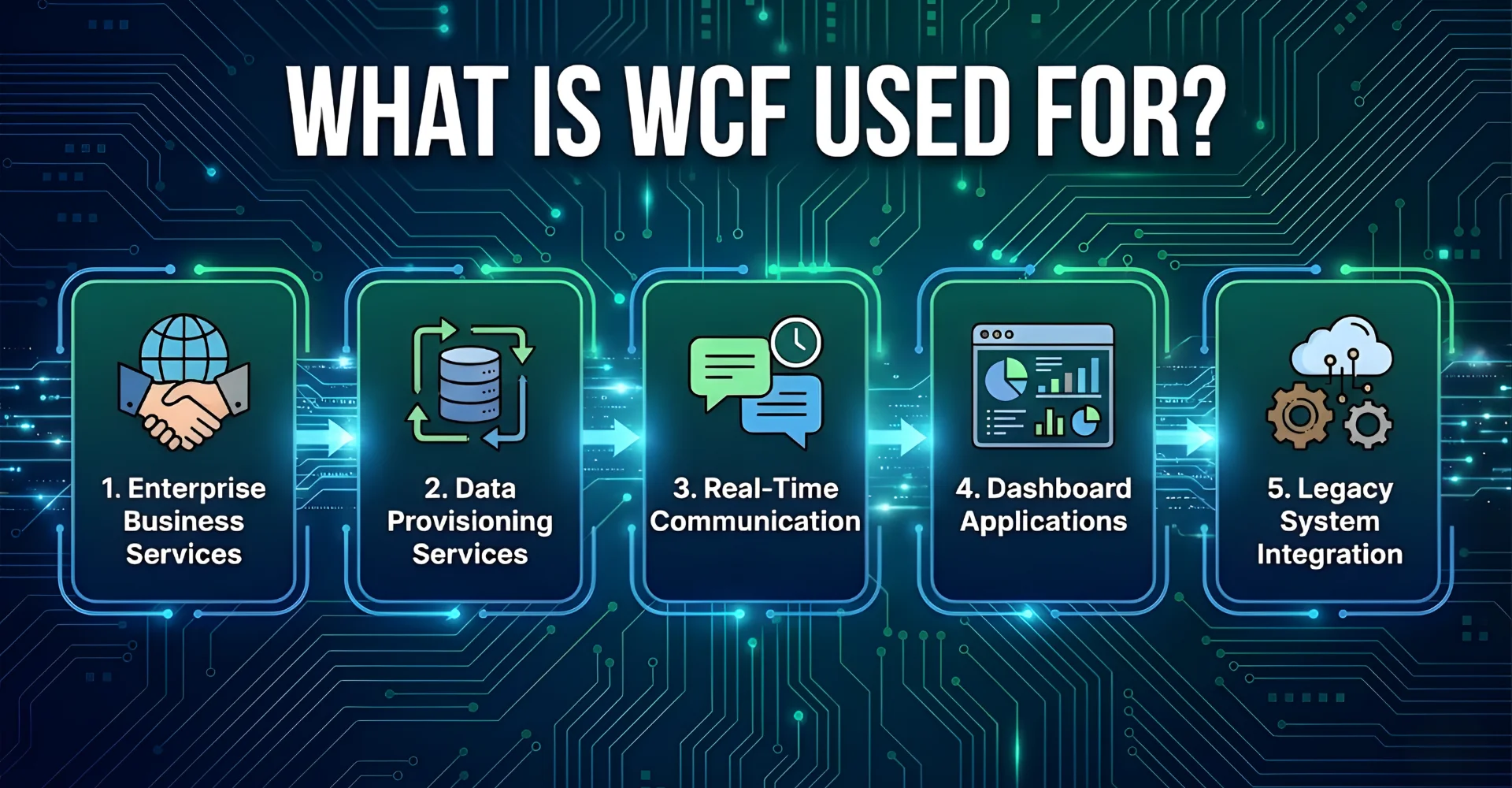
WCF is used for building enterprise-grade distributed applications that require reliable, secure communication across different networks, protocols, and security boundaries.
1. Enterprise Business Services
WCF serves as the backbone for mission-critical custom ERP development solutions and business process automation systems. These services handle complex business transactions, workflow orchestration, and cross-departmental data integration. For example, a manufacturing company might use WCF to connect their inventory management, production planning, and sales systems, ensuring real-time data consistency across the entire organization while maintaining transactional integrity.
2. Data Provisioning Services
WCF excels in scenarios requiring centralized data access and distribution across enterprise systems. These services act as reliable data hubs that supply consistent information to multiple consuming applications. In real estate development solutions, WCF data services might provide property listings, customer information, and transaction data to web portals, mobile applications, and internal management systems, ensuring all platforms work with the same updated information.
3. Real-Time Communication
The framework supports duplex communication patterns that enable real-time, two-way messaging between services and clients. This capability is crucial for applications requiring instant data updates and interactive user experiences. Financial institutions use WCF real-time services for stock trading platforms, where price updates must be delivered instantly to client applications, and for banking software development services that require live transaction monitoring and fraud detection systems.
4. Dashboard Applications
WCF provides the communication infrastructure for comprehensive business intelligence and monitoring dashboards that aggregate data from multiple sources. These applications continuously poll various services to collect and present unified business metrics. In custom CRM software services, WCF enables sales dashboards that combine customer interaction data, sales pipeline information, and marketing campaign results from different systems into a single, coherent view for decision-makers.
5. Legacy System Integration
One of WCF’s strongest capabilities lies in bridging modern applications with legacy systems through its support for multiple protocols and messaging standards. Organizations can use WCF to expose functionality from mainframe systems, AS/400 applications, or older COM components as modern web services. This approach is particularly valuable for insurance software development services that need to integrate modern web applications with decades-old policy administration systems while maintaining data integrity and business logic consistency.
How WCF Windows Communication Foundation Works?
WCF operates through a structured architecture based on endpoints, bindings, and contracts that define how services communicate with clients across various transport protocols.
The ABC of WCF Services: Address, Binding, Contract
Think of WCF as a sophisticated international shipping company that handles packages between different countries:
1. Address (Where to Deliver)
The Address specifies exactly where your service is located – similar to a complete shipping address with street, city, and zip code. In WCF terms, this is the URL where your service listens for incoming messages, such as http://www.yourcompany.com/OrderService or net.tcp://localhost:8080/InventoryService. This addressing system ensures that client applications know exactly where to find and connect to your services.
2. Binding (How to Ship)
Binding determines how the communication happens – think of it as choosing your shipping method and packaging. Do you want fast but expensive air freight (TCP binding for high performance)? Standard ground shipping (HTTP binding for web compatibility)? Or certified mail with delivery confirmation (WS binding with reliable sessions)? Each binding configuration specifies the transport protocol, encoding method, security requirements, and whether transactions are supported.
3. Contract (What to Ship)
The Contract defines what information can be exchanged – similar to a customs declaration form that specifies what’s inside the package. Service contracts describe what operations are available, data contracts define the structure of your business objects, and message contracts give you precise control over the SOAP message format.
The Complete Communication Process
When a client application calls a WCF service, here’s what happens behind the scenes:
- Client Makes a Request: Your application calls what looks like a local method, but it’s actually a proxy that knows how to communicate with the remote service.
- Message Preparation: WCF serializes your method call and parameters into a standardized SOAP message, complete with headers and security information.
- Channel Processing: The message passes through a stack of channels that handle security, encoding, reliability, and transport according to your binding configuration.
- Service Activation: The hosting environment (IIS, Windows Service, etc.) receives the message and activates the appropriate service instance.
- Message Processing: The service deserializes the message, validates security credentials, and executes your business logic.
- Response Return: The result travels back through the same channel stack to the client application, which receives it as a normal method return value.
This sophisticated process happens transparently, making distributed communication as simple as calling local methods while providing enterprise-grade reliability and security.
Benefits of using WCF
WCF provides comprehensive advantages for enterprise distributed systems, combining multiple communication technologies into a unified framework with robust security, interoperability, and reliability features.
1. Unified Programming Model
WCF eliminates the complexity of managing multiple communication technologies by providing a single, consistent approach to building connected applications.
- Consistent Development Experience: Use the same programming model regardless of whether you’re communicating over HTTP, TCP, MSMQ, or named pipes
- Reduced Learning Curve: Developers master one framework instead of multiple technologies like ASP.NET Web Services, .NET Remoting, and Enterprise Services
- Simplified Maintenance: Single codebase and configuration approach reduces long-term maintenance costs for software development services
2. Protocol Flexibility and Interoperability
The framework’s ability to communicate across different protocols and platforms makes it ideal for heterogeneous enterprise environments.
- Multiple Transport Support: Choose the right protocol for each scenario – HTTP for web compatibility, TCP for performance, MSMQ for reliable messaging
- Cross-Platform Communication: Interoperate with Java applications, mainframe systems, and other platforms using standard WS-* protocols
- Future-Proof Architecture: Adapt to new communication requirements without rewriting your service logic
3. Enterprise-Grade Security
WCF provides built-in security features that meet the demanding requirements of regulated industries and sensitive business applications.
- Comprehensive Protection: Support for transport security, message security, and mixed-mode security approaches
- Industry Standards Compliance: Implement WS-Security, WS-Trust, and other standards required for banking software development services
- Flexible Authentication: Choose from multiple authentication mechanisms including Windows, certificate, username, and custom authentication
4. Reliability and Transaction Support
The framework ensures message delivery and data consistency across distributed systems, which is crucial for business-critical applications.
- Guaranteed Message Delivery: Implement reliable sessions to ensure messages arrive in order and without duplication
- Distributed Transactions: Coordinate transactions across multiple services and databases using WS-Atomic Transaction
- Error Handling and Recovery: Built-in mechanisms for handling failures and recovering from communication problems
Challenges of WCF
While WCF offers powerful capabilities, organizations face several challenges related to complexity, performance, and evolving technology landscapes that require careful consideration and expertise.
1. Configuration Complexity
WCF’s extensive configuration options provide flexibility but also introduce significant complexity that can challenge development teams.
- Steep Learning Curve: Developers must understand numerous binding configurations, behaviors, and security settings
- Configuration Management: Complex XML configuration files can become difficult to maintain and troubleshoot
- Debugging Difficulties: Problems with security, serialization, or messaging can be challenging to diagnose and resolve
2. Performance Considerations
The framework’s comprehensive feature set and abstraction layers can impact performance in certain scenarios, requiring careful optimization.
- Serialization Overhead: XML serialization/deserialization can be slower than binary formats used by modern alternatives
- Memory Usage: The extensive object model and messaging infrastructure consume more memory than lightweight frameworks
- Startup Time: Services may have longer initialization times due to configuration processing and channel setup
3. Platform and Technology Evolution
WCF faces challenges related to its positioning in the evolving Microsoft technology ecosystem and modern development practices.
- Limited Cross-Platform Support: Traditional WCF is primarily Windows-focused, limiting deployment options
- Cloud Integration Challenges: While WCF services can run in Microsoft Azure, they may not leverage cloud-native features as effectively as modern alternatives
- Modern Framework Transition: Microsoft’s focus on .NET Core and .NET 5+ means WCF is no longer the strategic direction for new development
4. Migration and Modernization
Organizations with existing WCF investments face decisions about whether to maintain, migrate, or replace their WCF-based systems.
- Legacy System Dependencies: WCF services often integrate with older systems that may be difficult to replace
- Migration Effort: Moving to CoreWCF or alternative technologies requires significant investment and testing
- Skill Availability: Finding developers with deep WCF expertise becomes increasingly challenging as the technology matures
Why Choose Newwave Solutions for Your WCF Projects?
Choosing Newwave Solutions for your WCF projects means more than just hiring developer services, it’s about partnering with a team that masters enterprise communication frameworks and turns complex distributed systems into reliable, high-performance business solutions.
So Why us?
- Unmatched WCF Expertise – Certified developers with years of hands-on experience in building and optimizing WCF services for complex enterprise environments.
- End-to-End Services – From architecture design, legacy system integration, performance tuning, to long-term support and modernization.
- Security & Performance Focus – Robust security hardening and advanced optimization techniques to keep your applications reliable, fast, and secure.
- Strategic Guidance – Honest, practical advice on whether to continue with WCF, migrate to CoreWCF, or transition to modern alternatives like gRPC or ASP.NET Core Web API.
- Proven Cross-Industry Success – Trusted implementations for financial services, healthcare, manufacturing, and insurance.
Are you ready to modernize or scale your enterprise communication systems? Contact us today and let our WCF experts design the perfect solution for your business.
Conclusion
WCF Windows Communication Foundation remains a powerful and relevant technology for enterprises building distributed systems that require robust communication capabilities across diverse platforms and protocols.
While modern alternatives offer advantages for new development projects, WCF continues to provide significant value for maintaining and extending existing systems, especially in regulated industries like banking software development services and fintech solutions. Understanding what WCF is used for and how to leverage its capabilities effectively enables organizations to build and maintain sophisticated distributed applications that meet their business objectives.
Whether you’re maintaining existing WCF systems, planning a migration to modern platforms, or building new integration solutions, the principles of secure, reliable, and interoperable communication that WCF embodies remain essential for enterprise success in an increasingly connected business landscape.
Approach Newwave Solutions if you are in need of assistance for applying WCF smoothly into your project.
To Quang Duy is the CEO of Newwave Solutions, a leading Vietnamese software company. He is recognized as a standout technology consultant. Connect with him on LinkedIn and Twitter.



Read More Guides
Get stories in your inbox twice a month.
Let’s Connect
Let us know what you need, and out professionals will collaborate with you to find a solution that enables growth.
Leave a Reply