


What is Laravel? The Complete Guide to the PHP Framework
In the world of modern web development services, choosing the right technology stack can make or break your project. While content management systems like WordPress excel for content-driven sites, what about when you need to build a custom, scalable web application? This is where understanding what is Laravel becomes crucial. Whether you’re planning an ecommerce web development services platform or complex ERP software services, this guide will explore how Laravel’s elegant syntax and powerful features can accelerate your development process and deliver exceptional results.
What is Laravel?
Laravel is a free, open-source PHP web application framework designed for building modern, maintainable web applications following the model-view-controller (MVC) architectural pattern. Think of it as a comprehensive toolkit that provides developers with a structured foundation and pre-built components to accelerate development while ensuring code quality and scalability. Created by Taylor Otwell in 2011 as a more advanced alternative to existing PHP frameworks, Laravel has evolved into a mature ecosystem trusted by thousands of companies worldwide.
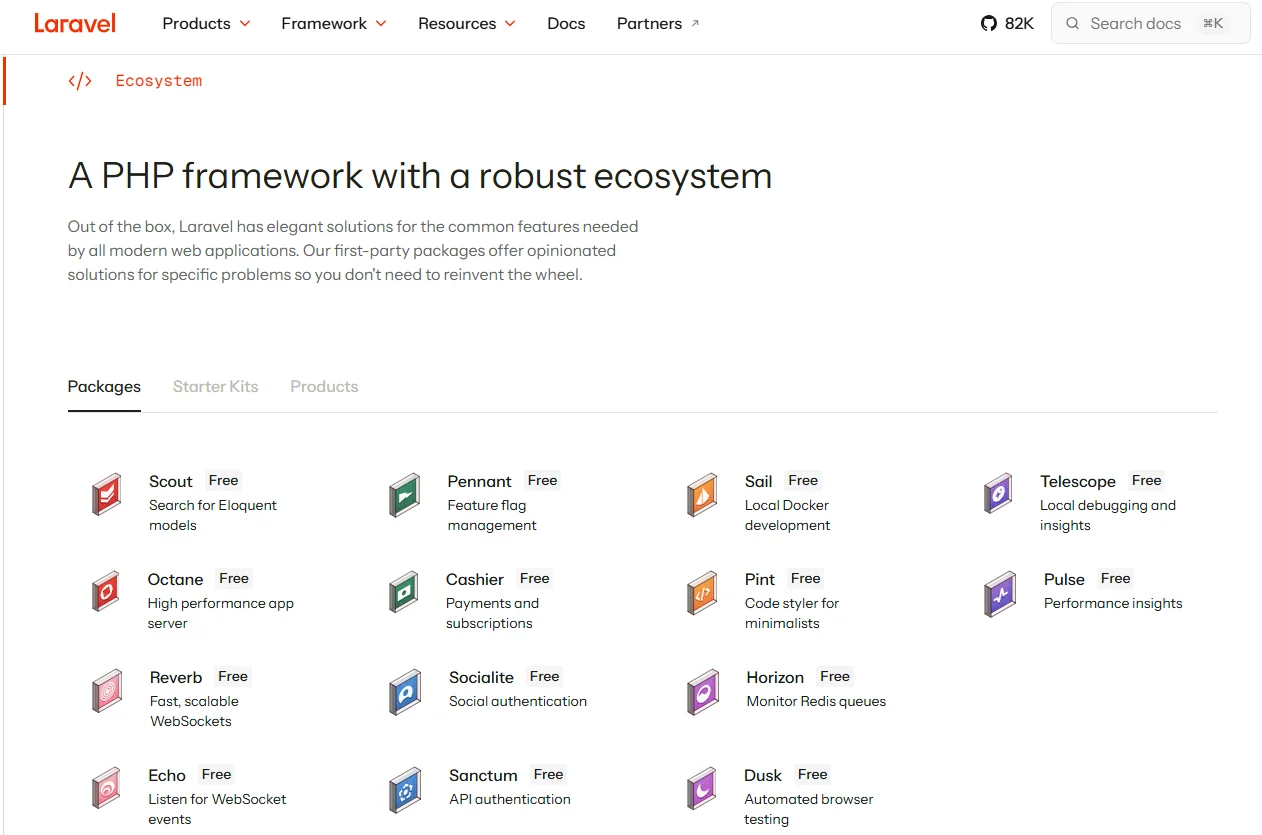
So, what is a Laravel application? It’s a web application built using Laravel’s conventions and structures, which separate business logic (Models), presentation (Views), and application flow (Controllers). This separation creates maintainable, testable codebases that can scale with your business needs. For non-technical users, this means working with a team that offers hire PHP developers services to build custom solutions. For technical leads, it means leveraging a framework that streamlines the entire SDLC (Software Development Life Cycle) with built-in testing, deployment, and maintenance capabilities.
Why Use Laravel?
You should use Laravel if you need a comprehensive PHP framework that combines elegant syntax with powerful features, making it ideal for developers who want to build professional web applications efficiently while maintaining code quality and scalability. Its growing popularity stems from its commitment to developer experience and modern web development practices:
1. MVC Architecture for Maintainable Code
Laravel follows the Model-View-Controller pattern, which separates business logic, presentation, and application flow. This separation results in cleaner, more organized code that’s easier to maintain and scale, especially important for long-term software maintenance services.
2. Eloquent ORM for Database Management
Laravel’s Eloquent ORM provides an elegant way to interact with your database using PHP syntax instead of writing complex SQL queries. Each database table has a corresponding “Model” used to work with that table, making database operations intuitive and efficient.
3. Built-in Authentication and Security
Laravel offers built-in authentication systems with secure, hashed password storage and protection against common vulnerabilities like SQL injection, cross-site request forgery (CSRF), and cross-site scripting (XSS).
4. Blade Templating Engine
Blade is Laravel’s powerful yet simple templating engine that helps create dynamic, reusable interfaces without bloated syntax. It allows for template inheritance and sections, making frontend development more efficient.
5. Artisan Command-Line Interface
Artisan is Laravel’s command-line tool that automates repetitive tasks like generating boilerplate code, running migrations, and managing databases. This significantly speeds up the development workflow.
6. Robust Ecosystem and Community
Laravel has a vibrant community and extensive ecosystem, including tools like Forge for server management, Nova for admin panels, and Vapor for serverless deployment. This wealth of resources ensures excellent support and continuous improvement.
Who Uses Laravel?
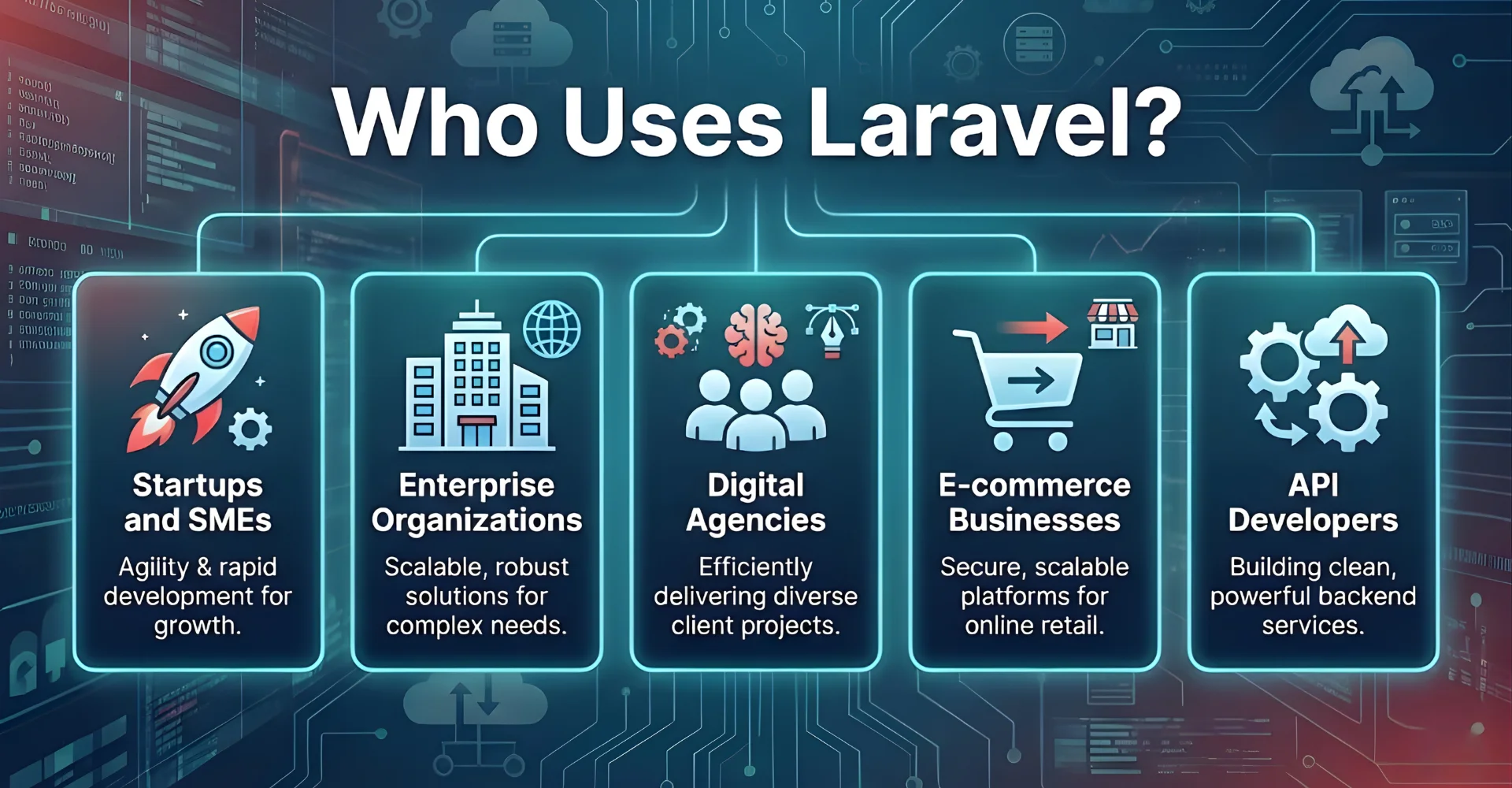
Laravel is used by businesses of all sizes, from startups building their first product to large enterprises running critical systems, particularly those who value clean code, rapid development, and scalability. Its flexibility makes it suitable for various industries and application types.
- Startups and SMEs: Companies building MVPs or custom applications that need to get to market quickly with robust foundations.
- Enterprise Organizations: Large companies using Laravel for internal tools, customer portals, and complex business systems.
- Digital Agencies: Web development service providers who need to deliver custom solutions efficiently for multiple clients.
- E-commerce Businesses: Organizations building custom ecommerce web development services platforms with unique requirements.
- API Developers: Teams building backend API development services for mobile apps and single-page applications.
In short:
- For startups, it’s a fast path to validated learning with quick prototyping.
- For enterprises, it’s a scalable solution for complex business logic.
- For developers, it’s a pleasure to work with due to the elegant syntax.
- For businesses, it’s a cost-effective framework for custom applications.
What is Laravel Used For?
Laravel is used for building a wide range of web applications, from simple websites to complex enterprise systems, with particular strengths in custom business applications, APIs, e-commerce platforms, and real-time applications. Its flexibility allows developers to tackle virtually any web development project while maintaining code quality and performance.
1. Custom Web Applications and Business Systems
Businesses use Laravel to build tailored applications that match their unique workflows. The framework’s MVC architecture and modular packages make it ideal for developing custom ERP software services, CRM systems, and project management tools that require complex business logic and database relationships.
Core Benefits:
- Rapid Development: Built-in components and generators accelerate custom application development.
- Maintainable Architecture: Clean code structure simplifies long-term maintenance and updates.
- Scalable Foundation: Handles increasing users and data volume as businesses grow.
2. E-commerce Platforms
While platforms like Shopify exist, Laravel enables businesses to build completely custom e-commerce solutions with unique features, pricing models, and integration capabilities. This is particularly valuable for ecommerce web development services that need to create specialized shopping experiences beyond off-the-shelf solutions.
Core Benefits:
- Complete Customization: Build exactly what the business needs without platform limitations.
- Integration Flexibility: Easily connect with payment gateways, shipping providers, and ERP systems.
- Performance Optimization: Implement custom caching and optimization strategies.
3. API Development and Backend Services
Laravel is excellent for building robust RESTful APIs that power mobile applications, single-page applications, or microservices architectures. With features like API resources, rate limiting, and Sanctum for authentication, it’s ideal for API development services.
Core Benefits:
- Robust API Tools: Built-in support for API development with authentication and rate limiting.
- Frontend Agnostic: Works with any frontend technology (Vue.js, React, Angular, mobile apps).
- Performance: Efficiently handles API requests with caching and optimization options.
4. Enterprise Portals and Internal Tools
Large organizations use Laravel to build secure web portal development solutions for employees, partners, or customers. Its authentication, authorization, and security features make it suitable for applications handling sensitive business data.
Core Benefits:
- Security Features: Built-in protection against common vulnerabilities for enterprise applications.
- User Management: Robust authentication and role-based access control systems.
- Audit and Logging: Comprehensive logging for compliance and debugging.
How Does Laravel Work? (The Technical Flow)
Laravel operates on a sophisticated but intuitive request-response cycle that efficiently handles web traffic. Understanding how Laravel works technically helps appreciate its power and efficiency :
- Request Entry: A user makes an HTTP request to your application (e.g., visiting a URL or submitting a form).
- Routing: Laravel’s router matches the request URL to a defined route in routes/web.php or routes/api.php.
- Middleware Processing: The request passes through middleware layers that can handle tasks like authentication, CSRF protection, and logging.
- Controller Action: The route executes the associated controller method, which contains your business logic.
- Model Interaction: The controller interacts with Eloquent models to retrieve or manipulate data from the database.
- View Rendering: Data is passed to a Blade template (view), which renders the HTML response.
- Response Return: The completed response is sent back through the middleware stack to the user’s browser.
This structured flow ensures clean separation of concerns, making applications easier to develop, test, and maintain throughout their lifecycle—a crucial consideration for long-term software maintenance services.
Advantages and Disadvantages
Laravel offers an exceptional combination of developer experience, features, and scalability, though it may have performance considerations compared to lighter frameworks and requires understanding its conventions.
Advantages
The pros of using Laravel make it a top choice for modern web development.
- Developer Experience: Elegant syntax, excellent documentation, and powerful tools like Artisan make development efficient and enjoyable.
- Comprehensive Feature Set: Built-in authentication, queue system, task scheduling, and more reduce the need for external dependencies.
- Strong Security: Built-in protections against common web vulnerabilities with secure authentication implementation.
- Scalability: Handles high traffic loads efficiently, especially when combined with tools like Laravel Octane and Redis caching.
- Vibrant Ecosystem: Large community, extensive packages, and official tools like Forge and Vapor.
Disadvantages
The cons are primarily trade-offs for its comprehensive feature set.
- Performance Overhead: More resource-intensive than micro-frameworks, though optimizable with caching.
- Learning Curve: While well-documented, mastering Laravel’s full capabilities takes time, especially for beginners.
- Update Frequency: Regular updates require maintenance effort to keep applications current.
How to Install Laravel and Get Started?
Installing Laravel is straightforward with multiple approaches depending on your development environment and experience level. Here’s a comprehensive Laravel PHP tutorial for getting started:
Method 1: Using the Laravel Installer (Recommended)
- Install Composer: Ensure PHP and Composer are installed on your system.
- Install Laravel Installer: Run composer global require laravel/installer
- Create New Project: Execute laravel new project-name
- Configure Environment: Set up your .env file with database credentials
- Run Development Server: Use php artisan serve to start local development
Method 2: Using Composer Create-Project
- Direct Creation: Run composer create-project laravel/laravel project-name
- Configure and Serve: Same configuration steps as above
How to Run an Old Laravel Project
When you need to run an old Laravel project, follow these steps:
- Check Laravel Version: Review the composer.json file for version requirements
- Install Dependencies: Run composer install to get the required packages
- Environment Setup: Copy .env.example to .env and configure for your environment
- Generate Key: Run php artisan key:generate
- Database Setup: Run migrations with php artisan migrate
- Asset Compilation: Install and compile frontend assets if needed
For complex projects, consider working with professionals who offer software development services to ensure proper setup and configuration.
FAQs
Is Laravel suitable for beginners?
Yes, Laravel is considered beginner-friendly due to its excellent documentation, intuitive syntax, and large community. However, basic PHP knowledge is recommended before starting with Laravel.
How does Laravel compare to other PHP frameworks like Symfony or CodeIgniter?
Laravel prioritizes developer experience and rapid application development, while Symfony offers more configuration flexibility, and CodeIgniter is lighter but has fewer built-in features. Laravel strikes a balance between features and usability.
Can Laravel handle high-traffic applications?
Yes, Laravel is capable of handling high-traffic applications when properly optimized with caching, database optimization, and tools like Laravel Octane. Major companies like 9GAG use Laravel for high-traffic sites.
What about long-term support and maintenance?
Laravel offers Long-Term Support (LTS) versions that receive security fixes for 3 years and bug fixes for 2 years. For ongoing software maintenance services, many businesses partner with specialized agencies.
Is Laravel only for backend development?
Primarily yes, but Laravel can be used for full-stack development when combined with Blade templates or frontend frameworks like Vue.js and React through Inertia.js.
Why Partner with a Professional Laravel Development Agency?
While Laravel is designed to be accessible, building production-ready applications that are secure, scalable, and maintainable requires deep expertise. Partnering with a professional agency that offers comprehensive software development services ensures your project follows best practices from inception through deployment and ongoing maintenance.
The strategic benefits include:
- Architecture Excellence: Experts design a scalable application structure that grows with your business
- Security Implementation: Professional setup of security measures beyond basic protections
- Performance Optimization: Database indexing, caching strategies, and code optimization
- Ongoing Maintenance: Regular updates, security patches, and feature enhancements
At Newwave Solutions, we have extensive experience with Laravel and modern PHP development practices. Our team of certified developers understands how to leverage Laravel’s full potential while implementing robust SDLC methodologies. We offer end-to-end solutions from MVP development to enterprise web portals development and ongoing software maintenance services.
Our approach combines Laravel’s rapid development capabilities with enterprise-grade architecture patterns to deliver applications that perform at scale. Whether you need the PHP web development services for a specific project or require comprehensive IT outsourcing services, we provide tailored solutions that align with your business objectives.
Conclusion
Laravel is a powerful, elegant PHP framework that has revolutionized how developers build web applications. Understanding what is Laravel used for—from custom business applications and e-commerce platforms to robust API services—helps you recognize its versatility and capability. While the framework has a learning curve, its comprehensive feature set, strong security model, and excellent developer experience make it an outstanding choice for projects of all sizes.
Whether you’re a business owner considering Laravel for your next project or a developer looking to expand your skillset, Laravel offers a mature, well-supported platform for building modern web applications. By following this Laravel PHP tutorial and understanding the framework’s capabilities, you can create robust applications that stand the test of time while delivering exceptional user experiences.
Are you ready to build a high-performance web application with Laravel? Contact us today for a free consultation, and let’s discuss your project!
To Quang Duy is the CEO of Newwave Solutions, a leading Vietnamese software company. He is recognized as a standout technology consultant. Connect with him on LinkedIn and Twitter.



Read More Guides


Get stories in your inbox twice a month.
Let’s Build Something Extraordinary
Sign up for a 30 min no-obligation strategic session with us. Transform your Ideas into scalable reality.
Leave a Reply