


What Is Flutter? Google’s Open-Source Framework for Modern Apps
In recent years, more businesses and developers have shifted from native app development to cross-platform frameworks because of their efficiency and cost benefits. Flutter stands out as a powerful cross-platform app development solution for building high-performing applications across mobile, web, and desktop. If you are looking for a quality cross-platform application development framework, this blog will help you explore what is Flutter, its use cases, and how it can transform your business applications.
What Is Flutter App Development?
Flutter is Google’s open-source UI toolkit designed to create high-quality applications for mobile, web, and desktop from a single codebase. By using one shared foundation, it allows developers to deliver native-like performance while significantly reducing time and cost. For enterprises, Flutter is especially important because it accelerates time-to-market and lowers the overhead of managing multiple native development teams.
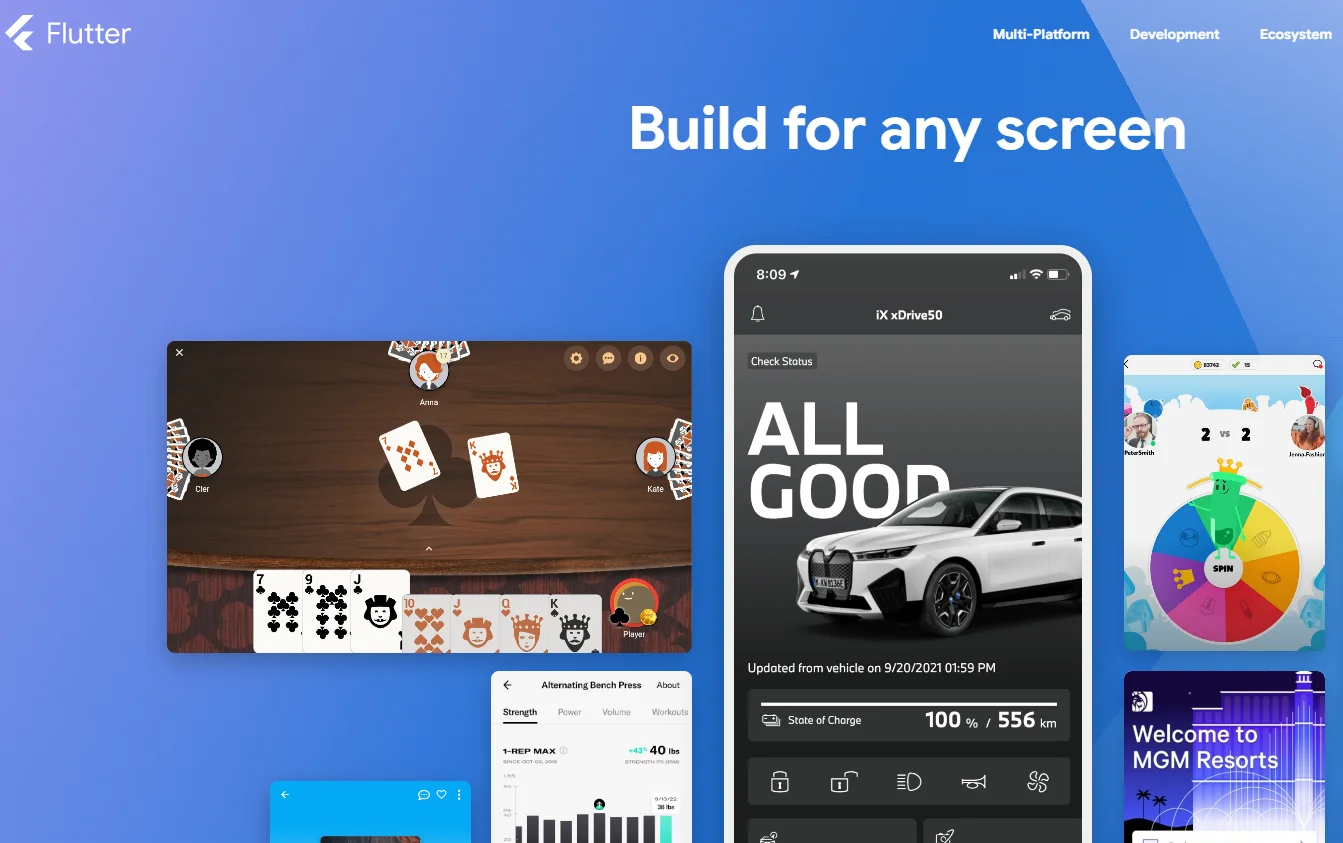
One popular brand that uses Flutter is Alibaba, which integrated the framework into its Xianyu app to improve scalability and speed of development. This move enabled the company to serve 50 million users more efficiently, enhancing performance and user engagement at scale.
How is Flutter supported?
Flutter SDK is backed by Google and an active open-source community that contributes packages, tools, and global events. Since its launch in 2018, Google has continuously updated the framework, with Flutter 3 adding stable support for macOS and Linux. The ecosystem is strengthened by thousands of third-party libraries available on pub.dev, along with extensive official documentation, tutorials, and developer challenges.
How Does Flutter Work?
Flutter operates through a layered architecture that combines its own language, visual components, and rendering engine to deliver smooth and responsive applications.
- Dart Language: Flutter uses Dart, a language optimized for UI development, ensuring faster execution and easier code maintenance.
- Widgets: Everything in Flutter is built with widgets, from buttons to layouts, allowing highly customizable and reusable UI components.
- Rendering Engine (Skia): Flutter relies on the Skia graphics engine to render pixels directly to the screen, which ensures high-performance graphics.
- Hot Reload: Developers can view changes instantly during development, improving productivity and reducing debugging time.
- Integration with Native APIs: Flutter provides direct access to device hardware and services, ensuring apps can use features like GPS, camera, and sensors effectively.
What Is Flutter Used For?
Flutter Dev is highly versatile, supporting multiple use cases across industries and platforms. Below are the most common applications of this framework:
- Mobile app development (iOS & Android): Flutter enables businesses to launch apps on both major platforms with a single codebase, saving time and resources.
- Web applications with responsive UI: Enterprises can create interactive and responsive web apps that deliver a consistent user experience across browsers.
- Desktop apps (Windows, Linux, macOS): Flutter extends beyond mobile, allowing companies to deploy full-featured desktop applications.
- Embedded systems for IoT and smart devices: Developers can use Flutter for smart screens, kiosks, or IoT devices that require dynamic UIs.
- Cross-platform MVPs for startups and SaaS: Flutter is ideal for rapidly building minimum viable products (MVPs) that can scale into full SaaS platforms.
9 Core Features of Flutter
- Reactive and modern structure: Flutter follows a reactive programming model that automatically updates the UI when data changes, ensuring applications remain responsive and dynamic.
- Dart programming language: Flutter uses Dart, a language optimized for UI development, which is simple to learn yet powerful enough to support enterprise-grade applications.
- Rapid development cycles: The hot reload feature allows developers to view changes instantly, accelerating development speed and reducing debugging time.
- Beautiful and fluid UIs: Flutter’s widget-based system enables the creation of visually appealing, smooth, and interactive user interfaces.
- Extensive widget library: It provides a vast catalog of pre-designed and customizable widgets, making it easier to deliver consistent user experiences.
- Consistent UI across platforms: Flutter apps maintain the same look and feel on iOS, Android, web, and desktop without needing separate codebases.
- High-performance applications: The Skia rendering engine ensures Flutter apps achieve near-native performance with fast rendering and smooth animations.
- Responsive layouts: Flutter offers flexible layout systems that adapt seamlessly to different screen sizes and devices, improving user experience.
- Seamless backend integration: Flutter supports asynchronous programming, allowing easy connection with APIs and back-end systems for real-time updates.
Pros & Cons of Flutter
|
Pros |
Cons |
| Faster cross-platform development: A single codebase allows apps to run on multiple platforms, reducing development time significantly. | Larger app size: Flutter applications tend to be bigger in file size compared to native apps, which can impact users with limited storage. |
| Cost efficiency for enterprises: Businesses save money by maintaining one codebase instead of separate teams for iOS and Android. | Learning curve with Dart: While Dart is powerful, developers familiar with JavaScript or Java may require time to adapt. |
| Highly expressive UI: Flutter’s widget system delivers customizable, pixel-perfect designs for branding and user engagement. | Limited native library support: Some advanced native device features may require custom code or third-party plugins. |
| Backed by Google and a strong community: Frequent updates, reliable documentation, and global community support ensure long-term viability. | Performance trade-offs in edge cases: For apps requiring complex background processes or advanced native APIs, native development can still outperform Flutter. |
| Enterprise scalability: Flutter supports microservices, real-time APIs, and integrates well with backend systems, making it suitable for large-scale deployments. |
5 Common Use Cases of Flutter in different Industries
Flutter has been successfully adopted by major brands across multiple sectors to streamline cross-platform app development. Below are the most common examples:
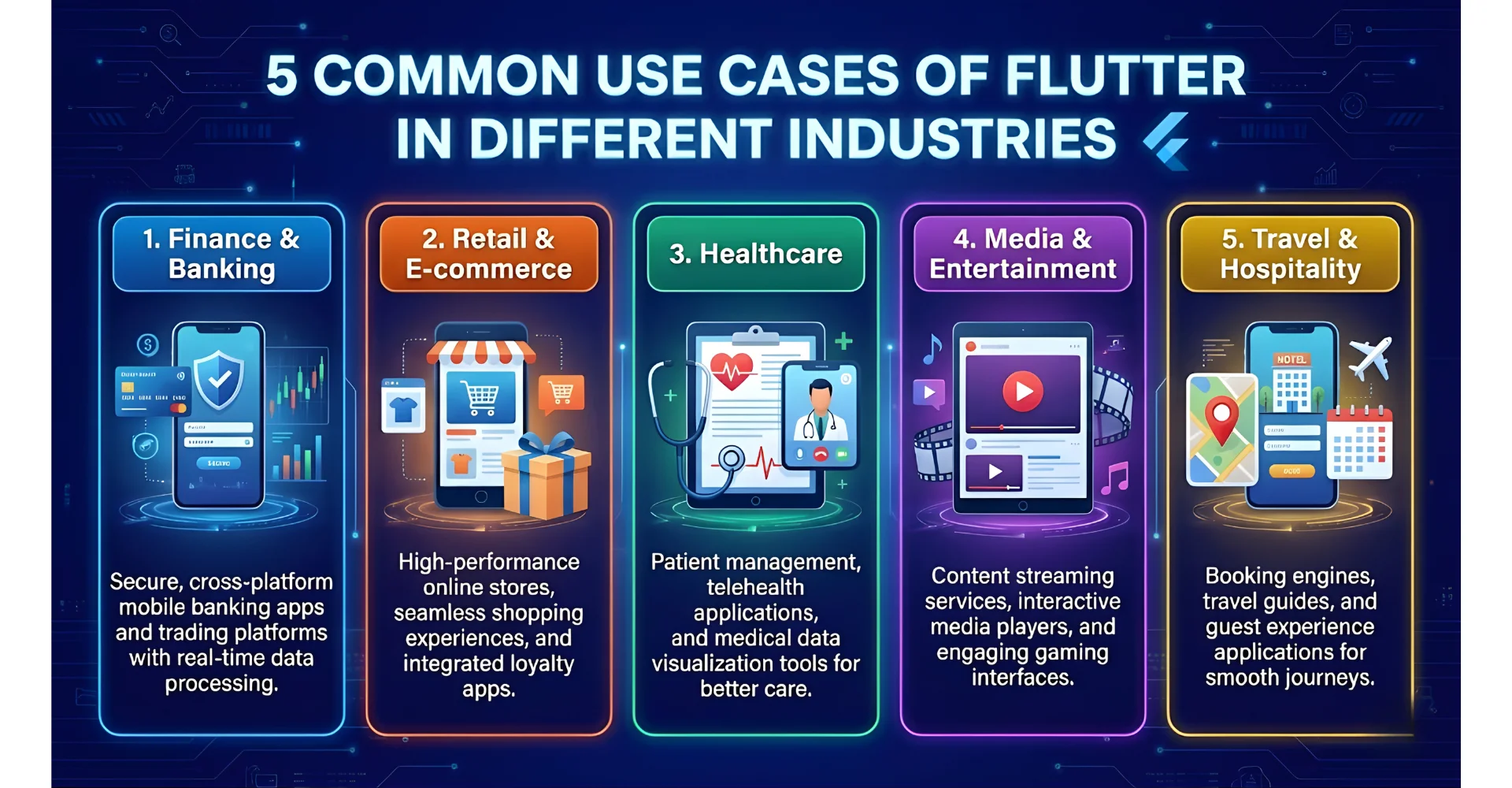
1. Finance & Banking
Flutter enables financial software development services and institutions to build secure and scalable mobile banking apps with responsive dashboards and real-time notifications.
Example: Nubank, one of the world’s largest digital banks, uses Flutter to deliver a unified app experience for millions of customers, achieving faster development cycles and improved user satisfaction.
2. Retail & E-commerce
Retailers use Flutter to create shopping apps that offer consistent performance and branding across iOS and Android devices.
Example: eBay Motors rebuilt its e-commerce platform using Flutter, enabling faster product search, smooth navigation, and an enhanced checkout experience.
3. Healthcare
Healthcare providers leverage Flutter for patient engagement, appointment scheduling, and telemedicine platforms accessible across devices.
Example: Philips uses Flutter in some healthcare software development solutions to ensure reliable cross-platform functionality for medical staff and patients.
4. Media & Entertainment
Media companies deploy Flutter to create streaming and interactive content apps with smooth video playback and attractive UIs.
Example: Tencent adopted Flutter for parts of its entertainment ecosystem, enabling richer mobile experiences for millions of users.
5. Travel & Hospitality
Travel platforms use Flutter for real-time booking, itinerary management, and GPS-enabled tracking features.
Example: BMW uses Flutter for its “My BMW” app, giving customers real-time vehicle tracking, booking services, and a consistent interface worldwide.
Flutter vs Other Cross-Platform Development Frameworks
While Flutter has gained strong traction as a cross-platform framework, it is not the only option available for businesses and developers.
- React Native, backed by Meta, enables mobile apps using JavaScript and native components, making it a popular choice for startups and mid-sized companies.
- Xamarin, supported by Microsoft, leverages C# and the .NET ecosystem to deliver apps, often preferred by enterprises already invested in Microsoft technologies.
To help you make the right decision, let’s compare these frameworks in detail and see which one fits your business needs best.
|
Criteria |
Flutter | React Native | Xamarin |
Best Choice |
| Performance with rendering | Uses Skia engine for near-native speed and smooth UIs. | Relies on native components, but performance may degrade with heavy UI complexity. | Compiles to native code but can introduce overhead. | Flutter, because of its consistent rendering across platforms. |
| Ecosystem and libraries | Rapidly growing ecosystem with thousands of community packages. | Mature ecosystem with strong third-party plugin support. | It has a limited ecosystem compared to others. | React Native, for its a mature and extensive ecosystem. |
| Scalability for enterprises | Supports modular codebases, microservices, and integrates well with the cloud. | Scalable, but can face issues with large-scale enterprise apps. | Good for enterprise if projects are . . .NET-centric. | Flutter, offering balanced scalability across industries. |
| Developer productivity | Hot reload, vast widget catalog, and Dart make rapid development easier. | Hot reload and a wide developer pool ensure good productivity. | Strong for .NET developers but slower learning for mobile. | Flutter, with faster UI iterations. |
| Enterprise adoption | Adopted by global brands like BMW, eBay, and Nubank. | Widely adopted in startups and mid-sized companies like Instagram and Facebook. | Favored in Microsoft-centric enterprises. | Depends – Flutter for cross-industry use, Xamarin for Microsoft shops. |
| Cost of development | Lower costs with one codebase for mobile, web, and desktop. | Also reduces costs but often needs more native bridging. | Higher costs due to licensing (Xamarin.Forms is free, but enterprise tools cost). | Flutter, for cross-platform affordability. |
| UI richness and customization | Provides full control of UI across all platforms with pixel-perfect design. | Depends on native components, limiting custom UI flexibility. | UI is tied closely to Microsoft’s design systems. | Flutter, for unmatched UI freedom. |
| Community support | Backed strongly by Google with global open-source contributions. | Backed by Meta, with a vast open community. | Backed by Microsoft, but with a less active community. | Tie – Flutter and React Native are both strong. |
Verdict: Flutter is the best choice for businesses prioritizing UI consistency, scalability, and cost efficiency across multiple platforms. React Native suits teams needing a wide ecosystem and fast prototyping, while Xamarin remains a solid pick for enterprises already invested heavily in Microsoft technologies.
How to Set Up and Use Flutter
For many businesses and developers, the main pain points of using Flutter come from not knowing where to start, struggling with environment setup, or confusion around multi-platform deployment. If you face these challenges, follow this simple step-by-step guide to learn how to set up Flutter and how to use Flutter effectively.
- Step 1: Install the Flutter SDK and configure your system environment variables so Flutter commands can run globally.
- Step 2: Set up an editor such as Android Studio or Visual Studio Code with Flutter and Dart plugins.
- Step 3: Create your first Flutter project using the flutter create project_name command or an IDE template.
- Step 4: Run the app on an emulator or physical device to test your setup.
- Step 5: Build and deploy the app across Android, iOS, web, or desktop, depending on your project’s requirements.
Future of Flutter in the Tech Ecosystem
Flutter continues to evolve as one of Google’s most strategic frameworks. With the Flutter 3+ updates, stable support now extends across iOS, Android, web, Windows, Linux, and macOS, making it a truly unified development platform.
Looking ahead, Flutter’s integration with Google’s Fuchsia OS signals its long-term vision as a cross-platform foundation beyond mobile. Enterprises, startups, and SaaS providers are already accelerating adoption due to its ability to deliver consistent UI, cost efficiency, and rapid time-to-market. This trajectory suggests that Flutter will remain a cornerstone in the multi-platform app ecosystem for years to come.
Newwave Solutions’ Flutter App Development Services
In today’s fast-paced digital landscape, not every business has the technical expertise to build cross-platform apps from scratch. That’s why services like Flutter app development have emerged — to support organizations that want to transform an idea into a fully functional application, even when they have little or no development background.
At Newwave Solutions, we design, build, and deliver end-to-end Flutter solutions tailored to your business goals.
What Our Flutter App Development Services Provide
- Custom Flutter App Development – We design and build tailored apps for Android, iOS, web, and desktop, ensuring consistent performance across all platforms.
- Cross-Platform Solutions – We help you reduce development time and costs by creating a single codebase that runs seamlessly on multiple operating systems.
- UI/UX Design with Flutter Widgets – Our team crafts beautiful, responsive, and user-friendly interfaces using Flutter’s rich widget library.
- App Migration to Flutter – We support migrating existing apps to Flutter for better performance, scalability, and maintenance.
- Third-Party Integration – We integrate essential APIs, plugins, and tools into your Flutter app for enhanced functionality and smoother workflows.
- App Maintenance & Support – We provide continuous updates, bug fixes, and performance optimization to keep your app secure and up to date.
- Flutter Consulting Services – We guide your business through the planning, strategy, and architecture design to maximize ROI with Flutter solutions.
Bonus: Hire Flutter Developer Services
For businesses or individuals with no in-house expertise, you can also consider our Hire Flutter Developers services, which cover every aspect of your project — from initial design to long-term maintenance.
Why choose our Flutter developers:
- Over 14 years of software development experience with 800+ successful projects delivered.
- A team of dedicated Flutter experts who adapt to your workflows and business objectives.
- ISO-certified processes ensure quality, security, and compliance.
- Flexible engagement models that allow you to hire remote, dedicated, or offshore developers to suit your project needs.
- Transparent pricing and agile practices that guarantee faster delivery with cost efficiency.
FAQs
1. What is Flutter Dev?
Flutter Dev refers to developing applications using Flutter, Google’s open-source UI toolkit, which allows developers to create cross-platform apps from a single codebase. It focuses on building mobile, web, desktop, and embedded apps with consistent performance and design.
2. Is Flutter free?
Yes, Flutter is completely free and open-source, maintained by Google and supported by a large developer community.
3. Does Flutter support enterprise-grade apps?
Yes, Flutter is designed to build enterprise-grade applications, offering scalability, strong performance, and seamless integration with cloud services and APIs.
4. What is the difference between Flutter and React Native?
Flutter uses the Dart programming language and a widget-based UI engine, while React Native relies on JavaScript and native components. Flutter generally delivers more consistent UI across platforms, whereas React Native benefits from a larger ecosystem.
5. Can Flutter be used for web development?
Yes, Flutter supports web development, enabling responsive web apps that share the same codebase as mobile and desktop apps.
6. What companies use Flutter?
Brands like Google Ads, BMW, Alibaba, and eBay use Flutter to power cross-platform applications, improving development speed while ensuring high-quality user experiences.
Conclusion
In summary, what is Flutter can be defined as Google’s open-source UI framework that uses the Dart programming language to build scalable and visually engaging apps across platforms. Today, it is widely adopted by startups and enterprises for delivering consistent user experiences on mobile, web, and desktop.
In case your business lacks in-house expertise to build or develop a cross-platform application, you can count on Newwave Solutions as your Flutter partner to ensure high-quality results for your project. With ISO-compliant processes, solid technical expertise, flexible engagement models, and transparent pricing, we deliver reliable cross-platform solutions tailored to your needs.
Get in touch with Newwave Solutions and start your cross-platform app development journey today!
To Quang Duy is the CEO of Newwave Solutions, a leading Vietnamese software company. He is recognized as a standout technology consultant. Connect with him on LinkedIn and Twitter.



Read More Guides
Get stories in your inbox twice a month.
Let’s Build Something Extraordinary
Sign up for a 30 min no-obligation strategic session with us. Transform your Ideas into scalable reality.
Leave a Reply