


Zero Trust Architecture: The Modern Standard for Securing Your Outsourced IT Infrastructure
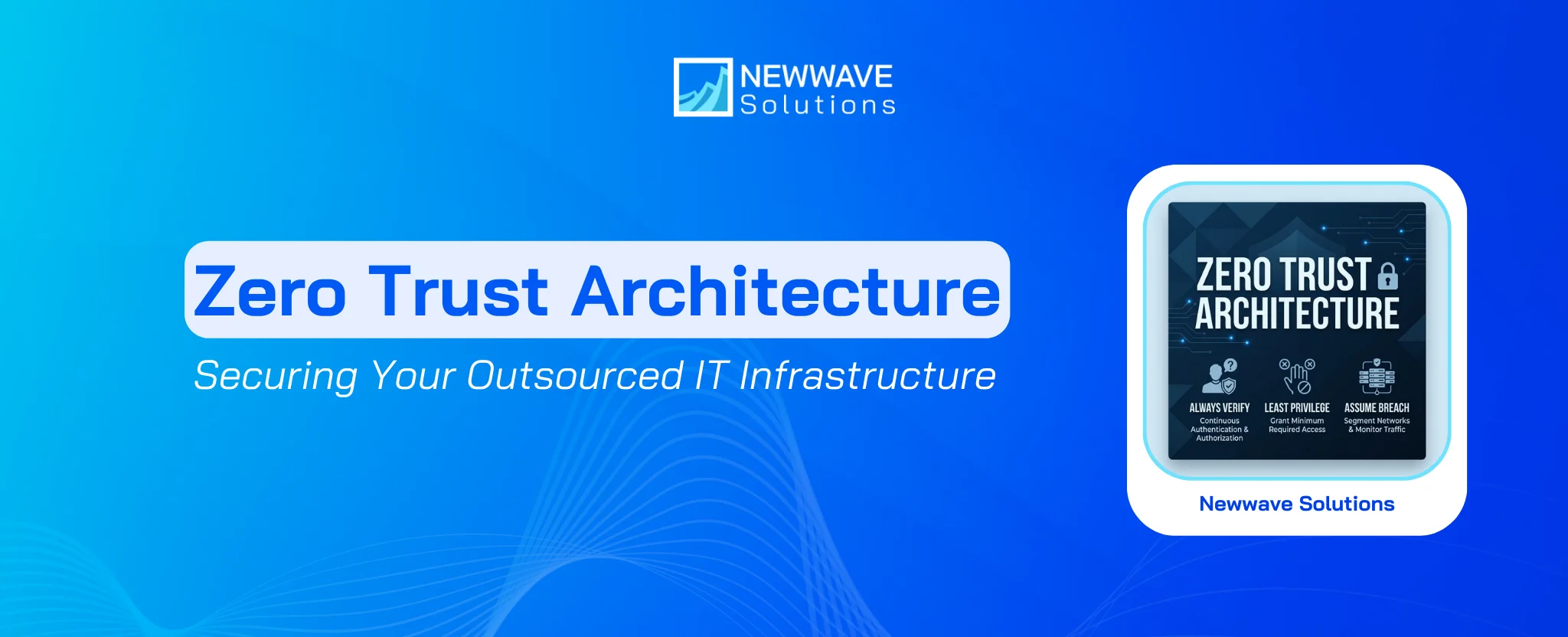
As traditional perimeter-based security fails to stop sophisticated cyberattacks, many organizations are shifting toward a Zero Trust Architecture to safeguard their digital assets. This “never trust, always verify” approach ensures that every access request is strictly authenticated, regardless of whether it originates inside or outside the network. This article explores the core principles of Zero Trust, compares it to legacy security models, and provides a roadmap to help you implement a robust defense strategy.
What Is Zero Trust Architecture?
Zero-trust architecture is a cybersecurity model where no user, device, or system is trusted by default, even if it operates inside the corporate network. Every access request must be authenticated, authorized, and continuously validated before permissions are granted, which ensures that organizations maintain strict control over every connection and system interaction.
Zero Trust Architecture example: Google implements Zero Trust Architecture across its BeyondCorp model, requiring every user and device—regardless of location—to authenticate identity, verify device health via continuous signals like endpoint security posture, and authorize access based on context-aware policies enforced through gateways and micro-segmentation for all internal applications. This approach eliminated traditional VPN reliance, reducing unauthorized access incidents by 75% while enabling secure remote work for 140,000+ employees during peak pandemic periods, achieving up to 99% uptime for critical services.
How Zero Trust Architecture works
Organizations that implement a zero-trust architecture replace the traditional perimeter-based security model with a continuous verification process that evaluates identity, device posture, and access policies before granting access to resources. In other words, every request to connect to an application, system, or dataset must pass through multiple verification layers that analyze the context and risk level of the request.
The following Zero Trust Architecture diagram illustrates how identity verification, device validation, and policy-based access control interact to secure enterprise environments:
- Identity layer
- Device layer
- Network layer
- Application layer
- Data layer
In a typical workflow, the process follows a structured sequence:
User → Identity verification → Policy engine → Secure resource access
First, a user or system attempts to access a resource within the network environment. Next, identity verification mechanisms such as multi-factor authentication confirm the legitimacy of the requesting entity. Afterward, the policy engine evaluates contextual signals, including device health, user behavior, and location, before allowing the connection to proceed. Finally, the system grants access only to the authorized application or dataset instead of exposing the entire network infrastructure.
Core principles of Zero Trust Architecture
Adopting Zero Trust is less about purchasing a specific product and more about embracing a strategic security mindset. Let’s explore some core principles of ZTA that can be considered the backbone of its functionality:
- Never trust, always verify: The central philosophy of a zero trust architecture states that organizations must verify every access request regardless of network location. This principle prevents attackers from exploiting internal trust assumptions after gaining initial access to the network.
- Least privilege access: A least privilege policy ensures that each user or system receives only the minimum permissions required to perform specific tasks. This approach significantly reduces the potential impact of compromised credentials or malicious activity.
- Assume breach: The assume breach principle requires security teams to design infrastructure with the expectation that attackers may already exist inside the network. As a result, systems must continuously monitor activity and isolate suspicious behavior to minimize damage.
- Context-Aware Access Policies: These policies evaluate multiple factors such as device security status, geographic location, user identity, and time of access before granting permissions. These policies allow organizations to dynamically adjust security controls based on real-time risk conditions.
- Microsegmentation: It divides networks into smaller protected zones that enforce strict access policies between systems. This approach prevents attackers from moving laterally across infrastructure after breaching one component.
Key Components & Use Cases of Zero Trust Architecture
Key Components
A successful ZTA deployment relies on an integrated ecosystem of tools working in harmony rather than a single isolated software. This part details the essential components, including Identity & Access Management (IAM) and microsegmentation, that power a reliable Zero Trust environment.
- Identity & Access Management (IAM): This component verifies every user, application, and machine identity through technologies such as multi-factor authentication, single sign-on, and behavioral analytics before any system access is granted.
- Device Posture Validation: This process continuously evaluates critical security indicators, including operating system updates, malware presence, firewall configuration, and endpoint protection status, before allowing any device to interact with enterprise resources.
- Microsegmentation: By dividing the network into isolated segments, microsegmentation ensures that users or applications can only access specific, authorized resources instead of the entire infrastructure.
- Policy Engine: The policy engine functions as a central brain that analyzes contextual signals such as user identity, device health, and network location to dynamically determine whether a specific access request should be approved or denied.
- Monitoring & Analytics: These platforms collect comprehensive logs from applications, networks, and endpoints while applying machine learning and threat intelligence to detect anomalies or suspicious behavior in real time.
Common Use Cases
Zero Trust Architecture is currently being applied across diverse industries to solve complex security challenges in various business models. From securing remote workforces to protecting cloud-native applications, the following use cases demonstrate the versatility of this framework in real-world scenarios.
- Remote DevOps & Engineering Security: Tech firms leverage Zero Trust frameworks to secure DevOps Software Development and DevOps engineers who access production environments and source code repositories from unmanaged home networks. Specialized security platforms verify both the developer’s identity and the real-time compliance status of their workstations before granting access to sensitive CI/CD pipelines.
- Privileged Administrative Threat Mitigation: System administrators and database engineers are governed by Zero Trust controls to prevent credential theft or accidental internal configurations that could compromise core infrastructure. Granular access policies restrict these high-level users to specific datasets and employ continuous behavioral monitoring to flag any deviation from standard operational patterns.
- Shadow IT & Unauthorized API Control: IT departments often struggle with “Shadow IT,” where developers or teams deploy unauthorized SaaS tools or third-party APIs without official security vetting. Zero Trust access policies effectively block these unknown applications and enforce rigorous authentication protocols before allowing any external service to interface with the corporate network.
- Hybrid & Multi-Cloud Microservices Protection: Enterprises managing containerized workloads and microservices across AWS, Azure, or on-premise clusters must secure traffic moving between different cloud environments. The Zero Trust model ensures that every inter-service request undergoes mutual TLS encryption and strict policy evaluation before any data exchange occurs between distributed cloud resources.
- Third-Party Managed Service Provider (MSP) Access: Organizations frequently collaborate with external IT consultants or MSPs who require elevated permissions to perform maintenance on internal servers. By applying Zero Trust, businesses can grant these partners “Just-In-Time” (JIT) access, ensuring they can only interact with specific virtual machines or databases during pre-authorized support sessions.
- IoT & Edge Computing Security: Tech-driven enterprises deploy Zero Trust principles to govern IoT sensors and Edge gateways that often lack robust, built-in security firmware. Security systems validate the unique device identity and baseline communication behavior before allowing these hardware components to transmit data to the central enterprise infrastructure.
Why Zero Trust Architecture Matters for Modern IT Security
In an era of sophisticated cyber threats, traditional perimeter defenses often fail to prevent catastrophic data breaches once an intruder gains internal access. Zero Trust Architecture (ZTA) addresses these vulnerabilities by ensuring that every access request is strictly verified, providing a robust shield for your company’s most sensitive digital assets.
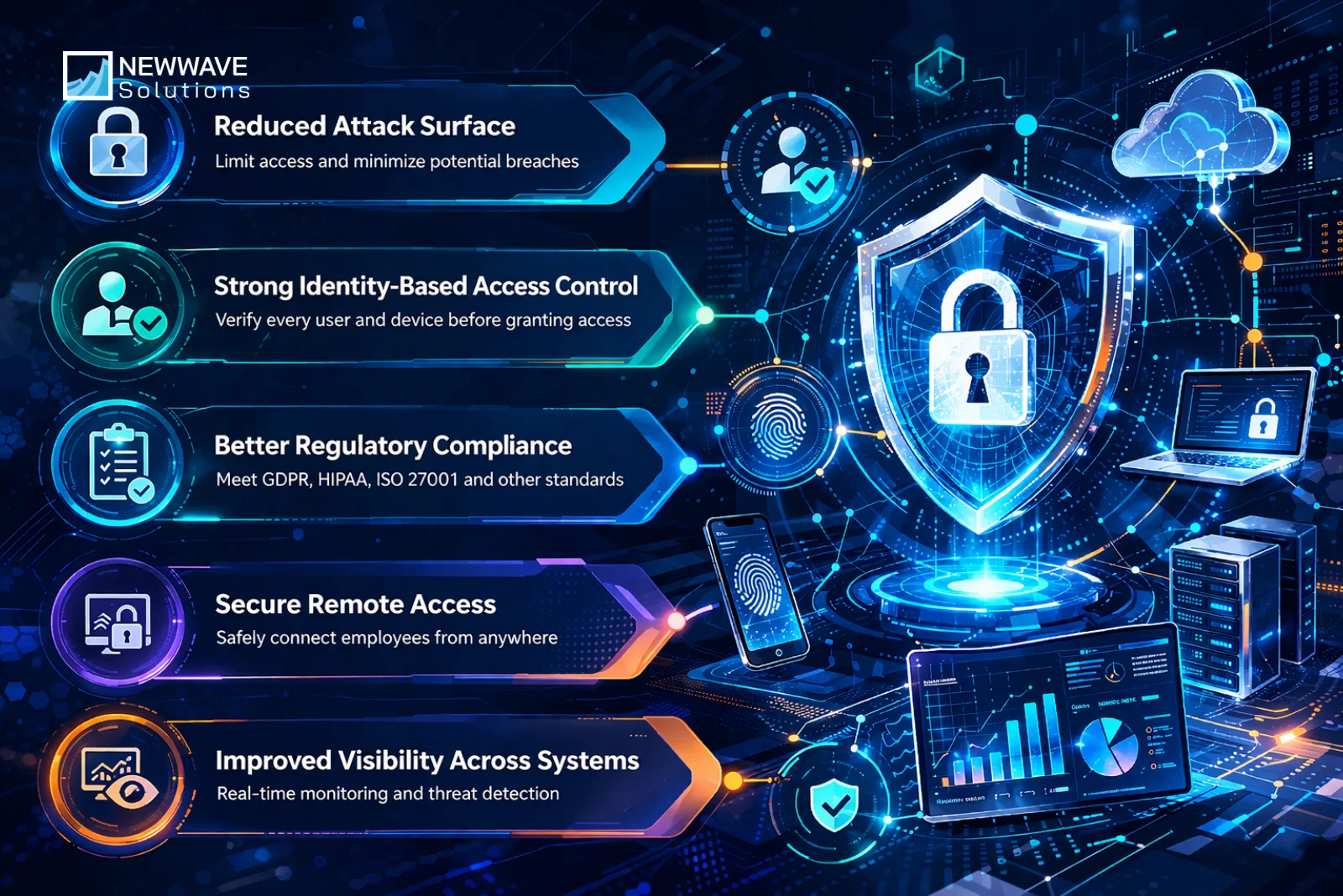
- Reduced Attack Surface: A properly implemented zero-trust architecture limits system access to specific verified identities and resources, which significantly reduces the number of potential entry points that attackers can exploit.
- Strong Identity-Based Access Control: Identity verification mechanisms ensure that only authenticated users, applications, or devices can access sensitive systems, which protects organizations from credential-based attacks and unauthorized access attempts.
- Better Regulatory Compliance: Security frameworks based on zero trust architecture provide detailed access control logs and monitoring capabilities that help organizations meet regulatory requirements such as GDPR, HIPAA, or ISO security standards.
- Secure Remote Access: Modern enterprises rely on remote work models, and zero-trust systems protect distributed environments by verifying device health and user identity before granting application access.
- Improved Visibility Across Systems: Continuous monitoring and analytics tools allow security teams to track user activity across networks, applications, and cloud environments while quickly identifying abnormal behavior patterns.
Zero Trust Architecture vs Traditional Network Security
Before the rise of Zero Trust, many organizations relied on “castle-and-moat” defenses that left internal networks exposed once the outer perimeter was breached. The following comparison highlights the critical differences between legacy methods and ZTA, helping you visualize the superior protection offered by modern identity-centric security.
|
Element |
Traditional Network Security | Zero Trust Architecture |
Verdict |
| Trust Model | Systems trust users and devices inside the network perimeter. | Systems verify every request regardless of location. | Zero Trust performs better because it removes implicit trust assumptions. |
| Access Control | Network access grants broad permissions after login. | Access policies restrict permissions based on identity and context. | Zero Trust provides stronger security through granular access control. |
| Authentication Process | Authentication usually occurs only once during login. | Authentication occurs continuously during each access request. | Zero Trust offers stronger protection against credential theft. |
| Network Visibility | Security monitoring often focuses only on external threats. | Monitoring tools track activity across every system and connection. | Zero Trust improves threat detection capabilities. |
| Attack Containment | Attackers can move laterally once inside the network. | Microsegmentation restricts movement between systems. | Zero Trust significantly reduces lateral attack risks. |
| Remote Access Security | VPN connections often grant broad network access. | Zero-trust network access allows only application-level connections. | Zero Trust is safer for distributed work environments. |
| Policy Management | Security policies are usually static and infrastructure-based. | Policies dynamically adapt based on identity, device, and context. | Zero Trust enables more adaptive and intelligent security control. |
Challenges of Implementing Zero Trust Architecture
While the benefits are clear, transitioning to a Zero Trust model involves navigating significant technical and organizational hurdles. Read on to discover the primary challenges of implementation and explore effective strategies to overcome these obstacles if your business is currently facing them.
- Complex Infrastructure Integration: Organizations often operate legacy systems, cloud platforms, and on-premise infrastructure that must all integrate into the same security framework. In order to solve this challenge, companies can gradually implement zero-trust architecture through phased deployment strategies that integrate identity management and monitoring tools first.
- Legacy System Compatibility: Older enterprise applications may not support modern identity verification or security protocols required by zero-trust models. To encounter such challenges, organizations often deploy identity gateways or access proxies that allow legacy systems to operate within modern security environments.
- Identity Management Challenges: A large enterprise may manage thousands of user identities, applications, and machine accounts across multiple platforms. If you want to handle this issue effectively, centralized identity management platforms and strong authentication frameworks should be implemented.
- High Initial Implementation Costs: Deploying new security tools, monitoring systems, and access control platforms can require significant investment during the early stages. Do not worry, since organizations can reduce costs by implementing zero-trust architecture incrementally across critical systems first.
- Organizational Culture and Process Changes: Security teams and employees may need to adapt to stricter authentication processes and new access workflows. In order to manage this challenge, organizations should implement training programs and clear security policies that explain the benefits of the zero-trust approach.
How to Implement Zero Trust Architecture in Your Organization
Many businesses lack the internal resources or specialized expertise required to integrate Zero Trust into their existing operational workflows. If your organization is unsure where to begin, this basic guide provides a step-by-step roadmap for successfully applying ZTA principles to your business infrastructure.
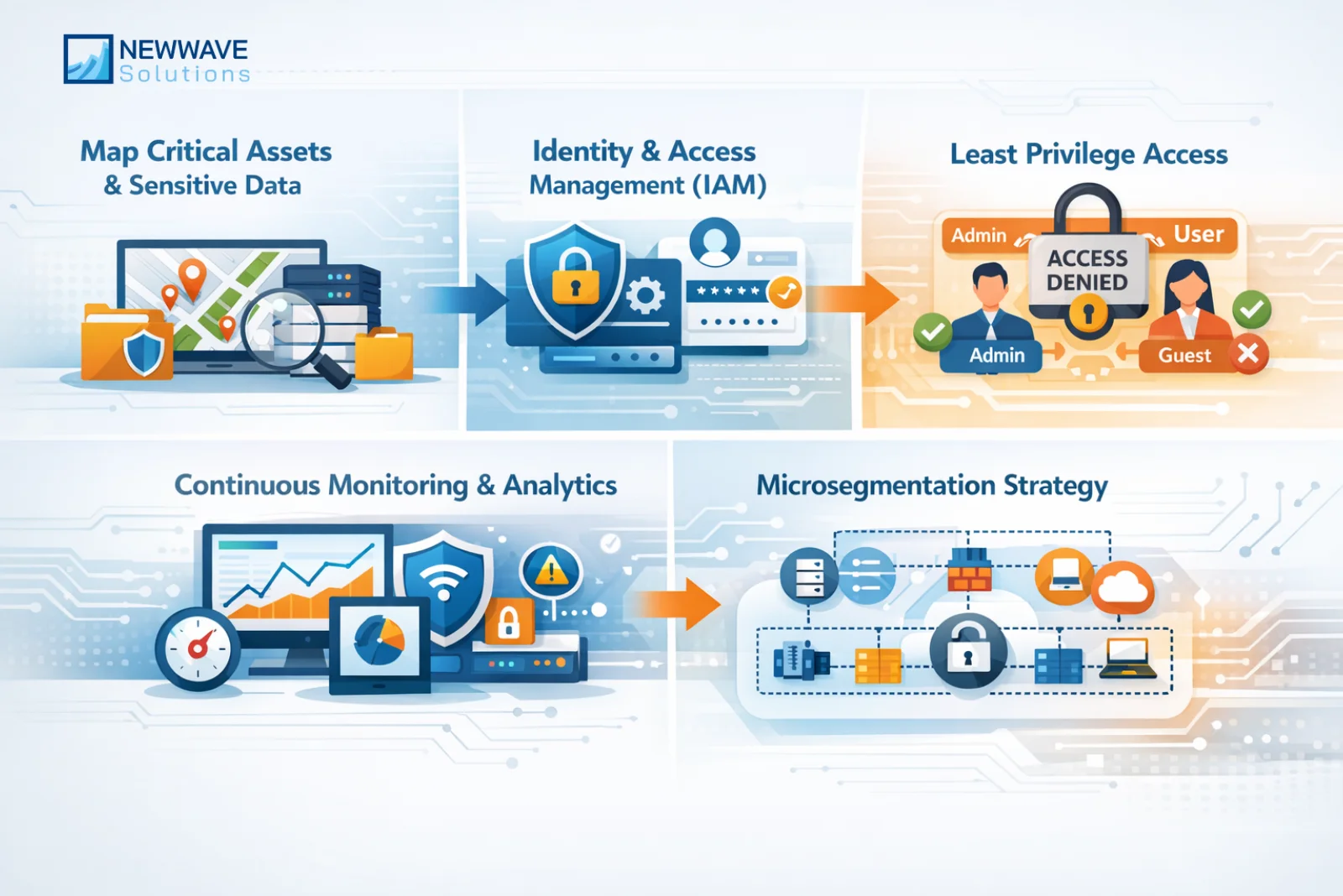
Step 1: Map Your Critical Assets and Sensitive Resources
The first phase involves a comprehensive audit to categorize high-value assets, including proprietary databases, legacy applications, and cloud-hosted APIs. By defining exactly what needs protection, security teams can establish a clear perimeter-less defense boundary around their most vital digital infrastructure.
Step 2: Establish Robust Identity and Access Management (IAM)
The foundation of any Zero Trust model is a sophisticated identity verification system that leverages multi-factor authentication (MFA) and single sign-on (SSO) to validate every user. Beyond simple passwords, organizations should integrate behavioral analytics to ensure that every access request is authenticated with high confidence before entering the environment.
Step 3: Enforce Strict Least Privilege Access Policies
Administrators must transition from broad network permissions to a “need-to-know” model where users are granted only the minimum level of access required for their specific roles. This strategic limitation significantly reduces the potential blast radius of a compromised account by preventing unnecessary lateral movement across the organization.
Step 4: Integrate Continuous Monitoring and Real-time Analytics
Effective Zero Trust requires deep visibility, which is achieved by deploying automated tools that track network traffic, user behavior, and application performance 24/7. These monitoring systems use machine learning to detect subtle anomalies, allowing your IT team to mitigate potential threats before they escalate into full-scale breaches.
Step 5: Architect Microsegmentation Across Your Infrastructure
Instead of relying on a single flat network, organizations should isolate individual workloads and microservices into secure, granular zones. This architectural approach ensures that even if one component is compromised, the threat remains contained, preventing attackers from traversing the broader network infrastructure.
The Future of Zero Trust Architecture
The landscape of Zero Trust Architecture is evolving rapidly alongside the explosion of AI-driven threats and automated defense mechanisms. We have identified the latest trends and innovations that enterprises should monitor to stay ahead of the curve in an increasingly digital-first world.
- AI-Driven Threat Detection: Artificial intelligence will enhance zero-trust architecture by analyzing user behavior patterns and detecting anomalies that may indicate cyber threats.
- Zero Trust for Cloud-Native Environments: Organizations increasingly deploy zero trust models to protect containerized workloads, microservices, and serverless cloud architectures.
- Integration with Identity Security Platforms: Identity security platforms will become the central layer of modern cybersecurity strategies as identity-based access control becomes the primary defense mechanism.
- Automated Security Orchestration: Security orchestration platforms will automatically enforce access policies and respond to suspicious behavior without requiring manual intervention.
- Zero Trust Adoption in IoT and Edge Computing: Enterprises will apply zero trust security principles to IoT devices and edge infrastructure to protect distributed networks and industrial systems.
Secure Your Digital Transformation with Newwave Solutions’ Zero Trust IT Outsourcing Services
While the benefits of Zero Trust are undeniable, many organizations find that self-implementing such a complex architecture is hindered by a critical lack of internal resources, technical expertise, and specialized security knowledge. Instead of struggling with these steep learning curves, forward-thinking enterprises prioritize outsourcing their IT development to reputable partners capable of building secure software, managing intricate data infrastructures, and establishing modern security ecosystems. Among the industry’s most trusted providers, Newwave Solutions stands out as a leader in delivering these high-stakes digital security transformations.
At Newwave Solutions, our IT outsourcing services are meticulously designed to help businesses accelerate innovation, scale with confidence, and optimize costs without sacrificing quality. Backed by 14+ years of proven expertise, we have partnered with global enterprises and ambitious startups alike to deliver solutions that truly transform operational efficiency. Furthermore, with our ISO 9001:2015 and ISO 27001:2022 certifications, we guarantee that your projects are established with the highest levels of international security standards, ensuring absolute safety and data integrity from day one.
How Newwave Solutions Secures the Zero Trust Architecture for Your Enterprise
- Standardized Security Compliance: We leverage our ISO 27001:2022 framework to build “Security by Design” into every software development lifecycle, ensuring your infrastructure meets global protection benchmarks.
- End-to-End Identity Governance: Our engineers implement sophisticated IAM and Multi-Factor Authentication (MFA) solutions to ensure that only verified users can access your sensitive business logic.
- Infrastructure & Data Orchestration: We manage your entire data ecosystem by applying microsegmentation, preventing lateral movement, and containing potential threats within isolated environments.
- Continuous Risk Assessment: Newwave Solutions provides 24/7 monitoring and real-time analytics to detect anomalies, ensuring your Zero Trust posture evolves alongside emerging cyber threats.
Together, Newwave Solutions will help your project achieve Zero Trust excellence, fortifying your security posture and ensuring maximum safety for your digital future.
Conclusion
Transitioning to a Zero Trust Architecture is no longer optional for businesses aiming to survive in a high-risk digital landscape; it is a fundamental requirement for long-term resilience. We recommend starting with a thorough audit of your sensitive assets and gradually integrating microsegmentation to eliminate lateral movement by attackers.
Contact Newwave Solutions if your enterprise is seeking a software development service partner to help implement Zero Trust into your management model and elevate your project’s security standards.
To Quang Duy is the CEO of Newwave Solutions, a leading Vietnamese software company. He is recognized as a standout technology consultant. Connect with him on LinkedIn and Twitter.



Read More Guides




Get stories in your inbox twice a month.
Let’s Build Something Extraordinary
Sign up for a 30 min no-obligation strategic session with us. Transform your Ideas into scalable reality.
Leave a Reply