


GraphQL vs REST API: Which API Architecture Should You Choose?
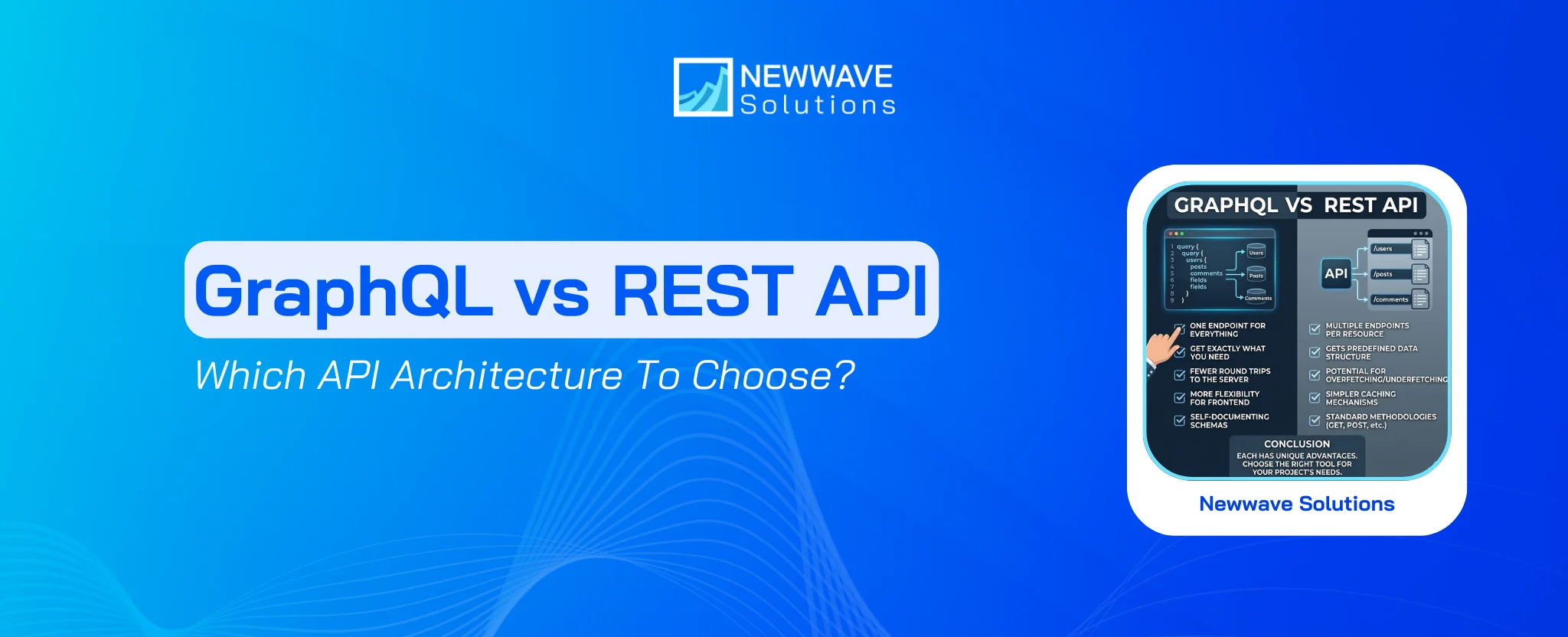
The choice of API design plays a critical role in determining how efficiently a business can scale its digital products. While REST has long been the dominant architectural style for web services, GraphQL has gained significant popularity as a flexible alternative that allows clients to request only the precise data they need. This guide explores GraphQL vs REST API by examining their architecture, advantages, and real-world use cases so enterprises can choose the best approach for their digital infrastructure.
What is GraphQL?
GraphQL is a query language and runtime for APIs that allows client applications to request exactly the data they need through a single endpoint instead of relying on multiple resource-based endpoints. This architecture enables applications to fetch data efficiently while maintaining a flexible and structured schema that defines how the API operates.
Key features of GraphQL
- Single API endpoint: A GraphQL server exposes a single endpoint through which clients send queries that define exactly which data fields should be returned.
- Client-defined queries: Client applications define their own queries, which allows them to retrieve only the data fields they require without over-fetching unnecessary information.
- Strongly typed schema: A strongly typed schema defines the structure of data, relationships between objects, and available operations, so developers can understand the API contract clearly.
- Resolver-based data fetching: Resolver functions connect the schema to actual data sources and determine how each field in a query retrieves its corresponding data.
- Flexible response structure: GraphQL responses follow the exact structure of the client’s query, which allows applications to receive customized data payloads tailored to their requirements.
Common Use Cases of GraphQL
- Complex UIs that aggregate data from multiple sources: E-commerce platforms leverage GraphQL to consolidate product details, inventory levels, and customer reviews from separate microservices into single queries, thereby minimizing API roundtrips and accelerating page load times for shoppers.
- Multi-client environments (web + mobile + IoT): Companies serving diverse platforms utilize GraphQL’s flexible schema so that web dashboards, iOS apps, and smart devices request only relevant data fields, which consequently reduces bandwidth costs and improves cross-client consistency.
- Real-time applications using subscriptions: Social media platforms implement GraphQL subscriptions over WebSockets to push live notifications like new messages or comments instantly, ensuring users experience seamless updates without constant polling.
- APIs that evolve rapidly and require non-breaking changes: Development teams at fast-growing SaaS providers adopt GraphQL’s versioning-free evolution, where clients specify exact fields needed, thus preventing disruptions during frequent schema updates.
What is the REST API?
A REST API is an architectural style for designing web services that expose resources through multiple endpoints and allow clients to interact with those resources using standard HTTP methods. RESTful services rely on stateless client-server communication and commonly use HTTP verbs such as GET, POST, PUT, and DELETE to manage resources.
Key features of REST APIs
- Resource-based architecture: A REST API organizes application data as resources that are accessible through unique URLs representing specific entities or collections.
- HTTP methods (GET, POST, PUT, DELETE): HTTP verbs define how clients interact with resources by specifying operations such as retrieving, creating, updating, or deleting data.
- Stateless client-server communication: Each request sent to a REST server contains all necessary information because the server does not store client session state between requests.
- Multiple endpoints for different resources: A REST architecture exposes different endpoints for each resource, which requires multiple requests when clients need data from several resources.
- Standardized web protocol usage: REST APIs rely on widely adopted web standards such as HTTP, URI structures, and status codes, which makes them highly compatible with web infrastructure.
Common Use Cases of REST API
- Public APIs (e.g., Twitter, Stripe, Shopify): Payment gateways like Stripe expose REST APIs for developers to process transactions securely through standardized HTTP endpoints, which support global merchant integrations with predictable response formats.
- Microservices architectures: Enterprises structure their backend services around REST APIs to enable independent scaling of components like user authentication and order processing, thereby facilitating resilient distributed systems.
- CRUD-style backends: Database-driven applications rely on REST APIs to perform standard create, read, update, and delete operations efficiently, making them ideal for admin panels managing consistent data models.
- Applications with stable, predictable data models: Legacy CRM systems maintain REST endpoints for fixed resources like contacts and accounts, where caching mechanisms significantly enhance performance under heavy read loads.
- Scenarios where caching provides a big performance boost: Content delivery networks use REST APIs with ETags and cache headers to serve static assets rapidly to millions of users, dramatically lowering latency compared to dynamic query systems.
Pros and Cons of GraphQL vs REST API
Selecting an API architecture requires a balanced evaluation of its inherent strengths and potential drawbacks. This section provides a detailed breakdown of the advantages and limitations of both GraphQL and REST to help you mitigate technical risks.
Pros and Cons of GraphQL
Pros
- Flexible data querying that returns only the required fields
- Single endpoint architecture that simplifies API management
- Strongly typed schema that improves developer experience
- Reduced network requests for complex data relationships
- Efficient integration with modern frontend frameworks
- Schema evolution without mandatory API versioning
Cons
- Increased server complexity due to query execution logic
- Limited native HTTP caching support compared with REST
- Steeper learning curve for teams unfamiliar with GraphQL
Pros and Cons of REST API
Pros
- Simple architecture that follows standard web protocols
- Strong HTTP caching support for improved performance
- Mature ecosystem with extensive tooling and documentation
- Easy integration with existing microservices architectures
- Clear resource-based URL structure for API design
- Broad compatibility with browsers, gateways, and CDNs
Cons
- Over-fetching or under-fetching data in complex applications
- Multiple endpoints required for related resources
- API versioning complexity as systems evolve
GraphQL vs REST API: Key Differences
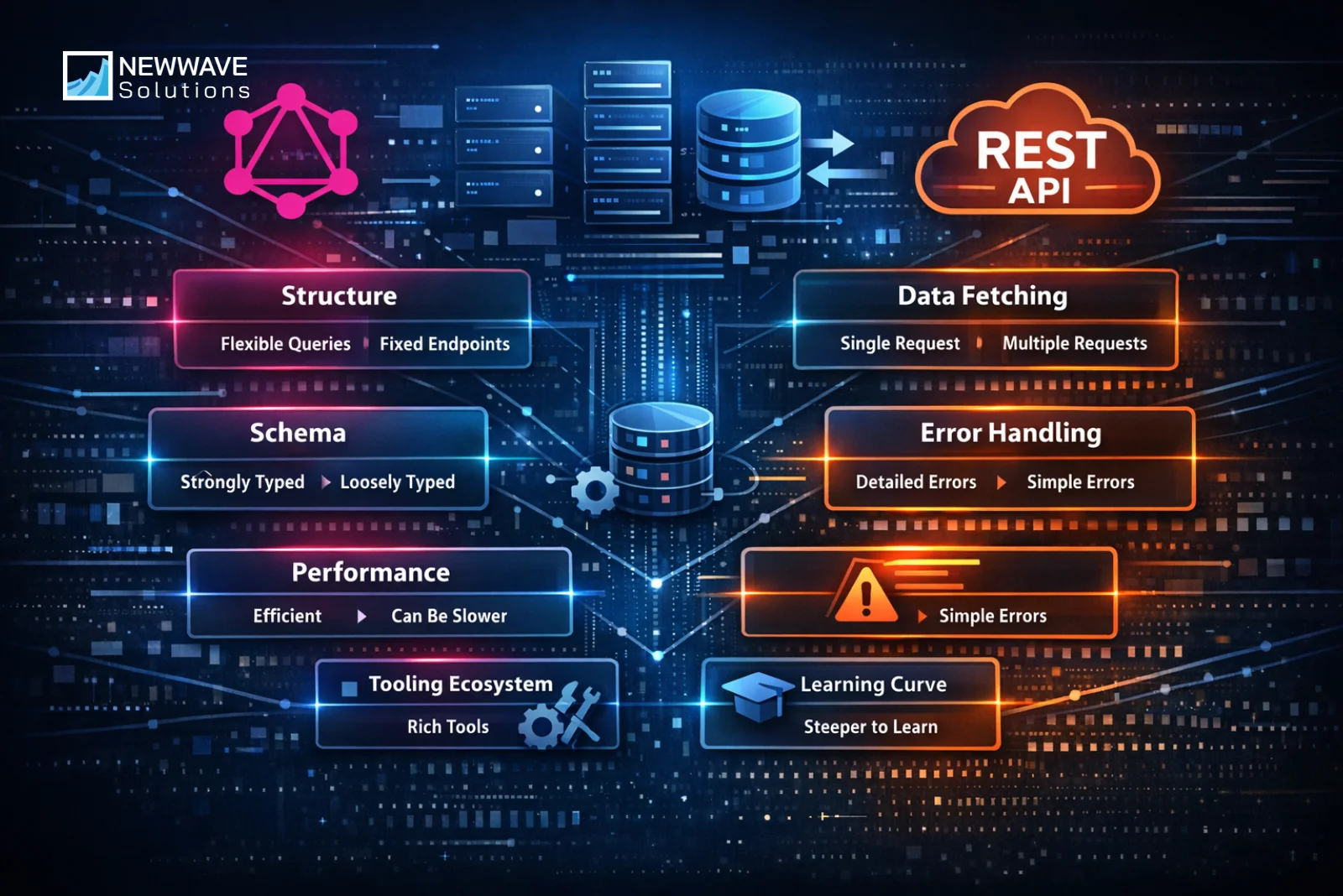
While both technologies serve the same fundamental purpose of data transfer, they operate completely different underlying philosophies. By examining the core technical distinctions below, you can identify how each method handles requests, data structures, and state management.
|
Criteria |
GraphQL | REST API |
Verdict |
| Structure | Single endpoint with query language | Multiple endpoints representing resources | GraphQL offers simpler endpoint management |
| Data fetching | Clients request specific fields | Fixed responses defined by server | GraphQL reduces over-fetching |
| Schema | Strongly typed schema defines API structure | Schema often implicit or documented separately | GraphQL improves API discoverability |
| Performance | Efficient for complex queries | Efficient for simple requests with caching | Depends on application complexity |
| Versioning | Schema evolves without versions | Versioning often required (v1, v2) | GraphQL reduces versioning overhead |
| Error handling | Errors returned within structured response | HTTP status codes and responses | REST provides simpler error semantics |
| Caching | Requires custom caching strategies | Native HTTP caching available | REST excels in caching scenarios |
| Tooling ecosystem | Growing ecosystem with specialized tools | Mature ecosystem across frameworks | REST still has broader tooling |
| Learning curve | Higher complexity for beginners | Easier for developers to learn | REST is easier to adopt |
Overall, GraphQL generally performs better in applications that require flexible and complex data queries, while REST remains a strong choice for simple APIs and systems that rely heavily on HTTP caching. Therefore, the optimal architecture depends on the complexity of the application and the operational requirements of the development team.
When Should You Use GraphQL vs REST API?
Choosing between these two architectures often depends more on your specific project needs than on the popularity of the tech stack. This section outlines the most common scenarios where one approach clearly outperforms the other to guide your strategic planning.
When to use GraphQL
- Complex Dashboards: Efficiently fetch multiple related datasets in a single query.
- Low-Bandwidth Mobile Apps: Minimize network overhead and requests for better performance.
- Rapidly Evolving SaaS: Support backward-compatible API evolution without breaking changes.
- Frontend-Driven Teams: Ideal for projects with frequent UI iterations and changing data needs.
- Data Aggregation: Unify multiple backend services into a single, cohesive API gateway.
When to use REST API
- Simple CRUD Backends: Best for straightforward applications requiring quick implementation.
- Public Platforms: Ensure high adoption with standard HTTP-based APIs familiar to all developers.
- Microservices Ecosystems: Maintain clear resource boundaries and predictable data models.
- High-Scale Caching: Leverage native HTTP caching to reduce server load and latency.
- Long-Term Stability: The go-to choice for systems with static and well-defined data structures.
Can GraphQL and REST Work Together?
The answer is YES, as GraphQL and REST can coexist within the same system, and many enterprises run both simultaneously. A common pattern is using REST for simple, resource-based endpoints while reserving GraphQL for complex, data-heavy queries that would otherwise require multiple REST calls. This hybrid approach lets teams adopt GraphQL incrementally without rewriting existing APIs.
The Future of API Architecture
API architecture continues to evolve as new communication protocols and integration patterns emerge. Technologies such as gRPC, AsyncAPI, and Model Context Protocol (MCP) extend the API landscape beyond traditional client-server communication models.
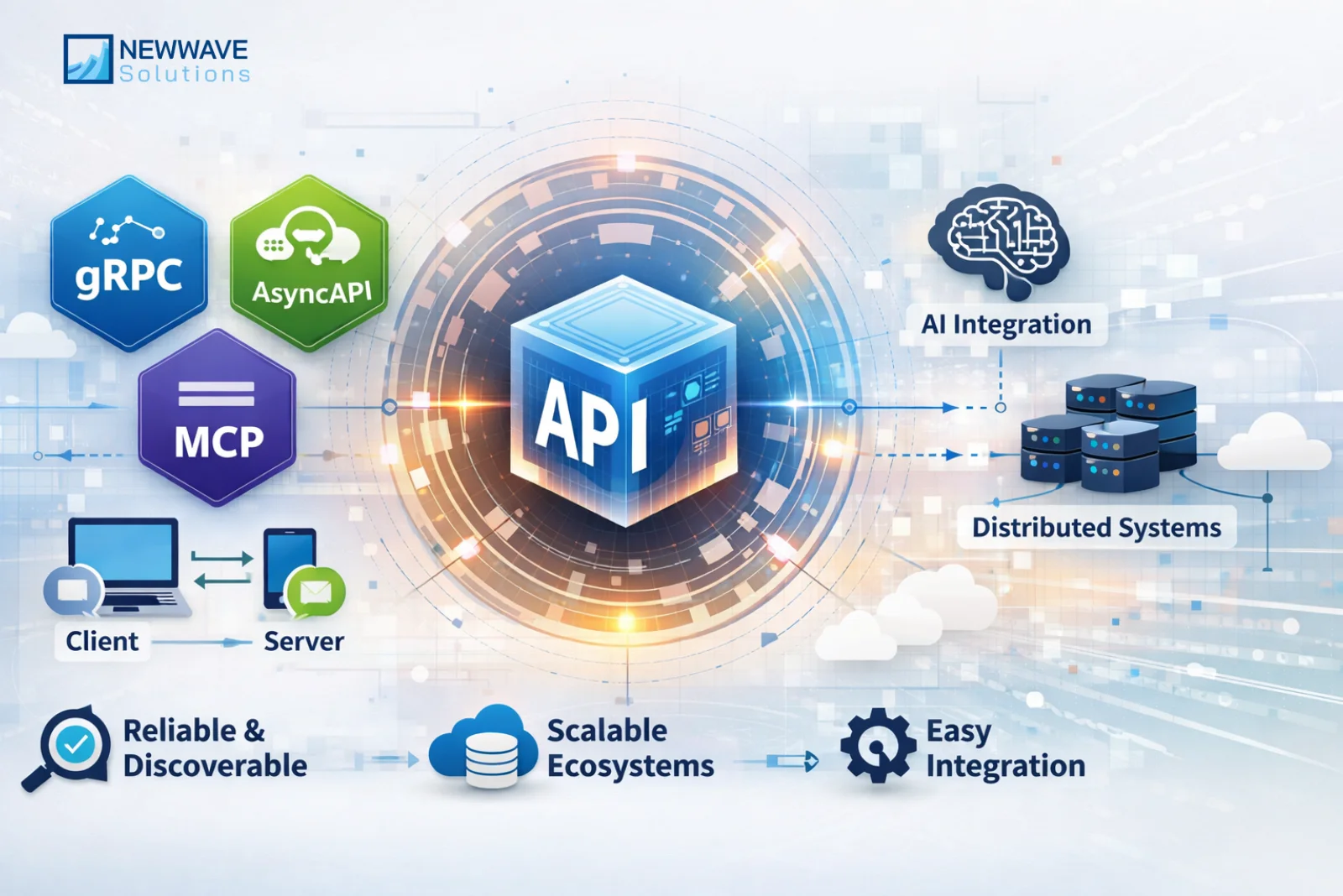
At the same time, the fundamental goal of API design remains consistent: building interfaces that are reliable, discoverable, and easy for developers to integrate. As organizations increasingly deploy AI systems and distributed applications, APIs will continue to function as the core execution layer that enables scalable digital ecosystems.
Partnering with Newwave Solutions for Seamless API Migration and Integration
Even after determining whether GraphQL or REST API is the ideal model, implementing these architectures into your project remains a challenge due to their high technical complexity. You will require a specialized team with deep expertise in mobile app development and web development who possess years of experience in utilizing advanced software development tools. More importantly, a reliable partner must thoroughly understand your project’s specific requirements and constraints to provide professional consultancy, ensuring you select the right tech stack from the start to optimize long-term costs and operational efficiency.
Newwave Solutions stands ready to meet these demands as a professional IT consultant specializing in software development services, mobile app development services, and web development services. We offer comprehensive API development services that empower businesses to connect applications, platforms, and data with maximum security and efficiency. By designing custom solutions, our team streamlines communication between systems and automates workflows to create unified digital experiences across web, mobile, and cloud environments.
What do Newwave Solutions’ API Development Services offer?
Based on our core capabilities, we provide a robust suite of API development solutions tailored to your infrastructure:
- API Design & Architecture: We create scalable and secure architectures for REST, SOAP, and GraphQL APIs that are strictly tailored to your specific business logic and operational goals.
- Custom API Development: Our engineers develop bespoke APIs to integrate diverse systems and enable seamless third-party access, significantly enhancing overall interoperability.
- API Integration Services: We enable reliable connections between applications, CRMs, and ERPs to ensure synchronized workflows and improved organizational productivity.
- Authentication & Security: Our team implements OAuth 2.0, JWT, SSO, and advanced encryption protocols to guarantee secure communication and strict control over data access.
- API Gateway & Management: We set up dedicated API gateways for traffic routing, throttling, caching, and continuous monitoring to ensure your system maintains optimal performance.
- Maintenance & Version Control: Newwave Solutions manages version updates, applies critical patches, and enhances features to keep your APIs secure and scalable as your business grows.
From integrating third-party services to building internal communication bridges, our solutions ensure your applications work in perfect harmony. Together we can ensure the future-proof of your technology stack by creating powerful, interconnected capabilities.
Conclusion
Overall, REST remains a reliable and widely adopted standard due to its simplicity and mature ecosystem, while GraphQL provides greater flexibility and efficiency for complex data interactions. Ultimately, the choice between GraphQL vs REST API depends on your specific project requirements, system architecture, and performance goals. Many organizations now successfully adopt hybrid approaches that combine the stability of REST with the flexibility of GraphQL to build truly scalable ecosystems.
Newwave Solutions’ experts are ready to assist you in optimizing both costs and technical efficiency for your next software project. Reach out to us and book a schedule instantly so that Newwave can fully understand your requirements and project aspirations.
To Quang Duy is the CEO of Newwave Solutions, a leading Vietnamese software company. He is recognized as a standout technology consultant. Connect with him on LinkedIn and Twitter.



Read More Guides


Get stories in your inbox twice a month.
Let’s Build Something Extraordinary
Sign up for a 30 min no-obligation strategic session with us. Transform your Ideas into scalable reality.
Leave a Reply