


AI Outsourcing: When to Outsource AI and How to Get It Right
AI outsourcing is becoming a more strategic option as AI moves deeper into enterprise IT. According to Gartner, AI is expected to touch all IT work by 2030, with 75% performed by people augmented with AI and 25% handled by AI alone. That shift is forcing companies to decide which AI capabilities require in house control and where external expertise can accelerate delivery.
In this guide, we’ll explain when AI outsourcing makes sense, which services to outsource, tips to choose the right partner, and how to manage risks and ROI effectively.
Key Takeaways
|
Why Companies are Outsourcing AI? 3 Benefits for Businesses
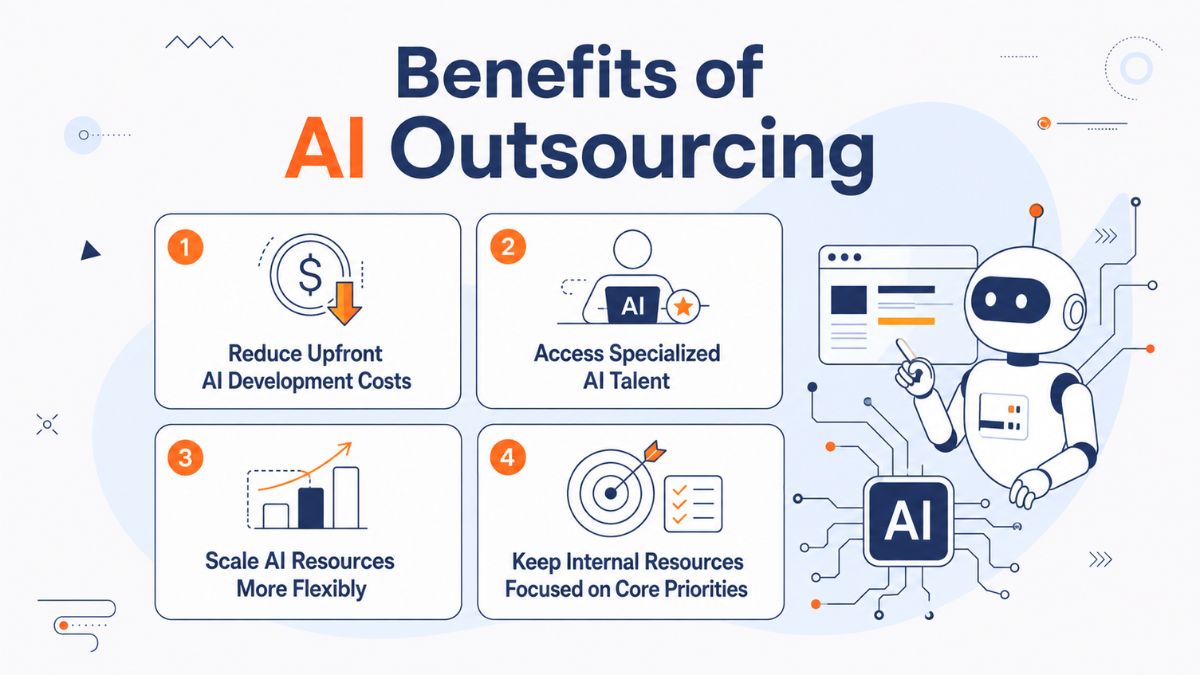
AI outsourcing allows businesses to access specialized expertise, control development costs, scale resources more flexibly, and keep internal teams focused on core priorities. This can be especially valuable when AI initiatives require skills or investment that would be difficult to build internally.
1. Reduce upfront AI development costs
Building AI capabilities in-house can require significant spending on specialist recruitment, advanced technologies, and continuous training. Outsourcing AI development can reduce these initial commitments by giving businesses access to external expertise without creating a full internal R&D team.
It can also support a lower risk starting point. External specialists can help validate an idea through an AI proof of concept, assess where AI fits the business, and test feasibility before larger investments are made. This matters because a RAND report found that roughly 80% of AI projects fail to deliver measurable business value.
2. Access specialized AI talent
AI projects often require expertise that is difficult to recruit internally. ManpowerGroup reports that 72% of employers struggle to fill roles, with AI and data capabilities among the hardest skills to find.
Through AI outsourcing, companies can access professionals with specialized knowledge without going through lengthy recruitment and team building processes. This broader talent pool can also help match specific project requirements with the expertise needed to develop and implement the solution.
3. Scale AI resources more flexibly
AI projects can change in size and technical requirements as they progress. Outsourcing gives businesses greater flexibility to expand or reduce external resources according to project needs.
This avoids the recruitment and redundancy costs associated with repeatedly resizing an internal team. Plus, Such adaptability also allow businesses to easily adjust development capacity when priorities or market conditions change.
4. Keep internal resources focused on core priorities
Outsourcing complex AI development can allow internal teams to concentrate more resources on the capabilities that are central to the business.
Rather than allocating substantial internal capacity to building specialized AI expertise, companies can rely on external teams for implementation while keeping greater focus on their core operations, innovation priorities, and business development.
Types of AI Services Commonly Outsourced
Companies can outsource different parts of AI development depending on the problem they need to solve and the expertise required. Common areas include machine learning, data analysis, natural language processing, and process automation.
1. Machine learning development
Machine learning development focuses on building algorithms that learn from data and make decisions without being explicitly programmed for every scenario. Businesses may outsource this work for applications such as predictive analytics and automated customer service, where specialist ML expertise is required.
2. Data analysis and interpretation
AI projects often depend on the ability to turn large volumes of raw data into useful information. Outsourced data analysis can help identify patterns, trends, and insights that support better planning and business decisions.
3. Natural language processing services
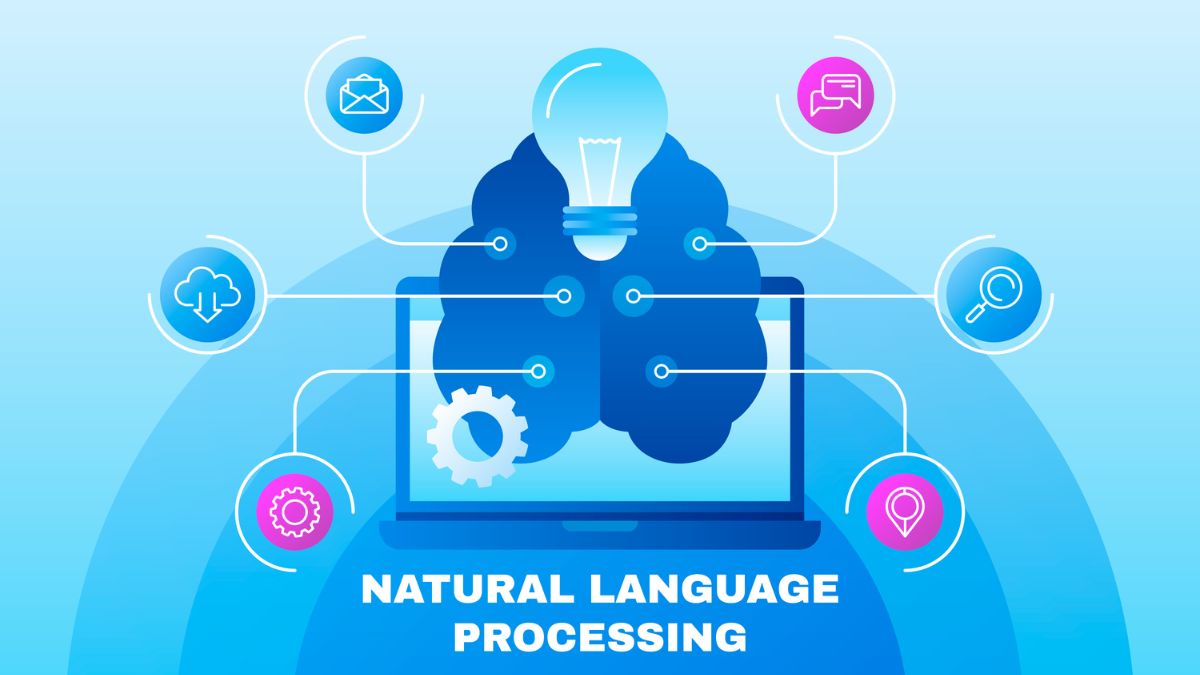
Natural language processing enables systems to understand and respond to human language. It is commonly used in digital assistants and customer service chatbots, making NLP a relevant area for companies looking to outsource AI capabilities focused on language-based interactions.
4. Robotic process automation
Robotic Process Automation helps automate repetitive, rules based tasks that would otherwise require manual effort. Typical examples include data entry, invoice processing, email management, and customer data updates.
Effective RPA implementation also requires a clear understanding of existing business processes, since the automation must be configured around how those processes actually work.
How AI Outsourcing Differs from Traditional Software Outsourcing
AI outsourcing differs from traditional software outsourcing because results are less predictable and depend heavily on data quality and ongoing model maintenance. As a result, it requires a different approach to planning, scoping, and delivery.
AI projects are more experimental
Traditional software projects often begin with defined requirements and produce deterministic functionality. AI projects are less predictable. A model may not reach the expected accuracy, may perform differently on real world data, or may require several rounds of experimentation before it becomes viable.
This means milestones and expectations in outsourcing AI development should account for uncertainty rather than assume every requirement will translate directly into a working outcome.
Data can become the main bottleneck
AI performance depends heavily on the quality and readiness of the underlying data. According to Anaconda’s 2024 survey, data scientists spend roughly 40% of their time preparing and cleaning data.
In an outsourced project, the challenge may be greater because external teams need to understand unfamiliar data sources and undocumented schemas. Incomplete, inconsistent, or poorly labeled data can delay progress regardless of the vendor’s technical capability.
Specialized AI talent is harder to access
AI outsourcing also reflects the limited availability of specialist talent. Stanford’s 2024 AI Index Report found that demand for AI specialists continues to exceed supply across major markets.
For companies that need expertise in areas such as computer vision, natural language processing, or reinforcement learning, outsourcing can provide access to these capabilities without relying solely on a lengthy internal recruitment process.
AI expertise is more specialized
AI projects often require narrow technical expertise across areas such as computer vision, natural language processing, or reinforcement learning. Unlike conventional software projects, the skills required can vary significantly depending on the model, data, and problem being addressed.
This makes team composition more important in AI outsourcing, as the required expertise needs to match the specific technical demands of each project rather than relying on a broadly defined software development team.
AI models require ongoing management
Machine learning models can become less accurate as real-world conditions change. Data drift and concept drift can gradually reduce model performance over time.
For this reason, AI outsourcing should include plans for monitoring, retraining, and maintaining data pipelines after deployment. Without these activities, a model that performs well at launch may lose effectiveness later.
When Should You Outsource AI & When to Keep AI In-house
The choice to outsource AI or keep it in-house depends on how important it is to the business and how much control it needs. In practice, the best approach is often a balance between external support and internal ownership, rather than choosing one model exclusively.
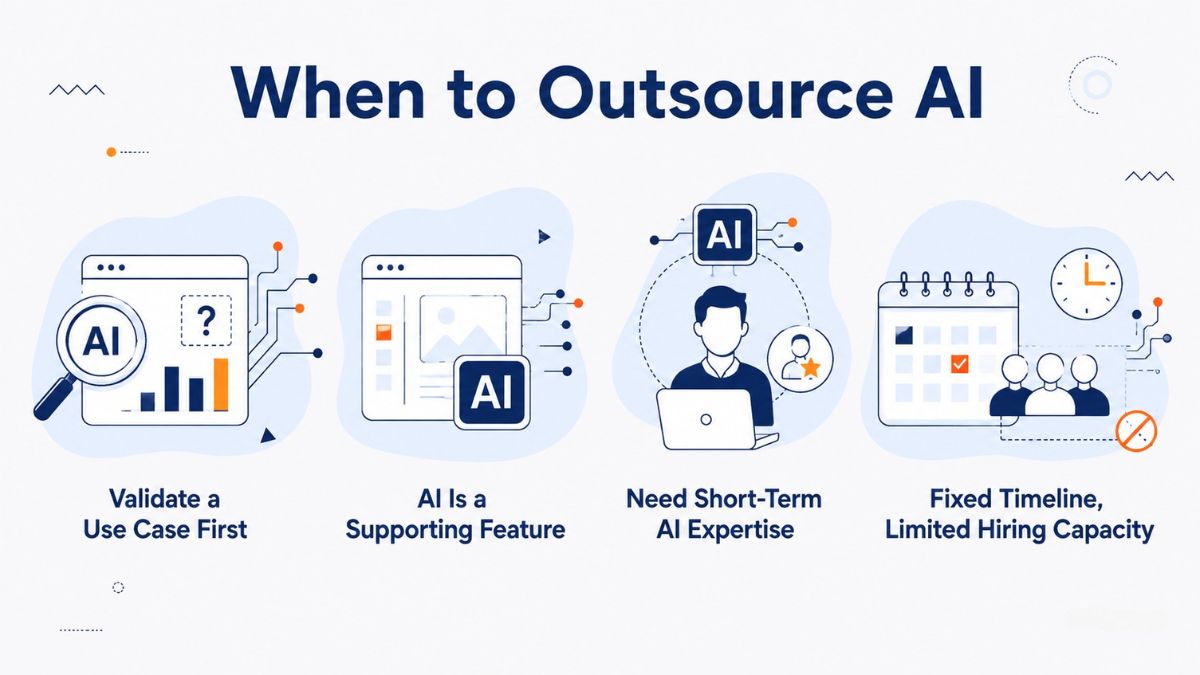
When to outsource AI
AI outsourcing is a strong fit when external expertise can accelerate validation or delivery without weakening control over the core product.
- Validate a use case first: A proof of concept can test whether ideas such as predictive analytics, personalization, or an AI powered support assistant are technically feasible before the business invests in a larger team or solution.
- AI is a supporting feature: Functions such as recommendations, dynamic pricing, fraud detection, or AI chatbots can be developed externally while the internal team continues to focus on the main platform, provided the integration between both sides is clearly defined.
- Need short-term AI expertise: Capabilities such as computer vision, large language models, or robotic process automation may require specialist knowledge without creating enough ongoing work to justify permanent roles.
- Fixed timeline, limited hiring capacity: Outsourcing can provide additional delivery capacity when a project must meet a committed launch date or another time sensitive requirement.
When to keep AI in-house
Some AI capabilities require closer internal ownership because they are tightly linked to competitive advantage, sensitive information, or continuous product decisions.
- AI is the core product or a primary competitive advantage: Outsourcing the central model can create long term dependency on an external provider.
- The data cannot be shared externally: Highly sensitive data or regulatory constraints may make external development unsuitable even when contractual and governance measures are in place.
- The AI capability requires frequent product iteration: When model development needs to remain closely connected to weekly product decisions and sprint planning, communication overhead with an external team can slow down execution.
- The required talent already exists internally: If the issue is limited capacity rather than missing expertise, staff augmentation or contract to hire may be more appropriate than outsourcing the entire project.
What to outsource vs. what to keep in-house
Deciding how to divide responsibilities between internal teams and external partners is a critical step in any AI initiative. The table below helps you decide which to outsource and which is better to keep in-house.
|
AI Component |
Recommended Approach |
Why |
| Data pipeline engineering | Outsource | Infrastructure work can be transferred effectively to an external team. |
| Model training and experimentation | Outsource | This work requires specialized AI expertise. |
| MLOps infrastructure setup | Outsource | It depends on specialist tooling knowledge. |
| Proof of concept development | Outsource | External expertise can support faster validation. |
| Data labeling and annotation | Outsource | The work is labor intensive and can be managed remotely. |
| Problem definition and success criteria | Keep in-house | These depend on deep understanding of the business context. |
| Data access and governance | Keep in-house | Security and compliance responsibility should remain internal. |
| Model evaluation and acceptance | Keep in-house | Final acceptance requires business judgment, not only technical assessment. |
| Production integration | Keep in-house | Integration is closely tied to the company’s existing architecture. |
| Ongoing monitoring and retraining | Co-own | Ownership can transition gradually as internal teams build operational capability. |
Best Use Cases for AI Outsourcing
AI outsourcing can support a wide range of business functions, from customer service and fraud detection to predictive analytics and process automation. Here’re most relevant use cases across different industries.
1. Telecom
AI is widely adopted in telecom, with 41% of telecoms already adopted AI systems and a further 48% considering it (Statista). Telecom companies can use outsourced AI capabilities to improve both network operations and customer service. Common applications include:
- Network optimization: Real time and predictive analytics can support more efficient network management.
- AI powered chatbots: Automated support tools can help improve customer interactions.
- Fraud detection: Machine learning can identify suspicious activity in real time.
- Billing and customer management: Robotic process automation can automate repetitive administrative tasks.
2. Retail
Retailers can apply AI to customer engagement, pricing, inventory, and marketing. Common use cases include:
- Chatbots and virtual assistants: NLP based systems can provide customer support around the clock.
- Personalization engines: AI can generate tailored product recommendations and offers based on customer information.
- Inventory and supply chain management: AI can help align supply with demand while reducing overstocking and delays.
- Dynamic pricing: Pricing can be adjusted in real time using customer and inventory data.
- Marketing automation: AI can support personalized campaigns and content generation.
3. Healthcare
By leveraging external AI expertise, healthcare organizations can enhance operational efficiency while continuing to deliver high-quality patient care. Outsourcing AI can support:
- Smart hospitals: AI combined with IoT devices can support more efficient hospital operations.
- AI powered triage: AI systems can help prioritize urgent cases and reduce waiting times.
- Predictive health analytics: AI can be used to forecast patient risks.
- Administrative automation: Appointment scheduling and billing are examples of processes that can be automated.

4. Financial services
Financial institutions can use AI to analyze complex datasets and support faster decision making. Firms often choose AI outsourcing services for tasks like:
- Fraud and anomaly detection: AI can identify suspicious financial activity in real time.
- Credit risk assessment: Customer data can be analyzed to support risk evaluation.
- Robo advisory and portfolio analytics: AI can provide investors with automated advice and portfolio data insights.
- Customer service and onboarding: Chatbots can answer customer questions and help accelerate onboarding processes.
5. Insurance
Insurance companies can apply AI to risk assessment, claims, fraud detection, and customer personalization. Key use cases include:
- Risk prediction: AI can assess customer risk to support faster underwriting.
- Claims automation: Automated processing can help reduce waiting times.
- Fraud detection: AI can identify potentially fraudulent claims before they create further financial impact.
- Personalized policies: AI can support tailored policy quotes and recommendations based on customer information.
How to Choose the Right AI Outsourcing Partner
Choosing an AI outsourcing partner requires more than reviewing portfolios or general technical credentials. A strong evaluation should cover three areas: technical capability, delivery maturity, and clear contractual terms.
Evaluate technical depth
Look beyond polished demos and ask how the team handles real production challenges. Useful areas to assess include:
- MLOps capability: Ask how the vendor manages experiment tracking, model versioning, data validation, and model retraining.
- Data engineering expertise: Evaluate whether the team can work with incomplete, inconsistent, or changing data, not only clean datasets prepared for demos.
- Production deployment experience: Ask how many deployed models are still running in production and how their performance is monitored over time.
These questions help distinguish teams that can build an AI prototype from those equipped to support a reliable production system.
Assess process and team maturity
The way a vendor communicates and organizes delivery can directly affect project visibility and continuity.
- Transparent reporting: Ask to see examples of previous status reports. Strong reporting should include model performance, data quality, and experiment results rather than only completed tasks or hours worked.
- Team stability: Confirm who will actually work on the project and how stable the team is. Frequent engineer changes can lead to repeated knowledge loss and additional onboarding time.
- Clear ownership: Ensure responsibilities for trained models, custom code, and derivatives created from training data are explicitly defined.
Review data security and contract terms
AI projects often involve sensitive data and valuable intellectual property, so contractual details should be specific rather than implied.
Review how the vendor addresses:
- Encryption in transit and at rest
- Access controls
- Data residency requirements
- GDPR compliance where applicable
- ISO 27001 certification
- Ownership of models, code, and data derivatives
Key Phases of a Successful AI Outsourcing Project
A structured AI outsourcing engagement should move through discovery, development, and handover rather than committing immediately to a full build. Each phase should have clear objectives and decision points so the project can continue, change direction, or stop based on validated results.
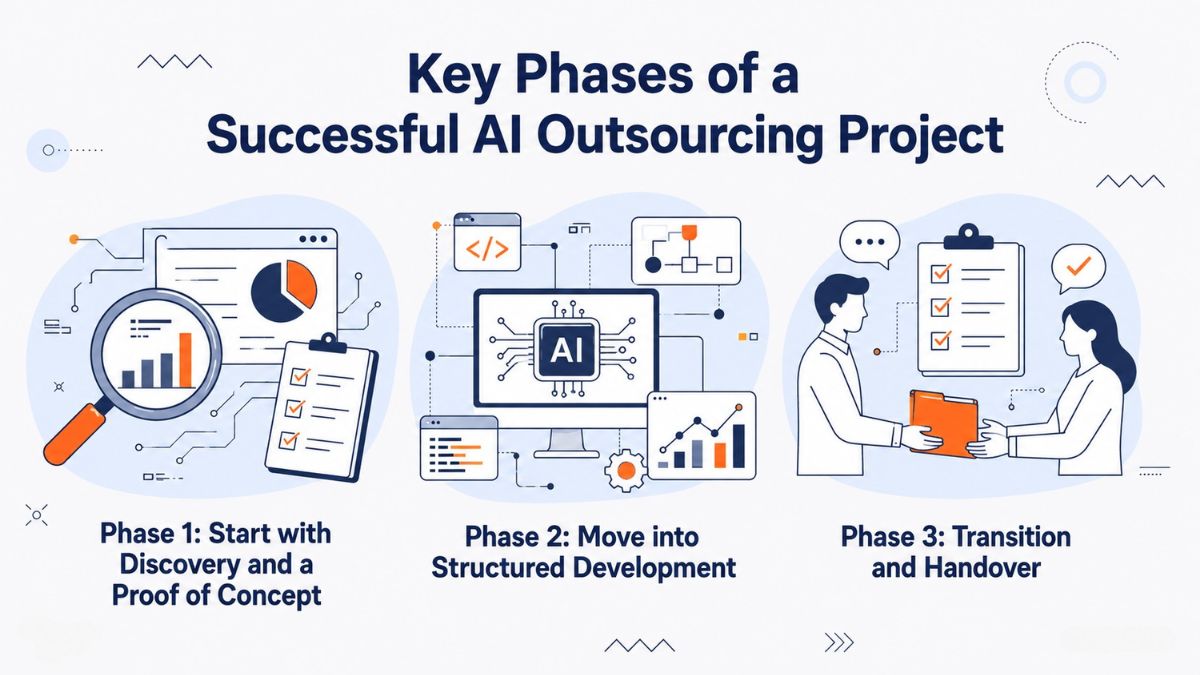
Phase 1: Start with discovery and a Proof of Concept
The first phase typically lasts 6 to 12 weeks and uses a time and materials model. Its purpose is to define the business problem, assess whether the available data is ready for AI development, and build a proof of concept.
The PoC should answer a fundamental question: Is the proposed solution feasible enough to justify further investment? Moving directly into a large development contract without this validation phase can increase project risk.
Phase 2: Move into structured development
Once feasibility has been confirmed, the project can progress to full development. The delivery model should reflect how clearly the work can be defined.
- Milestone based delivery fits projects with measurable deliverables, such as training a model on production representative data or deploying an end to end pipeline in a staging environment.
- Dedicated team delivery is better suited to projects that require continued exploration and cannot be fully scoped in advance.
Milestones should not rely only on fixed accuracy targets. Process progress, data readiness, and model development should all be considered when evaluating each stage.
Phase 3: Transition and handover
The final phase typically takes 4–8 weeks and should account for around 15–20% of the total engagement timeline. Its purpose is to transfer enough technical knowledge and operational responsibility to the internal team so the system can be maintained after the outsourcing partner steps back.
The handover should cover:
- Complete technical and operational documentation.
- Structured knowledge-transfer sessions.
- Pair programming between the vendor and internal engineers.
- A supervised operating period in which the internal team runs the system while vendor support remains available.
Important note: Build go/no-go checkpoints into every phase
A successful AI outsourcing project should include explicit decision gates rather than assuming continuation once work begins. After the PoC, the organization decides whether results justify further investment; after the first production-quality model, it evaluates business impact; and after staging deployment, it assesses operational readiness.
These checkpoints enable clear decisions to continue, pivot, or stop before additional costs accumulate.
Proven Strategies for Successful AI Outsourcing
A successful AI outsourcing engagement requires more than assigning development work to an external team. The project should be structured so both sides have a shared understanding of the system, the data, responsibilities, and how performance will be evaluated throughout development and after deployment.
1. Define the system boundary and expected behavior
Start by clarifying how the AI solution fits into the wider business and technical environment rather than defining only the use case. This gives the outsourced team a clearer picture of what the system must interact with and how it should behave in real operating conditions.
- Define which functions belong inside the AI layer and which remain outside it.
- Map data inputs, transformations, and downstream consumers.
- Identify where human review or override is required.
- Define expected behavior for edge cases, failures, latency, and fallback scenarios.
2. Validate data readiness and secure access early
AI development can slow down when teams discover data quality or accessibility problems after model work has already begun. Data should therefore be reviewed and made accessible before it becomes a dependency for development.
- Audit data for quality, completeness, and consistency.
- Establish schemas, validation rules, fallback handling, and data contracts.
- Provide timely access to required datasets and business systems.
- Set up secure environments early and minimize manual data handoffs.
3. Treat integration and MLOps as core workstreams
Integration and production operations should be planned alongside model development rather than added near the end. This helps ensure the outsourced solution can work with existing systems and remain manageable once deployed.
- Identify API dependencies and technical constraints early.
- Design for asynchronous processing, retries, and failure handling.
- Test integrations with real system inputs rather than controlled datasets alone.
- Establish model versioning, monitoring, alerting, rollback procedures, and drift tracking from the outset.
4. Design the AI system for continuous iteration
AI systems need to change as new data, patterns, and operating requirements emerge. Building flexibility into the initial architecture makes future model and feature updates easier to manage.
- Base retraining decisions on real performance signals rather than fixed schedules alone.
- Keep feature and data pipelines flexible enough to support updates.
- Avoid tightly coupled components that make future changes difficult.
- Use operational feedback to guide model and feature improvements.
5. Establish clear ownership between teams
Internal and outsourced teams need explicit responsibility boundaries so operational issues do not become shared problems with no clear owner. Ownership should cover both development and post-deployment activities.
- Define who owns data pipelines, models, and deployment layers.
- Assign responsibility for monitoring, incidents, updates, and maintenance.
- Avoid overlapping responsibilities that can slow decisions or create confusion.
6. Build feedback loops into the workflow
Real-world usage provides information that development datasets alone cannot capture. Capturing this feedback allows teams to identify where the AI system needs adjustment after it begins operating.
- Collect user feedback and system outputs early.
- Track where predictions, responses, or other outputs fail.
- Feed these findings into retraining and feature-update decisions.
7. Measure progress through outcomes
Project reviews should focus on whether the AI system performs effectively in real scenarios rather than only tracking completed development tasks. Business and technical results can then guide subsequent priorities.
- Evaluate model performance under realistic operating conditions.
- Track business-level outcomes alongside technical delivery.
- Reassess priorities based on what is actually producing useful results.
Measuring the ROI of AI Outsourcing Investments
The ROI of AI outsourcing should be assessed beyond the initial development price. A complete evaluation therefore looks at the speed of value creation, the quality of outcomes, and the long-term cost of operating and maintaining the system after deployment.
Compare time-to-value with in-house development
Measure how much earlier outsourcing can bring the AI solution to market compared with building it internally. For example, if outsourcing enables delivery six months earlier, evaluate the value of that time advantage rather than comparing hourly development rates alone.
The assessment should consider:
- Revenue associated with earlier market entry.
- The value of improved competitive positioning.
- The cost of hiring and ramping the internal team that would otherwise be required.
Outsourcing is not necessarily cheaper on a per-hour basis, so ROI should account for the value of faster first delivery rather than development rates alone.
Translate model performance into business outcomes
Technical metrics should be connected to operational or financial results. Instead of evaluating a model only by a metric such as 90% accuracy, translate the improvement into outcomes that business stakeholders can measure.
For example, reducing customer churn by 15% could be expressed as $180,000 in retained monthly revenue. According to McKinsey’s 2024 survey, organizations that quantify AI impact using business metrics are 1.5 times more likely to scale AI successfully.
Measure knowledge transfer and internal capability
AI outsourcing should also be evaluated by how independently the internal team can manage the system after the engagement. If engineers cannot retrain models, diagnose failures, or extend the solution without the vendor, the organization remains dependent on external expertise.
Before the transition period ends, assess whether the internal team can:
- Perform a supervised model retraining.
- Debug system or model failures.
- Extend and operate the solution with the knowledge transferred during the engagement.
Calculate the total cost of ownership
The initial AI build typically represents only 30–40% of first-year costs, so ROI calculations should account for expenses that continue after development. Focusing only on the outsourcing contract can therefore understate the actual investment required to operate the system.
Total cost of ownership should include:
- Ongoing model and system monitoring.
- Periodic model retraining.
- Computing, storage, and serving infrastructure.
- Internal team members responsible for operating the system after handover.
Challenges and Considerations in AI Outsourcing
While AI outsourcing can give businesses access to external development capabilities, working with a third-party provider also introduces risks that need to be managed throughout the engagement.
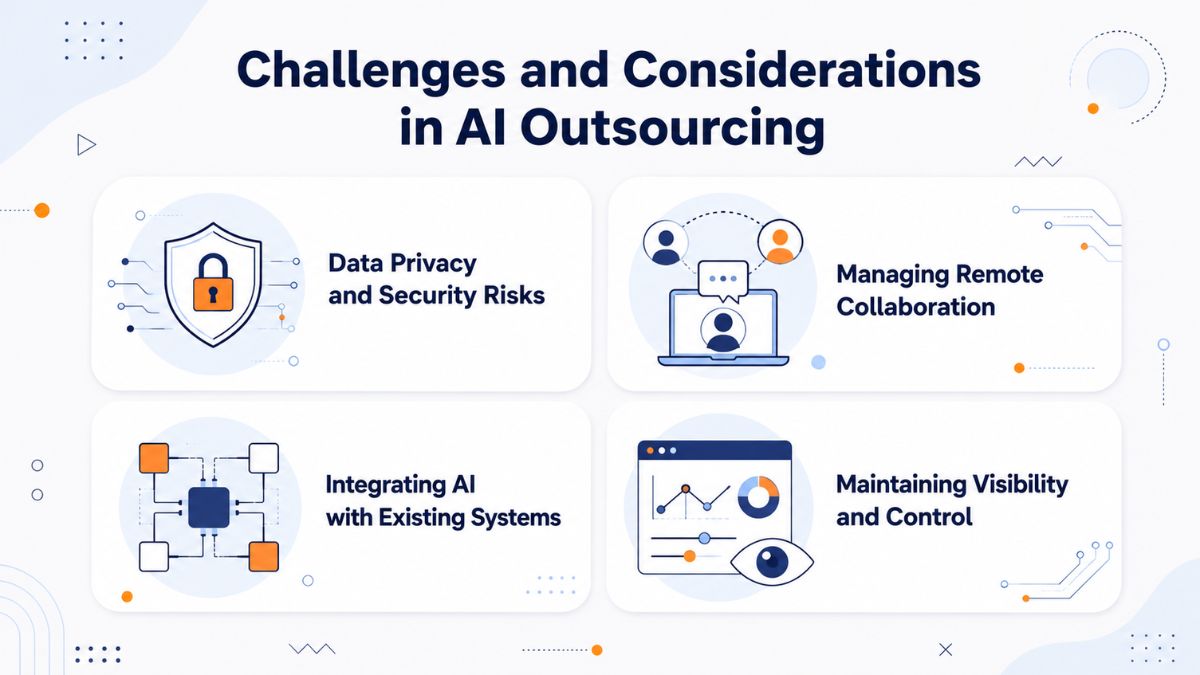
Data privacy and security risks
Sharing sensitive business or customer data with an external AI provider creates potential security risks. Businesses can mitigate these concerns by evaluating how vendors manage and protect data, particularly whether they follow robust data governance practices and comply with standards or requirements such as ISO 27001 and GDPR.
Managing remote collaboration
Offshore AI development can offer a more cost-effective delivery model, but differences in time zones and working cultures may create communication challenges. Selecting a provider that maintains clear communication and provides regular project updates can help keep the engagement coordinated and on track.
Integrating AI with existing systems
New AI infrastructure needs to work effectively with the organization’s existing platforms. The outsourcing provider should therefore prioritize system compatibility and seamless integration to reduce operational disruption and support data-driven decision-making across business processes.
Maintaining visibility and control
Outsourcing development does not mean businesses should give up control over project delivery. Organizations should establish clear accountability by defining KPIs, requiring regular performance reporting, and maintaining transparent, two-way communication with the service provider throughout the engagement.
The Future of AI Outsourcing
As AI capabilities continue to expand, AI outsourcing is likely to play a larger role in how businesses access expertise, deploy new technologies, and scale AI initiatives. Several shifts are already shaping how outsourcing models may evolve.
AI-as-a-Service will gain more ground
More businesses are choosing AI-as-a-Service (AIaaS) instead of building every capability internally. Similar to cloud-based SaaS, AIaaS gives companies on-demand access to AI functionality without requiring the same level of upfront investment associated with in-house development.
Generative AI will move into more business processes
Generative AI is broadening the use of AI across content creation, design, and problem-solving. As adoption expands, outsourcing providers are expected to help businesses integrate generative AI into a wider range of workflows and customer-facing processes.
Global AI outsourcing hubs will continue to shift
Regions such as India, Eastern Europe, and Southeast Asia have become important AI outsourcing destinations because of their expanding talent pools and cost advantages. This trend is expected to continue as Western companies increasingly explore offshore and nearshore models for AI development.
Outsourcing will become more strategic
AI outsourcing is gradually moving beyond a purely cost-saving model toward longer-term partnerships focused on innovation and growth. As AI develops quickly and in-house expertise becomes harder to build and maintain, businesses may rely more heavily on external specialists to access the skills needed to implement and scale AI effectively.
Why Newwave Solutions Is a Reliable AI Outsourcing Partner
Newwave Solutions provides AI outsourcing services that help businesses extend their AI capabilities without building every resource in-house. By combining external AI expertise with a structured development process, we help companies in turning business requirements into scalable AI solutions while reducing the burden of recruiting, coordinating, and maintaining a specialized internal team.
From early planning through development, deployment, and optimization, Newwave Solutions can support businesses across the AI project lifecycle. This approach helps organizations accelerate implementation, adapt solutions as requirements evolve, and maintain clearer control over delivery, security, and long-term system performance.
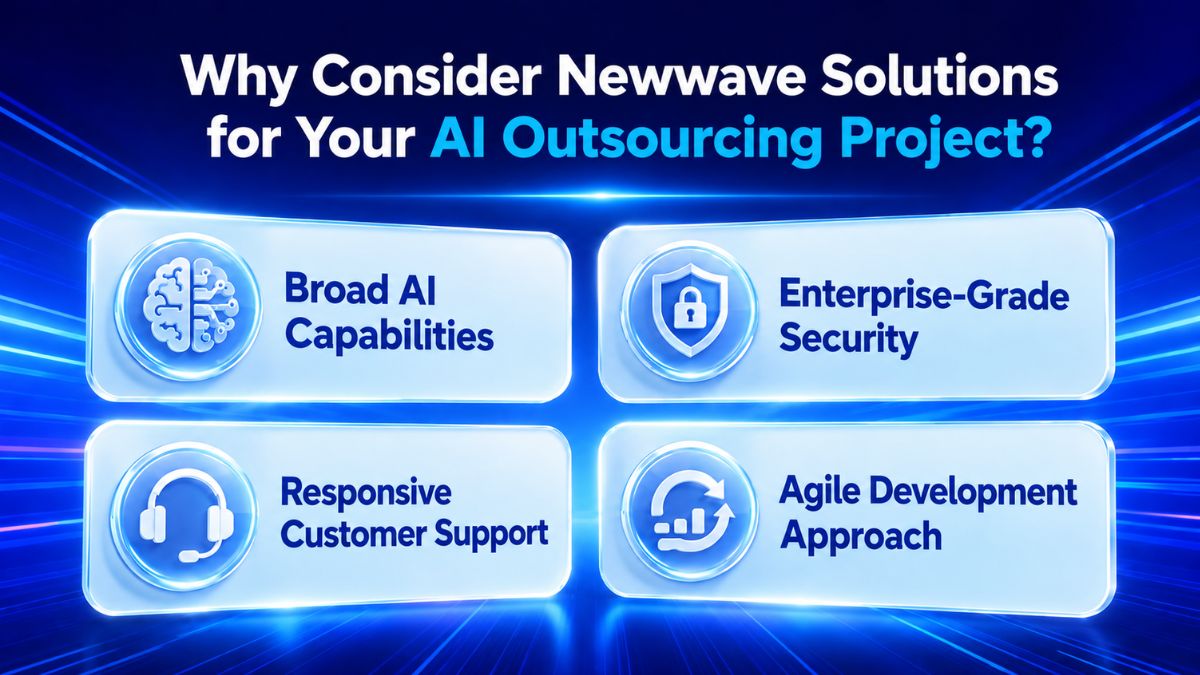
Why consider Newwave Solutions for your AI outsourcing project?
- Broad AI capabilities: Newwave Solutions works across machine learning, RPA, NLP, computer vision, document intelligence, generative AI, and other AI technologies, allowing solutions to be tailored to different automation, analytics, and business intelligence needs.
- Enterprise-grade security: Our commitment to ISO 27001 and the use of NDAs provide a structured approach to protecting project data and sensitive information throughout AI development.
- Responsive customer support: Prompt support and clear communication are built into our service approach, helping clients stay informed and engaged throughout the outsourcing relationship.
- Agile development approach: Newwave Solutions uses Agile methods to support incremental development, transparent progress monitoring, and faster adaptation when project requirements evolve.
Contact our team now to discuss your requirements and develop an AI solution aligned with your business goals.
Final Thought: Is AI Outsourcing the Right Move for Your Business?
AI outsourcing offers businesses another path to building AI capabilities when developing and maintaining everything in-house is not the preferred approach. The decision should focus on whether outsourcing can provide the expertise, delivery model, and long-term support needed to turn an AI initiative into sustainable business value.
The right engagement begins with well-defined objectives and clear expectations between your business and the external team. If outsourcing fits those priorities, Newwave Solutions can help shape the project, develop the solution, and support its evolution after deployment, giving your business a structured path from AI requirements to implementation.
Talk to our AI experts to discuss your outsourcing goals, evaluate the right engagement model, and identify the next steps for your AI project.
FAQs
1. How much does AI outsourcing typically cost?
AI outsourcing costs vary by project complexity, data readiness, and vendor location. A PoC typically costs $30,000–$80,000, full development can range from $100,000–$500,000+, and dedicated teams may cost $15,000–$40,000 per month. The initial build often represents only 30–40% of first-year total cost of ownership once monitoring, retraining, and infrastructure are included.
2. What is the typical timeline for an outsourced AI project?
An outsourced AI project often begins with a 6–12-week discovery and PoC phase to validate feasibility and data readiness. Development time then depends on project scope, followed by a 4–8-week transition and handover period for documentation, knowledge transfer, and supervised operation.
3. What are the risks of AI outsourcing?
Key risks include data privacy and security issues, integration difficulties, remote collaboration challenges, limited project oversight, and choosing a vendor without the right expertise. These risks can be reduced through strong data governance, clear communication, defined KPIs, compatible system architecture, and transparent vendor accountability.
4. Should I outsource AI or build an in-house team?
AI outsourcing can make sense when faster delivery and access to specialized expertise are more important than building those capabilities internally from the start. An in-house approach may provide greater internal ownership, while outsourcing can avoid the time required to recruit and ramp a specialized team, so the decision should reflect your existing capabilities and long-term operating model.
5. What to evaluate in an AI outsourcing partner?
Evaluate the provider’s proven AI expertise, relevant industry experience, security practices, communication approach, and ability to integrate with your existing systems. You should also clarify project ownership, performance reporting, knowledge transfer, and whether your internal team will be able to maintain and extend the solution after handover.
To Quang Duy is the CEO of Newwave Solutions, a leading Vietnamese software company. He is recognized as a standout technology consultant. Connect with him on LinkedIn and Twitter.



Read More Guides
Get stories in your inbox twice a month.
Let’s Build Something Extraordinary
Sign up for a 30 min no-obligation strategic session with us. Transform your Ideas into scalable reality.
Leave a Reply