


Blockchain Cost: A Strategic Guide to Budgeting Your Development Project
Understanding the blockchain cost when development is a critical first step in evaluating its ROI. However, getting a straightforward answer to “how much does it cost to build a blockchain application?” is challenging, as costs are influenced by a complex mix of technical decisions, project scope, and team structure. This guide cuts through the complexity. We provide a transparent, detailed breakdown of the factors that shape your investment, from initial discovery to long-term maintenance. Whether you’re exploring a new blockchain app development cost or seeking to implement blockchain in your existing operations, this resource will equip you with the knowledge to plan your budget confidently and partner effectively with top companies for blockchain development.
Which Main Factors Affect Blockchain Development Cost?
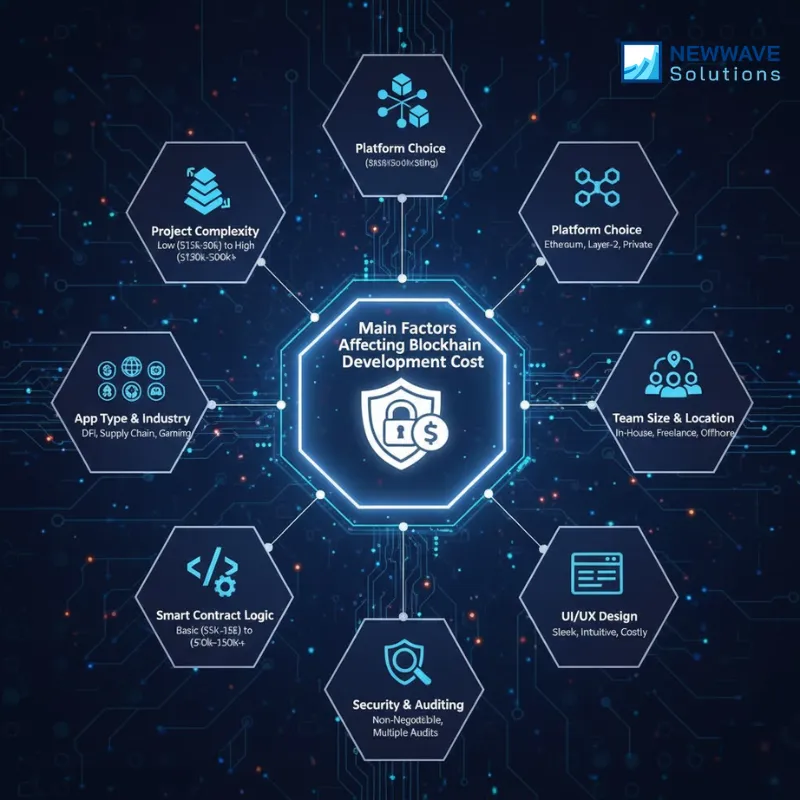
Before allocating a budget for your blockchain initiative, it’s crucial to understand that blockchain development cost is not a single number but a variable outcome of several interconnected decisions. From the technical foundation you choose to the team that builds it, each factor plays a significant role in determining the final investment required to build a blockchain application. Below, we break down the seven core criteria that directly answer the question: How much does it cost to implement blockchain?
Project Complexity
The scope and sophistication of your project are the most significant cost drivers. A simple proof-of-concept has vastly different requirements than a full-scale enterprise platform.
- Low Complexity: Basic smart contracts, simple tokens. Cost: $15,000 – $50,000.
- Medium Complexity: NFT marketplaces, staking dApps. Cost: $50,000 – $150,000.
- High Complexity: DeFi protocols, complex supply chains. Cost: $150,000 – $500,000+.
Blockchain Platform Choice
Your choice of foundation affects both initial development and long-term operational expenses like gas fees.
- Ethereum: High security, established ecosystem, but can have high gas fees.
- Layer-2 Solutions (Polygon, Arbitrum): Lower fees, faster transactions, ideal for most new projects.
- Private Blockchains (Hyperledger): Higher initial cost, full control, no gas fees, suited for enterprise consortia.
App Type & Industry
The specific application you are building and its industry vertical set the baseline for features, compliance, and security needs.
- Finance/DeFi: Highest complexity due to stringent security and economic modeling.
- Supply Chain: Moderate to high complexity, focusing on traceability and IoT integration.
- Gaming/NFTs: Variable complexity, driven by in-game economies and asset ownership models.
Team Size & Location
The composition and geography of your development team are a primary budget component. Partnering with a firm specializing in offshore development Vietnam can offer significant cost savings without compromising quality.
- In-House Team: Highest cost, maximum control.
- Freelancers: Lower cost, but higher management overhead and potential reliability issues.
- Dedicated Offshore Team: The optimal balance of cost, control, and talent quality.
Smart Contract Complexity
The business logic encoded in your smart contracts directly impacts development time and the critical cost of security audits.
- Basic: Standard tokens, simple logic. Audit cost: $5,000 – $15,000.
- Intermediate: Custom logic, handles user funds. Audit cost: $15,000 – $50,000.
- Advanced: Complex protocols, novel economics. Audit cost: $50,000 – $150,000+.
UI/UX Design
The user interface is the gateway to your dApp. A sleek, intuitive design for complex on-chain interactions requires significant effort and investment, directly influencing user adoption and the overall blockchain app development cost.
Security & Auditing
A non-negotiable expense, especially for applications handling value. Professional smart contract audits are a core part of the cost of blockchain development, not an optional add-on. For serious projects, multiple audits from reputable firms are standard practice.
Blockchain Cost Breakdown by Development Stage
Understanding how your budget is allocated across the development lifecycle is crucial for financial planning and project management. A structured approach to blockchain development solutions ensures that each phase receives appropriate investment, minimizing risks and avoiding costly rework. Here’s how the blockchain development cost typically distributes across key stages of the SDLC:
| Stage | Typical Cost Allocation | Key Activities & Deliverables |
|---|---|---|
| Discovery & Planning | 5% – 10% | Technical feasibility, requirement analysis, project scoping, architecture design, and creating a detailed project roadmap. |
| UI/UX Design | 10% – 15% | Designing wireframes, mockups, and a user-friendly interface for the dApp. Critical for user adoption and engagement. |
| Core Development | 40% – 50% | The most resource-intensive phase involving smart contract coding, frontend/backend development, and blockchain integration. |
| Testing & Auditing | 15% – 25% | Comprehensive QA, penetration testing, and professional smart contract audits to ensure security and functionality. |
| Deployment & Launch | 5% – 10% | Covering gas fees for contract deployment, node setup, app store launches, and initial network configuration. |
| Maintenance & Support | 5%+ (ongoing) | Ongoing bug fixes, updates, customer support, and infrastructure monitoring (typically as a monthly retainer). |
This breakdown highlights why partnering with experienced top companies for blockchain development is crucial – they understand how to optimize spending at each stage while maintaining quality and security standards.
Blockchain Cost Estimate Based on Different Blockchain Platform Choices
The selection of a blockchain platform is one of the most fundamental technical decisions that directly impacts your project’s capabilities, performance, and overall blockchain development cost. Each platform offers distinct trade-offs between decentralization, scalability, security, and transaction costs. Understanding these differences is crucial when evaluating how much does it cost to build a blockchain application that meets your specific business needs.
Ethereum: The Established Pioneer
As the most established smart contract platform, Ethereum offers the largest developer ecosystem and highest security assurance, but this comes with significant cost considerations.
- Development Cost: High ($80,000 – $500,000+)
- Gas Fees: Very High ($10 – $500+ per complex transaction)
- Developer Availability: Extensive talent pool
- Best For: Applications requiring maximum security and decentralization, DeFi protocols, projects where ecosystem size outweighs cost concerns
- Considerations: Mainnet deployment costs can be substantial, making Ethereum prohibitive for small projects without Layer-2 solutions
Polygon & Other Layer-2 Solutions: The Cost-Effective Alternative
Layer-2 solutions built on Ethereum provide a balance between Ethereum’s security and affordable transaction costs.
- Development Cost: Medium ($50,000 – $300,000)
- Gas Fees: Very Low ($0.01 – $0.50 per transaction)
- Developer Availability: Good, with growing ecosystem
- Best For: Most new projects, NFT marketplaces, gaming dApps, businesses seeking Ethereum compatibility with lower costs
- Considerations: Slightly reduced security compared to Ethereum mainnet, but dramatically improved user experience due to low fees
Solana: The High-Performance Contender
Solana’s high throughput and low fees make it attractive for applications requiring fast, cheap transactions.
- Development Cost: Medium ($60,000 – $350,000)
- Gas Fees: Very Low ($0.00001 – $0.001 per transaction)
- Developer Availability: Growing rapidly, but smaller than Ethereum’s
- Best For: High-frequency trading, gaming, social media dApps, applications requiring sub-second finality
- Considerations: Different programming model (Rust), younger ecosystem, has experienced network outages
Hyperledger Fabric & Enterprise Solutions: The Private Option
For businesses requiring complete control and privacy, private blockchain solutions offer a different approach to blockchain development solutions.
- Development Cost: High ($100,000 – $500,000+)
- Gas Fees: None (private network)
- Developer Availability: Specialized, enterprise-focused talent
- Best For: Supply chain management, inter-company data sharing, regulated industries, applications requiring permissioned access
- Considerations: Higher initial investment but predictable ongoing costs, no native cryptocurrency required
The platform choice represents a fundamental trade-off between cost, security, and performance. Many successful projects adopt a multi-chain strategy, leveraging different platforms for different aspects of their blockchain app development cost optimization.
Blockchain Cost Estimate Based on Blockchain App Types
The type of application you choose to build fundamentally shapes your budget, timeline, and resource requirements. Different blockchain applications come with inherent complexities and feature sets that have different level of cost. Here’s a detailed breakdown of common blockchain development solutions and their associated costs:
| App Type | Estimated Cost Range | ETA | Common Features Included |
|---|---|---|---|
| Basic Token (ERC-20, BEP-20) | $5,000 – $15,000 | 2-4 weeks | Token creation, transfers, balance checks, basic wallet integration. Ideal for MVP development. |
| Crypto Wallet | $25,000 – $80,000 | 3-5 months | Multi-currency support, send/receive functions, transaction history, secure key management. |
| NFT Marketplace | $45,000 – $200,000+ | 3-6 months | Minting, trading, auctions, royalty system, wallet integration, and advanced filters. |
| DeFi Staking/Farming Platform | $50,000 – $150,000 | 4-8 months | Staking pools, reward distribution, liquidity provisioning, dashboard analytics, and smart contract audits. |
| Supply Chain Solution | $90,000 – $300,000+ | 6-9+ months | Product tracking, IoT integration, private permissions, stakeholder dashboards, and audit trails. |
This table demonstrates that the blockchain app development cost varies significantly based on the features and security requirements. A simple token implementation serves as an excellent entry point into blockchain technology, while complex supply chain or DeFi applications represent more significant investments in emerging technology software solutions.
Blockchain Cost Estimate Based on Smart Contract Complexity
Smart contracts form the operational backbone of any blockchain application, and their complexity is arguably the most significant technical factor influencing your blockchain development cost. The sophistication of your business logic, the number of interactions between contracts, and the security requirements all contribute to the final price tag when you build a blockchain application.
Basic & Standardized Contracts
These contracts utilize well-established patterns and minimal custom logic, making them the most affordable option for businesses exploring blockchain technology.
- Cost Range: $5,000 – $20,000
- Key Characteristics: Uses audited standards like OpenZeppelin, simple readable logic, few functions
- Examples: Simple ERC-20 tokens, basic NFT minting contracts, straightforward vesting wallets
- Audit Requirements: Light review or automated tools ($2,000 – $5,000)
- Development Time: 1-3 weeks
Intermediate & Custom Logic Contracts
This tier introduces custom business logic, multiple contract interactions, and handling of user funds, significantly increasing both development and security requirements.
- Cost Range: $25,000 – $80,000
- Key Characteristics: Custom business logic, interaction with other protocols, management of user funds
- Examples: Staking dApps, token sale mechanisms, basic DEX functionality, multi-signature wallets
- Audit Requirements: Professional audit mandatory ($10,000 – $30,000)
- Development Time: 4-8 weeks
Advanced & Complex Protocol Contracts
These sophisticated systems represent the highest level of complexity, comprising multiple interconnected contracts that form the foundation for protocols requiring maximum security and reliability.
- Cost Range: $100,000 – $300,000+
- Key Characteristics: Suite of interconnected contracts, novel economic mechanics, intensive gas optimization
- Examples: Lending/borrowing protocols, advanced DEX with limit orders, cross-chain bridges, complex DAOs
- Audit Requirements: Multiple rigorous audits ($50,000 – $150,000+)
- Development Time: 12-20+ weeks
| Smart Contract Complexity Tier | Development Cost | Audit Cost | Total Estimated Cost |
|---|---|---|---|
| Basic | $5,000 – $15,000 | $2,000 – $5,000 | $7,000 – $20,000 |
| Intermediate | $15,000 – $50,000 | $10,000 – $30,000 | $25,000 – $80,000 |
| Advanced | $50,000 – $150,000 | $50,000 – $150,000 | $100,000 – $300,000+ |
It’s crucial to note that for any contract handling value (Intermediate and Advanced tiers), the audit cost is not optional—it’s a fundamental component of your blockchain development cost. Many projects utilize proxy patterns for upgradeability, allowing for future improvements without complete redeployment, which represents a strategic approach to managing long-term blockchain app development cost.
How Much for Hiring Outsourced Blockchain Developers?
The talent you choose to build your blockchain solution represents one of the largest portions of your overall blockchain development cost. When considering how to implement blockchain in your organization, understanding the various hiring models and their associated costs is crucial for making an informed decision that balances quality, control, and budget.
Freelance Developers: The Flexible Option
Freelancers offer maximum flexibility but come with significant management overhead and potential reliability concerns for complex projects.
- Cost Range: $30 – $80/hour
- Best For: Small, well-defined tasks or proof-of-concepts
- Pros: Low commitment, flexible engagement
- Cons: High management overhead, variable quality, potential reliability issues
- Total Project Impact: May seem cheaper initially but can lead to higher costs due to rework and coordination challenges
Project-Based Agencies: The Full-Service Solution
Agencies provide comprehensive services but typically come with premium pricing that significantly impacts your blockchain app development cost.
- Cost Range: $80 – $150+/hour
- Best For: Companies wanting turnkey solutions with fixed project scope
- Pros: Full-service team, established processes, reduced management overhead
- Cons: Highest cost model, potential for less flexibility in project evolution
- Total Project Impact: Predictable costs but often the most expensive option for medium to large projects
Dedicated Offshore Teams: The Optimal Balance
This model, particularly through offshore development Vietnam, offers the best balance of cost efficiency and quality for businesses seeking sustainable blockchain development solutions.
- Cost Range: $35 – $70/hour
- Best For: Most businesses seeking quality and cost efficiency for sustained projects
- Pros: Optimal cost-quality ratio, high control, scalable team size
- Cons: Requires some management coordination, time zone considerations
- Total Project Impact: Significant cost savings (40-60% compared to Western rates) while maintaining high quality standards
Regional Cost Comparison (Senior Blockchain Developer Rates):
| Region | Hourly Rate | Monthly Full-Time Cost | Annual Salary Equivalent |
|---|---|---|---|
| North America | $100 – $200+ | $16,000 – $32,000+ | $150,000 – $250,000+ |
| Western Europe | $80 – $150 | $12,800 – $24,000 | $120,000 – $180,000 |
| Eastern Europe | $50 – $100 | $8,000 – $16,000 | $80,000 – $120,000 |
| Vietnam | $35 – $70 | $5,600 – $11,200 | $35,000 – $70,000 |
The choice of hiring model directly impacts not only your immediate cost of blockchain development but also the long-term maintainability and scalability of your solution. Many top companies for blockchain development now provide hire developer services with leverage dedicated offshore teams to access top-tier talent while optimizing their development budgets.
The Hidden Fees
While most businesses focus on the direct development costs, many projects exceed their budget due to overlooked or underestimated ancillary expenses. These hidden fees can significantly impact your total blockchain development cost and often catch organizations by surprise. Being aware of these potential cost drivers is essential when planning to implement blockchain in your operations.
Gas Fees: The Silent Budget Drain
Gas fees represent one of the most substantial and unpredictable hidden costs in blockchain development, particularly on networks like Ethereum.
- Deployment Costs: $5,000 – $15,000+ for complex smart contract deployments
- Ongoing Transaction Fees: $0.50 – $500+ per user interaction depending on network congestion
- Testing Environment Costs: While testnets are free, comprehensive mainnet testing can cost thousands
- Mitigation Strategy: Consider Layer-2 solutions, optimize contract code, and budget for network congestion periods
Infrastructure & Third-Party Services
Beyond core development, various infrastructure components contribute to the ongoing blockchain app development cost.
- Node Operation: $200 – $2,000/month for reliable node infrastructure or managed services
- Decentralized Storage: $100 – $1,000/month for IPFS/Filecoin storage depending on data volume
- Oracle Services: $500 – $5,000/month for real-world data feeds (e.g., Chainlink)
- API development Services: $200 – $2,000/month for blockchain data APIs and analytics platforms
Post-Launch Maintenance & Support
Many organizations underestimate the ongoing costs required to maintain a blockchain application after launch.
- Technical Support: $2,000 – $10,000+/month for dedicated support teams
- Regular Updates: $5,000 – $25,000 per major update or protocol upgrade
- Monitoring Tools: $500 – $2,000/month for performance and security monitoring
- Backup & Recovery: $1,000 – $5,000/month for comprehensive data protection
Compliance & Legal Considerations
Regulatory requirements can introduce significant unexpected costs to your blockchain development solutions.
- Legal Consultation: $5,000 – $20,000+ for regulatory compliance assessment
- KYC/AML Integration: $10,000 – $50,000 for compliant identity verification systems
- Licensing Fees: $10,000 – $100,000+ for necessary operational licenses
- Audit & Reporting: $5,000 – $25,000 annually for compliance auditing
Unexpected Technical Debt
Rushed development decisions can lead to technical debt that becomes expensive to address later.
- Code Refactoring: $10,000 – $50,000 for poorly architected systems
- Security Patching: $5,000 – $25,000 for vulnerability remediation
- Performance Optimization: $10,000 – $40,000 for scaling-related improvements
- Migration Costs: $15,000 – $75,000+ for platform or protocol migrations
Understanding these hidden fees is crucial for accurate budgeting and prevents the common scenario where the initial cost to build a blockchain application is dramatically underestimated. Proper planning and working with experienced top companies for blockchain development can help identify and mitigate these potential cost overruns early in the project lifecycle.
How to Save Cost for Blockchain Development Project?
Implementing blockchain technology doesn’t have to break your budget. With strategic planning and smart decision-making, you can significantly optimize your blockchain development cost while maintaining quality and security standards. Here are proven strategies to maximize your return on investment:
Start with an MVP Approach
Building a Minimum Viable Product allows you to validate your core concept while minimizing initial investment.
Cost Reduction: 40-60% compared to full-scale development
Key Benefits:
- Test market demand with real users
- Secure early feedback for iterative improvement
- Attract investors with a working prototype
- Focus resources on core features that deliver value
Implementation: Identify the essential features that solve your primary business problem and build those first through MVP development
Choose the Right Blockchain Platform
Selecting an appropriate foundation can dramatically impact both initial and ongoing costs.
Cost-Saving Strategies:
- Use Layer-2 solutions (Polygon, Arbitrum) for Ethereum-compatible apps with lower fees
- Consider alternative Layer-1 platforms (Solana, BSC) for high-throughput requirements
- Evaluate private blockchains for enterprise applications where public transparency isn’t required
- Leverage established ecosystems to avoid reinventing common components
Optimize Team Structure and Location
Strategic resource allocation is one of the most effective ways to manage your blockchain app development cost.
Proven Approaches:
- Partner with offshore development Vietnam for quality talent at competitive rates
- Hire a dedicated team rather than individual freelancers for better coordination
- Combine senior architects with mid-level developers for optimal knowledge transfer
- Use agile methodologies to maintain flexibility and control over development pace
Leverage Established Tools and Frameworks
Building on existing, audited code bases reduces development time and security risks.
Key Resources:
- OpenZeppelin Contracts for secure, standard smart contract components
- Hardhat or Truffle for development and testing environments
- IPFS/Filecoin for decentralized storage solutions
- The Graph for efficient blockchain data indexing
Implement Phased Development
Break your project into manageable phases with clear deliverables and budget allocations.
Sample Phasing Strategy:
- Phase 1: Core smart contracts and basic UI ($50,000-$80,000)
- Phase 2: Advanced features and user testing ($30,000-$50,000)
- Phase 3: Scaling optimizations and additional features ($20,000-$40,000)
- Phase 4: Enterprise integrations and advanced analytics ($25,000-$45,000)
Smart Contract Optimization
Efficient contract design reduces both development time and long-term operational costs.
Optimization Techniques:
- Use proxy patterns for upgradeability to avoid redeployment costs
- Optimize gas usage through efficient coding practices
- Implement modular architecture for easier maintenance and updates
- Schedule audits at appropriate stages rather than one massive final audit
By implementing these strategies, businesses can typically reduce their overall cost of blockchain development by 30-50% while maintaining high-quality standards. The key is to work with experienced partners who understand how to balance cost optimization with technical excellence in blockchain development solutions.
So, How Much Does It Cost to Build a Blockchain?
As we’ve detailed, the final figure is a composite of your platform choice, app complexity, team structure, and operational overhead. For a simple token, costs might start around $5,000, while a complex, custom enterprise solution can easily reach $500,000 or more. A typical medium-complexity dApp, such as a staking platform or an NFT marketplace, often falls in the $50,000 to $150,000 range.
Navigating this complex cost landscape requires a partner who can provide clarity and value. This is where Newwave Solutions delivers.
At Newwave Solutions, we demystify blockchain development cost for our clients. Our journey began with a strong foundation in enterprise-grade Java development, instilling in us a deep-seated discipline for robust, scalable, and secure architecture—a principle we carry into all our emerging technology software solutions. This engineering rigor is the bedrock of our blockchain development solutions.
We understand that every business has unique needs. That’s why we begin with a thorough consultation to understand your goals, followed by a transparent, detailed proposal that breaks down the cost to implement blockchain for your specific use case. Our team in Vietnam offers the perfect synergy of high-quality emerging technology software solutions and competitive rates, ensuring you receive exceptional value without compromising on quality throughout the entire SDLC.
Let us help you transform your vision into a secure, scalable, and cost-effective blockchain reality.
Ready to get a precise estimate for your project? Contact Newwave Solutions today for a free, no-obligation consultation. We’ll analyze your requirements and provide a clear roadmap for how much does it cost to implement blockchain in your business, leveraging our expertise to deliver a solution that drives your success.
To Quang Duy is the CEO of Newwave Solutions, a leading Vietnamese software company. He is recognized as a standout technology consultant. Connect with him on LinkedIn and Twitter.



Read More Guides
Get stories in your inbox twice a month.
Let’s Connect
Let us know what you need, and out professionals will collaborate with you to find a solution that enables growth.
Leave a Reply