


Custom eCommerce Development: Benefits, Steps & Common Mistakes
The rapid explosion of eCommerce has created an immense demand for businesses to launch their own online stores or platforms. Custom eCommerce development has become increasingly popular as it allows companies to tailor features, services, and products specifically to their unique needs and preferences.
For businesses planning to move beyond off-the-shelf eCommerce platforms and build truly customized solutions, this article offers comprehensive information on benefits, development processes, costs, and key considerations. Make sure you read till the end to equip the essential knowledge to approach custom eCommerce development confidently.
What is Custom eCommerce Development?
Custom eCommerce development is the process of building an online store or commerce platform from scratch (or with heavy customization) so that it matches precisely a business’s unique needs, workflows, branding, and customer-experience requirements. Unlike ready-made eCommerce templates or off-the-shelf platforms, custom development gives full control over UI/UX, backend logic, integrations, performance, and scalability — which allows companies to differentiate and optimize for their target market.
Example:
A global retailer — Amazon — invested in custom ecommerce development to build its multi-vendor marketplace and global storefront systems; this bespoke infrastructure enables Amazon to support an enormous product catalog, deliver personalized customer experiences, integrate complex logistics and payment flows, and maintain performance at massive traffic volumes.

The Benefits of Custom eCommerce Development
Custom eCommerce development offers several advantages over using pre-built eCommerce platforms. Let’s explore some of the key benefits:
1. Scalability
Custom eCommerce solutions can be built to scale as your business grows. You have the flexibility to add new features, functionalities, and integrations to meet the evolving needs of your business.
2. Enhanced UX
Tailoring the user interface and user experience (UI/UX) to fit your target audience can significantly improve customer satisfaction and conversion rates. You can create a seamless and personalized shopping experience that reflects your brand identity.
3. Integration Capabilities
Custom eCommerce platforms allow for seamless integration with third-party tools and services such as payment gateways, inventory management systems, shipping providers, and marketing automation tools. This enables you to streamline your operations and provide a smoother customer journey.
4. Optimized Performance
Custom eCommerce solutions are optimized for performance, ensuring faster page load times, improved website speed, and enhanced overall performance. This is crucial for reducing bounce rates and improving search engine rankings.
5. Better Security
As cyber threats continue to evolve, having a secure online store is of utmost importance. Custom eCommerce development allows you to implement robust security measures and ensure the safety of your customers’ sensitive information.
Main Types of Custom eCommerce Development
Since custom ecommerce development can be highly varied depending on business goals and requirements, below are the main types of custom eCommerce solutions — along with when they make the most sense and what their primary impact is.
1. B2C Retail Online Stores
This solution is tailored for businesses selling directly to end-customers (consumers), providing a polished, brand-centric online store that emphasizes user experience, ease of purchase, and responsive design. This type suits retail brands that want to create a strong brand identity, deliver high-quality UX across devices, and build direct relationships with customers rather than relying on third-party marketplaces. The main impact is enhanced conversion rates, customer loyalty, and brand equity thanks to a user-friendly and on-brand shopping experience.

2. B2B eCommerce Platforms
This type of custom solution caters to businesses selling wholesale or supplying other businesses, often requiring features like user-role management, tiered pricing, bulk orders, custom catalogs, and account-based ordering workflows. B2B platforms are appropriate when your customers are other businesses or enterprises rather than individuals. The primary impact is streamlined ordering and management, better control over business customers’ requirements, and scalability to support large-volume or repeated orders.
3. Multi-Vendor Marketplace / Drop-shipping Platforms
This custom development approach builds a platform where multiple sellers/vendors can list products, manage inventory, and sell through a single storefront — effectively functioning as a marketplace rather than a single store. This solution is suitable for businesses that want to host many vendors (for example, aggregated marketplaces or platforms supporting drop-shipping). The key impact is enabling a diverse product range, scaling vendor participation without managing inventory directly, and facilitating marketplace-style commerce with shared infrastructure.
4. Subscription & Membership Stores
This solution offers custom support for subscription-based services or membership models — including recurring billing, user dashboards, membership tiers, renewals, content or product delivery scheduling, and access management. This type works well for businesses offering subscription boxes, recurring services, or membership-based access. The outcome is steady recurring revenue, improved customer retention, and easier management of subscription logic tailored to business needs.
5. Omnichannel / Headless Commerce Stores
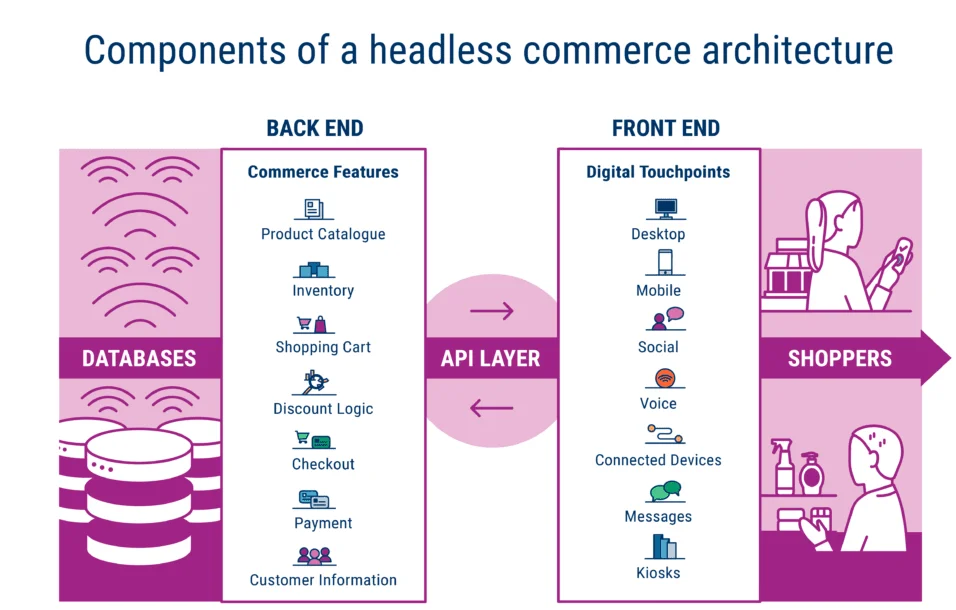
This custom solution separates backend (commerce logic, data, APIs) from frontend presentation, enabling multiple frontends (web, mobile, app, POS systems) to use the same backend — ideal for businesses needing presence across channels. This type suits companies that want flexibility in how customers interact (web, mobile, in-store, app) while maintaining a unified backend infrastructure. The main benefit is consistent data and business logic, easier expansion to new channels, and better flexibility for UX across platforms.
Detailed Steps to Custom eCommerce Development
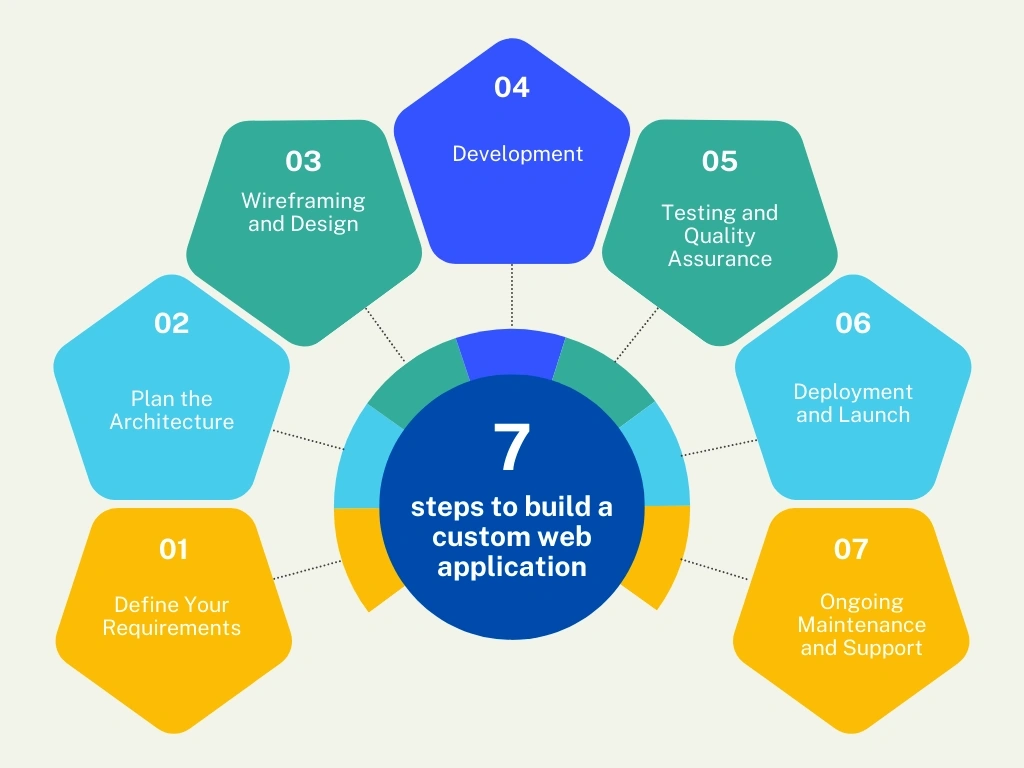
Step 1: Requirements Gathering & Business Analysis
In this step, stakeholders — including business owners, product managers, and potential end-users — collaborate to capture all functional and non-functional requirements, business workflows, user roles, and integration needs. The goal is to define what the eCommerce solution must accomplish, what constraints exist (e.g., security, compliance, performance), and what differentiating features are required. Clear documentation and alignment at this stage are critical to avoid misunderstandings and scope creep later in development.
Step 2: Architecture & Solution Design
Once requirements are set, software architects and system designers plan the overall system architecture — including data models, backend services, APIs, integrations, scalability, and security considerations. This design phase ensures that the eCommerce platform can support anticipated load, growth, data handling, and third-party services (payment gateways, shipping, ERP/CRM, etc.). Proper design documentation and review are essential to maintain maintainability and support future extension or scaling.
Step 3: UI/UX & Front-end Design
If your eCommerce project involves a customer-facing interface (website, mobile site, or app), designers create wireframes, mockups, and prototypes to establish user flows, interface layout, branding compliance, and responsive behavior across devices. The design work must reflect brand identity, user experience best practices, mobile-first and accessibility standards, ensuring that customers have an intuitive, seamless shopping journey. Stakeholders should review and approve design deliverables before moving to development to avoid rework or misalignment.
Step 4: Development & Coding
In this phase, developers implement the frontend (if applicable), backend services, database, business logic, payment and shipping integrations, and any custom modules required. The coding should follow best practices, version control, modular structure, and support for future maintenance or scaling. Regular code reviews, alignment with requirements, and close collaboration between frontend and backend teams help ensure quality and accuracy.
Step 5: Testing, QA & Performance Optimization
Quality assurance teams perform functional testing, usability and compatibility testing across devices and browsers, performance/load testing, security audits, and bug fixing. This stage ensures that the store works reliably under expected traffic, delivers a smooth user experience, secures customer data, and supports payment and transaction workflows without errors. It is crucial to include regression and real-world scenario testing before launch, as eCommerce sites face high variability in usage patterns.
Step 6: Deployment & Launch
After successful testing, the application is deployed to production infrastructure — including setting up hosting or cloud environment, configuring databases, security certificates, backups, monitoring, and ensuring integration with payment gateways and other external services. The launch should be carefully planned to minimize downtime, ensure data integrity, and prepare support channels for customer issues or post-launch hiccups. Businesses should also activate analytics, monitoring, and marketing mechanisms at launch to track performance and user behavior.
Step 7: Post-Launch Maintenance & Continuous Improvement
Once live, the eCommerce platform requires ongoing maintenance, including bug fixes, security patches, performance tuning, updates, feature enhancements, and possibly new modules as the business evolves. Continuous monitoring of user behavior, sales performance, load metrics, and system health enables iterative improvements and scaling. This ongoing commitment ensures long-term reliability, adaptability to market changes, and a high-quality user experience as the business grows.
>>> See more: Top 7 Ecommerce Website Development in India
Common Mistakes in Custom eCommerce Website Development
When developing an eCommerce website, there are several common mistakes that should be avoided. These include:
- Poor User Experience: One of the biggest mistakes is not focusing on providing a seamless and user-friendly experience. Complex navigation, slow loading speed, and confusing checkout processes can frustrate customers and lead to high bounce rates.
- Lack of Mobile Optimization: With the increasing use of smartphones and tablets, it is essential to optimize your eCommerce website for mobile devices. Ignoring mobile responsiveness can result in a poor user experience and lost sales.
- Inadequate Product Information: Providing incomplete or inaccurate product information can negatively impact your customers’ confidence in purchasing from your site. It is crucial to provide detailed and accurate product descriptions, specifications, images, and customer reviews.
- Complex Checkout Process: Having a long and complicated checkout process can lead to shopping cart abandonment. Streamlining the checkout process by minimizing steps and offering guest checkout options can help improve conversion rates.
- Insufficient Security Measures: Security is a major concern for eCommerce websites. Failing to implement proper security measures can result in data breaches and loss of customer trust. Implementing SSL certificates, secure payment gateways, and regularly updating software are essential for maintaining a secure website.
- Lack of Customer Support: Providing excellent customer support is crucial in eCommerce. Not having clear contact information or a responsive customer support system can deter customers from making purchases. Offering live chat, email, or phone support can help address customer inquiries and build trust.
- Ignoring SEO Optimization: Without a well-implemented SEO strategy, your eCommerce website may struggle to rank well in search engine results. Ignoring SEO practices such as keyword optimization, meta tags, and quality content can limit your website’s visibility and organic traffic
Cost & Time Factors in Custom eCommerce Development
1. Cost Factors
- Feature complexity & functionality scope: The more advanced features you need — such as multi-currency support, complex product configuration, custom checkout flows, or advanced search/filtering — the higher the cost will be. Custom features require more development time and testing, which drives up overall expenses.
- Third-party integrations: Integration with payment gateways, shipping providers, ERP/CRM systems, or other external services adds to cost because each integration requires development, testing, and maintenance.
- Number of products, users, and expected load (scale/performance requirements): Stores with large product catalogs, high traffic, or many users need more robust architecture, hosting, and optimization — these requirements increase development and infrastructure cost.
- Custom UI/UX design and branding: A bespoke design aligned with brand identity (rather than using standard templates) increases cost because design work (wireframes, mockups, responsive layouts) and front-end development demand more effort and expertise.
- Security, compliance, and performance optimization: If your eCommerce site must comply with security standards (e.g., PCI-DSS), implement advanced security, or support high performance (load balancing, caching, CDN), these add to both initial development cost and ongoing maintenance.
2. Time Factors
- Project scope and complexity: A simple store with a basic catalog, cart, checkout, and no complex integrations can take a few weeks. Meanwhile, a complex custom eCommerce platform with many features, integrations, and scalability will require several months.
- Feature set and custom functionality: The more custom logic, integrations, and unique features you require (custom payments, dynamic pricing, personalized UX), the longer the development and testing phases will be.
- Design and review cycles (UI/UX, feedback, iterations): When design is custom and brand-specific, multiple review loops, prototype testing, and adjustments take additional time before development begins.
- Testing, QA, and performance/security validation: Thorough testing — functional, security, load/performance, cross-device/browser — adds to total time, especially for enterprise-grade or high-traffic stores.
- Deployment, integration, and pre-launch preparation: Setting up hosting, domain, SSL, payment gateways, integrations, data migration, backups, and preparing for launch adds further time before going live.
Although a custom eCommerce solution typically involves higher upfront costs and longer development time, the investment often pays off over time because a well-built custom store may reduce total cost of ownership, allow easier scaling, and deliver better ROI — especially for larger or fast-growing businesses.
How to Choose the Right Custom eCommerce Development Company
Developing a custom eCommerce site can be complex, resource-intensive, and demanding — especially for businesses without prior experience. For new or inexperienced companies, outsourcing to dedicated custom eCommerce web development services or companies becomes a reasonable choice because such partners can handle everything from initial idea and planning through to launch and long-term support. However, selecting the right partner is critical, since many providers offer similar services.
Below are key criteria to guide your decision:
- Relevant industry experience & portfolio diversity: The company should have proven experience building eCommerce platforms for businesses similar to yours (in size, market, complexity). A strong portfolio reduces risk and demonstrates their ability to deliver.
- Technology stack & integration capabilities: The agency’s technical skills must align with your platform requirements — e.g. payment gateways, ERP/CRM integrations, security standards, scalability needs. This ensures seamless integration and long-term maintainability.
- UI/UX design and customization support: Good design quality matters for conversion and brand identity — the company should provide custom design, responsive layouts, mobile optimization, and usability focus rather than relying on generic templates.
- Quality assurance, security practices & post-launch support: Robust QA, security, performance optimization, and commitment to maintenance or updates post-launch are essential for reliability and long-term success.
- Transparent pricing & clear project management process: The vendor should offer clear cost breakdowns (features, integrations, maintenance), transparent timelines, milestones, and communication to avoid scope creep and unexpected costs.
- Scalability and future-proofing capability: The partner must design an architecture that can scale with growing traffic, products, or features — ensuring that your store can evolve as the business grows.

If you find the above criteria overwhelming to evaluate, you can check our latest blog post listing the top 5 eCommerce development companies to quickly review and compare reputable service providers on the market.
Final Words
Custom eCommerce development provides businesses with the flexibility, scalability, and control they need to create a successful online store. By following the steps outlined in this guide, you can ensure that your custom eCommerce platform is tailored to meet your specific business requirements while providing an exceptional user experience for your customers.
In case you are not familiar with the process yet, investing in a custom eCommerce development company like Newwave Solutions can help you unlock the full potential of your online business and achieve sustainable growth and success.
With over 14 years of experience and a dedicated team of more than 300 professionals, Newwave Solutions is proudly among the best IT outsourcing companies that provide professional eCommerce development services to global users/ enterprises. Our experienced developers, software engineers, QA testers, etc., work together to deliver you the full custom eCommerce development life cycle, from idea conceptualization to project launching & maintenance.
You can connect with us through various channels as below, and we can start the custom eCommerce journey instantly:
Contact Information:
- Head Office (Hanoi): 1F, 4F, 10F, Mitec Building, Cau Giay Ward, Hanoi City, Vietnam
- Branch Office (Tokyo): 1chōme118 Yushima, Bunkyo City, Tokyo 1130034, Japan
- Hotline: +84 985310203
- Website: https://newwavesolution.com
- Email: [email protected]
To Quang Duy is the CEO of Newwave Solutions, a leading Vietnamese software company. He is recognized as a standout technology consultant. Connect with him on LinkedIn and Twitter.



Read More Guides
Get stories in your inbox twice a month.
Let’s Connect
Let us know what you need, and out professionals will collaborate with you to find a solution that enables growth.
Leave a Reply