


Generative AI in Ecommerce: Use Cases, Costs & Implementation Guide
Generative AI in ecommerce is becoming a major industry shift as businesses look for smarter ways to personalize customer interactions, automate repetitive tasks, and scale digital operations. From content creation to customer support, AI-driven solutions are changing how online commerce is built and managed.
However, integrating generative AI into ecommerce requires more than selecting a powerful model. Businesses need to understand where AI creates real value, what challenges may arise, and how much investment is required for successful adoption. This guide explores AI capabilities, practical use cases, implementation steps, costs, and risks to help organizations build an effective generative AI strategy.
Key Takeaways
|
Growing Role of Generative AI in Ecommerce
The role of generative AI in ecommerce is expanding as online retail moves beyond traditional approaches to meet rising customer expectations. Shoppers increasingly expect personalized experiences, immediate responses, and consistent interactions across different touchpoints. Generative AI ecommerce solutions are helping businesses explore new ways to improve these areas while supporting broader operational goals.
The business impact of adopting generative AI for ecommerce is becoming increasingly visible. According to McKinsey, companies investing in AI have reported a 3% to 15% increase in revenue and a 10% to 20% improvement in sales ROI. However, the value of ecommerce generative AI extends beyond financial metrics, as changing customer behaviors are also accelerating adoption.
71% of consumers want generative AI integrated into their shopping experiences, while 63% consider AI-powered recommendations a major factor influencing their purchasing decisions (Capgemini). These preferences highlight the growing demand for more personalized and AI-supported interactions throughout the shopping journey.

Businesses are also increasing investment in generative AI adoption. McKinsey reports that B2B companies allocate a higher share of their ecommerce budgets to generative AI, ranging from 11% to 25%, compared with B2C companies.
Taken together, these trends show that generative AI is becoming a practical investment for ecommerce businesses looking to respond to changing customer expectations and improve commercial performance.
How Generative AI Works in Ecommerce? Understand Models Behind
Generative AI in ecommerce relies on different AI models, each designed to handle specific types of data and tasks. By combining language, image, and content generation capabilities, these models enable businesses to create personalized experiences, automate processes, and generate valuable content across the customer journey.
- Large Language Models (LLMs): LLMs, such as GPT-4 and Google’s Gemini, are used for natural language generation tasks. They can understand and create human-like text, making them suitable for applications such as customer service conversations and marketing content creation.
- Generative Adversarial Networks (GANs): GANs use two neural networks, a generator and a discriminator, that work together to create realistic outputs. In ecommerce, these models can support visual content creation, including product images and virtual try-on experiences.
- Diffusion Models: Diffusion models are used for generating images and videos by progressively refining random noise into more coherent visual outputs. They support the creation of high-quality visual assets for ecommerce applications.
Benefits of Generative AI in eCommerce
Generative AI in ecommerce is changing how businesses engage customers, optimize operations, and manage digital shopping experiences. By using AI-generated content, recommendations, and automated interactions, companies can create more personalized journeys while improving efficiency across different ecommerce activities.
1. Better customer experiences
Online shoppers increasingly expect relevant recommendations, quick responses, and guidance throughout their purchasing journey. Unlike static product pages or generic search results, generative AI can support conversational interactions, provide product explanations, and help customers make decisions through more natural communication.

Traditional personalization approaches often rely on predefined customer segments, while modern shoppers expect experiences that are more tailored to their individual needs. Generative AI enables businesses to create dynamic recommendations and offers based on customer behavior, context, and intent.
This approach reduces the need for businesses to manually create multiple versions of campaigns while supporting more individualized customer experiences.
2. Improving e-commerce operational efficiency
Ecommerce operations involve many repetitive activities, including catalog creation, customer support responses, campaign content generation, and product tagging. Generative AI can automate these tasks while adapting to new inputs, helping businesses reduce manual workload and accelerate operational workflows.
3. Building more intelligent ecommerce systems
Generative AI is contributing to the shift from traditional online storefronts toward more adaptive commerce platforms. By connecting different business functions with live data, these systems can adjust content, recommendations, and customer interactions based on ongoing customer activity.

Practical Applications of Generative AI Driving the Future of eCommerce
Generative AI in ecommerce is being applied across multiple areas, from customer engagement and content creation to operations and analytics. These applications help businesses create more personalized experiences, automate repetitive processes, and improve decision-making across the ecommerce lifecycle.
Hyper-personalized customer experiences
Generative AI for ecommerce enables businesses to move beyond basic personalization and create shopping experiences tailored to individual customers. AI systems can analyze factors such as browsing behavior, purchase history, and customer preferences to generate personalized recommendations, content, and interfaces.
These capabilities allow ecommerce platforms to present more relevant products and experiences for each shopper. Instead of showing identical recommendations to all users, generative AI can adapt shopping journeys based on customer context and interests.
Real-world example: Amazon uses AI-powered recommendations to provide more contextual product suggestions. Instead of displaying general recommendations, its system can consider factors such as shopping behavior, seasonal trends, and customer interests to create more relevant suggestions.

Automated product descriptions and content generation
Creating product content for large catalogs can require significant time and resources. Generative AI ecommerce tools help automate product description creation by generating detailed listings from basic product information, images, or existing website content.
This application allows sellers to manage product information more efficiently while maintaining consistent content across large numbers of listings. It reduces the need for manual content creation and helps teams focus on higher-value activities.
Real-world example: eBay uses generative AI to automate product description generation, helping the platform manage millions of product listings more efficiently.
Visual search
Generative AI is improving product discovery through visual search capabilities. Customers can upload images or use cameras to find similar products, identify items, and receive product suggestions without relying only on text-based searches.
This makes the shopping process more intuitive, especially when customers may not know the exact words to describe a product. Visual AI tools can also understand product styles, fashion contexts, and compatibility to support more relevant discovery experiences.
Real-world example: Perry Ellis partnered with Syte to use AI solutions for clothing and ecommerce. These visual AI tools help understand fashion contexts, seasonal trends, and style compatibility.

Predictive inventory and supply chain optimization
Generative AI use cases in ecommerce extend to inventory and supply chain management. AI systems can analyze different factors, including historical sales, seasonal patterns, weather forecasts, economic indicators, and social media trends, to support demand forecasting.
These insights help businesses optimize inventory levels, identify when products may need replenishment, and make more informed supply chain decisions. This can help address challenges such as stock shortages or excess inventory.
Real-world example: Walmart uses generative AI to understand customer intent, sessions, and engagement. These insights help adjust inventory levels to avoid stockouts and reduce excess stock.
Intelligent customer support
Generative AI is transforming ecommerce customer service through AI-powered assistants that can better understand customer requests compared with traditional chatbots. These systems can interpret customer intent, rephrase questions, learn from previous conversations, and operate across different platforms.
This enables businesses to provide continuous customer support while helping human teams manage customer interactions more effectively.
Real-world example: DoorDash developed an AI system that reduced agent transfers and improved first-contact resolution. This helped improve customer service efficiency and reduce operational costs.

Hyper-targeted marketing campaigns
Generative AI in ecommerce marketing helps businesses create more personalized campaigns at scale. Instead of developing one message for all customers, AI can generate customized email content, social media posts, and advertising copy based on customer behavior and preferences.
AI systems can also help determine suitable channels, message formats, and timing based on customer patterns. This allows businesses to create more relevant marketing experiences for different customer segments.
Real-world example: Nike uses personalized content based on audience segmentation to improve engagement and conversion rates. This approach helps the brand create more relevant customer interactions and improve marketing efficiency.
Immersive shopping experiences
Generative AI in retail and ecommerce supports immersive shopping experiences through AR and VR technologies. These experiences allow customers to visualize products before purchasing, helping them make more confident decisions.
Customers can preview furniture in their own spaces, adjust placement and size, or virtually try on apparel using uploaded photos. These experiences create a closer connection between online shopping and physical product interaction.
Real-world example: Wayfair’s Decorify tool uses spatial computing to show how rooms could look in different design styles using its products. Customers can visualize room transformations before making purchases.

Fraud detection and enhanced eCommerce security
As ecommerce transactions continue to grow, businesses face increasing challenges in detecting and preventing online fraud. According to Statista, global ecommerce losses from online payment fraud were estimated at $44 billion in 2024 and are expected to exceed $100 billion by 2029. Traditional fraud detection methods often depend on fixed rules, which can become less effective as fraudulent behaviors change.
Generative AI for ecommerce security provides a more adaptive approach to fraud detection. AI-powered systems can analyze transaction patterns, device information, behavioral biometrics, and typing patterns to identify suspicious activities in real time. These systems continuously learn from transaction data, helping improve their ability to detect emerging fraud patterns while supporting a more secure online payment experience.
Real-world example: PayPal uses AI-powered fraud detection systems to monitor transactions, identify potential risks, and prevent fraudulent activities in real time. This approach helps the platform reduce fraud and provide users with a more secure payment experience.
Creative design and product innovation
Generative AI is opening new possibilities for product development by helping businesses understand what customers need before creating new offerings. AI systems can analyze customer feedback, market trends, and competitor products to identify potential opportunities and support more informed product decisions.
After that, companies can use these AI-generated insights to develop products that better reflect customer expectations and market demand.
Real-world example: Unilever created an interactive diagnostic tool for one of its haircare brands. Customers answer questions about their hair and scalp conditions, and the AI generates personalized profiles and product recommendations based on dermatology knowledge.
Pricing optimization
Pricing decisions in ecommerce often require businesses to consider multiple changing factors. Generative AI can support dynamic pricing strategies through the analysis of customer price sensitivity, inventory availability, seasonal demand, competitor pricing, and other market conditions.
These AI-powered systems can adjust pricing based on business goals such as increasing revenue, managing inventory, or improving market competitiveness while maintaining customer satisfaction.
Real-world example: Uber uses machine learning and AI in its surge pricing model to adjust fares according to real-time supply and demand conditions.

Customer insights and analytics
Generative AI helps ecommerce businesses extract meaningful insights from large amounts of customer and operational data. Instead of requiring extensive manual analysis, AI tools can generate summaries, identify emerging trends, and highlight potential actions for decision-makers.
With faster access to relevant insights, businesses can make more informed decisions across areas such as customer experience, planning, and daily operations.
Real-world example: Netflix uses generative AI to analyze customer preferences and improve its content discovery features.
Steps to Implement Generative AI in eCommerce
Implementing generative AI in ecommerce is easier to manage when businesses start with a focused use case, prepare the right data, and expand only after the initial results are clear. A phased approach can reduce unnecessary complexity and make it easier to track whether the initiative is delivering the intended outcome.
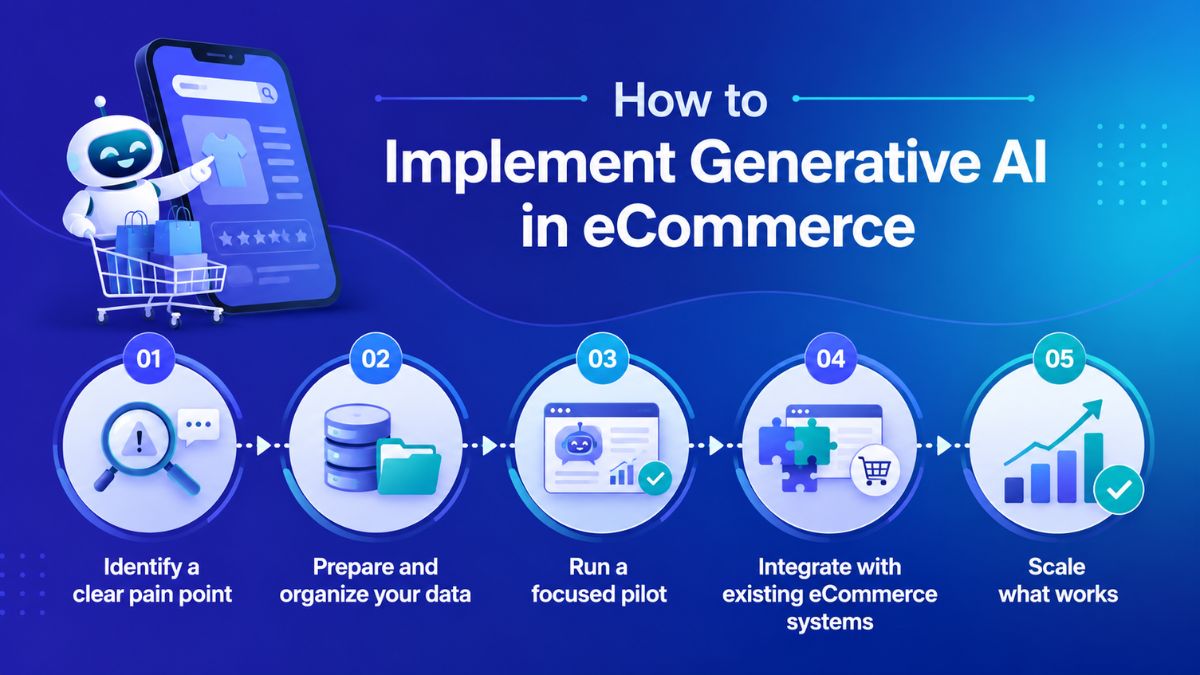
Step 1: Identify a clear pain point
Start with one area where generative AI can address a specific business need and where results can be measured. Suitable starting points may include:
- Customer service automation
- Product description generation
- Basic email personalization
- Simple inventory forecasting.
Step 2: Prepare and organize your data
Before implementing the AI solution, review the data it will rely on. Clean and organize customer data, product information, and transaction records so the system receives consistent and reliable inputs.
Poorly structured or inaccurate data can weaken the quality of the output, so treat data preparation as a required step rather than something to fix later.
Step 3: Run a focused pilot
Test the selected use case on a limited group of customers, products, or processes before rolling it out more widely. Keep the pilot narrow enough that you can clearly see what is working and where adjustments are needed.
Track the metrics that matter for that use case, such as customer satisfaction, conversion rates, or operational efficiency. These metrics are essential to decide whether the pilot is ready to expand.
Step 4: Integrate with existing ecommerce systems
Once the pilot is working, connect the AI solution with the systems already used across the business. This may include your CRM, ERP, eCommerce platform, and marketing automation tools.
Plan these integrations carefully so data can move between systems without creating new silos. The goal is to make the AI solution part of the existing workflow rather than operate as a separate tool.
Step 5: Scale what works
Expand the initiative only after the pilot has shown clear results. Start by extending the use case to more customers, products, or business processes instead of scaling everything at once.
Continue tracking the KPIs linked to the original objective as adoption grows. This helps confirm whether the use of generative AI remains cost effective and whether further expansion is justified.
How Much Does It Cost to Implement Generative AI in eCommerce
The cost of implementing generative AI in ecommerce depends on the scale of the project and the implementation approach. Small and medium sized businesses typically spend $40,000 to $400,000 on an initial AI implementation. At the enterprise level, generative AI initiatives can reach up to $110 million on average.
The total budget usually covers four main areas:
- Technology infrastructure: Expenses include cloud computing, AI API usage, and software licenses required to run the solution.
- Data preparation: Businesses need to clean and organize their existing data before it can be used effectively by generative AI systems.
- Development and integration: Costs may include custom software work and connecting generative AI with existing business systems.
- Training and change management: Part of the budget goes toward preparing employees to work with the new technology and processes.
These figures should be treated as ranges rather than fixed prices. The final cost of generative AI for ecommerce still depends on how broadly the technology is implemented and the scale of your organization.
Challenges and Risks of Gen AI in E-commerce
Once AI becomes part of customer facing and internal workflows, businesses also need to manage how data is handled, how outputs are checked, and how generated content represents the brand. Here are some challenges you should be mindful of:
1. Data privacy and compliance
Generative AI systems may process customer information such as personal details, payment data, and behavioural patterns. This creates privacy and security requirements that need to be addressed from the start.
Businesses therefore need clear rules for how data is collected, accessed, anonymized, and used by AI systems. The implementation must also follow applicable regional regulations, including GDPR and HIPAA where relevant, together with the organization’s own security policies.

2. Hallucinations and incorrect content
Generative models can produce information that sounds credible but is incorrect or fabricated. In e-commerce, the issue becomes more serious when AI generates product information or answers customer questions because these outputs can influence purchase decisions.
For this reason, generative AI for ecommerce should not operate without checks in areas where factual accuracy matters. Human review and predefined validation rules can be used to examine generated product information and automated responses before inaccurate content reaches customers.
3. Brand voice consistency
AI generated content does not automatically match a company’s existing communication style. Without sufficient direction, the wording may become repetitive, generic, or inconsistent across marketing and customer service channels.
Businesses can reduce this inconsistency by giving the system clear brand instructions and supervising how it produces content. Training the system around defined communication guidelines can also help generated responses stay closer to the tone the organization wants customers to experience.
4. Ethical concerns
AI-powered recommendations can affect what customers see and ultimately what they choose to buy. Businesses therefore need to consider how these systems influence purchasing behavior rather than focusing only on their ability to generate recommendations.
Clear disclosure around AI usage can also help customers understand when automated systems are influencing their experience.
5. Implementation cost
Adopting ecommerce generative AI also requires upfront investment. Costs may come from infrastructure setup, system integration, and the processes needed to monitor AI after deployment.
To optimize the cost, businesses can begin with targeted use cases and expand gradually. This approach allows investment to be matched more closely with measurable results before the implementation grows in scope.

Future of Generative AI in E-commerce
The future of generative AI ecommerce is expected to move toward connected AI platforms, longer agent based workflows, and more precise workflow design. The emphasis will shift from isolated tools toward AI that works across core commerce systems while keeping human review at defined decision points.
Federated AI platforms across commerce operations
E-commerce AI is expected to move beyond standalone assistants toward shared platforms with common orchestration, governance, observability, and integration. These platforms can connect systems such as PIM, DAM, OMS, and CDP, allowing reusable AI components to work across merchandising and service. Within this setup, AI may draft product copy, identify catalog gaps, summarize return drivers, and send exceptions to the appropriate reviewer.
Long-horizon agentic workflows with human review
A second direction is the use of agentic workflows that can carry out multi-step tasks over longer periods while requiring human confirmation at selected stages. In e-commerce, agents may coordinate product onboarding from supplier file ingestion through attribute normalization, prepare search rules, create enrichment tasks, draft localization updates, and produce quality check notes.
Catalog changes and customer messages would still remain subject to review by an assigned merchandiser or service supervisor.
Workflow design becomes more important than model selection
As frontier models become more similar in capability, the business impact of generative AI for ecommerce is expected to depend more on how work is mapped and controlled than on choosing one particular model.
This means breaking operations into specific sub-processes, including Product Detail Page enrichment, taxonomy repair, promotion brief drafting, and return reason clustering. Under this direction, e-commerce AI will increasingly take the form of governed, workflow-specific agents built around defined operational tasks.
Why Newwave Solutions is Your Trusted Partner for Integrating Generative AI in eCommerce?
Newwave Solutions helps eCommerce businesses apply generative AI to real customer and operational needs, with a focus on practical business outcomes rather than isolated experimentation. Our AI development Services makes GenAI useful in everyday commerce activities while keeping output quality, business context, and system fit in view.
By combining generative AI with existing eCommerce data and workflows, businesses can use AI to create more relevant customer interactions, reduce repetitive work, and improve how teams handle content and service at scale.
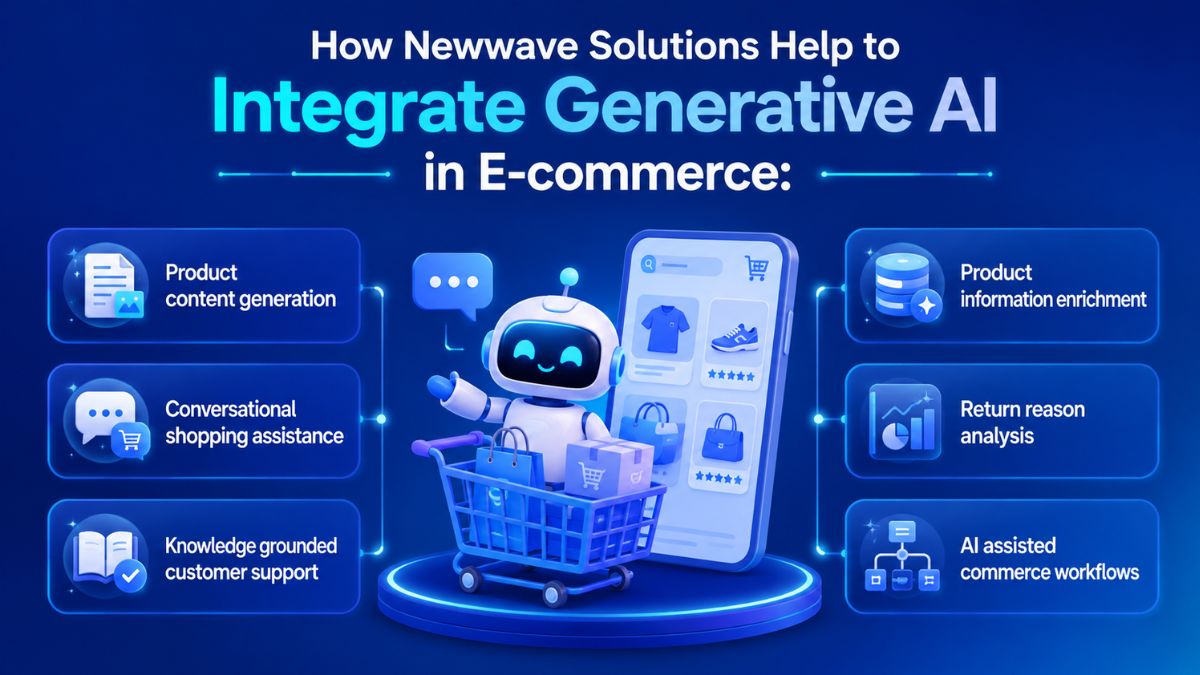
In practice, Newwave Solutions can help apply GenAI across several eCommerce use cases:
- Product content generation: Use generative AI to draft product descriptions and related commerce content, helping teams handle large content volumes with less manual effort.
- Conversational shopping assistance: Build GenAI powered interactions that answer product questions and guide customers through product discovery in a more natural way.
- Knowledge grounded customer support: Connect AI with approved business knowledge so customer responses are based on relevant internal information instead of relying only on a general model.
- Product information enrichment: Apply GenAI to identify missing catalog information, support attribute enrichment, and improve how product data is prepared for customer facing channels.
- Return reason analysis: Use AI to summarize and group return related information, helping commerce teams identify recurring patterns that require further review.
- AI assisted commerce workflows: Apply GenAI within multi step operational tasks, where AI can prepare content, classify information, or route exceptions while keeping human review at defined decision points.
If you are exploring where generative AI in ecommerce can create the most practical value, Newwave Solutions can help turn the right use case into a solution that fits your existing business environment. Talk to our team to discuss your GenAI initiative.
Conclusion
The real opportunity with generative AI is not simply producing more content or automating more tasks. It comes from applying AI where it can make shopping experiences more relevant, support faster operations, and help teams use customer and product data more effectively. Those gains still depend on reliable data, human oversight, and clear controls around how AI is used.
Businesses exploring generative AI in ecommerce should therefore prioritize use cases with clear operational or customer value before expanding adoption. Newwave Solutions supports this next step by helping companies apply GenAI within existing eCommerce environments, with attention to workflow fit, output quality, and practical business objectives.
Discuss with our AI experts to explore the right GenAI use case for your eCommerce business today.
FAQs
1. How does AI help e-commerce businesses increase sales?
AI can increase sales by making shopping experiences more relevant to individual customers. It can generate personalized recommendations, improve product discovery, reduce cart abandonment, and help businesses deliver more targeted marketing based on customer behavior and preferences.
2. Is generative AI expensive to implement?
The cost varies by project scale and implementation approach. Small and medium sized businesses typically spend $40,000 to $400,000 on an initial AI implementation, while enterprise initiatives can be much larger, with costs covering infrastructure, data preparation, integration, training, and change management.
3. What are the best generative AI use cases in e-commerce?
Common use cases include personalized recommendations, automated product content, intelligent customer support, and inventory forecasting. The right choice depends on the business problem, available data, and where generative AI can create measurable customer or operational value.
4. How to implement generative AI for eCommerce effectively?
Start with one clearly defined business problem, then prepare the data required for that use case and test the solution through a focused pilot. Once the results are clear, integrate the AI with existing systems and expand only where the initial implementation has demonstrated measurable value.
5. Can small eCommerce businesses benefit from Generative AI?
Yes. Smaller eCommerce businesses can start with targeted applications such as product description generation, customer service automation, email personalization, or simple inventory forecasting. Starting with a narrow use case can make costs easier to manage while allowing the business to evaluate results before scaling further.
To Quang Duy is the CEO of Newwave Solutions, a leading Vietnamese software company. He is recognized as a standout technology consultant. Connect with him on LinkedIn and Twitter.



Read More Guides

Get stories in your inbox twice a month.
Let’s Build Something Extraordinary
Sign up for a 30 min no-obligation strategic session with us. Transform your Ideas into scalable reality.
Leave a Reply