


Generative AI in Retail: Use Cases, Business Value & Challenges
Retailers often have more customer, product, and transaction data than their teams can turn into timely action. At the same time, shoppers expect faster support, more relevant recommendations, and consistent experiences across channels. Generative AI in retail offers a way to close that gap by helping teams produce content, answer questions, assist decision making, and personalize interactions at scale.
But adoption is not as simple as adding an AI tool to existing systems. This guide covers the most practical retail use cases, the benefits and limitations to expect, real world examples, and the factors that matter when planning a GenAI initiative.
Key Takeaways
|
How Generative AI is Changing the Retail Industry
Generative AI in retail is changing how companies handle customer interactions, marketing, product planning, and day-to-day operations. The technology can produce text, images, audio, and video, while newer large language models make it possible to interact with AI through natural conversations.
Adoption is already widespread, with 87% of retailers having experimented with generative AI, and McKinsey estimating that the technology could create $240 billion to $390 billion in annual economic value for retailers.
Its impact is also becoming more visible on the customer side. An Adobe survey cited in the source found that 39% of shoppers have already used generative AI for shopping inspiration, while another 53% are interested in using it.
How Generative AI Works in Retail?
Generative AI in retail works through large machine learning models trained on extensive datasets, such as sales records or product catalogs. By learning patterns from this information, the models can generate new outputs that retailers can use within existing business processes.
In practice, generative AI acts as an additional layer within the retail technology stack. It takes patterns learned from retail data and uses them to produce relevant content or interactions for specific tasks. For example, a retailer can use it to create personalized email campaigns designed to encourage purchases and follow up with customers.
This means generative AI for retail does not operate separately from retail data and systems. Its outputs are based on the patterns contained in the datasets used to train the underlying machine learning models.
Generative AI in Retail: 4 Benefits for Customers and Businesses
Generative AI in retail can create value on both sides of the transaction. Customers can receive more relevant interactions, while retailers can reduce manual work, improve marketing output, and use data more effectively across daily operations.
1. More personalized customer experiences
Generative AI can analyze customer behavior, preferences, previous purchases, shopping activity, and browsing patterns to interpret intent and provide more relevant suggestions.
This matters because customer experience directly affects retention. PwC found that 52% of consumers stopped buying from a brand after a bad experience, while 73% rank buying experience behind only price and product quality.
Amazon shows how this can work at scale. Its AI-supported product discovery helps shoppers search across more than 300 million products, while generative AI is also used to tailor product descriptions and promotional messages based on factors such as shopper style and region.
2. Faster, more targeted marketing
According to SAS report, 85% of marketers already use generative AI, and 90% of those users report seeing ROI. One reason is its ability to produce multiple versions of marketing copy and visuals for different regions and communication channels, reducing the need to create every asset manually.
Generative AI can also analyze large datasets to estimate which campaigns or products may perform better. This gives retailers more information for refining promotions and allocating advertising spend.
3. Better data-informed decisions
Generative AI can help retail teams interpret business and customer data rather than relying only on manual analysis. It can provide information on market conditions, customer preferences, and possible business scenarios.
Retail leaders can then use those findings to make more informed decisions across areas such as marketing, operations, inventory, and customer engagement.

4. Lower operating costs and better efficiency
Generative AI can lower retail operating costs by automating routine work and helping teams use resources more efficiently. McKinsey estimates that generative AI has the potential to automate activities that currently take 60% to 70% of employees’ time, making efficiency gains possible across several business functions.
|
Area |
How Generative AI can support |
| Routine operations | Automates tasks such as payroll, ticketing, and document handling, reducing manual workload and freeing employees for higher-value work. |
| Inventory and operations | Analyzes demand forecasts and supports reordering, which can help reduce overstocks and stockouts and improve warehouse and logistics efficiency. |
| Customer support | Powers interactive FAQs, handles queries 24/7, retrieves information, and suggests responses, reducing pressure on support teams. |
| Marketing | Produces content at scale, localizes product information, and automates A/B testing, helping lower creative production effort and improve marketing efficiency. |
| Decision-making | Provides insights from market conditions, customer preferences, and what-if scenarios to help business leaders make more informed decisions. |
Popular Applications of Generative AI in Retail Industry
Generative AI is helping retailers create more responsive, personalized, and efficient shopping experiences. From customer interactions to behind-the-scenes operations, the technology enables retailers to adapt more quickly to changing needs.
AI-Powered customer service and shopping assistants
Generative AI allows retail chatbots to understand customer intent and respond conversationally instead of relying only on fixed commands. Virtual shopping assistants can also help customers search large product catalogs through text, voice, or image prompts.
For example, Newwave Solutions’ ShopMate AI chatbot integrates directly into eCommerce stores to understand natural customer questions, recommend products using catalog data, and guide shoppers through product discovery, comparison, and checkout. It maintains conversation context and provides 24/7 assistance, helping customers move through the buying journey in a single interaction.

Personalized shopping and dynamic pricing
Generative AI for retail can analyze purchase history, browsing behavior, preferences, and contextual factors to create more individualized shopping experiences. Retailers can use this information to tailor marketing messages and promotions to specific customers rather than broad audience groups.
Generative models are also used in dynamic pricing. Amazon’s pricing engine, for example, changes prices millions of times per day in response to demand and other market factors, helping the company remain competitive while protecting margins.
Virtual product creation and design
Generative AI can help retailers visualize product concepts earlier in the design process and use feedback to refine them before production. McKinsey estimates that applying generative AI to product research and design could generate $60 billion in productivity value.
Walmart’s Trend-to-Product tool shows how this works in practice. It analyzes emerging fashion trends and generates mood boards, helping accelerate fashion product development by 18 weeks.
Retailers in home decor can also use generative AI to create realistic room visualizations so customers can preview how products such as furniture or paint colors may look before purchasing.
Supply chain forecasting and optimization
Generative AI use cases in retail also extend to supply chain planning. Retailers can combine GenAI with digital twins to model supply chain scenarios, anticipate shortages, and recommend operational adjustments.
For example, Unilever uses an AI-driven forecasting and replenishment model that connects forecast data with actual sales information to improve coordination between demand and sourcing. Target also uses predictive AI to monitor inventory across stores and distribution centers, anticipate demand changes, and adjust restocking schedules.

Fraud detection in online transactions
Generative AI can help retailers identify suspicious activity by learning from new transaction data and detecting fraud patterns that may not be captured by static rules. It can also generate synthetic examples of fraudulent behavior to support model training.
This is increasingly relevant for online retail, as Juniper Research projects that payment fraud alone could cause $343 billion in global e-commerce losses by 2027. Retailers can use GenAI to flag suspicious orders and detect possible account takeovers in real time, helping reduce financial exposure and protect customer trust.
Real-world Examples of Generative AI in Retail
Generative AI in retail is already being applied across different areas, including customer support, product discovery, personalization, and online shopping experiences. Retailers are using generative AI to help customers find relevant products, answer questions, and create more tailored interactions based on available customer and product data.
1. Amazon Rufus: AI-powered shopping assistance
Amazon uses its generative AI virtual assistant, Rufus, to help customers search for products, compare options, and receive personalized recommendations through conversational interactions. Rufus was trained using Amazon’s product catalog, customer reviews, and other resources, allowing it to provide responses based on product information and shopping context.
For example, when customers ask questions such as what they need for go hiking, Rufus can suggest relevant product lists based on their needs. It can also answer product-related questions, such as providing care instructions for specific items.

2. CarMax: Automated vehicle comparisons
CarMax applies generative AI to create detailed vehicle comparisons. The system generates information covering specifications, features, benefits, and customer reviews, helping shoppers evaluate different vehicle options more efficiently.
This application demonstrates how generative AI for retail can support customers during the decision-making process by organizing complex product information into easier-to-understand comparisons.
3. Sainsbury’s: Personalized offers and search improvement
Sainsbury’s uses generative AI to provide location-specific specials and improve online search experiences. The company applies AI to analyze user preferences and deliver more relevant search results for customers.
This use case shows how generative AI in retail industry can support more personalized digital shopping journeys by adapting experiences based on customer interests and context.
4. Sephora: Personalized beauty recommendations
Sephora uses generative AI to provide personalized product recommendations based on information collected from customer profiles. The company also offers customized makeup tutorials and skincare routines to support individual customer needs.
This application highlights how generative AI retail solutions can combine customer information with AI-generated recommendations to create more tailored shopping experiences.

The Challenges and Limitations of Generative AI for Retail
While generative AI in retail creates new opportunities for customer experiences and operational improvements, businesses must also address challenges related to accuracy, quality control, transparency, and implementation complexity. Understanding these limitations is essential for retailers that want to apply generative AI responsibly and effectively.
Inaccurate content and AI hallucinations
One of the main challenges of generative AI for retail is the possibility of generating incorrect information, commonly known as AI hallucinations. These inaccurate outputs can create risks in customer-facing applications, such as incorrect product descriptions, misleading claims, or irrelevant content appearing online.
Retailers need to ensure that AI systems can retrieve and use reliable information from available data sources. Models that support long-context data processing can help improve accuracy when handling complex queries, such as conversational shopping experiences.
Maintaining response quality and human validation
Generative AI can produce content for different retail activities, including product copy and trend insights, but generated outputs still require human review. Since these models predict likely responses, they may sometimes produce generic answers instead of responses that fully match a retailer’s specific context.
Retailers can reduce this risk through approaches such as using open-weight models that can be privately fine-tuned with proprietary data. This supports more customized workflows, including knowledge search, customer support, and RFP responses, while maintaining greater control over generated content.
Transparency and responsible AI usage
As generative AI becomes more common in retail communications, businesses need to consider how they disclose AI involvement in customer interactions and content creation. Customers may increasingly expect clarity about whether information comes from humans or AI systems.
Retailers should establish ethical AI usage policies to ensure generative AI applications align with responsible business practices. Clear guidelines can help organizations address questions around AI-generated content and maintain trust in customer relationships.
Implementation complexity and model selection
Adopting generative AI in the retail industry requires businesses to identify where AI can create the most value, whether in customer experience, marketing, or in-store productivity. However, developing and training a model from scratch can require significant cost, time, and technical expertise.
Task-specific models (TSMs) provide an alternative approach for retailers that need focused AI capabilities. These pre-trained models are designed for specific tasks, making them easier to customize and requiring less training data compared with general-purpose models.
For example, a semantic search TSM can help shoppers find products using their own words by understanding search intent rather than relying only on exact keywords. Similarly, contextual answer models can generate responses based on trusted retailer content to deliver more accurate and brand-aligned customer support.
Data security and private AI deployment
Retailers often handle sensitive customer information and regulated transactions, making secure AI deployment an important consideration. Generative AI systems must be implemented in environments that support appropriate data protection requirements.
Private AI deployment options allow AI assistants to operate within secure virtual private clouds (VPCs) or on-premise environments. This approach supports retailers that require greater control over where AI systems process and store information.

Emerging Generative AI Trends in Retail: What You Should Prepare for
As AI models and their applications in commerce continue to advance, retailers are exploring new ways to improve operations and create more engaging customer experiences. Here’re some trends that are driving generative AI in retail industry:
Shaping sustainable retail practices
Sustainability is becoming an increasingly important expectation in retail. More than two-thirds of Americans believe sustainability should be a standard business practice rather than an optional initiative, while 44% believe companies should remove unsustainable products from the market.
Generative AI for retail can support these sustainability goals through data-driven analysis and operational optimization. AI systems can analyze production data to identify waste, predict excess inventory, recommend more sustainable supply options, create virtual product samples before production, and optimize distribution routes.
These generative AI use cases in retail can help businesses improve resource efficiency while working toward environmental targets without overlooking profitability.
Digital twins and immersive shopping experiences
The combination of generative AI with technologies such as digital twins, augmented reality (AR), and virtual reality (VR) is creating new possibilities for retail experiences. Digital twins allow retailers to test promotions and forecast potential outcomes before applying changes in real-world environments.
AR and VR applications powered by generative AI retail solutions also help customers visualize products before purchase. Shoppers can preview furniture in their homes or try on apparel virtually, creating a closer connection between online and in-store shopping experiences.
IKEA and Nike use immersive technologies to help customers visualize products before purchasing. IKEA allows customers to virtually place furniture in their homes, while Nike provides virtual apparel try-on experiences that help shoppers evaluate products before buying.
AI-driven customer experience innovations
Generative AI in the retail industry is expected to play a larger role in customer engagement and decision support. Future AI systems may act as retail copilots that remember previous customer interactions across different touchpoints and generate personalized suggestions before customers actively request assistance.
Retail experiences may also include AI systems that create customized offers using voice or visual inputs. As these capabilities develop, retailers will need to combine AI-powered interactions with human service to create more effective customer experiences.
Accelerate Generative AI Adoption in Retail with Newwave Solutions
Newwave Solutions brings over 15 years of experience in software engineering, with expertise in developing AI-powered solutions that help businesses improve operations, enhance customer experiences, and accelerate digital transformation.
Through our AI development services, we design and build customized generative AI solutions that align with specific business needs, including intelligent applications, automation systems, AI assistants, and data-driven platforms. Our team supports organizations throughout the AI development journey, from identifying suitable use cases and designing AI solutions to integrating generative AI capabilities into existing business processes.
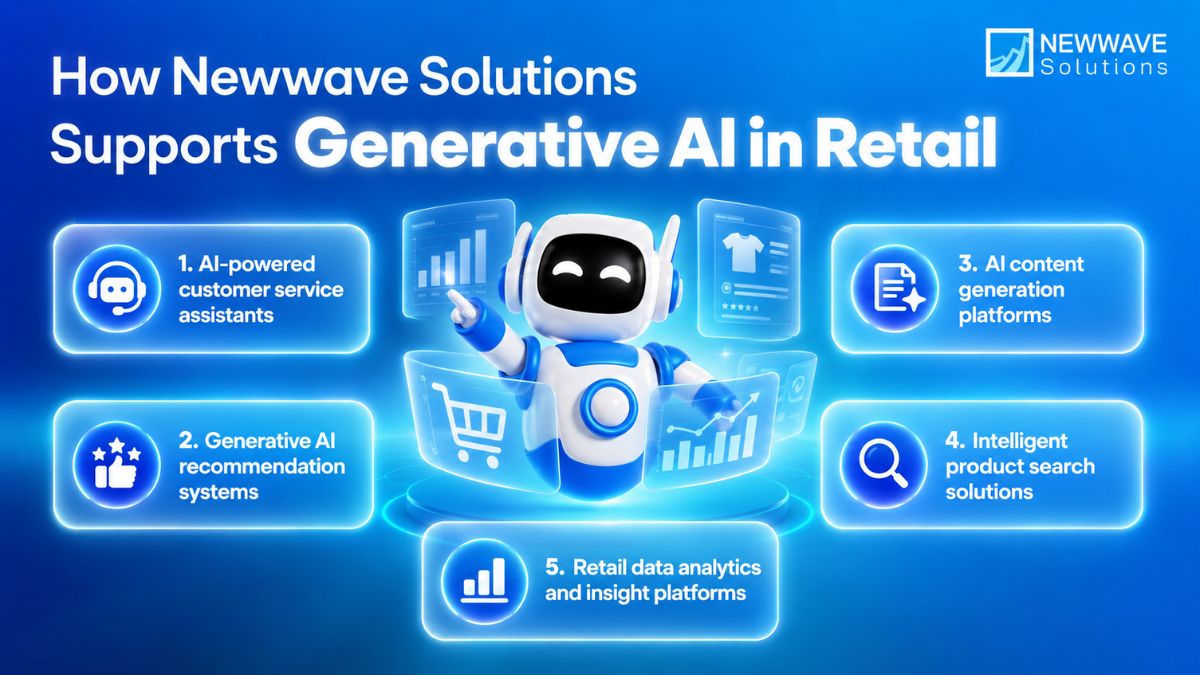
For businesses in the retail industry, Newwave Solutions can support generative AI adoption through:
- AI-powered customer service assistants: Develop intelligent conversational AI systems that understand customer requests, provide product information, answer questions, and support 24/7 customer interactions.
- Generative AI recommendation systems: Build AI-driven recommendation engines that analyze customer preferences, browsing behavior, and purchase history to deliver more relevant product suggestions.
- AI content generation platforms: Create automated content generation systems that support product descriptions, marketing materials, and ecommerce content creation at scale.
- Intelligent product search solutions: Implement AI-powered search systems that understand customer intent and improve product discovery through more relevant search results.
- Retail data analytics and insight platforms: Develop AI-based analytics solutions that process customer and operational data to generate insights for better business decisions.
With a combination of software engineering expertise and AI development capabilities, Newwave Solutions helps retailers identify valuable AI opportunities, build customized solutions, and accelerate the adoption of generative AI in their business operations.
Final Thoughts
The future of retail will depend on how effectively businesses apply generative AI to solve real operational and customer challenges. The most valuable implementations focus on practical applications, including personalized experiences, intelligent automation, and AI-powered systems that improve efficiency while maintaining control and accuracy.
Choosing the right technology approach is essential to avoid unnecessary complexity and maximize business value. Newwave Solutions helps organizations develop and integrate generative AI solutions designed around their specific retail requirements. Schedule a consultation with our experts to identify the right AI opportunities for your business.
FAQs
1. How is generative AI used in retail?
Generative AI is used in retail to create more intelligent and adaptive business processes. Common applications include improving customer interactions, automating content-related tasks, supporting product discovery, and helping teams make decisions with better insights from available data.
2. What are the main benefits of generative AI for retailers?
Generative AI helps retailers improve efficiency, deliver more relevant customer experiences, and reduce the effort required for repetitive tasks. It also enables businesses to respond faster to changing customer needs and make more informed decisions based on data.
3. How is generative AI different from traditional AI in retail?
Traditional AI mainly focuses on analyzing information, recognizing patterns, and making predictions. Generative AI can create new outputs such as text, images, or responses based on the data it has learned from, making it suitable for more interactive and content-driven retail applications.
4. How does generative AI improve customer experience in retail?
Generative AI improves customer experience by making interactions more personalized and responsive. It helps retailers better understand customer needs, provide relevant assistance, and create smoother shopping journeys across digital channels.
5. How does generative AI help with inventory management?
Generative AI supports inventory management by helping retailers analyze demand-related information and identify patterns that influence stock decisions. This allows businesses to better plan inventory levels, respond to changes in demand, and improve operational efficiency.
To Quang Duy is the CEO of Newwave Solutions, a leading Vietnamese software company. He is recognized as a standout technology consultant. Connect with him on LinkedIn and Twitter.



Read More Guides

Get stories in your inbox twice a month.
Let’s Build Something Extraordinary
Sign up for a 30 min no-obligation strategic session with us. Transform your Ideas into scalable reality.
Leave a Reply