


How to Choose a Software Development Company: Key Factors to Consider

Choosing the wrong software development company can lead to missed deadlines, budget overruns, poor collaboration, and software that fails to support your business goals. To avoid that outcome, you need more than a quick portfolio review. You need a clear way to assess technical capability, delivery process, industry fit, communication, and long-term reliability. This guide explains how to choose a software development company using a practical evaluation framework, so you can compare potential development partners with confidence, avoid costly mistakes, and make a better hiring decision.
What to Prepare Before Choosing a Software Development Company?
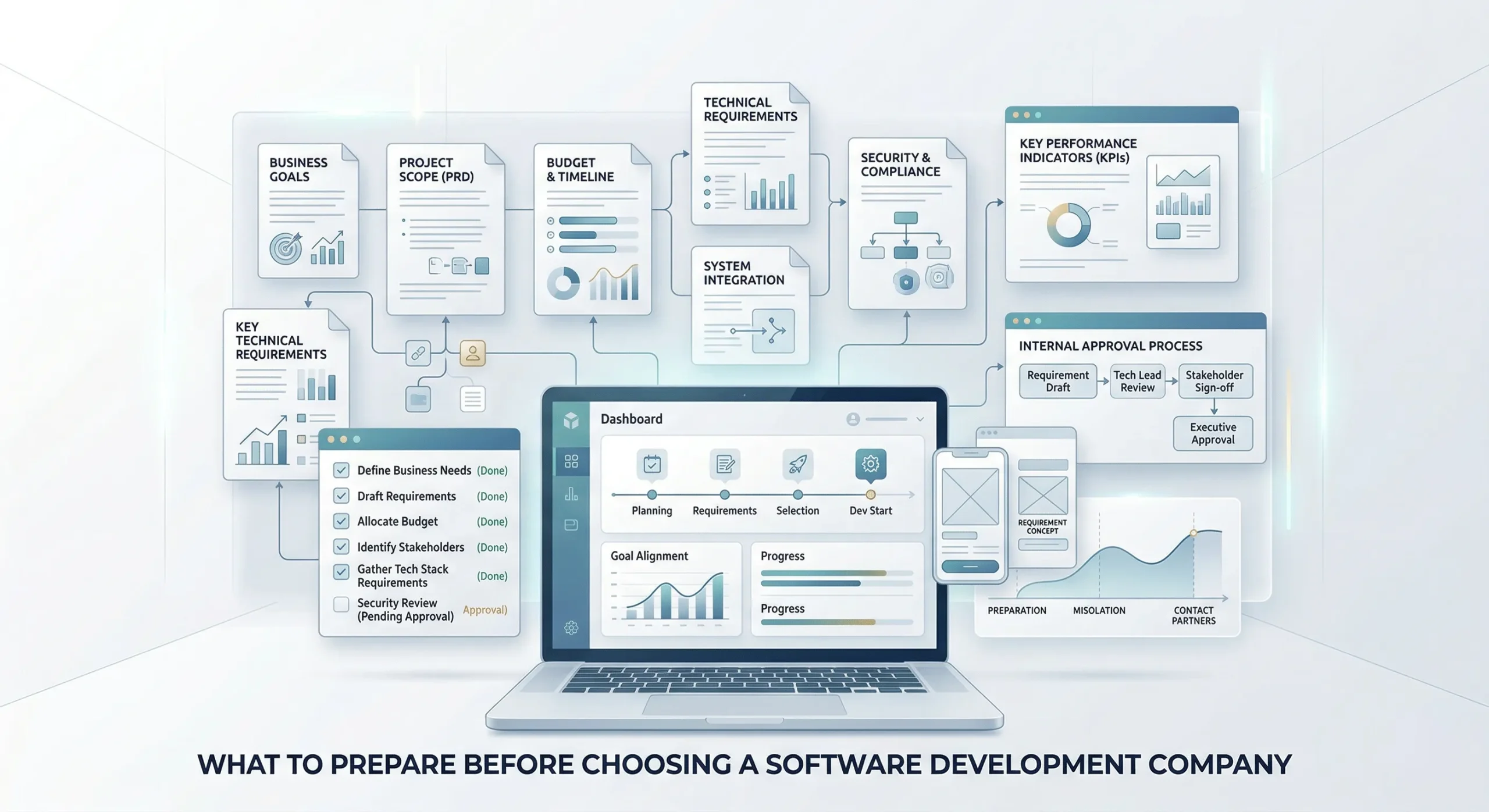
Before evaluating any software development company, make sure your internal requirements are clear. Without that foundation, it is much harder to compare options, control costs, and choose a partner that fits your business goals. Use the checklist below to prepare your team before reaching out to potential development partners.
Preparation Checklist:
- Clearly define your business objectives, including why you need the software and what problems it should solve.
- Set a realistic budget range and timeline so you can assess each company’s delivery and pricing fit.
- Identify the platforms, technologies, and integrations required for the project.
- Outline any compliance, security, or regulatory requirements the solution must meet.
- Decide whether an onshore, nearshore, or offshore development partner best fits your needs in terms of cost, communication, and time zone.
- Assign an internal point of contact, such as a product owner or project lead, to support communication and decision-making.
- List expected deliverables, success metrics, and KPIs to measure project outcomes.
- Research similar projects in the market to clarify your expectations around quality, scope, and execution.
- Create a basic requirements document or PRD before asking for proposals.
- Decide who on your side will review deliverables and approve changes.
How to Evaluate and Shortlist a Software Development Company
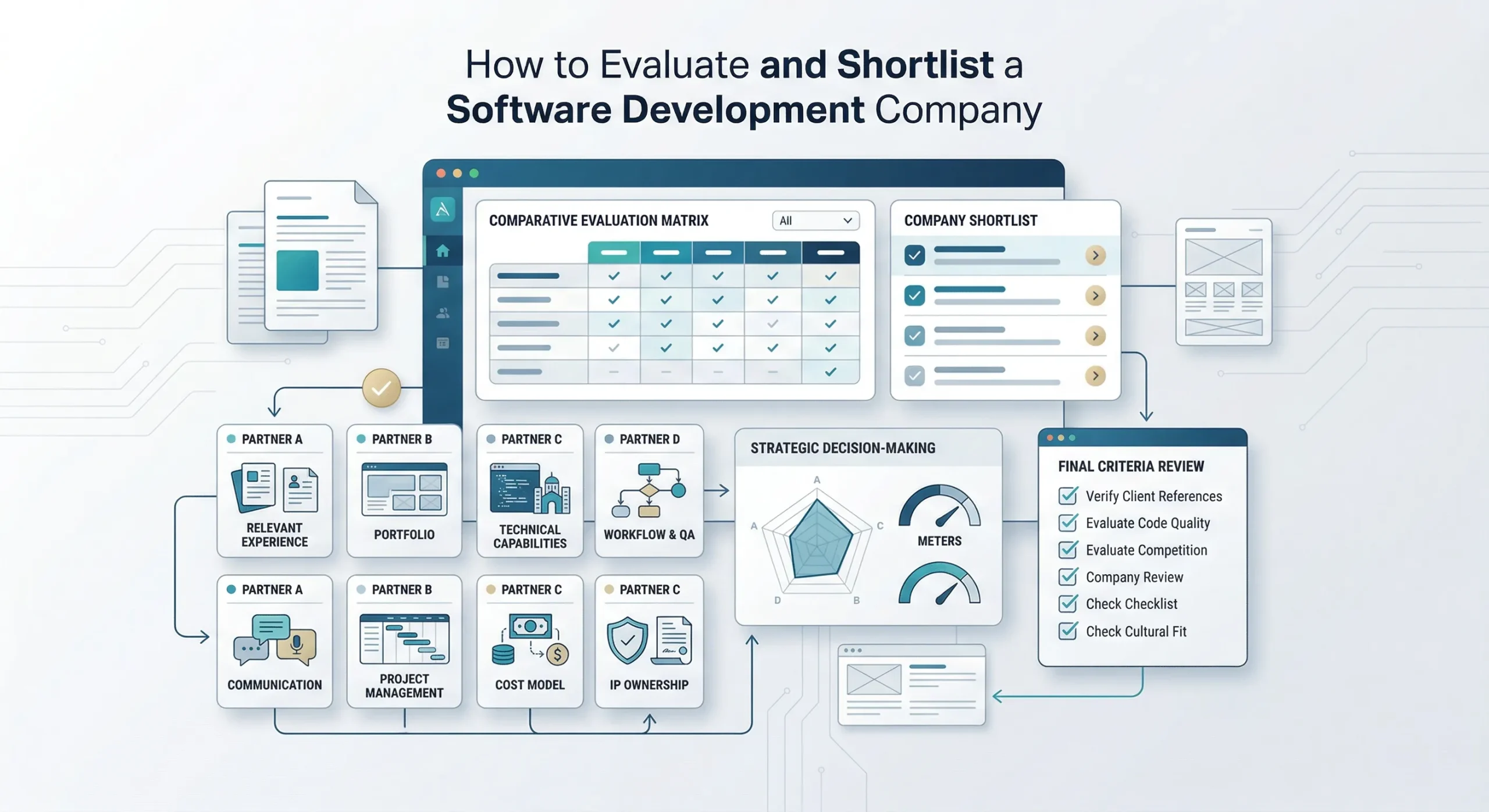
Once you know what you need, the next step is learning how to choose a software development company through a structured evaluation process. Instead of comparing firms based on surface-level impressions, use the steps below to shortlist the right options, reduce hiring risk, and make a more confident decision.
Step 1. Define your scope, budget, and timeline
Before reaching out to any company, make sure your internal scope is clear. That includes your business goals, required features, expected timeline, budget range, compliance needs, and internal approval process. If your requirements are vague, it becomes much harder to compare proposals or assess whether a software development company is truly the right fit.
Step 2. Shortlist vendors based on relevant experience
The fastest way to narrow your list is to focus on companies with experience that matches your project. Look for relevant domain knowledge, similar product types, and delivery models that fit your needs. For example, if your project involves fintech, healthcare, SaaS, or enterprise systems, the company should understand the technical and regulatory context of that space. This is also where you should check whether their preferred tech stack genuinely fits your project, or whether they are pushing tools based on internal convenience rather than business suitability.
Step 3. Review portfolio, case studies, and references
A strong portfolio should show more than visual quality. It should help you understand whether the company has handled projects with similar scope, complexity, and industry requirements. Prioritize case studies with measurable outcomes, such as faster operations, better conversion rates, lower manual workload, or improved system performance. It is also worth asking whether the showcased work was delivered fully in-house or whether parts of it were subcontracted. When possible, speak with past clients to verify how the team performed during delivery, not just how the final product looked.
Step 4. Assess technical skills, process, and QA
When evaluating technical fit, go beyond a list of programming languages or frameworks. A capable software development company should be able to explain why a certain architecture, stack, or integration approach is suitable for your goals. You should also assess whether they can support scaling, maintenance, and post-launch improvements. On the process side, ask how they manage sprint planning, reviews, acceptance criteria, change requests, bug triage, and QA ownership. A good process is not just about saying they use Agile. It is about showing how they handle change without losing control of delivery quality.
Step 5. Evaluate communication, project management, and flexibility
Communication is one of the biggest factors in choosing a software development company, especially for long-term or outsourced engagements. You should know who your day-to-day contact will be, how often progress will be reported, and whether you will work directly with the delivery team or mainly through account managers. Strong partners do more than follow instructions. They ask smart questions, challenge weak assumptions, and help bridge the gap between business goals and technical execution. Flexibility also matters: when priorities change, the team should be able to adapt without creating confusion or unnecessary delays.
Step 6. Compare pricing models, contracts, and ownership terms
Price matters, but low cost alone is not a reliable reason to choose a software development company. Compare what is included and excluded in each proposal, how change requests are billed, and whether testing, deployment, support, maintenance, or third-party integrations create additional costs. The payment structure should also be clear, ideally with milestones tied to agreed deliverables. Review ownership terms carefully as well, including source code ownership, repository access, documentation expectations, and handover conditions. If a quote is vague or unusually low, treat that as a red flag rather than a bargain.
>> If your project will evolve over time, compare whether a dedicated development team or a fixed-scope model is the better fit before reviewing final contracts.
Step 7. Interview the final vendors and ask key questions
Before making a final decision, speak directly with the shortlisted companies. This is often the best way to understand how they think, how they communicate, and how they handle uncertainty. Ask who will actually work on your project, how they deal with changing scope, what risks they see in your requirements, and what success would look like from their perspective. The right development partner should give clear answers, set realistic expectations, and show that they can support your business beyond initial delivery.
Questions to Ask Before Choosing a Software Development Company
Knowing how to choose a software development company is not just about reviewing portfolios or comparing proposals. It also depends on asking the right questions before signing a contract. The questions below can help you uncover delivery risks, clarify expectations, and determine whether a company is the right long-term fit for your business.
1. Have you built projects similar to ours in scope or industry?
This helps you verify whether the company has relevant experience, not just general development capability. Look for examples that match your project size, business model, technical complexity, or compliance requirements.
2. Who will be on our team, and what are their roles?
Do not evaluate a company based only on its brand or sales team. Ask who will actually work on your project, what their responsibilities are, and whether key roles such as project manager, developers, QA engineers, and solution architects are already defined.
3. How do you handle changing requirements after development starts?
Requirements often evolve during development. A reliable software development company should be able to explain its process for handling scope changes, reprioritization, approvals, and timeline or budget adjustments.
4. What is included in your estimate, and what counts as extra cost?
This question helps prevent budget surprises later. Clarify what is covered in the proposal and what may be billed separately, such as revisions, additional testing, deployment support, integrations, maintenance, or post-launch fixes.
5. Who owns the source code, documentation, and deployment assets?
Ownership terms should be clear from the beginning. Make sure you understand who will control the source code, technical documentation, cloud environments, repositories, and other delivery assets after the project is completed.
6. What testing process do you follow before delivery?
A good partner should have a defined QA process, not just ad hoc testing at the end. Ask about manual testing, automated testing, bug tracking, acceptance criteria, and who is responsible for quality control before release.
7. How often will we receive updates, demos, and reports?
Consistent communication reduces risk and keeps both sides aligned. Ask how frequently the team shares progress, what reporting format they use, and whether you will receive sprint demos, milestone reviews, or regular status updates.
8. What happens if timelines slip?
Delays can happen, but the response matters. A trustworthy development partner should explain how risks are flagged early, how delays are communicated, and what recovery actions they take if the project falls behind.
9. What support do you provide after launch?
Delivery is not the end of the relationship. Ask what kind of post-launch support is available, whether bug fixes are included, how maintenance is handled, and what response times you can expect if issues arise.
10. Can we speak with a recent client?
Client references can reveal details that sales materials often leave out. A recent client can give you a more realistic view of communication quality, delivery reliability, problem-solving ability, and the overall working relationship.
=> Use these questions before scheduling final interviews or requesting proposals for your custom software development services shortlist.
Red Flags When Choosing a Software Development Company
Knowing how to choose a software development company also means knowing what to avoid. Even a polished proposal or impressive sales pitch can hide delivery risks that only appear after the project starts. The red flags below can help you identify weak processes, misaligned expectations, and costly problems before you sign a contract.
- Overpromising on timelines or budgets: Be cautious of any company that promises unusually fast delivery or pricing that seems too good to be true. Unrealistic estimates often lead to rushed execution, lower quality, missed deadlines, or continuous upselling once the project is underway.
- Poor transparency in communication: If updates are vague, inconsistent, or overly optimistic, small issues can grow into major delivery risks. A reliable development partner should communicate clearly about progress, blockers, dependencies, and risks instead of only sharing positive news.
- No clear development process: A software development company should be able to explain how it handles planning, sprint execution, reviews, QA, releases, and issue tracking. If the process feels improvised or changes from one conversation to another, delivery consistency will likely be a problem.
- Weak portfolio or unverified claims: Be careful with companies that make broad claims but cannot show relevant work. A strong portfolio should include projects similar in scope, industry, or complexity, supported by case studies, references, or clear evidence of execution.
- Unclear ownership of source code and delivery assets: Ownership should never be assumed. If the contract does not clearly define who owns the source code, repositories, documentation, cloud accounts, and deployment assets, you may face serious problems during handover or future scaling.
- No documentation or handover plan: A company that focuses only on delivery without discussing documentation or transition is a risk. Without proper technical documentation, onboarding notes, and handover planning, your internal team or next partner may struggle to maintain the product after launch.
- Vague QA or testing process: If a vendor says they “test everything” but cannot explain how, that is a warning sign. Ask whether they have clear testing stages, acceptance criteria, bug triage, regression checks, and defined QA responsibilities before release.
- No dedicated project manager or point of contact: A project without a clear day-to-day owner often leads to confusion, delayed decisions, and communication gaps. You should know who is responsible for coordination, escalation, progress tracking, and cross-team alignment.
- Unwillingness to explain trade-offs: A good partner does not just say yes to every request. They should be able to explain trade-offs around cost, speed, quality, scope, and technical decisions. If they avoid these conversations, they may be prioritizing short-term agreement over long-term project success.
- Pricing that seems far below market: A quote that is significantly lower than other proposals may signal hidden exclusions, weak staffing, limited QA, or unrealistic assumptions. Low pricing can look attractive early on, but it often creates more cost and risk later.
- No clear method for handling change requests: Requirements change in most software projects. If the company cannot explain how scope changes are reviewed, approved, estimated, and documented, your project can quickly lose control over timeline, budget, and priorities.
Final Checklist for Choosing the Right Software Development Partner
If you are still deciding how to choose a software development company, use this final checklist to review your decision before moving forward. A strong partner should meet both your technical requirements and your working expectations, not just offer an attractive proposal.
Final checklist
- Our project scope, priorities, budget, and timeline are documented.
- We know which requirements are fixed and which may change during delivery.
- The company has relevant case studies in a similar scope, industry, or business model.
- We verified client reviews, references, or third-party credibility signals.
- Their technical approach fits our actual needs, not just their preferred stack.
- Their communication process, reporting cadence, and points of contact are clear.
- Their development process includes sprint reviews, change requests, and defined acceptance criteria.
- Their pricing model is transparent, including what is included, excluded, and billed separately.
- Code ownership, repository access, documentation, and handover terms are clearly defined.
- Their QA process, testing responsibilities, and post-launch support are documented.
- We understand how they handle delays, risks, and changing priorities.
- We compared at least three qualified software development companies before making a decision.
Before signing, make sure the company is not only capable of building your product, but also capable of collaborating with your team, adapting to change, and supporting the product after launch.
Why Businesses Consider Newwave Solutions
Once you understand how to choose a software development company, the next step is identifying a partner that matches those criteria in practice. Businesses often consider Newwave Solutions because the company combines custom software development services with outsourcing experience, a clear delivery process, and long-term support beyond launch.
- Relevant experience in custom software development and outsourcing: Newwave Solutions supports businesses with a range of delivery models, from dedicated teams to full-project execution. This makes it easier for companies to find a setup that fits their budget, internal resources, and product goals.
- Transparent collaboration and delivery process: A strong software partner should be clear about communication, planning, delivery milestones, and change handling. Newwave Solutions follows a structured software development process designed to keep collaboration visible and manageable throughout the project lifecycle.
- Full-cycle support from planning to post-launch: From early planning and product development to QA, launch, and ongoing post-launch support, businesses often look for partners that can stay involved beyond the first release. This full-cycle model helps reduce handover gaps and supports long-term product growth.
>>> If you already have a project in mind, you can contact our team to discuss your requirements and see whether Newwave Solutions is the right fit for your software development needs.
FAQs
1. How many software development companies should I compare before making a decision?
In most cases, comparing at least three qualified companies is a practical benchmark. This gives you enough range to evaluate pricing, technical fit, communication style, and delivery approach without making the process too slow. If all options look similar, compare them more closely on process clarity, ownership terms, and post-launch support rather than price alone.
2. Should I choose a local, nearshore, or offshore software development company?
That depends on your priorities. A local company may offer easier communication and closer market understanding, while a nearshore or offshore development team can provide broader talent access and better cost efficiency. The right choice depends on your budget, required overlap in working hours, project complexity, and how much day-to-day collaboration your team expects.
3. What should be included in a software development contract?
A strong contract should clearly define project scope, deliverables, timeline, payment terms, change request process, acceptance criteria, support scope, confidentiality terms, and dispute handling. It should also state who owns the source code, documentation, repositories, and deployment assets. If any of these areas are vague, the risk of future conflict increases significantly.
4. How do I verify a vendor’s technical expertise?
Start by reviewing relevant case studies, technical proposals, and the technologies they have used in similar projects. Then ask how they would approach your architecture, integrations, scalability, QA, and long-term maintenance. A capable company should be able to explain technical decisions clearly, including trade-offs, rather than just listing tools or buzzwords. Looking at their software development process can also reveal whether their execution is as strong as their pitch.
5. Who should own the source code and documentation after the project ends?
In most cases, the client should own the source code, technical documentation, and core delivery assets once the agreed payments are completed. That includes access to repositories, cloud environments, deployment files, and handover materials. These terms should be written clearly into the contract from the start, especially for long-term custom software development services or outsourced delivery models.
Conclusion
Choosing the right software development company requires more than comparing prices or portfolios. A better decision comes from defining your requirements clearly, evaluating experience and process carefully, asking the right questions, and watching for red flags before you commit.
To Quang Duy is the CEO of Newwave Solutions, a leading Vietnamese software company. He is recognized as a standout technology consultant. Connect with him on LinkedIn and Twitter.



Read More Guides
Get stories in your inbox twice a month.
Let’s Connect
Let us know what you need, and out professionals will collaborate with you to find a solution that enables growth.
Leave a Reply