


Top 5 Layer 2 Scaling Solutions Powering Fast and Low Cost Blockchains
As blockchain adoption accelerates, scalability has become one of the biggest challenges facing the industry. Networks like Bitcoin and ETH laid the foundation for decentralized systems, but they struggle to handle growing demand. This is where layer 2 scaling solutions come in. These technologies are transforming how modern blockchain technology operates by enabling faster transactions, lower costs, and better user experiences. Whether you are building a dApp, launching a DeFi platform, or scaling enterprise systems, understanding Layer 2 is essential. In this guide, we explore how Layer 2 works, the different types available, and the best layer 2 scaling solutions leading the market.
What Is layer 2 scaling solutions?
Layer 2 scaling solutions are protocols built on top of Layer 1 blockchains such as Ethereum or Bitcoin. Instead of processing every transaction directly on the main chain, Layer 2 handles transactions off chain and then settles the final results back on Layer 1. This approach allows networks to scale without compromising security.
Think of Layer 1 as a main highway and Layer 2 as an express lane. The express lane handles most of the traffic and only sends final results back to the main road. This model is critical for supporting modern applications like DeFi, gaming, and NFT development solutions that require high speed and low cost infrastructure.
When Are Layer 2 Solutions Needed?
Layer 2 solutions are not a luxury; they are a necessity born from the inherent limitations of popular Layer 1 networks . Consider the transaction throughput of major blockchains compared to traditional finance:
- Bitcoin: Processes approximately 7 transactions per second (TPS) .
- Ethereum: Handles roughly 15-30 TPS .
- Visa: Processes about 1,700 TPS on average .
As blockchain technology gained mainstream attention, millions of users flooded these networks to use dApps, trade NFTs, and participate in DeFi. This congestion leads to a poor user experience with slow confirmation times and, most critically, astronomical fees. During peak periods on Ethereum, a single transaction could cost over $100. This pricing out of ordinary users created an urgent need for a scaling solution. L2s are required to absorb this demand, making interactions fast and affordable for everyone.
Main Purpose and the Problems L2 Solves
The primary purpose of layer 2 scaling solutions is to enable blockchain technology to scale for global mass adoption. They accomplish this by solving three fundamental problems:
- High transaction fees: Layer 2 significantly reduces costs by batching transactions. Fees can drop by up to 90 to 95 percent compared to Layer 1.
- Slow transaction speed: Transactions that take minutes on Layer 1 can be processed in seconds on Layer 2.
- Limited throughput: Layer 2 increases the number of transactions a network can handle, making it possible to support millions of users and applications.
This is especially important for businesses building financial development solutions or platforms within fintech development services, where speed and cost efficiency are critical.
How Many Types of L2 Solutions Are There?
The landscape of layer 2 scaling solutions is diverse, with different architectures offering unique trade-offs. While there are several models, Rollups have emerged as the dominant and most promising technology. Here’s a breakdown of the main types you’ll encounter.
Optimistic Rollups
How They Work: Optimistic Rollups, as the name suggests, are optimistic by nature. They assume all off-chain transactions are valid by default and do not perform any computation on them. They rely on a fraud-proof mechanism. After a batch of transactions is posted to L1, a challenge window (typically 7 days) opens. During this time, network “verifiers” can dispute a transaction if they believe it’s fraudulent. If fraud is proven, the rollup corrects the record and penalizes the bad actor .
Pros:
- High EVM Compatibility: They are incredibly compatible with the Ethereum Virtual Machine (EVM). This means most existing Ethereum smart contracts and developer tools (like Solidity) work with little to no modification, making it easy to port existing projects .
- Mature Ecosystem: Having been in development longer, they boast the most mature ecosystems with the deepest liquidity and a wide array of dApps.
Cons:
- Delayed Withdrawals: The 7-day challenge window means users cannot immediately withdraw funds from the rollup back to L1. While third-party services can speed this up for a fee, it’s a native UX friction point.
- Dependence on Verifiers: The security model relies on at least one honest verifier being online to submit a fraud proof during the challenge window.
Common Example: Arbitrum One, OP Mainnet (Optimism).
Suitable For: General-purpose dApps, DeFi protocols, and NFT marketplaces where EVM compatibility and a rich, established ecosystem are the top priorities.
Zero-Knowledge Rollups (ZK-Rollups)
How They Work: ZK-Rollups take a more mathematically rigorous approach. For every batch of off-chain transactions, they generate a cryptographic validity proof (a ZK-proof). This proof is then posted to L1, where the network can instantly verify the correctness of the entire batch without needing to re-execute a single transaction .
Pros:
- Instant Finality: Withdrawals are secure and fast because the validity proof is verified immediately on L1.
- Enhanced Security & Privacy: The cryptographic proof guarantees the integrity of all transactions, offering superior security. Furthermore, the details of individual transactions are not revealed on L1, providing inherent privacy benefits .
- Data Efficiency: Because the proofs are compact, they take up less space on L1, theoretically allowing for even greater scalability.
Cons:
- EVM Compatibility Challenges: Historically, it has been difficult to make ZK-proofs work with the EVM. While this gap is closing rapidly in 2026 with projects like zkSync Era, it’s not as plug-and-play as Optimistic Rollups.
- Computational Intensity: Generating ZK-proofs requires significant computing power, though this is becoming cheaper and faster over time.
Common Example: zkSync Era, Starknet, Scroll.
Suitable For: High-value transfers, institutional-grade applications, trading platforms, and projects requiring strong privacy or instant settlement finality.
State Channels
How They Work: State channels are the oldest form of L2 scaling. They allow a set of participants (e.g., two users) to lock a portion of the blockchain’s state (like funds in a multisig wallet) and then conduct an unlimited number of transactions off-chain, privately and instantly. Only the final state, after all transactions are complete, is settled on L1 .
Pros:
- Unlimited Throughput: For the participants in the channel, transaction speed and cost are essentially limitless.
- Instant Finality: Transactions are confirmed instantly between parties.
- Ultimate Privacy: Transaction details are only visible to the channel participants.
Cons:
- Limited Use Case: They require participants to be online and are not suitable for open, public interactions. You also need to lock up funds to open a channel.
- Liquidity Lock-up: Funds are committed to the channel until it is closed.
Common Example: The Bitcoin Lightning Network is the most prominent example, enabling fast, low-cost Bitcoin payments.
Suitable For: High-frequency, repetitive interactions between a known set of participants, such as streaming micropayments, recurring subscriptions, or specific two-player games.
Sidechains and Plasma
Sidechains are independent, EVM-compatible blockchains (like the Polygon PoS chain) that run in parallel to the main chain and connect to it via a two-way bridge. They have their own consensus mechanisms and security models, meaning they do not inherit the full security of the L1. This makes them faster and cheaper but introduces a different set of security assumptions.
Plasma was an early framework for creating “child chains” that periodically commit their state to L1. While conceptually important, it has largely been outpaced by rollups due to complexities with data availability and the user experience of exiting funds. For most new projects, rollups are the preferred architecture over sidechains and Plasma.
Top 5 Layer 2 Scaling Solutions for your best choice
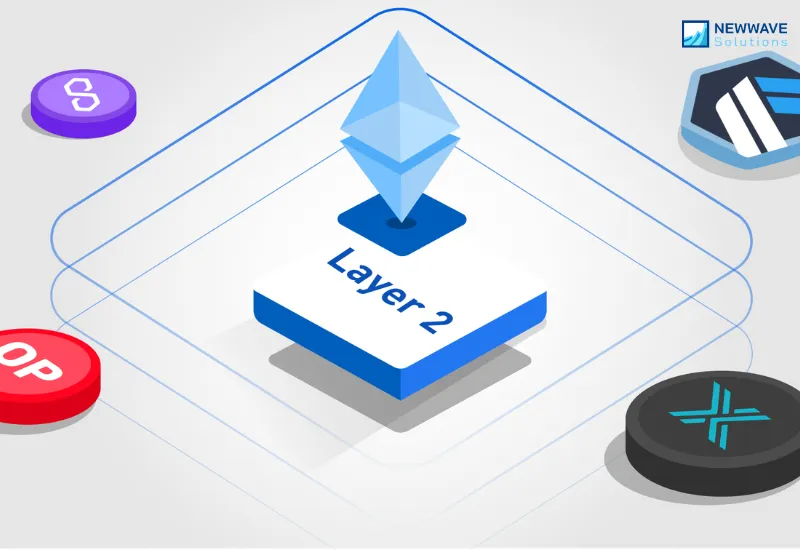
As of early 2026, the layer 2 scaling solutions ecosystem has matured into a multi-billion-dollar industry, with specific platforms dominating total value secured (TVS) and daily active users. Here are the top 5 performers you need to know.
Arbitrum One
Arbitrum One is the undisputed market leader, securing between $16.8 billion and $19 billion in total value. As an Optimistic Rollup, it has become the home of DeFi on L2, hosting major protocols like GMX, Uniswap, and Aave. Its dominance is built on first-mover advantage, deep liquidity, and continuous technical upgrades like Nitro, which enhances speed and compatibility. With its upcoming Stylus upgrade, developers will soon be able to write smart contracts in Rust and C++, opening the door for a new wave of high-performance applications. It consistently processes over 4 million daily transactions.
Base
Built by Coinbase using the OP Stack (the same technology as Optimism), Base has exploded onto the scene to become the second-largest L2, with approximately $10.7–12 billion in TVS. This Optimistic Rollup is laser-focused on bringing the next billion users on-chain through consumer applications, social platforms, and gaming. It’s a transaction powerhouse, processing a staggering 12-13 million daily transactions and boasting over 382,000 daily active users. Its direct integration with Coinbase, the largest US crypto exchange, provides an unparalleled ramp for new users unfamiliar with blockchain technology.
OP Mainnet (Optimism)
OP Mainnet, commonly known as Optimism, is another foundational Optimistic Rollup, with a TVS between $1.9 billion and $3 billion . Beyond its own robust ecosystem of dApps, its most significant contribution is the “Superchain” vision—a network of interoperable L2s (like Base) that share security, a communication layer, and tooling. This aims to solve the problem of liquidity fragmentation across different rollups. Optimism is also renowned for its Retroactive Public Goods Funding (RetroPGF), which financially rewards developers for building open-source software that benefits the entire ecosystem.
zkSync Era
Developed by Matter Labs, zkSync Era is a leading ZK-Rollup with approximately $600 million+ in TVL . It is prized for being one of the first ZK-rollups to offer native EVM compatibility, making it developer-friendly while delivering the security and performance benefits of ZK technology. It also features native account abstraction, which greatly improves user experience by allowing wallets to pay fees in any token and enabling more complex transaction logic. For developers looking to build on cutting-edge zero-knowledge technology without sacrificing compatibility, zkSync Era is a top choice.
Starknet
Starknet, developed by StarkWare, is a ZK-Rollup that utilizes a unique, quantum-proof STARK cryptographic proof. Unlike zkSync, it is built on its own Cairo programming language, which is specifically designed to maximize the scalability and efficiency of ZK-proofs for resource-intensive applications . While this introduces a learning curve for developers, it unlocks unparalleled computational capacity. Starknet secures around $225–520 million in TVL and is ideal for complex dApps, such as on-chain games and high-frequency trading protocols, that would be too expensive or slow to run on general-purpose EVM chains.
Quick comparison summary:
| Solution | Type | Strength | Best for |
| Arbitrum | Optimistic Rollup | Liquidity and ecosystem | DeFi and dApps |
| Base | Optimistic Rollup | User adoption | Consumer apps |
| Optimism | Optimistic Rollup | Ecosystem collaboration | Developer platforms |
| zkSync | ZK Rollup | Security and speed | Financial applications |
| Starknet | ZK Rollup | Advanced scalability | Complex systems |
Insights and Tips to Choose the Best Layer 2 Solution
With so many powerful options, choosing the right layer 2 scaling solutions for your project can be daunting. It’s not about picking the “best” in a vacuum, but the best fit for your specific needs. Here are key insights and tips to guide your decision:
Define Your Application’s Core Requirements
- For DeFi and General dApps: Prioritize ecosystem maturity and liquidity. In this case, Arbitrum One is the safest and most robust choice.
- For Consumer Apps (Gaming/Social): Focus on user acquisition and low costs. Base is the emerging leader here, with its massive built-in user base from Coinbase.
- For High Security and Instant Finality: If your project handles high-value assets or requires immediate settlement, a ZK-Rollup like zkSync Era or Starknet is the superior architectural choice.
Understand the Technology Trade-offs (Optimistic vs. ZK)
This is the most critical technical decision. As you’ve learned from the optimistic rollups vs zk rollups breakdown, optimistic solutions offer better EVM compatibility today, while ZK-rollups offer superior security and faster withdrawals. Your choice depends on whether you prioritize ease of development or cutting-edge performance.
Assess Liquidity and User Base
An L2 is only as good as its users and capital. A vibrant ecosystem with high daily transaction volume and deep liquidity (like Arbitrum and Base) means your application has a better chance of finding users and partners from day one. A newer, less liquid L2 might offer technical advantages but will require more effort to bootstrap your project.
Consider the Development Experience
For teams with existing Solidity codebases, the EVM-compatible L2s (Arbitrum, Optimism, Base, zkSync) will be much easier to port to. If you’re building something highly specialized and are willing to learn a new language, the power of Starknet’s Cairo might be worth the investment.
Plan for Interoperability and Futureproofing
Think about how your project will interact with other chains. Building within a cohesive ecosystem like the “Superchain” (Optimism, Base) might offer easier cross-chain composability in the future than building on a completely isolated L2.
Wrap Up
Layer 2 scaling solutions have successfully done what was once thought impossible: they have made blockchains fast, cheap, and usable for everyone. They have transformed Ethereum from a congested experiment into a scalable settlement layer for a global financial system. From DeFi platforms to gaming ecosystems, layer 2 scaling solutions are enabling faster, cheaper, and more scalable applications across industries. As adoption continues to grow, choosing the right Layer 2 will define the success of your product.
At Newwave Solutions, we help businesses build scalable blockchain systems that leverage the full potential of Layer 2. As one of the emerging blockchain development companies in Vietnam, our team delivers:
- Custom blockchain platforms built on modern blockchain technology
- High performance dApp development
- Secure smart contract architecture
- Scalable DeFi platforms as a trusted Defi development company
- Advanced exchange systems and NFT development solutions
- Enterprise grade solutions aligned with fintech development services
We focus on delivering practical, production ready systems tailored to your business goals.
While we continue to explore emerging technologies, our current expertise is centered on blockchain development. At this stage, we are not yet integrating AI into blockchain systems, allowing us to focus fully on building robust and scalable infrastructure.
If you are exploring the best layer 2 scaling solutions or planning to build your next blockchain platform, our Vietnam based team is ready to support your journey from idea to deployment.
Let’s build the future of blockchain together.
To Quang Duy is the CEO of Newwave Solutions, a leading Vietnamese software company. He is recognized as a standout technology consultant. Connect with him on LinkedIn and Twitter.



Read More Guides
Get stories in your inbox twice a month.
Let’s Connect
Let us know what you need, and out professionals will collaborate with you to find a solution that enables growth.
Leave a Reply