


Migrate VB6 to VB.NET: Steps, Challenges & Tools
As VB6 systems continue to age and lose compatibility with modern operating systems, security standards, and development practices, many enterprises are facing increasing risks to their core systems and daily operations. Consequently, the decision to migrate VB6 to VB.NET has become a critical modernization step, as VB.NET provides a more secure, scalable, and future-ready platform while still allowing businesses to preserve essential business logic and workflows. For organizations that are navigating this migration journey, this article delivers end-to-end insights covering migration steps, common challenges, and effective tools to ensure a smooth and reliable transition.
Key Risks of Staying on VB6 in 2026
Thousands of enterprises still run VB6 applications that handle core operations such as accounting, inventory, sales, and manufacturing workflows. However, since VB6 is no longer an actively supported Microsoft platform, continued reliance on it creates growing exposure across security, talent availability, and long term scalability. Therefore, the reasons below explain why the decision to migrate VB6 to VB.NET is more urgent than ever.
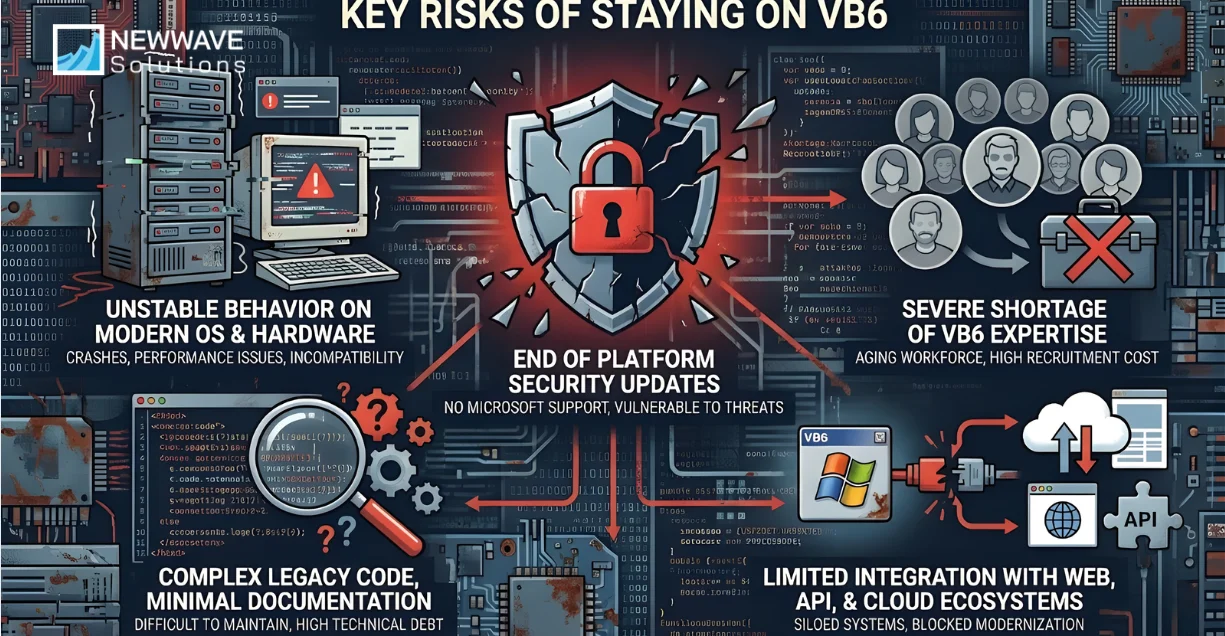
- End of platform security updates: A VB6 system depends on an outdated technology base that does not receive modern security hardening. As a result, the risk of vulnerabilities and compliance gaps rises over time, especially for systems that process financial or customer data.
- Unstable behavior on modern OS and hardware: Many VB6 applications face unpredictable issues on newer Windows versions and modern architectures. Consequently, downtime risk increases, and operational continuity becomes harder to guarantee.
- Severe shortage of VB6 expertise: The VB6 talent pool continues to shrink, while hiring costs and replacement risk increase. Therefore, a single resignation can quickly become a delivery and maintenance crisis for critical systems.
- Complex legacy code with minimal documentation: A VB6 codebase often includes tightly coupled logic that is hard to read, test, and change safely. In addition, weak documentation makes troubleshooting slower and increases the chance of breaking mission-critical workflows.
- Limited integration with web, API, and cloud ecosystems: A VB6 system is not designed for modern integration patterns and platform services. As a result, adding APIs, connecting to cloud services, or enabling digital channels becomes slower, riskier, and more expensive.
Why choose VB.NET for this upgrade?
VB.NET is a modern evolution within the .NET ecosystem, and it is designed as a long-term replacement path for VB6 while supporting enterprise-grade development requirements. Therefore, many organizations choose VB.NET because it enables modernization without forcing businesses to abandon proven business logic.
- Microsoft-Supported Platform: Long-term stability with ongoing ecosystem support.
- Modern OS and 64-bit Compatibility: Reliable operation on current Windows environments.
- Improved Maintainability: Cleaner structure that simplifies updates and enhancements.
- Easier Integration Capability: Native support for APIs, web, and cloud services.
- Future-Ready Architecture: A solid foundation for ongoing modernization strategies.
- Preserved Business Logic: Retained workflows proven through years of operation.
Step-by-Step Guide to a Successful VB6 to .NET Migration
A reliable VB6 modernization effort typically follows a structured flow, moving from discovery and planning to conversion, remediation, and enterprise-grade validation. Therefore, the steps below provide a clear path to migrate VB6 to VB.NET with better control over risk, quality, and continuity.
- Step 1: System assessment and scope definition – The migration process begins with a thorough assessment of the existing VB6 system, including modules, dependencies, and mission-critical workflows. At this stage, stakeholders define scope, risk tolerance, success metrics, and constraints to avoid unexpected disruption later in the project.
- Step 2: Migration approach selection – Once the system landscape is clear, technical leaders determine whether a manual rewrite, automated conversion, or hybrid approach is most appropriate. This decision depends heavily on ActiveX usage, Win32 API calls, third-party libraries, and the level of business logic preservation required.
- Step 3: Environment preparation and dependency mapping – Before any conversion takes place, teams prepare the target VB.NET environment, including build pipelines, version control, and testing frameworks. At the same time, external dependencies such as databases, COM components, and integration endpoints are carefully mapped to reduce downstream friction.
- Step 4: Code conversion to VB.NET – The VB6 codebase is then converted into VB.NET using a consistent and controlled conversion approach. By standardizing conversion patterns early, teams can minimize inconsistencies and accelerate later remediation and optimization efforts.
- Step 5: Refactoring and compile issue remediation – After conversion, development teams focus on resolving compile errors, replacing unsupported components, and refactoring high-risk legacy patterns. This phase improves code clarity and maintainability, ensuring that the migrated system does not inherit long-term technical debt.
- Step 6: Functional testing and validation – Quality assurance teams validate that all critical workflows behave exactly as expected in the new VB.NET environment. Regression testing is essential at this stage to confirm that financial rules, inventory logic, and transactional processes remain intact.
- Step 7: Performance, security, and operational hardening – Before release, the system undergoes performance benchmarking, security validation, logging setup, and monitoring configuration. These activities ensure that the migrated application meets enterprise-grade operational standards.
- Step 8: Deployment planning and controlled rollout – Finally, the system is deployed through a phased rollout strategy with rollback options and user acceptance checkpoints. This controlled approach minimizes downtime and protects ongoing business operations during the transition.
Recommended Tools for VB6 to VB.NET Migration
If your organization chooses an automated approach to migrate VB6 to VB.NET, several tools on the market can help accelerate the conversion process. However, each tool differs significantly in accuracy, scope, and ability to preserve business logic, so understanding their strengths and limitations is essential before making a decision.
1. CodeShift VB
CodeShift VB is an AI-powered modernization platform designed to automate and accelerate the process to migrate VB6 to VB.NET for enterprise systems. The solution combines pattern-based conversion with an intelligent AI fix loop that continuously analyzes, compiles, and resolves errors, significantly reducing manual effort during migration.
Most importantly, CodeShift VB operates entirely in an on-premise environment, ensuring zero source code upload and full data isolation, which makes it particularly suitable for enterprises with strict security, compliance, and governance requirements.
Unlike traditional conversion tools that focus primarily on syntax translation, CodeShift VB is built to understand legacy code structure, dependencies, and business logic. As a result, development teams can modernize complex VB6 systems while maintaining full control over quality, traceability, and long-term maintainability.
Pros
- 90% Compile Errors Automatically Resolved: CodeShift VB has demonstrated the ability to automatically fix up to 90% of compile errors through its AI fix loop, which repeatedly analyzes and corrects issues until the project reaches a stable build state.
- Reduced Operational Risk for Legacy Systems: By minimizing manual intervention and supporting controlled rollback through Git-based traceability, CodeShift VB lowers the risk of system instability during migration.
- Shorter Migration Time and Lower Total Cost: Automated conversion and error remediation significantly reduce the time and effort required compared to manual rewrites, leading to measurable savings in both delivery timeline and migration cost.
- Preserved Business Logic with Developer Control: The AI handles repetitive and error-prone migration tasks, allowing developers to focus on understanding, validating, and refining mission-critical business rules instead of fixing syntax issues.
- Improved Code Quality and Maintainability: CodeShift VB not only converts code but also supports refactoring and structural improvements, resulting in cleaner, more maintainable VB.NET codebases.
- Strong Foundation for Future Modernization: After migration, systems are better positioned for further modernization initiatives such as API enablement, cloud adoption, and modular architecture evolution.
Cons
- Relatively New Compared to Legacy Migration Tools: As a newer solution, CodeShift VB may not yet have the same historical footprint as long-established migration tools.
- Requires Structured Validation and Testing: Enterprises should allocate sufficient testing and validation effort to ensure migration quality, especially for highly complex or business-critical systems.
Overall, CodeShift VB is particularly well-suited for large enterprises running complex VB6 applications that have evolved over many years and contain deeply embedded business logic. With its secure on-premise deployment model, AI-assisted error resolution, and full traceability, CodeShift VB provides a controlled and scalable path to migrate VB6 to VB.NET without compromising system integrity or data security.
2. Microsoft .NET Upgrade Assistant
Microsoft .NET Upgrade Assistant is a free tool provided by Microsoft to help assess legacy projects and guide developers through upgrade steps. The tool is widely used as an initial assessment aid and can integrate with modern development workflows, including support for GitHub Copilot in refactoring scenarios.
Pros
- Officially supported by Microsoft
- Free to use and actively maintained
- Helpful for initial project assessment
Cons
- Limited support for complex VB6-specific patterns
- Requires significant manual intervention
- Not designed for full-scale enterprise VB6 migration
3. CodeConvert.ai (Third-Party Tool)
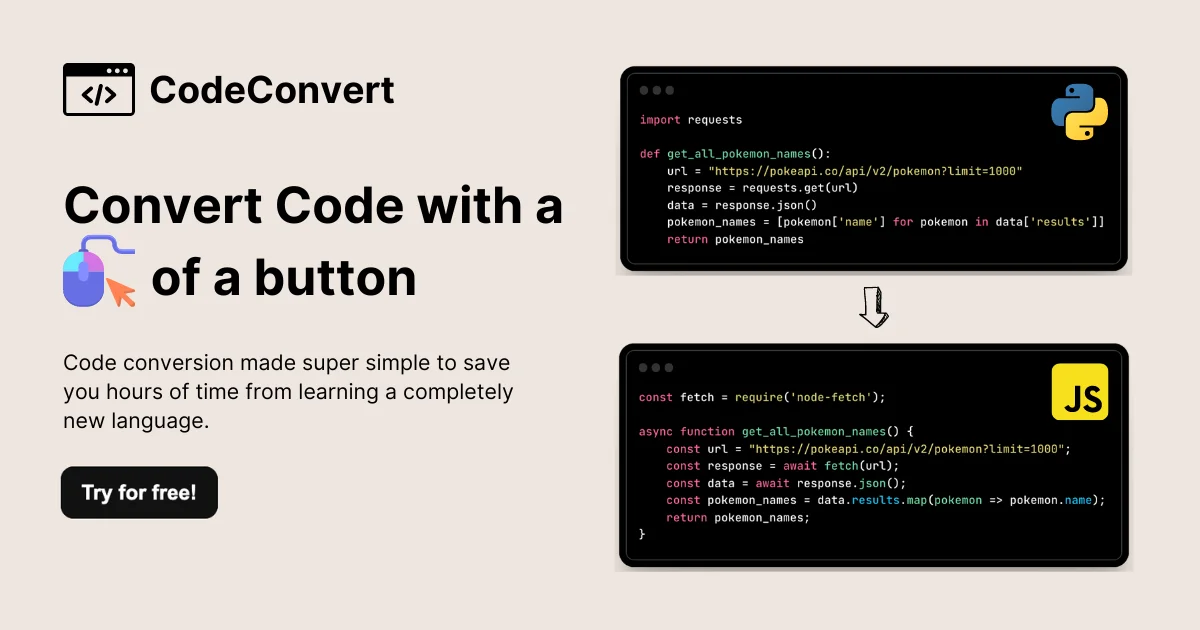
CodeConvert.ai is an AI-powered online code conversion tool that supports VB6 to VB.NET transformation at a snippet or file level. The tool is commonly used for quick experimentation rather than full enterprise migrations.
Pros
- Fast and easy to use
- Useful for small code samples or prototyping
Cons
- Not suitable for full project migration
- No dependency analysis or system-level context
- Data privacy and source code exposure concerns
Case Studies of Successful VB6 to VB.NET Migration
1. Siemens Healthineers
Siemens Healthineers publicly documented the modernization of legacy VB6-based internal tools to the .NET platform to support long-term maintainability and compliance. The migration focused on preserving critical workflows while aligning the system with modern Windows environments.
As a result, the organization improved system stability and reduced dependency on outdated technologies. The key lesson from this migration was the importance of phased conversion and rigorous validation of business logic.
2. HP Enterprise Services
HP Enterprise Services migrated several VB6-based enterprise applications to VB.NET as part of a broader modernization initiative. The transition allowed HP to standardize development practices and integrate legacy systems with newer enterprise platforms.
Following the migration, HP achieved better scalability and easier maintenance across its application portfolio. This case highlights how VB.NET enables long-term modernization without a full system rewrite.
3. ABB Group
ABB Group modernized internal VB6 applications used for industrial operations and reporting by migrating them to VB.NET. The migration was driven by the need for improved reliability and compatibility with modern operating systems.
The successful transition reduced operational risk and extended the lifecycle of critical systems. ABB’s experience shows that preserving proven business logic while upgrading the platform is often more effective than rebuilding from scratch.
Common Challenges in VB6 Modernization
A VB6 modernization project is rarely straightforward, as most migration tools and methods can introduce syntax issues, compatibility gaps, and business logic deviations. Therefore, before you decide to migrate VB6 to VB.NET, it is critical to understand the most common challenges that may impact stability, cost, and delivery timelines.
- Compile Errors After Conversion: Automated conversion often produces code that does not compile due to unsupported syntax or deprecated constructs. These errors can significantly slow down delivery if not handled systematically.
- ActiveX and COM Component Dependencies: Many VB6 applications rely on ActiveX controls and COM components that are not natively supported in VB.NET. Replacing or refactoring these components requires careful planning and testing.
- Win32 API Compatibility Issues: Direct calls to Win32 APIs may behave differently or require rewrites in a managed .NET environment. Incorrect handling can lead to runtime instability or security risks.
- Hidden Dependency Chains: Legacy VB6 systems often contain undocumented dependencies between modules, libraries, and external services. These hidden links can cause unexpected failures during or after migration.
- Business Logic Preservation Risks: Complex business rules embedded across forms and modules may be altered unintentionally during conversion. Even small logic deviations can have serious operational consequences.
Useful Tips for VB Migration Smoothly
- Always start with a full dependency audit before converting any code.
- Avoid migrating the entire system at once and prioritize business-critical modules first.
- Use automated conversion tools to accelerate migration, but plan manual validation for high-risk logic.
- Establish regression test cases early to verify business behavior after each migration phase.
- Refactor incrementally to improve maintainability instead of replicating legacy patterns.
- Maintain version control and rollback options throughout the migration process.
Conclusion
In summary, the decision to migrate VB6 to VB.NET requires careful planning, a clear understanding of technical challenges, and a structured migration approach to protect system stability and business continuity. While traditional migration tools often fall short in handling complex legacy code, advanced third-party solutions such as CodeShift VB stand out by deeply understanding legacy logic, improving automated migration quality, and effectively supporting compile error fixes and refactoring.
To receive tailored guidance for your enterprise migration needs, we recommend leaving your contact information with Newwave Solutions through the official form to explore a secure and efficient VB6 to VB.NET transition strategy through our CodeShift VB solution.
To Quang Duy is the CEO of Newwave Solutions, a leading Vietnamese software company. He is recognized as a standout technology consultant. Connect with him on LinkedIn and Twitter.



Read More Guides



Get stories in your inbox twice a month.
Let’s Connect
Let us know what you need, and out professionals will collaborate with you to find a solution that enables growth.
Leave a Reply