


Nearshore and Offshore – Which One is the Best for Your Outsourcing Services?
In the quest to build innovative technology while optimizing resources, business leaders are presented with a critical strategic choice: finding the right talent in the right location. The debate between nearshore and offshore outsourcing is more than just geography; it’s about aligning your operational model with your project’s DNA. This guide cuts through the complexity, offering a clear framework to help you decide whether a nearby partner or a distant expert is the key to unlocking your project’s success, ensuring your outsourcing strategy is a powerful engine for growth, not a hurdle.
What is Nearshore and Offshore?
Before we dive into the differences, let’s establish what these terms mean in the world of business outsourcing. At its core, outsourcing is the practice of hiring a third-party company or team to handle specific business functions, such as software development. This is where nearshore and offshore models come into play, each representing a different geographical and strategic approach to building your external team.
Nearshore
Nearshore outsourcing refers to delegating your business processes or services to a company located in a nearby country, typically within a similar time zone. For a business based in the United States, a nearshore partner would be located in a country like Mexico, Canada, or Brazil. The key here is proximity. This closeness isn’t just geographical; it often translates to greater cultural alignment, easier collaboration, and more convenient travel options. Think of it as working with a neighbor—communication is smoother, and coordination feels almost seamless.
Pros
- Similar Time Zones: Enables real-time collaboration, daily stand-up meetings, and faster feedback loops, which is crucial for Agile development methodologies.
- Cultural Affinity: Reduced cultural barriers lead to better understanding of business goals, fewer misunderstandings, and more harmonious teamwork.
- Easier Travel: Short flights allow for in-person kick-off meetings, workshops, and team-building activities without significant expense or jet lag.
- High-Quality Talent: Access to a skilled, often specialized talent pool that understands your regional market nuances.
Cons
- Higher Cost: While more cost-effective than hiring locally, nearshore services are generally more expensive than offshore options due to higher regional wage standards.
- Smaller Talent Pool: The selection of available companies and developers, while high-quality, is not as vast as the global offshore market.
Offshore
Offshore outsourcing involves partnering with a service provider in a distant, often lower-cost country, frequently with a significant time zone difference. Classic examples include U.S. companies working with teams in India, the Philippines, or Eastern European nations like Ukraine. The primary driver for offshore outsourcing is maximizing cost savings while accessing a massive and diverse pool of global talent. It’s a model built for scalability and efficiency on well-defined projects.
Pros
- Significant Cost Reduction: The most compelling advantage, offering the lowest labor rates and the highest potential for budget savings.
- Vast Talent Pool: Access to a enormous global network of developers with a wide range of skills and specializations.
- Around-the-Clock Potential: A major time zone difference can be leveraged as an advantage, allowing work to progress overnight on your local time, potentially accelerating project timelines.
- High Scalability: Easily scale your team up or down quickly due to the large availability of resources.
Cons
- Communication Challenges: Significant time zone differences can delay real-time communication and require meticulous planning for meetings.
- Cultural & Language Barriers: Differences in work culture, language fluency, and accents can sometimes lead to misunderstandings and require more careful management.
- Limited In-Person Interaction: Travel for face-to-face meetings is long, expensive, and often impractical.
What is Different Between Nearshore and Offshore?
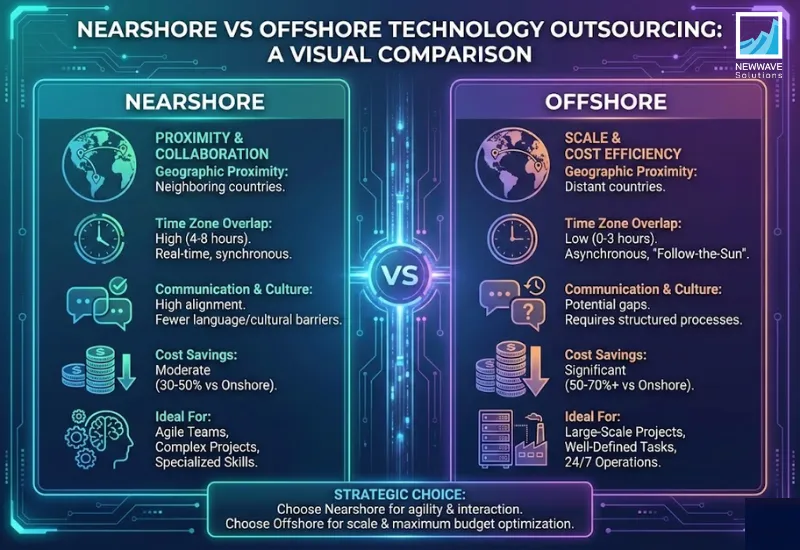
While both models involve hiring an external team, the difference between nearshore and offshore outsourcing boils down to a fundamental trade-off: cost versus convenience. Offshore outsourcing prioritizes maximum cost reduction, often at the expense of easy communication and cultural synergy. Nearshore outsourcing, on the other hand, offers a balanced approach, sacrificing some level of cost savings for greater operational efficiency, smoother collaboration, and strategic partnership. The best choice isn’t universal; it depends entirely on your project’s specific requirements, goals, and internal capabilities.
Let’s take a look at a table of Key Differences Between Nearshore and Offshore:
| Criteria | Nearshore Outsourcing | Offshore Outsourcing |
| Primary Goal | Balance between cost savings and operational efficiency. | Maximum cost reduction. |
| Location | Neighboring or nearby countries (e.g., Mexico for the USA). | Distant, low-cost countries (e.g., India, Philippines). |
| Time Zone | Similar or overlapping (1-3 hours difference). | Significantly different (8-12+ hours difference). |
| Communication | Easier. Real-time collaboration is feasible. | Challenging. Requires async communication and careful planning. |
| Cultural Similarity | Higher. Similar business cultures and practices. | Lower. Requires effort to bridge cultural gaps. |
| Cost Structure | Moderate savings. Good cost-quality balance. | Highest potential savings. Lowest labor costs. |
| Travel Ease | Easy and affordable. In-person meetings are viable. | Difficult and expensive. Meetings are typically virtual. |
| Talent Pool | Smaller, but often high-quality and regionally specialized. | Extremely large and diverse. |
In general, the nearshore vs offshore outsourcing debate doesn’t have a one-size-fits-all winner. Nearshore is your go-to for projects requiring close collaboration and strategic input, while offshore is ideal for well-defined projects where budget is the primary constraint and the work can be done independently.
Nearshore and Offshore, Which One is Better for You?
The question isn’t which model is objectively better, but which one is better for you. Your unique project needs, company culture, and strategic goals will point you toward the right answer. To make this critical decision, you need a structured framework to evaluate your options. Here are criteria to compare and choose the Best Model for your business:
1. Project Requirements & Complexity
The nature of your project plays a crucial role in determining the right outsourcing model.
- Choose Nearshore if your project requires high collaboration. If you’re developing a complex, innovative product that demands daily communication, real-time feedback, and close integration with your in-house team—such as in Agile or Scrum frameworks—nearshore is ideal. Its geographical and temporal proximity ensures smoother coordination and faster decision-making.
- Choose Offshore if your project is well-defined and independent. For tasks that are clearly documented and can be executed with minimal oversight, such as software maintenance, support, or modular development, offshore outsourcing offers significant cost advantages. The time zone difference becomes less critical when workflows are structured and autonomous.
2. Communication & Culture
Effective communication is the backbone of successful outsourcing.
- Prioritize Nearshore for real-time interaction. If your project involves brainstorming, rapid iterations, or spontaneous discussions, nearshore’s overlapping time zones and cultural similarities facilitate seamless communication.
- Evaluate language proficiency and cultural affinity. Regardless of the model, ensure your partner’s team is fluent in your language and understands your business culture. This reduces misunderstandings and fosters a more productive working relationship.
3. Total Cost of Engagement
While hourly rates are important, the total cost of engagement provides a more accurate financial picture.
- Offshore typically offers lower hourly rates. This makes it attractive for budget-conscious projects.
- Consider hidden costs. Offshore engagements may require additional investment in management, documentation, and travel. Nearshore may have higher hourly rates but often involves lower hidden costs due to easier collaboration and reduced need for extensive oversight.
4. Talent & Expertise
The right talent can make or break your project:
- Match the model to your skill requirements. Certain regions specialize in specific technologies or industries. For example, India is renowned for IT development, while Eastern Europe excels in engineering and game development. Choose a partner whose expertise aligns with your project’s needs.
- Decide between innovation and execution. If you need a team to contribute strategically and innovate, nearshore’s collaborative environment is preferable. If you need efficient execution of a predefined plan, offshore can deliver quality results at a lower cost.
5. Risk Management
Mitigating risks is essential for a successful outsourcing partnership:
- Assess data security and IP protection. Ensure your partner complies with international standards (e.g., ISO 27001) and has robust measures in place to protect your intellectual property.
- Evaluate political and economic stability. Choose a destination with a stable business environment to avoid disruptions.
- Focus on vendor reliability. Conduct thorough due diligence, including reference checks and case studies, to ensure your partner has a proven track record. Starting with a pilot project can help you gauge their capabilities before committing long-term.
So how to choose the best models?
We’ve followed criteria to choose above, but how to choose by process in a clear way? By following these criteria, you can move beyond the hype and choose a model that aligns perfectly with your vision for success:
1. Define Your Primary Goal
Start by asking yourself the most important question: “What is the #1 objective I want to achieve by outsourcing?” Your answer will immediately narrow down your choices:
- Choose Offshore if your primary goal is maximum cost reduction. If the driving force behind outsourcing is to achieve the lowest possible operational expense for a well-defined task, then the significant labor cost advantages of an offshore model are likely your best bet.
- Choose Nearshore if your goal is strategic partnership and efficiency. If you value real-time collaboration, easier communication, and want a team that can integrate deeply with your in-house processes and contribute strategically, the nearshore model is worth the investment.
2. Analyze Your Project’s Nature
The characteristics of your project are a major deciding factor. Break down your project’s requirements:
- Choose Nearshore for complex, collaborative projects. If your initiative requires constant communication, rapid iterations, and Agile development (e.g., building a minimum viable product from scratch), the proximity and time zone alignment of a nearshore team are invaluable.
- Choose Offshore for independent, well-defined tasks. For projects that are clearly documented and can be executed with minimal daily oversight (e.g., QA testing, maintenance, or specific modular development), the offshore model can deliver quality results efficiently and cost-effectively.
Matching the model to the project’s communication needs is key to avoiding friction and delays.
3. Evaluate Your Internal Capabilities
Be honest about your own company’s structure and management style. Do you have a seasoned, dedicated project manager who is experienced in handling cross-cultural, cross-timezone teams?
- Choose Nearshore if your management bandwidth is limited. If you lack a dedicated project manager experienced in handling cross-cultural teams and large time zone gaps, a nearshore partner will be far easier to manage and integrate seamlessly.
- Choose Offshore if you have strong project management. If you have an experienced PM who can create detailed specifications, manage asynchronous communication, and navigate cultural differences, you can successfully leverage an offshore team and its cost benefits.
4. Conduct a Vendor Shortlist
Once you’ve leaned towards a model, the next step is to find the right partner. Don’t just choose a country; choose a company. Look for vendors with:
- Proven expertise in your required technology stack.
- Strong client testimonials and case studies.
- Robust communication and project management processes.
- Transparency in their pricing and operations.
- A cultural mindset that aligns with your own.
The success of your project hinges more on the vendor’s expertise and processes than on their location. Whether you lean towards nearshore or offshore, shortlist partners with proven expertise in your technology stack, stellar client testimonials, and transparent communication practices. A great partner in either model is better than a mediocre one in the “perfect” model.
5. Run a Pilot Project
This is your most important step. Before you sign a massive contract for a year-long project, start with a pilot. Engage your shortlisted vendor for a small, well-scoped project lasting 4-8 weeks. Use this pilot to evaluate the real-world communication flow, the quality of the code delivered, their problem-solving approach, and the overall cultural fit. The pilot project will give you concrete data and experience to make your final, confident decision.
Why Choosing Outsourcing with Newwave Solutions?
Navigating the nearshore and offshore landscape can be complex, but you don’t have to do it alone. At Newwave Solutions, we blend the best of both worlds to provide a seamless, high-value outsourcing experience. Based in a strategically advantageous location, we offer a powerful balance of nearshore-like collaboration and competitive, offshore-style pricing.
Our strength lies in our ability to act as a true extension of your team. We prioritize transparent communication, Agile processes, and deep technical expertise to ensure your project’s success. Whether you need to looking for software outsourcing services or hire mobile app developers to build the next killer iOS or Android application, hire game developers for an immersive Unity or Unreal Engine experience, or hire full stack developer teams to own a project from front-end to back-end, we have the talent ready to integrate with your workflow.
Our extensive hire developers services cover every facet of modern technology:
- Hire Front-End Developers (React, Angular, Vue.js)
- Hire Back-End Developers (Node.js, .NET, Python, Java)
- Hire Software Developer specialists
- Hire Web Developer experts for robust web applications
- Hire QA Engineers to ensure flawless performance and user experience
We eliminate the traditional risks of outsourcing by providing dedicated teams that work exclusively on your projects, coupled with rigorous project management and a commitment to quality that mirrors your own. Choosing Newwave Solutions means choosing a partner committed to your growth, not just a vendor fulfilling a task.
The journey through the world of nearshore and offshore outsourcing reveals that the “best” choice is deeply personal to your business. It’s a strategic decision weighing cost, control, collaboration, and culture. By thoroughly defining your goals, understanding your project, and carefully selecting a partner like Newwave Solutions, you can transform outsourcing from a daunting challenge into your most powerful competitive advantage. The global talent pool is waiting; now you have the map to navigate it successfully.
To Quang Duy is the CEO of Newwave Solutions, a leading Vietnamese software company. He is recognized as a standout technology consultant. Connect with him on LinkedIn and Twitter.



Read More Guides

Get stories in your inbox twice a month.
Let’s Connect
Let us know what you need, and out professionals will collaborate with you to find a solution that enables growth.
Leave a Reply