


What Is Offshore Outsourcing? Types, Advantages & Disadvantages
Offshore outsourcing helps businesses expand delivery capacity without increasing fixed costs. It provides access to global talent, faster execution, and greater flexibility. With the right partner, offshore outsourcing can support growth while keeping internal teams focused on strategic goals. This guide explains the offshore outsourcing meaning, the business impact, models, selection criteria, and day-to-day management practices—so we can capture the upside while controlling the downside.
What Is Offshore Outsourcing?
Offshore outsourcing is a business model where a company hires a third-party provider in another country to manage specific tasks, operations, or processes. Businesses often use offshore outsourcing to lower operational costs, access specialized global talent, scale teams faster, and maintain continuous work across different time zones.
Which Industries Can Use Offshore Outsourcing?
Offshore outsourcing is highly versatile. Almost every industry can benefit, but the following sectors rely on it the most:
- Information Technology (IT) – Offshore software outsourcing and application development.
- E-commerce and Retail – Customer service, logistics management, and marketing automation.
- Finance and Fintech – Accounting, analytics, and fraud detection.
- Healthcare – Medical billing, data entry, and telehealth software development.
- Manufacturing – Production outsourcing for cost efficiency and resource optimization.
- Education & E-learning – App and platform development for digital learning.
Offshore Outsourcing vs nearshore vs onshore
Offshore outsourcing is one of several outsourcing approaches organizations can choose from, alongside nearshore and onshore models. Offshore outsourcing often favored for cost savings and global talent access, nearshore outsourcing for closer time zone alignment, and onshore outsourcing for the highest level of proximity and collaboration.
|
Model |
Definition | Key Benefits | Main Challenges |
Best For |
| Offshore Outsourcing | Working with a service provider in a distant country, often across major time zones. | Lower costs, larger talent pools, flexible scaling, and extended development coverage. | Time zone gaps, cultural differences, and higher need for process control. | Software development, QA, IT support, BPO, and long term delivery teams. |
| Nearshore Outsourcing | Partnering with a provider in a nearby country with similar or overlapping time zones. | Easier communication, faster collaboration, cultural proximity, and moderate cost savings. | Smaller talent pool than offshore and higher costs than some offshore markets. | Agile development, product teams, customer support, and projects needing frequent meetings. |
| Onshore Outsourcing | Hiring an external provider within the same country. | Strong communication, legal familiarity, easier site visits, and closer market understanding. | Higher labor costs and limited scalability in competitive talent markets. | Regulated industries, strategic consulting, local support, and projects requiring close coordination. |
How Offshore Outsourcing Works
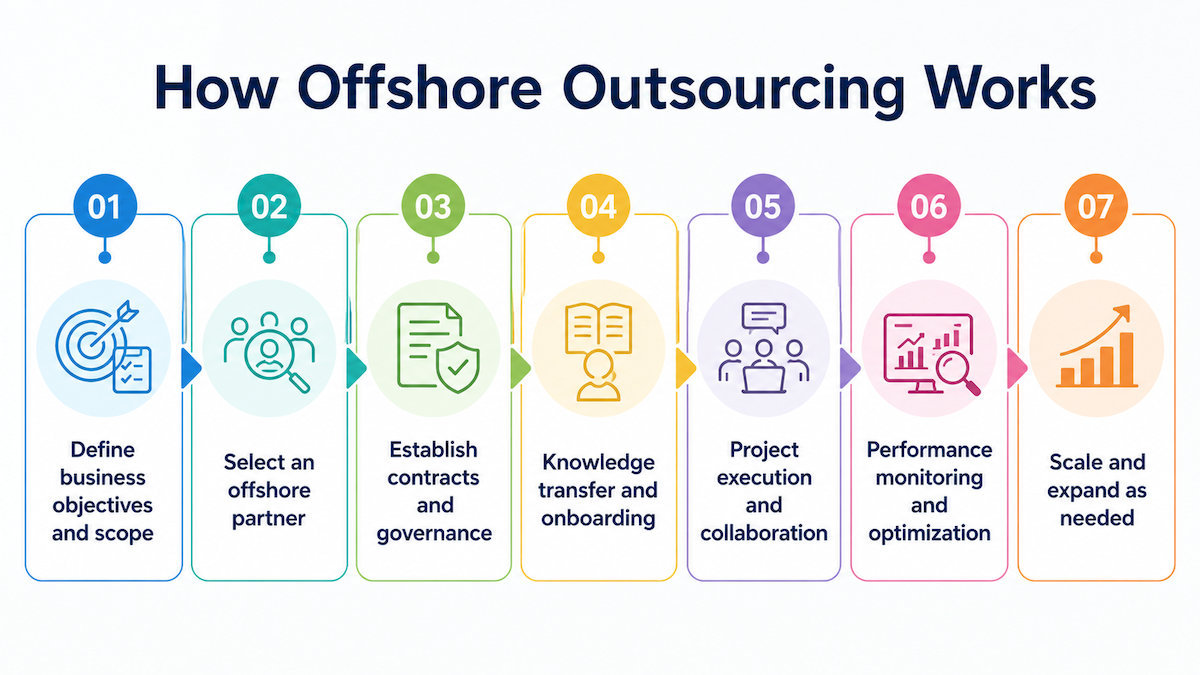
Offshore outsourcing follows a structured process that allows businesses to access external expertise while maintaining control over goals, priorities, and outcomes. Although the exact approach varies by project, most successful outsourcing engagements follow these key stages:
- Define business objectives and scope: Identify the functions, projects, or processes to outsource, along with expected outcomes, timelines, budgets, and performance requirements.
- Select an offshore partner: Evaluate providers based on technical expertise, industry experience, delivery capabilities, security standards, and cultural fit.
- Establish contracts and governance: Agree on engagement models, SLAs, communication protocols, reporting structures, security requirements, and compliance obligations.
- Knowledge transfer and onboarding: Share business requirements, workflows, documentation, and operational processes to ensure the offshore team can work effectively from the start.
- Project execution and collaboration: The offshore team delivers services through agreed workflows, tools, and communication channels while coordinating regularly with internal stakeholders.
- Performance monitoring and optimization: Track KPIs, quality metrics, delivery progress, and business outcomes. Regular reviews help identify improvements and optimize performance over time.
- Scale and expand as needed: As business needs evolve, organizations can increase team size, add new capabilities, or expand the scope of outsourced services without major recruitment efforts.
How Many Types of Offshore Outsourcing?
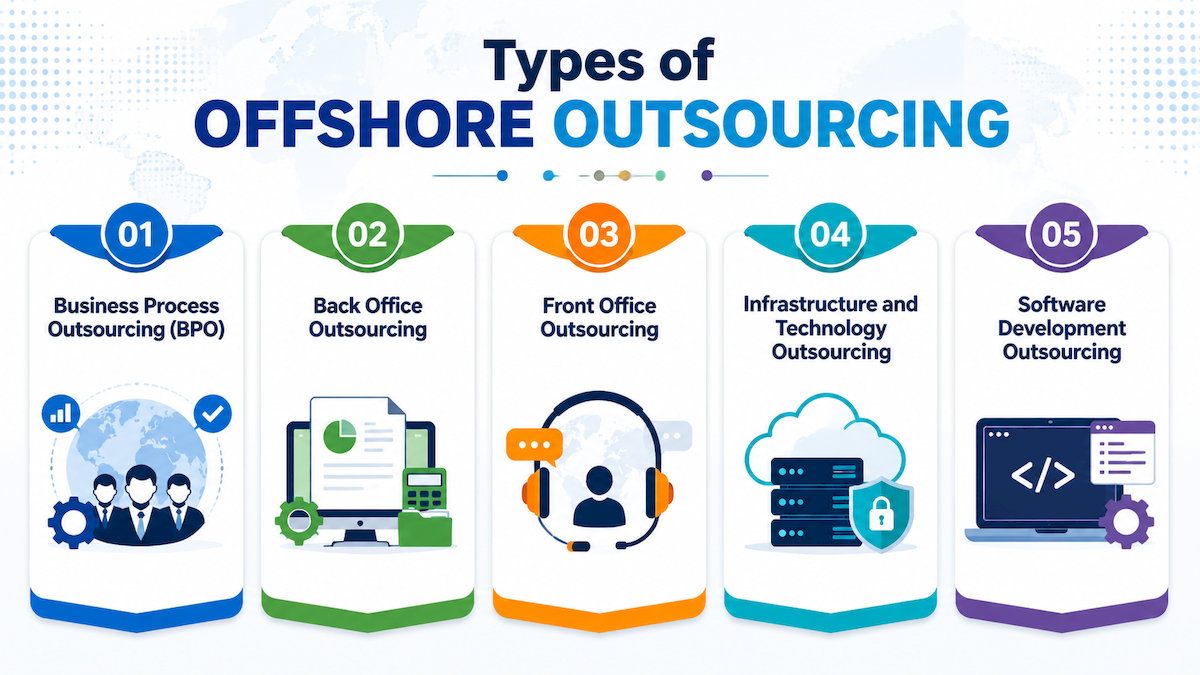
There are several types of offshore outsourcing, each suited to different objectives. Below we detail the most common models and how they work:
|
Outsourcing Type |
Definition | Best For | Key Advantages |
Main Challenges |
| Business Process Outsourcing (BPO) | Delegating repeatable business functions such as customer support, finance, HR, or claims processing to offshore providers. | Organizations with high volume transactional work. | Scalable operations, measurable KPIs, process visibility, and lower costs. | Knowledge transfer, context understanding, and business alignment. |
| Back Office Outsourcing | Outsourcing internal administrative tasks such as payroll, data entry, accounts payable, and vendor onboarding. | Finance, logistics, eCommerce, and enterprises with heavy admin workloads. | Lower transaction costs, faster turnaround, and automation opportunities. | Data security, compliance, and quality control. |
| Front Office Outsourcing | Delegating customer facing operations such as contact centers, support, sales assistance, and L1 technical help. | Businesses needing 24/7 customer support or seasonal service capacity. | Round the clock coverage, multilingual support, and lower service costs. | Brand consistency, product knowledge, and customer empathy. |
| Infrastructure and Technology Outsourcing | Outsourcing IT operations, infrastructure management, DevOps, NOC, SOC, and platform reliability work. | Enterprises lacking in house infrastructure or SRE expertise. | Better uptime, proactive monitoring, stronger security, and predictable costs. | Access control, cost transparency, and operational visibility. |
| Software Development Outsourcing | Delegating product engineering tasks such as discovery, UI/UX, coding, QA, DevOps, deployment, and support. | Companies needing faster development, niche skills, or scalable engineering teams. | Access to specialized talent, faster releases, flexible scaling, and better resource use. | IP protection, architecture consistency, and coding standards. |
>> For more insights of types of outsourcing, consider to read our blog: Outsourcing vs Offshoring: Which Is Better for Making Strategic Business Decisions?
Advantages and Disadvantages of Offshore Outsourcing
While the offshore outsourcing benefits are compelling, understanding its potential drawbacks is equally crucial. Companies that evaluate both sides from the start can design a balanced outsourcing strategy—one that reduces risks, ensures efficiency, and supports long-term growth. Below is a complete look at the offshore outsourcing pros and cons to help you make informed decisions.
Advantages of Offshore Outsourcing
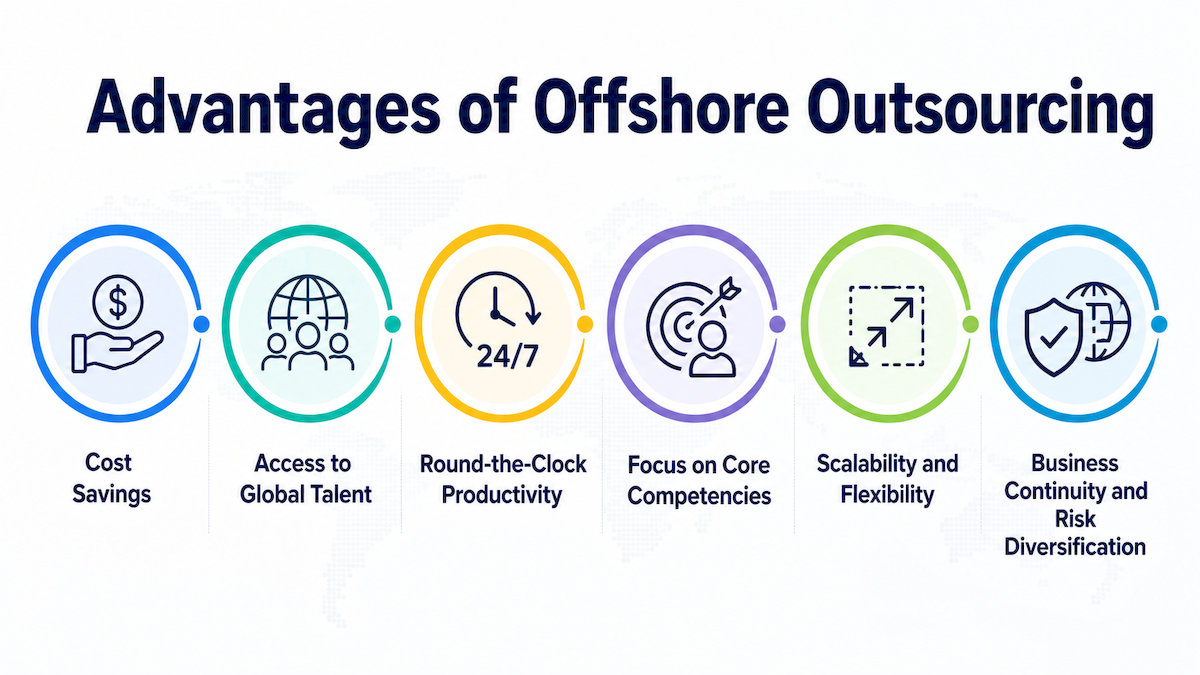
1. Cost Savings
The most common reason companies choose offshore outsourcing is cost optimization. By delegating work to countries with lower labor and operational costs, businesses can save significantly on salaries, facilities, and utilities while maintaining high output quality.
- Example: Many Western companies outsource administrative or manufacturing functions to Vietnam or India, where costs can be 40–70% lower.
- Impact: Reduced OPEX, higher profit margins, and the ability to reinvest in innovation or market expansion.
- Best for: Manufacturing, logistics, finance, and customer service industries seeking leaner operations.
2. Access to Global Talent
Offshore outsourcing opens the door to a worldwide pool of skilled professionals, which larger talent pools when compared with onshore outsourcing. From finance and HR specialists to engineers and designers, companies can access expertise that may not be readily available locally.
- Benefit: A wider choice of vendors and professionals with diverse skills, language capabilities, and cultural backgrounds.
- Outcome: Higher-quality outputs and improved innovation through diverse perspectives.
- Industries leveraging this: Healthcare, IT, R&D, and business consulting.
3. Round-the-Clock Productivity
When your offshore partner operates in a different time zone, your business can run 24 hours a day. This continuous cycle means faster project turnaround, shorter delivery times, and uninterrupted customer support. And this lead to results are you could improve customer satisfaction with faster service response, and enhanced productivity.
4. Focus on Core Competencies
By outsourcing non-core tasks, organizations can dedicate more time and resources to core business activities—such as innovation, strategy, and customer relationships. This makes the positive impact on business, which enhanced productivity and organizational focus on high-value areas that drive revenue. The smartest companies use offshore outsourcing not just to save money, but to free their teams for the work that differentiates them in the market.
5. Scalability and Flexibility
Offshore outsourcing enables companies to scale operations quickly without the burden of permanent hiring or infrastructure costs. Whether responding to market expansion or seasonal demand, capacity can be adjusted with minimal disruption. Hence, business can have greater agility to meet market changes while minimizing risk. This flexibility is especially valuable for startups and enterprises that experience fluctuating workloads or rapid growth phases.
6. Business Continuity and Risk Diversification
Offshore outsourcing helps distribute operational risks by diversifying locations and partners. In the event of local disruptions—political, economic, or environmental—offshore teams can maintain workflow stability. With offshore outsourcing, business can reduce downtime, steady delivery, and a stronger global footprint. Offshore outsourcing is not just about efficiency—it’s also a resilience strategy for long-term sustainability.
Disadvantages of Offshore Outsourcing
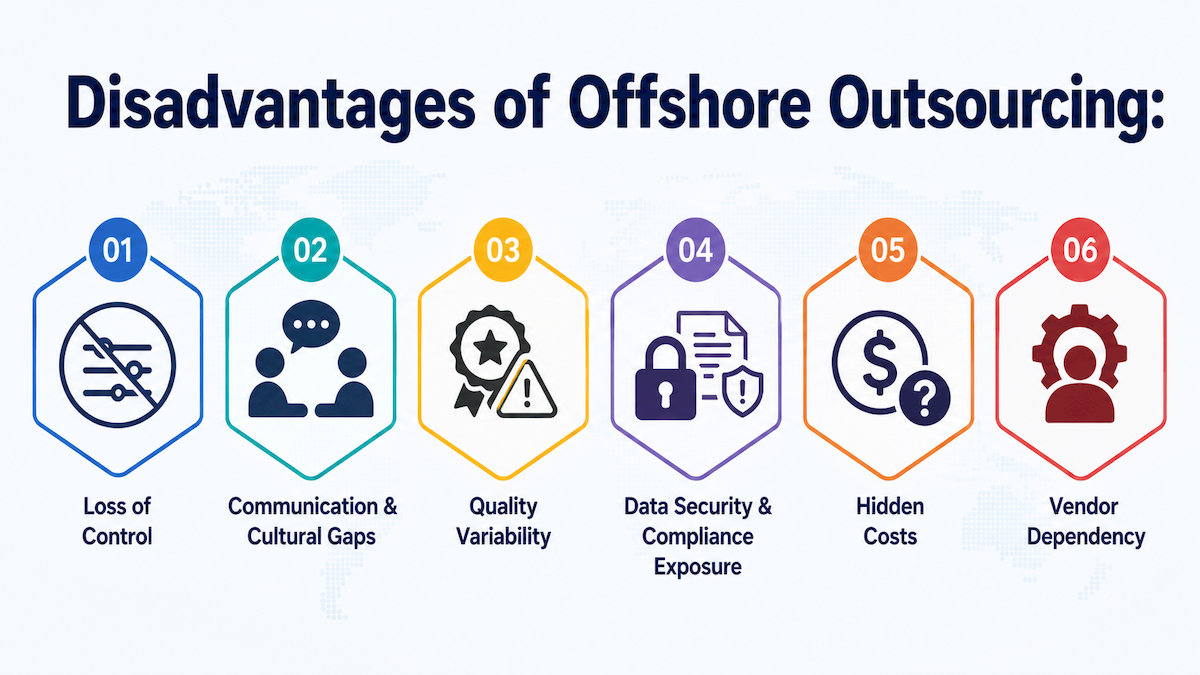
1. Loss of Control
The benefits include major cost savings, but with an equally dreadful downside: the absence of direct control. While starting businesses have little problem keeping close oversight when they hire locally, outsourcing tasks to remote teams can make this difficult. The lack of managerial influence may lead to miscommunication and diverging priorities, making it hard to ensure that the job is done according to the vision.
2. Communication & Cultural Gaps
Working across continents introduces time-zone delays, language nuances, and cultural differences in communication or decision-making. Without overlapping hours, shared documentation, and well-defined rituals (like daily syncs or sprint reviews), alignment fades and delivery velocity drops. Misunderstandings can snowball into rework or missed expectations.
3. Quality Variability
Quality often fluctuates when KPIs, coding standards, and review processes are not clearly enforced. Inconsistent testing, rushed handoffs, or lack of peer reviews can lead to defects slipping through the cracks. Over time, rework and technical debt can consume the very savings outsourcing was meant to deliver.
4. Data Security & Compliance Exposure
Offshoring involves moving sensitive information—sometimes customer or financial data—across jurisdictions. If the partner lacks robust security frameworks (SOC2, ISO 27001) or the data-processing roles are unclear, compliance risks multiply. Weak access controls, unencrypted transfers, or unclear IP ownership can result in audit failures or legal exposure.
5. Hidden Costs
When scope, deliverables, and responsibilities aren’t tightly defined, hidden expenses surface: change requests, integration rework, travel for alignment, or post-launch support not covered in the contract. These indirect costs can inflate the total cost of ownership (TCO) and offset expected savings.
6. Vendor Dependency
Relying too heavily on a single offshore partner can create operational and strategic lock-in. If the vendor faces talent churn, financial instability, or capacity issues, your delivery pipeline is at risk. A balanced portfolio—retaining key capabilities in-house and maintaining transition plans—reduces that dependency.
For mitigation in one line:
Define KPIs, SLOs, and acceptance criteria early; embed automated quality and security checks; maintain transparent governance; and keep product ownership and architecture decisions under your control.
When all things are considered, offshore outsourcing must be done after weighing its pros and cons to ensure that it fits well in the framework of your business’s long-term strategy.
How to Pick the Right Offshore Partner?
Choosing the right offshore outsourcing partner starts with aligning your business goals to the partner’s strengths, maturity, and delivery capabilities. The ideal partner should bring proven technical expertise, process transparency, and a security-first mindset—while also fitting your culture, time zone, and communication style. A good offshore partner isn’t just a vendor; they operate as an integrated extension of your team, ensuring consistency, scalability, and accountability across every stage of development. Success comes from selecting the right location, evaluating operational readiness, and partnering with a company that can scale confidently with your long-term strategy.
Right Locations
The best offshore outsourcing destinations share five characteristics: talent availability, technical maturity, cost efficiency, language proficiency, and geopolitical stability. However, not every country fits every need. Choosing the right location depends on your project type, security requirements, time-zone preferences, and the scale of collaboration you envision.
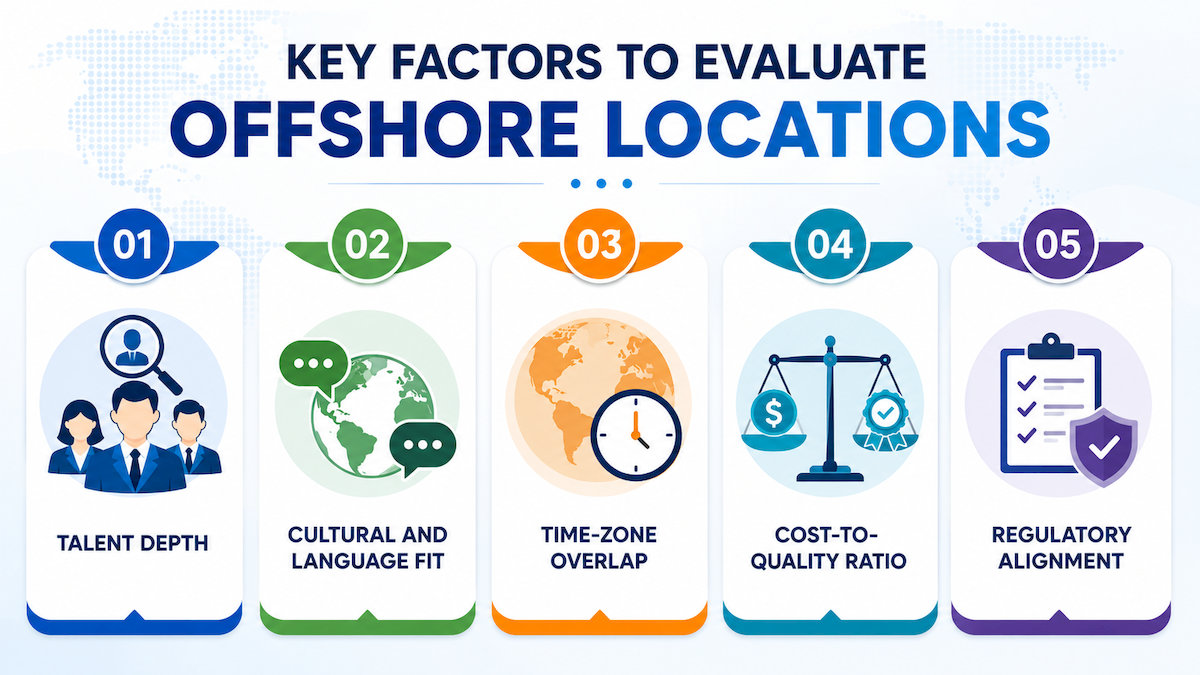
When evaluating offshore locations, consider:
- Talent depth: Access to specialized engineers, domain experts, and certified professionals.
- Cultural and language fit: Communication fluency and alignment with your working culture.
- Time-zone overlap: Ability to maintain real-time collaboration for agile teams.
- Cost-to-quality ratio: Not just cheap labor, but sustainable value over the long term.
- Regulatory alignment: Countries with clear data protection and IP enforcement laws.
Here’s a quick snapshot of industry-to-location fit based on global strengths and focus areas:
| Industry / Need | Strong Matches & Rationale |
|---|---|
| Product Engineering (Web/Mobile, Cloud) | Vietnam (balance of cost, skill, and reliability; fast-growing senior developer pool), Poland (EU proximity, exceptional computer science talent), India (massive scale, diverse frameworks and technology stack). |
| Data/AI & Analytics | Poland, Romania, India – deep STEM backgrounds, enterprise-level experience, and availability of data scientists and AI/ML engineers. |
| 24/7 Customer Support | Philippines (native English fluency, strong CX orientation), Malaysia (multilingual capacity), Colombia (strategic for U.S. time-zone alignment). |
| Finance & Back Office Operations | India, Vietnam – proven at handling large-scale finance processes, automation expertise (RPA/ML), and high compliance awareness. |
| Security Operations (SOC/NOC) | Mexico, Poland, India – certified cybersecurity professionals, 24/7 coverage, and deep enterprise security maturity. |
| Media & Localization | Philippines, Vietnam, Eastern Europe – extensive experience in content operations, media QA, and multilingual adaptation. |
Regional insights:
- Vietnam delivers an exceptional blend of affordability, quality, and reliability. With a rapidly growing IT ecosystem, strong government backing, and cultural compatibility with Western markets, it’s emerging as one of the top destinations for offshore software outsourcing.
- Eastern Europe (Poland, Romania, Ukraine) offers strong technical education, EU compliance, and cultural proximity—making it ideal for enterprise clients and startups across Europe.
- The Philippines remains the global hub for customer experience outsourcing thanks to its service culture, fluency in English, and experience supporting large-scale front-office operations.
Right Partners & Tips
Finding the right offshore outsourcing partner is not just about cost—it’s about trust, capability, and process maturity. The right partner should feel like an extension of your own team, not a separate vendor.
Here’s how to evaluate potential partners thoroughly:
1. Evidence of Outcomes
Look for proven success stories, not just promises. Ask for case studies, references, and quantifiable results such as delivery velocity, defect escape rate, or SLA adherence. A credible partner will show you past projects that mirror your industry or tech stack.
2. Security & Compliance Readiness
Data protection must be non-negotiable. Confirm that your partner complies with SOC 2, ISO 27001, and GDPR or equivalent local data laws. Ensure they have Data Processing Agreements (DPA) in place, enforce least-privilege access (IAM), and can offer data residency options to comply with local regulations.
3. Team Composition & Leadership
Insist on meeting the actual delivery leads, not just sales executives. Assess technical seniority, domain fit, and leadership stability. Ask how they structure teams—whether they use dedicated squads or cross-functional pods—and evaluate their retention rates.
4. Process & Tooling Maturity
Your offshore partner’s process discipline determines your long-term success. Evaluate whether they use modern engineering practices like CI/CD pipelines, test automation, observability tools, and structured incident management. Mature partners document everything and maintain transparent dashboards on performance metrics.
5. Communication & Collaboration Quality
Healthy communication is the backbone of distributed delivery. Ensure the partner offers:
- Time-zone overlap for key meetings and demos.
- Strong English proficiency or multilingual capability.
- Clear demo cadence, sprint rituals, and decision logs.
- Transparent escalation paths and governance structure.
6. Financial Stability & Scalability
Assess the vendor’s long-term sustainability. Check their financial background, team size, and bench depth. A partner with stable funding and low attrition in core roles is more likely to deliver continuity and quality over time.
7. Contract Clarity & Governance
A solid Master Service Agreement (MSA) should define IP ownership, warranties, confidentiality, liability limits, and exit procedures. Always secure clauses for source code ownership, data protection, and change management to avoid disputes. Governance frameworks should define how you track progress, approve changes, and manage scope.
Practical Tips for Selecting Offshore Partners
- Start with a pilot project: Run a 2–4 week discovery sprint to test collaboration, delivery speed, and quality before committing to a long-term contract.
- Lock KPIs early: Define measurable goals—velocity, code coverage, MTTR, CSAT, or defect rates—tied directly to business outcomes.
- Avoid vendor lock-in: Keep control of architecture, backlog, and release approvals internally. Maintain your IP and ensure all repositories are in your organization’s name.
- Document relentlessly: Maintain architecture decision records (ADRs), runbooks, SOPs, and a living product wiki to ensure smooth onboarding and continuity.
- Budget for sustainment: Plan resources for post-launch optimization, monitoring, and analytics-driven improvements. Sustainable partnerships don’t end at release—they evolve.
Partnering with an offshore team is a long-term strategic investment, not a transaction. The right location ensures access to quality talent; the right partner ensures consistent delivery, trust, and innovation. At Newwave Solutions, which one of the best IT outsourcing companies based in Vietnam, we combine both—offering a cost-efficient, technically advanced, and secure offshore outsourcing model designed for global enterprises seeking scalability and quality without compromise.
How to Manage Your Offshore Outsourcing Services?
Successful offshore outsourcing depends on more than selecting the right provider. Clear governance, effective communication, and ongoing performance management are essential for maintaining quality, minimizing risks, and achieving long term business goals.
Best practices for managing offshore outsourcing
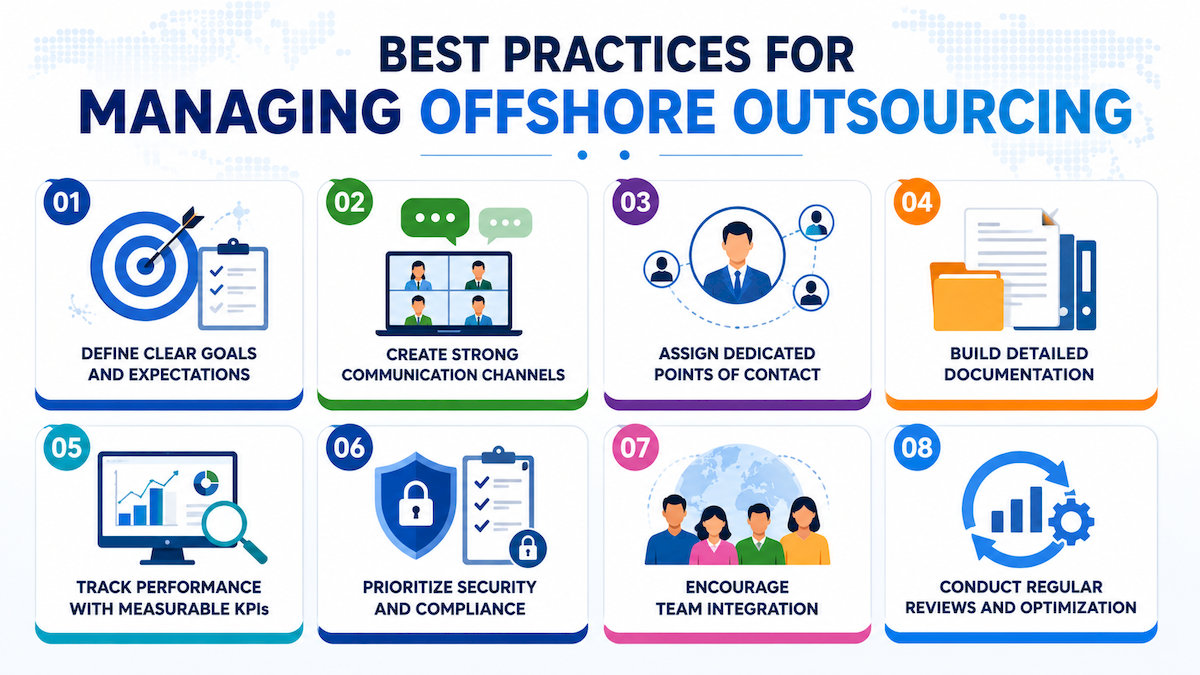
- Define clear goals and expectations: Establish project objectives, deliverables, timelines, KPIs, and responsibilities from the beginning.
- Create strong communication channels: Use regular meetings, collaboration tools, and documented workflows to keep teams aligned across locations.
- Assign dedicated points of contact: Designate internal and vendor-side stakeholders to streamline decision making and issue resolution.
- Build detailed documentation: Maintain up to date requirements, processes, technical specifications, and knowledge bases to reduce misunderstandings.
- Track performance with measurable KPIs: Monitor quality, productivity, delivery speed, SLA compliance, and business outcomes through regular reporting.
- Prioritize security and compliance: Implement access controls, NDAs, data protection policies, and compliance reviews to safeguard sensitive information.
- Encourage team integration: Treat offshore teams as part of the broader organization through shared goals, collaboration, and regular engagement.
- Conduct regular reviews and optimization: Evaluate performance, gather feedback, and continuously improve processes to maximize outsourcing value over time.
Management factors to track
Managing an offshore team requires visibility into both delivery outcomes and operational health. Tracking the right metrics helps organizations identify risks early, improve decision making, and ensure outsourcing investments continue to deliver measurable business value.
- Delivery: Velocity trend, predictability (planned vs. done), lead time, change failure rate.
- Quality: Defect density, test coverage, escaped defects, MTTR, performance regressions.
- Reliability: SLO attainment, uptime, incident frequency/severity.
- Cost: Burn vs. value delivered, cloud/runtime cost per feature or user, efficiency trajectory.
- Engagement: Team stability, satisfaction, communication responsiveness, escalation resolution time.
- Compliance: Access audits, data handling conformance, evidence for certifications.
One guardrail: keep product ownership and key architectural decisions in-house. The partner should advise and execute; we decide the trade-offs.
Is Offshore Outsourcing Right for Your Business?
Offshore outsourcing is especially valuable when internal teams need more execution capacity, better delivery focus, and stronger operational resilience. Among all outsourcing models, IT outsourcing is one of the most widely used because businesses now rely on software, cloud, automation, and digital platforms to stay competitive.
To turn that demand into real business outcomes, working with an experienced technology partner becomes essential, and Newwave Solutions is ready to support that journey.
At Newwave Solutions, we help businesses worldwide build, launch, and scale digital products through flexible IT outsourcing services backed by 14+ years of experience, 300+ technology professionals, and 800+ successful projects delivered across industries.
Why Businesses Choose Newwave Solutions
Businesses across industries (healthcare, fintech, real estate…) partner with Newwave Solutions to gain reliable technology expertise, accelerate innovation, and achieve sustainable growth. Here are some of the key reasons clients choose to work with us:
- Access Specialized Technology Expertise: Work with experienced software engineers, QA specialists, cloud architects, DevOps professionals, AI experts, and business analysts without lengthy recruitment cycles.
- Accelerate Time to Market: Expand delivery capacity quickly and bring products to market faster through dedicated teams and proven Agile development practices.
- Scale Resources on Demand: Adjust team size, project scope, and technology capabilities as business priorities evolve without increasing permanent overhead.
- Optimize Development Costs: Leverage Vietnam’s highly skilled engineering talent to achieve significant cost efficiencies while maintaining quality and security standards.
- Enterprise Grade Security and Quality: Benefit from ISO 27001 certified processes, secure development practices, comprehensive testing, and transparent project governance.
Proven Offshore Delivery in Action
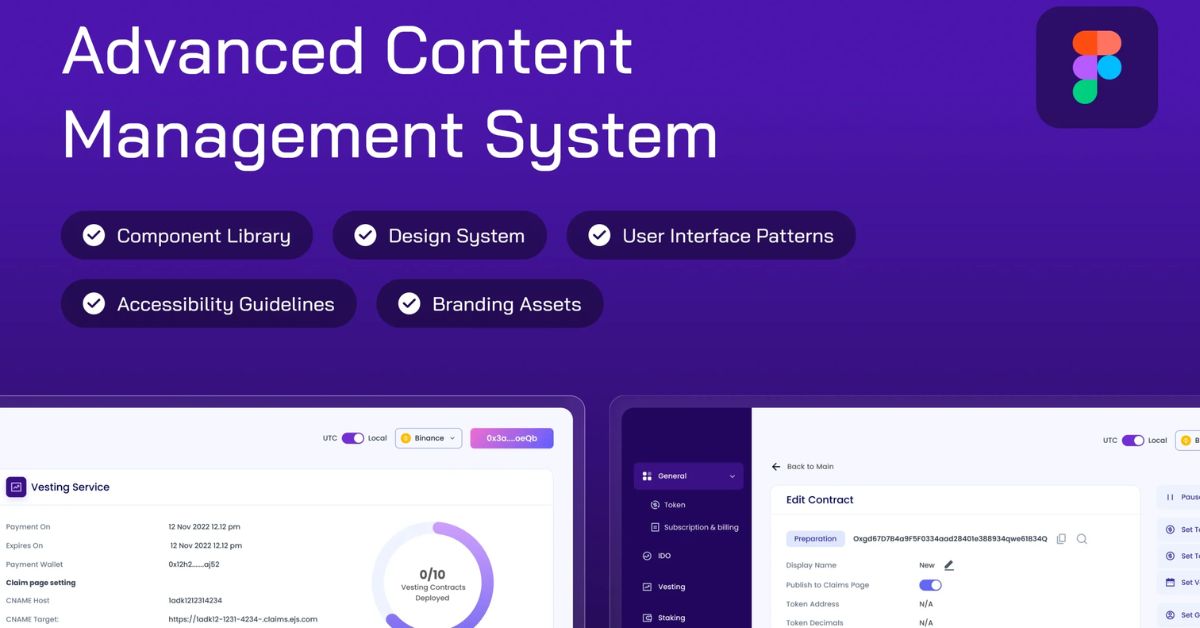
Newwave Solutions helps businesses solve complex technical challenges by combing domain expertise, modern technologies, and scalable delivery models. One example is a blockchain powered digital wallet platform developed for a global client seeking to enter the fast growing decentralized finance market.
Challenge
The client approached Newwave Solutions with an ambitious vision: to launch a secure blockchain powered digital wallet. While the opportunity was significant, building an in house blockchain team from the ground up would have required substantial investment and extended timelines. To move faster without compromising quality, they turned to our offshore development model.
Our solution
Newwave Solutions assembled a dedicated team of blockchain specialists, mobile developers, backend engineers, and QA experts. Together, we transformed the initial concept into a fully functional digital wallet ecosystem, complete with secure asset management, smart staking capabilities, and an intuitive user experience designed for long term growth.
Result
The collaboration resulted in the successful launch of a scalable blockchain based financial platform. By leveraging our offshore expertise, the client was able to accelerate development, access highly specialized talent, and bring their product to market efficiently.
Whether you need a dedicated development team, end to end product development, cloud services, QA and testing, or long-term technology support, Newwave Solutions is ready to help. Contact us today to discuss your project and discover how our IT outsourcing services can accelerate your business goals.
Final Thoughts
The growing adoption of offshore outsourcing reflects a broader shift in how businesses build and scale technology capabilities. Organizations are looking beyond local talent markets to gain faster access to expertise, improve delivery efficiency, and remain competitive in an increasingly digital economy.
With more than a decade of experience delivering IT outsourcing services to global clients, Newwave Solutions helps businesses build reliable offshore teams that align with their goals, timelines, and quality expectations.
If you’re planning your next software project or expanding development capacity, contact us to explore the right outsourcing model for your business.
FAQs
1. What is an example of offshore outsourcing?
A common example of offshore outsourcing is a US or European company partnering with a software development team in Vietnam to build and maintain a web application or mobile app. The client gains access to skilled developers at competitive rates while the offshore team handles development, testing, and ongoing support remotely.
2. What services are commonly outsourced offshore?
Organizations commonly outsource software development, QA testing, IT support, customer service, data processing, finance operations, cloud management, and infrastructure support.
3. What are the risks of offshoring?
Offshoring can present challenges such as communication barriers, time zone differences, data security concerns, and quality management issues. However, these risks can be minimized by selecting an experienced outsourcing partner, establishing clear processes, and maintaining regular communication throughout the project.
4. How do companiesmaintainquality in offshore outsourcing?
Quality is maintained through clearly defined requirements, service level agreements (SLAs), performance metrics, regular reviews, automated testing, and structured communication processes. Many leading offshore providers also follow international standards such as ISO 27001 and established quality management frameworks.
5. How do I choose the right offshore outsourcing partner?
Look for a provider with relevant industry experience, strong technical expertise, transparent delivery processes, robust security practices, and positive client references. It is also important to evaluate communication capabilities, cultural compatibility, scalability, and the provider’s ability to support long term business goals.
To Quang Duy is the CEO of Newwave Solutions, a leading Vietnamese software company. He is recognized as a standout technology consultant. Connect with him on LinkedIn and Twitter.



Read More Guides
Get stories in your inbox twice a month.
Let’s Build Something Extraordinary
Sign up for a 30 min no-obligation strategic session with us. Transform your Ideas into scalable reality.
Leave a Reply