


Next JS vs SvelteKit: Which Framework Is Better for Scalable Web Apps?
Modern web application development increasingly demands high performance, seamless scalability, and strong SEO capabilities, especially as businesses expand across global markets. In this context, the debate around Next JS vs SvelteKit has become more relevant, as these two frameworks represent fundamentally different architectural philosophies — one built on React’s runtime ecosystem and the other driven by a compiler-first approach. Therefore, this comparison aims to help technical leaders evaluate which JavaScript framework best aligns with their system architecture, team capability, and long-term product strategy.
What Is Next JS?
Next JS is a React-based meta-framework designed to build scalable, production-ready web applications with built-in rendering and routing capabilities. Moreover, it has become one of the most widely adopted full-stack JavaScript frameworks due to its strong ecosystem, enterprise support, and seamless integration with modern cloud infrastructure. As a result, businesses leverage Next JS for SEO-optimized websites, SaaS platforms, e-commerce systems, and performance-critical applications that require both frontend and backend capabilities within a unified framework.
Example: Netflix uses Next JS for parts of its web interface to optimize performance and deliver server-rendered content efficiently to global users. By leveraging server-side rendering and optimized routing, the platform enhances page load speed and improves overall user experience at scale.
Core Architecture and Philosophy
- React-based meta-framework: Next JS extends React by adding built-in routing, server-side rendering, API routes, and performance optimizations, allowing teams to build full-stack applications without complex configuration.
- SSR, SSG, ISR, Server Components: It supports multiple rendering strategies, including Server-Side Rendering, Static Site Generation, and Incremental Static Regeneration, while Server Components enable efficient data fetching and reduced client-side JavaScript.
- App Router and Edge runtime: The App Router introduces modular layouts and nested routing for better scalability, and Edge runtime allows deployment closer to users, reducing latency and improving global performance.
What Is SvelteKit?
SvelteKit is a modern full-stack framework built on top of Svelte, designed to deliver highly optimized web applications through a compiler-first approach. Unlike traditional runtime-heavy frameworks, SvelteKit compiles components into efficient JavaScript at build time, thereby reducing client-side overhead. Consequently, it is increasingly adopted by teams seeking lightweight applications, strong performance, and flexible deployment across various cloud environments.
Example: Apple has used Svelte for certain web experiences, demonstrating how compiler-based rendering can deliver highly responsive user interfaces. By minimizing runtime overhead, such implementations achieve faster load times and smoother user interactions.
Core Architecture and Philosophy
- Compiler-first framework: SvelteKit compiles components into minimal JavaScript during build time, eliminating the need for a heavy runtime framework in the browser.
- No virtual DOM: Unlike React-based systems, SvelteKit does not rely on a virtual DOM; instead, it updates the DOM directly at compile time, improving runtime efficiency.
- Hybrid rendering model: It supports server-side rendering, static generation, and client-side rendering in a flexible manner, enabling developers to choose the most suitable approach per route.
Next JS vs SvelteKit: Key Comparison
Both Next JS and SvelteKit are full-stack JavaScript frameworks that support server-side rendering, static generation, and modern deployment strategies, making them suitable for scalable web applications. However, despite these similarities, they differ significantly in architectural philosophy, ecosystem maturity, and enterprise readiness. By exploring the key differences below, your development team can better determine which framework aligns with your technical strategy and long-term growth objectives.
1. Architecture and Rendering Model
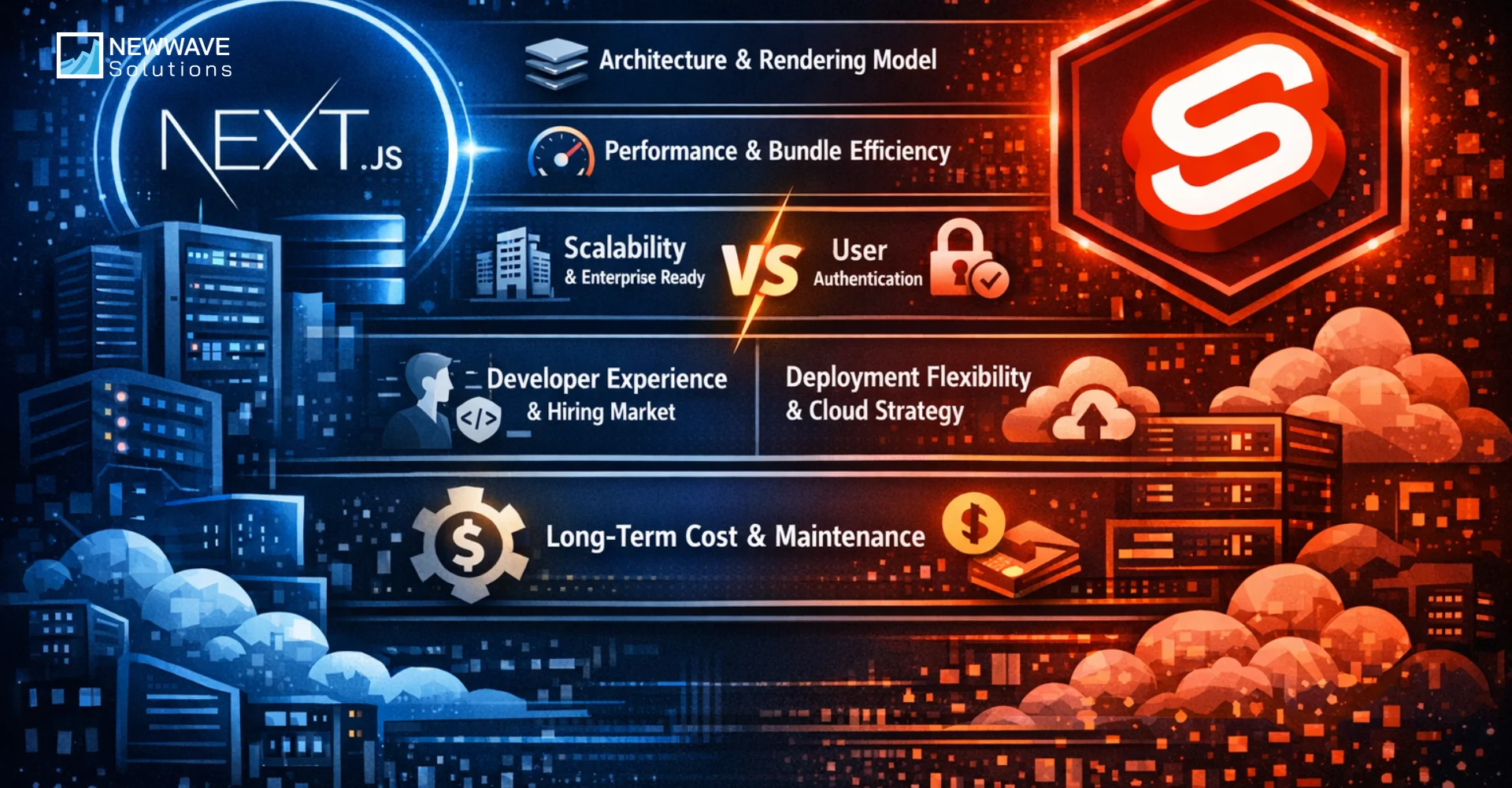
Next JS operates as a React-based meta-framework that supports multiple rendering strategies, including SSR, SSG, ISR, and Server Components, thereby giving teams flexibility to optimize performance and SEO per page or route. In addition, its App Router architecture enables scalable layout composition and modular development, which is particularly valuable for large SaaS or enterprise platforms that evolve over time.
In contrast, SvelteKit follows a compiler-first approach, meaning components are transformed into optimized JavaScript at build time rather than relying on a heavy runtime layer. Consequently, this architecture reduces browser overhead and simplifies the rendering pipeline, making applications structurally leaner and potentially easier to reason about.
Verdict: Next JS holds the advantage in today’s enterprise web development landscape because its multi-mode rendering flexibility and React ecosystem integration provide stronger scalability and architectural maturity for complex production systems.
2. Performance and Bundle Efficiency
Next JS delivers strong performance optimizations through code splitting, server components, and edge rendering; however, because it relies on React’s runtime and virtual DOM, a certain level of client-side overhead remains unavoidable. Nevertheless, its performance model is highly optimized for real-world production workloads and balances speed with maintainability.
On the other hand, SvelteKit eliminates the virtual DOM entirely and compiles components into minimal JavaScript during build time, which significantly reduces bundle size and runtime processing. As a result, applications built with SvelteKit often achieve faster initial load times and lighter client execution, especially in smaller or performance-sensitive projects.
Verdict: SvelteKit leads in raw bundle efficiency and minimal runtime overhead, particularly for performance-focused applications; however, in large-scale enterprise contexts, Next JS remains more widely trusted due to its proven optimization strategies at scale.
3. Scalability and Enterprise Readiness
Next JS has been widely adopted by large enterprises and global SaaS companies, which demonstrates its readiness for high-traffic systems and complex product ecosystems. Furthermore, its strong documentation, tooling maturity, and cloud platform integrations make it a stable choice for organizations planning long-term growth.
Conversely, SvelteKit is technically capable of scaling but has fewer enterprise-level case studies and a smaller ecosystem supporting large distributed infrastructures. Therefore, while it performs well in modern applications, its enterprise track record remains comparatively limited.
Verdict: Next JS clearly dominates in enterprise readiness due to its widespread adoption, mature ecosystem, and lower perceived implementation risk in large-scale environments.
4. User Authentication
Next JS integrates seamlessly with established authentication solutions such as NextAuth, OAuth providers, and enterprise identity systems, thereby reducing implementation complexity in secure environments. Additionally, its API routes and middleware capabilities simplify authentication logic within full-stack applications.
Meanwhile, SvelteKit supports authentication through custom endpoints and third-party libraries; however, the ecosystem is less standardized, which may require additional engineering effort to configure and maintain secure authentication flows.
Verdict: Next JS is preferable for authentication-heavy systems because its ecosystem maturity and ready-made integrations reduce risk and accelerate secure implementation.
5. Developer Experience and Hiring Market
Next JS benefits from React’s global popularity, which significantly expands the available talent pool and simplifies onboarding, especially for distributed or offshore teams. Moreover, extensive community resources and standardized best practices help maintain consistency across projects.
In contrast, SvelteKit is praised for its elegant syntax and reduced boilerplate, which can enhance developer productivity once mastered; however, the smaller talent pool may limit hiring flexibility and increase ramp-up time for large teams.
Verdict: Next JS holds a advantage in hiring scalability and offshore collaboration due to its massive global developer base and ecosystem familiarity.
6. Deployment Flexibility and Cloud Strategy
Next JS is highly optimized for Vercel’s infrastructure, particularly with edge runtime capabilities, yet it also supports deployment across AWS, Azure, and other major cloud providers. This flexibility enables enterprises to integrate seamlessly into existing DevOps pipelines.
By comparison, SvelteKit offers adapter-based deployment that allows developers to target multiple environments, including Node, serverless, and static hosting platforms, thereby maintaining strong hosting neutrality.
Verdict: While SvelteKit provides slightly stronger platform neutrality, Next JS is more strategically favored in modern cloud-native environments due to its production-optimized ecosystem and edge computing support.
7. Long-Term Cost and Maintenance
Next JS reduces long-term uncertainty through its stable release cycle, strong community backing, and predictable upgrade paths, which are critical factors for enterprise systems. Furthermore, its ecosystem reduces the need for custom engineering solutions over time.
Alternatively, SvelteKit’s lightweight architecture may lower runtime complexity and dependency weight; however, its smaller ecosystem could increase reliance on custom implementations as projects grow in complexity.
Verdict: Next JS is generally the safer long-term investment for enterprise web applications, as its ecosystem maturity and predictable maintenance model outweigh SvelteKit’s architectural simplicity in large-scale systems.
Which Framework Is Better for Your Business?
There is no universal “best” answer in the debate of Next JS vs SvelteKit, as each framework serves different technical priorities and business contexts. To determine which option aligns with your web development strategy, your development team should evaluate several core factors that directly influence scalability, performance, and long-term sustainability.
- Team skillset: Choose Next JS if your team already has strong React experience or you plan to scale quickly with offshore developers; choose SvelteKit if your team prefers a simpler syntax and is comfortable adopting a newer ecosystem.
- Project scale: Select Next JS for large-scale, enterprise-grade platforms requiring modular architecture and long-term expansion; opt for SvelteKit for smaller to mid-sized applications with clearly defined scopes.
- Performance requirements: Choose SvelteKit if minimizing bundle size and runtime overhead is the top priority; choose Next JS if you need balanced performance combined with SEO and server-side rendering flexibility.
- Hiring strategy: Prefer Next JS when hiring scalability and access to a global talent pool are critical; consider SvelteKit only if you have stable internal expertise and limited dependency on large-scale recruitment.
- Cloud architecture: Choose Next JS for production-optimized deployments on platforms like Vercel and strong cloud ecosystem support; choose SvelteKit if you prioritize platform neutrality and adapter-based deployment flexibility.
Neither Next.js nor SvelteKit may be the right fit if your project calls for a cross-platform approach from the ground up. That’s where Top 10 Best Cross Platform App Development Frameworks comes in — a practical guide to help you match the right framework to what your application actually needs.
Next JS vs SvelteKit: When to use What?
If you are still evaluating which framework fits your web development roadmap, the following practical use cases can help clarify where each solution performs best under specific technical and business conditions.
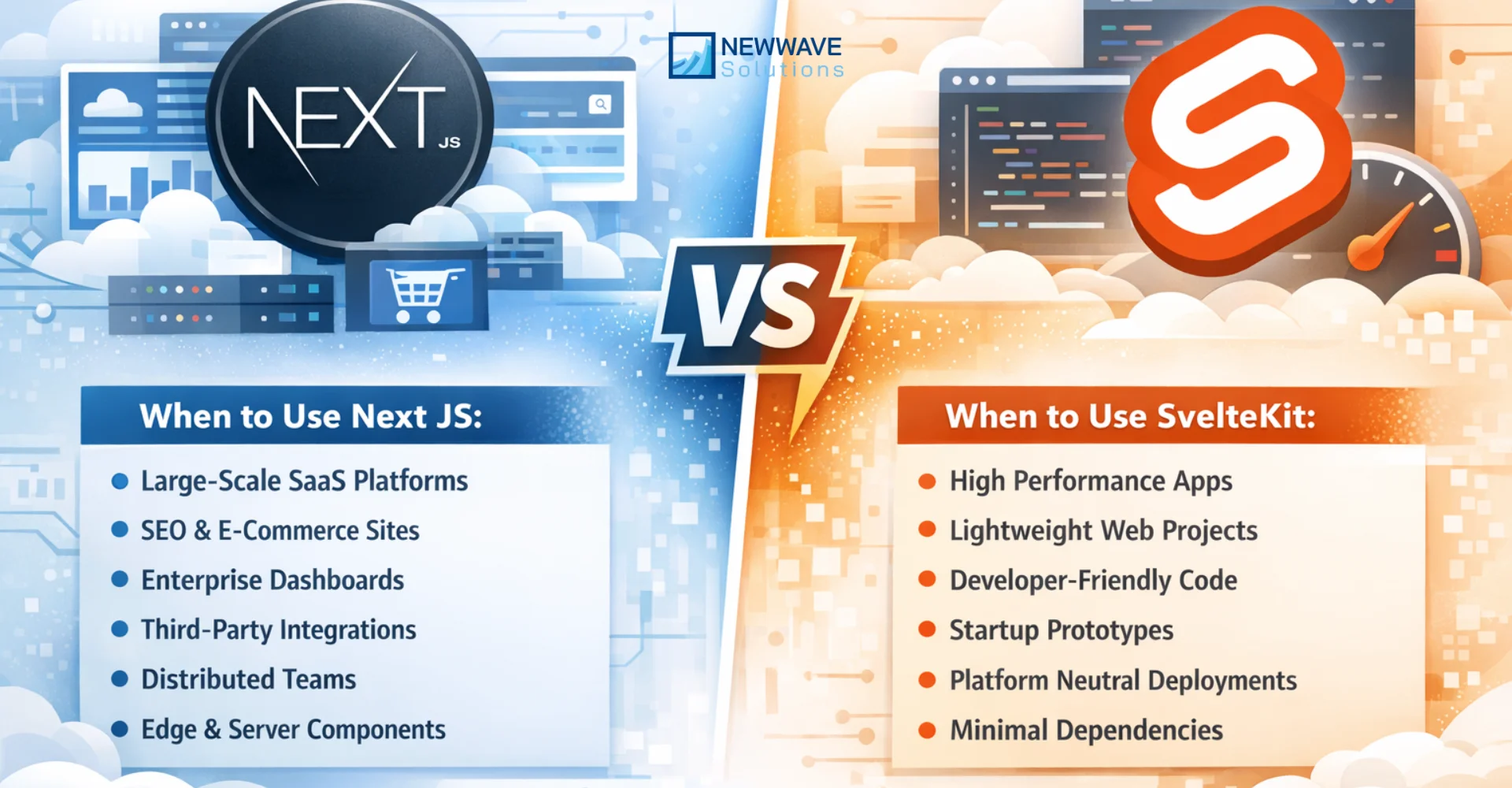
When to Use Next JS
- Large-scale SaaS platforms requiring modular architecture and scalable routing
- SEO-heavy applications such as content platforms or e-commerce sites
- Enterprise dashboards and internal portals with complex authentication needs
- Projects requiring strong ecosystem support and third-party integrations
- Distributed or offshore development teams needing easier hiring scalability
- Cloud-native systems leveraging edge deployment and server components
When to Use SvelteKit
- Performance-critical applications where minimal runtime overhead is essential
- Lightweight web platforms with limited complexity
- Developer-focused products prioritizing clean syntax and maintainability
- Startups experimenting with modern, lean frontend architecture
- Projects requiring platform-neutral deployment flexibility
- Applications with limited long-term ecosystem dependency requirements
Choose Next JS or SvelteKit for your Offshore Software Development Teams
When you engage an offshore team to build your software product, choosing between Next JS and SvelteKit becomes more than a technical preference—it becomes a workforce decision. The selected tech stack directly affects hiring flexibility, onboarding speed, long-term maintainability, and even communication efficiency between your in-house stakeholders and offshore engineers. A well-aligned framework enables offshore teams to maximize productivity while minimizing coordination risks and unexpected delays.
From our perspective at Newwave Solutions, where we provide offshore software development services with experienced developers, QA engineers, and designers, Next JS often proves to be the more optimal choice over SvelteKit in several key areas.
- Large and Accessible Talent Pool: Because Next JS is built on React, offshore vendors can access a vast global pool of experienced developers. This makes team scaling, replacement, and knowledge continuity significantly easier compared to niche frameworks.
- Mature Ecosystem and Ready-Made Solutions: The extensive library support, community tools, and established best practices around Next JS reduce research time and custom engineering effort. For offshore teams, this translates into faster problem-solving and more predictable delivery timelines.
- Lower Knowledge Transfer Risk: Due to its widespread adoption, Next JS projects are easier to hand over between teams or vendors without major disruption. This reduces long-term operational risk for businesses relying on offshore partnerships.
- Better Collaboration Efficiency: Standardized architecture patterns and well-documented conventions in Next JS improve communication between onshore stakeholders and offshore developers. As a result, project alignment becomes clearer and execution more streamlined.
Ultimately, whether you choose Next JS or SvelteKit should depend on what best optimizes collaboration between your business and your offshore development team. However, if your organization lacks a strong internal engineering bench or seeks predictable scalability, Next JS generally provides a safer and more flexible foundation.
Conclusion
When evaluating Next.JS vs SvelteKit, the decision should be driven by technical roadmap, team readiness, and long-term maintainability rather than short-term trends. Although both frameworks are capable, Next JS benefits from broader industry adoption and stronger enterprise validation. From an offshore software development perspective, this widespread adoption translates into easier hiring, lower onboarding friction, and greater ecosystem support.
If you are seeking a trusted partner to leverage the power of Next.js within your offshore software development strategy, contact Newwave Solutions today to receive expert consultation and high-quality services tailored to your business growth.
To Quang Duy is the CEO of Newwave Solutions, a leading Vietnamese software company. He is recognized as a standout technology consultant. Connect with him on LinkedIn and Twitter.



Read More Guides



Get stories in your inbox twice a month.
Let’s Connect
Let us know what you need, and out professionals will collaborate with you to find a solution that enables growth.
Leave a Reply