


NFT Marketplace Development: A Complete Guide
In recent years, the world has witnessed a dramatic rise in the popularity of non-fungible tokens (NFTs), and correspondingly, a flood of new platforms serving creators, collectors, and traders. Many organizations and entrepreneurs have jumped into the market, aiming to launch their own NFT marketplaces to tap into this growing demand and unique digital assets ecosystem.
If your company plans to build an NFT marketplace from scratch, this guide will deliver everything you need — including clear definitions, marketplace types, key features, development process, cost considerations, and future trends. Don’t miss any detail if you are planning to jump into the NFT marketplace development game seriously!
What is NFT Marketplace Development?
NFT marketplace development refers to the creation of a digital platform that allows users to mint, list, buy, sell, and trade NFTs on a blockchain. It combines blockchain technologies, smart-contract implementation, wallet integration, and web/mobile frontend/back-end to support secure, decentralized transactions. As a result, such marketplaces enable creators and collectors to exchange unique digital assets (art, collectibles, virtual real estate, etc.) with transparent ownership and immutable transaction records.
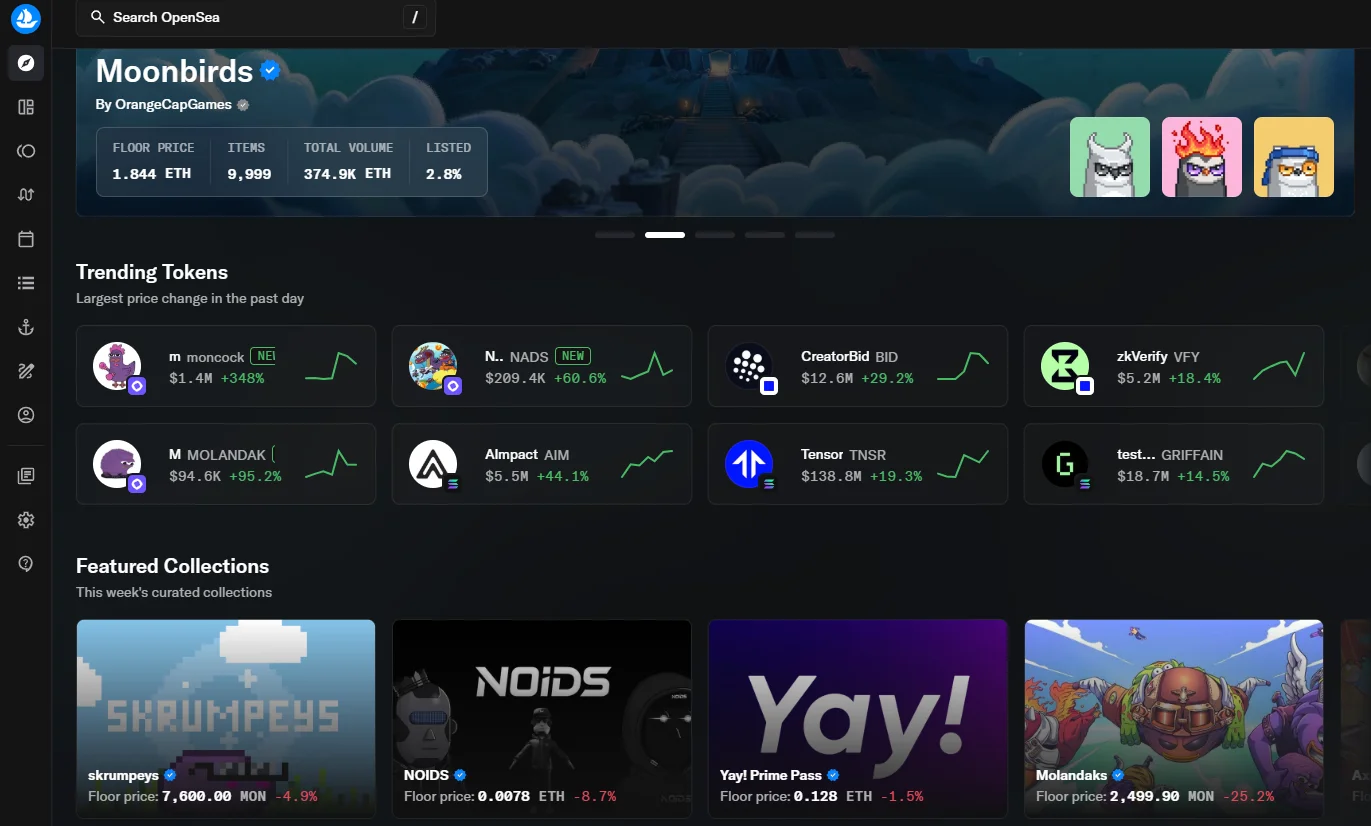
Example: OpenSea — founded by Devin Finzer and Alex Atallah — operates one of the largest global NFT marketplaces. The platform supports minting, listing, and trading of millions of NFTs, and continues to lead the sector by offering multi-blockchain support, vast user base, and strong liquidity.
Why Businesses Should Invest in Their Own NFT Marketplace?
Instead of partnering with an existing NFT marketplace, your enterprise can create its own version due to the following benefits:
- Revenue control via transaction fees and commissions — Building your own marketplace allows businesses to define listing fees, transaction commissions, or royalties rather than relying on third-party platforms.
- Brand identity and direct user relationship — A proprietary marketplace helps maintain brand image and direct interaction with collectors/clients without depending on external platforms and their rules.
- Custom features tailored to niche or community needs — Own development enables implementing unique functions (e.g., fractional NFTs, membership NFTs, custom auction types) that match specific target audience or business model.
- Data ownership and user analytics — Running a self-managed platform gives full access to user behavior, transaction data, and metadata — useful for marketing, personalization, and future business strategy.
- Scalability and flexibility for growth and expansion — Controlling infrastructure allows easier scaling, addition of new features, support for multiple blockchains or assets, and adaptation to market changes.

5 Key Technologies for Developing an NFT Marketplace
Below are the key technologies that major businesses implement during their marketplace development process:
- Smart Contracts & Token Standards — Smart contracts (e.g., using ERC-721, ERC-1155) define token ownership, transfer logic, royalties, and minting rules; they enforce trustless, transparent transactions on blockchain. The correct standard implementation ensures interoperability and security for NFT assets.
- Blockchain Infrastructure & Node/Network Integration — Marketplace backend needs access to blockchain nodes (public or private), transaction monitoring, indexing, and metadata storage to handle minting, transfers, ownership verification, and smart-contract calls reliably. This infrastructure ensures high availability, consistency, and scalability as the user base grows.
- Wallet & Payment Gateway Integration — Integration with crypto wallets and optionally fiat-on-ramp/payment gateways allows users to buy/sell NFTs seamlessly, manage ownership, and transactions. This tech ensures smooth UX and broader audience reach by supporting various payment methods and currencies.
- Frontend & Responsive UI/UX + Backend APIs — A user-friendly frontend ensures easy navigation, listing, filtering, bidding, and account management; backend APIs link frontend to blockchain and server logic to process metadata, orders, user actions, and transactions securely. This stack determines usability, performance, and reliability of the marketplace.
- Security & Compliance Tools (Audit, Encryption, Anti-Fraud) — Security measures, including smart-contract audits, data encryption, transaction validation, and anti-fraud safeguards, protect assets and user trust, which is critical in blockchain applications handling real value. Robust security stack reduces risk of hacks, manipulation, or unauthorized access.
NFT Marketplace: Step-by-Step development process
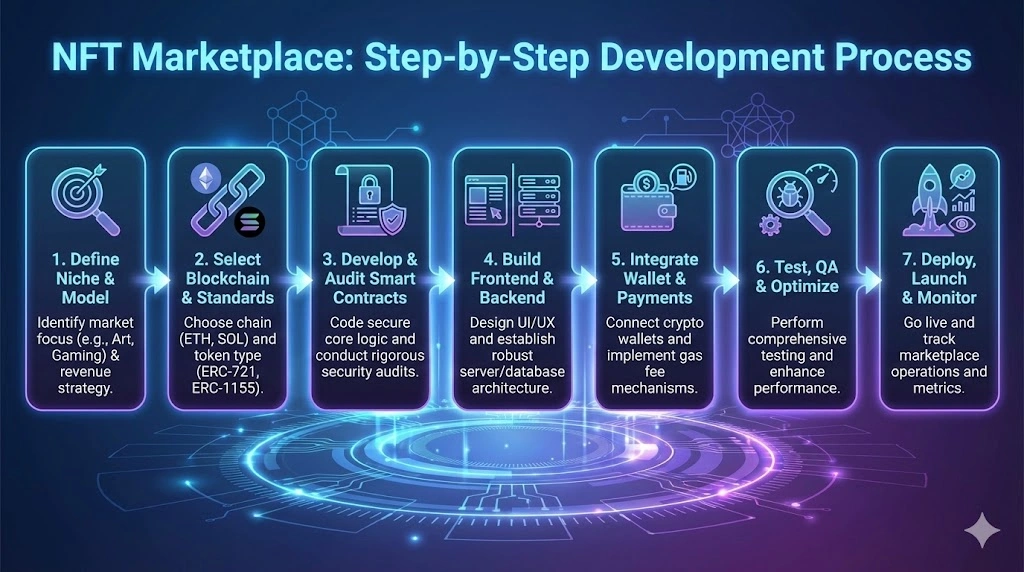
The process on how to build an NFT marketplace involves several sequential phases that together ensure your platform is robust, secure, and market-ready. Each phase requires clear decisions, technical diligence, and strategic planning to deliver a functional marketplace that meets both user needs and business goals.
Step 1: Define Niche & Business Model
At the outset, a business must clearly define the niche and unique value proposition for its NFT marketplace so that the platform attracts a target audience rather than trying to serve a generic crowd. This initial focus helps shape all subsequent development decisions — from asset types (art, gaming, virtual real estate, etc.) and revenue model (fixed price, auction, royalty, subscription) to platform features and user journey design.
Step 2: Select Blockchain & Token Standards
After defining the marketplace vision, the next step involves selecting an appropriate blockchain network and NFT token standard (for example, ERC-721 or ERC-1155) that aligns with your project’s needs regarding gas fees, scalability, performance, and compatibility. The blockchain and standard choice directly influence how NFTs will be minted, stored, transferred, and how ownership metadata will be managed across the platform.
Step 3: Develop Smart Contracts & Conduct Security Audit
Once blockchain infrastructure is chosen, the development of smart contracts begins — including logic for minting, listing, bidding/sale, transfers, royalties, and ownership verification. Subsequently, the smart-contract code must go through rigorous security audits and testing to identify and fix vulnerabilities before any live deployment, thereby safeguarding users and assets.
Step 4: Build Frontend & Backend Architecture
With smart contracts in place, the technical team proceeds to build the frontend (web or mobile) that provides an intuitive user experience for browsing, listing, buying, selling, and wallet integration, while simultaneously developing the backend system that handles user data, metadata storage, transaction processing, indexing, and scalability. This backend-frontend integration ensures that user interactions on the UI are correctly and securely mapped to blockchain operations and server-side logic.
Step 5: Integrate Wallet & Payment / Gas Fee Mechanisms
In order to enable transactions, the platform needs integration with cryptocurrency wallets and a payment gateway or fiat-to-crypto on-ramp, facilitating users to purchase or trade NFTs even if they do not currently hold compatible crypto assets. The integration must correctly handle gas fees, transaction signing, wallet connections, and possibly multi-chain support to ensure convenience and broad user accessibility.
Step 6: Perform Testing, QA & Performance Optimization
Before going live, the platform must undergo comprehensive testing, including functional tests, smart-contract testing, load testing, security testing, and user-acceptance testing to ensure every feature works as expected under real-world conditions. During this phase, performance bottlenecks, UI/UX issues, transaction failures, or smart-contract vulnerabilities should be identified and fixed to guarantee a reliable and smooth user experience.
Step 7: Deploy, Launch & Monitor Marketplace
As soon as the development and testing are completed successfully, the NFTs marketplace can be deployed: smart contracts are published on the blockchain, backend and frontend are hosted, and the platform becomes accessible to users. After launch, the team needs to monitor activity, transactions, performance, user feedback and prepare for scaling as the user base and trading volumes grow. Continuous maintenance, updates, and monitoring will support long-term stability and security of the marketplace.
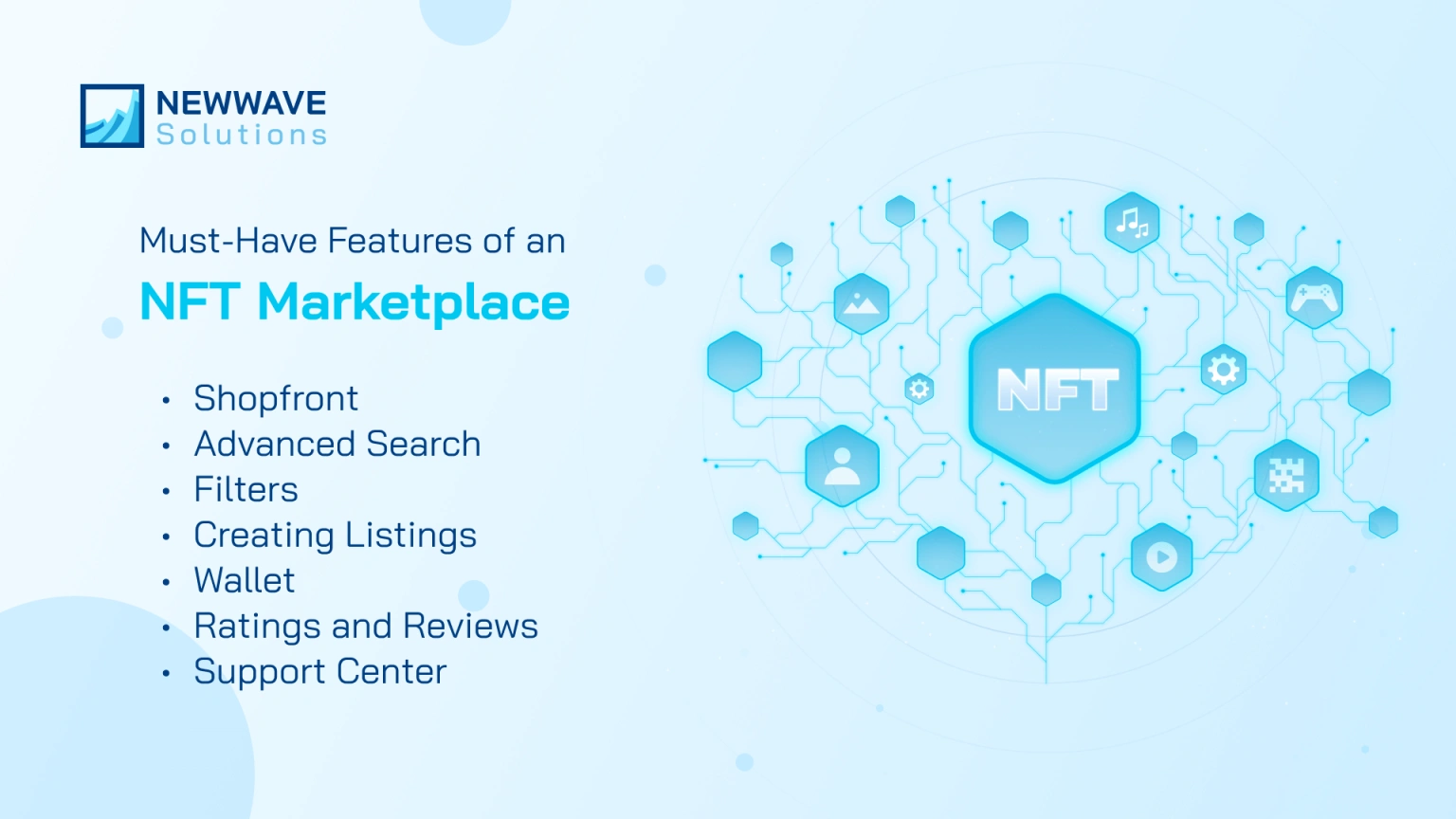
7 Must-Have Functions Of an NFT Marketplace
After understanding the above steps for building an NFT marketplace, there are certain core functions that your marketplace should deliver, including:
1. Shopfront
A shopfront should have flawless UI/UX to offer customers a dashboard with all the necessary information, like product title, owner, price, description, offer, and payment gateway. Keep this in mind when you carry out your project.
2. Advanced Search
This is one of the most useful tools you can’t neglect when you implement an NFT marketplace development project. With advanced search options, users are able to narrow the scope of a search query to find the exact content more quickly. Advanced search options can include options for type, feature, color, etc.
3. Filters
Just like advanced search, filters are a significant feature you should never leave out in your NFT marketplace development process. Navigating a website with a lot of content can be easier with the help of filters, since it helps users effectively browse and find items, drill down to their needs, and eliminate numerous search queries.
4. Creating Listings
It is best to allow users to create their own listings so they can save or share collectibles. Listings should have basic information, such as title, description, price, or tags.
5. Wallet
Users must have a wallet to transfer, receive, and store NFTs and cryptocurrencies. The easiest and most convenient solution for this case is to integrate with some popular cryptocurrency wallets like MetaMask, Formatic, WalletConnect, or Coinbase.
6. Ratings and Reviews
Everyone loves to see ratings and reviews about the seller that they are buying from. The ranking system and feedback will help users find out how credible sellers are and make it easier for new users to choose items.
7. Support
A support system can assist users in resolving problems and conflicts. It can be a call center, an email support center, or a chatbot; include this in your NFT marketplace development project!
Costs for NFT Marketplace Development
Creating a brand new NKT marketplace can cost you a fortune if you are not able to manage the budget carefully. Take a closer look at the detailed cost breakdown below to estimate your budgeting plan before jumping into the development process
- Initial development & smart-contract implementation — approx. USD 30,000–80,000 depending on complexity (basic vs advanced features, blockchain choice, integrations).
- UI/UX design + frontend & backend development — additional USD 10,000–30,000 for marketplace interface, user flows, responsive design, and backend logic.
- Blockchain infrastructure & node/network setup — roughly USD 2,000–10,000 for node provisioning, hosting, indexing, and performance optimization.
- Wallet/payment integration & cross-chain support — USD 5,000–15,000+ depending on the number of blockchains, payment options, and complexity of integration.
- Security audit & compliance checks — USD 3,000–10,000 for thorough smart-contract audits and security hardening, essential for a live marketplace.
- Maintenance, updates, hosting & operations (annual) — ~ 15–25% of initial build cost per year to cover server costs, support, scaling, bug fixes, upgrades.
Top 5 NFT Marketplaces Worldwide
To give you some ideas on how some current NFT marketplaces are functioning, here are several real-world examples for reference:
1. OpenSea
OpenSea remains the largest and most versatile NFT marketplace globally, offering a wide variety of digital assets from art and collectibles to virtual real estate and gaming items. The platform supports multiple blockchains and handles high trading volumes, delivering strong liquidity and broad market reach. Its user-friendly interface and large community make it a go-to marketplace for both creators and collectors.
2. Blur
Blur has gained popularity among serious traders and collectors due to its trading tools, fast transaction handling, and efficient fee structure. The platform often leads in trading volume on Ethereum-based NFTs and attracts users looking for speed and advanced market tools rather than casual browsing. Its pro-oriented UX makes it a strong competitor in 2025’s NFT marketplace landscape.
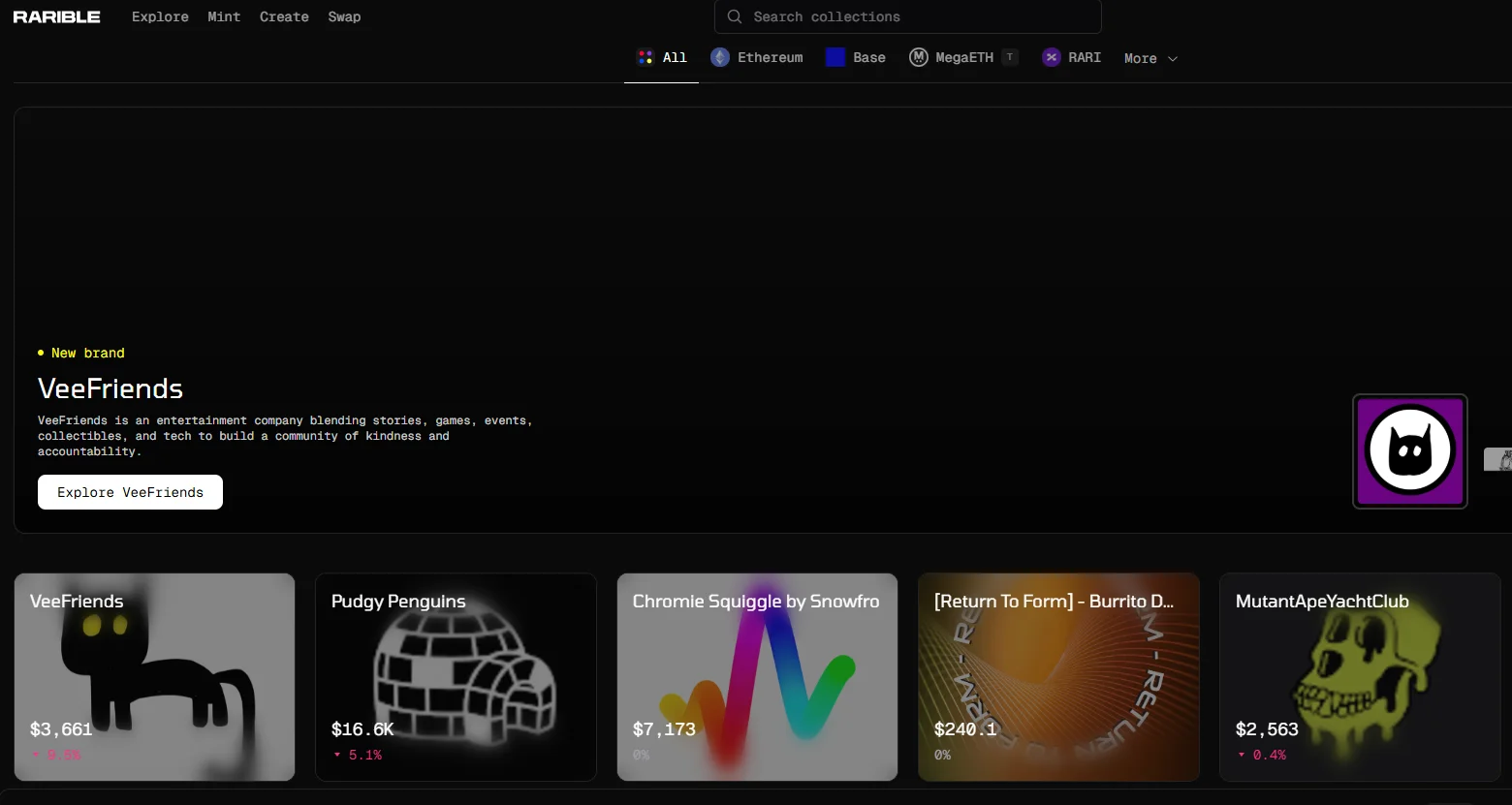
3. Rarible
Rarible differentiates itself with multi-chain support, creator-friendly policies, and flexible minting options, including lazy minting. The platform appeals to artists and creators due to its community-driven model and less restrictive listing rules compared with some larger marketplaces. Its emphasis on decentralization and creator control makes it a strong option for independent artists and niche communities.
4. Foundation
Foundation focuses on curated digital art and high-end NFTs, catering to serious collectors and artists seeking premium exposure. Its curated model ensures quality over quantity, leading to a more selective and premium user base. For creators and brands aiming at exclusivity and prestige, this platform represents a high-quality reference in the NFT marketplace space.
5. Magic Eden
Magic Eden stands out especially for blockchain networks beyond Ethereum, offering NFT trading on chains like Solana and others, often with lower fees and faster transaction speed. The platform suits users interested in gaming, digital collectibles, and low-gas-cost NFTs. Its flexibility and multi-chain support make it a popular choice among communities exploring blockchain variety and cost efficiency.
In case you want to develop an NFT marketplace like these popular cases but don’t know where to begin, you can consult our latest article on the top 5 NFT marketplace development companies and select the appropriate partner to assist your building process.
How can Newwave Solutions help with NFT marketplace development?
Don’t worry too much if you have no experience with developing an NFT marketplace before, since you can outsource the whole process to a professional IT/ blockchain development service provider like Newwave Solutions.
We offer comprehensive NFT marketplace development services designed to support businesses through every stage of building a brand-new marketplace. With deep expertise in blockchain technologies and 10+ years of software development experience, we guide clients from initial project discovery to post-launch growth strategies. Our approach ensures secure, scalable, and user-friendly NFT platforms that meet market demands and regulatory compliance.
From concept to deployment, Newwave Solutions manages all critical phases of NFT marketplace development, including strategic planning, UX/UI design, smart contract development, and platform architecture. We prioritize creating seamless user experiences that encourage engagement and foster trust among creators and collectors. Scalable infrastructure and robust security practices underpin every solution to safeguard digital assets and user data effectively.
Our NFT development services include:
- Project Discovery and Requirement Analysis: Clarifying business objectives, competitor landscape, target audiences, and essential features to form a solid foundation.
- UI/UX Design: Crafting intuitive interfaces that simplify art minting, buying, selling, and community interactions to enhance user satisfaction.
- Blockchain Architecture & Smart Contract Development: Building secure, decentralized smart contracts for minting, trading, and ownership verification on Ethereum and other chains.
- Integration Services: Connecting wallets like MetaMask and Coinbase Wallet, payment gateways, and third-party APIs for a complete ecosystem.
- Quality Assurance and Security Audits: Conducting rigorous testing and blockchain security reviews to ensure platform reliability and compliance.
- Deployment and Launch Support: Managing the release process, ensuring smooth go-live operations, and handling app store or platform listings.
- Ongoing Maintenance and Scaling: Providing continuous updates, optimization, feature addition, and scaling strategies to support growing transaction volumes and user bases.
Final Thoughts
Clearly, the NFT sector is exciting with a promising future ahead. However, an NFT marketplace development project is definitely not easy to start alone since you have to go through lots of steps and different technical challenges.
If possible, just reach out to the right NFT marketplace development company to turn your idea into success. With diverse knowledge and experience in blockchain-based software development, Newwave Solutions can provide you with excellent NFT development services to allow you to develop and manage an NFT marketplace effectively. Let’s make headway in NFT marketplace development by contacting us today!
Contact Information:
- Head Office (Hanoi): 1F, 4F, 10F, Mitec Building, Cau Giay Ward, Hanoi City, Vietnam
- Branch Office (Tokyo): 1chōme118 Yushima, Bunkyo City, Tokyo 1130034, Japan
- Hotline: +84 985310203
- Website: https://newwavesolution.com
- Email: [email protected]
To Quang Duy is the CEO of Newwave Solutions, a leading Vietnamese software company. He is recognized as a standout technology consultant. Connect with him on LinkedIn and Twitter.



Read More Guides

Get stories in your inbox twice a month.
Let’s Connect
Let us know what you need, and out professionals will collaborate with you to find a solution that enables growth.
Leave a Reply