


Outsourcing SaaS Development – Complete Guide for Outsourcing Smarter, not Cheaper
Outsourcing SaaS development has become a strategic choice for businesses looking to scale quickly and efficiently, which helps you move faster with less overhead while keeping quality high. By leveraging external expertise, companies can reduce costs, accelerate time-to-market, and access top-tier talent. Below is a detailed, practical guide to help you choose models, anticipate benefits and risks, and run a smooth, ROI-positive engagement from day one.
What is Outsourcing SaaS Development?
Outsourcing SaaS development is the practice of delegating the planning, design, engineering, testing, deployment, and post-launch operations of a software-as-a-service product to an external team. Instead of hiring, onboarding, and managing a large in-house function, you assemble the capacity you need from a specialist vendor that already has the skills, infrastructure, and delivery playbooks in place. This approach compresses time-to-market, reduces fixed costs, and enables you to scale expertise up or down as your roadmap evolves.
If you’re new to the fundamentals of SaaS product lifecycles, revisit the basics through the lens of What is SaaS development to align terminology, roles, and decision points across your stakeholders.
What can you outsource in SaaS?
- Product strategy & discovery: market research, problem framing, value hypothesis, KPI design, solution architecture options.
- UI/UX design services: user research, journey mapping, information architecture, wireframes, prototypes, design systems, accessibility audits.
- Frontend & mobile: SPA frameworks, responsive web, native and cross-platform mobile.
- Backend & cloud: microservices, APIs, serverless, multi-tenant architecture, DB design, observability, FinOps.
- Data & AI: analytics pipelines, event tracking, ML/LLM integrations, personalization, recommendation, fraud detection.
- QA & test automation: unit/integration/e2e testing, performance, security, chaos testing, release hardening.
- DevOps & SRE: CI/CD, IaC, blue/green/canary, SLIs/SLOs/SLAs, incident response.
- Compliance & security: DPA, SOC 2, ISO 27001, HIPAA/GDPR alignment, threat modeling, secrets management.
- Customer support enablement: knowledge base, admin tooling, analytics for success and retention.
- Post-launch: A/B testing, growth experiments, backlog grooming, maintenance & L3 support.
Get to Know 3 Models of Outsourcing SaaS Development
When outsourcing SaaS development, businesses typically choose from three main models, each offering distinct advantages depending on the specific needs of the project. Choosing the right commercial and collaboration model shapes cost, control, speed, and risk. Below are the three most common models, when to use them, and what to watch:
Project-Based Model
In this model, businesses outsource the entire SaaS development project to an external provider. The outsourcing partner is responsible for all aspects of development, from initial design to final deployment. This model is ideal for companies with a clear project scope and defined requirements, as it allows for a hands-off approach, focusing on results. However, it may be less flexible if changes or adjustments are needed during the development process.
Suitable for who?
- Teams with well-defined requirements and a stable roadmap
- Organizations that need budget certainty and minimal day-to-day oversight
Pros
- Predictable cost and schedule
- Clear accountability for deliverables
- Low management overhead once started
Cons
- Limited flexibility if market or priorities shift mid-project
- Risk of “gold-plating” or under-specification if discovery was shallow
- Change requests can slow momentum and increase cost
Dedicated Team Model
The dedicated team model involves hiring a full external team to work exclusively on your SaaS development. This team operates as an extension of the in-house staff, providing ongoing support and collaboration throughout the project. This model offers more flexibility and control than the project-based approach, allowing for real-time adjustments and deeper integration with company goals. It’s a great option for long-term projects or businesses that require continuous updates and improvements to their SaaS product.
Suitable for who?
- Companies with evolving roadmaps and long-term product goals
- Scale-ups needing sustained velocity and domain retention
Pros
- High flexibility and rapid reprioritization
- Deep domain knowledge and continuity
- Easier scaling up/down without rehiring internally
Cons
- Requires active product ownership and governance
- Budget is variable month-to-month (capacity-based)
- Initial ramp-up to reach peak velocity
Staff Augmentation Model
In this model, businesses hire individual developers or specialists from outsourcing firms to fill specific skill gaps within their in-house team. This allows companies to access specialized expertise without committing to a full external team. The staff augmentation model is best suited for companies that already have a solid development team but need additional skills for certain aspects of SaaS development, such as front-end design or backend infrastructure.
Suitable for who?
- Strong in-house teams that need specific skills temporarily
- Organizations facing short-term spikes (a feature, a migration, a release)
Pros
- Fast access to niche expertise
- Maximum control over day-to-day work
- Minimal disruption to current processes
Cons
- Requires robust internal engineering management
- Knowledge silos if handover is weak
- Can feel like “extra hands” vs. a solution-oriented unit
Each model offers varying levels of control, flexibility, and cost, making it important for businesses to choose the one that aligns with their goals and resources when outsourcing SaaS development.
Benefits Of SaaS Outsourcing
Done thoughtfully, Saas outsourcing is far more than cost arbitrage. It enables companies to innovate faster, scale smarter, and operate more efficiently. It combines access to specialized expertise, flexible resource models, and proven delivery practices that enhance product quality and business agility.
Access to Specialized Talent, Immediately
Outsourcing gives you instant access to senior engineers, architects, and AI/DevOps experts who have already built successful SaaS products. You skip long hiring cycles and onboarding, gaining a skilled team ready to start delivering from day one. This accelerates execution while ensuring technical precision and domain knowledge.
Faster Time-to-Market
Experienced outsourcing partners bring pre-built frameworks, CI/CD pipelines, and agile workflows that shorten the product lifecycle. Their teams work in parallel across design, development, and QA, helping you release faster without compromising quality—crucial for startups validating MVPs or enterprises launching new features.
Cost Control and Predictability
With outsourcing SaaS, you convert fixed costs like salaries and infrastructure into flexible, usage-based expenses. Transparent pricing models—fixed, dedicated, or hourly—help control budgets while eliminating recruitment, equipment, and overhead costs. This lets you reinvest savings into growth and product innovation.
Focus on Core Differentiation
By outsourcing technical execution, your internal team can focus on strategy, customer experience, and innovation. The vendor manages engineering, QA, and maintenance so your leadership can direct energy toward scaling and strengthening competitive advantages.
Quality Through Process and Automation
Established outsourcing firms apply standardized coding practices, automated testing, and continuous integration to maintain consistent quality. Built-in QA and peer reviews reduce errors, enhance reliability, and ensure each release meets performance and security benchmarks.
Elastic Scale
Outsourcing allows you to adjust resources in line with project demands—scaling up for new releases or scaling down during maintenance. This flexibility keeps costs aligned with workload while maintaining performance and delivery speed.
Fresh Tooling and Innovation
Top outsourcing SaaS providers constantly adopt new tools, frameworks, and AI-driven workflows across projects. Partnering with them gives you early access to proven innovations—modernizing your tech stack without the risk and expense of internal experimentation.
>>> Maybe you’ll want to read more for the best decision: Outsourcing Vs Offshoring – Which Is Better To Make Strategic Business Decisions?
Challenges of Outsourcing SaaS Development
Outsourcing SaaS development can offer many benefits, but it also presents specific challenges that businesses need to address. Anticipating them early—and designing countermeasures—keeps your risk low and your momentum high:
Data Security and Privacy
When outsourcing SaaS development, ensuring that the external team adheres to stringent security protocols is crucial. Protecting sensitive customer data and complying with regulations like GDPR becomes more complex when external developers are involved.
Communication and Collaboration
Working with external teams can lead to communication gaps, especially if they’re located in different time zones. Poor collaboration can result in delays, misaligned goals, and potential misunderstandings in the development process.
Quality Control
Maintaining consistent quality in outsourced SaaS development is a challenge. Businesses need to implement clear guidelines, regular performance evaluations, and thorough testing processes to ensure the final product meets expectations.
Integration with Existing Systems
Outsourced teams may face difficulties in seamlessly integrating new SaaS solutions with a company’s existing systems, especially if they are unfamiliar with legacy infrastructure or third-party software.
Hidden Costs
While outsourcing can reduce upfront costs, businesses may encounter hidden expenses related to ongoing support, integration, or scaling of the SaaS product. Change requests, premium environments, or proprietary accelerators can accumulate cost or create dependence. Ask for transparent rate cards, exit plans, and IP assignment upfront. Carefully managing the budget and expectations is key to avoiding unexpected financial burdens.
Loss of Control
Outsourcing SaaS development involves handing over significant control to an external provider. This can lead to concerns about managing project timelines, quality, and confidentiality. Establishing clear contracts and KPIs helps mitigate these risks.
Navigating these challenges requires careful planning and clear communication. Businesses can enjoy the benefits of outsourcing SaaS development by maintaining control over critical areas such as data security, quality assurance, and cost management.
Eight Steps of SaaS Outsourcing Process
To successfully implement outsourced SaaS, you should follow a structured approach. This eight-step process can help ensure a smooth collaboration and maximize the benefits of outsourcing SaaS Development.
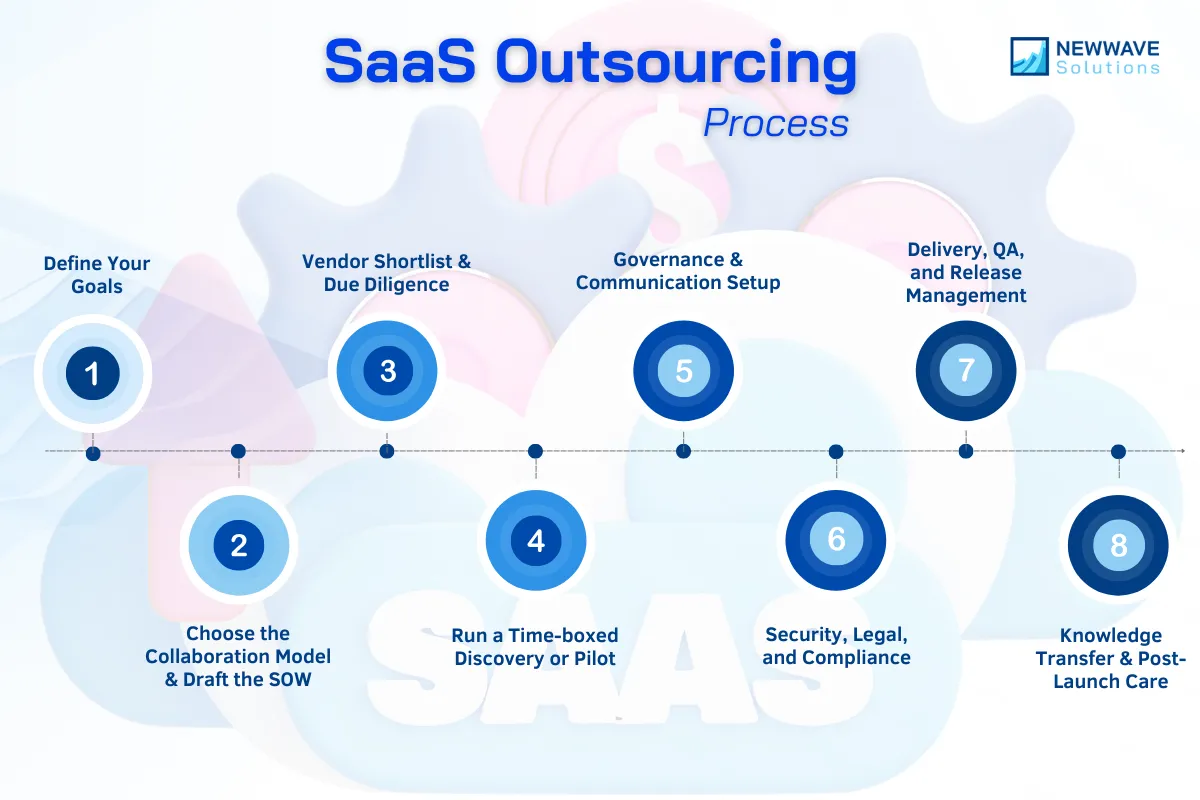
Step 1: Define Your Goals
In Outsourcing SaaS Development, defining clear goals is crucial for the success of any project. Start by articulating the “why” behind your outsourcing initiative. What business problem are you solving, and how will success be measured? Define core metrics such as activation rate, churn reduction, uptime, or cost per feature delivered. Don’t overlook non-functional goals like scalability, security, or data residency.
Translate these metrics into a one-page product requirements document (PRD) and a KPI tree that connects business outcomes to deliverables. This clarity ensures every decision made by your outsourcing partner aligns with measurable impact, not assumptions.
Tip: If you can’t clearly state success criteria, your partner can’t build toward it. Define outcomes before deliverables.
Step 2: Choose the Collaboration Model & Draft the SOW
Select a collaboration model that matches your project’s certainty and desired level of control—project-based for defined scopes, dedicated team for ongoing work, or staff augmentation for skill gaps. Once chosen, draft a Statement of Work (SOW) that acts as your project blueprint.
A solid SOW should include:
- Scope & Deliverables: What will be delivered and what’s excluded
- Timeline & Milestones: Key dates and checkpoints
- Acceptance Criteria: Clear definition of “done”
- RACI Matrix: Roles and accountability
- Non-functional Requirements: Performance, security, compliance, and quality
This document becomes your reference for progress, communication, and accountability throughout the engagement.
Tip: Include an “assumptions and exclusions” section to prevent scope creep and clarify ownership boundaries early.
Step 3: Vendor Shortlist & Due Diligence
Once the scope is defined, begin vendor evaluation. Create an evaluation matrix that scores potential partners on technical expertise, domain experience, team scalability, security posture, and communication quality.
Analyze case studies, verify references, and conduct interviews—not just with the sales team but with the actual delivery leads. Assess their problem-solving approach, code quality, and cultural alignment. Review their project management tools, quality assurance methods, and reporting cadence to ensure compatibility with your internal processes.
Here is the shortlist for you to find the best SaaS Outsourcing vendor:
- Research Potential Partners: Use online platforms, seek recommendations from your network, and attend tech events to find outsourcing companies.
- Evaluate Technical Expertise: Review the company’s portfolio for relevant experience and inquire about team qualifications to ensure they meet your project’s needs.
- Consider Cultural Fit: Assess communication styles and cultural alignment to ensure smooth collaboration, especially regarding time zone differences.
- Check References and Reviews: Contact previous clients for insights and look for online reviews or case studies to evaluate reliability and performance.
- Assess Financial Stability: Verify the company’s financial health and pricing model to ensure they can support your project long-term within your budget.
Tip: Request to meet the engineers or designers who will work directly on your project. Their technical depth and communication style matter as much as the vendor’s brand name.
By diligently selecting your outsourcing partner based on these criteria, you can significantly enhance the likelihood of successful collaboration and high-quality outsourced SaaS development.
Step 4: Run a Time-boxed Discovery or Pilot
Before full-scale engagement, launch a 2–4 week discovery or pilot phase. This period validates architecture assumptions, tests collaboration flow, and derisks integrations or APIs critical to your SaaS platform.
During this sprint, focus on building a thin, functional vertical slice of your product. Evaluate how the vendor manages stand-ups, documentation, delivery quality, and feedback loops. The pilot helps you gauge technical competence, communication efficiency, and team responsiveness under realistic conditions.
Tip: Treat the pilot as a production-grade release. Define measurable outcomes and hold a demo session to review delivery quality before committing long term.
Step 5: Governance & Communication Setup
Strong governance frameworks make remote collaboration seamless. Establish a communication plan that defines meeting cadence, reporting frequency, and escalation paths. Align on sprint rituals—stand-ups, demos, retrospectives—and define who owns decisions at each layer.
Set up transparent dashboards to track progress, risks, and blockers in real time. Tools like Jira, Notion, or Confluence are invaluable for sharing sprint goals, velocity, and documentation. Encourage asynchronous communication to accommodate time zone differences.
Tip: Maintain a “living product wiki” containing designs, architecture diagrams, and runbooks. It centralizes knowledge and accelerates onboarding for new team members.
Step 6: Security, Legal, and Compliance
Before development begins, finalize all legal and security frameworks. Sign the Master Service Agreement (MSA), Statement of Work (SOW), Non-Disclosure Agreement (NDA), and Data Processing Agreement (DPA) to clearly define responsibilities and IP ownership.
Map data flows between your systems and the vendor’s infrastructure. Identify data controllers and processors, outline encryption standards, and confirm compliance with GDPR, SOC 2, or HIPAA—depending on your market. Require secure access policies (VPNs, IAM roles, audit logs) to protect sensitive information.
Tip: Integrate automated security scans (SAST/DAST) in the CI/CD pipeline and schedule quarterly penetration tests to maintain ongoing compliance.
Step 7: Delivery, QA, and Release Management
Execution is where process discipline pays off. Adopt trunk-based development with feature flags for safer deployments and continuous integration for faster feedback loops. Enforce peer code reviews and maintain automated QA pipelines covering unit, integration, and regression testing.
Plan release strategies like canary or blue-green deployments to minimize downtime and mitigate release risks. Define Service Level Indicators (SLIs) for latency, uptime, and error rates, and monitor them via shared dashboards accessible to both internal and vendor teams.
Tip: Treat every release as an opportunity to gather metrics—delivery velocity, defect density, and customer impact—to refine processes continuously.
Step 8: Knowledge Transfer & Post-Launch Care
A successful SaaS outsourcing partnership doesn’t end at launch—it evolves into continuous improvement. Ensure your partner provides complete documentation: architecture diagrams, runbooks, configuration guides, and Architectural Decision Records (ADRs).
Define post-launch responsibilities clearly:
- L2/L3 Support: Issue response times, escalation matrix
- Maintenance: Regular updates, performance tuning, security patches
- Optimization: Data-driven refinements based on analytics and user feedback
Schedule a post-launch retrospective to assess KPIs, gather lessons learned, and realign priorities for future sprints or releases.
Tip: Maintain ongoing collaboration for feature updates and system optimization—it’s more efficient than re-onboarding a new vendor later.
Tips for Outsourcing SaaS Development Successfully
Outsourcing SaaS Development depends not just on choosing the right partner, but also on how you collaborate. The most effective outsourcing relationships are based on transparency, shared accountability, and disciplined communication. Below are the key Do’s and Don’ts that make the difference between a smooth, outcome-driven partnership and one that risks inefficiency or misalignment.
Do
Establish a partnership designed for transparency and speed. Make decisions visible, remove ambiguity quickly, and use data—not assumptions—to drive product direction. These principles ensure alignment and help both sides focus on value creation rather than firefighting.
- Codify outcomes early: Define KPIs and acceptance criteria before development begins. A single one-page KPI sheet per epic gives everyone clarity on what success looks like and prevents subjective interpretations later.
- Invest in discovery: Spend time on personas, journey mapping, and Jobs-To-Be-Done (JTBD) analysis. A small investment upfront prevents expensive rework by ensuring the product is solving the right problem for the right users.
- Instrument from day one: Build analytics, monitoring, and logging early so you can measure how users interact with your SaaS product and quickly identify where performance or UX issues occur.
- Think elastic: Plan your outsourced capacity around project milestones—expand during high-demand phases like feature launches, then scale down during maintenance. This keeps spending efficient without losing momentum.
- Balance cost with value: Don’t chase the lowest hourly rate. Optimize for total ROI—consider developer velocity, product quality, and long-term maintainability. A slightly higher rate from a seasoned partner often delivers far better outcomes.
- Standardize your toolchain: Ensure version control, CI/CD, ticketing, and documentation tools are consistent across teams. A shared environment reduces confusion and keeps everyone aligned on delivery processes.
- Protect IP: Clearly define intellectual property ownership, licensing terms, and confidentiality clauses. Review all third-party software used in your SaaS to avoid legal or compliance risks later.
- Close the loop with users: Hold frequent demos, usability sessions, and feedback reviews. Continuous input from users helps steer your roadmap based on real-world behavior rather than assumptions.
Pro Tip: Successful SaaS outsourcing feels less like “outsourcing” and more like co-creation—a rhythm of shared decisions, measurable progress, and mutual accountability.
Don’t
Avoid shortcuts that create technical debt or break trust. The following mistakes are common in SaaS outsourcing and can quietly erode long-term success if not addressed early.
- Don’t skip non-functional requirements: Reliability, performance, and security are just as important as new features. Define Service Level Objectives (SLOs), data encryption standards, and compliance expectations upfront to prevent costly redesigns.
- Don’t outsource product ownership: Keep backlog management, feature prioritization, and roadmap control in-house. The outsourcing team should build solutions, not make business trade-offs on your behalf.
- Don’t rely on verbal decisions: Always document key agreements—feature changes, design choices, or deadline shifts—and link them to tickets or pull requests. Written records protect both teams from miscommunication.
- Don’t ignore integration risk: If your SaaS product connects with third-party systems (CRM, ERP, or payment gateways), build quick prototypes early to test compatibility. Integration issues caught late can derail release timelines.
- Don’t let tech debt balloon: Allocate at least 10–15% of every sprint to refactoring and code quality improvements. Regular maintenance keeps your product stable and scalable as it grows.
- Don’t accept black-box delivery: Ask for visibility into development progress—access to repositories, test reports, and sprint metrics. Transparency is essential for trust and ongoing performance management.
- Don’t forget the exit plan: Every outsourcing contract should include clear clauses for handover, code ownership, and documentation. This ensures continuity if you transition the project internally or to another partner.
- Don’t underfund post-launch: The real work begins after release. Budget for analytics-driven improvements, feature enhancements, and continuous QA to maintain competitive performance and user satisfaction.
Pro Tip: Treat outsourcing as a long-term strategic partnership, not a short-term resource fix. The best outcomes come from ongoing alignment, feedback, and shared accountability for success.
FAQs
What are the Main Benefits of Outsourcing SaaS Development for Startups?
Startups gain senior talent on demand, faster MVP cycles, and lower fixed costs while focusing founders on distribution, partnerships, and fundraising. With SaaS development outsourcing you also inherit delivery discipline—CI/CD, testing, and secure SDLC – without building it from scratch. Elastic capacity helps you handle spikes (launches, migrations) without permanent payroll. Finally, access to cross-industry learnings and modern platform services shortens the path to product-market fit.
How Can Startups Choose the Right Outsourcing Partner?
Start with a scored matrix: domain relevance, architecture depth, security posture, references, and communication quality. Review case studies that mirror your scale and constraints (multi-tenant, compliance, mobile-first, data volume). Meet the actual leads, not just sales. Run a paid discovery/pilot to validate collaboration and quality. Align on a model—project-based for clear scope; dedicated team for evolving roadmaps; staff aug for targeted skills. Insist on transparent rate cards, IP assignment, and an exit plan to avoid lock-in.
How does it cost for outsourcing SaaS?
Budgets vary by region, seniority, and model, but plan along these lines: a small project-based MVP (10–14 weeks) with a compact squad can range from modest five figures to low six figures; a SaaS development outsource dedicated squad (e.g., PM, designer, 3–5 engineers, QA, DevOps) will be a monthly retainer tied to capacity; staff augmentation is time-and-materials per role. Control cost with a crisp SOW, change-control discipline, capacity bands, and a continuous-discovery cadence that prevents building low-value features.
Final Though – Build Smarter, Ship Faster, Scale Confidently
Outsourcing is no longer a synonym for cheap labor, it is a lever for capability, speed, and resilience. When you outsource saas development with the right model, guardrails, and partner, you cut cycle time, elevate quality, and align spend tightly to outcomes. You retain product ownership while unlocking an execution engine that flexes with your roadmap.
At Newwave Solutions, we design engagements around outcomes, not hours. We combine strong product discovery, battle-tested engineering practices, and secure delivery to help you ship faster with confidence. Our teams cover the full spectrum—from research and UI/UX design to cloud architecture, data/AI, QA automation, and SRE—so you can focus on market growth while we handle throughput. If you need broader scale beyond SaaS, our custom software development services adapt to unique constraints across industries and compliance regimes.
Let’s turn your roadmap into reliable releases—on time, on budget, and ready to grow.
To Quang Duy is the CEO of Newwave Solutions, a leading Vietnamese software company. He is recognized as a standout technology consultant. Connect with him on LinkedIn and Twitter.



Read More Guides
Get stories in your inbox twice a month.
Let’s Build Something Extraordinary
Sign up for a 30 min no-obligation strategic session with us. Transform your Ideas into scalable reality.
Leave a Reply