


What Is Web3 Technology? Benefits, Applications and Trends
Web3 is shaping the next evolution of the internet. It introduces a shift from centralized platforms toward a decentralized, user-owned digital environment powered by blockchain technology. As organizations explore new digital strategies, Web3 becomes a foundational part of how businesses interact with data, assets, and online ecosystems. Many companies, investors and enterprises are exploring Web3 to understand its potential, its risks and how it can reshape digital experiences. To support this exploration, this guide explains what Web3 is, how it works, where it is used and why it is becoming an important part of future digital systems.
What is Web3?
Web3 (or Web 3.0) refers to an internet where users own their identity, data, and digital assets instead of relying on centralized entities such as banks, social networks, and large cloud providers. Ownership is established through cryptographic wallets, public-private key signatures, and decentralized governance embedded in code.
It is a response to the challenges that emerged from Web2, where platforms captured user data, monetized it, and controlled user interactions. Web3 shifts this power back to the user.
The key technology behind Web3 is obviously blockchain technology, a distributed and immutable database replicated across thousands of nodes. At the moment, users have to trust companies to deliver the service they promise, but with Web3, products and services are decentralized and built on blockchains, so users no longer have to place their trust in those companies.
Web3 is not a single technology. It is an interconnected stack that includes:
- Blockchain networks (Ethereum, Solana, Polygon, Sui, Aptos)
- Smart contracts that execute logic automatically
- Cryptographic wallets that authenticate users
- Decentralized storage systems (IPFS, Arweave, Filecoin)
- Decentralized identity frameworks (DIDs, Verifiable Credentials)
- Token standards for assets, governance, and utility
- WebAssembly and advanced runtime environments for performance
- Semantic web components for machine-readable data
Together, these elements define what is Web3 technology and why it is fundamentally different from the centralized, platform-driven architecture of today.
Web3 vs Web2 vs Web1: What’s the Difference?
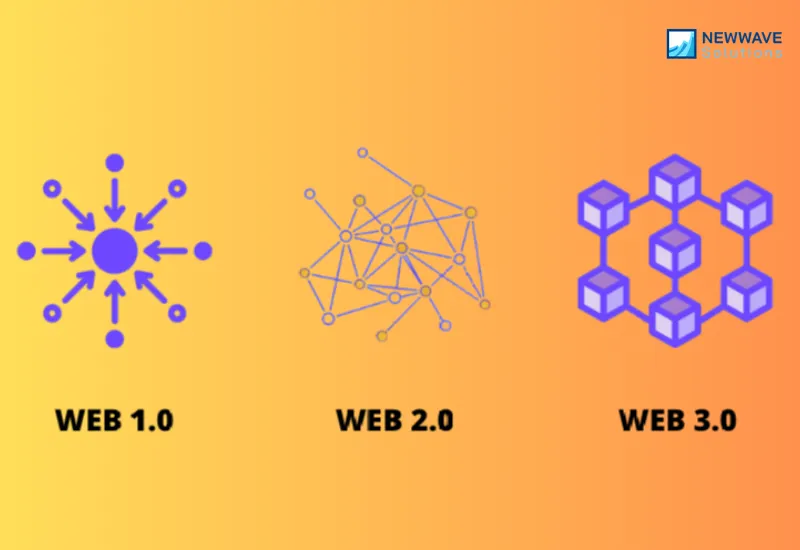
To understand what’s Web3 all about, it helps to look at the progression of the internet:
Web1 – The Read-Only Web
Web1 was the earliest version of the internet, consisting of static web pages. Users could read information but could not interact or create content. It was open and decentralized but limited in functionality.
Web2 – The Read-Write Social Web
Web2 introduced social networks, interactive platforms, user-generated content, and mobile-first applications. It powered global innovation but concentrated control in the hands of a few large corporations. Data became the core asset, but users did not own it.
Web3 – The Read-Write-Own Web
Web3 addresses Web2’s centralization challenges with decentralized technologies. It enables users to:
- Own digital assets
- Manage identities without logins from major platforms
- Participate in governance
- Move value directly between peers
Web3 creates a trustless environment based on transparent blockchain rules instead of platform policies.
Below is a table that illustrates Web3 vs Web2 vs Web1 for clarity:
| Aspect | Web1 (Read-Only) | Web2 (Read-Write) | Web3 (Read-Write-Own) |
|---|---|---|---|
| Core Paradigm | Static content | Interactive platforms | Decentralized ownership |
| Data Control | Website owners | Centralized corporations | Users via cryptographic keys |
| Architecture | Centralized servers | Cloud platforms | Distributed networks |
| Monetization | Basic ads | Targeted ads & data usage | Tokens, digital assets, micro-economies |
| Identity | Anonymous browsing | Platform accounts | Decentralized identity (DID) |
| Trust Model | Trust publisher | Trust platform | Trustless code & consensus |
| Interoperability | Limited | API-driven | Built-in, protocol-level |
| Value Transfer | Not native | Through intermediaries | Peer-to-peer with tokens |
How Does Web3 Work?
Web3 systems operate through a distributed model where logic, data and ownership are shared across networks instead of being managed by a central authority. To understand how Web3 works, it helps to divide it into core components.
Core Principles of Web3 Operation
- Decentralization: Nodes participate in maintaining the network, removing the need for central servers.
- Consensus Mechanisms: Transactions are validated through proof based systems that prevent double spending and ensure network integrity.
- Smart Contract Automation: Rules are embedded into self executing programs that run independently once deployed.
- User Identity and Ownership: Wallets provide users with private keys that manage identity, assets and permissions.
- Token Incentives: Many networks use tokens to reward participation and maintain decentralized security.
Process Flow of Web3 Interactions
- A user signs a transaction using a cryptographic wallet.
- The transaction is broadcast to the network for validation.
- Consensus nodes confirm the transaction and record it on the blockchain.
- Smart contracts process logic automatically.
- The result becomes visible to all participants.
Web3 relies on the cooperation of distributed parties rather than centralized platforms. This design enhances transparency and reduces dependencies on single entities. These characteristics help answer how does Web3 work and why it is seen as a more resilient model for future applications.
Web3 Applications
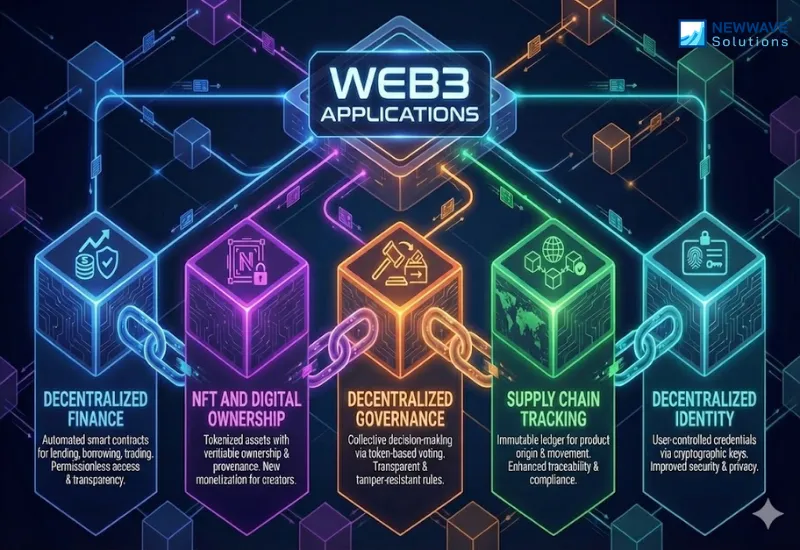
Web3 applications operate differently from traditional digital systems, which are decentralized applications running on blockchain networks. They run on decentralized networks, automate processes through smart contracts and give users ownership of data and assets. Below are the expanded descriptions for each category of Web3 application:
Decentralized Finance
Decentralized Finance introduces financial services that operate without banks or intermediaries. In these applications, smart contracts manage lending, borrowing, trading and liquidity. Web3 transforms this area by reducing counterparty risk and increasing transparency. Every transaction is traceable, and the logic is visible to all participants, helping remove the need for trust in a single authority.
Web3 strengthens financial applications by enabling permissionless access. Users anywhere can participate without complex onboarding or eligibility restrictions. Automated processes also reduce operational overhead. For businesses, this creates new opportunities to build financial products at lower cost and with broader global reach.
Example: Aave supports decentralized lending and borrowing using transparent smart contracts that determine interest rates and collateral rules.
NFT and Digital Ownership
NFT applications use Web3 to tokenize digital assets and link ownership directly to a users cryptographic wallet. This eliminates ambiguity around provenance and rights. Web3 impacts digital ownership by creating a standardized method to represent collectibles, virtual products and intellectual property in a verifiable format.
Smart contracts also define how assets can be transferred, monetized or shared. This offers creators and brands new monetization pathways. Collectors gain proof of authenticity and ownership that persists across platforms, as the data is stored on decentralized networks rather than private databases.
Example: Nike .Swoosh uses NFTs to create virtual merchandise with verifiable ownership and traceable history.
Decentralized Governance
Decentralized governance applications provide a framework for communities and organizations to make collective decisions through token based voting. Web3 impacts governance by making decision making processes transparent and resistant to manipulation. Smart contracts enforce voting rules and record outcomes on chain.
These systems support open participation and reduce administrative overhead. They help organizations coordinate more efficiently and ensure accountability, as decisions are made using verifiable rules rather than centralized control.
Example: Aragon provides a suite of tools for creating DAOs where voting, proposals and treasury management are executed through smart contracts.
Supply Chain Tracking
Supply chain applications use Web3 to record product origin, movement and quality in a tamper resistant ledger. This improves traceability and helps businesses maintain compliance across complex networks. Web3 strengthens these applications by ensuring that each event is logged permanently and cannot be altered later.
Companies gain visibility into every stage of the supply chain while reducing manual reconciliation. Customers also benefit from transparent information about product origin and authenticity, supporting industries where trust and validation are essential.
Example: Everledger tracks diamonds and other high value assets by recording their provenance on a blockchain based system.
Decentralized Identity
Decentralized identity systems use Web3 to give users control over authentication and personal data. Instead of relying on centralized platforms that store credentials, users manage their identity through cryptographic keys. This reduces the risks associated with data breaches and unauthorized access.
Web3 strengthens identity applications by providing verifiable credentials that users can share selectively. Organizations benefit from enhanced security and reduced exposure to personal data. This model supports compliance with privacy regulations and improves user trust.
Example: SpruceID enables users to authenticate to services using decentralized identity standards rather than traditional password based systems.
Web3 Benefits and Limitations
The benefits of Web3 highlight why many industries are experimenting with decentralized applications, token models and automated workflows. These strengths provide opportunities for differentiation and open new forms of digital interaction. However, Web3 also presents limitations that stem from emerging infrastructure, evolving regulations and the complexity of user experience.
A clear view of both benefits and limitations helps answer practical concerns including is Web3 safe and how suitable it is for production environments. The following sections outline each advantage and challenge in detail to support informed decision making for enterprises and innovators.
Benefits
- User Ownership & Control: Individuals own their data, content, and digital assets, which are portable across services.
- Censorship Resistance: Decentralized networks are harder for any single entity to control or censor.
- Transparency & Trust: Open, auditable blockchains and predetermined smart contract rules reduce the need for blind trust.
- New Economic Models: Enables micro-economies, direct creator monetization, and users earning from their contributions.
Limitations
- User Experience & Complexity: Managing private keys, paying “gas fees,” and understanding wallets create a steep learning curve for mainstream users.
- Scalability & Performance: Many blockchains struggle with high transaction costs and slow speeds during peak usage.
- Regulatory Uncertainty: The decentralized, global nature of Web3 creates complex legal and compliance questions.
- Security Paradigm: While secure in theory, applications are vulnerable to smart contract bugs and phishing attacks, with no central authority to reverse fraudulent transactions.
Understanding both sides gives enterprises realistic expectations for adoption and integration.
What Platforms And Languages Should Be Used In Web3 Development?
Developing Web3 applications requires choosing the right blockchain platform and the appropriate blockchain programming languages. These choices influence performance, security and scalability. Besides that, teams must align their technical decisions with SDLC best practices, security, interoperability, and scalability requirements.
Before looking into specifics, here is what development teams should consider:
- Whether the application demands high throughput or strong decentralization
- The cost profile of the target blockchain platform
- Availability of developer tools and open-source libraries
- The maturity of the ecosystem and community support
- Integration needs with existing infrastructure
- Fit for MVP development and long-term scaling
With that in mind, here are the main categories of technologies involved:
Major Development Platforms
- Ethereum: The most widely used platform for smart contracts and decentralized applications. It has a large ecosystem and strong developer support.
- Solana: Optimized for high throughput and low cost. Suitable for applications requiring fast transactions.
- Polygon: A Layer 2 framework that enhances Ethereum scale and performance.
- Sui and Aptos: Platforms built for secure, high performance transaction handling using the Move language.
- Arbitrum and other rollups: Improve Ethereum scalability through off chain computation.
These platforms help answer how to access Web3 and how to connect to Web3 because most users interact through wallets integrated with these networks.
Essential Programming Languages
- Solidity: The main language used to write Ethereum smart contracts.
- Rust: Used for Solana and other high performance blockchains.
- Move: Designed for safety and predictable execution on Sui and Aptos.
- JavaScript and TypeScript: Used to build Web3 interfaces and integrate applications with blockchain nodes.
- Python: Popular for scripting, analytics and backend logic.
Developers combine these languages to build complete Web3 applications, manage smart contract logic and support ecosystem interoperability.
Trends of Web3 and Beyond
Web3 is moving into a period of accelerated maturity, shaped by technological breakthroughs, stronger enterprise adoption, and an expanding regulatory foundation. As decentralized systems become more usable and scalable, Web3 is expected to influence finance, digital identity, infrastructure, supply chains, and consumer applications. The next wave of innovation focuses on bridging traditional industries with blockchain-driven models, improving user experience, and enabling new forms of digital ownership and automation. These trends signal a future where Web3 becomes a foundational digital layer rather than a niche technology.
Below are the leading trends driving the next stage of Web3 development:
Real-World Asset Tokenization (RWA)
Businesses are converting physical and financial assets—such as real estate, commodities, invoices, or funds—into digital tokens on blockchain networks. This enables fractional ownership, expanded liquidity, and more efficient asset transfer across markets.
AI x Web3 Convergence
The integration of artificial intelligence and decentralized systems is reshaping how smart contracts operate and how data is managed. AI agents can interact with on-chain logic, optimize decision-making, automate workflows, and enable more intelligent dApps built on trustworthy decentralized data sources.
DePIN (Decentralized Physical Infrastructure Networks)
DePIN models allow individuals to provide physical infrastructure—like wireless hotspots, sensors, energy systems, or compute resources—in exchange for tokens. This creates decentralized, user-owned alternatives to traditional cloud and telecom networks.
Institutional Adoption and Regulatory Clarity
Frameworks such as Europe’s MiCA and improved global compliance standards are giving enterprises and financial institutions the confidence to adopt Web3. This leads to increased tokenization, blockchain-based settlement systems, and enterprise-grade decentralized solutions.
Advanced User Experience Enhancements
Innovations such as account abstraction, gas sponsorship, and social recovery aim to remove complexity from Web3 interactions. These improvements help dApps feel more like familiar Web2 applications, lowering onboarding barriers and enabling more mainstream adoption.
What Newwave Solutions Offers You in Web3 Development?
As businesses accelerate digital transformation, many seek reliable partners to navigate Web3 strategy, blockchain architecture, and secure decentralized development. This is where Newwave Solutions supports organizations globally.
Located in Vietnam and with our deep expertise in blockchain technology, we support your web3 projects through:
- Web3 solution consulting: Helping you evaluate your idea, select the right blockchain platform, and plan your MVP development.
- Custom Web3 & dApp development: Building decentralized applications, NFTs, DAO platforms, and token systems.
- Blockchain integration: Smart contracts, wallet integration, and secure architecture.
- Custom eWallet development solutions for Web3 identity and asset management.
- Full-cycle SDLC execution from discovery to deployment.
- Ongoing maintenance and scaling on Web3 networks.
Why Choose Newwave Solutions?
- Vietnam-based team with strong technical talent
- Proven experience delivering Web3 applications across industries
- Competitive pricing compared to other blockchain development companies
- Expertise across leading blockchain programming languages and platforms
- Strong portfolio: NFT marketplaces, DeFi apps, decentralized identity systems, and more
Web3 represents an important transformation in how digital systems operate. Whether you explore new applications, develop decentralized workflows or modernize existing systems, Newwave Solutions can help you evaluate strategic opportunities and implement practical solutions for your organization.
If you’re exploring how to connect to Web3 or want to bring a decentralized idea to life, we’re here to support you at every stage—from strategy to launch.
To Quang Duy is the CEO of Newwave Solutions, a leading Vietnamese software company. He is recognized as a standout technology consultant. Connect with him on LinkedIn and Twitter.



Read More Guides
Get stories in your inbox twice a month.
Let’s Connect
Let us know what you need, and out professionals will collaborate with you to find a solution that enables growth.
Leave a Reply