


How to Start Blockchain Development: The Complete Guide for All
As the demand for decentralized applications (dApps) and smart contracts continues to rise, more businesses and developers are seeking ways to start blockchain development effectively. Whether you’re a startup looking to launch a custom token, a company exploring how to start with blockchain for supply chain traceability, or a tech enthusiast getting started with blockchain development, this comprehensive guide will walk you through every step. From understanding blockchain technology to preparing your tools and avoiding common pitfalls, here’s everything you need to confidently build a blockchain project.
Preparing Before You Start
Before writing any code, you need to prepare and understand your foundation. This preparation phase saves you time later and prevents many common mistakes. Think of it as building the ground floor for everything you will learn in the future. This includes conceptual knowledge, development tools, and technical readiness. The success of your project depends on how well you understand the ecosystem and plan the Software Development Life Cycle (SDLC) for blockchain applications.
You will prepare in four areas:
- Your basic knowledge
- Your technical skills
- Your tools and environment
- Your learning resources
When these are in place, you can start building real projects with confidence:
Foundational Knowledge
First, you need to know what you are working with. You do not need advanced mathematics, but you do need a clear mental picture of how a blockchain works.
You should understand:
- What a blockchain is and how it differs from a normal database
- How blocks are linked together and why this linkage is important
- What nodes are and how they share data in a peer to peer network
- How public keys and private keys form the basis of identity and signatures
Spend time reading simple explanations and watching visual videos. Ask yourself: “If I had to explain this to a friend in basic terms, could I do it?” If the answer is yes, you are moving in the right direction.
Then going to understand the core principles of blockchain technology is non-negotiable. These are the key concepts to master:
- Cryptography: Learn about hash functions, public-private key encryption, and digital signatures to understand how data is secured.
- Decentralized networks: Grasp the peer-to-peer (P2P) architecture and how nodes communicate and validate transactions.
- Consensus algorithms: Explore protocols like Proof of Work (PoW), Proof of Stake (PoS), and Delegated Proof of Stake (DPoS) that enable network agreement.
- Immutability and transparency: Learn why data on blockchains can’t be altered and how this ensures trust.
- Merkle Trees and data structures: Understand how blockchains verify data integrity using cryptographic trees.
By studying these elements, you’ll understand blockchain technology deeply and be ready for development challenges.
Technical Prerequisites
After theory, you need basic programming skills. If you’re wondering how to start blockchain development on a practical level, these are the core skills and knowledge you’ll need:
- Blockchain programming languages: Solidity for Ethereum, Rust for Solana, and Go or C++ for building your own chains.
- General-purpose languages: JavaScript, TypeScript, or Python are often used for testing and front-end development.
- Web development basics: HTML, CSS, and frameworks like React or Next.js to build user-facing dApps.
- Version control: Use Git and GitHub for managing your codebase and collaborating with teams.
- Node.js and npm: Many tools and libraries for blockchain development depend on the Node ecosystem.
Start with one ecosystem and one language. Most beginners choose Solidity because Ethereum has many tutorials and tools. Learn how contracts are structured, how state variables work, and how functions change or read the state. Understanding how the backend (smart contracts) and frontend (UI) interact will help you bridge the gap between blockchain and user experience.
Development Tools and Environments
Now you are ready to set up your working environment. This means installing and connecting the tools that you will use every day. Getting the right stack in place is crucial before you start blockchain development.
Start with:
- Node.js and npm, which many blockchain frameworks use
- A modern code editor, such as Visual Studio Code, with a Solidity extension
- A browser wallet, such as MetaMask, which will sign transactions and connect to your apps
MetaMask is important. It simulates a real user wallet. It connects to main networks, public test networks, and local development chains. You will use it to send test transactions and verify that your app works as expected.
Next, set up a local blockchain for testing. You have two popular options:
- Ganache, which is a personal Ethereum blockchain that runs on your machine and provides test accounts with fake Ether
- The built in local network from a framework such as Hardhat, which starts automatically when you run tests or scripts
A local chain lets you deploy contracts quickly, reset the state at any time, and test without spending real money.
Then pick at least one smart contract framework:
- Hardhat, known for flexibility, plugins, and strong debugging tools
- Truffle, known for a clear project structure and simple migration process
Create a sample project, compile the example contracts, and run tests. Make sure everything works from beginning to end.
Finally, add supporting tools:
- Remix, the online Solidity editor for quick experiments
- A block explorer, such as Etherscan, for viewing transactions and contract data on test networks
- OpenZeppelin contract libraries, which provide secure, standard implementations of tokens and other common patterns
Together, these tools form your everyday toolkit.
Learning Resources and Tutorials
The blockchain community is rich in resources. Here are some standout tutorials and courses to guide your learning journey:
- CryptoZombies: Teaches Solidity with an interactive game-based format.
- OpenZeppelin documentation: A must-read for understanding token standards and smart contract security.
- MetaMask blog: Offers tutorials on deploying ERC-20 tokens and other guides.
- FreeCodeCamp’s Solidity course: A full-length video course for beginners.
- Communities: Engage in r/ethereum, Discord groups, or developer meetups to stay up-to-date.
Whether you’re building a quick MVP development or a long-term platform, these resources will boost your confidence.
How to Start Blockchain Development?
Starting blockchain development becomes much easier when you follow a clear roadmap. Instead of jumping straight into coding, you need to understand your business goals, choose the right technologies, design your architecture, and validate everything through small, safe iterations. This section gives you a complete, step by step process showing exactly how to start blockchain development from idea to prototype.
Below are the essential stages every beginner, startup, or enterprise should follow:
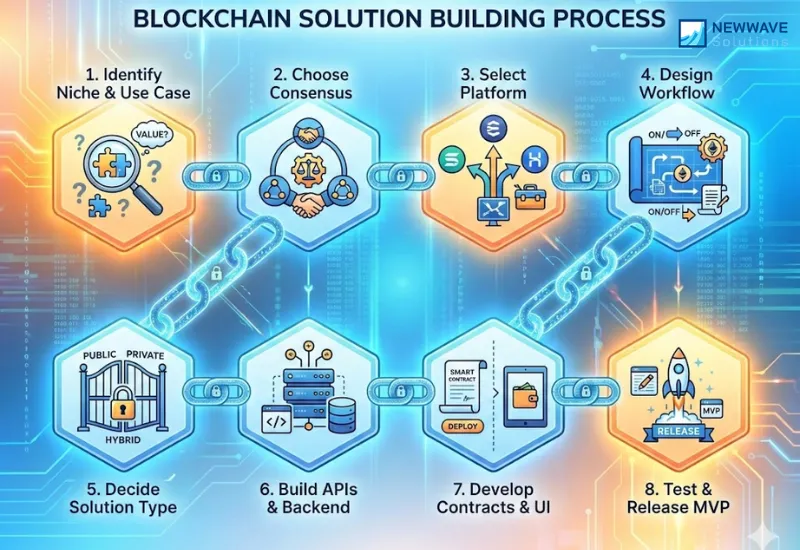
Step 1: Identify Your Business Niche and Use Case
Before writing a single line of code, define why your project needs blockchain. Many companies fail because they try to use blockchain without a clear reason. Ask yourself:
- What problem am I solving?
- Why can’t traditional databases or systems solve this problem?
- Does decentralization add real value to my process?
To help you decide, here are industries where blockchain excels:
Blockchain works especially well for:
- Data authentication and verification: Immutable storage, digital signatures, encryption for tamper proof records.
- Smart asset lifecycle management: Asset issuance, escrow, tracking, automated execution.
- Smart contracts: Automated business logic that removes intermediaries and reduces fraud.
Once you identify your real business need, you will understand what type of blockchain solution you should build and which platform fits best later.
Step 2: Find a Suitable Consensus Mechanism
Once you know your use case, you can decide how the network will agree on the state of the ledger. This is the role of the consensus mechanism.
You do not need to master every algorithm, but you do need to select a family that fits your goals:
- Proof of Stake and Delegated Proof of Stake: Good for public networks where you need economic security and open participation.
- Byzantine Fault Tolerant variants: Practical Byzantine Fault Tolerance, Federated Byzantine Agreement, and related models are often used in permissioned or consortium networks where participants are known.
- Round Robin and federated models: Suitable when you have a fixed set of validators, for example several banks or enterprises that share a ledger.
Think about:
- How many parties will validate transactions
- How tolerant you must be to malicious or offline nodes
- How fast you need confirmations and how much energy or hardware cost you can justify
This choice will narrow down the platforms and frameworks that make sense for your project.
Step 3: Select the Blockchain Platform That Matches Your Requirements
Your chosen blockchain platform determines the development tools, programming languages, speed, cost, and scalability of your system. Most modern platforms are open source, which gives you flexibility, but each platform serves different types of applications. Instead of choosing what is popular, choose what aligns with your actual use case.
Questions to guide your choice:
- Does your project need smart contracts, tokens, high speed, or privacy features?
- Do you need public transparency or controlled internal access?
- How much traffic do you expect the system to handle?
- Do you need long-term scalability?
Examples of suitable platforms:
- Ethereum / Polygon: Smart contracts, NFTs, DeFi, multi-chain apps.
- Solana: High-speed apps like gaming or trading.
- Hyperledger Fabric: Permissioned enterprise networks.
- Quorum: Financial institutions requiring privacy and performance.
- BNB Chain / Avalanche: Flexible ecosystems for consumer applications.
A correct platform choice saves months of development and ensures your system grows smoothly.
Step 4: Design Your Blockchain Workflow
After selecting your platform, you must design how your entire blockchain system will function. Blockchain architecture requires careful planning because core elements—like the consensus model or data flow—are difficult to change once development begins.
Clarify:
- How data enters the system, is validated, and written on chain
- Which actions are handled by smart contracts and which remain off chain
- What roles exist in the system and what each role is allowed to do
Translate this into a concrete plan:
- Define smart contracts, events, and on chain data structures
- Define off chain services, queues, and integrations with existing systems
- Create a deployment pipeline for local, testnet, and production environments
Some design decisions are very costly to change later, especially around consensus, privacy, and contract architecture. It is wise to review your workflow with internal experts or an experienced blockchain development partner before you commit.
Step 5: Decide on the Type of Blockchain Solution You Will Build
Now that your architecture is clear, choose the structure of your blockchain: public, private, hybrid, or permissioned. Each structure affects how users interact with your system, how data is stored, and how secure or open the environment will be.
Types of blockchain solutions to choose from:
- Permissionless (Public): Anyone can participate. Suitable for dApps, tokens, NFTs, open networks.
- Permissioned (Private): Access is restricted. Often used by banks, enterprises, governments.
- Private blockchains: Ideal for internal workflows, identity management, supply chain tracking.
- Public blockchains: Best for consumer-facing decentralized applications.
- Hybrid blockchains: Combine public transparency with private data protection, often used for KYC, banking, and multi-party systems.
This choice shapes the entire direction of your platform, from security rules to user onboarding.
Step 6: Create Core APIs and Backend Services
With the architecture defined, you can start building the technical backbone of your application. This is where the earlier step by step flow about writing and deploying contracts fits in.
Your backend will usually include:
- Smart contracts
Implement the core rules for asset management, access control, and business logic. Use a framework like Hardhat or Truffle, write tests, and deploy to a local chain first. - APIs and services
Expose safe endpoints for your front end and other systems to interact with the blockchain. Typical capabilities are:- Generating and managing key pairs and addresses
- Submitting transactions and monitoring their status
- Verifying signatures and performing data authentication
- Listening to events and syncing off chain databases
- Storage and indexing
Store raw or derived data in databases or search indexes for fast queries that would be too expensive to perform on chain.
At this point you will be working daily with blockchain programming languages for your contracts and a general purpose language like JavaScript or Python for your APIs and scripts.
Step 7: Develop Smart Contracts, the UI, and the Admin Console
This is the stage where your idea becomes a working product. Smart contracts form the core logic of your application. They must be written clearly, tested thoroughly, and optimized for safety.
Smart contract development tasks:
- Write your contracts in Solidity, Rust, Go, or another platform-specific language.
- Test them repeatedly using frameworks like Hardhat, Truffle, or Foundry.
- Check for vulnerabilities and ensure gas efficiency.
- Simulate real user actions to confirm correct behavior.
Once your contracts are stable, you can build the user interface. This is what users will interact with when connecting their wallet, sending transactions, or managing assets.
UI development tasks:
- Choose a front-end framework such as React or Vue.
- Connect to wallets like MetaMask using libraries such as Ethers.js or Web3.js.
- Display real-time blockchain data and transaction status.
- Ensure that interactions feel simple and intuitive.
An admin console is also important. It gives you full control over the system, letting you monitor transactions, manage configurations, and review analytics.
Step 8: Test, Deploy, Optimize, and Release Your MVP
Thorough testing is critical before launching your blockchain app. Blockchain behaves differently from traditional systems, so you must test performance, stability, and security in both local environments and public test networks.
What to test before deployment:
- Transaction speed and network latency.
- Memory usage, storage behavior, and crash resistance.
- Smart contract vulnerabilities and unexpected edge cases.
- Gas cost estimates to ensure user-friendly interaction.
After testing, deploy your application first as an MVP (Minimum Viable Product). An MVP helps you:
- Validate your idea in real-world conditions.
- Collect user feedback early.
- Fix issues before your system scales.
- Save time and cost by avoiding oversized initial development.
An MVP development approach works well here. Start with the smallest version of your solution that proves the concept and delivers real value, then iterate. This reduces risk, makes it easier to estimate how much does a blockchain development cost for future phases, and gives you evidence to show stakeholders and investors.
By following these steps in order, you move from idea to real product in a structured way that answers how to start blockchain in practice, not just in theory.
How to start a blockchain project with Newwave solutions?

If you’re ready to start blockchain development but don’t know where to begin, Newwave Solutions is here to help. As one of the top blockchain development companies in Vietnam, we offer custom blockchain development solutions tailored to your business needs.
From conceptualization to MVP development, we guide you through every stage of the SDLC — including architecture, smart contract programming, front-end integration, and final deployment. Whether you’re launching a DeFi protocol, a token ecosystem, or a blockchain-based game, our custom DApp development services will ensure your product is secure, scalable, and user-friendly.
Why us for you blockchain development project?
- Consultation: We help you understand blockchain technology and choose the right blockchain development platforms for your needs.
- Full-stack expertise: Our developers are fluent in top blockchain programming languages like Solidity, Rust, and JavaScript.
- Security-first mindset: From audits to upgrades, we follow best practices for reliability.
- Proven experience: We’ve delivered blockchain applications across industries: DeFi lending apps, NFT marketplaces, supply chain tracking, and DAOs.
- Vietnam-based team: Our developers offer competitive pricing, deep expertise, and fast turnaround times.
So, how do you start a blockchain project with us? Simply reach out for a free consultation. We’ll help estimate how much does a blockchain development cost, evaluate your idea, and propose the best strategy to get you from POC to production.
Get in touch today and let Newwave Solutions bring your blockchain vision to life!
To Quang Duy is the CEO of Newwave Solutions, a leading Vietnamese software company. He is recognized as a standout technology consultant. Connect with him on LinkedIn and Twitter.



Read More Guides
Get stories in your inbox twice a month.
Let’s Connect
Let us know what you need, and out professionals will collaborate with you to find a solution that enables growth.
Leave a Reply