


What Is Mobile App Development? A Complete Guide for Enterprises
Mobile app development has become a strategic imperative for businesses as mobile devices continue to dominate how users engage with brands, services, and digital products. Enterprises that adopt an effective mobile strategy can unlock deeper customer engagement, streamlined operations, and a significant competitive advantage.
If you are concerned about this topic to build your own mobile app, this article will reveal what is mobile app development, review the key stages of the process, outline the main types of mobile apps, and help you choose the right mobile app development services partner for your business.
What is Mobile App Development?
Mobile app development is the end-to-end process of designing, building, and deploying applications tailored for smartphones and tablets, which includes everything from ideation to post-launch support. This discipline plays a vital role in helping businesses reach users on their preferred devices, deliver personalised experiences, and integrate mobile-first workflows into their operations. As enterprises increasingly rely on mobile platforms, mobile app development becomes a core component of digital transformation strategies.
Example:
Uber — the global ride-hailing company — developed a mobile app that allows users to book rides, track drivers in real-time, and pay seamlessly. Because of these features, Uber remains the largest ride-hailing operator worldwide, as in 2025, the company had about 180 million monthly active users.

Benefits of Mobile App Development for Enterprises
- Enhanced customer engagement and retention: Mobile apps allow enterprises to deliver push notifications, personalised offers, and seamless service access, which helps to build stronger customer loyalty and increase repeat usage.
- Operational efficiency and automation: By shifting internal workflows and customer interactions onto mobile platforms, businesses can streamline tasks such as order processing, field operations, and real-time reporting, thereby reducing cost and manual effort.
- Data-driven insights and decision-making: Mobile apps capture rich user behaviour, device data, and interaction metrics, enabling enterprises to analyse patterns, refine offerings, and make more informed strategic choices.
- Brand differentiation and competitive advantage: A polished mobile application can strengthen a brand’s image, reinforce quality perceptions, and position the business ahead of competitors who rely only on mobile-web or legacy approaches.
- New revenue streams and business models: Mobile apps provide opportunities to monetise via subscriptions, in-app purchases, premium features, or service extensions, thereby opening fresh revenue channels beyond traditional web platforms.
Main Types of Mobile App Development
Since there are so many types of mobile app development that are being deployed in the marketplace, we will focus solely on the main, most common ones below:
1. Native App Development
There are many different types of mobile app development, but the most common one is Native app development. This method means that if you want to create an app for both iOS and Android, then the app will be developed separately for each platform with the use of completely different technology stacks. This approach has many benefits, but the best one is that your apps can run on more devices, support all available features of the platform, and have better performance overall.
Advantages of Native App Development:
- Top performance
- 100% support of OS features
- Access to hardware-related features
- Clear app update path and supported toolset
- Highly reliable, secure, & responsive
- Platform-specific UI implementation
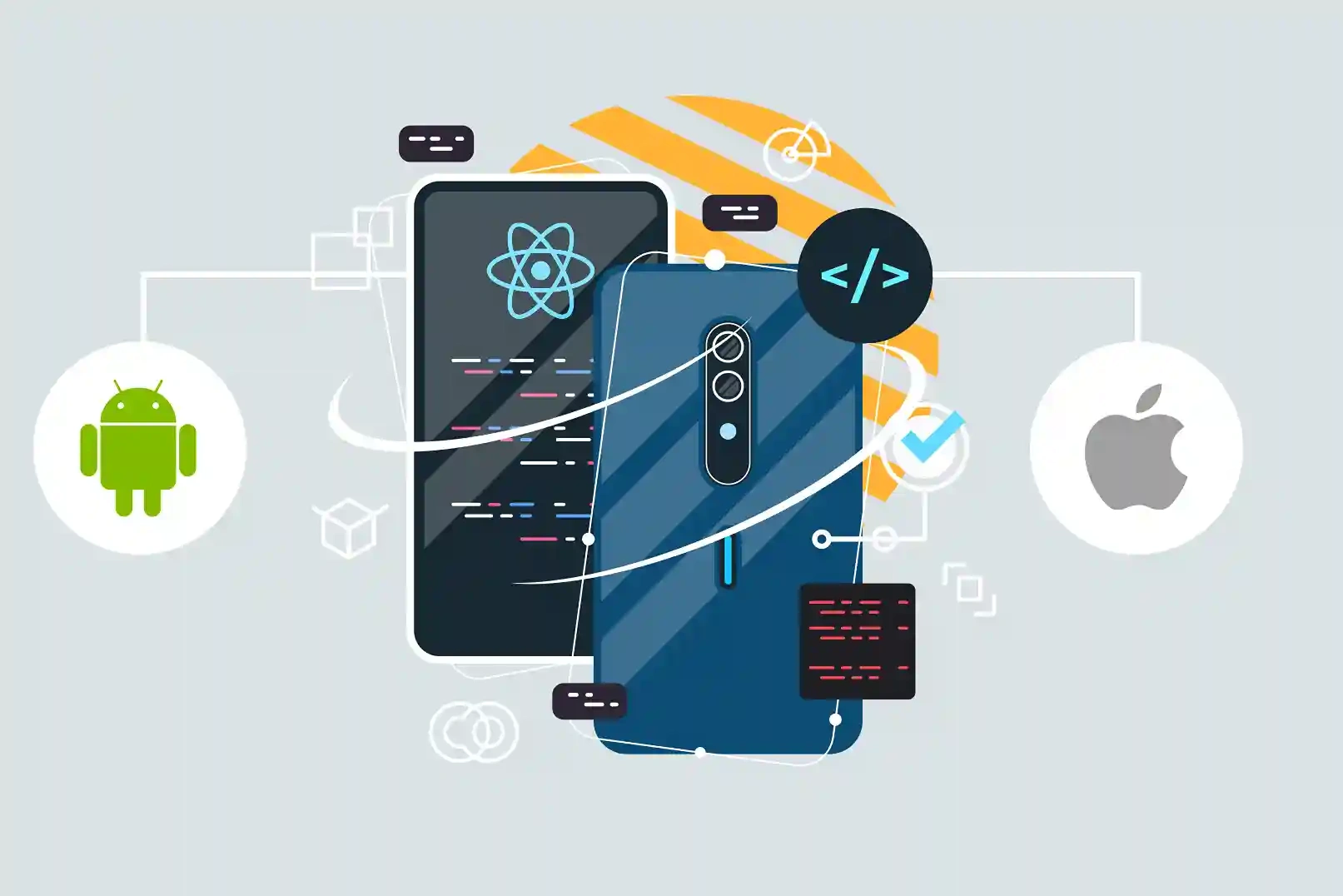
2. Cross-Platform App Development
A cross-platform mobile application simply means developing apps that run on different platforms. But, unlike native development, this method creates a separate application for each mobile platform. In other words, you will deliver your cross-platform app development on multiple platforms with the use of languages (JavaScript, .NET, or C#) and tools different from native toolsets offered by Google and Apple.
Advantages of Cross-Platform Development:
- Uniformity across all platforms
- Effective for budget control or low funding
- Publishing can be at once for all platforms
- Source code can be reusable
- High demographic coverage
- Fast time to market
- Implementation is simple
3. Progressive Web Apps: PWAs
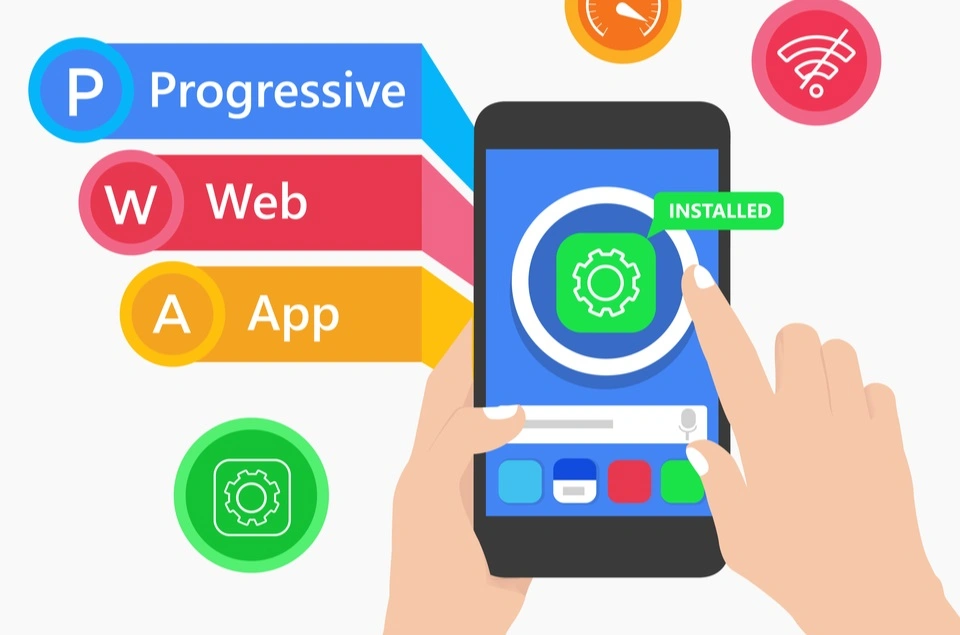
Progressive web apps (PWAs) are actually not mobile apps but are web apps with a similar appearance and function to any native app. PWAs have been specifically designed with an adaptable and user-friendly interface for mobile users. So, your users can simply skip the download step. Even though progressive web apps are not common among users and developers, they are becoming more widespread and will likely gain more features and capabilities later on.
Advantages of Progressive Web Apps (PWAs):
- Easy app maintenance
- Single codebase
- Mobile-friendly UI
- Works on and offline
- No need for app stores to host/download
As a project owner, you might wonder which mobile development approach will benefit your business the most. Well, many mobile app development companies will say native development, but it actually depends on the project. The most effective mobile development approach is the one that can satisfy all your requirements and optimize both development time and production costs.
Key Stages of the Mobile App Development Process
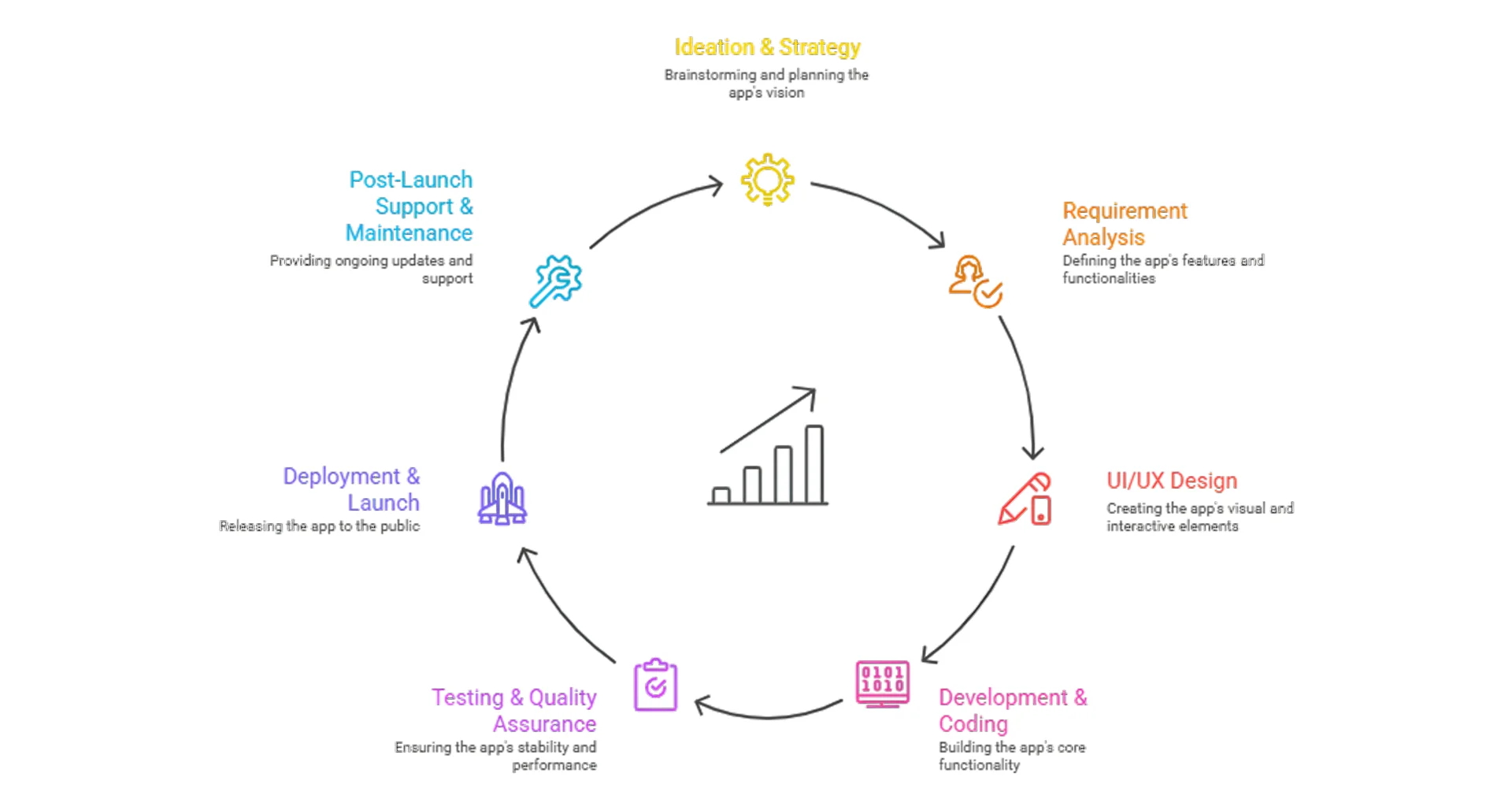
For enterprises that are not familiar with mobile app development, we would like to introduce the 7 key stages of the development process, from ideation to post-launch support, to help you understand the whole concept:
Stage 1: Ideation & Strategy
In this stage, the project team and business stakeholders define the app’s purpose, target audience, competitive landscape, and business goals; they also select the platform(s) and estimate the budget, timeline, and resources. The process involves market research, user-persona definition, and value-proposition development. Business owners must ensure alignment with corporate strategy and validate viability before moving forward.
Stage 2: Requirement Analysis
During this phase, software architects, business analysts, and product owners gather functional and non-functional requirements, document user stories and acceptance criteria, and define the feature-set SKU for the Minimum Viable Product (MVP). The team selects technology stacks, identifies dependencies, and assesses feasibility in terms of performance, security, and integration. Enterprises should pay attention to clear documentation and change-control processes to mitigate scope creep.
Stage 3: UI/UX Design
The design team creates wireframes, interactive prototypes, and high-fidelity mock-ups, while UX researchers validate navigation flows and usability with target users. Designers ensure that visual design, branding, accessibility, and mobile-specific interactions (touch, gestures, small screens) are handled properly. Business stakeholders must approve and align the design with user expectations, brand identity, and technical capabilities.
Stage 4: Development & Coding
Now, developers build the app’s functionality based on approved design and requirements; this includes front-end development (mobile UI) and back-end services (APIs, databases, integrations). The team follows the chosen tech stack, enforces code standards, and uses version control and continuous integration practices. It is crucial for businesses to monitor progress, maintain high code quality, and ensure alignment with the roadmap and performance targets.
Stage 5: Testing & Quality Assurance
Quality assurance teams perform functional testing, usability testing, performance and load testing across devices and network conditions, and manage bug-fixing cycles. Automated and manual tests verify that the app meets acceptance criteria, is secure, and delivers a consistent user experience. Enterprises must plan for device labs/emulators, user-feedback loops, and regression testing to preserve app stability.
Stage 6: Deployment & Launch
In the deployment phase, the development team configures production environments, prepares store-listing assets (app-store metadata, visuals), and executes a release plan (beta, roll-out, launch). The business marketing team may coordinate push notifications, promotional campaigns, and user-onboarding flows to maximise uptake. It is essential to define monitoring metrics, rollback strategies, and support readiness for post-launch issues.
Stage 7: Post-Launch Support & Maintenance
After launching, the development team needs to monitor performance, collect user analytics and feedback, deliver updates, fix bugs, and add new features in response to changing market or user needs. The business should budget for regular updates, user-retention strategies, and iterative improvement rather than treating the app as a one-time build. Continuous improvement and adaptation are key to sustaining relevance and value in the mobile ecosystem.
In case you are not capable of applying these steps to reality for building your own mobile app, feel free to view these top 9 mobile app development companies in Vietnam to assist your task with ease.
How Much Does It Cost to Develop a Mobile App?
There are many types of fees and costs — both fixed and variable — that arise during mobile app development. Below is a breakdown of the main expense categories that your business should consider before starting a mobile-app project, along with rough cost estimates and what each fee covers.
🔧 Fixed Costs
These are typically set up front or based on an agreed scope, and they remain relatively stable regardless of usage or scale.
- Design & UI/UX Planning: This includes wireframes, mockups, UI/UX design, and prototyping. For a basic app, this stage might cost between USD 5,000 – 15,000, depending on the number of screens, complexity of UI, and custom design elements.
- Initial Development (MVP / Basic App Build): For a simple application with core functionality only, expect a cost range of USD 5,000 – 50,000.
- Comprehensive App Build (Medium to Complex Apps): For apps with moderate to advanced features — such as backend integration, user authentication, data storage, and integration with external services — typical costs range from USD 50,000 – 120,000 for medium complexity, and USD 120,000 – 300,000+ for complex projects.
- Platform & Environment Setup: This includes setting up server or cloud infrastructure, databases, the production environment, and necessary tools. Depending on project needs and environment (cloud, hybrid, on-prem), this might be a small fixed portion or a more significant one for enterprise-grade architecture.
🔁 Variable Costs
These costs fluctuate based on project complexity, ongoing needs, and future changes or growth.
- Testing & Quality Assurance (QA): Conducting device testing, cross-platform checks, security testing, performance testing, and bug fixes. For apps supporting many devices or requiring high reliability, QA costs might be substantial — typically in the range of USD 5,000 – 30,000+, depending on scope and number of test cycles.
- Feature Complexity & Third-Party Integrations: Implementing advanced features (e.g., real-time updates, payment processing, social login, API integrations, GPS, push notifications) increases development and maintenance effort, thereby increasing costs — often pushing a “medium” app into the “complex” budget tier.
- Maintenance, Updates & Post-Launch Support: After launch, apps require updates, bug fixes, version compatibility updates, server or backend maintenance, and possibly new feature rollouts. This ongoing cost depends on app usage, update frequency, and infrastructure demands; many businesses reserve a percentage of the initial budget annually for maintenance.
- Cross-Platform or Multi-Platform Support: If the app is developed for multiple platforms (iOS, Android, perhaps a web companion), testing, optimization, and maintenance multiply, increasing total cost compared to single-platform apps.
Besides the cost breakdown above, you can explore more hidden fees and factors affecting costs from our latest article about all types of mobile app development costs.
5 Best Frameworks for Mobile App Development
Using the right mobile app development platform can speed up and simplify your app development process greatly. Below are the top 5 mobile app development frameworks that support both Android and iOS users.
1. React Native is an open-source UI software framework created by Facebook or Meta. React Native is used to develop applications for Android, iOS, macOS, Web, Windows, and UWP. The advantages of React Native include:
- Reusable elements for optimal performance
- Best deployment features
- Ease of maintenance
- Compatibility with many third-party extensions
2. Flutter is an open-source UI software development kit created by Google. It is used to develop cross-platform applications for Android, iOS, Linux, macOS, Windows, and web from a single codebase. The advantages of Flutter include:
- Fast development
- Cross-platform
- Appealing and engaging visuals
- Similar performance to native
- Provide strong widget support
3. Xamarin is an open-source platform for building modern and performant applications for iOS, Android, and Windows with .NET software framework. The advantages of Xamarin include:
- Rapid advancement
- Appearance and touch of a native app
- Compatibility with a variety of devices
- Google Emulator Manager
- Versatile backend infrastructure
- Diagnostic tools
4. Ionic is a complete open-source SDK for hybrid mobile app development created in 2013. The advantages of Ionic include:
- Suitable for many platforms
- Consistent user interface
- Optimal performance
- Flexible for users
5. Swiftic is a do-it-yourself app creation platform that allows anyone to quickly and easily create custom mobile apps for all iOS or Android devices, with minimal cost and no coding necessary. The advantages of Swiftic include:
- Interaction and navigation are simple.
- Strong integration with other parties
Common Challenges in Mobile App Development
- Device and OS fragmentation: Many enterprises struggle with supporting a wide variety of devices, screen sizes, and operating-system versions; the solution lies in comprehensive device testing and a responsive architecture that accommodates variability.
- Changing requirements and scope creep: Mobile app projects often evolve rapidly with user feedback or market shifts; managing this challenge requires flexible development models like agile sprints and regular stakeholder alignment.
- Performance and resource constraints: Mobile devices have limited CPU, memory, and battery compared to desktops; business owners must prioritise efficient code, optimisation for lower resource consumption, and native hardware capabilities.
- Security and compliance risks: Mobile apps frequently handle sensitive customer data or enterprise services; addressing this challenge calls for secure data storage, encryption, secure APIs, and adherence to regulatory standards.
- User acquisition and retention: Launching the app is only the first step—keeping users engaged and returning is difficult; enterprises must invest in UX design, regular updates, and analytics-driven iteration to sustain growth.
Approach Newwave Solutions for quality Mobile App Development Services
The development of mobile applications presents significant challenges due to their complexity, the need for extensive experience, and the requirement for diverse resources. For businesses lacking in-house expertise, partnering with a professional mobile app development service provider becomes essential to achieve successful outcomes.
Fortunately, Newwave Solutions stands as a leading provider of high-quality mobile app development services, bringing over 14 years of experience and more than 800 successful projects worldwide. At Newwave Solutions, our services empower businesses to create user-focused, high-performance apps that transform innovative ideas into market-ready digital products, spanning multiple industries and platforms.
Our key mobile app development services include:
- Native App Development Services
- iOS App Development Services
- Android App Development Services
- React Native App Development Services
- Cross-platform App Development Services
- Flutter App Development Services
- Hybrid App Development Services
Our service commitment ensures that your mobile app development project is completed with outstanding quality, meets deadlines, and receives effective support before, during, and after the project.
For more detailed information, please explore our mobile app development services in detail to make an informed decision.
Conclusion
Now you have been introduced to a complete guide to what is Mobile App Development and its entire process. Developing a mobile app is not a task that can be completed in a day or two, but one that takes months. A professional mobile app development company knows that every step of the app development strategy must be effectively executed in order for the project to be successful.
If you have long-term revenue goals from your business application, feel free to consider Newwave Solutions to get the best results for your investment. Contact us instantly to get started developing your business mobile app. You can also get free consulting from our experienced developers.
Contact Information:
- Head Office (Hanoi): 1F, 4F, 10F, Mitec Building, Cau Giay Ward, Hanoi City, Vietnam
- Branch Office (Tokyo): 1chōme118 Yushima, Bunkyo City, Tokyo 1130034, Japan
- Hotline: +84 985310203
- Website: https://newwavesolution.com
- Email: [email protected]
To Quang Duy is the CEO of Newwave Solutions, a leading Vietnamese software company. He is recognized as a standout technology consultant. Connect with him on LinkedIn and Twitter.



Read More Guides

Get stories in your inbox twice a month.
Let’s Connect
Let us know what you need, and out professionals will collaborate with you to find a solution that enables growth.
Leave a Reply