


RWA Tokenization: The Complete Guide to Real-World Assets
Real-world asset (RWA) tokenization is one of the fastest-growing applications of blockchain technology, with 10% of the world’s GDP stored on blockchain networks. By bringing real-world assets such as real estate, commodities, and financial instruments onchain, tokenization enables greater accessibility, transparency, and efficiency.
This complete guide explains everything you need to know about RWA tokenization, how the technology works, the key assets being tokenized today, and its common use cases.
Key Takeaways
|
What is Real World Asset Tokenization?
Real-world asset (RWA) tokenization is the process of converting physical or traditional financial assets into blockchain-based digital tokens. These tokens represent ownership or rights to assets such as real estate, commodities, bonds, equities, cash, artwork, and intellectual property, allowing them to be stored, transferred, and managed onchain.
By connecting real-world assets with blockchain infrastructure, tokenization introduces new possibilities for asset ownership and financial services. It improves transparency, enables fractional ownership, increases accessibility, and creates more efficient ways to trade and manage traditionally illiquid assets through decentralized technologies.
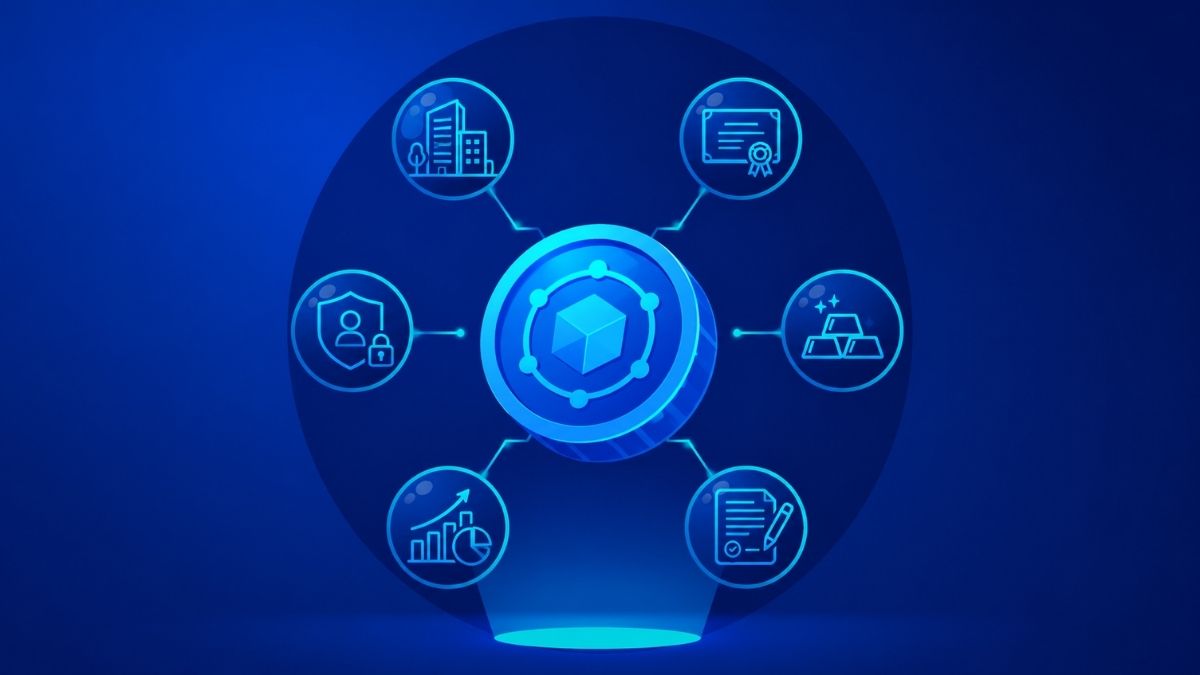
The Technology Stack for RWA Tokenization
RWA tokenization depends on several connected technology layers that manage asset issuance, regulatory compliance, investor identity, custody, settlement, and trading. Each layer must work together to ensure that tokenized assets remain secure, legally transferable, and accessible to eligible investors.
Blockchain layer
The blockchain layer provides the infrastructure for issuing, recording, and transferring tokenized assets. Ethereum and EVM-compatible networks such as Polygon, Avalanche, and Base are widely used because of their mature development tools, supported token standards, and compatibility with institutional custodians.
Other options include Solana for higher transaction throughput, Stellar for compliance-focused functionality, and permissioned networks such as Hyperledger Besu or R3 Corda.
Compliance engine
The compliance engine converts legal and regulatory requirements into rules enforced by smart contracts. These rules may cover investor accreditation, holding periods, jurisdiction restrictions, transfer limits, and maximum numbers of token holders.
Before a transfer is completed, the engine checks the recipient’s verified credentials against the token’s compliance rules. If the transaction violates a requirement, the smart contract automatically rejects it.
Token standards
Token standards define how an RWA token is issued, transferred, restricted, and managed on-chain.
ERC-3643 is commonly used for regulated securities because it supports identity checks and transfer controls, while ERC-1400 enables partitioned tokens suitable for structures such as different debt tranches. ERC-20 may support simpler tokenization models but does not include compliance controls by default.
Custody and settlement
The custody and settlement layer safeguards tokenized assets and manages the exchange of tokens and payments. Institutional solutions typically rely on regulated custodians that provide secure wallet infrastructure, private key management, and asset segregation.
Delivery-versus-payment, or DvP, enables the token and payment to move at the same time. Either both sides of the transaction are completed or neither is, reducing settlement delays and counterparty exposure.
Identity layer
The identity layer handles investor onboarding, Know Your Customer checks, Anti-Money Laundering screening, and ongoing monitoring. Providers such as Quadrata, Civic, and Synaps can issue digital identity attestations that confirm investor eligibility without publishing sensitive personal information on-chain.
Compliance engines can reference these credentials whenever a token is purchased or transferred. This may also allow one verified identity to be recognized across multiple issuances and compatible marketplaces.
Execution layer
The execution layer supports order matching, price discovery, and trade completion in primary or secondary markets. Central limit order books are suited to assets with active trading, while request-for-quote systems are often used for large transactions or less liquid instruments.
Institutional execution platforms may also support advanced order types such as iceberg, time-weighted average price, and stop-limit orders. The appropriate model depends on trading volume, asset liquidity, and investor requirements.
How Real World Asset Tokenization Works
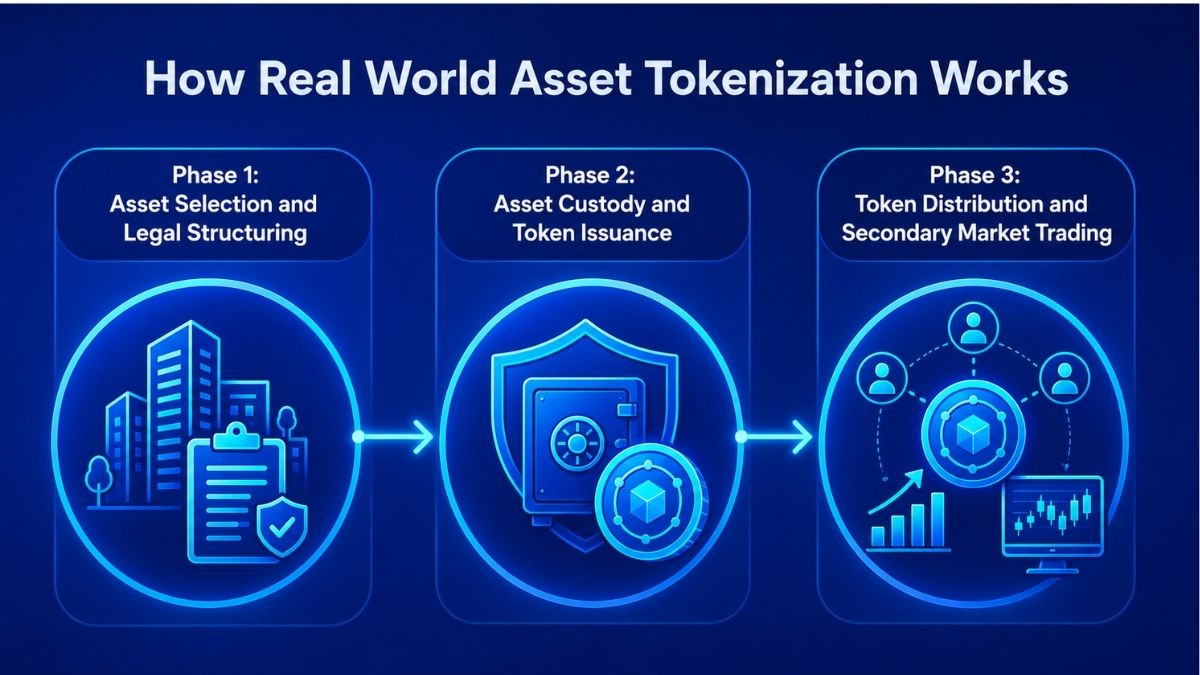
Asset tokenization converts ownership or economic rights in a real-world asset into digital tokens recorded on a blockchain. Although the exact structure varies by asset type and jurisdiction, the process generally involves three main phases: legal preparation, token issuance, and investor distribution.
Phase 1: Asset selection and legal structuring
The process begins with selecting a suitable asset such as real estate, private credit, commodities, or funds. The asset is evaluated based on demand, value, ownership clarity, regulatory requirements, and its ability to be divided into smaller investment units.
Once selected, the issuer conducts due diligence to verify valuation, ownership records, financial performance, and legal status. This ensures the asset is legitimate, properly valued, and free from hidden risks or disputes.
Finally, the asset is placed into a legal structure such as an Simplified Payment Verification (SPV) or trust. This separates it from the issuer’s liabilities, with tokens representing ownership or economic rights tied to that entity.
Phase 2: Asset custody and token issuance
After the legal structure has been established, the underlying asset or its ownership documentation must be securely held.
Depending on the asset, this responsibility may be handled by a regulated bank, trust company, licensed custodian, property trustee, or specialized vault provider. Custody helps prove that the issued tokens are backed by a real and properly secured asset.
The technical tokenization process then begins:
- Blockchain selection: The issuer selects a blockchain based on security, scalability, speed, and cost efficiency.
- Token standard selection: A token standard is chosen to define how the asset is issued, transferred, and managed, often including compliance features.
- Smart contract development: Smart contracts are built and audited to automate token functions such as transfers, compliance checks, and distributions.
- Token minting: Tokens are created on-chain to represent fractional interests in the asset, based on its structure and legal framework.
Phase 3: Token distribution and secondary market trading
After issuance, tokens are offered to eligible investors through a primary market platform. Investors must complete KYC and AML verification, and may need to meet jurisdiction-specific or accreditation requirements before participating.
Most Common Types Of Tokenized Assets
Almost any asset with clearly defined ownership and economic value can be tokenized. However, market adoption is currently concentrated in financial instruments and assets that benefit most from fractional ownership, faster settlement, automated compliance, and improved access.
Private credit
Private credit remains one of the largest and most established categories in the tokenized RWA market. It includes loans issued outside public markets, such as corporate loans, SME financing, trade receivables, and asset-backed lending.
RWA.xyz tracked approximately $6.93 billion in distributed tokenized credit and $35.75 billion in represented credit value. Platforms such as Maple and Centrifuge are active in this segment, while products such as Apollo’s ACRED and Hamilton Lane’s SCOPE demonstrate growing institutional participation.
U.S. treasuries and government debt
Tokenized U.S. Treasuries have become a leading gateway for institutional capital entering on-chain finance. These products provide blockchain-based exposure to Treasury bills, government securities, repurchase agreements, or regulated money market funds holding short-term government debt.
Major examples include Franklin Templeton’s BENJI and BlackRock’s BUIDL, which held approximately $2.5 billion in asset value.
Commodities
Gold dominates the tokenized commodity market and remains its most mature use case. Tokenized commodities represent ownership of, or economic exposure to, physical assets such as gold, silver, oil, and agricultural products.
The tokenized commodity market reached approximately $7.4 billion in July 2026. Tether Gold and Pax Gold accounted for a significant share of the market, with respective values of around $2.5 billion and $2.3 billion.
Institutional funds
Tokenized institutional funds are becoming one of the fastest-growing bridges between traditional asset management and blockchain infrastructure. They represent shares in investment vehicles such as money market funds, private credit funds, bond funds, and private equity strategies.
Leading examples include BlackRock’s BUIDL, Franklin Templeton’s BENJI, and Apollo’s ACRED. By recording fund shares on-chain, these products can streamline subscriptions, ownership tracking, distributions, and redemptions while potentially lowering investment minimums. However, many remain available only to accredited, professional, or qualified investors.
RWA Tokenization vs. Traditional Securities
RWA tokenization represents ownership or economic rights in real-world assets through blockchain-based tokens. Compared with traditional securities, tokenized assets can enable faster settlement, continuous trading, fractional ownership, and real-time transaction visibility.
|
Feature |
Tokenized Assets |
Traditional Securities |
|
Settlement |
Transactions may settle within seconds or minutes, depending on the blockchain’s finality, or the point when a transaction becomes irreversible. | Usually settle on T+1 or T+2, meaning ownership and payment are completed one or two business days after the trade. |
|
Trading hours |
Can support 24/7 global trading where the platform and regulations permit. | Mainly trade during fixed exchange hours, with limited after-hours access. |
|
Ownership granularity |
Fractional ownership is built into the token structure, allowing assets to be divided into smaller investment units. | Typically traded as whole shares or units, although some platforms offer fractional shares. |
|
Auditability |
Transactions, balances, and ownership history can be verified in real time on the blockchain. | Records are maintained across separate systems and periodically reconciled by brokers, custodians, and depositories. |
|
Intermediaries |
Smart contracts can automate issuance, transfers, compliance checks, and distributions, reducing some intermediaries. | Usually involve brokers, custodians, clearing houses, transfer agents, and other service providers. |
|
Investor protections |
Depend on the token’s legal structure, regulatory status, issuer, and jurisdiction. | Generally operate under established securities laws and standardized investor protection frameworks. |
|
Dispute resolution |
Procedures vary depending on the legal agreement and jurisdiction governing the tokenized asset. | Supported by established regulatory, court, and arbitration processes. |
Benefits of Tokenizing Real World Assets
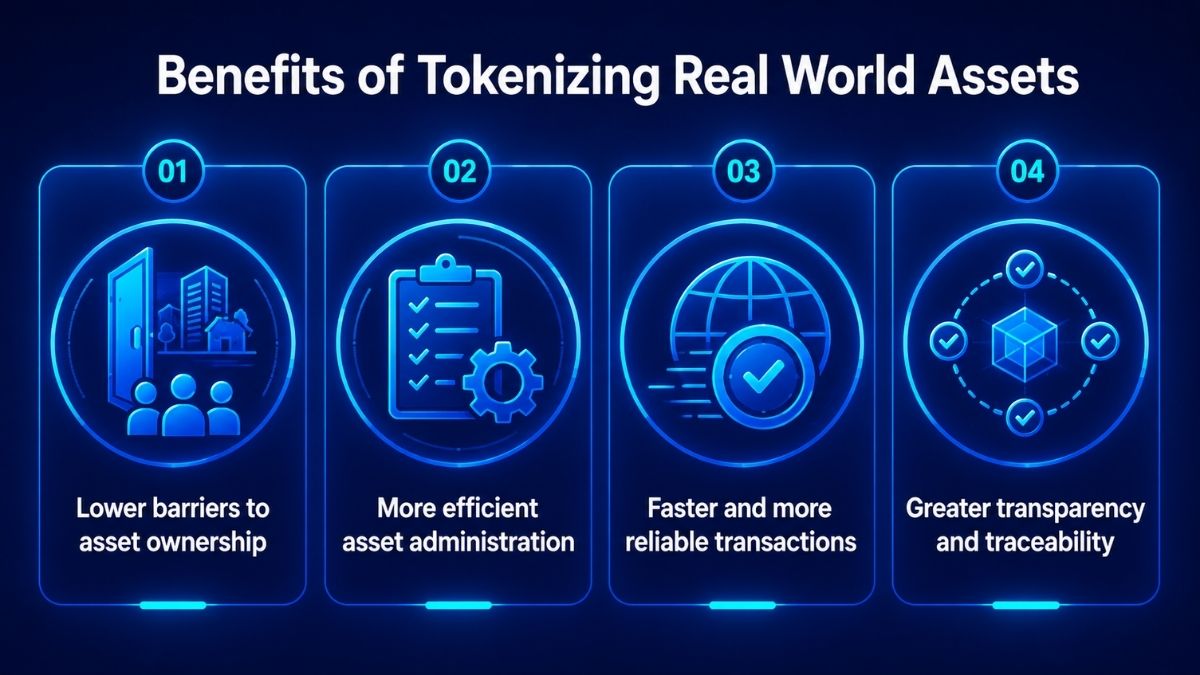
Tokenizing real-world assets can improve how investments are structured, transferred, and managed. By combining legally defined asset rights with blockchain infrastructure, tokenization can expand access while reducing operational friction across the asset lifecycle.
Lower barriers to asset ownership
Tokenization allows high-value assets to be divided into smaller digital units, reducing the amount of capital needed to participate. This can make assets such as real estate, private credit, commodities, and investment funds accessible to a wider investor base.
Fractional ownership does not necessarily change the underlying asset or investment terms. Instead, each token represents a clearly defined share or economic right within the established legal structure.
More efficient asset administration
Traditional asset management often requires separate systems for investor onboarding, compliance checks, ownership records, payments, and reporting. Tokenization can connect these activities through smart contracts and shared digital infrastructure.
This reduces repetitive administrative work, limits manual data entry, and helps issuers, custodians, and investors work from more consistent records. The efficiency gains can become especially valuable when managing large numbers of assets or investors.
Faster and more reliable transactions
Blockchain-based ownership records can reduce the number of steps required to transfer an asset. Instead of waiting for multiple intermediaries to update and reconcile separate databases, transactions can be recorded directly on a shared ledger.
This can shorten settlement times, reduce counterparty exposure, and improve capital efficiency. The benefit is particularly relevant for cross-border transactions, although actual settlement speed still depends on the blockchain, payment method, and regulatory requirements.
Greater transparency and traceability
Blockchain creates a time-stamped record of asset issuance, ownership changes, transfers, and other lifecycle events. Authorized participants can use this shared record to verify information without relying entirely on periodic reports or disconnected databases.
Improved visibility can support audits, compliance monitoring, and risk management. It also helps reduce information gaps among issuers, investors, custodians, and regulators, strengthening confidence in how the asset is managed.
Challenges and Risks of Asset Tokenization
Tokenizing real-world assets requires more than issuing tokens on a blockchain. Projects must align legal rights, operational systems, custody arrangements, and market infrastructure while managing risks that could affect investors after issuance.
Key challenges of RWA tokenization
Tokenization projects must overcome structural and operational barriers before they can scale effectively. These challenges often arise from the need to bridge traditional financial systems with blockchain-based infrastructure.
- Legal and regulatory clarity: Varying regulations create uncertainty around ownership, transfer rules, investor protections, and cross-border compliance.
- Technology and system integration: Existing systems often cannot handle tokenized transactions smoothly due to fragmented standards and gaps between on-chain and off-chain processes.
- Operational capability: Teams may lack expertise, requiring new processes for wallets, smart contracts, compliance, and blockchain recordkeeping.
- Liquidity and market structure: Tokenization improves efficiency but does not guarantee demand; many assets still have low trading activity.
- Custody and safekeeping: Custodians are still adapting to digital assets, with ongoing challenges around key management, legal clarity, and asset reconciliation.
Key risks of tokenized real-world assets
Even after successful issuance, tokenized assets expose investors to a range of financial, technical, and legal risks. These risks can affect the value, liquidity, and enforceability of the investment.
- Smart contract and technical risk: Bugs, oracle failures, or network issues can disrupt operations or cause losses.
- Counterparty and custodial risk: Failures by custodians, issuers, or auditors can impact asset security and investor funds.
- Regulatory risk: Changing rules or enforcement actions may affect token classification and compliance.
- Liquidity risk: Limited trading can make it hard to sell tokens quickly or at fair prices.
- Redemption risk: Restrictions like minimums, delays, or fees can limit or reduce access to funds.
Use Cases of Real World Asset Tokenization (With example)
Real-world asset tokenization is being applied across various sectors to improve accessibility, liquidity, and efficiency in traditional markets. The following examples highlight how different asset classes are being transformed through blockchain technology.
Real estate
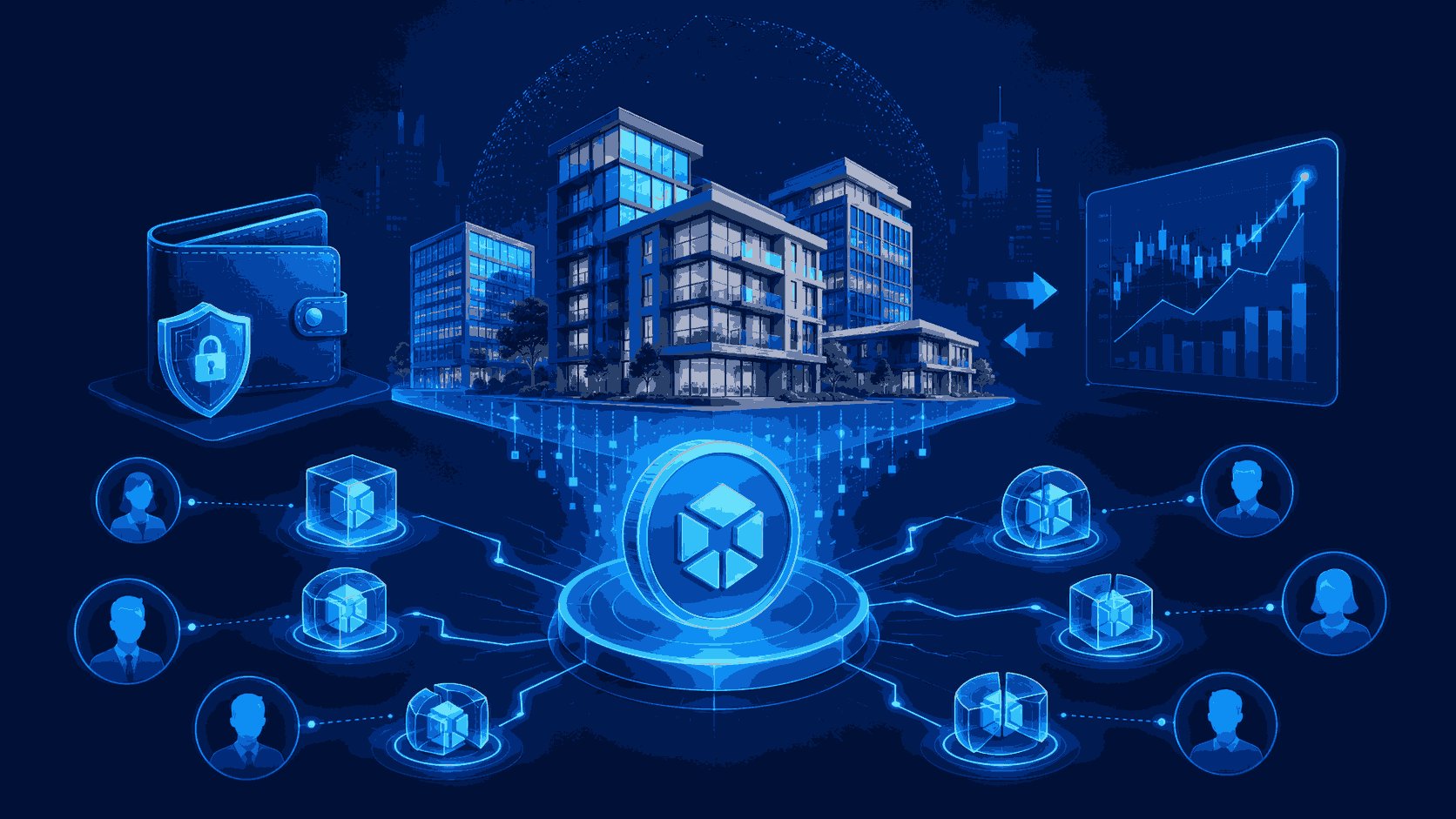
Real estate tokenization divides ownership or economic rights in a property into smaller digital units, allowing multiple investors to participate without purchasing the entire asset. Tokens may represent shares in a property-owning company and entitle holders to a proportional share of rental income and potential appreciation.
RealT, for example, offers fractional ownership in tokenized properties and distributes rental income to investors weekly.
Money market funds
Tokenized money market funds represent fund shares on a blockchain while retaining a traditional portfolio of short-term, high-quality instruments. UBS’s Ethereum-based uMINT applies this model by enabling investors to subscribe to and redeem tokenized fund shares through UBS Tokenize and authorized partners.
Precious metals
Precious metals can be tokenized by linking each digital token to a specific quantity of physical metal held by a qualified custodian. This gives investors blockchain-based transferability while preserving ownership of the underlying commodity.
Each PAX Gold token, for example, represents one fine troy ounce of London Good Delivery gold stored in LBMA-accredited vaults and held in custody by Paxos.
Corporate securities and collateral
Tokenized corporate securities can be transferred or used as collateral on-chain without moving through multiple disconnected systems. J.P. Morgan’s Tokenized Collateral Network, for example, enables institutions to mobilize eligible assets as collateral with faster settlement and clearer ownership records.
Why Secondary Markets Matter for RWA Tokenization
RWA platforms have made significant progress in issuing compliant tokens, but issuance alone does not create liquidity. Without an active secondary market, investors may still be unable to exit positions before maturity, making tokenized assets little more liquid than their traditional counterparts.
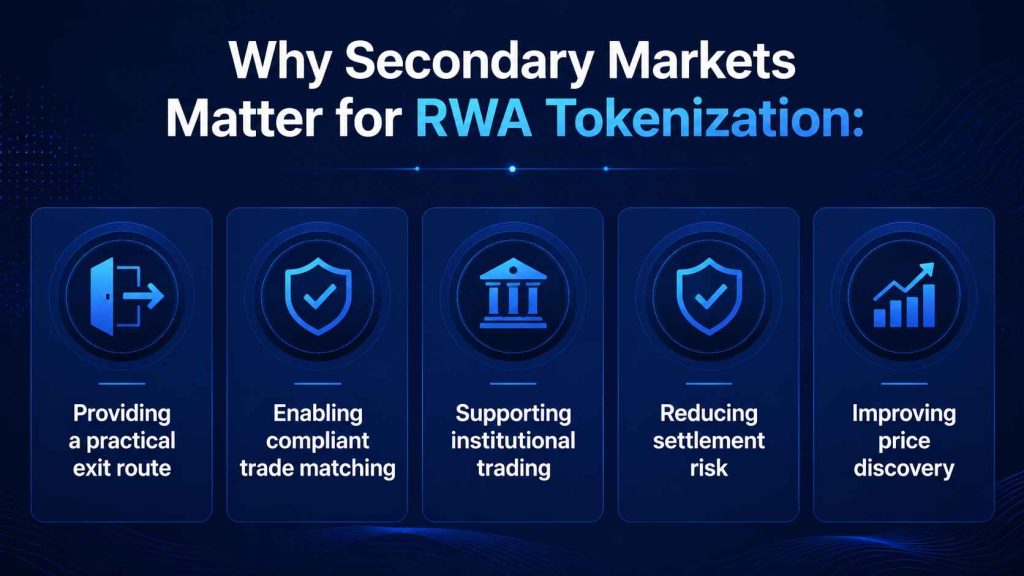
Providing a practical exit route
A functioning secondary market gives investors a place to sell tokenized assets before the end of the holding period. Without one, they may need to find buyers privately, arrange bilateral transfers, or wait until maturity, all of which limit the value of tokenization.
Enabling compliant trade matching
Secondary markets ensure that trades happen within regulatory boundaries while still enabling efficient execution. Matching engines must verify investor eligibility and enforce transfer restrictions automatically.
They also need to support multiple settlement currencies to accommodate diverse participants. This balance between compliance and efficiency is critical for scalable trading.
Supporting institutional trading
Institutional investors require advanced trading infrastructure to participate confidently. Tools like order management systems, execution systems, and portfolio controls are standard expectations.
Without these, tokenized markets appear immature and difficult to integrate into existing workflows. A strong secondary market bridges this gap and attracts professional capital.
Reducing settlement risk
A well-designed secondary market integrates trading with custody and settlement processes. Delivery-versus-payment ensures that assets and funds move simultaneously, reducing counterparty risk. This mechanism builds trust among participants and aligns with traditional financial standards.
Improving price discovery
Secondary markets generate real-time pricing based on actual trades and order flow. This transparency helps investors assess fair value and make informed decisions. It also provides regulators with visibility into market behavior. Accurate price discovery is essential for building confidence and long-term market growth.
Future Trends in Real World Asset Tokenization
RWA tokenization is moving beyond early experimentation toward institution-led adoption. Growth is increasingly driven by traditional financial institutions, clearer regulation, broader post-issuance utility, and demand for assets with predictable liquidity.
TradFi and blockchain are converging
The boundary between traditional finance and blockchain markets is becoming less distinct. Major institutions such as BlackRock, Franklin Templeton, JPMorgan, Goldman Sachs, and Citi have launched or announced tokenization initiatives backed by established financial infrastructure and significant assets.
As large asset managers bring funds and securities on-chain, demand will grow for compatible custody, compliance, trading, and settlement systems. This institutional participation is turning tokenization from a limited experiment into a long-term financial strategy.
Regulatory frameworks are becoming clearer
Regulatory clarity is improving as governments develop rules for issuing, holding, and trading tokenized assets. The EU’s MiCA framework, evolving U.S. guidance, and digital asset regulations in Singapore, the UAE, and Switzerland are giving market participants clearer paths to compliance.
Differences between jurisdictions will remain, but the overall direction is toward more defined and gradually aligned regulatory models.
Tokenized assets are gaining more utility
Tokenized assets are increasingly being used after issuance rather than simply held as digital representations of traditional investments. DBS has integrated tokenized money market funds as collateral, while Binance has supported tokenized RWAs such as USYC and cUSDO as yield-bearing, off-exchange collateral.
Adoption is concentrating on liquid assets
Tokenization activity remains concentrated in assets with relatively stable values and familiar liquidity profiles. This helps explain why U.S. Treasuries and money market funds currently account for a large share of the market.
Interest in tokenized equities and funds is also growing, with Nasdaq, NYSE, Robinhood, Coinbase, and Kraken exploring related offerings. These products could allow capital to remain on-chain across trading, custody, and settlement, although broader adoption still depends on regulation, market infrastructure, and secondary-market participation.
Conclusion
RWA tokenization is reshaping ownership, capital formation, and liquidity by combining financial infrastructure with blockchain technology. However, successful implementation requires more than token development; it demands a parter who understands regulatory expertise, secure smart contracts, reliable custody planning, and scalable blockchain architecture.
Newwave Solutions helps fintech companies implement asset tokenization with precision and compliance in mind. We support the creation of secure asset-backed tokens, development of smart contracts, and seamless integration with existing financial infrastructure such as payment gateways, KYC/AML systems, custodial services, and crypto wallets.
Book a consultation with Newwave Solutions to accelerate your RWA tokenization project, reduce implementation risks, and launch a secure, compliant platform built for long-term growth.
FAQs
1. Which industry benefited most from RWA tokenization?
Financial services and capital markets have seen the strongest adoption, particularly in tokenized U.S. Treasuries, money market funds, private credit, and institutional funds. These assets benefit from faster settlement, programmable compliance, fractional access, and more efficient collateral management.
2. What are the top RWA platforms?
Leading RWA platforms include Securitize, Ondo Finance, Centrifuge, Maple Finance, Goldfinch, ADDX, and tZERO. They serve different needs, from tokenized funds and private credit to compliant asset issuance and secondary-market trading.
3. What is the downside of tokenization?
Tokenization can introduce regulatory uncertainty, smart contract and cybersecurity vulnerabilities, custody complexity, operational costs, and limited secondary-market liquidity. It may improve how an asset is managed and transferred, but it does not remove the asset’s underlying credit, market, or counterparty risks.
4. Is XRP a RWA?
No. XRP is a native digital asset of the XRP Ledger, not a token representing an external real-world asset such as property, gold, or a bond. However, XRP and the XRP Ledger can support payments, settlement, and infrastructure for issuing and transferring tokenized RWAs.
5. Can I tokenize my real estate?
Yes, real estate can be tokenized by placing the property or its economic rights within an appropriate legal structure and issuing tokens that represent fractional ownership or related financial rights. The process requires property valuation, legal documentation, regulatory compliance, custody or asset administration, smart contract development, and a platform for investor onboarding and token management.
To Quang Duy is the CEO of Newwave Solutions, a leading Vietnamese software company. He is recognized as a standout technology consultant. Connect with him on LinkedIn and Twitter.



Read More Guides


Get stories in your inbox twice a month.
Let’s Build Something Extraordinary
Sign up for a 30 min no-obligation strategic session with us. Transform your Ideas into scalable reality.
Leave a Reply