


How to Build an MVP: 7 Steps to Validate Your Idea Fast
Every groundbreaking application that reshapes our daily lives—from Uber to Instagram—started not as a feature-complete behemoth, but as a simple, functional core. The chasm between a visionary idea and a successful product is vast, filled with the risks of wasted resources, misguided development, and market rejection. The single most effective tool to bridge this chasm is the Minimum Viable Product (MVP). If you’re holding an idea that you believe has potential, understanding how to build an MVP is not just a development tactic; it’s a fundamental strategy for de-risking innovation and navigating the uncertain journey from concept to market-fit without betting the farm.
What is MVP?
A Minimum Viable Product (MVP) is the most pared-down version of a product that can still be released to early adopters to collect the maximum amount of validated learning about their needs and behaviors with the least effort.
Think of it as an experiment. The product itself is not the final goal; it is the vehicle for conducting that experiment. Its primary purpose is to test fundamental business hypotheses: Do we have a problem-solution fit? Will users actually use this? How do they behave? The “minimum” refers to the feature set required to run the experiment, not to the quality of the execution. The “viable” means it must be functional and stable enough to deliver that core value proposition convincingly to the user.
The MVP functions as the engine of a simple, powerful cycle:
- Build: You build the smallest thing that can test your core hypothesis.
- Measure: You release it to a targeted segment of early adopters and measure how they use it.
- Learn: You analyze the quantitative data and qualitative feedback to learn whether your hypothesis was correct.
The data from an MVP reveals a story of real user behavior, transforming guesswork into evidence. This creates a critical choice: pivot toward what the data validates or persevere on the original path. Reaching this moment of clarity is the goal of a well-executed MVP development process, which provides the compass teams need to navigate toward product-market fit without costly detours.
How to Build an MVP?
Building an MVP isn’t about perfect code. It’s about starting a learning cycle. It requires focus and smart choices. Follow these steps to turn your idea into a real product that teaches you what you need to know.
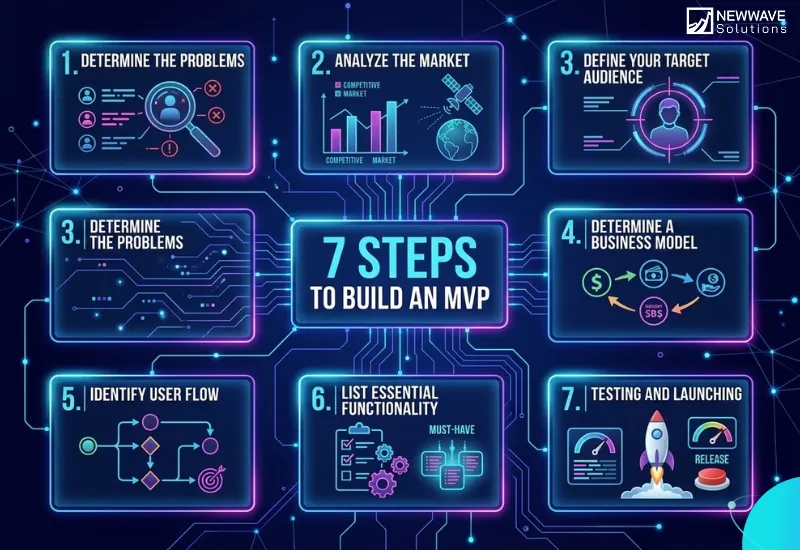
1. Determine the Problems
Every successful MVP begins with a crystal-clear understanding of the problem you’re solving. This step transcends surface-level observations and requires you to excavate the root causes that drive user frustration.
When Airbnb’s founders identified the problem of expensive hotel accommodations during peak conference seasons, they didn’t stop at “hotels are expensive.” They recognized that travelers valued authentic, local experiences and flexible pricing options—insights that shaped their entire platform architecture.
Effective problem identification demands a research approach that prioritizes authentic user insights over convenient data collection methods:
- Prioritize direct customer interviews over surveys – Face-to-face conversations prevent the rationalization that occurs when users respond to written questionnaires, revealing genuine frustrations and workarounds
- Conduct 20-30 in-depth user conversations – This sample size typically reveals consistent patterns while providing enough depth to understand behavioral nuances and decision-making processes
- Focus on current workarounds and pain points – Users’ existing solutions often indicate problem severity and willingness to adopt new approaches, providing clearer market validation signals
- Analyze language patterns for value proposition insights – The specific words users employ to describe frustrations frequently become the foundation of compelling marketing messages and product positioning
- Document problem frequency, intensity, and economic impact – Understanding not just what problems exist, but their scope and business consequences, enables more accurate market sizing and prioritization decisions
This deep problem analysis directly influences your MVP’s core functionality and positioning strategy.
2. Analyze the Market
Market analysis for MVP development differs significantly from traditional market research. You must know what other solutions exist. Your goal isn’t to find a market with no competition. It’s to find how you can be different or better.
Comprehensive competitive analysis requires expanding your perspective beyond obvious competitors to understand the complete solution ecosystem your users navigate:
- Map direct competitors and their positioning – Identify companies offering similar solutions, their core features, pricing models, and market messaging to understand established competitive dynamics
- Include indirect solutions and workarounds – Users often cobble together multiple tools or manual processes to solve problems, creating opportunities for integrated solutions that replace fragmented workflows
- Analyze adjacent products in user workflows – Tools that users employ before, during, or after your proposed solution can reveal integration opportunities or competitive threats from unexpected sources
- Study actual user behavior patterns – Slack’s analysis of email patterns, meeting schedules, and wiki usage revealed that their real competition wasn’t other messaging platforms, but the entire ecosystem of fragmented communication methods teams were already using
Your market analysis should also include a realistic assessment of market timing. Technologies, regulatory changes, and cultural shifts create windows of opportunity that can make or break your MVP’s success.
Instagram launched when smartphone cameras reached sufficient quality and mobile internet became reliable enough for seamless photo sharing. The same concept attempted three years earlier would have failed due to technological constraints.
3. Define Your Target Audience
Defining your target audience for an MVP requires surgical precision rather than broad demographic categories. Generic descriptions like “small business owners” or “millennials” provide insufficient direction for product decisions
Move beyond basic demographics to understand your users’ deeper motivations. This focus ensures your MVP solves a real problem for a specific group.
- Understand Psychographics: Identify what truly drives your users—their goals, frustrations, and how they choose solutions.
- Example: A project management tool for agency owners must prioritize client visibility and billing. For corporate managers, it must focus on resource allocation and reporting.
- Build for One Primary User: Design your MVP for a single, core persona. This forces clear priorities in features and design, preventing a bloated product that tries to please everyone but satisfies no one.
- Validate Before Expanding: Once you’ve proven your solution with your primary audience, you can confidently expand to secondary user groups.
Create multiple user personas but prioritize one primary persona for your MVP. This constraint forces you to make clear trade-offs in functionality and user experience design. Trying to serve multiple personas equally in your initial version typically results in a product that satisfies no one completely. Once you’ve validated your solution with your primary persona, you can expand to secondary audiences with confidence.
4. Determine a Business Model
Your business model determines not just how you’ll generate revenue, but how users will discover, evaluate, and adopt your solution. The choice between subscription, freemium, marketplace, or transaction-based models fundamentally shapes your MVP’s feature set and user experience.
Your monetization strategy must reflect how your users naturally discover, use, and pay for products like yours.
- Match Pricing to Product Value: High-value, infrequently purchased products (e.g., specialized software) often suit a one-time payment model. Recurly used services (e.g., SaaS platforms) align with subscription models.
- Factor in Acquisition Cost & Lifetime Value: Your model dictates your economics.
- Freemium models require a massive user base to convert a small percentage to paying customers, but they can leverage viral growth to lower marketing costs.
- Direct paid models require higher spending to acquire each customer but need far fewer users to become profitable.
- Let User Psychology Guide You: Choose a model that feels intuitive and fair to your user. A freemium model leverages a user’s desire to try before they buy, while a simple subscription offers straightforward access.
Test your business model assumptions early in the MVP process. Create pricing experiments, gauge willingness to pay through pre-launch sign-ups, and analyze how pricing affects user behavior. Many successful companies discovered their optimal business model through experimentation rather than initial planning.
Twitter’s advertising model emerged after years of exploring subscription and premium features, ultimately succeeding because it aligned with user behavior patterns and provided value to both users and advertisers.
5. Identify User Flow
User flow mapping reveals the critical path users must navigate to achieve their primary goals within your product. This step transcends simple wireframing by identifying potential friction points, decision moments, and opportunities for user engagement throughout their journey. Your MVP’s user flow should eliminate unnecessary steps while preserving essential functionality that drives core value delivery.
Identify the essential path a user takes to achieve their primary goal with your product. This journey includes every step, from their first interaction to successful completion.
- Identify the Key Moment of Value: Pinpoint the most critical step in the journey—the exact moment a user realizes your product’s core value. Direct all design and resources toward making this moment seamless and reliable.
- Analyze Decision Points: Document every point where a user must make a choice. These junctures determine whether they proceed or abandon the process. Ensure the information needed to make each decision is provided clearly and at the right time.
- Minimize Friction: Ruthlessly eliminate unnecessary steps, form fields, or clicks within the core flow. Each obstacle at a critical point can significantly reduce conversion rates and overall user satisfaction.
When Uber designed their initial user flow, they recognized that the most critical moment wasn’t app download or account creation—it was the anxiety users experienced while waiting for their ride. This insight led them to prioritize real-time driver tracking and estimated arrival times over features like in-app messaging or ride scheduling.
6. List Essential Functionality
Determining essential functionality requires ruthless prioritization that distinguishes between features users need and features they want. This distinction becomes critical when operating within MVP constraints of limited time, budget, and development resources.
Use a structured framework to separate what is essential from what can be developed later. This ensures your MVP remains minimal and focused.
- Apply the “Remove and Test” Rule: For any proposed feature, ask if its absence would completely prevent users from achieving the core objective. If a workaround exists, the feature is not essential for the MVP and should be deferred.
- Categorize with a Three-Tier Hierarchy: Organize all functionality into distinct groups to clarify development priorities.
- Critical: Required for the product to function and deliver its core value. These form your MVP.
- Important: Enhance the experience but are not essential for the first release. These become your immediate post-launch roadmap.
- Nice-to-Have: Potential future enhancements that do not impact on the initial value proposition.
- Maintain Flexibility: This framework provides clear priorities while allowing you to adapt your scope based on real user feedback and technical realities after launch.
List your essential functionality should balance user value with implementation feasibility. Sometimes delivering 80% of a feature’s value with 20% of the development effort provides better MVP outcomes than perfecting individual features while delaying overall launch.
WhatsApp’s initial version focused exclusively on message sending and receiving, deliberately excluding features like voice calls, file sharing, and group administration tools that seemed important but weren’t essential for basic communication.
7. Testing and Launching
Testing and launching your MVP requires a strategic approach that balances speed with quality. Your goal isn’t to achieve perfection, but to gather meaningful user feedback while maintaining enough product stability to provide authentic user experiences. This phase determines whether your MVP succeeds in validating core assumptions or becomes another product that launches without generating actionable insights.
A controlled, gradual approach to testing and launch ensures you gather high-quality feedback while minimizing risk.
- Implement Progressive Testing: Expand your testing in deliberate phases to maintain feedback quality.
- Begin with internal testing to catch obvious bugs and usability issues.
- Progress to a small, targeted group of external users who perfectly match your primary persona.
- Observe Behavior, Not Just Opinions: Carefully document what users do within the product, not just what they say. Actual behavior often provides more reliable data than stated preferences.
- Prioritize Learning Over Scale: Your launch goal is validation, not virality. Focus on attracting a small cohort of high-quality, engaged users who will provide detailed feedback, rather than pursuing massive initial user acquisition.
- Limit Your Initial Launch Scope: Consider restricting access by geography, user segment, or platform. This controlled approach allows you to refine the experience based on real usage before expanding to a broader audience.
Establish clear success metrics before launching, but prepare to adjust them based on early user behavior. Traditional metrics like downloads or sign-ups might be less meaningful than engagement depth, feature usage patterns, or user-generated content quality. Monitor both quantitative metrics and qualitative feedback to understand not just what users do, but why they behave in certain ways. This dual approach enables more informed product iteration decisions.
Which are the Benefits of Building an MVP?
Adopting the MVP approach is a strategic decision that yields profound benefits beyond simply saving money.
1. Reduced Development Costs and Risk
Building an MVP fundamentally transforms your relationship with product development risk. Instead of committing substantial resources based on assumptions, you make incremental investments guided by validated learning. This approach significantly reduces both cost and risk by focusing your efforts only on what delivers real user value.
- Validates Demand Before Major Investment: An MVP tests your core hypothesis with minimal resources, preventing the high cost of building a full product that nobody wants.
- Eliminates Unnecessary Features: By focusing only on must-have functionality, you avoid wasting development time and money on features that users don’t actually need or value.
- Prevents Complete Product Failure: The MVP acts as an early warning system, helping you identify fundamental flaws in your concept before they become expensive mistakes.
This risk reduction compounds over time. Each development cycle becomes more efficient as you build features users explicitly request, rather than speculating. Companies that adopt an MVP methodology often report significantly fewer wasted features and higher adoption rates for new functionality, accelerating their path to a sustainable product.
Dropbox exemplifies this approach perfectly. Instead of building a complete file synchronization system with enterprise features, mobile apps, and advanced sharing capabilities, they created a simple video demonstration showing their core concept. This “fake door” MVP approach cost approximately $5,000 in time and resources while generating 75,000 sign-ups overnight. The overwhelming response validated market demand before they invested millions in infrastructure, security, and feature development. When they eventually built the full product, they had clear direction on user priorities and willingness to pay.
2. Faster Market Entry
An MVP approach accelerates your time-to-market, providing strategic advantages that go far beyond simply launching first. Early entry allows you to establish user relationships, gather real-world competitive intelligence, and refine your core value proposition while competitors are still building in isolation.
- Establishes Market Presence: Launching early lets you capture mindshare and user loyalty, creating significant switching costs for competitors who enter later.
- Generates Invaluable Market Learning: Real-world user interactions in an active market reveal opportunities, threats, and use cases that are impossible to predict through analysis alone. This often leads to discovering new, more valuable market segments.
- Enables Agile Adaptation: An early but established presence allows you to iterate and adapt to local conditions, regulations, and user preferences faster than a competitor launching a fully-formed, but less flexible, product.
This learning advantage often proves more valuable than the competitive head start. Companies that enter markets early with an MVP frequently report that the insights gained from live user behavior fundamentally shape and improve their long-term strategy.
Uber’s rapid expansion strategy demonstrated this advantage clearly. Instead of perfecting their platform in one market before expanding, they launched basic functionality in multiple cities simultaneously, iterating based on local feedback and regulatory requirements. This approach allowed them to establish market presence before local competitors could respond effectively. By the time competitors launched more feature-rich alternatives, Uber had already captured user loyalty and driver networks that created significant switching costs.
3. User-Centric Development
The MVP process enforces a user-centric approach by mandating the integration of real user feedback throughout the development cycle. This creates products that solve genuine problems rather than just showcasing technical capability.
- Prioritizes User Value Over Features: The framework forces teams to constantly ask, “Does this feature deliver real value to the user?” This prevents building features for the sake of technical novelty or competitive parity.
- Builds User Loyalty: Products evolved through user feedback create a sense of co-creation and investment. This fosters emotional connections that lead to higher satisfaction and lower churn, which is a critical advantage in crowded markets.
- Reveals Pivot Opportunities: Continuous close contact with users can uncover unexpected ways they are using your product, revealing opportunities to pivot into a far more valuable direction than originally imagined.
This approach builds a sustainable competitive advantage. When functional differences between products are minimal, the loyalty built through a user-centric development process becomes your most powerful differentiator.
Slack’s evolution from gaming platform to enterprise communication tool illustrates the power of user-centric development. Their original MVP focused on team coordination for game development, but user feedback revealed that their communication features provided more value than their gaming functionality. By prioritizing user needs over original product vision, they pivoted to become one of the most successful software companies in history. This transformation would have been impossible without continuous user feedback integration.
4. Validated Learning and Market Fit
The ultimate benefit of an MVP is the generation of validated learning, which de-risks strategic decisions and dramatically increases the odds of achieving true product-market fit.
- Informs Broader Strategy: The insights from each build-measure-learn cycle extend beyond the product, offering invaluable data on market dynamics and business model effectiveness that can shape company-wide strategy.
- Guides Pivotal Decisions: Real user data provides the confidence to make significant pivots in business model or market positioning, moving from assumption to evidence-based strategy.
- Creates an Organizational Learning Culture: The iterative process builds a company-wide competency in listening to the market, which improves performance across all products and initiatives.
This evidence-based approach ensures a product evolves toward user needs, creating a stronger market position over time and a much higher rate of success than traditional development methods.
Airbnb’s early MVP focused on providing affordable accommodations during conferences, but user feedback revealed demand for authentic travel experiences and local connections. This insight led them to expand beyond price-focused positioning to experience-based differentiation, fundamentally changing their business model and market positioning. The validated learning from their initial MVP guided strategic decisions worth billions in market value.
What Challenges When Building an MVP?
Even with a clear strategy, teams often encounter specific hurdles during MVP development. Understanding these challenges helps in planning and avoiding common pitfalls.
1. Scope Creep
The most frequent challenge is scope creep—adding features beyond the MVP’s core purpose. This often happens due to stakeholder requests or trying to match competitors. Prevent it by strictly tying every feature to solving the primary user problem and parking non-essential ideas for later review.
2. Resource Constraints
Teams often underestimate the time and budget needed while overestimating their capacity. This can lead to rushed work or cutting essential features. Solve this by defining scope based on available resources, not ambitions, and including buffer time for unexpected issues.
3. Market Timing
Launching too slowly may mean missing market opportunities, while launching too fast can compromise quality. Stay agile by continuously monitoring the market and being ready to adjust your plan based on real-world changes and feedback.
4. Technical Debt
Taking shortcuts to launch quickly can create technical problems that slow down future development. Manage this by making conscious trade-offs, keeping code quality standards high, and planning to address technical compromises in future updates.
Navigating these challenges requires balancing competing needs—speed versus quality, focus versus flexibility. Awareness and planning make it easier to avoid these common issues.
FAQs
How long should MVP development take?
MVP development timelines typically range from 3-6 months, depending on product complexity, team size, and technical requirements, though this varies significantly based on specific circumstances. Simple digital products with existing technology stacks might achieve MVP status in 6-8 weeks, while complex platforms requiring custom integrations or novel technologies might require 9-12 months. The key principle is establishing timeline constraints that force prioritization decisions rather than allowing unlimited development time that leads to scope creep.
What metrics should I track for MVP success?
MVP success metrics should focus on user engagement and behavior patterns rather than vanity metrics like downloads or page views that don’t indicate actual value delivery. Primary metrics include user activation rates (percentage of users who complete key actions), retention rates over specific time periods, and feature usage patterns that indicate which functionality drives value. Secondary metrics might include user feedback sentiment, support ticket volume and type, and conversion rates through your defined user flow
What legal considerations should I address before launching an MVP?
MVP legal considerations encompass data privacy compliance, intellectual property protection, user agreement terms, and liability limitations that vary significantly based on product type, target markets, and user data handling requirements. GDPR, CCPA, and similar privacy regulations require specific user consent mechanisms and data handling procedures that must be implemented before user acquisition begins
How do I know when to pivot from my original MVP concept?
Pivot indicators typically emerge through consistent patterns in user feedback, usage data, and market response rather than isolated incidents or short-term metrics fluctuations. Strong pivot signals include persistently low user engagement despite multiple iteration attempts, consistent user requests for functionality outside your core value proposition, or discovery of user behaviors that suggest different problems than you originally intended to solve.
Final Thoughts
Building an MVP isn’t just a step-in product development—it’s a mindset. It’s about embracing uncertainty, prioritizing learning over perfection, and making evidence-based decisions that steadily de-risk your vision. Whether you’re a startup founder or a product leader in an established company, the MVP approach provides the clarity and confidence needed to navigate the complex journey from idea to impact.
Ready to see if your idea holds up in the real world? Let’s talk with Newwave Solutions and turn concepts into testable MVPs—fast with our MVP Development Services. We help you validate demand, refine your product, and avoid costly missteps. Stop guessing and start building with confidence.
To Quang Duy is the CEO of Newwave Solutions, a leading Vietnamese software company. He is recognized as a standout technology consultant. Connect with him on LinkedIn and Twitter.



Read More Guides


Get stories in your inbox twice a month.
Let’s Build Something Extraordinary
Sign up for a 30 min no-obligation strategic session with us. Transform your Ideas into scalable reality.
Leave a Reply