


What Is the Difference Between Optimistic Rollups vs ZK Rollups?
Ethereum scalability is no longer a theoretical discussion. It is a production-level engineering challenge shaping how modern decentralized applications are built. At the center of this challenge lies one of the most important debates in blockchain technology today: optimistic rollups vs zk rollups. Both are Layer 2 scaling solutions designed to reduce fees and increase throughput on Ethereum. Yet they differ fundamentally in how they achieve security, how they manage trust, and what trade-offs they impose on developers and users. Understanding these differences is critical for teams building serious products on Ethereum and beyond.
What Is Optimistic Rollup?
Optimistic Rollups are a Layer 2 scaling approach that improves Ethereum performance by executing transactions off-chain while publishing compressed transaction data back to Ethereum for security. The word “optimistic” reflects their core assumption: transactions are considered valid by default unless proven otherwise.
This design emerged as one of the earliest practical Layer 2 solutions when Ethereum congestion and gas fees became a serious bottleneck. Projects such as Optimism, Arbitrum, and later Base adopted this model to deliver faster and cheaper execution without rewriting Ethereum’s execution environment.
Optimistic rollups are commonly used today to scale DeFi applications, DApps, and Smart contracts that require full compatibility with Ethereum’s existing tooling.
How Do Optimistic Rollups Work?
Optimistic rollups batch thousands of transactions off-chain and submit them to Ethereum as a single compressed transaction. These batches include transaction data but do not immediately prove correctness.
Instead, a challenge period (often around 7 days) is introduced. During this window, anyone can submit a fraud proof if they detect an invalid state transition. If fraud is proven, the invalid batch is reverted and the dishonest sequencer is penalized.
In simple terms:
- Transactions are executed off-chain
- Results are posted on Ethereum
- Validity is assumed unless challenged
- Ethereum acts as the final arbitrator
This mechanism allows optimistic rollups to scale without heavy cryptographic computation, preserving strong security guarantees from Ethereum itself.
Benefits
Optimistic rollups gained early adoption because they strike a practical balance between scalability and developer experience.
From a system-design perspective, their advantages include:
- Near-perfect EVM compatibility, allowing existing Ethereum DApps to migrate with minimal changes
- Mature developer tooling aligned with Ethereum’s ecosystem
- Lower operational complexity compared to cryptographic proof systems
- Reduced transaction fees compared to Ethereum Layer 1
- Faster time-to-market for teams already building on Ethereum
These benefits make optimistic rollups a popular choice for DeFi protocols and infrastructure projects that value ecosystem alignment.
Challenges
Despite their practicality, optimistic rollups introduce important trade-offs that must be understood clearly.
Key challenges include:
- Long withdrawal times due to fraud-proof challenge periods
- Reliance on at least one honest watcher to detect fraud
- User experience friction when bridging assets back to Layer 1
- Limited suitability for real-time trading or payments
- Increasing competition as ZK solutions mature
These constraints are central to debates such as optimistic rollup vs ZK rollup and optimistic vs ZK rollup deep dive discussions.
What Is ZK Rollup?
ZK Rollups, or Zero-Knowledge Rollups, take a fundamentally different approach to scaling. Instead of assuming transactions are valid, ZK rollups cryptographically prove that every batch of transactions is correct before it is accepted on Ethereum.
This model leverages advanced zero-knowledge proofs such as ZK-SNARKs and ZK-STARKs. The concept has existed in academic research for years but only became production-ready as cryptographic tooling improved.
ZK rollups are now used by networks like zkSync Era, StarkNet, Polygon zkEVM, and Scroll to enable faster, more secure Ethereum scaling.
How Do ZK Rollups Work?
ZK rollups process transactions off-chain, just like optimistic rollups. However, instead of relying on a challenge period, they generate a validity proof for each batch of transactions.
This proof mathematically guarantees that:
- All transactions follow protocol rules
- State transitions are correct
- No fraud is possible once the proof is verified
Ethereum verifies the proof on-chain. Once verified, the batch is final immediately.
In effect:
- Transactions are executed off-chain
- A cryptographic proof is generated
- Ethereum verifies correctness instantly
- No challenge window is required
This architecture removes the need for social or economic assumptions about honest actors.
Benefits
ZK rollups offer a more theoretically optimal scaling model, especially for user experience and security.
Their advantages include:
- Near-instant finality and fast withdrawals
- Strong security based purely on cryptography
- No reliance on fraud detection assumptions
- Potential for privacy-preserving applications
- Better long-term scalability through data compression
These properties make ZK rollups attractive for payments, exchanges, gaming, and consumer-grade DApps.
Challenges
ZK rollups are powerful but come with significant technical and operational hurdles.
Key challenges include:
- Extremely high cryptographic complexity
- Expensive proof generation costs
- Steeper learning curve for developers
- Incomplete or evolving EVM compatibility
- More complex debugging and tooling
These trade-offs are central to discussions such as zk vs optimistic rollup and zk rollup vs optimistic rollup comparisons.
What Is the Difference Between Optimistic Rollups vs ZK Rollups?
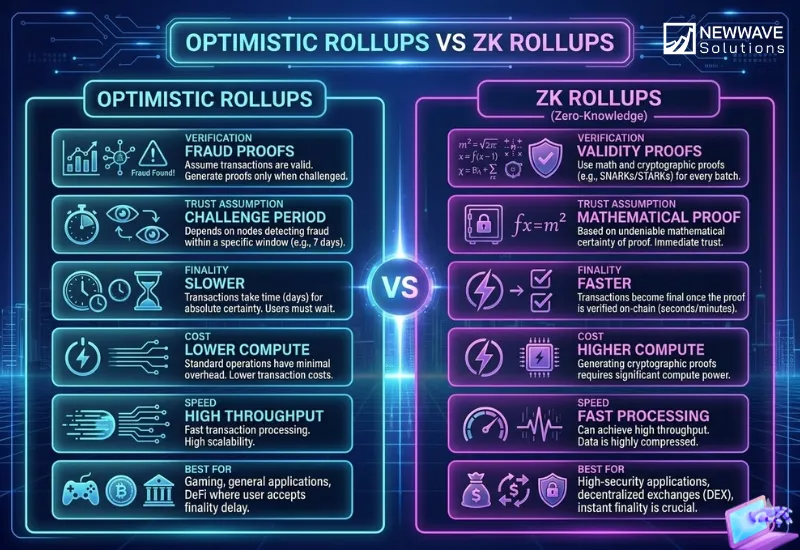
At a high level, the difference between optimistic rollups vs zk rollups lies in how transaction validity is guaranteed and when that guarantee becomes final for users and applications. Both approaches scale Ethereum by moving execution off-chain, but they make fundamentally different assumptions about trust, security, and user experience.
Optimistic rollups rely on economic and social mechanisms to detect fraud after the fact. ZK rollups rely on cryptographic proofs to prevent fraud from ever being accepted. This single distinction cascades into differences across withdrawal time, performance, complexity, and long-term scalability.
Core Differences Table between Optimistic Rollups vs ZK Rollups:
| Aspect | Optimistic Rollups | ZK Rollups |
| Core principle | Assume transactions are valid by default | Prove transactions are valid before acceptance |
| Security mechanism | Fraud proofs with challenge window | Zero-knowledge validity proofs |
| Trust assumption | At least one honest watcher exists | Only cryptography must be correct |
| Withdrawal time to L1 | Long (typically 1–7 days) | Short (minutes to hours) |
| On-chain computation | Light, fraud checks are rare | Heavy, proof verification every batch |
| EVM compatibility | Native and immediate | Achieved via zkEVM with varying equivalence |
| Privacy potential | Not supported by default | Strong potential via ZK properties |
| Technical complexity | Lower, easier to implement | Very high, cryptography-intensive |
| Typical examples | Arbitrum, Optimism, Base | zkSync, StarkNet, Polygon zkEVM |
1. Trade-Off: “Waiting Time” vs “Computational Complexity”
The most visible and user-facing difference between optimistic vs zk rollups is the trade-off between time and computation.
Optimistic rollups choose to keep computation simple by avoiding expensive cryptographic proofs. Instead, they introduce a waiting period during which anyone can challenge an invalid transaction. This makes the system easier to build and cheaper to operate in the short term, but it directly impacts user experience, especially when withdrawing funds back to Ethereum.
ZK rollups take the opposite approach. They accept heavy computational overhead to generate zero-knowledge proofs, but in return they offer immediate finality once the proof is verified on Layer 1. Users do not need to wait for a challenge window, because invalid state transitions are mathematically impossible to accept.
In practice:
- Optimistic rollups delay trust to reduce complexity
- ZK rollups increase complexity to eliminate waiting time
This trade-off is central to any optimistic rollup vs zk rollup decision, especially for consumer-facing applications.
2. Trust and Attack Model
The trust model is where zk rollups vs optimistic rollups diverge most fundamentally.
Optimistic rollups assume that the system is being actively monitored. As long as at least one honest participant is watching the network and willing to submit a fraud proof, invalid transactions can be caught and reverted. This model works well in practice but introduces a social and economic assumption into the security model.
ZK rollups remove this assumption entirely. Every batch of transactions must come with a validity proof. If the proof verifies, the batch is correct by definition. There is no need to trust watchers, sequencers, or challengers. Security is reduced to the correctness of cryptographic primitives.
This leads to two very different attack surfaces:
- Optimistic rollups are vulnerable if no one challenges fraud during the window
- ZK rollups are vulnerable only if the cryptography itself is broken
This distinction often anchors compare and contrast optimistic vs zk rollups discussions in security-sensitive environments.
3. Cost and Real-World Scalability
From a cost perspective, both rollup models currently rely on posting transaction data (calldata) to Ethereum, which means their baseline costs are similar today. The difference lies in where costs are paid and how they scale over time.
Optimistic rollups keep on-chain computation minimal, which makes them cheaper to operate initially. However, they do not significantly compress transaction data, so long-term scaling is still constrained by calldata costs.
ZK rollups incur higher costs upfront due to proof generation and verification. However, they offer superior data compression and open the door to advanced models such as Validium, where data availability is handled off-chain. This creates a stronger path toward massive scalability at very low per-transaction cost, albeit with additional design trade-offs.
In real-world terms:
- Optimistic rollups scale well in the short to medium term
- ZK rollups offer better long-term scalability potential as Ethereum evolves
This cost dynamic is a key factor in zk rollup vs optimistic rollup evaluations for long-lived platforms.
How to Choose the Best One?
Choosing between optimistic rollups vs zk rollups is not about picking the most advanced technology on paper. It is about understanding your product’s current constraints, future roadmap, and the trade-offs your team is willing to manage. Both approaches are production-ready, but they optimize for very different priorities.
The right choice depends on developer experience, user expectations, security assumptions, and how quickly you need to move.
Choose Optimistic Rollups When
Optimistic rollups are well suited for teams that want to scale Ethereum applications quickly without fundamentally changing how they build today. Their strength lies in ecosystem compatibility and operational simplicity.
They are typically the better choice when:
- You need immediate and near-complete EVM compatibility, allowing existing smart contracts to run with minimal or no refactoring
- You are building complex DeFi protocols that depend on mature Ethereum tooling and composability
- You want to iterate quickly using familiar developer workflows, libraries, and debugging tools
- Your application can tolerate delayed withdrawals in exchange for simpler infrastructure
- Your team prefers lower cryptographic complexity and wants to avoid managing proof-generation pipelines
For many projects in early or growth stages, optimistic rollups provide a pragmatic path to scaling without introducing unnecessary technical risk.
Choose ZK Rollups When
ZK rollups are better suited for applications where user experience, security guarantees, and long-term scalability are core requirements rather than future optimizations.
They become the preferred option when:
- User experience is critical and long withdrawal times would create friction or confusion
- Fast and predictable withdrawals back to Layer 1 are essential to your product flow
- You want security guarantees that rely purely on cryptography rather than social or economic assumptions
- You are building trading platforms, payment systems, games, or consumer-facing applications where real-time interaction matters
- Your team has the technical depth and resources to work with advanced cryptographic systems and evolving zkEVM tooling
For teams building toward the next generation of Ethereum applications, ZK rollups offer a more future-proof foundation, even if the upfront complexity is higher.
In summary, the choice between optimistic rollups vs zk rollups is not about theoretical superiority. It is about deciding which trade-offs your application can afford today, and which constraints you want to remove tomorrow.
Trends and Beyond
Ethereum’s scaling roadmap is no longer framed as a binary choice between competing Layer 2 models. Instead, it is increasingly shaped by convergence, where optimistic rollups and ZK rollups evolve toward similar goals from different starting points. This convergence reflects practical engineering realities rather than ideological preference.
Both models are actively adapting in response to user expectations, developer demands, and Ethereum’s own protocol upgrades.
Key trends shaping the future include:
- Optimistic rollups reducing withdrawal delays
Optimistic rollups are experimenting with mechanisms such as faster challenge resolution, sequencer guarantees, and liquidity-backed exits. These improvements aim to minimize the user-facing impact of long withdrawal windows while preserving the underlying fraud-proof model. - ZK rollups achieving full zkEVM equivalence
ZK rollup teams are rapidly closing the gap in EVM compatibility. Progress toward full zkEVM equivalence allows existing Ethereum smart contracts to run with minimal modification, reducing one of the biggest barriers to adoption and making ZK rollups more accessible to mainstream developers. - Increased adoption of hybrid models
Many emerging architectures combine elements of both approaches. For example, systems may use optimistic execution paths for general transactions while relying on ZK proofs for settlement or verification. These hybrid designs aim to balance performance, security, and cost more flexibly. - Stronger Layer 2 interoperability
The ecosystem is moving toward seamless communication between Layer 2 networks. Improved bridging, shared sequencing, and standardized messaging protocols are making it easier for applications and liquidity to move across rollups without friction. - Alignment with broader scalability debates across ecosystems
Ethereum’s rollup strategy increasingly mirrors broader discussions such as SOL vs ETH, where trade-offs between monolithic performance and modular security are debated. Lessons learned across ecosystems are influencing rollup design choices on Ethereum.
Looking ahead, many experts believe ZK rollups represent the most theoretically sound end state for Ethereum scaling due to their strong security guarantees and superior user experience. However, optimistic rollups are likely to remain dominant in the near term because of their maturity, simplicity, and deep ecosystem integration.
Rather than a winner-takes-all outcome, the future of Ethereum scaling is likely to be pluralistic, with multiple rollup models coexisting and serving different application needs over time.
Conclusion
The debate around optimistic rollups vs zk rollups reflects a deeper truth about Ethereum’s evolution. Scaling is no longer about a single breakthrough, but about choosing the right trade-offs at the right time.
Optimistic rollups deliver practicality and ecosystem alignment today. ZK rollups deliver cryptographic certainty and user-first experience for the future. Together, they form the backbone of Ethereum’s Layer 2 ecosystem, much like how Bitcoin and Ethereum coexist at Layer 1.
At Newwave Solutions, we help teams navigate these architectural choices with clarity. Our work spans dApp development solutions, Layer 2 integration, Smart contracts, custom token design, and even fully self-hosted blockchain (L0) architectures. Our engineers work fluently across modern blockchain programming language stacks and support everything from DeFi systems to NFT development services.
To Quang Duy is the CEO of Newwave Solutions, a leading Vietnamese software company. He is recognized as a standout technology consultant. Connect with him on LinkedIn and Twitter.



Read More Guides



Get stories in your inbox twice a month.
Let’s Build Something Extraordinary
Sign up for a 30 min no-obligation strategic session with us. Transform your Ideas into scalable reality.
Leave a Reply