


Bun vs Node JS Comparison: Which JavaScript Runtime Is Better?
Node.js has long served as the industry standard for building scalable network applications, yet the demand for higher performance has led to the emergence of innovative alternatives. Bun – a newborn JavaScript/ TypeScript tool kit – has rapidly gained traction by offering a highly optimized environment that promises to reduce execution times and streamline the entire development workflow compared to traditional runtimes. This guide investigates the insights of Bun vs Node JS by comparing their architecture, key differences, and use cases so that CTOs and tech leads can choose the best runtime for their IT projects.
What is Bun?
Bun is a modern JavaScript runtime designed to execute server-side JavaScript and TypeScript applications with high performance and simplified tooling. The runtime was introduced to address performance limitations and tooling complexity in traditional JavaScript environments, positioning itself as a faster and more integrated alternative to Node.js for modern backend development. Bun was built in the Zig programming language and leverages the JavaScriptCore engine, which allows the runtime to reduce startup time and improve execution efficiency for many workloads.
Bun Architecture
Bun follows a design philosophy focused on integrated tooling and high performance, which contrasts with the modular architecture used in many traditional JavaScript runtimes.
Core architectural components:
- JavaScript runtime engine: Bun runs on the JavaScriptCore engine, the same engine used by the Safari browser, which enables faster startup times and efficient execution for many JavaScript workloads.
- All-in-one runtime toolkit: The Bun runtime bundles multiple development tools into a single executable that includes a package manager, test runner, and bundler.
- Direct system-level integration: Bun interacts closely with operating system capabilities and system calls, which reduces abstraction layers and improves runtime performance.
This architecture allows Bun to provide a single unified developer experience, where runtime execution, dependency management, and testing workflows operate within the same toolchain.
What is Node.js?
Node.js is a server-side JavaScript runtime that allows developers to run JavaScript outside the browser for backend development, APIs, and scalable network applications. The platform was introduced in 2009 and quickly became a foundational technology in modern web development due to its event-driven architecture and extensive open-source ecosystem. Today, Node.js remains one of the most widely adopted JavaScript runtimes for production systems across enterprises and startups.
Node JS Architecture
Node.js follows a philosophy centered on modular ecosystem flexibility, which differs from Bun’s integrated runtime design.
Core architectural components:
- JavaScript runtime engine: Node.js runs on the Google V8 JavaScript engine, which compiles JavaScript into machine code for high-performance execution.
- Event-driven architecture: Node.js uses a non-blocking event loop model that enables applications to handle thousands of concurrent requests efficiently.
- Modular tooling ecosystem: The Node.js environment relies on external tools such as npm, Webpack, Jest, and other backend frameworks to handle package management, bundling, and testing.
This architecture provides developers with extensive flexibility, although it also introduces additional configuration complexity when building large-scale applications.
Pros and Cons of Bun vs Node JS
As developers face increasing pressure to deliver high-performance applications, understanding the trade-offs between a mature ecosystem and a high-speed newcomer is essential. This section explores the specific strengths and weaknesses of Bun and Node.js to provide you with a transparent view of how each runtime performs in real-world production environments.
Pros & Cons of Bun
Pros
- Extremely fast runtime performance
- Built-in package manager and bundler
- Native TypeScript execution
- Simplified developer workflow
- Fast startup for serverless environments
Cons
- Smaller ecosystem
- Partial compatibility with some npm packages
- Limited production maturity
Pros & Cons of Node.js
Pros
- Mature ecosystem and community support
- Millions of npm packages available
- Stable production environment
- Extensive documentation and tooling
Cons
- Toolchain complexity with multiple tools
- Slower package installation compared with Bun
- Higher startup overhead in some workloads
Bun and Node JS: Core Differences
Choosing the wrong runtime can lead to significant technical debt and performance bottlenecks that hinder your application’s scalability over time. We will now examine the architectural distinctions and engine variations between Bun and Node.js to help you identify which internal structure best supports your system’s data processing needs.
Modern benchmarks show that Bun outperforms Node.js in several performance-related areas, particularly in HTTP request handling, startup time, and CPU-heavy workloads. For example, some benchmark tests report that Bun can process over 50,000 requests per second, while Node.js handles roughly 13,000 requests per second in similar scenarios.
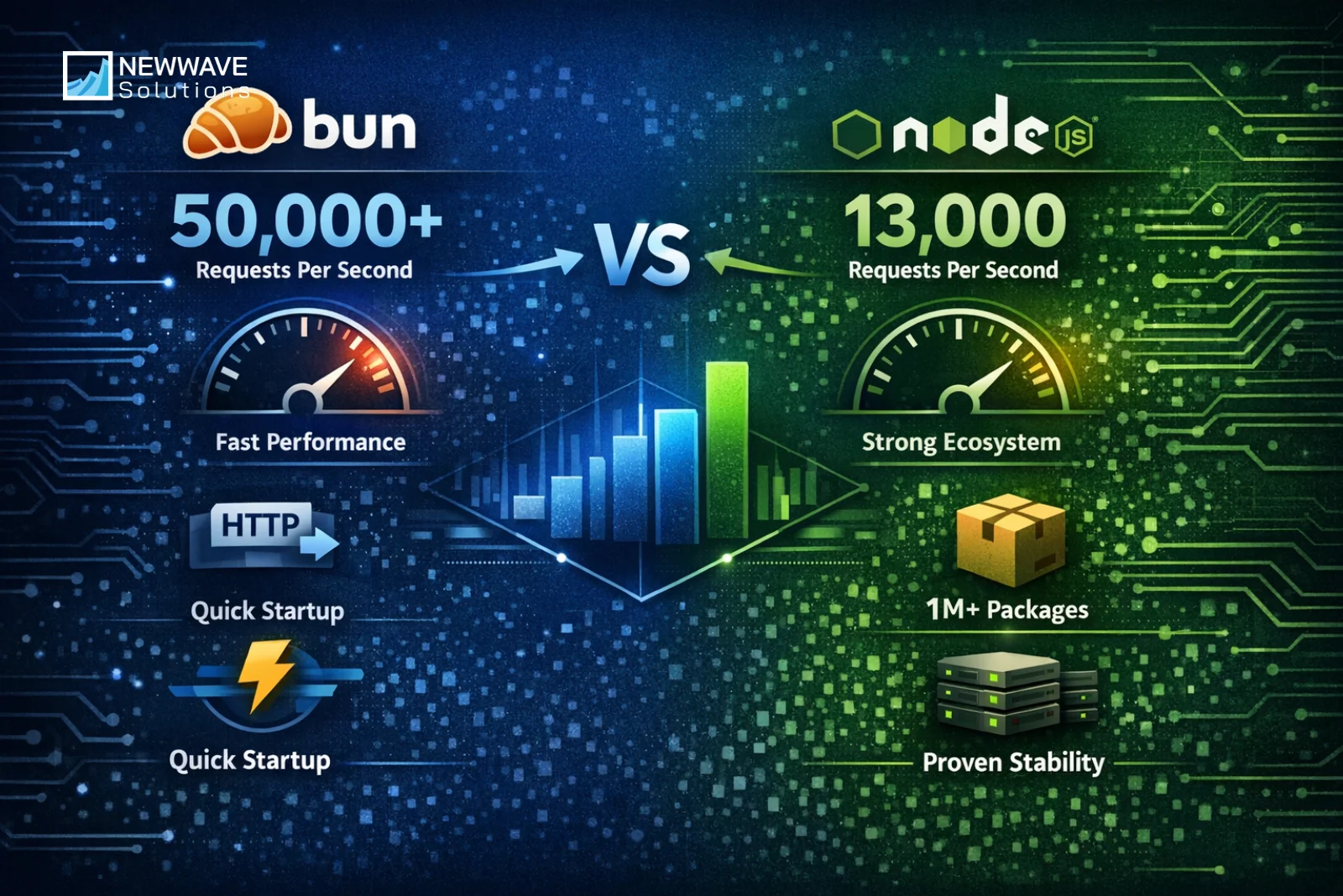
However, Node.js still holds a strong advantage in areas such as ecosystem maturity and production reliability. Many developers continue to prefer Node.js for enterprise systems because its ecosystem includes millions of packages and extensive tooling support.
Which Tool is on the Edge for Modern JavaScript Environment
In my view, the comparison of Bun vs Node.js reveals that each runtime serves a different stage of the JavaScript ecosystem rather than replacing one another entirely. Bun clearly aligns with many emerging trends in modern backend development, particularly those focused on performance optimization and simplified developer workflows.
Several factors explain why Bun attracts attention in modern environments:
- Integrated developer toolchain that removes the need for separate bundlers, package managers, and test runners
- High-performance runtime execution that improves startup times and HTTP request throughput
- Native TypeScript support that eliminates additional build steps for many projects
At the same time, Node.js still remains the dominant platform for production workloads because its ecosystem maturity and long-term stability provide strong operational confidence. Therefore, developers evaluating Bun.js vs Node.js often consider Bun for new projects while maintaining Node.js for existing enterprise systems.
When Should You Use Bun vs Node JS?
The “best” runtime is rarely a universal choice but rather one that depends on your project’s maturity, team expertise, and specific performance benchmarks. By highlighting the ideal scenarios for both Bun and Node.js, this comparison enables you to make a strategic selection that balances innovation with long-term stability.
When to use Bun
- Modern TypeScript Projects: Native execution of .ts files allows developers to bypass complex transpiration and build steps entirely.
- High-Performance APIs: Engineering teams should opt for Bun when benchmarks demand maximum request throughput and faster CPU processing.
- Serverless & Edge Computing: Faster startup speeds make this runtime ideal for minimizing cold-start latency in distributed environments.
- All-in-One Toolchain: Bun is the perfect fit for teams wanting to simplify their workflow with a built-in package manager, bundler, and test runner.
- Innovation-Focused Teams: Organizations ready to embrace cutting-edge tech can leverage Bun’s speed if they are comfortable navigating a younger ecosystem.
When to use Node.js
- Enterprise Stability: Large-scale applications should remain on Node.js to leverage its mature ecosystem and well-established infrastructure dependencies.
- Regulated Environments: Companies requiring Long-Term Support (LTS) and rigorous security audits will find Node.js provides the necessary reliability.
- Extensive Module Dependency: Node.js is the safer choice for platforms relying on niche npm packages, ensuring 100% ecosystem compatibility.
- Established CI/CD Workflows: Maintenance-heavy teams should continue using Node.js to avoid the operational risks and costs of migrating existing pipelines.
- I/O Bound Systems: If your backend performance is limited by database queries rather than runtime execution, the stability of Node.js outweighs the speed of Bun.
Future of JavaScript Runtimes
The JavaScript runtime ecosystem is evolving rapidly as new platforms challenge the long-standing dominance of Node.js. Bun represents a new generation of runtimes that emphasize performance, integrated tooling, and developer productivity, which explains why many developers are experimenting with it for modern backend services.
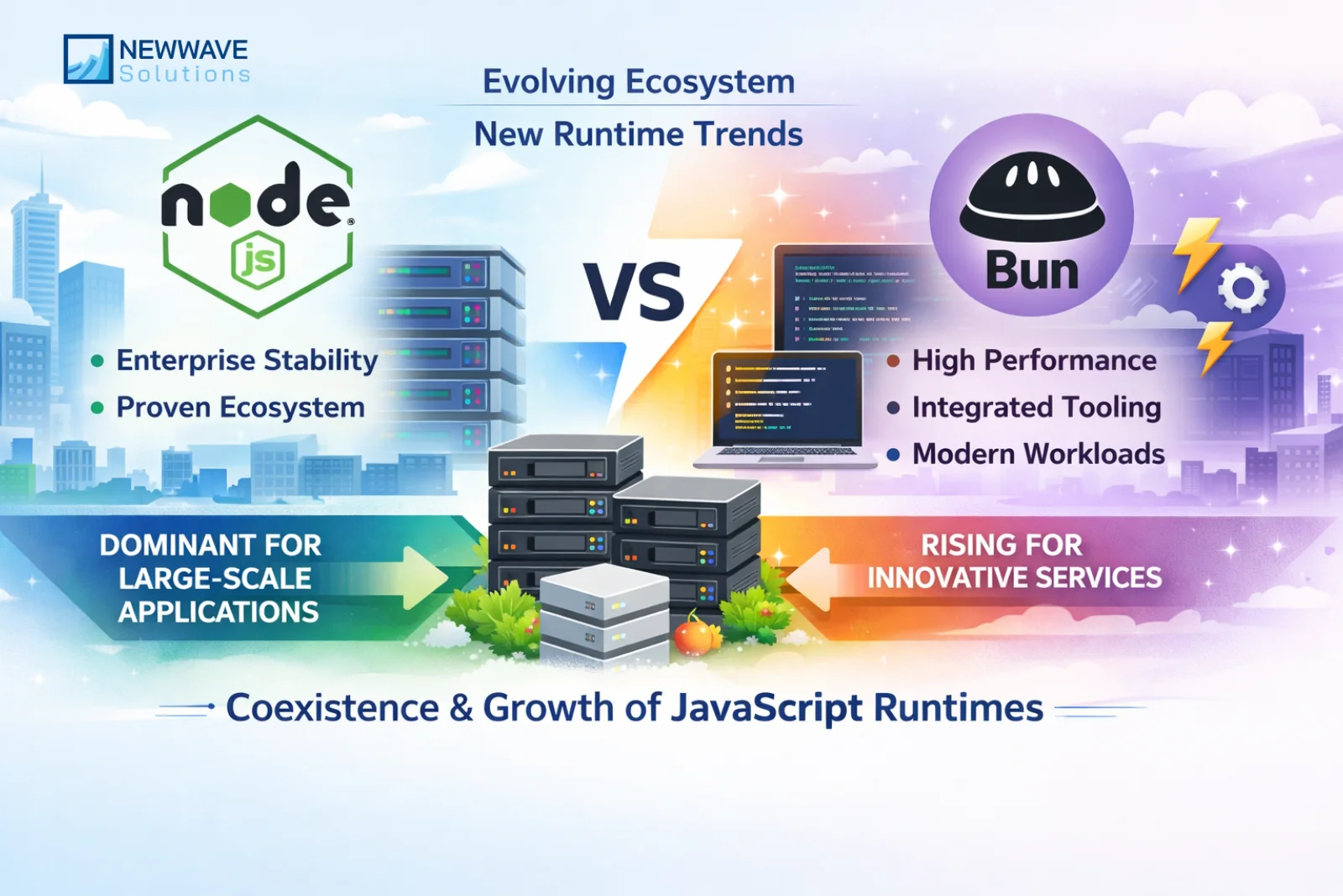
However, Node.js will likely remain the primary runtime for large-scale enterprise applications in the near future because its ecosystem maturity and operational reliability have been proven over more than a decade of production use. As a result, the most realistic trend for the coming years is not a complete replacement of Node.js, but rather a gradual expansion of alternative runtimes like Bun for performance-focused workloads and new application architectures.
Hire JavaScript Developers from Newwave Solutions to Optimize Your Runtime Strategy
Deciding between Bun and Node.js requires a profound understanding of system architecture to ensure that your current business operations remain uninterrupted. To solve these complex technical challenges, you need a dedicated team of JavaScript experts who possess the strategic insight to implement the most efficient runtime solutions. Newwave Solutions stands as a premier provider of software development and staffing services, helping enterprises overcome technical barriers with precision and agility.
With over 14 years of industry experience and a talent pool of 300+ high-level specialists, Newwave Solutions guarantees international service quality backed by ISO 9001:2015 and 27001:2022 certifications. Our professional Hire JavaScript developers services go beyond mere staffing by providing the deep domain knowledge required to resolve backend performance bottlenecks, whether you choose the proven stability of Node.js or the high-speed innovation of Bun. We empower your business to navigate the evolving JavaScript landscape by delivering customized technical expertise that aligns perfectly with your infrastructure goals.
Why Partner with Newwave Solutions?
By leveraging our specialized services, your business gains access to a range of unique advantages and industry-leading expertise:
- Top 1% JavaScript Talent: We provide access to elite developers who are proficient in both traditional frameworks and modern runtimes like Bun to ensure your project stays ahead of the curve.
- Flexible Engagement Models: Businesses can choose from project-based hiring, hourly rates, or building a dedicated Offshore Infrastructure Development Center (OIDC) to optimize their operational budget.
- Vast Domain Expertise: Our specialists bring extensive experience across diverse sectors, including Fintech, Healthcare, and E-commerce, allowing us to understand the unique challenges of your specific industry.
- Rapid Integration & Scaling: Newwave Solutions enables you to onboard skilled developers within days, ensuring your project timelines are met and allowing for seamless scaling as your requirements grow.
- Global Security Standards: Every development process follows rigorous ISO security and quality management protocols to ensure your source code is secure, robust, and sustainable.
- Cost-Efficient Solutions: We offer high-quality development services at an optimized cost structure, helping you save significant resources compared to local in-house recruitment.
We encourage you to prioritize and trust Newwave Solutions as your strategic partner for high-performance software projects. Our team is ready to help your business build a solid technological foundation, optimize your runtime efficiency, and realize your digital vision with speed and reliability.
Furthermore, if your organization decides to remain loyal to the established Node.js ecosystem, you should consider our specialized Hire Node.js developers services to ensure your legacy systems are maintained and scaled by the industry’s finest experts.
Conclusion
The rivalry between Bun and Node.js encourages much-needed innovation that ultimately benefits the entire software development industry. Even though the final decision will fluctuate based on team familiarity, legacy constraints, and specific API needs, forward-thinking enterprises are encouraged to adopt Bun for its remarkable efficiency and integrated toolkit.
Regardless of the tool’s choice, your organization can receive expert support from Newwave Solutions by evaluating project requirements and technology stacks before recommending the most suitable runtime architecture. Approach Newwave Solutions today so we can help you build your JavaScript-based projects efficiently with the tool that best fits your budget and technological vision.
To Quang Duy is the CEO of Newwave Solutions, a leading Vietnamese software company. He is recognized as a standout technology consultant. Connect with him on LinkedIn and Twitter.



Read More Guides



Get stories in your inbox twice a month.
Let’s Build Something Extraordinary
Sign up for a 30 min no-obligation strategic session with us. Transform your Ideas into scalable reality.
Leave a Reply