


Top 10 Best Backend Frameworks in 2026: The Definitive Guide
Backend frameworks help developers build secure, scalable, and efficient web applications faster. They provide core tools for routing, databases, authentication, and APIs. Popular backend frameworks such as Django, Laravel, Spring Boot, and ASP.NET Core continue to power modern web apps across startups and enterprises.
In this guide, we’ll compare the top 10 backend frameworks by their key strengths, trade-offs, and ideal use cases. By the end, you’ll know how to choose the right framework based on project scale, performance needs, development speed, and long-term maintainability.
What is a Backend Framework?
A backend framework is a collection of pre-written code, libraries, and tools designed to simplify and accelerate the development of web applications. These frameworks handle server-side operations, such as routing, database interactions, user authentication, and API management. By leveraging a backend framework, developers can focus on building application-specific logic and functionality, rather than spending time on low-level implementation details.
Common Features of a Backend Framework:
Since a backend framework can contain a massive series of functions and roles in the backend development process, we will only focus on the important features below:
- Routing System: Maps incoming requests to the correct URL handlers, helping organize endpoints and process requests efficiently.
- ORM/Database Integration: Allows developers to interact with databases using code objects instead of writing raw SQL manually.
- Authentication & Authorization: Manages user login, identity verification, roles, and permissions to protect restricted resources.
- Middleware Support: Handles shared logic such as logging, error handling, compression, and request processing in one reusable layer.
- Templating Engine: Combines backend data with HTML templates to generate dynamic web pages.
- Security Protections: Helps prevent common web threats such as SQL injection, XSS, CSRF, and unauthorized access.
- Caching Mechanisms: Stores frequently used data temporarily to reduce database load and improve response speed.
Top 10 Backend Frameworks for Modern Web Development
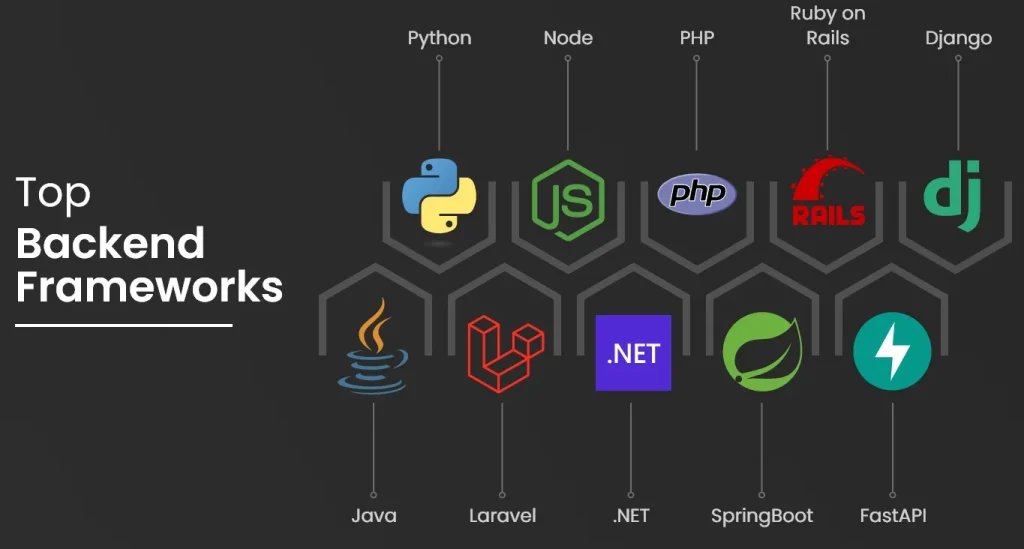
Here are the 10 best backend frameworks that are being used widely by businesses and enterprises around the globe:
|
Framework |
Pros | Cons |
Best For |
| Django (Python) | Batteries-included, built-in ORM, admin panel, authentication, strong security, mature ecosystem. | Can feel heavyweight for simple APIs; less flexible than micro-frameworks. | Enterprise web apps, SaaS platforms, eCommerce, CMSs, data-driven applications. |
| Node.js (JavaScript) | High concurrency, non-blocking I/O, full-stack JavaScript, huge npm ecosystem. | Callback/async complexity, CPU-intensive tasks may require additional solutions. | Real-time apps, streaming platforms, APIs, chat applications, microservices. |
| Laravel (PHP) | Elegant syntax, powerful ORM, strong developer productivity, rich ecosystem. | Performance overhead compared to lightweight frameworks; tied to PHP ecosystem. | Business applications, eCommerce, CMSs, custom web platforms. |
| Ruby on Rails (Ruby) | Rapid development, convention over configuration, strong productivity, mature ecosystem. | Lower runtime performance than some modern frameworks; smaller talent pool. | SaaS products, startups, marketplaces, MVP development. |
| Express.js (JavaScript) | Lightweight, flexible, easy to customize, large middleware ecosystem. | Few built-in features; requires more architectural decisions and integrations. | APIs, microservices, backend services, single-page applications. |
| Spring Boot (Java) | Enterprise-grade scalability, security, cloud-native support, strong Spring ecosystem. | Steeper learning curve; more verbose than lightweight frameworks. | Enterprise systems, banking, fintech, large-scale microservices, cloud applications. |
| Flask (Python) | Simple, lightweight, flexible, easy to learn, highly customizable. | Limited built-in features; requires additional libraries for larger projects. | Small to medium web apps, APIs, prototypes, AI backends, microservices. |
| ASP.NET Core (C#) | High performance, cross-platform, excellent tooling, strong Microsoft integration. | Best experience often tied to the Microsoft ecosystem; learning curve for newcomers. | Enterprise applications, cloud-native systems, APIs, business platforms. |
| Ruby Grape (Ruby) | Lightweight, API-focused, built-in versioning and validation, integrates with Rails. | Limited scope outside APIs; smaller community compared to Rails. | REST APIs, microservices, API gateways, service-oriented architectures. |
| FastAPI (Python) | Excellent performance, async support, automatic validation and documentation, modern developer experience. | Smaller ecosystem than Django; async concepts may increase complexity. | High-performance APIs, AI/ML services, SaaS platforms, modern microservices. |
1. Django (Python)
Django is a high-level Python backend framework that has been a staple in the web development community for over a decade. Known for its “batteries included” philosophy, Django provides a comprehensive set of features out of the box, including an ORM (Object-Relational Mapping) for database interactions, URL routing, a templating engine, and robust security features.
Key Features
- Model-View-Template (MVT) Architecture: Django follows the MVT architectural pattern, which separates the application logic into three interconnected components: models (data access layer), views (business logic), and templates (presentation layer).
- Django ORM: The Django ORM (Object-Relational Mapping) provides an abstraction layer for working with databases, allowing developers to write database-agnostic code and seamlessly interact with various database management systems.
- Admin Interface: Django comes with a built-in admin interface that provides a user-friendly way to manage and interact with your application’s data.
- Form Handling: Django simplifies form handling and validation, making it easier to create and process web forms.
- Robust Security: Django includes numerous security features out of the box, such as protection against cross-site scripting (XSS), cross-site request forgery (CSRF), SQL injection, and clickjacking.
Example: Instagram relies on Django for its backend infrastructure to manage billions of daily photo uploads and user interactions efficiently. The framework’s robust ORM and admin panel have enabled Instagram to scale seamlessly while maintaining high security standards against spam and abuse. This implementation supports real-time feeds and global content delivery with minimal downtime.
Use Django when:
- You need a full-stack framework with built-in ORM, admin panel, authentication, and security features.
- You are building complex web apps such as eCommerce platforms, CMSs, SaaS products, or enterprise systems.
- Your project has many user roles, permissions, database models, and long-term maintenance needs.
2. Node.js (JavaScript)
Node.js is a JavaScript runtime built on Chrome’s V8 JavaScript engine, allowing developers to run JavaScript backend frameworks on the server side. Although not a traditional framework, the Node.js backend framework has gained immense popularity for its event-driven, non-blocking I/O model, making it highly scalable and efficient for building real-time applications. Overall, Node.js offers a lightweight and scalable foundation for building real-time applications and APIs that power React applications.

Key Features
- Event-Driven Architecture: Node.js utilizes an event-driven, non-blocking I/O model, which enables efficient handling of concurrent connections and real-time applications.
- Single-Threaded, Asynchronous Programming: Node.js employs a single-threaded, event-loop architecture, enabling asynchronous programming and efficient resource utilization.
- NPM (Node Package Manager): Node.js has a vast ecosystem of open-source packages and modules available through NPM, allowing developers to easily extend the functionality of their applications.
- Scalability: Node.js is known for its scalability, making it a popular choice for building high-performance, real-time applications that can handle a large number of concurrent connections.
- Java Backend Frameworks Everywhere: With Node.js, developers can use JavaScript on both the client and server sides, enabling code reuse and streamlining the development process.
Example: Netflix utilizes Node.js extensively for its backend services, particularly in handling real-time recommendations and user profile management across millions of concurrent streams. Node.js’s event-driven architecture has significantly reduced latency in API responses, improving content delivery speed and user satisfaction worldwide. The framework’s scalability supports Netflix’s transition to a microservices architecture effectively.
Use Node.js when:
- You need a scalable backend for real-time apps, chat systems, streaming platforms, or APIs.
- Your team wants to use JavaScript across both frontend and backend.
- The application needs to handle many concurrent connections with non-blocking performance.
3. Laravel (PHP)
Laravel is a PHP web framework known for its elegant syntax, developer-friendly approach, and robust set of features aimed at simplifying the development process. With a focus on expressive code and developer productivity, Laravel has gained popularity for building modern web applications.
Key Features
- Eloquent ORM: Laravel includes Eloquent, an advanced ORM that simplifies database interactions and allows developers to work with database records as objects.
- Blade Templating Engine: Laravel’s Blade templating engine offers a simple yet powerful way to create reusable, clean, and efficient templates for your application’s views.
- Artisan CLI: Laravel comes with Artisan, a command-line interface that automates repetitive tasks, such as database migrations, seeding, and testing.
- Middleware: Laravel provides middleware for filtering HTTP requests entering your application, allowing you to implement cross-cutting concerns like authentication, logging, and more.
- Routing: Laravel offers a simple and expressive routing mechanism that allows developers to define application routes using a concise and readable syntax.
Example: BBC employs Laravel for several backend systems, including content management and user authentication platforms serving global audiences. Laravel’s elegant syntax and built-in security features have streamlined BBC’s development process while ensuring compliance with strict broadcasting regulations. The framework enables rapid feature deployment for news portals and multimedia services.
Use Laravel when:
- You want a PHP framework with elegant syntax, built-in tools, and fast development speed.
- You are building CMSs, eCommerce platforms, portals, or business web applications.
- Your project needs routing, ORM, authentication, queues, and templating in one ecosystem.
4. Ruby on Rails (Ruby)
Ruby on Rails, often simply referred to as Rails, is a full-stack web application framework written in Ruby. Known for its convention-over-configuration philosophy and emphasis on developer happiness, Rails prioritizes simplicity and productivity, making it a favorite among startups and established companies alike.
Key Features
- Convention over Configuration: Rails follows the principle of “convention over configuration,” reducing the need for manual setup and configuration by enforcing best practices and standard conventions.
- Active Record: Rails includes Active Record, an ORM that simplifies database interactions by mapping database tables to Ruby objects and providing intuitive methods for querying and manipulating data.
- Scaffolding: Rails offers scaffolding generators that automatically create boilerplate code for common tasks like creating models, views, and controllers, speeding up the development process.
- RESTful Architecture: Rails promotes RESTful design principles, making it easy to build APIs and adhere to standard HTTP conventions for creating, reading, updating, and deleting resources.
- Gem Ecosystem: Rails has a vast ecosystem of gems (Ruby libraries) that extend its functionality, allowing developers to easily add features like authentication, authorization, and payment processing to their applications.
Example: GitHub powers its core platform with Ruby on Rails, managing code repositories, pull requests, and collaboration features for millions of developers. Rails’ convention-over-configuration approach accelerated GitHub’s growth from startup to enterprise scale while maintaining code readability and developer productivity. This foundation supports GitHub’s marketplace and CI/CD integrations seamlessly.
Use Ruby on Rails when:
- You want to build MVPs, SaaS products, marketplaces, or startup web apps quickly.
- Your team values convention-over-configuration and fast feature delivery.
- The project needs clean CRUD workflows, database-backed features, and strong developer productivity.
5. Express.js (JavaScript)
Express.js is a minimalist and flexible Node.js web application framework that provides a robust set of features for building web and mobile applications. As a lightweight framework, Express.js is highly customizable and allows developers to create APIs, web servers, and single-page applications with ease.
A minimalist Node.js web framework that provides a robust set of features for building web applications and APIs. Its flexibility and focus on core functionalities make it a popular choice for building the React backend framework.
Key Features
- Middleware: Express.js uses middleware functions to handle requests, perform tasks, and modify responses, allowing developers to modularize their code and create reusable components.
- Routing: Express.js offers a simple yet powerful routing mechanism that enables developers to define routes, handle HTTP methods, and execute callback functions based on incoming requests.
- Template Engines: Express.js supports various template engines like Pug, EJS, and Handlebars, making it easy to generate dynamic HTML content for web applications.
- Error Handling: Express.js provides built-in error handling mechanisms, middleware for error processing, and tools for debugging and logging errors, ensuring robustness and reliability in applications.
- Extensibility: Express.js is highly extensible, with a rich ecosystem of plugins and middleware available through NPM, allowing developers to add additional functionality and features to their applications.
Example: PayPal leverages Express.js for numerous microservices handling payment processing and transaction APIs with high reliability. Express.js’s minimalist design allows PayPal to maintain a lightweight backend while integrating complex financial compliance requirements efficiently. The framework’s flexibility supports PayPal’s global payment gateway operations across multiple currencies.
Use Express.js when:
- You need a lightweight Node.js framework for APIs, microservices, or web servers.
- Your project requires high flexibility and custom architecture.
- You want a simple backend layer for React, Vue, Angular, or mobile applications.
6. Spring Boot (Java)
Spring Boot is an opinionated framework built on top of the Spring framework for Java, designed to simplify the development of production-ready applications. With a focus on convention over configuration, Spring Boot eliminates much of the boilerplate code typically associated with Java development, allowing developers to quickly build robust and scalable applications.
Key Features
- Auto-Configuration: Spring Boot provides auto-configuration, which automatically configures your application based on dependencies and project structure, reducing the need for manual setup and configuration.
- Embedded Servers: Spring Boot supports embedded servers like Tomcat, Jetty, and Undertow, allowing developers to package their applications as standalone JAR files with embedded servers for easy deployment.
- Spring Ecosystem: Spring Boot leverages the broader Spring ecosystem, including Spring Security, Spring Data, and Spring Cloud, providing a comprehensive set of tools for building enterprise-grade applications.
- Actuators: Spring Boot Actuators offer production-ready features like health checks, metrics, and monitoring, giving developers visibility into the runtime behavior of their applications.
- Developer Tools: Spring Boot includes developer tools like automatic restarts, live reload, and enhanced debugging capabilities, improving developer productivity and workflow efficiency.
Example: LinkedIn uses Spring Boot for its professional networking platform backend, managing member profiles, job recommendations, and messaging systems at a massive scale. Spring Boot’s auto-configuration and embedded servers have reduced LinkedIn’s deployment complexity while enabling rapid iteration of machine learning features. This architecture powers LinkedIn’s premium subscription services reliably.
Use Spring Boot when:
- You are building enterprise-grade Java applications, REST APIs, or microservices.
- Your project requires strong security, scalability, monitoring, and cloud-native deployment.
- Your team needs integration with the broader Spring ecosystem, including Spring Security, Spring Data, and Spring Cloud.
7. Flask (Python)
Flask is a lightweight and versatile Python backend framework that provides the essentials for building web applications without imposing restrictions or requirements on developers. With a simple and modular design, Flask is easy to learn and allows developers to create a wide range of web applications, from simple prototypes to complex enterprise solutions.
Key Features
- Minimalistic: Flask follows a “micro” framework philosophy, keeping the core simple and lightweight while allowing developers to add extensions and libraries based on their specific needs.
- Jinja2 Templating: Flask uses the Jinja2 templating engine to render dynamic HTML content, making it easy to create templates, include variables, and control the flow of logic in views.
- Werkzeug WSGI Toolkit: Flask is built on the Werkzeug WSGI toolkit, which provides low-level utilities for handling HTTP requests, responses, and routing, giving developers fine-grained control over the application.
- Extensible: Flask has a rich ecosystem of extensions that add additional functionality, such as authentication, database integration, and API development, allowing developers to tailor their applications to meet specific requirements.
- RESTful Support: Flask supports building RESTful APIs out of the box, making it a popular choice for creating web services and backend systems that follow REST principles.
Example: Pinterest implements Flask for various backend APIs handling image processing and recommendation algorithms serving visual discovery features. Flask’s lightweight nature allows Pinterest to customize data pipelines quickly while maintaining high performance for pin collections and boards. The framework supports Pinterest’s personalization engine effectively across global users.
Use Flask when:
- You need a lightweight Python framework for small apps, APIs, prototypes, or microservices.
- Your team wants full control over libraries, architecture, and database choices.
- The project does not need heavy built-in features like an admin panel or full-stack tooling.

8. ASP.NET Core (C#)
ASP.NET Core is a cross-platform, high-performance framework for building modern, cloud-based, and internet-connected applications using C#. Developed by Microsoft, ASP.NET Core offers a unified framework for developing web UIs, APIs, and real-time applications that run on Windows, Linux, and macOS.
Key Features
- Cross-Platform: ASP.NET Core is cross-platform and can run on Windows, Linux, and macOS, providing flexibility and portability for developers working on different operating systems.
- Modular Design: The .NET framework backend follows a modular design, allowing developers to include only the necessary components and dependencies for their applications, resulting in lightweight and efficient deployments.
- Razor Pages: ASP.NET Core includes Razor Pages, a page-focused programming model that simplifies building web UIs with clean and testable code, making it easy to create dynamic web pages.
- Entity Framework Core: ASP.NET Core combines Entity Framework Core, which is an ORM that streamlines database operations and enables developers to interact with databases using C# objects and LINQ queries.
- Dependency Injection: ASP.NET Core provides built-in support for dependency injection, making it easy to manage object dependencies and promote loose coupling between components in the application.
Example: Stack Overflow relies on ASP.NET Core for its Q&A platform backend, supporting millions of daily questions, answers, and reputation calculations. ASP.NET Core’s cross-platform capabilities and high performance have enabled Stack Overflow to optimize database queries and caching strategies significantly. This implementation ensures fast page loads and reliable search functionality.
Use ASP.NET Core when:
- You are building high-performance web apps, APIs, microservices, or cloud-native systems with C#.
- Your project benefits from Microsoft ecosystem integration, Azure deployment, and .NET tooling.
- You need cross-platform support across Windows, Linux, and macOS.

9. Ruby Grape (Ruby)
Grape is a REST-like API micro-framework for Ruby that provides a simple and fast way to create APIs with minimal effort. Designed for building lightweight and scalable API services, Grape offers a DSL (Domain-Specific Language) for defining endpoints, parameters, and response formats, making API development straightforward and efficient.
Key Features
- DSL for API Endpoints: Grape uses a DSL to define API endpoints, request parameters, response formats, and error handling, allowing developers to create APIs quickly and intuitively.
- Middleware Stack: Grape provides a middleware stack for processing requests and responses, enabling developers to add custom logic, authentication, and validation to their API endpoints.
- Versioning Support: Grape supports API versioning out of the box, making it easy to manage multiple versions of an API and introduce breaking changes without disrupting existing clients.
- Pluggable: Grape is highly pluggable, with a rich ecosystem of plugins and extensions that add functionality like caching, documentation generation, rate limiting, and more to API services.
- Integration with Rails: Grape can be integrated with Ruby on Rails applications, allowing developers to use Grape for building APIs while leveraging Rails for web application functionality.
Example: Airbnb utilizes Ruby Grape for its RESTful API layer that powers search functionality and booking systems across global listings. Grape’s lightweight routing and parameter validation have improved Airbnb’s API response times while simplifying integration with the Rails monolith. This micro-framework enhances Airbnb’s host-guest matching precision and availability management.
Use Ruby Grape when:
- You need a lightweight Ruby framework focused specifically on RESTful API development.
- Your project requires API versioning, parameter validation, and clean endpoint definitions.
- You want to add an API layer to an existing Ruby on Rails application.
10. FastAPI (Python)
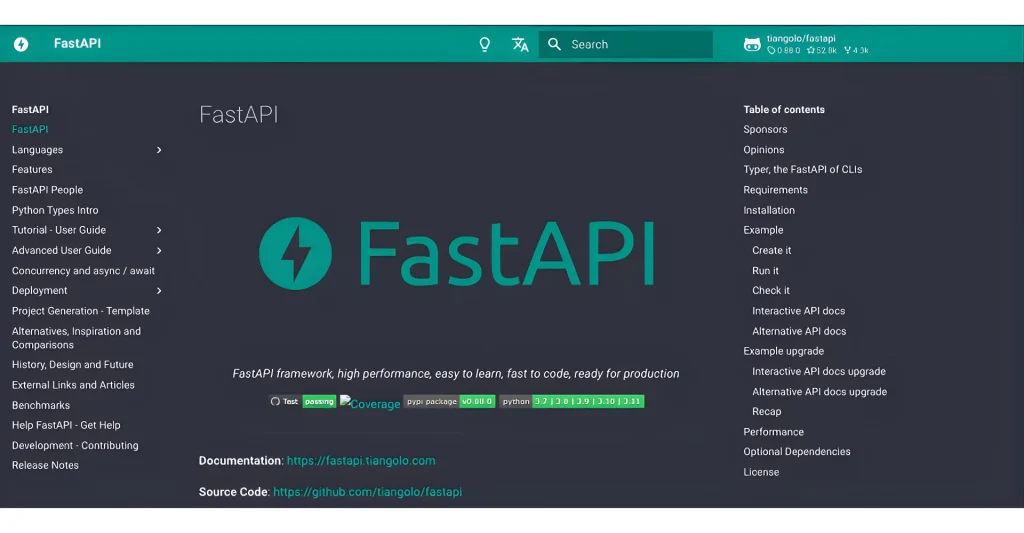
FastAPI is a modern Python web framework for building APIs with high performance, based on standard Python type hints. Leveraging the power of Python 3.6+ features like type annotations and asynchronous programming, FastAPI offers auto-generated OpenAPI documentation, data validation, and dependency injection, making API development fast, efficient, and reliable.
Key Features
- Fast Performance: FastAPI is built for speed, utilizing Starlette for asynchronous I/O operations and Pydantic for data validation, resulting in high performance and low latency for API endpoints.
- Automatic OpenAPI Documentation: FastAPI automatically generates interactive OpenAPI documentation (formerly known as Swagger) for APIs, allowing developers to visualize, test, and explore API endpoints with ease.
- Type Annotations: FastAPI uses Python-type hints for defining request and response data structures, enabling automatic data validation, serialization, and documentation generation without additional boilerplate code.
- Dependency Injection: FastAPI supports dependency injection, allowing developers to declare dependencies for route handlers, request handlers, and other components, promoting modularity and testability in applications.
- Compatibility with ASGI: FastAPI is compatible with the ASGI (Asynchronous Server Gateway Interface) specification, enabling seamless integration with ASGI servers and middleware for building asynchronous web applications.
Example: Microsoft incorporates FastAPI in several internal services and Azure documentation tools due to its automatic API documentation and high performance. FastAPI’s async capabilities have accelerated Microsoft’s developer portal response times while providing OpenAPI specifications for seamless client integration. The framework supports Microsoft’s API-first development strategy effectively.
Use FastAPI when:
- You are building high-performance APIs, AI services, SaaS APIs, or microservices in Python.
- Your project needs automatic API documentation, type validation, and async support.
- You want a modern Python backend framework for API-first products.
If your business wishes to develop front-end alongside back-end, you are going to need some quality front-end frameworks as well. Follow our latest blog to explore both aspects with the appropriate frameworks
5 Factors to Consider When Choosing a Backend Framework
Selecting the appropriate backend framework can fundamentally influence the performance, maintainability, and scalability of your web application. The following factors should be carefully weighed to ensure that your choice aligns with both present requirements and future growth ambitions:
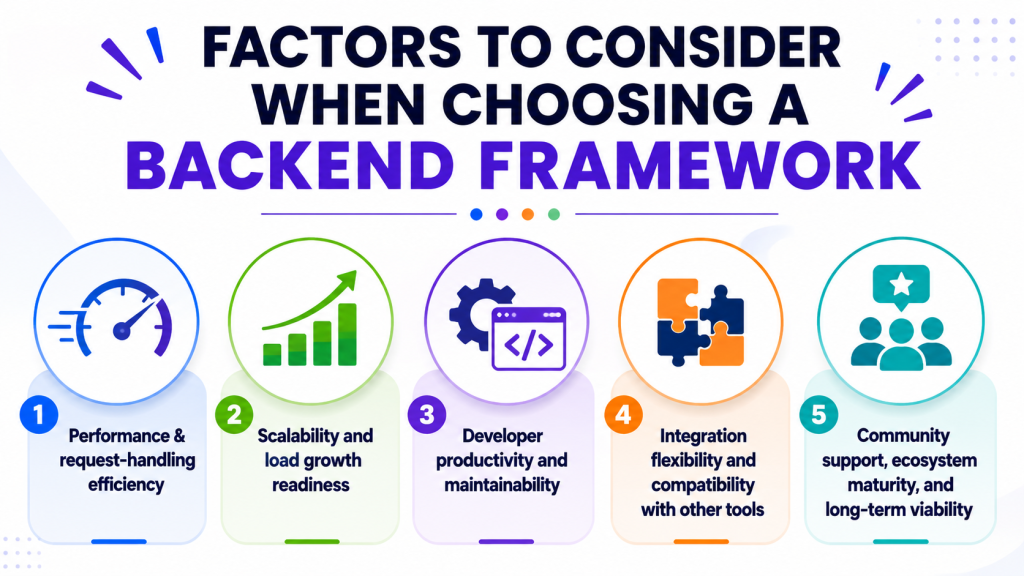
1. Performance & request-handling efficiency
Performance matters when your application must process many requests quickly or support real-time user interactions. For example, FastAPI and Node.js are strong choices for high-concurrency APIs, while Spring Boot and ASP.NET Core are often preferred for enterprise-grade systems that need stable performance under heavy workloads.
2. Scalability and load growth readiness
A backend framework should support your application as traffic, data volume, and feature complexity increase. For example, Spring Boot works well for large microservice architectures, Node.js is useful for scalable real-time systems, and Django can support complex, data-heavy platforms when paired with proper caching, database optimization, and deployment architecture.
3. Developer productivity and maintainability
A productive framework helps teams build faster while keeping the codebase easier to maintain. Django and Ruby on Rails are good examples because they provide strong conventions and built-in tools, while Laravel improves productivity with features like Eloquent ORM, Blade templates, Artisan CLI, and clean routing.
4. Integration flexibility and compatibility with other tools
The framework should work smoothly with databases, APIs, cloud services, caching tools, queues, and third-party platforms. Express.js and Flask are highly flexible because developers can choose only the libraries they need, while ASP.NET Core integrates well with Microsoft Azure, Entity Framework, and enterprise .NET tools.
5. Community support, ecosystem maturity, and long-term viability
A mature ecosystem reduces development risk because teams can rely on documentation, plugins, security updates, and experienced developers. Django, Laravel, Spring Boot, Express.js, and Ruby on Rails all have strong communities, making them safer choices for long-term projects that require stable maintenance and available talent.
Ultimately, the best backend framework depends on your specific project needs and team expertise. By carefully considering these factors, you can make an informed decision that sets your web development project up for success.
Build Your Backend Team with Newwave Solutions
Choosing the right backend framework is only the first step. Successful backend development also requires the right architecture, database design, security strategy, cloud infrastructure, and experienced engineers who can turn business requirements into scalable systems. Without the right expertise, even the best framework can become difficult to maintain and scale.
At Newwave Solutions, we help businesses build reliable backend systems by providing experienced backend developers who can seamlessly join your team or take ownership of the entire development process. Whether you are launching a new product, modernizing a legacy system, or scaling an existing platform, our specialists help accelerate delivery while maintaining performance, security, and long-term maintainability.
Our backend development expertise includes:
- Hire Node.js Developers: Build scalable APIs, real-time applications, streaming platforms, and microservices with experienced Node.js engineers.
- Hire Laravel Developers: Develop secure, feature-rich PHP applications, business portals, eCommerce platforms, and custom web solutions using Laravel.
- Hire PHP Developers: Create reliable backend systems, CMS platforms, custom integrations, and server-side applications tailored to your business needs.
- Hire Python Developers: Build modern backend systems with Django, Flask, or FastAPI for SaaS products, AI applications, data platforms, and APIs.
- Hire .NET Developers: Develop enterprise-grade applications, cloud-native systems, and business-critical platforms with the Microsoft technology stack.
- Hire ASP.NET Developers: Create high-performance web applications, APIs, and enterprise portals with strong security, scalability, and maintainability.
Whether you need a single backend specialist, a dedicated development team, or end-to-end product development support, Newwave Solutions provides the technical expertise and delivery experience needed to bring your project to market faster and scale with confidence.
Conclusion
Choosing the right backend frameworks is a crucial decision that can significantly impact the success of your web development project. By considering factors like speed, scalability, user-friendliness, interoperability, and community support, you can select a framework that aligns with your project requirements and development preferences.
Ready to take the next step in your web development journey? Contact Newwave Solutions today to discuss your project requirements and explore how our dedicated development team can bring your vision to life. With expertise in a wide range of top ten backend frameworks and technologies, we’re here to help you build secure, scalable, and innovative web applications that propel your business forward.
FAQs
1. Which Backend Framework Is Most Used?
The most used backend frameworks vary depending on the programming language and the type of applications being developed. Some of the popular backend frameworks in 2024 include Django (Python), Node.js (JavaScript), Laravel (PHP), Ruby on Rails (Ruby), and Express.js (JavaScript). Choose a framework based on your familiarity with the language, project requirements, and desired features.
2. Is Node.js faster than Django?
In many real-time or high-concurrency use cases, Node.js can be faster than Django because of its event-driven, non-blocking I/O model. However, actual performance depends on the application architecture, database design, caching, deployment setup, and workload type. Django may still be a better choice for complex, data-driven applications that need built-in features and strong structure.
3. What is the most famous backend framework?
There is no single “most famous” backend framework for every use case, but Django, Laravel, Express.js, Spring Boot, Ruby on Rails, and ASP.NET Core are among the most widely recognized. For Python backend development, Django is one of the most famous and mature frameworks.
4. Is Python replacing JavaScript?
No, Python is not replacing JavaScript. The two languages serve different purposes and often complement each other. Python is widely used for backend development, AI, machine learning, and data science, while JavaScript remains the dominant language for frontend web development and is also popular on the backend through Node.js. Many modern applications use both languages together.
5. Is Node.js declining?
No, Node.js is not declining. It remains one of the most widely used backend technologies for APIs, microservices, real-time applications, and full-stack JavaScript development. While newer frameworks such as FastAPI, Bun, and Deno have gained attention, Node.js continues to have a large ecosystem, strong community support, and widespread adoption among startups and enterprises.
To Quang Duy is the CEO of Newwave Solutions, a leading Vietnamese software company. He is recognized as a standout technology consultant. Connect with him on LinkedIn and Twitter.



Read More Guides
Get stories in your inbox twice a month.
Let’s Build Something Extraordinary
Sign up for a 30 min no-obligation strategic session with us. Transform your Ideas into scalable reality.
Leave a Reply