


AI Development Cost: Pricing Guide by Type, Stage & Industry
AI development cost in 2026 can start with a relatively lean proof of concept and grow into a six-figure investment for complex, production-ready systems. The problem is that the development quote rarely represents the full budget. Data preparation, cloud infrastructure, API usage, model inference, integrations, monitoring, and maintenance continue adding costs long after launch.
In this guide, we break down AI costs by project type and industry, uncovers the hidden expenses that affect total cost of ownership, compares build vs. buy and in-house vs. outsourcing, and provides a practical framework for estimating a realistic AI budget.
Key Takeaways
|
AI Development Cost by Project Type
AI software development cost varies substantially by project scope and technical complexity. A proof of concept can start at $5,000–$25,000, while enterprise AI platforms can reach $300,000–$1.5 million or more.
Proof of Concept (PoC): $5,000–$25,000
A proof of concept can range from $5,000–$25,000. It is designed to answer a narrow question: can AI solve the intended problem with acceptable accuracy? It is a working test rather than a production-ready product.
A basic internal AI chatbot, for example, is estimated at $5,000–$15,000, rising to $20,000–$25,000 when a custom knowledge base and lightweight interface are added.
Typical scope includes:
- Pre-built model integration: Uses existing models through APIs such as OpenAI, Claude, or Llama.
- Single integration point: Connects the prototype to one platform or data source.
- Basic prompt engineering and testing: Configures and evaluates how the model responds to the target use case.
- Validation: Includes a report with accuracy metrics to assess feasibility.
- Development timeline: Typically 2–4 weeks.
Basic AI product: $25,000–$80,000
For organizations moving beyond validation, the AI software development cost for a basic production-ready product ranges from $25,000 to $80,000. This tier focuses on a defined use case rather than building a complete AI platform. Examples include customer support chatbots connected to multiple knowledge sources, document classifiers integrated into existing workflows, and AI-powered search features.
Typical features include:
- API integration with fallback handling: Supports more reliable interaction with the selected AI service.
- Custom UI/UX: Provides a dedicated interface designed around the AI functionality.
- Multiple data connections: Integrates the AI feature with more than one information source.
- Production deployment and monitoring: Moves the solution into a live environment and tracks its operation.
- Development timeline: Typically 4–8 weeks.
Custom Machine Learning System: $80,000–$350,000
The AI model development cost rises to approximately $80,000–$350,000 when the project requires a model trained specifically on an organization’s own data and use case. Unlike an API-based basic product, this tier includes the infrastructure required to deploy, monitor, and retrain the custom model.
Typical features include:
- Custom model training: Uses the organization’s dataset and requires approximately 5,000–50,000+ labeled examples.
- Model-serving infrastructure: Typically hosts the trained model in a cloud environment.
- API endpoints: Allow the model to connect with other applications or systems.
- Performance monitoring and logging: Tracks model behavior after deployment.
- MLOps pipeline: Supports future model retraining.
- Development timeline: Approximately 3–6 months.
Production generative AI application: $100,000–$500,000+
Production generative AI applications range from $100,000 to $500,000+. These systems can work with text, images, code, or multiple modalities, with the model adapted to a specific domain and infrastructure designed for production traffic. The exact scope changes substantially within this price range.
At $100,000–$200,000, the scope can include:
- A fine-tuned foundation model such as Claude, GPT-4, or Llama 3.
- Production infrastructure with auto-scaling.
- Comprehensive testing and safety guardrails.
- Basic compliance documentation.
- A development timeline of 4–8 months.
At $300,000–$500,000+, projects can expand to:
- Custom model training from scratch or extensive fine-tuning.
- Enterprise-grade security and compliance.
- Multi-region deployment.
- Full MLOps and observability tooling.
- An optimization team supporting the launch.
- A development timeline of 8–14 months.
Enterprise AI platform: $300,000–$1.5M+
According to Kellton’s 2026 research, at the highest tier, an enterprise AI platform is estimated at $300,000–$1.5 million+ upfront. This type of system integrates AI across multiple business functions. Plus, annual maintenance can account for 20–30% of the initial development cost, covering areas such as model retraining, infrastructure updates, security patches, and performance tuning.
Costs can increase further when the platform requires:
- Multi-system integration: Connections with systems such as SAP, Salesforce, and legacy databases may require custom middleware and API development.
- Compliance certification: Regulatory and security requirements can add audit and certification expenses.
- Global deployment: Multi-region infrastructure may be needed for latency and data-residency requirements.
- Change management: Large-scale adoption may require employee training, documentation, and ongoing support.
What Drives AI Development Cost in 2026?
AI development cost is shaped by more than the type of solution being built. Team rates, technical complexity, data requirements, infrastructure choices, testing, maintenance, and compliance can all change the final budget. These factors also explain why two AI projects with similar business goals may have very different development and operating costs.
Developer rates and team location
Developer rates are another major factor in AI development cost. According to Clutch, most AI outsourcing companies charge around $45–$85 per hour. The table below compares indicative average hourly rates for AI specialists across regions.
|
Region |
Indicative hourly rate |
|
India |
$25–$50 |
|
Latin America |
$35–$75 |
|
Eastern Europe |
$45–$85 |
|
Western Europe |
$50–$99 |
|
United States |
$99–$180 |
Beyond location, the final labor cost depends on the seniority and expertise required. Specialized AI work involving solution architecture, model development, data preparation, or MLOps can therefore carry a very different price than a simpler implementation.
Types of AI model
The underlying AI technology is one of the strongest cost drivers because different systems require different amounts of data, computing power, engineering work, and development time.
- Rule-based systems: These follow predefined logic rather than learning from new data. Development can start from around $10,000, reflecting their relatively limited data and processing requirements.
- LLM-based generative AI: Solutions built with models such as GPT, Claude, or Mistral AI require AI pipelines, datasets, and frameworks such as LangChain or LlamaIndex. An MVP can start at approximately $50,000–$60,000.
- Machine learning models: Systems that learn patterns from data to make predictions or decisions start from around $50,000.
- Deep learning and neural networks: These projects can start at approximately $100,000 because they may require large datasets, GPU infrastructure, and longer training periods.
- NLP and computer vision: Solutions involving sophisticated language or visual processing can cost around $150,000, depending on the algorithms, data requirements, and development effort involved.
Using an existing foundation model can lower the cost of AI development because the underlying model has already been trained for broad capabilities. Building or training more specialized models requires more work to be funded within the project itself.
Project complexity
As an AI system becomes more sophisticated, both development and maintenance requirements increase. A simple personal finance chatbot, for example, can rely on an existing platform and relatively basic integration. An advanced predictive maintenance system may instead require custom model training, extensive data collection, stronger computing resources, scalable deployment infrastructure, and ongoing monitoring.
Complexity therefore affects several parts of the AI software development cost at once:
- Model development: More advanced systems require greater training and engineering effort.
- Infrastructure: Complex projects need more capable computing and deployment environments.
- Data: Advanced use cases can require substantially more collection and preparation work.
- Maintenance: Sophisticated production systems require continuous monitoring and updates rather than minimal ongoing maintenance.
Data type, quality, and dataset size
Data requirements can represent a significant part of AI model development cost. Costs depend not only on how much data is required, but also on how it must be collected, cleaned, structured, labeled, stored, and secured.
Data collection and preparation
Gathering, cleaning, and organizing data can cost around $10,000, although the amount varies with dataset complexity and volume. A project that relies heavily on proprietary transaction data, for example, requires more preparation than one that can reuse knowledge already available in a foundation model.
For LLM-based applications, this can reduce the amount of data preparation required, but task-specific data still needs to be structured, accurate, and relevant.
Dataset size
Projects using very large datasets can push data-related costs to around $50,000. Training on millions of labeled images, for instance, requires more storage, greater processing capacity, and longer training periods. By contrast, applications built on foundation models may only need to complement the model’s existing knowledge with a smaller proprietary dataset, which can lower generative AI development costs.
Data labeling
Labeling can cost around $30,000, particularly when the task requires specialized expertise. Medical-image annotation is one example where accurate labels may depend on domain knowledge. This expense is generally less prominent in LLM-based applications because much of the underlying training and labeling work has already been handled by the model provider.
Data security and privacy
Protecting sensitive datasets may add up to $20,000 through measures such as encryption and access controls. The actual cost depends on the sensitivity of the information and the level of protection required. Standard development practices may reduce some of this additional work, but security remains part of the overall data budget.
The key budgeting implication is that dataset size alone does not determine AI model development cost. A smaller but highly specialized dataset may still require substantial preparation, labeling, and security work, while an application built on a foundation model can reduce training-related expenses by relying on existing model knowledge.
In practice, data quality and task relevance can matter more than simply collecting the largest possible dataset.
Infrastructure and Development Tools
Infrastructure choices can materially affect AI development cost because expenses continue beyond model development. Cloud computing, API consumption, storage, deployment, testing, and ongoing maintenance all contribute to the total cost of ownership.
- Platform limitations and API usage: LLM-based applications inherit the pricing and usage limits of their underlying platforms. Open-source models such as Mistral AI can reduce licensing costs, while GPT-based services may charge by input and output tokens. A high-volume customer-facing assistant can exceed $1,000–$1,500 per month in LLM API fees before retrieval and cloud costs are included.
- Computing power: Training complex models, particularly deep learning systems, can require expensive GPU infrastructure from AWS, Google Cloud, or Azure. NVIDIA A100 or H100 instances can cost around $30–$40 per hour. Lower-cost GPUs may reduce hourly spending but require longer training, while spot instances can cut training costs but are less suitable for production workloads that need uninterrupted availability.
- Development tools and frameworks: Open-source frameworks such as TensorFlow and PyTorch remove software licensing fees and support custom AI development, but they still require experienced engineers to build and maintain models. Managed platforms such as IBM Watson or Microsoft Azure AI provide built-in capabilities, support, and managed services, but typically at a higher cost.
- Vector databases and storage: Retrieval-Augmented Generation applications require infrastructure for storing and retrieving embeddings. Managed services introduce subscription costs, while self-hosted alternatives require additional computing resources and engineering.
- Testing and validation: AI systems may require extensive validation depending on the use case. Self-driving systems, for example, can need costly simulations, while financial AI models may require stress testing across different market conditions. The more demanding the validation process, the more it can add to overall development expenditure.
- Deployment and maintenance: Retrieval-Augmented Generation applications require infrastructure for storing and retrieving embeddings. Managed services introduce subscription costs, while self-hosted alternatives require additional computing resources and engineering.
Regulatory compliance and AI governance
Regulatory compliance can become a significant part of AI development cost, especially when a system handles personal, financial, or healthcare data. Because legal requirements can affect architecture, data storage, security, documentation, and monitoring, they should be considered during discovery rather than added later, when redesigns may be more expensive.
- GDPR: Compliance may require Data Protection Impact Assessments (DPIAs), privacy-by-design controls, secure data residency, and mechanisms for handling deletion requests. These requirements can increase both development effort and infrastructure costs.
- HIPAA: AI applications that process protected health information may need compliant cloud providers, Business Associate Agreements (BAAs), detailed audit logging, and recurring security audits, adding both technical and operational expenses.
- EU AI Act: High-risk AI systems can require conformity assessments, extensive technical documentation, and post-market monitoring. These obligations may make compliance particularly resource-intensive for affected projects.

Organizations operating across several regions or regulated industries may need to meet multiple frameworks at the same time. These requirements are cumulative rather than interchangeable, as each regulation introduces its own technical, legal, documentation, and monitoring obligations.
Beyond formal regulation, AI projects also need governance practices covering:
- Privacy and data security: Build privacy-by-design principles and secure data management into the system.
- Transparency and explainability: Establish mechanisms that make AI decisions easier to understand and review.
- Bias management: Include processes for detecting and mitigating potential bias.
- Accountability: Clearly define roles, responsibilities, and ownership for AI-related decisions and risks.
- Continuous monitoring: Track compliance, system behavior, and emerging risks throughout the AI lifecycle.
Overall, regulatory and compliance activities typically add around 5–10% to AI development costs. However, highly regulated or high-risk projects may require substantially more investment because of audits, documentation, infrastructure modifications, and ongoing compliance monitoring.
How Much Does AI Development Cost: Price Breakdown
The cost of AI development extends beyond the initial engineering budget. A realistic estimate should separate the one-time build from recurring expenses such as model usage, monitoring, retraining, product improvements, security, and support.
Initial development and deployment
The upfront budget covers the work required to move an AI solution from architecture through initial deployment. For a mid-complexity system, this stage is estimated at $150,000–$350,000. Depending on the project, development can include data engineering, model development, system integration, testing, and deployment.
However, this initial figure does not represent the full AI software development cost. Once the system enters production, organizations must continue paying to run, maintain, and improve it.
AI infrastructure cost breakdown
Infrastructure costs vary primarily with usage volume, deployment model, and the amount of computing and data processing required. For LLM-based applications, API inference can remain relatively modest at low traffic but increase sharply as request volume grows. Teams that self-host models instead face recurring GPU costs, while production systems may also require vector databases, ML platforms, storage, and observability tools.
|
Infrastructure Component |
Estimated Cost |
Note |
| LLM API inference – low volume | $500–$5,000/month | Fewer than 100K requests per month |
| LLM API inference – medium volume | $5,000–$30,000/month | 100K–1M requests per month |
| LLM API inference – high volume | $30,000–$150,000+/month | More than 1M requests per month |
| Self-hosted GPU – A10G class | $1,200–$3,600/month | Per always-on instance |
| Self-hosted GPU – A100 class | $3,000–$9,000/month | Per always-on instance |
| Managed vector database | $200–$3,000/month | Services such as Pinecone, Weaviate, or Qdrant Cloud |
| Managed ML platform | $1,000–$8,000/month | Platforms such as Vertex AI or SageMaker; cost varies with usage |
| Data storage and processing | $500–$5,000/month | Scales with data volume |
| Monitoring and observability | $300–$2,000/month | Tools such as LangSmith, Datadog, or custom monitoring |
| Training compute | $500–$15,000/run | Periodic model retraining |
Ongoing cost of AI
Beyond infrastructure consumption, organizations also need to budget for the people and processes required to keep an AI system reliable, secure, and useful after launch.
|
Ongoing Activity |
Estimated Annual Cost |
What It Covers |
| Model monitoring and maintenance | $20,000–$80,000 | Drift detection, alerting, and tuning |
| Scheduled retraining | $15,000–$60,000 | Data refresh, evaluation, and redeployment |
| Feature updates and improvements | $30,000–$120,000 | Continued product development |
| Security and compliance reviews | $10,000–$40,000 | Patching and compliance work, particularly in regulated industries |
| Support and incident response | $10,000–$30,000 | On-call support and SLA management |
3-year total cost of ownership
Looking only at the initial build can therefore substantially understate AI development over its operating life. For a mid-complexity AI system, the cost profile can develop as follows:
|
Period |
Cost Category |
Estimated Cost |
| Year 0 | Build and deployment | $150,000–$350,000 |
| Year 1 | Infrastructure, operations, and improvements | $80,000–$200,000 |
| Year 2 | Infrastructure, retraining, and improvements | $70,000–$180,000 |
| Year 3 | Infrastructure, retraining, and major update | $90,000–$250,000 |
| 3-Year Total | Total cost of ownership | $390,000–$980,000 |
AI Development Cost in Different Industries
AI development cost varies considerably by industry because each sector has different data requirements, technical environments, use cases, and regulatory obligations. The estimates below illustrate how industry-specific AI applications can fall into different investment ranges rather than following a single standard price.
|
Industry |
AI Software Examples |
Estimated Pricing Range |
| Healthcare | Predictive health analytics, AI-assisted diagnosis, personalized treatment applications | $300,000–$600,000+ |
| Finance | Fraud monitoring, financial risk analysis, algorithmic trading systems | $300,000–$800,000+ |
| Retail | Personalized product recommendations, inventory optimization, customer segmentation | $200,000–$500,000+ |
| Manufacturing | Equipment failure prediction, automated quality inspection, supply chain optimization | $400,000–$800,000+ |
| Transportation & Logistics | Route planning and optimization, autonomous transportation systems, fleet management | $500,000–$700,000+ |
| Telecommunications | Network performance optimization, automated customer support, churn prediction | $300,000–$500,000+ |
| Real Estate | Automated property valuation, real estate demand forecasting, AI virtual assistants | $250,000–$600,000+ |
| Education | Adaptive and personalized learning systems, student performance analytics | $150,000–$800,000+ |
| Energy & Utilities | Smart-grid applications, energy demand forecasting, AI-driven energy management | $400,000–$700,000+ |
| Automotive | Autonomous driving technology, vehicle maintenance prediction, intelligent in-car assistants | $600,000–$500,000+ |
Hidden Costs That Go Unnoticed in AI Budgeting
Some AI expenses are easy to miss because they appear after development begins or continue after deployment. Accounting for these items early gives a more realistic view of the total cost of an AI project.
|
Hidden Cost |
What It Covers |
Typical Budget Impact |
| Data cleaning backlog | Correcting historical data quality problems before the data can be used effectively in the AI system | +10–20% of project cost |
| Model retraining cadence | Periodic retraining required to address model drift and keep performance aligned with current data | +10–20% annually |
| Bias and fairness audits | Reviews used to evaluate fairness and bias, particularly for public-facing AI applications | +$5,000–$25,000/year |
| API overages | Additional charges when actual usage exceeds the limits assumed in the original plan | +$500–$5,000/month |
| Legacy refactoring | One-time backend changes required to connect AI capabilities with existing systems | +$15,000–$60,000 one-time |
Build vs Buy AI Solutions: When Custom AI Development Wins
For many text-based AI use cases in 2026, buying a pre-built AI solution can be a lower-risk starting point. These platforms often use foundation models such as Claude or GPT-class systems, with API usage costing roughly $2.50–$5.00 per million tokens. This helps businesses access ready-to-use AI capabilities without the upfront expense of building and maintaining a custom solution.
Custom AI becomes more compelling when proprietary data, regulatory restrictions, or very high usage volumes change the economics.
- Narrow tasks backed by proprietary data: If an organization has 50,000+ labeled examples for a specific classification or extraction task, fine-tuning a smaller model can outperform prompting a larger foundation model in cost, latency, and accuracy.
- Strict regulatory constraints: HIPAA, SOC 2, and financial regulations may require sensitive data to stay on-premises or in approved regions, limiting external AI APIs. Healthcare PHI violations can incur $50K–$1.9M per incident, and some FINRA-supervised firms may be barred from third-party APIs. In such cases, custom deployment is needed for compliance, not just cost.
- High-volume usage: At roughly 10 million+ daily requests, recurring API charges can become large enough to change the cost equation. At this scale, self-hosting a custom or fine-tuned model may offer lower long-term inference costs, making custom AI development more financially attractive despite the higher upfront investment.
|
Approach |
Typical Cost Structure |
When It Makes More Sense |
| Buy / API-first | At 50,000 daily requests, Claude Sonnet is estimated at about $100/day, or $3,000/month and $36,000/year. | Suitable when existing foundation models can handle the task and the organization values lower upfront investment and flexibility to change models or approaches. |
| Build / Custom fine-tuned model | Development of a fine-tuned Llama 3 model is estimated at $80,000–$150,000, plus approximately $2,000–$5,000 per month in infrastructure. Estimated breakeven is 18–36 months. | More attractive when proprietary data provides an advantage, external APIs cannot satisfy regulatory requirements, or API usage becomes expensive at very high scale. |
In-House vs Outsourced AI Development Cost
The delivery model can significantly affect AI development cost, particularly through salaries, recruiting expenses, employee overhead, and hourly engineering rates.
Building an AI team in-house in the US carries the highest direct staffing costs in this comparison, while outsourcing to India or Eastern Europe reduces labor expenses and shifts recruiting costs into the vendor contract.
|
Cost Component |
In-House (US) | Outsourced (India) |
Outsourced (Eastern Europe) |
| Senior ML Engineer | $150,000–$220,000/year | $25,000–$45,000/year | $50,000–$90,000/year |
| Recruiting per hire | $20,000–$40,000 | Included in contract | Included in contract |
| Benefits and overhead | +25–35% of salary | Not applicable | Not applicable |
| Average hourly rate | $100–$180/hour | $30–$50/hour | $50–$80/hour |
From a budgeting perspective, the comparison is therefore not simply between hourly rates. In-house development combines compensation with recruiting and employment overhead, whereas outsourcing converts much of that staffing expense into contracted development costs.
How AI Tools Help to Optimize AI Development Cost
AI coding tools can reduce AI development cost by compressing engineering effort across repetitive coding, iteration, and optimization tasks. In one documented seven-week sprint using Claude Code, a developer produced 219,000 lines of code across eight projects. A COCOMO-based estimate valued that output at approximately $7–$8 million in conventional engineering effort.
Here are other impacts of AI tools on AI software development:
- Faster boilerplate development: AI tools can accelerate repetitive work such as API integrations, data-pipeline scaffolding, and testing harnesses. Tasks that previously required days of manual coding may be completed in hours or minutes, reducing the engineering time allocated to foundational development.
- Shorter iteration cycles: AI assistance can speed up refactoring, optimization, and other work required to move from prototype to production. Faster iterations allow teams to test and refine solutions with less manual engineering effort, potentially reducing both project duration and development expenditure.
- Smaller development teams: A smaller team with established AI-assisted coding practices may complete certain tasks faster than a larger team using conventional workflows.
Common Mistakes that Derail Your AI Development Cost
AI budgets often go off track not because the initial estimate is too low, but because key validation, data, operating, and scope decisions are handled too late. The following mistakes can add tens or even hundreds of thousands of dollars to a project, but each can be addressed with a more disciplined budgeting approach.
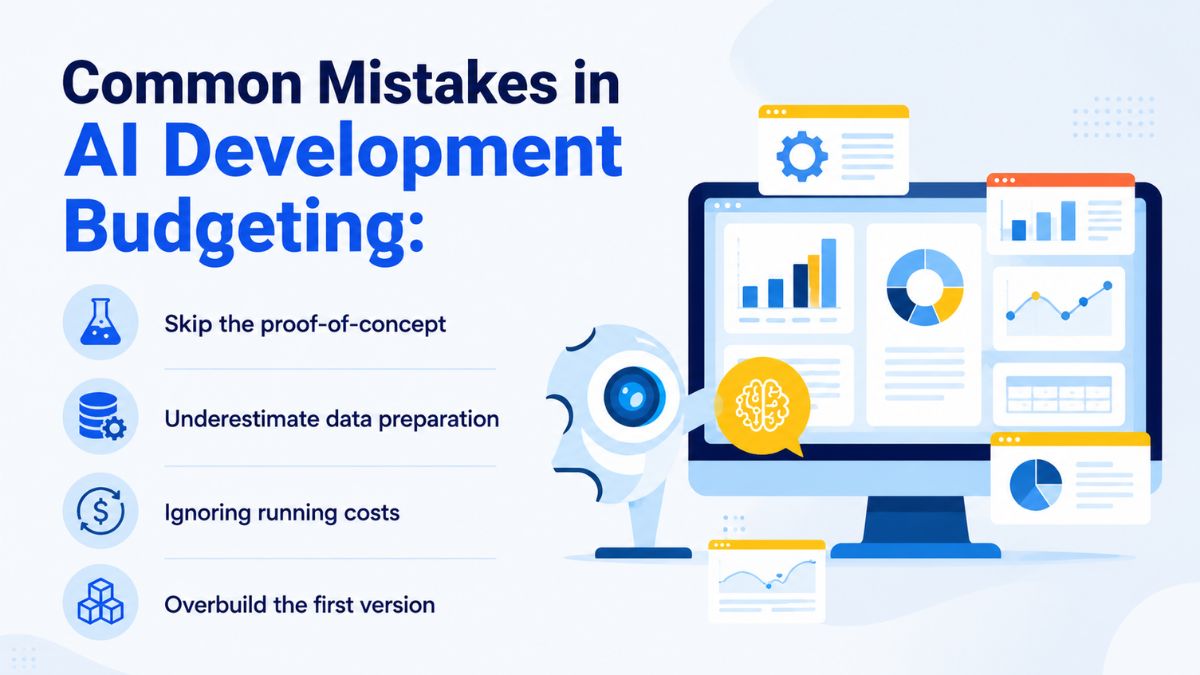
Skip the proof-of-concept
Moving directly into full development without testing feasibility can put $100,000–$300,000 at risk if the AI cannot solve the intended problem. A $15,000–$30,000 PoC completed over 4–6 weeks can validate or reject the approach before a larger commitment.
How to avoid it: validate technical feasibility first, then scale investment only after the core assumption is proven.
Underestimate data preparation
Teams may allocate only 5–10% of the budget to data work even though actual requirements can reach 20–40%. Cleaning, structuring, and labeling can therefore exceed initial estimates before model training begins.
How to avoid it: plan for a 2× buffer on data-related costs rather than treating preparation as a minor line item.
Ignoring running costs
A development-only budget misses the recurring cost of running AI in production. A $75,000 chatbot with $8,000 per month in inference expenses becomes a $171,000 Year 1 investment.
How to avoid it: estimate production inference costs before signing development contracts and include them in the total Year 1 budget.
Overbuild the first version
Multi-region deployment, custom model training, and enterprise-grade observability can add $50,000–$150,000 to an initial build before the product has been validated.
How to avoid it: launch a functional v1 with basic infrastructure, confirm that the product meets real demand, and add more sophisticated architecture only when the need is established.
Step-by-Step Guide to Estimate Your AI Development Budget
A useful AI budget should go beyond a broad development range and calculate the full Year 1 investment. The process starts with defining the project tier, then assessing data readiness, adding operating costs, and validating the plan before committing full development.
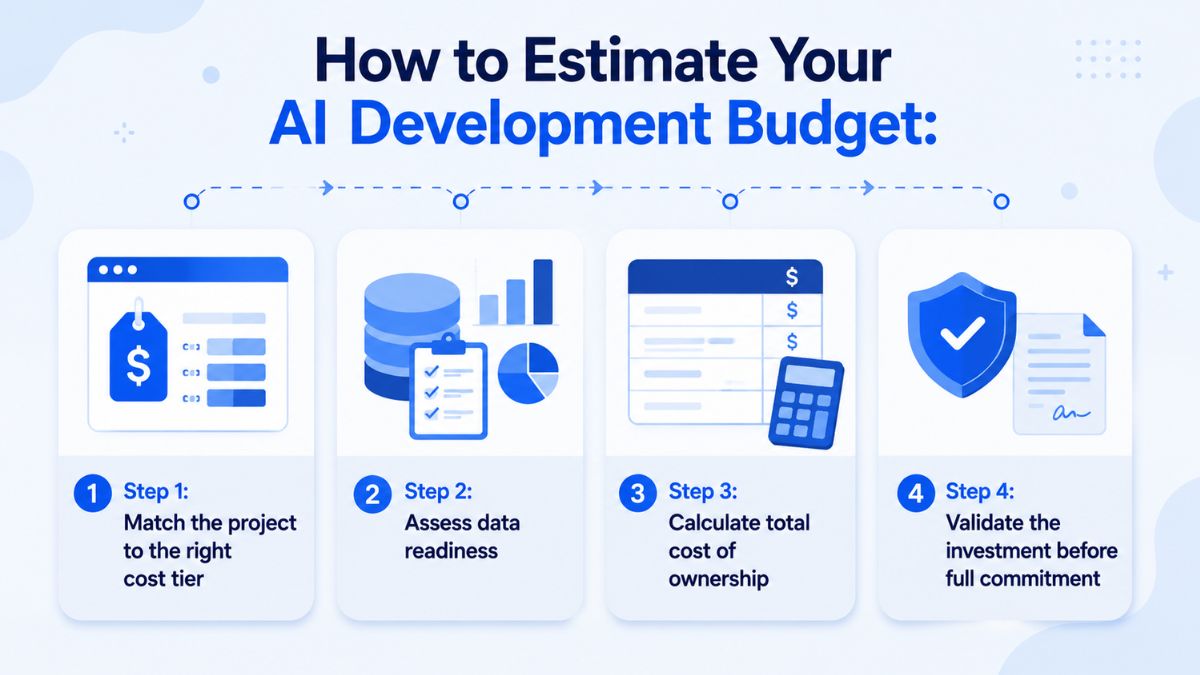
Step 1: Match the project to the right cost tier
Start by identifying the development tier that most closely reflects the intended scope:
- PoC or basic AI: $5,000–$75,000
- Custom machine learning: $80,000–$350,000
- Production GenAI: $100,000–$500,000+
- Enterprise AI platform: $300,000–$1.5 million+
Most projects should begin with a PoC and progress to a larger implementation after the approach has been validated. Moving directly to enterprise-scale development can create $100,000+ in unnecessary exposure before feasibility is established.
Step 2: Assess data readiness
Next, evaluate whether the available data can support training or fine-tuning. Three questions help reveal whether additional preparation should be included in the budget:
- Do you have 10,000+ examples available for training or fine-tuning?
- Is the data already cleaned, labeled, and structured?
- Can the development team access it programmatically?
If the answer to any of these questions is no, add approximately 30–50% to the development budget for data preparation. Another option is to consider an API-first approach that does not depend on custom training data.
Step 3: Calculate total cost of ownership
The development quote is only one part of the budget. To estimate the actual first-year investment, combine the initial build with data preparation, infrastructure, inference, and ongoing maintenance.
Cost components include:
- Development cost from Step 1
- Data preparation, if required
- Infrastructure for Year 1
- API and inference costs for Year 1
- Maintenance at 15–30% of development cost
This calculation provides a more complete budget than development cost alone because it incorporates the expenses required to operate and maintain the system during its first year.
Step 4: Validate the investment before full commitment
Before committing to a $150,000 AI development contract, a $15,000–$30,000 scoped assessment can be used to reduce uncertainty around the larger investment.
The assessment should establish:
- Data readiness: whether the available data can support the proposed AI solution.
- Technical architecture: the recommended approach for building and deploying the system.
- Build vs. buy direction: whether custom development or an existing AI solution is more appropriate.
- Timeline and budget: a more realistic estimate of the resources required for implementation.
Tips on Cutting the AI Development Cost
Reducing AI development cost does not necessarily mean cutting capabilities or quality. The biggest savings often come from avoiding unnecessary custom work, limiting the initial scope, using existing tools effectively, and keeping operating expenses under control.
- Reuse existing AI technologies: Open-source frameworks such as TensorFlow and PyTorch remove software licensing costs, while pre-trained models from platforms such as Hugging Face can reduce the time and resources needed to develop models from scratch. AutoML tools can further simplify and accelerate parts of model development.
- Start small and iterate: Building an MVP limits upfront spending to the features needed for an initial release. Agile development supports this approach through short iterations and frequent feedback. This allows teams to refine the solution progressively rather than investing heavily before requirements are validated.
- Use cloud resources strategically: Cloud AI services from providers such as AWS and Google Cloud can provide access to infrastructure without requiring equivalent upfront investment in dedicated resources. Teams should also continuously monitor operational costs as usage grows.
- Optimize data collection and management: Streamlining how data is collected and aggregated can reduce unnecessary storage and processing expenses. A more efficient data pipeline helps control costs before those datasets become larger and more expensive to manage.
- Structure the team around actual needs: Outsourcing non-core development tasks can reduce the time and cost of maintaining all capabilities internally. When hiring directly, combining experienced specialists with more junior developers can also help balance expertise with staffing costs.
Partner with Newwave Solutions to Develop Your AI Solutions
Newwave Solutions provides custom AI software development services for businesses that need tailored models, automation systems, and intelligent platforms rather than one-size-fits-all solutions.
With more than a decade of IT outsourcing experience, we apply Agile development and structured quality and security practices, including ISO 9001 and ISO 27001 standards, across AI projects.
We delivery process covers the full AI lifecycle, from defining the problem and designing the architecture to development, launch, scaling, and post-deployment optimization. Newwave Solutions also supports third-party AI and ML API integrations and provides ongoing monitoring, performance tuning, and updates after deployment.
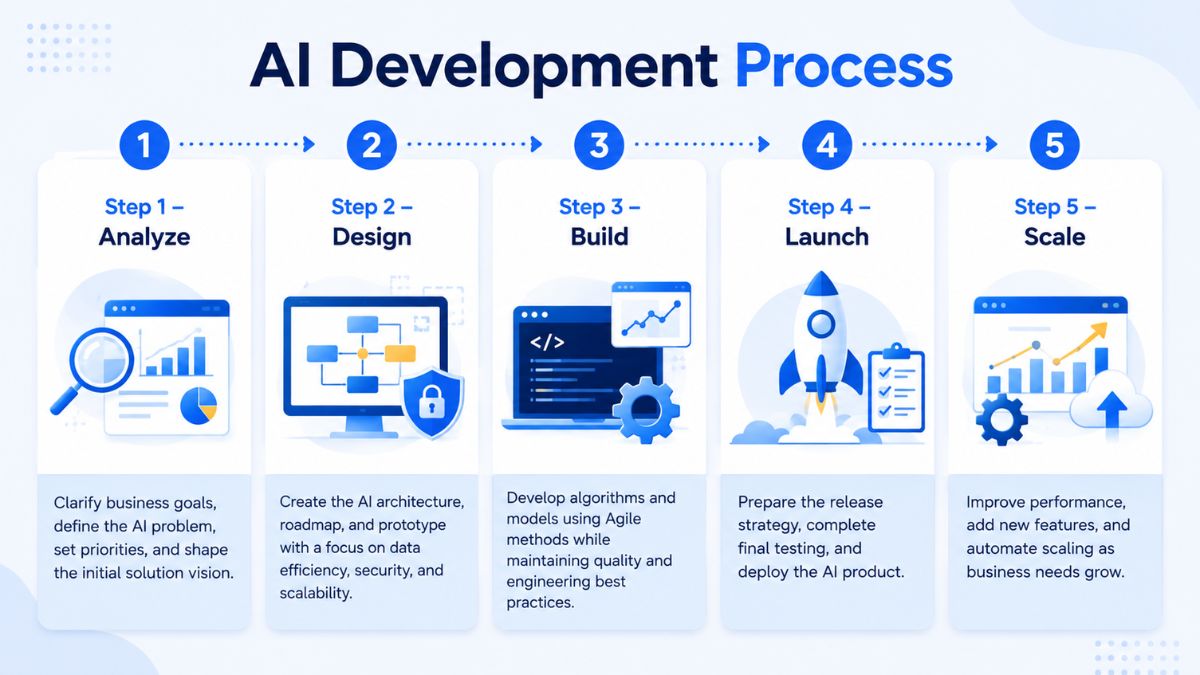
Here’s how Newwave Solutions can support with our AI capabilities:
- AI Operating Systems: AI-powered operating systems that strengthen business intelligence and support better operational performance.
- Robotic Process Automation (RPA): Automate repetitive tasks and workflows to reduce manual effort while improving operational efficiency and scalability.
- Document Intelligence: AI solutions that extract, classify, and search document data, making business information easier to access and process.
- Computer Vision: Tailored solutions that analyze images and videos to extract visual data accurately and support more efficient decision-making.
- Machine Learning: Machine learning algorithms that identify patterns in business data and automate critical processes to improve operational efficiency.
- Natural Language Processing (NLP): Apply NLP models to analyze unstructured data, uncover trends, and generate insights that support business operations.
- Compliance Tracking: Use AI to continuously monitor compliance-related data and turn it into actionable insights for more effective compliance management.
- Generative AI: Implement generative AI solutions to automate workflows and enhance customer service, helping teams improve efficiency and service delivery.
Build a Realistic AI Budget Before You Invest
Understanding AI development costs is essential before committing resources to any AI initiative. The real budget goes beyond initial development and should account for data preparation, infrastructure, inference, maintenance, compliance, and ongoing improvements. A structured cost estimate helps teams compare development options, control financial risk, and avoid expensive surprises after deployment.
Once the budget is clear, the next step is choosing a development approach that fits both technical requirements and business priorities. Newwave Solutions can help assess your AI needs, define the right scope, and build a tailored solution with a more predictable development plan and cost structure.
Talk to our experts for an AI cost estimate or consultation to tailor your solution and get started today.
FAQs
1. How much does it cost to build an AI system?
AI development can range from $5,000–$75,000 for a PoC or basic solution to $80,000–$350,000 for custom ML, $100,000–$500,000+ for production GenAI, and $300,000–$1.5 million+ for enterprise AI platforms. The final cost depends on project scope, data requirements, infrastructure, model usage, and ongoing maintenance.
2. How long does AI development take?
Development time varies by project complexity and scope. A proof of concept can take around 4–6 weeks, while larger custom or production AI systems require more time for data preparation, development, testing, integration, and deployment. Starting with a PoC can help validate feasibility before committing to a longer development cycle.
3. Is it cheaper to build AI in-house or hire external team?
Outsourcing can have lower direct staffing costs. A senior ML engineer in the US may cost $150,000–$220,000 annually, plus 25–35% in benefits and overhead and $20,000–$40,000 in recruiting costs. Average outsourced rates are approximately $30–$50/hour in India and $50–$80/hour in Eastern Europe, compared with $100–$180/hour for US in-house talent.
4. What is the difference between building AI vs buying an AI tool?
Buying or using an existing AI service generally involves lower upfront investment and recurring API or subscription costs. Building custom AI requires greater initial development and infrastructure investment but can make more sense when proprietary data, regulatory requirements, or very high usage volumes justify greater control.
5. What are the most commonly overlooked costs in AI projects?
Commonly missed expenses include data cleaning, model retraining, bias and fairness audits, API overages, and legacy-system refactoring. Teams may also underestimate recurring inference, monitoring, maintenance, security, and compliance expenses.
To Quang Duy is the CEO of Newwave Solutions, a leading Vietnamese software company. He is recognized as a standout technology consultant. Connect with him on LinkedIn and Twitter.



Read More Guides
Get stories in your inbox twice a month.
Let’s Build Something Extraordinary
Sign up for a 30 min no-obligation strategic session with us. Transform your Ideas into scalable reality.
Leave a Reply