


AI Chatbot in Banking: Use Cases, Benefits and Implementation
AI chatbot in banking is moving beyond scripted FAQ tools. Modern systems can recognize customer intent, retrieve information from connected banking platforms, guide multi-step requests, and support selected service actions. That creates an opportunity to expand self-service, reduce repetitive support work, and make digital banking interactions more responsive.
The same capability also raises questions about accuracy, authentication, customer data, compliance, and the point where automation should stop. Understanding those trade-offs is necessary before deciding how broadly conversational AI should be used. The article below examines banking chatbot use cases, business benefits, how the technology works, and the main risks and implementation steps involved.
Key Takeaways
|
What Is an AI Chatbot in Banking?
An AI chatbot in banking is a conversational system that understands customer requests and connects them with banking information or services. Unlike a basic FAQ bot, it can support tasks such as checking account details, blocking a card, or opening a service request when connected to the relevant bank systems.
Yet having a chatbot does not mean customers will use it. A Deloitte survey of 2,027 U.S. bank customers, conducted in January 2025, found that 37% had never interacted with a banking chatbot. This suggests that adoption depends not only on availability, but also on whether the chatbot is useful, reliable, and easy to use.
For a broader view of how generative AI is being applied across financial services beyond conversational support, see our guide to generative AI in finance. It covers additional use cases, benefits, risks, and implementation considerations across the finance sector.

How AI Chatbots Work in Banking?
An AI chatbot in banking turns a customer message into a banking request, connects that request to the right system, and returns the result through the same conversation. Consider a customer who types, “Transfer $500 from checking to savings.” The interaction may follow this sequence:
Interpret the customer’s request
The chatbot first determines what the customer wants to accomplish. In this case, it needs to recognize a transfer request and identify details such as the source account, destination account, and amount. Unclear wording, spelling mistakes, or multiple requests in one message can make this stage harder.
Retrieve the information needed to process the request
Once the intent is clear, the chatbot uses APIs to reach the banking systems required for the task. For a transfer, that could mean checking the relevant account data and whether the requested action can proceed. Simpler questions may only require access to a knowledge base, while transactional requests depend on connected banking systems.
Confirm the action before it is completed
The chatbot presents the transaction details back to the customer before money is moved. Only after the customer explicitly confirms the request should the action proceed. The system can then return the transaction result in plain language so the customer knows what happened.
Transfer the conversation when automation is not enough
Not every request should be completed automatically. If the chatbot cannot interpret the request reliably, access the required system, or complete the task safely, it should route the case to a human agent. Passing the conversation context with the handoff prevents the customer from having to explain the same issue again.
Key Benefits of AI Chatbots in Banking
AI chatbots can improve banking service by handling routine interactions faster and reducing the amount of work passed to human agents. Their value is strongest when they increase service capacity while making customer conversations more relevant and easier to complete.
Faster customer resolution
AI chatbots can handle common questions as soon as customers ask them, without requiring a phone call or manual search through several screens. Bank of America reports that more than 98% of Erica users find the information they need within 44 seconds on average.
This result suggests that AI chatbots can reduce resolution time for routine banking inquiries when the required information is available within connected systems. Faster access to answers can also lower dependence on live support for simple requests, allowing service teams to focus on cases that require human judgment.

Lower support costs and workload
Routine requests consume staff time even when they require little human judgment. Automating a portion of these interactions allows service teams to spend more time on disputes, unusual account issues, and other cases that cannot be handled through a standard flow.
This also changes how support capacity grows. An increase in repetitive customer questions does not necessarily require a proportional increase in staff if the chatbot can absorb part of that volume. For instance, basic account questions can be handled automatically while agents focus on requests that need investigation or direct customer contact.
Stable service at scale
Customer demand does not arrive evenly throughout the day. Traffic can rise outside business hours or during periods when many customers need assistance at once. AI chatbots can remain available during these periods and continue responding without relying on the availability of individual agents.
A customer encountering a card issue while travelling, for example, can still start the support process even when the bank’s service center is operating with limited staff. This gives banks another service channel that can handle routine demand before escalation becomes necessary.

More personalized banking experiences
A chatbot can make a conversation more relevant when it has access to permitted customer information such as account type, card usage, transaction history, or previous interactions. Instead of returning the same answer to every customer, the system can use that context to respond to the specific request.
For example, someone asking about saving options could receive information that reflects their existing banking relationship rather than a generic list of products. The same customer context can also make follow-up questions more useful, since the chatbot does not need to treat every interaction as a completely new conversation.
Common Use Cases of AI Chatbot in Banking
AI chatbots can be applied across a wide range of banking interactions, from routine customer requests to internal operational tasks. Their role varies by use case, depending on the data, systems, and level of action involved.
Everyday banking and account support
For routine requests, a chatbot can give customers access to account information without requiring them to search through multiple screens or contact a service agent. Typical tasks include checking balances, reviewing recent transactions, answering account questions, or managing basic card requests.
The business value comes from shifting frequent, predictable interactions toward self-service. This reduces pressure on customer support teams while giving customers faster access to common banking services.

Payments, transfers, and service requests
When connected to core banking and payment systems through secure APIs, a chatbot can move beyond answering questions and initiate approved actions. Customers may use the conversation to transfer funds, pay bills, check payment status, or submit service requests.
Bringing these steps into one interaction can shorten the path from request to completion. For banks, it also creates an opportunity to automate structured workflows that would otherwise require manual support or several digital touchpoints.
Customer onboarding and product assistance
Chatbots can guide prospective or existing customers through multi-step journeys such as account opening, document submission, KYC checks, loan inquiries, or product selection. They can collect required information, explain what is needed next, and connect the user with relevant systems during the process.
This can make complex application journeys easier to follow. From an operational perspective, structured conversational flows can also reduce the amount of manual guidance required for repetitive onboarding and product-related questions.

Personalized financial engagement
A chatbot can use permitted customer and transaction information to make conversations more relevant to the individual. This may include explaining spending patterns, providing budgeting information, suggesting savings options, or presenting financial products that fit the customer’s current context.
The value is not simply personalization for its own sake. Relevant information can make the chatbot more useful across ongoing banking relationships and give customers a clearer way to understand financial choices without searching through generic product information.
Fraud alerts and security assistance
When a monitoring system flags unusual activity, the chatbot can bring the issue directly into the customer conversation. It can present the relevant transaction, ask whether the customer recognizes it, and, based on the response, initiate an approved next step such as freezing a card or creating a fraud case.
The chatbot’s function here is not to identify fraud independently. Instead, it turns signals from fraud detection systems into a customer-facing workflow, helping the bank move from an alert to verification and follow-up action within the same interaction.

Human handoff and omnichannel service
Some requests are too complex, unclear, or sensitive for automated handling. In these cases, the chatbot can classify the request and pass it to a human agent together with the conversation context already collected.
The same context can also be carried across supported digital channels so customers do not have to restart the interaction each time they move from one touchpoint to another. This makes automation more practical because the chatbot is not treated as the final destination for every request.
Internal banking operations
AI chatbots can also be used by bank employees rather than customers. When integrated with internal systems, they can answer routine policy or process questions, handle access or service requests, and trigger defined operational workflows.
This reduces the time employees spend searching for information or submitting repetitive requests manually. It can also provide a common conversational entry point for internal processes that would otherwise be spread across several systems.
Real-World Examples of AI Chatbot in Banking
Banks and financial technology providers have applied conversational AI to different parts of the customer journey, from routine account questions to transaction monitoring. The following examples show how an AI chatbot in banking can take on different roles depending on the services and systems behind it.
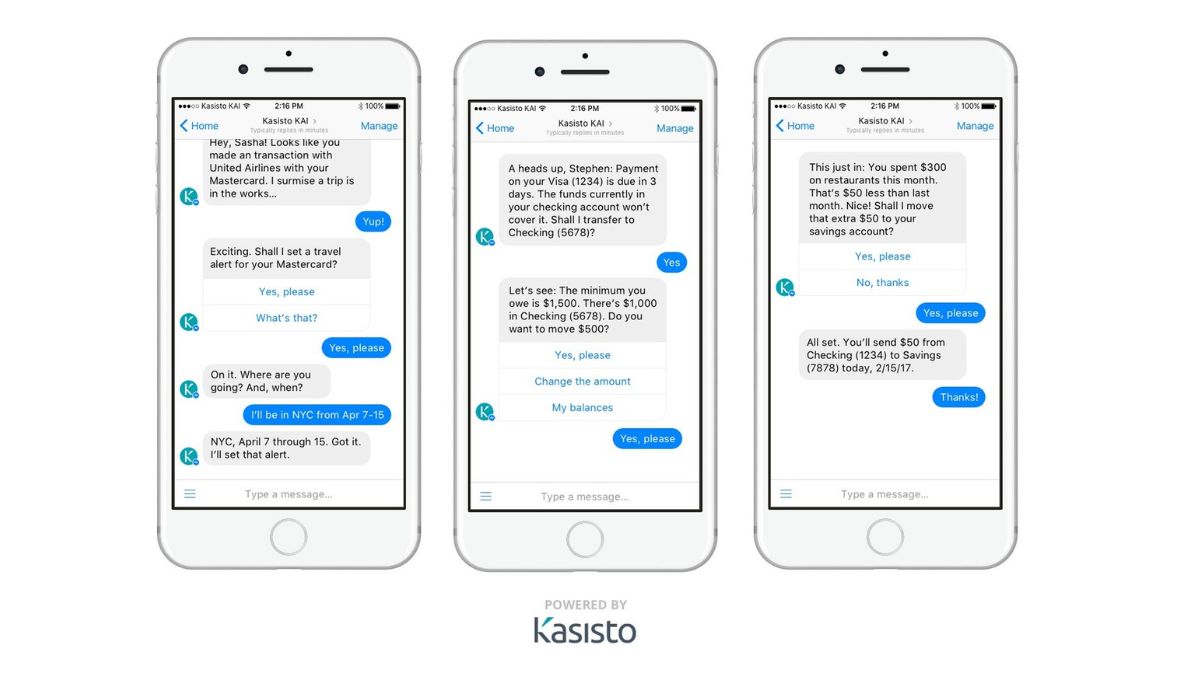
KAI
Developed by Kasisto, KAI is a conversational AI platform used to power virtual assistants for banking institutions. It can provide a conversational layer across banking services while retaining context as customers move through different requests.
For banks, this model offers a way to handle more customer interactions through automated conversations without treating every question as an isolated exchange. Its broader role is to provide the technology foundation on which banks can build their own digital assistants.
Amy
Amy, used by HSBC, focuses primarily on answering frequently asked questions and directing customers to relevant banking services. This type of chatbot is particularly suited to high-volume, repeatable questions. By handling these requests automatically, banks can reduce the amount of basic information inquiries that need to reach service teams.
Erica
Bank of America’s Erica combines everyday banking assistance with more proactive customer engagement. It can answer common questions, provide information about spending, and send reminders related to customers’ financial activity.
The assistant therefore goes beyond responding only when something goes wrong. By using banking information within the interaction, Erica can make routine account management easier while giving customers timely information about their finances.
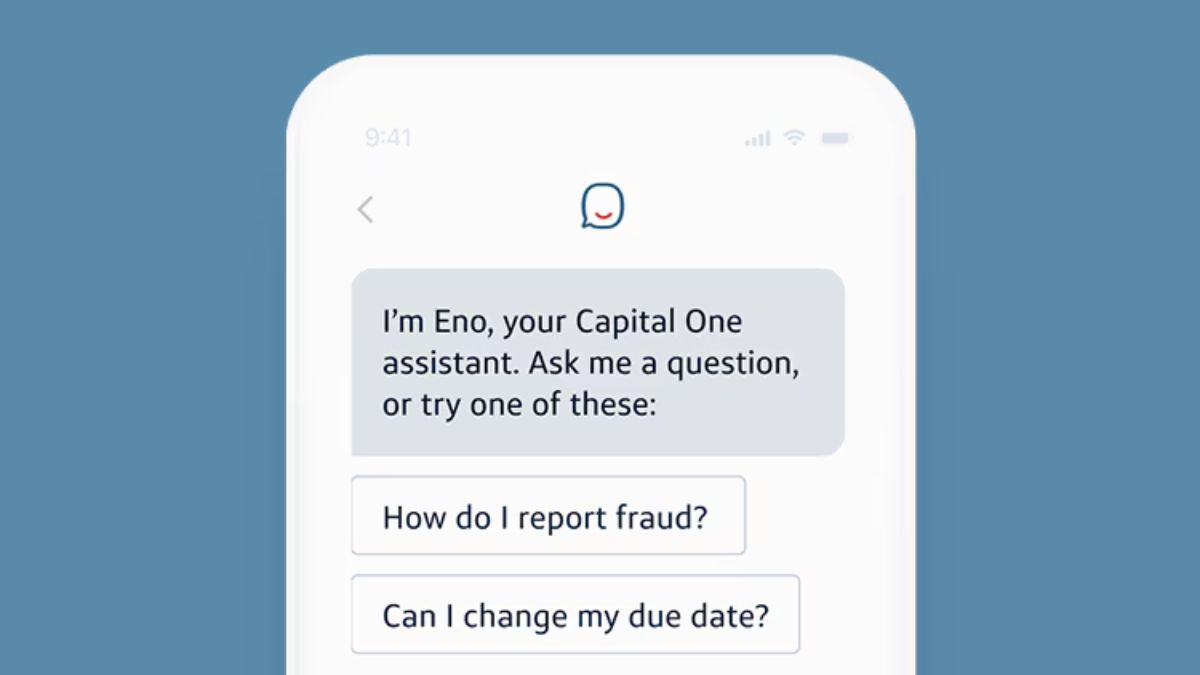
Eno
Capital One’s Eno combines conversational assistance with account monitoring. It can provide information about spending and payments while also alerting customers to issues such as unusual activity or duplicate charges.
This allows the chatbot to take a more proactive role in digital banking. Rather than waiting for a customer to notice a potential problem, Eno can surface relevant account activity and give the user an opportunity to respond.
Ally Assist
Ally Assist supports common banking activities within Ally Bank’s digital experience. Customers can use it to check balances, transfer money, and get answers to routine banking questions.
Its main value lies in bringing frequently used account tasks into a conversational interface. Customers can complete basic requests without relying on a service representative for every interaction, making the assistant another self-service channel for day-to-day banking.
Risks and Challenges of AI Chatbots in Banking
AI chatbots can expand what banks automate, but they also introduce new operational and technical risks. Successful adoption depends on controlling those risks without making the customer experience harder or the system too complex to manage.
High upfront implementation cost
The initial investment can be substantial, particularly when the chatbot must connect with older banking systems or support sensitive transactions. Costs may extend beyond the AI itself to integration work, security controls, testing, maintenance, and ongoing model updates.
A practical way to control this exposure is to start with a limited set of well-defined use cases and expand after the underlying integrations have proved stable. This avoids committing to a broad rollout before the technical and operational requirements are fully understood.
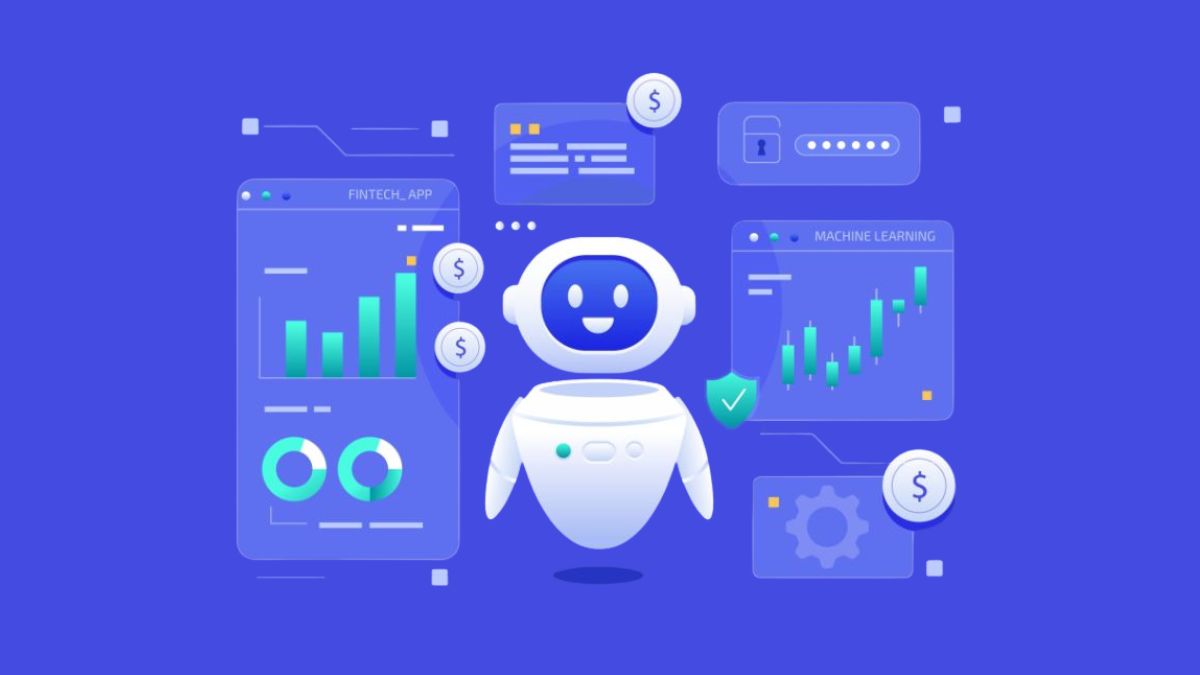
Connecting chatbots with legacy banking infrastructure
A chatbot cannot provide useful account-specific support if it cannot reach the systems where the relevant data or actions reside. Legacy infrastructure can make that connection harder, especially when core banking, CRM, payment, and other systems were not designed around modern API-based access.
Banks can begin by mapping which systems each priority use case needs, then introduce APIs or middleware where appropriate. Starting with a narrower integration scope also makes it easier to test data consistency and system behavior before adding more complex workflows.
Building customer confidence in AI-based support
Customers may hesitate to rely on automated support when the conversation involves money, account access, or sensitive personal information. Confusing responses, unclear verification steps, or difficulty reaching a person can quickly reduce trust.
Banks can address this by keeping interactions easy to follow, making security checks explicit, and providing a clear route to human assistance. Customers should also understand how their information is being handled when they interact with the chatbot.
Protecting sensitive data and meeting regulatory requirements
Banking chatbots may handle personal information, account data, and requests that affect financial activity. Weak access controls or insecure data handling can therefore create both security and compliance concerns. Prompt injection and jailbreak attempts add another risk, as malicious inputs may try to override system instructions, expose restricted information, or trigger unintended actions.
Protection needs to be built into the interaction flow. Depending on the use case, this can include encryption, multi-factor authentication for sensitive actions, audit trails, and controls aligned with requirements such as GDPR and PCI DSS. Sensitive requests should not be treated the same way as general information queries.
Keeping AI responses accurate and context-aware
Banking conversations can include ambiguous wording, several requests in one message, or questions where incomplete information could lead to a wrong response. Generative AI can also produce unreliable answers if the system lacks sufficient context or appropriate controls.
Accuracy can be strengthened by using real banking interaction data during development, preserving conversation context, and applying additional checks to higher-risk responses. Production conversations should also be reviewed so recurring failure patterns can be identified and the chatbot adjusted over time.

Preparing teams and processes for AI adoption
Technical deployment does not automatically translate into effective day-to-day use. Teams still need to know who owns the chatbot, how escalated cases should be handled, and what happens when automation reaches its limits.
Frontline staff should be involved early, particularly in defining escalation paths and operational responsibilities. Training, clear ownership, and ongoing performance monitoring make it easier to treat the chatbot as part of the bank’s service model.
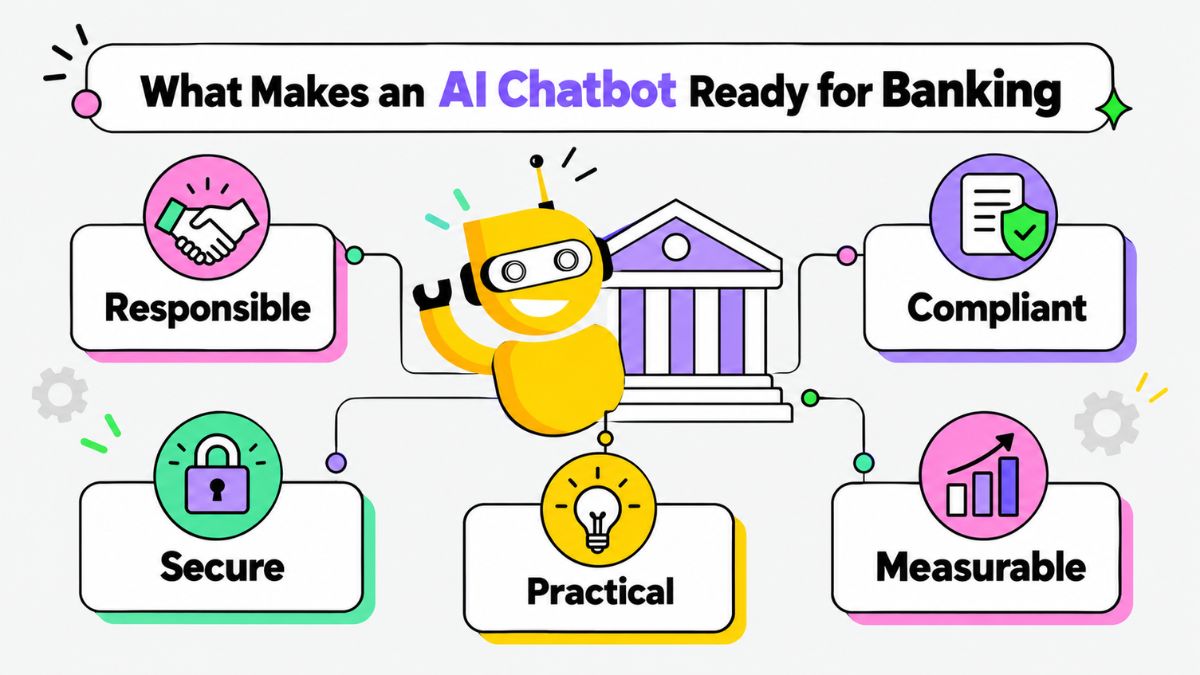
What Makes an AI Chatbot Ready for Banking?
A banking chatbot is not production-ready simply because it can answer questions correctly in testing. Before launch, banks need to confirm that the system can operate within defined controls, protect customer information, fit existing operations, and produce results that can be monitored.
Responsible: Keep customer-facing answers under control
Banks should be able to control what information the chatbot gives customers, especially for financial products, account services, and other sensitive topics. Approved content, response boundaries, and escalation rules can reduce the risk of unsupported or misleading answers reaching users.
Check before launch: Can the bank control what the chatbot is allowed to say and redirect questions it cannot answer reliably?
Secure: Protect data throughout the conversation
Customer information must remain protected throughout the interaction. Security controls may include encrypted data transfer, sensitive-data redaction, controlled access to banking systems, and restrictions on where conversation data can be processed or stored.
Check before launch: Is customer data protected across the chatbot, connected systems, and any AI infrastructure involved?
Practical to integrate and operate
A chatbot should fit the bank’s existing systems and service processes without creating excessive maintenance or training work. Banks should assess integration effort, staff onboarding, content updates, and how easily the system can be expanded after the initial rollout.
Check before launch: Can teams integrate, maintain, and update the chatbot without adding excessive operational overhead?
Compliant: Make every interaction traceable
Chatbot interactions should be traceable so banks can review conversations, investigate incidents, and meet governance requirements. This includes clear rules for logging, data storage, privacy, and handling requests that fall outside the chatbot’s approved scope.
Check before launch: Can conversations and data flows be monitored, reviewed, and managed under the bank’s compliance requirements?
Measurable: Proving that the chatbot is improving banking service
Banks need clear metrics to determine whether the chatbot is producing useful results after deployment. Measures can include automation rates, escalation levels, service efficiency, and whether customers can complete intended tasks without unnecessary human intervention.
Check before launch: Are there defined metrics that show whether the chatbot is improving service and operational performance?
A Strategic Guide to Implement an AI Chatbot in Banking
Implementing an AI chatbot in banking is not only about selecting the right AI technology but also about creating a solution that fits customer needs, operational processes, and existing banking systems. A well-planned approach helps avoid common implementation issues and ensures the chatbot can deliver long-term value.
Here’s how to build an AI chatbot strategy that supports secure, scalable, and effective banking operations:
Step 1: Prioritize a banking problem worth automating
The first step is selecting where an AI chatbot can create measurable impact. Instead of attempting to automate every customer interaction at once, banks should prioritize repetitive, high-volume, and clearly defined requests.
Common starting points may include account information requests, transaction inquiries, appointment scheduling, or card-related support. The goal is to clearly define the chatbot’s responsibilities and map the complete customer journey. Banks should also establish success metrics such as resolution rate, response time, or the percentage of conversations completed without human assistance.

Step 2: Build around real customer conversations
An effective chatbot in banking should be built around actual customer behavior rather than assumptions about what users need. Customer support records, mobile app interactions, call center conversations, and previous service requests provide valuable insights into common questions and recurring pain points.
By analyzing these interactions, banks can identify major customer intents, understand where users experience difficulties, and determine which conversations require automation. This information becomes the foundation for designing accurate intent recognition models and training data.
Step 3: Map data, API, and banking systems
A chatbot without access to relevant banking data can only provide generic answers. To deliver meaningful support, the system needs secure connections with core banking platforms, transaction services, CRM systems, and other enterprise applications.
A typical architecture requires an integration layer that manages communication between the AI model and internal systems. This layer helps control data access, apply business rules, and ensure responses are generated from trusted information rather than static content.
For example, when a customer asks about a transaction status, the chatbot should retrieve information from authorized banking systems instead of relying on pre-written responses.
Step 4: Design automation and human handoff
Modern ai chatbots banking solutions need to handle more than predefined conversation paths. Banking interactions often involve multiple steps, follow-up questions, and sensitive decisions.
Conversation design should focus on completing tasks efficiently while maintaining context throughout the interaction. The chatbot should provide clear responses, guide users through required actions, and recognize situations where human support is necessary.
For sensitive cases such as disputes, financial advice, or complex account issues, a smooth transition to human agents is essential to maintain service quality and customer trust.

Step 5: Build security and governance into the flow
Because AI chatbots may process personal and financial information, protection mechanisms need to be embedded throughout the system design.
Important considerations include user authentication, access control, permission management, data protection, and activity monitoring. Sensitive information should be handled according to appropriate security practices, while interaction records should be maintained for auditing and improvement purposes.
Step 6: Launch in stages and improve from real usage
The first version of an AI chatbot for banking should be treated as an evolving system rather than a finished product. A phased rollout allows banks to test performance, collect user feedback, and identify areas that require refinement.
After deployment, organizations should continuously monitor metrics such as customer satisfaction, escalation frequency, response accuracy, and unresolved queries. These insights can be used to improve intent recognition, expand supported services, and optimize conversation flows.
Over time, a chatbot that begins with customer support can develop into a broader banking assistant supporting additional services and internal operations.
Companies exploring advanced solutions may benefit from working with generative AI development companies that can design scalable architectures, integrate enterprise data, and build AI systems aligned with banking requirements.
AI Chatbot in Banking: How Much Does It Cost?
The cost of implementing an AI chatbot in banking depends on the complexity of the solution, the level of automation required, and the systems it needs to support. Instead of focusing only on the initial development cost, banks should also consider the ongoing cost of running AI models and maintaining reliable customer interactions.
Research from Backbase highlights that the cost efficiency of AI models can vary significantly depending on the approach. In its study on banking AI, Backbase reported that a specialized banking AI model with 12 billion parameters achieved performance comparable to larger general-purpose models while operating at a cost up to 50 times lower than GPT-4.1.
This shows that selecting the right AI approach can have a significant impact on operational expenses. For banking organizations, the focus is not simply on choosing the largest AI model, but on finding a solution that delivers accurate customer support while maintaining reasonable operating costs.
Beyond model costs, the total investment for an AI chatbot for banking is also influenced by factors such as system integration, supported use cases, and security requirements. Banks typically need to evaluate both the expected efficiency gains and the long-term cost of operating the solution before scaling adoption.
How to Measure Banking Chatbot Performance
Measuring the effectiveness of an AI chatbot in banking requires looking beyond basic usage volume. Performance metrics below provide the insights needed to identify strengths, uncover limitations, and continuously optimize the system.
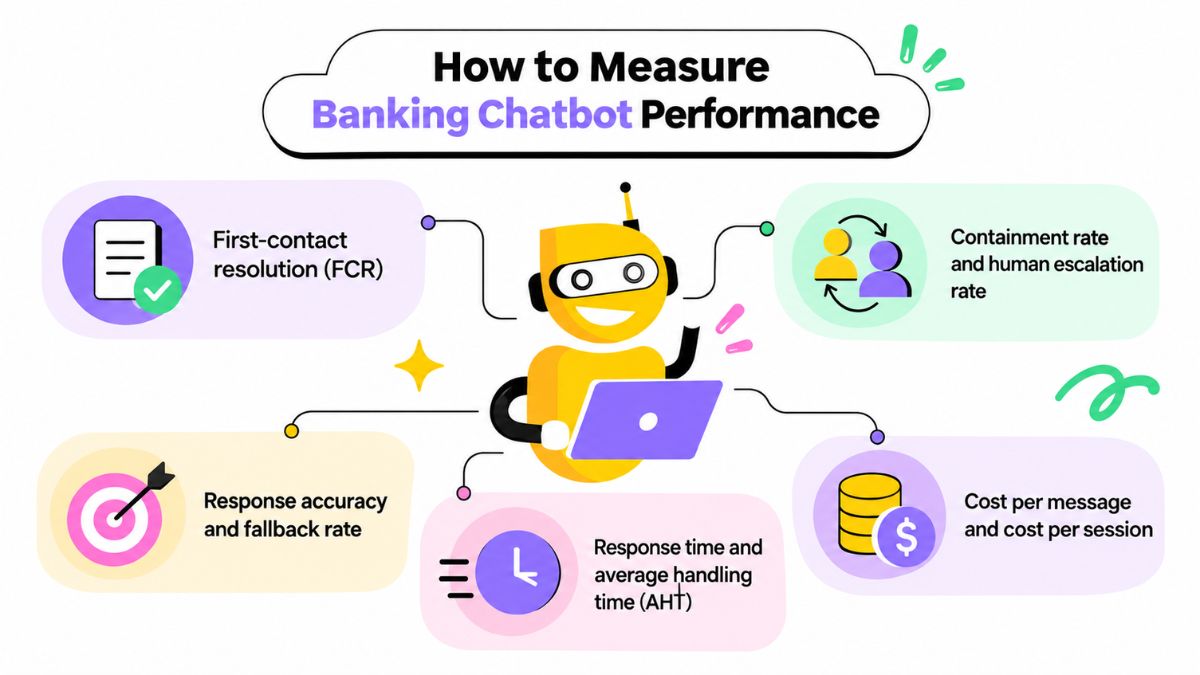
First-contact resolution (FCR)
First-Contact Resolution measures the percentage of customer requests successfully completed during the first interaction without requiring additional support. This metric reflects how well the chatbot understands user intent and handles common banking needs. A strong FCR rate indicates that the system can provide effective assistance while reducing unnecessary workload for customer service teams.
Containment rate and human escalation rate
Containment rate shows how many conversations the chatbot resolves independently without involving human agents. However, banks should evaluate this metric together with human escalation rate to ensure automation does not come at the expense of service quality. A well-designed chatbot should handle suitable requests automatically while transferring complex or sensitive situations to the right support channel.
Response accuracy and fallback rate
Response accuracy evaluates whether the chatbot provides correct and relevant answers based on customer requests. Meanwhile, fallback rate helps identify situations where the chatbot fails to understand queries or cannot provide appropriate assistance, highlighting areas for improving training data and conversation design.
Response time and average handling time (AHT)
Response speed is an important factor in digital banking experiences, where customers expect quick assistance. Response latency measures how quickly the chatbot replies after receiving a request, while Average Handling Time tracks the duration needed to complete an interaction.
Cost per message and cost per session
Operational cost metrics help banks evaluate the financial efficiency of chatbot deployment. Cost per message (CPM) measures the expense of processing individual interactions, while cost per session (CPS) evaluates the overall cost of completing a customer conversation.
The Future of AI Chatbots in Banking: From Conversation to Action
The next stage of AI chatbot in banking development is moving beyond answering questions toward completing complex banking workflows. Instead of acting as a standalone support channel, AI systems are evolving into intelligent assistants that can understand customer intent, coordinate multiple processes, and execute actions across connected banking systems.
A simple chatbot may help a customer identify a duplicate transaction and start a dispute request. A more advanced AI-driven system can continue the workflow by checking relevant information, applying banking rules, updating the case status, and keeping the customer informed throughout the process.
As AI chatbots take on more complex banking tasks, governance becomes essential to ensure safe and reliable operations. Banks need clear rules for human intervention, action approval, and interaction tracking. These controls help AI systems expand beyond simple conversations while maintaining security, compliance, and customer trust.
As conversational AI becomes more action-oriented, banks will increasingly explore AI agents that can manage multi-step tasks across different services. Understanding the types of AI agents will help organizations evaluate how these technologies can support future banking operations.
Develop Custom AI Chatbots for Banking with Newwave Solutions
Newwave Solutions provides custom AI chatbot development services for banking organizations that want to apply conversational AI to real business needs. Our team supports the entire development process, from identifying suitable automation opportunities to building and integrating chatbot solutions into existing digital systems. This helps businesses create AI applications that are practical, scalable, and aligned with their operational goals.
Our AI development services focus on developing chatbots based on actual business processes and customer interaction patterns. By understanding how users engage with banking services, the solution can be designed to support relevant workflows, improve service efficiency, and provide more consistent customer experiences across different touchpoints.
Newwave Solutions developed an AI-powered chatbot integration platform that has supported more than 10,000 accesses a day. The solution shows how conversational AI can be integrated into business processes to handle customer interactions more efficiently and create a more scalable approach to digital services.
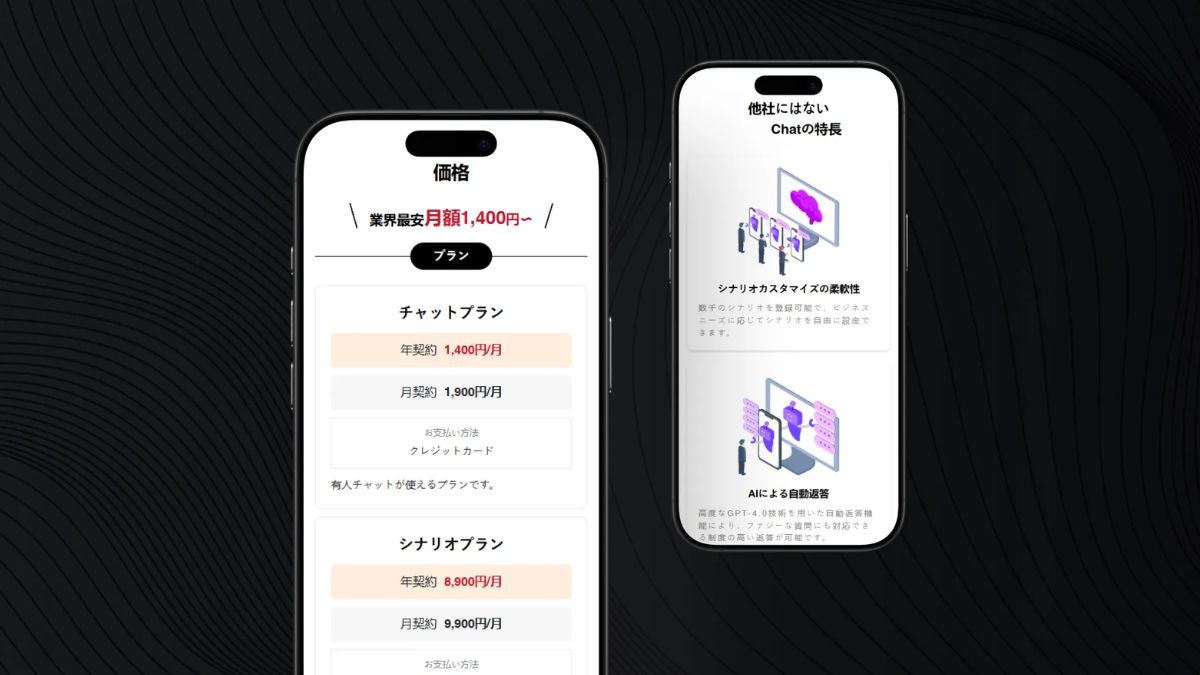
Explore the full case study to learn more about the project and implementation: AI Chatbot for 10K+ Daily Website Consultation
Conclusion
AI chatbot in banking is becoming more valuable when it moves beyond answering questions and supports meaningful customer journeys. The key is to balance automation with reliability by choosing practical use cases, connecting the chatbot with trusted banking systems, and maintaining strong security and governance.
Before scaling adoption, banks should evaluate business goals, customer needs, and operational readiness. Newwave Solutions can support organizations in designing and developing AI chatbot solutions aligned with real banking workflows. Discuss with our experts to explore the right approach for your banking AI initiatives.
FAQs
1. How is AI being used in banking?
AI is used in banking to support customer service, automate routine processes, analyze customer information, and improve operational efficiency. AI chatbot in banking can help customers with account inquiries, transactions, service requests, and personalized financial interactions when connected with relevant banking systems.
2. Can AI chatbot in banking handle complex customer interactions?
Yes, AI chatbot in banking can handle more complex interactions when it is connected to banking systems and designed with proper workflows. However, sensitive cases or situations requiring judgment should still include human support to maintain service quality and customer trust.
3. How do AI chatbot in banking protect customer data?
AI chatbot in banking protects customer data through security controls such as authentication, access permissions, data protection measures, and interaction monitoring. Banks also need to maintain audit trails and ensure that sensitive information is handled according to security and compliance requirements.
4. Which are the four most important AI use cases in banking?
Common AI use cases in banking include customer service automation, fraud and security support, personalized financial engagement, and internal operational assistance. These applications help banks improve customer interactions, automate repetitive tasks, and support employees with faster access to information.
5. Which are the top 5 AI chatbots?
Examples of widely used AI chatbots in banking include KAI by Kasisto, Amy by HSBC, Erica by Bank of America, Eno by Capital One, and Ally Assist by Ally Bank. These solutions show different applications of conversational AI, from answering customer questions to supporting account management and proactive financial assistance.
To Quang Duy is the CEO of Newwave Solutions, a leading Vietnamese software company. He is recognized as a standout technology consultant. Connect with him on LinkedIn and Twitter.



Read More Guides
Get stories in your inbox twice a month.
Let’s Build Something Extraordinary
Sign up for a 30 min no-obligation strategic session with us. Transform your Ideas into scalable reality.
Leave a Reply