


AI in ERP System: Benefits, Popular Types & Best Use Cases
AI in ERP is reshaping how companies use enterprise data, moving ERP systems beyond record keeping toward prediction, automation, and faster decision making. The challenge is no longer whether AI can add value, but where it fits, how deeply it should be integrated, and whether the expected gains justify the cost and complexity.
This guide covers how AI works in ERP, the technologies and use cases driving adoption, key ERP system options, and the costs and challenges to consider before implementation.
Key Takeaways
|
Key Benefits of Using AI in ERP
AI in ERP can extend the value of integrated ERP systems by improving how businesses automate work, analyze data, allocate resources, and monitor operations. Below are key benefits that AI brings to ERP systems.
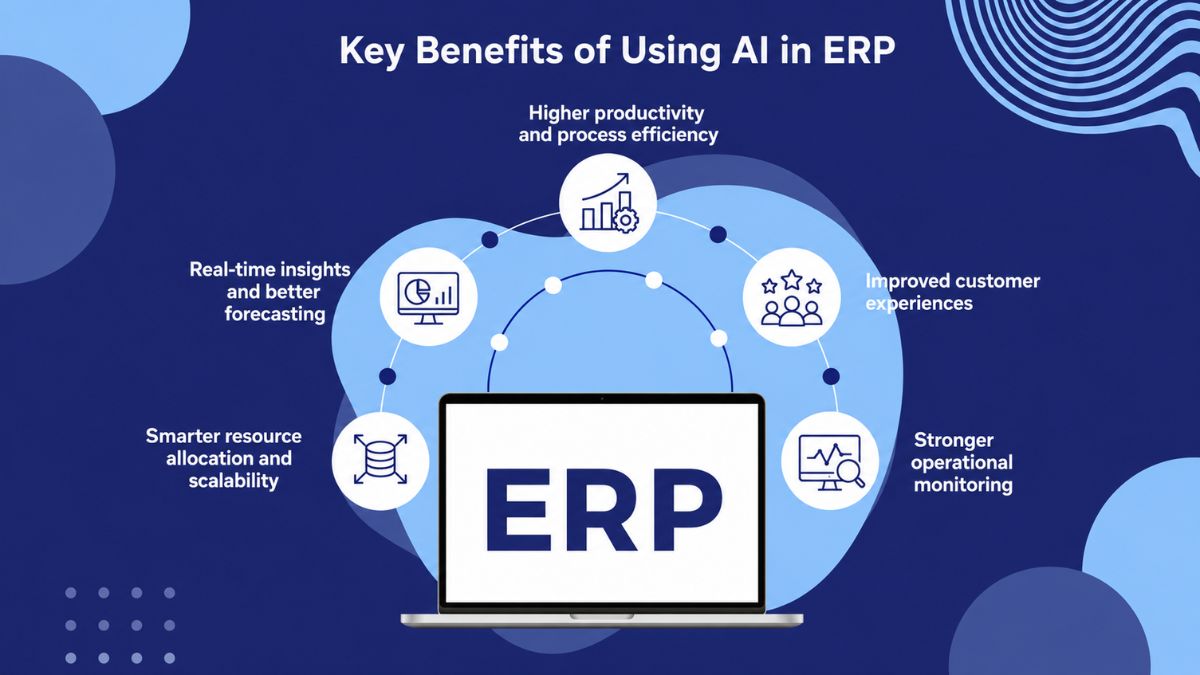
Higher productivity and process efficiency
AI-powered ERP systems can improve productivity by automating repetitive workflows and reducing manual effort. Technologies such as RPA, machine learning, and image recognition can streamline tasks including invoice processing, invoice matching, customer order management, and data entry. This can speed up transaction processing while reducing errors caused by manual data handling.
With routine work automated, employees can focus more on complex and strategic activities that contribute to operational efficiency.
Real-time insights and better forecasting
Machine learning can analyze historical sales data alongside current market conditions to forecast future demand. These insights can help businesses adjust inventory levels and production schedules, reducing the risk of stockouts or excess inventory.
AI can also identify patterns across ERP data. For example, analyzing order-processing times, delivery performance, and supplier activity can reveal supply chain bottlenecks and support more informed operational improvements.
Improved customer experiences
AI technologies such as NLP, machine learning, and predictive analytics can help ERP systems analyze customer interactions, feedback, needs, and preferences to deliver more relevant recommendations and support. Chatbots can further personalize interactions for ERP users, supporting more responsive service and stronger customer satisfaction and loyalty.
These capabilities can also anticipate potential issues, such as shortages of high-demand products, allowing businesses to respond before customers are directly affected.
Smarter resource allocation and scalability
Machine learning can help AI ERP systems allocate resources according to real-time demand forecasts and available operational capacity. Better allocation can reduce waste and improve production efficiency, inventory management, and workforce planning.
Stronger operational monitoring
AI-powered ERP software can use anomaly detection to continuously monitor transactions and system activity for unusual patterns. Examples include unexpected transaction behavior or unauthorized system access. Detecting these deviations in real time can help businesses identify potential security or compliance issues earlier.
How Does AI Work in ERP Systems?
AI in ERP works by adding an intelligence layer to existing ERP data and workflows rather than replacing the core system. This integration can be understood through five key layers:
- Prepare and unify ERP data: AI starts with the information already stored across the ERP, such as orders, invoices, equipment records, and budgets. This data is cleaned and organized so AI models can learn from a consistent and reliable foundation.
- Train and manage AI models: Once the data is ready, models learn from historical records. They can examine past sales patterns to forecast demand or analyze equipment histories to identify potential failures. The system can also track model versions and retrain models as new data becomes available.
- Apply AI during daily operations: Trained models can support ERP processes in real time. An AI-powered ERP system may flag sudden demand changes, recommend when parts should be reordered, or automate repetitive work such as invoice matching.
- Explain recommendations and capture feedback: Explainable AI can show the main factors behind a recommendation, such as why a reorder alert or maintenance warning was generated. Users can accept, adjust, or reject the suggestion, and that feedback can be used to improve subsequent model behavior.
- Embed AI into existing ERP workflows: AI insights can appear directly within ERP dashboards, side-panel assistants, or inline guidance rather than requiring users to switch to separate applications. This keeps AI-supported decisions and actions connected to the workflows employees already use.
Common AI Technology Integrated into ERP Systems
Modern AI ERP systems combine several technologies to analyze business data, automate routine work, improve forecasting, and make ERP interfaces easier to use. Each technology serves a different role, from learning patterns in historical data to processing language, visual information, and unusual operational activity.
|
Technology |
ERP Use Case |
Business Impact |
| Machine learning | Forecasting, pattern detection, task automation | Supports better planning and reduces manual effort |
| Natural language processing | Processing emails, reports, feedback, and user queries | Improves data accessibility and ERP usability |
| Chatbots and virtual assistants | Information retrieval, navigation, customer service, employee self-service | Provides immediate assistance and reduces manual intervention |
| Predictive analytics | Demand forecasting, maintenance planning, financial planning | Supports proactive planning and resource allocation |
| Image recognition | Document processing, inventory tracking, quality control | Automates analysis of visual data |
| Robotic process automation | Data entry and transaction processing | Speeds up repetitive workflows and reduces manual errors |
| Data mining and advanced analytics | Pattern discovery, demand analysis, supply chain optimization | Supports data-driven decisions and cost reduction |
| Sentiment analysis | Customer feedback and sentiment analysis | Helps identify customer needs and changing perceptions |
| Anomaly detection | Fraud, process irregularities, supply chain disruptions | Helps detect errors, inefficiencies, and unusual activity |
Machine learning
Machine learning is a key component of advanced ERP systems, helping improve operational efficiency and reduce errors across a wide range of tasks. Its adoption is also expanding rapidly, with the global machine learning market projected to grow from $55.80 billion in 2024 to $282.13 billion by 2030, according to Grand View Research.
Within ERP systems, ML identifies patterns in existing data and learns from them to make predictions without being explicitly programmed for every scenario. This enables AI-powered ERP systems to automate routine tasks while also supporting predictive analytics for more informed planning, forecasting, and decision-making.
Natural language processing
Natural language processing (NLP) enables computers to understand, interpret, and generate human language. Recent advances in large language models such as ChatGPT have strengthened NLP capabilities by producing more coherent, relevant, and context-aware responses.
In ERP systems, NLP can process unstructured text such as customer feedback, emails, and reports while also interpreting user queries and commands in natural language. This helps extract insights from text, automate certain data-entry activities, and enable conversational interaction with ERP systems, improving overall accessibility and usability.
Chatbots and virtual assistants
Chatbots and virtual assistants provide the conversational interface through which users can access NLP capabilities in ERP systems. Built on scripted dialogues or AI-generated responses, they can simulate conversations and help users complete tasks such as retrieving information or navigating ERP software.
These tools can provide immediate, 24/7 assistance, reducing the need for manual intervention in routine interactions. They are especially useful for customer-service inquiries and employee self-service portals, where frequent user engagement is required.

Predictive analytics
Predictive analytics, also known as predictive modeling, uses historical data, statistical algorithms, and machine learning techniques to estimate the likelihood of future outcomes. In ERP systems, it can support activities such as demand forecasting, maintenance scheduling, and financial planning.
For example, predictive analytics can combine past sales data with market trends to forecast product demand. Businesses can then adjust inventory and production plans to reduce overstock and stockouts. This can support better resource allocation, lower costs, stronger customer satisfaction, and earlier action on potential issues.
Robotic process automation (RPA)
Robotic process automation uses software bots to perform routine tasks across applications based on predefined rules and instructions. Adoption has grown significantly, with a Deloitte survey reporting that 74% of respondents were already implementing RPA, compared with 13% in 2015.
Within ERP systems, RPA is well suited to repetitive and error-prone activities such as data entry and transaction processing. By reducing the need for manual intervention, it can improve processing efficiency and allow employees to focus on more strategic work.
Image recognition
Image recognition enables systems to identify objects, people, places, and actions within visual content. In ERP systems, it can automate the processing and analysis of images, video, and scanned documents.
For example, image recognition can detect defects or irregularities in raw materials to support manufacturing quality control. It can also recognize and track goods for inventory management and convert scanned documents into editable, searchable formats. This helps businesses analyze visual data more efficiently and gain deeper insights into products and operational processes.
Data mining and advanced analytics
ERP systems consolidate large volumes of operational data across functions such as finance, HR, and customer management. Data mining and advanced analytics examine this information to uncover patterns, correlations, and insights that may not be immediately visible.
These capabilities can support demand forecasting, identification of cost-saving opportunities, and supply chain optimization. By revealing relationships across business data, they help organizations make more proactive, data-driven decisions and improve operational efficiency, cost control, and customer outcomes.
Sentiment analysis
Sentiment analysis is a branch of NLP that identifies and classifies emotions expressed in text. Within ERP-connected CRM processes, it can analyze customer feedback, reviews, and social media interactions to assess satisfaction and identify areas for improvement.
These insights can support activities such as monitoring brand perception, understanding customer needs, and adapting marketing or engagement strategies. They can also help businesses respond more proactively to changing customer concerns and preferences.
Anomaly detection
Anomaly detection identifies data points or events that differ significantly from normal patterns. In ERP systems, it can monitor financial transactions, operational processes, and supply chain activity for irregularities that may indicate fraud, errors, or inefficiencies.
For example, anomaly detection can help flag suspicious financial activity, identify quality-control issues in manufacturing, and recognize supply chain disruptions. By surfacing unusual patterns quickly, it can support faster responses to operational risks and unexpected events.

AI-Native vs. AI-Enabled ERP: What’s the Difference?
An AI-native ERP is designed with AI as a core part of the system from the beginning. AI is embedded into the underlying logic and operational layers rather than added as a separate feature. These systems can rely on continuous learning from user interactions, broad data integration, and adaptive algorithms to support functions such as real-time decision-making and autonomous actions.
By contrast, an AI-enabled ERP keeps its existing core logic while adding AI capabilities to extend or simplify specific functions. These additions may include predictive analytics, recommendation engines, or automated support. In this model, AI enhances the ERP system without fundamentally changing the architecture on which it was originally built.
|
Factor |
AI-Native ERP |
AI-Enabled ERP |
| Core integration | AI is built into the system as a central component | AI is added as an additional capability |
| Development approach | Designed with AI from the outset | AI is retrofitted into an existing system |
| System logic | AI is embedded across operational layers | Core logic remains largely unchanged |
| Typical capabilities | Continuous learning, adaptive algorithms, real-time decision support | Predictive analytics, recommendations, automated support |
| Performance | Often more efficient and responsive because AI is tightly integrated | Depends on how AI components are integrated into the existing system |
| User experience | Can support more intuitive and personalized interactions | Improves selected workflows or functions through added AI features |
Types of AI-Powered ERP Systems for Businesses
AI-powered ERP systems can be deployed in different ways depending on how a business manages infrastructure, data, scalability, legacy systems, and industry-specific workflows. Each type offers a different balance of accessibility, control, flexibility, and specialization.
Cloud-based AI ERP
Cloud-based AI ERP systems run on off-site servers, giving businesses scalable access to real-time information while reducing the need for large upfront infrastructure investments. They can also connect with other cloud services, making them suitable for companies that prioritize agility, accessibility, and cost efficiency.
Key features
- Real-time analytics: AI-powered dashboards provide current insights into areas such as finance, supply chain activity, and customer trends to support faster decisions.
- Automation: Machine learning can support tasks such as invoice processing, demand forecasting, and inventory management.
- Cloud integration: These systems can connect with CRM, eCommerce, and IoT platforms to create a more unified operating environment.
- Security: Data protection can include advanced encryption and compliance support for standards and regulations such as GDPR and SOC 2.
Business benefits
- Lower infrastructure burden: Cloud deployment can offer a more cost-effective path for small and medium-sized businesses by reducing upfront infrastructure requirements.
- Global accessibility: Real-time access to information can help multinational organizations manage operations and supply chains across locations.
- Faster deployment: Cloud ERP systems can be implemented in weeks rather than the months often required for traditional deployments, helping businesses respond more quickly to changing conditions.

On-premises AI ERP
On-premises AI ERP systems are installed on company-controlled servers, giving organizations greater control over data, customization, and security. This model is particularly relevant where regulatory requirements are strict or workflows are highly specialized and proprietary.
Key features
- Data control: Organizations retain full control over sensitive business data, which can be important in regulated sectors such as finance, healthcare, and government.
- High customization: AI models can be adapted to specific business processes, including specialized use cases such as personalized risk assessment.
- Legacy system integration: On-premises ERP can connect with existing internal software, helping organizations preserve investments in current infrastructure.
- Machine learning support: AI can enhance internal processes such as production scheduling and quality control.
Business benefits
- Regulatory support: Greater control over data and infrastructure can help organizations manage strict compliance requirements.
- Support for complex workflows: Businesses with rigid or highly specialized processes can tailor ERP functions to match operational requirements.
- Long-term cost control: Although initial implementation costs are higher, on-premises systems avoid recurring cloud subscription fees and can provide more predictable long-term budgeting.
Hybrid AI ERP
Hybrid AI ERP systems combine cloud and on-premises deployment, allowing businesses to use cloud scalability while keeping critical data or systems under direct control. This model can suit organizations moving gradually to the cloud or balancing modernization with existing legacy infrastructure.
Key features
- Flexible deployment: Sensitive data can remain on-premises while functions such as CRM or HR use cloud-based scalability.
- Connected data flow: Cloud and on-premises modules can exchange data to reduce information silos across the ERP environment.
- Cost optimization: Businesses can balance cloud subscription costs with existing investments in on-premises infrastructure.
- Disaster recovery: Cloud backups can improve resilience while local systems help maintain operational continuity during outages.
Business benefits
- Gradual cloud adoption: Organizations can modernize selected areas without replacing their entire existing ERP environment at once.
- Control with scalability: Businesses can use cloud-based AI capabilities where flexibility is needed while retaining sensitive or high-value information locally.
- Business continuity: Combining cloud and on-premises systems can reduce disruption when one environment becomes unavailable.
Industry-specific AI ERP
Industry-specific AI ERP systems are designed around the operational requirements of sectors such as manufacturing, retail, healthcare, and construction. They apply AI to specialized challenges including regulatory compliance, supply chain complexity, customer engagement, and sector-specific workflows.
Key features
- Specialized AI models: Industry-focused algorithms can support use cases such as predictive analytics in manufacturing or patient scheduling in healthcare.
- Compliance automation: AI can assist with adherence to sector-specific requirements, including standards such as FDA regulations in pharmaceuticals.
- Workflow optimization: Tailored automation can support processes such as just-in-time inventory management in retail or project tracking in construction.
- Vertical integration: These systems can connect with specialized industry tools such as CAD software in manufacturing or EHR systems in healthcare.
Business benefits
- Manufacturing efficiency: AI-powered ERP systems can predict equipment failures, helping reduce unplanned downtime and improve production throughput.
- Retail personalization: AI-driven customer analytics can support more targeted marketing and customer engagement.
- Healthcare optimization: AI ERP systems can automate processes such as patient scheduling and billing, helping reduce administrative workload and costs.
How is AI Transforming ERP? Use Cases of AI-powered ERP Systems
AI in ERP is changing how core business functions handle data, exceptions, forecasting, and repetitive work. Its impact is especially visible in departments where teams manage large transaction volumes, complex decisions, and time-sensitive workflows.
Finance
Finance teams can use AI-powered ERP systems to reduce manual review and improve the accuracy and speed of financial processes.
- Invoice anomaly detection: AI can flag duplicate invoices, unusual amounts, and suspicious vendor patterns so finance teams can investigate potential issues faster.
- Cash flow forecasting: AI can analyze behavioral and seasonal patterns to improve cash flow projections and give teams a clearer view of future liquidity.
- Collections prioritization: AI can recommend which customers or suppliers to contact first based on their likelihood to pay, helping teams focus collection efforts where they may be most effective.
These use cases can be tracked through metrics such as cycle time, error rates, and exception volumes.
Procurement
Procurement teams must balance cost, supplier risk, availability, and compliance across a growing supplier base. AI can improve visibility and consistency while reducing manual work.
- Spend classification: AI can categorize purchases even when product or service descriptions are inconsistent or poorly standardized.
- Supplier risk analysis: AI can use supplier history to identify potential late deliveries or quality issues.
- Contract detail extraction: AI can extract key information from contracts, including renewal dates, obligations, and penalties.
These applications can reduce manual effort and help organizations manage procurement-related risks more effectively.
Supply chain
Supply chain operations face constant variability in demand, suppliers, and logistics. AI can combine historical and current data to help teams respond to these changes with greater consistency.
- Inventory optimization: AI can analyze demand volatility and historical patterns to adjust safety stock levels and reorder points.
- Logistics optimization: AI can support route planning and analyze trade-offs between service levels and transportation costs.
- Shipment block management: AI can identify shipment holds and logistics exceptions so teams can resolve them more quickly.
- Demand forecasting: AI can incorporate external signals, seasonality, and product lifecycle data to improve forecast accuracy.
These use cases directly influence service levels, inventory costs, and fulfillment performance.
Human resources
In HR, AI is primarily used to streamline high-volume employee processes rather than replace human decision-making. It can help teams reduce response times and manage case backlogs more efficiently.
- Case summarization: AI can summarize employee case histories and document recommended next steps, reducing the time required to handle HR tickets.
- Document intake automation: AI can extract and validate information from employee-submitted forms, reducing manual data entry.
- Workforce insights: AI can analyze workforce data to identify attrition risks and support staffing decisions.
Improvements in these use cases can be monitored through case resolution time, backlog reduction, and employee satisfaction scores.
Examples of AI-Powered ERP Systems
Several established ERP platforms now integrate AI directly into their systems to automate work, improve decision-making, and make business processes more intelligent. The examples below highlight top AI-driven ERP systems and the key capabilities each platform provides.
Oracle
Oracle integrates artificial intelligence and machine learning across its ERP ecosystem to automate transactions, generate recommendations, analyze operational data, and support functions such as finance and supply chain management. Its AI capabilities span packaged ERP applications, cloud AI services, generative AI, and custom machine learning development.
- Oracle AI Apps for ERP: Cloud-based applications automate transactional processes, surface insights, and recommend actions through capabilities such as Supplier Recommendations, Intelligent Payment Discounts, Automated Expense Audits, Procure-to-Pay, and Order-to-Cash.
- Oracle Cloud Infrastructure AI Services: OCI provides AI capabilities including natural language processing, computer vision, speech recognition, conversational AI, anomaly detection, and predictive analytics that can support functions such as finance, HR, marketing, and manufacturing.
- Oracle Generative AI: Oracle provides generative AI services covering large language models, NLP, computer vision, speech recognition, and conversational AI, with integration into Oracle cloud applications and platforms.
- Machine Learning Services: Oracle enables data scientists to build, train, deploy, and manage custom machine learning models using open-source frameworks or in-database ML technologies within its cloud ecosystem.
Microsoft Dynamics 365
Microsoft brings AI into ERP systems through Dynamics 365, applying it across sales, finance, supply chain, commerce, HR, fraud prevention, and customer engagement. Its AI capabilities focus on turning business data into actionable insights while automating processes and supporting faster decisions. [Source: Top10ERP – Microsoft Dynamics 365]
- Dynamics 365 AI for Sales: Uses AI-generated insights to help sales teams identify and prioritize leads and opportunities with a higher likelihood of conversion.
- AI Summarization: Synthesizes complex information from Supply Chain Management, Finance, Commerce, and Human Resources into more accessible insights for operational decision-making.
- Customer Insights: Combines customer data from multiple sources to create a 360-degree customer view that can support personalized engagement and proactive service.
- Supply Chain Management: AI helps predict disruptions, automate inventory-related processes, and provide intelligent recommendations for order fulfillment.
- Fraud Protection: Applies AI to identify and prevent fraudulent activity in real time, supporting the protection of transactions and customer information.
- Virtual Agents: AI-driven agents interact with customers and employees to provide immediate answers and support, reducing the need for manual responses to routine requests.
SAP
SAP combines AI-powered ERP capabilities through SAP Business AI and its Joule AI copilot. Rather than treating AI as a separate tool, SAP integrates it into core workflows across finance, procurement, supply chain, sales, marketing, HR, and IT to support automation and data-driven decisions.
- Industry-Specific AI: Uses industry- and company-specific data to make AI outputs more relevant to the organization’s operating context.
- Ethical AI Deployment: Applies ethics and data privacy standards to support responsible use of AI across the organization.
- Integrated AI: Embeds AI into core business processes across departments, helping connect functions rather than operating AI capabilities in isolation.
- Agile Decision-Making: Uses insights generated from business data to support faster and more informed decisions.
- Task Automation: Automates repetitive work so employees can spend more time on higher-value and strategic activities.

Acumatica
Acumatica applies AI and machine learning to practical ERP workflows such as invoice processing, search, warehouse operations, user support, reporting, and analytics. Its approach emphasizes reducing manual work and making operational data easier to access and use.
- AP Document Recognition: Uses AI/ML to create accounts payable documents from vendor bills automatically, reducing manual data entry and related errors.
- Natural Language Search: Allows users to find ERP data and information through natural-language queries instead of relying only on traditional navigation or structured searches.
- Helpdesk Self-Support: Provides AI/ML-powered interactive assistance that helps users find information and resolve common issues through self-service.
- Warehouse Shipping and Receiving: Applies AI/ML to automate and optimize warehouse activities such as picking, packing, receiving, and shipping, supporting greater process efficiency and accuracy.
- Guided Reporting and Analytics: Uses AI/ML-generated insights and recommendations in reports and dashboards to support data-driven decision-making.
How Much Does AI Integration in ERP Systems Cost?
The cost of implementing AI in ERP varies widely with project scale and technical complexity. A small AI-enhanced ERP project may start at $40,000–$80,000, while enterprise-grade implementations can reach $1 million–$10 million+. Beyond the core build, businesses may also need to budget for custom integrations, infrastructure upgrades, and ongoing maintenance.
AI-ERP integration cost by project scale
Small projects generally focus on adding limited AI capabilities to an existing ERP environment, while mid-sized implementations require more advanced models and data processing. Enterprise-level AI-powered ERP systems involve a much broader technical scope, which can significantly increase development and infrastructure spending.
|
Project Scale |
Typical AI Applications | Estimated Cost |
Main Cost Components |
| Small-scale projects | Basic AI such as chatbots and simple automation |
$40,000–$80,000 |
Software, cloud hosting, and basic integration |
| Mid-sized projects | Predictive analytics and natural language processing |
$100,000–$500,000 |
Data processing, model training, and infrastructure |
| Enterprise-grade solutions | Deep learning and autonomous systems |
$1M–$10M+ |
R&D, high-performance computing, and compliance requirements |
Additional AI-ERP integration costs
The initial project estimate may not cover all expenses required to connect, modernize, and operate an ERP with AI. Additional costs can arise from adapting existing workflows and maintaining the AI components after deployment.
|
Additional Cost |
What It Covers |
Estimated Cost |
| Custom integration | API development, data-pipeline modifications, and workflow redesign |
$50,000–$200,000 |
| Infrastructure upgrades | Legacy-system modernization or cloud migration |
Varies by project |
| Ongoing expenses | Maintenance, model retraining, cloud storage, and compliance oversight involving 1–3 FTEs |
$30,000 annually or more |
Key Challenges of Integrating AI into ERP Systems
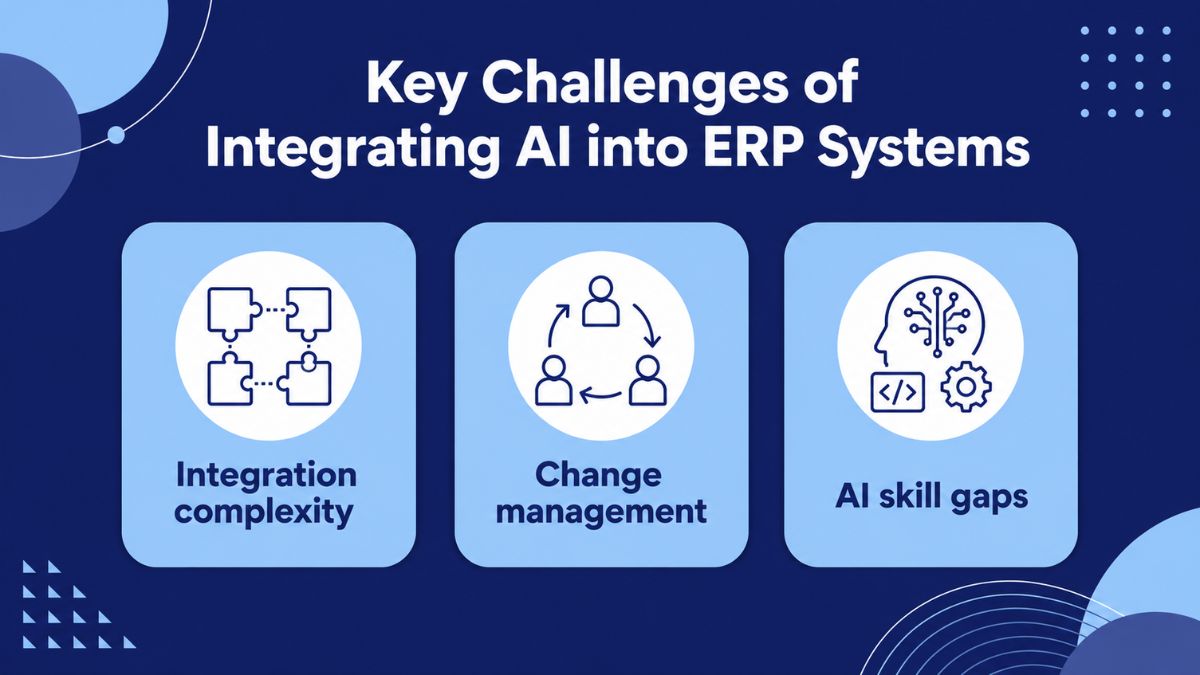
Although AI in ERP can automate processes and make ERP environments easier to manage, implementation still introduces technical and organizational challenges. Businesses need to address system integration, workforce adoption, and AI expertise to support a smoother transition.
Integration complexity
The effectiveness of AI depends heavily on the quality of the data it analyzes, so businesses need clean and consistent data across ERP functions. Finance, CRM, supply chain, HR, and other components must integrate effectively, while separate AI tools also need to work with the broader ERP environment. Modular, AI-ready ERP solutions with natively connected components can make this integration easier.
Change management
Introducing AI-powered ERP can reshape existing processes, workflows, and employee skill requirements. Staff may need additional training and technical upskilling, as well as support in adapting to AI-driven operations and decision-making.
Resistance may arise when employees are uncomfortable with new technology or concerned about job displacement. To overcome this challenge, businesses require careful planning, clear communication, and training programs.
AI skill gaps
Deploying and managing AI in ERP systems may require expertise in areas such as data science, machine learning algorithms, and AI integration that existing teams do not have.
Organizations may therefore need to train current employees or recruit specialists. Qualified AI professionals can be difficult and costly to attract and retain. That’s why investing in employee training and development can help businesses build the skills required to use AI capabilities within their ERP systems effectively.
Best Practices for Successful AI Adoption in ERP
Integrating AI into ERP systems requires a clear, structured approach to ensure successful implementation and business value. It involves aligning technology with business objectives, data readiness, user adoption, security, and performance measurement.
1. Define business goals and prepare the data foundation
Clear business objectives and reliable data provide the starting point for AI adoption. Before selecting solutions, businesses should assess current data quality and infrastructure, then establish standards that support accurate AI outputs.
- Set clear business objectives: Conduct a formal assessment of data quality and infrastructure, then define specific, measurable outcomes aligned with strategic goals, such as a 20% productivity increase or 12% fewer reporting errors.
- Establish data quality standards: Implement a data governance framework that unifies companywide data and uses automated validation tools to continuously cleanse and monitor information. This provides reliable inputs for applications such as GenAI report drafting and inventory prediction.
2. Prepare people and roll out AI gradually
AI implementation can change existing processes, roles, and workflows. Structured training and controlled deployments can help organizations introduce these changes while limiting disruption.
- Invest in change management and training: Provide structured change management, upskilling opportunities, and role-based hands-on training before AI features go live, such as using historical account issues to prepare customer service teams for an LLM-powered search feature.
- Implement pilot programs and phased rollouts: Begin with controlled deployments, define expectations, document problems and successes, and expand gradually to reduce risk.
3. Evaluate ERP and AI vendors carefully
Vendor selection should reflect business requirements, integration needs, and long-term flexibility.
- Assess vendor capabilities: Review transparency, governance practices, integration capabilities, peer experiences, and hands-on demos.
- Compare AI integration models: Check whether AI features are built into the ERP or added separately, as this may affect performance, scalability, and flexibility.
4. Prioritize security and responsible AI
Security, privacy, and governance should be built into AI-enabled ERP processes from the start.
- Apply responsible AI practices: Address fairness, transparency, bias, accountability, and privacy.
- Strengthen compliance controls: Review high-risk AI processes and embed protections for requirements such as GDPR and CCPA.
5. Monitor and retrain AI models
AI performance can decline as data patterns and underlying technology evolve over time. This drift in models can reduce accuracy, making continuous monitoring and periodic updates essential to maintain reliable results.
- Monitor model accuracy: Use real-time dashboards and alerts to identify when performance falls outside acceptable thresholds.
- Retrain when needed: Update and validate models to maintain the accuracy of predictive analytics and GenAI tools.
6. Measure AI performance beyond ROI
AI performance should be assessed through both financial and operational indicators.
- Track diverse KPIs: Measure financial returns, efficiency gains, user adoption, and strategic value.
- Review results regularly: Compare performance with past baselines and consider metrics such as time to value, cost savings, and customer satisfaction.
The Current State of AI in ERP Systems and Future Outlook
By 2026, AI in ERP has moved toward a more mature stage, with basic AI capabilities becoming more common across platforms and clearer frameworks emerging for implementation. ERP vendors are also expanding beyond assistant-style AI toward more autonomous capabilities.
For example, SAP introduced updates at Sapphire 2025 that evolved Joule from a copilot toward an autonomous agent, while Microsoft Copilot is also moving from assistant to agent capabilities.
Emerging AI trends in ERP systems include:
- Explainable AI: As AI models become more complex, businesses may increasingly require visibility into how ERP systems reach AI-driven decisions.
- Hyperautomation: AI could become more deeply integrated into ERP software to automate a wider range of business processes.
- Augmented intelligence: AI is expected to increasingly complement human decision-making and support closer collaboration between people and intelligent systems.
- Cross-platform AI: AI capabilities that work across different ERP platforms and integrations may support more connected, cross-functional operations.
These trends show that ERP is shifting from transactional systems to intelligent decision platforms. Competitive advantages will depend on high-quality data, governance, and human-AI collaboration.
As AI becomes more autonomous and embedded, success will depend less on adoption and more on orchestration across systems and trust in AI decisions.
Build an AI-Powered ERP System with Newwave Solutions
With 15+ years of software development experience, Newwave Solutions delivers custom ERP solutions designed around real business processes. Our ERP development approach connects departments, centralizes data, automates workflows, and integrates with existing business systems to improve operational visibility and support long-term scalability.
Our AI-driven ERP system can bring these capabilities together while making business data more actionable:
- End-to-End Process Automation: Automate repetitive workflows across departments to reduce manual work, improve accuracy, and accelerate daily operations.
- Data Integration & Centralization: Connect data from different functions and systems in one environment, giving teams a more consistent view of business operations.
- Real-Time Analytics & Reporting: Turn centralized operational data into timely insights that support faster, more informed decisions.
- Inventory & Supply Chain Management: Improve visibility across inventory and supply chain processes, helping teams coordinate operations and respond more effectively to changing requirements.
- Sales & CRM Integration: Connect ERP with CRM processes to create smoother information flows between sales, customer management, and back-office operations.
- Human Resources & Payroll: Bring employee and payroll processes into the same ERP environment to reduce fragmented workflows and simplify administration.
- Role-Based Access Control: Control access based on user roles to protect business information and support more secure ERP operations.
- Custom Dashboards & KPIs: Present the metrics that matter most to each business function, making performance easier to monitor and evaluate.
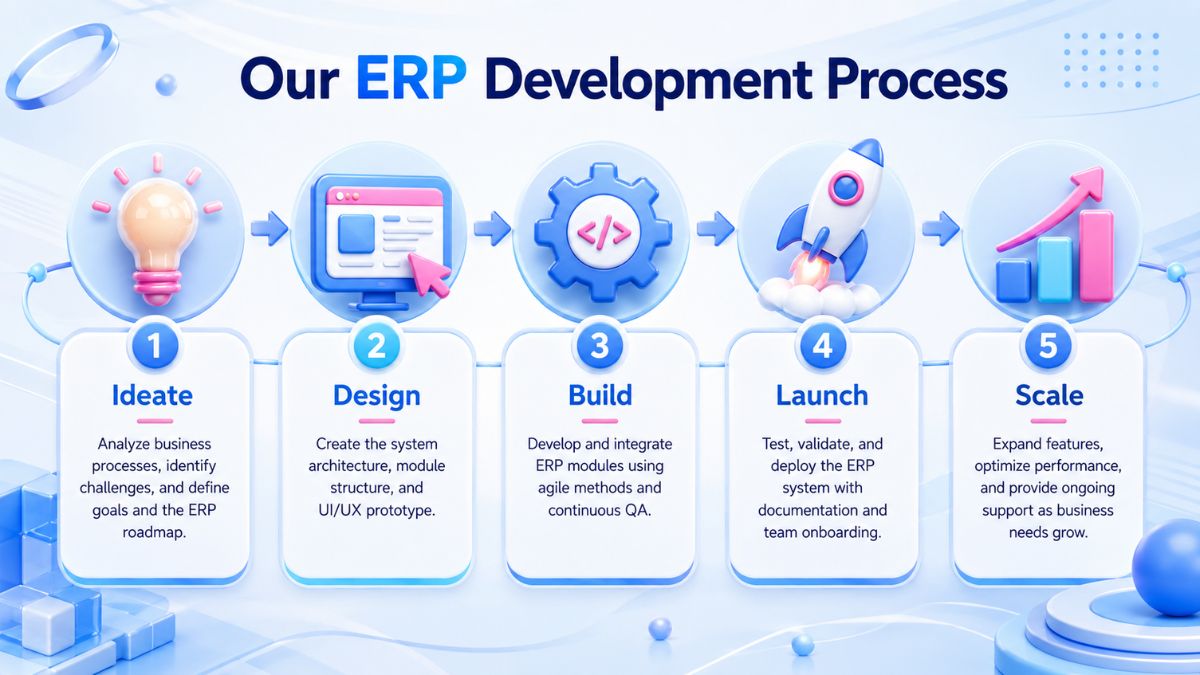
Our capability is highlighted in an ERP project for a museum in Singapore, which features an Axelor-based ERP backend with an eCommerce website and gamified visitor application. The solution brought previously disconnected systems together into a more cohesive platform, helping simplify operations, improve user and reward management, and create a smoother overall visitor experience.
Ready to explore how AI and ERP can fit your workflows and operational priorities? Book a consultation with Newwave Solutions to discuss your requirements and define the right approach for your ERP transformation.
Turning AI in ERP into Business Value
AI in ERP creates the most value when intelligence is applied to real operational needs rather than added as a standalone feature. Automation, predictive insights, and smarter decision support can improve efficiency, but outcomes still depend on reliable data, the right system architecture, and a clear implementation strategy.
Before adopting an AI-powered ERP, businesses should evaluate where AI can solve measurable problems, how well the solution fits existing workflows, and whether governance and scalability are in place. Newwave Solutions can support this process from ERP assessment and AI integration to custom development. Contact us now to get started with your ERP transformation.
FAQs
1. What is AI in the context of ERP?
AI in ERP refers to the integration of technologies such as machine learning, predictive analytics, NLP, and automation into enterprise resource planning systems. These capabilities help ERP systems analyze data, automate routine processes, generate predictions, and support faster business decisions.
2. How can AI be used in ERP?
AI can support ERP processes across finance, procurement, supply chain, and HR. Common applications include invoice anomaly detection, demand forecasting, inventory optimization, contract data extraction, employee case summarization, and workforce analysis.
3. What are the easiest AI use cases to start with in ERP?
Good starting points are narrow, repetitive processes with measurable outcomes, such as invoice matching, document processing, data entry, or basic anomaly detection. These use cases are easier to pilot in a controlled environment before expanding AI across broader ERP workflows.
4. Can AI replace an ERP system?
No. AI typically adds an intelligence layer to ERP rather than replacing its core infrastructure, data repositories, and workflows. AI can enhance automation, forecasting, and decision support while the ERP continues to manage core enterprise processes and records.
5. What are the top 3 ERP systems?
There is no universal top three because the right ERP depends on business size, requirements, existing technology, and implementation goals. However, SAP S/4HANA, Oracle NetSuite, and Microsoft Dynamics 365 are widely recognized major ERP platforms; SAP S/4HANA, for example, now integrates Joule directly into its cloud ERP experience.
To Quang Duy is the CEO of Newwave Solutions, a leading Vietnamese software company. He is recognized as a standout technology consultant. Connect with him on LinkedIn and Twitter.



Read More Guides
Get stories in your inbox twice a month.
Let’s Build Something Extraordinary
Sign up for a 30 min no-obligation strategic session with us. Transform your Ideas into scalable reality.
Leave a Reply