


Cloud Application Development: Process, Cost & Best Practices
Cloud application development is becoming increasingly important as more business data and workloads move to the cloud, with over 50% of corporate data already stored there. Yet building a cloud application involves more than choosing a provider and moving software online. Architecture, scalability, security, technology choices, and operating costs can all influence long term performance and maintainability.
To help you make better decisions and avoid common pitfalls, this guide explains how cloud applications are developed, which technologies are commonly used, and which best practices matter most when building secure, scalable cloud solutions.
Key Takeaways
|
What is Cloud Application Development?
Cloud application development is the process of building applications within a cloud environment rather than on a local server or machine. These applications may run through a web browser, while important components such as data storage remain online and rely on cloud services.
Cloud computing has become widely adopted. According to Quantumrun, 94% of companies worldwide use cloud computing in their operations.
This is because businesses increasingly need reliable performance, scalable data storage, and simpler ways to manage digital operations. Cloud application development supports these needs by making data collection and storage more convenient while also simplifying application management and security.
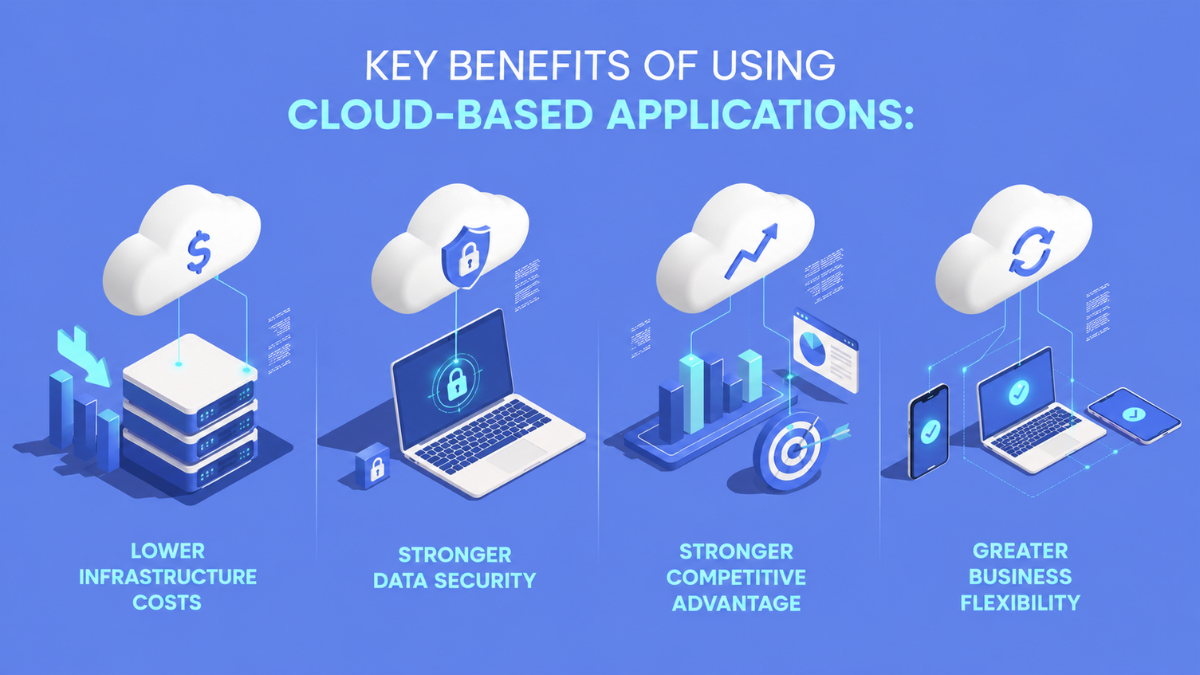
Key Benefits of Using Cloud-based Applications
By moving key systems and infrastructure to the cloud, businesses can streamline how resources are managed and focus more on core development activities. This approach also supports broader improvements in how technology is used across the organization.
1. Lower infrastructure costs
Cloud-based applications can reduce the need for on-site servers and other capital expenses. Instead of paying upfront for hardware capacity, businesses can pay for the cloud services they actually use and add resources as demand grows. Some providers also offer discounts for long-term contracts or larger customers.
2. Better data security
Cloud services provide security measures designed to help protect sensitive business data. Depending on the service, these measures may include file encryption or built-in encryption, making stored information harder for hackers and other unauthorized users to access.
Cloud hosts also continuously monitor security, which can strengthen protection compared with conventional in-house systems. According to RapidScale, 94% of businesses reported improved security after moving to the cloud.
3. Stronger competitive advantage
Cloud-based applications can help businesses stay competitive by reducing the time internal IT teams spend managing infrastructure. Verizon’ research shows that 77% of businesses believe cloud technology improves their competitiveness.
With cloud service providers handling much of the underlying environment, teams can focus more on building solutions that support business growth. Additionally, cloud providers also continue to update their services, which helps businesses access newer technology without requiring additional investment in hardware or software.
4. Greater business flexibility
Cloud based applications give businesses more room to adjust resources as operational needs change. Instead of being limited by local server capacity, organizations can increase bandwidth when demand grows. This flexibility helps support changing workloads and allows teams to respond faster to market requirements.
Cloud services also reduce the need for internal teams to handle hosting and infrastructure directly. As a result, technical resources can spend more time on business focused solutions rather than routine infrastructure management.
Step-by-Step Process for Developing a Cloud Application
A structured process provides a clear roadmap for building and managing application development in the cloud, ensuring consistency and direction throughout the entire development lifecycle.
Step 1: Define project scope and budget
Start by clarifying the application’s purpose, core features, budget, and expected outcomes. Clear boundaries make it easier to focus research on relevant market trends, user needs, and competitive insights. Defining these elements early also helps prevent the project from considering options that exceed available resources.
Step 2: Research market trends and opportunities
Analyze existing cloud applications and competitor strategies to understand what works, what does not, and where user needs remain unmet. This research can help identify market gaps and shape a more relevant product concept before development begins.
Step 3: Choose the development team
Once the market, user needs, and project goals are clear, the next step is choosing who will build the cloud application. Businesses typically have three options: creating an in-house team, hiring freelancers, or outsourcing development to a software company.
|
In-house team |
Freelancers |
Outsourcing |
|
| Best for | Large organizations with ongoing, long-term development needs | Small projects, MVPs, or clearly defined tasks | Businesses seeking specialized expertise, scalable resources, and faster delivery |
| Cost | Can be high due to salaries, infrastructure, and development tools | Usually lower because developers are commonly paid by the hour | Moderate to high depending on project scope and the selected vendor |
| Expertise | Strong but limited to the skills available internally | Varies by individual and is often focused on specific tasks | Generally broad when working with an experienced provider that follows established development practices |
| Scalability | Constrained by existing team size and hiring capacity | Limited by freelancer availability | High, as vendors can increase or reduce team capacity based on project needs |
| Risk management | Directly managed by the business, allowing internal teams to address issues as they arise | Depends largely on the freelancer’s working practices and reliability | Depends on the development provider’s policies and processes |
| Speed | Often slower because recruitment and onboarding require time | Moderate and dependent on developer availability | Typically faster because an established team can begin development sooner |
Cloud applications often require ongoing updates and new features as business and market requirements change. For this reason, the selected development model should provide enough capacity to respond to those changes throughout the project.
Step 4: Define core features
Identify the features that represent the core value of the product and prioritize those needed for an MVP. The initial version should address the main user problem without unnecessary complexity. Testing the MVP with real users can then provide feedback for future improvements.
Step 5: Select a cloud service provider
When comparing options, evaluate factors such as pricing, compliance, integration capabilities, and customer support. These considerations help determine whether a provider fits both the technical requirements and business needs of the application.
The provider you select can affect scalability, security, performance, and overall costs, so each option should be assessed carefully before making a decision. Major providers include Amazon Web Services (AWS), Microsoft Azure, and Google Cloud Platform (GCP). Other available options include IBM Cloud, Salesforce Cloud, and Oracle Cloud Infrastructure (OCI).
Step 6: Plan the application architecture
Application architecture defines how an app operates, defining how its components interact, how it scales, and how it connects with other technologies. Common architecture options include:
- Monolithic: Combines all components into one tightly connected application. It is simpler to design but can become harder to scale and update.
- Microservices: Divides the application into independent services that communicate through APIs. This improves flexibility and scalability but adds complexity.
- Serverless: Uses small event-driven functions without requiring direct server management. It can be flexible and cost-effective but may not suit resource-intensive workloads.
- Hybrid: Combines on-site infrastructure with public or private cloud resources. It provides flexibility but can introduce security and integration challenges.
Step 7: Choose tools and technology
There is no universal tech stack for every cloud application. The right choice depends on the development team’s skills and available resources, as well as the specific requirements of the project. Key factors to consider include project scope, scalability requirements, number and type of integrations, security considerations.
Common technologies used in cloud based application development include:
|
Technology category |
Common options |
| Programming languages | Node.js, Java, Python, Ruby, .NET, Go, PHP, TypeScript |
| Databases | MySQL, PostgreSQL, MongoDB, Amazon RDS, Cosmos DB, Firestore, Firebase Realtime Database |
| Frameworks | Spring Boot, Django, Flask, Express.js, .NET Core, Ruby on Rails, Angular, React, Vue.js |
| Containers and orchestration | Docker, Kubernetes, OpenShift, Amazon ECS |
| Frontend | React, Angular, Vue.js, Bootstrap, Materialize, Tailwind CSS |
Step 8: Develop the MVP and test regularly
Build a functional MVP with enough features to validate the product with real users and collect feedback. During development, conduct functional, usability, and performance testing to identify issues early and check whether the application meets technical requirements.
Step 9: Launch and maintain the application
After testing and final adjustments, the application is ready to release to users. Development continues after launching through regular maintenance, including bug fixes, security checks, and new feature updates. Ongoing maintenance helps the application continue operating smoothly while adapting to changing user needs.
Tech Stack Used in Cloud Application Development
Cloud application development relies on different platforms, services, and tools to build, deploy, and manage applications. These technologies can be grouped into three main layers, each supporting a different part of the development environment.
Infrastructure layer
The infrastructure layer provides the core computing resources that cloud applications run on, including servers, storage, and networks. Common providers include:
- Amazon Web Services (AWS)
- Microsoft Azure
- Google Cloud Platform (GCP)
- IBM Cloud
- Oracle Cloud
Platform layer
The platform layer gives developers a ready-to-use environment for building and deploying applications. It reduces the need to directly manage servers, networking, and scaling. Common options include:
- Heroku
- Google App Engine
- Microsoft Azure App Service
- AWS Elastic Beanstalk
- Red Hat OpenShift
Application and development tools layer
This layer includes the tools and services used to build, operate, and maintain cloud applications within the development environment.
|
Category |
Common tools and services |
| Databases | MongoDB Atlas, Firebase, Amazon RDS |
| Containers and orchestration | Docker, Kubernetes |
| CI/CD tools | GitHub Actions, Jenkins, GitLab CI/CD |
| Monitoring and logging | Prometheus, Datadog, New Relic |
| Security tools | Cloudflare, HashiCorp Vault |
| Serverless computing | AWS Lambda, Google Cloud Functions |
How Much Does Cloud Application Development Cost
Cloud application development cost varies widely because it depends on the scope, complexity, technology choices, and delivery timeline of each project. Development typically ranges from $30,000 to $300,000 or more, with larger and more complex applications requiring higher investment and longer timelines.
|
Type of Cloud App |
Estimated Cost |
Estimated Timeline |
| Basic Cloud App |
$30,000 – $60,000 |
3 – 6 months |
| Intermediate Cloud App |
$60,000 – $150,000 |
6 – 9 months |
| Complex Cloud App |
$150,000 – $300,000+ |
6 – 12 months+ |
These estimates generally do not include cloud hosting costs. Besides, other factors can influence the final cost of developing a cloud application:
- Product design complexity: More detailed UI/UX requirements and design work can increase development effort.
- Product features: A larger number of features or more complex functionality generally requires more development resources.
- Project size and complexity: Larger applications with more extensive requirements typically demand additional time and effort.
- Technology stack: The programming languages, frameworks, and development tools selected for the project can affect overall cost.
- Development timeframe: Projects with shorter delivery schedules may require additional resources and can result in higher costs.
Because these variables differ from one project to another, an accurate estimate should consider the complete scope, technical requirements, and expected delivery schedule rather than relying on a fixed price.
Common Challenges in Developing Cloud Application
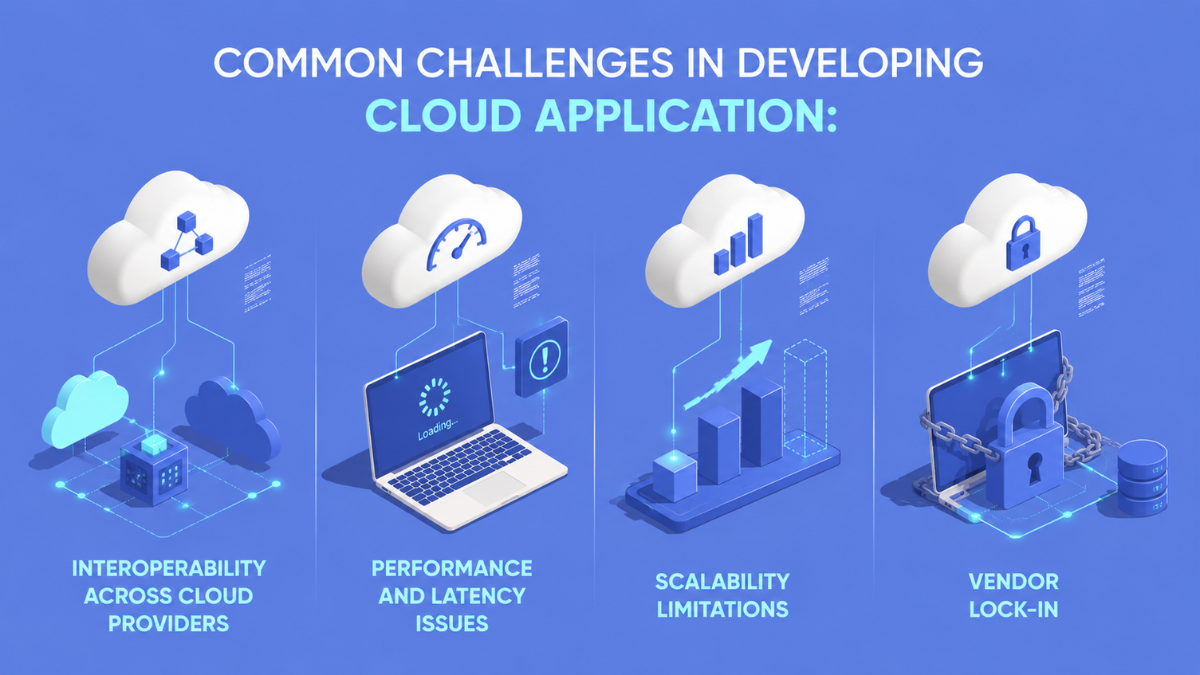
During development process, teams can still face technical and operational challenges related to portability, performance, scalability, and provider dependency. Addressing these issues early can help reduce future migration complexity and improve application stability.
Interoperability across cloud providers
Each cloud provider uses different services and environments, which can make application portability more difficult. Adapting the code to work across multiple providers and following common cloud standards can require additional effort, but it can also make the application more flexible and easier to move in the future.
Performance and latency issues
Application performance can vary depending on the selected provider and the location of its data centers. Latency may become a problem if the environment is not well matched to the application. Regular testing and monitoring can help identify performance issues and support more stable operation.
Scalability limitations
Cloud providers may offer scalable infrastructure, but actual performance can still vary as user demand increases. For this reason, teams should verify the provider’s processing capacity rather than rely only on general scalability claims. A hybrid approach can also reduce dependence on a single platform.
Vendor lock-in
Relying heavily on proprietary services from one provider can make future migrations, infrastructure changes, or multi-cloud adoption more complex and expensive. To reduce this risk, organizations can use open standards, containerization, Infrastructure as Code, and portable architectures. These approaches can make it easier to adapt the application when technical or operational requirements change.
Real-World Examples of Cloud-Based App Development
Real-world cases below show how cloud application development supports different business and technical needs, from large-scale streaming to real-time personalization and multi-cloud operations.
- Netflix: Netflix uses a cloud-native architecture built on Amazon Web Services and runs thousands of microservices to support millions of users globally. Its Chaos Monkey approach intentionally introduces failures so the platform can test system resilience and maintain high availability.
- Spotify: Spotify uses cloud-based, event-driven systems to process billions of events each day. This infrastructure supports real-time data processing and personalized music recommendations at scale.
- Airbnb: Airbnb uses a multi-cloud strategy to support different parts of its platform, including payment processing and search. Multiple cloud services work together while maintaining a consistent user experience across the platform.
Best Practices for Building Effective Cloud Applications
A structured approach to cloud application development can improve scalability, security, efficiency, and user experience. The following practices help teams align technical decisions with business goals while supporting reliable development and ongoing operations.
1. Build a clear cloud strategy
Define clear goals, success metrics, and business objectives before development begins. The strategy should also cover the cloud model, data management, and resource allocation. Involving stakeholders from areas such as IT, finance, and operations can help ensure that different business needs are considered.
2. Design for scalability
Plan the application architecture so it can support more users and features over time. The choice of coding language and architecture can influence how easily the application scales. Microservices, for example, can improve flexibility by separating the application into smaller components that can be developed, deployed, and scaled independently.
3. Prioritize security throughout development
Cloud providers may offer baseline security, but application security still requires active management throughout the development lifecycle and after deployment. Teams should follow secure coding practices, conduct regular vulnerability assessments, and perform penetration testing to identify potential issues such as misconfigurations or unsecured APIs.
4. Use automation across development and deployment
CI/CD pipelines can automate building, testing, and deployment activities. This can streamline release workflows and reduce deployment errors. Maintaining clear CI/CD documentation also helps teams apply consistent processes across development activities.
5. Focus on user experience
Cloud applications may be accessed from different devices, so the experience should remain consistent and easy to use. User research, including surveys, interviews, and usability testing, can help teams understand user needs. Applications should also support different screen sizes, simple navigation, and efficient loading. After launch, user feedback can guide further improvements.
6. Monitor and optimize performance
Post-deployment monitoring helps identify performance issues before they affect users. Key areas to track include response time, latency, availability, resource utilization, and log errors. Continuous monitoring can help teams locate bottlenecks, resolve issues, and use resources more efficiently.
Emerging Trends in Cloud Application Development
Several technologies are shaping how cloud application development is evolving, particularly around automation, performance, infrastructure management, and deployment flexibility.
- AI and machine learning integration: AI and machine learning are increasingly being integrated into cloud applications to automate processes, improve user experiences, and support more personalized services.
- Edge computing: As IoT and cloud computing become more connected, edge computing is gaining importance for reducing latency. By processing data closer to where it is generated, cloud applications can respond faster and operate more efficiently.
- Serverless computing: More businesses are adopting serverless architecture because it allows developers to build scalable applications without directly managing the underlying servers.
- Hybrid cloud solutions: Enterprises are increasingly combining private and public cloud infrastructure rather than relying on only one environment. This approach can provide a balance between security, compliance, and scalability.
Build Scalable Cloud Applications with Newwave Solutions
Newwave Solutions provides custom cloud application development services for businesses looking to build, scale, or modernize digital products. Our teams can support cloud-native applications designed around flexible scalability, helping organizations create software that can evolve alongside changing operational and business requirements.
Rather than treating cloud development as an isolated technical task, Newwave Solutions combines strategic guidance with end-to-end engineering and post-launch support. This enables businesses to move from initial requirements and architecture decisions through development, QA, deployment, and ongoing optimization with one technology partner.
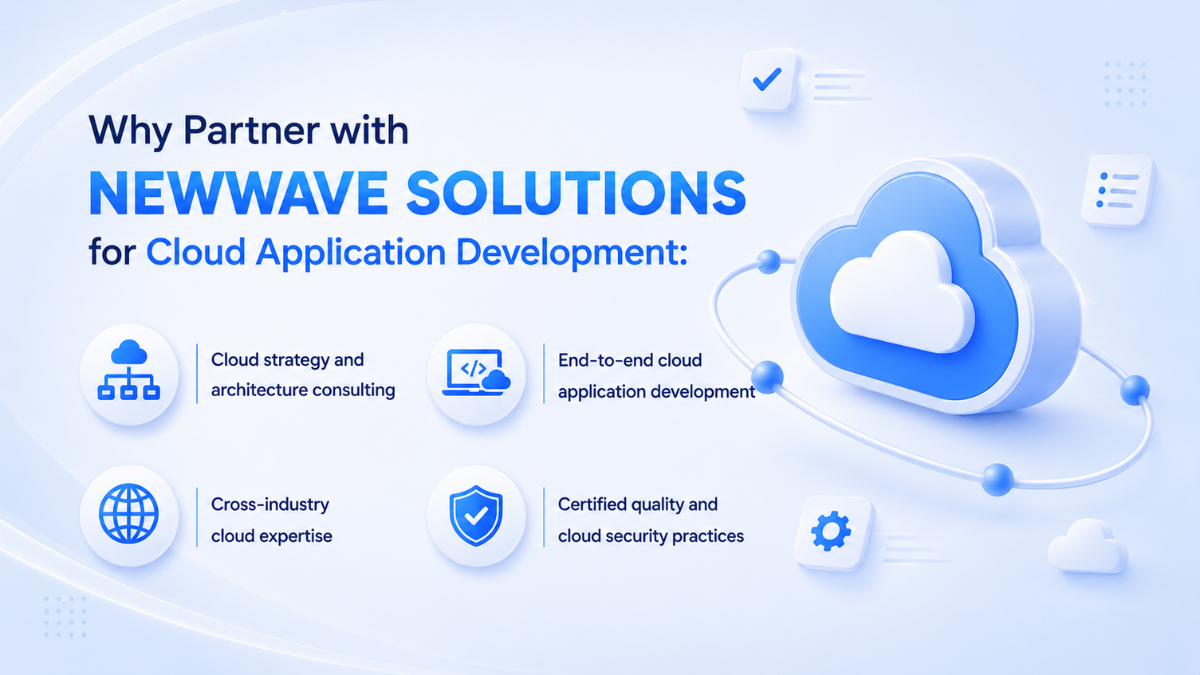
Here’s what makes us a trusted partner for cloud application development:
- Cloud strategy and architecture consulting: Newwave Solutions helps businesses assess application requirements, scalability needs, and modernization goals to define a cloud architecture and development approach that fits the project from the start.
- End-to-end cloud application development: We provide comprehensive delivery across design, build, testing, deployment, and post-launch support, ensuring continuity from initial development through long-term operation under a single team.
- Cross-industry cloud expertise: Experience across sectors such as fintech, healthcare, logistics, eCommerce, education, and manufacturing helps Newwave Solutions adapt cloud applications to different operational, data, and industry-specific requirements.
- Certified quality and cloud security practices: Quality and information-security management are supported by ISO 9001:2015 and ISO 27001:2022 certifications, providing structured processes for software quality, data protection, and secure cloud application delivery.
Ready to build or modernize a cloud application that can scale with your business? Talk to our experts at Newwave Solutions to discuss your architecture, migration, development requirements and identify the right path from planning to deployment.
Conclusion: Building Secure, Scalable Cloud Applications for Future Growth
The value of cloud application development comes from creating a foundation that supports both current requirements and future change. Businesses should focus on making sound architecture and technology decisions early, while keeping the application flexible enough to evolve as users, workloads, and operational priorities change.
If your business is preparing to build or modernize a cloud application, Newwave Solutions can provide the technical support needed throughout the development lifecycle. Start by discussing your cloud goals with our team and identifying the development approach that best fits your next stage of growth.
FAQs
1. What is a cloud-based application?
A cloud-based application is software that runs partly or entirely on cloud infrastructure rather than relying only on local devices or on-premises systems. It uses cloud resources to provide capabilities such as remote access, scalable computing, storage, and application delivery.
2. What are the types of cloud computing models?
The main cloud computing service models are IaaS, PaaS, and SaaS. IaaS provides infrastructure resources, PaaS provides an environment for developing and deploying applications, while SaaS delivers complete software applications to users over the internet.
3. What are the key KPIs to track after launching a cloud application?
Post-launch monitoring should focus on metrics that show whether the application remains reliable and efficient, including availability, response time, error rates, resource utilization, and cloud spending. The specific KPIs should reflect the application’s performance requirements and business objectives.
4. How is security handled differently in cloud-native environments?
Cloud-native security needs to account for applications distributed across cloud infrastructure rather than relying solely on a traditional network perimeter. Security therefore needs to be incorporated throughout development and operations, with controls applied to areas such as data, access, infrastructure, and application components.
5. How can I reduce costs on cloud app creation?
Cloud application costs can be managed by defining requirements clearly before development and selecting an architecture and cloud services that match actual project needs. After deployment, monitoring resource consumption and optimizing cloud usage can also help control ongoing costs as the application scales.
To Quang Duy is the CEO of Newwave Solutions, a leading Vietnamese software company. He is recognized as a standout technology consultant. Connect with him on LinkedIn and Twitter.



Read More Guides
Get stories in your inbox twice a month.
Let’s Build Something Extraordinary
Sign up for a 30 min no-obligation strategic session with us. Transform your Ideas into scalable reality.
Leave a Reply