


AI Agent Development Cost: 2026 Detailed Pricing Guide
AI agent development cost is becoming a critical planning question as adoption moves beyond experimentation. McKinsey’s 2025 State of AI report found that 62% of surveyed organizations were already experimenting with AI agents, yet most had not scaled AI across the enterprise.
The challenge is that AI agent costs vary widely based on complexity, data readiness, integrations, and other factors, making it difficult to set a realistic budget without understanding the full cost structure. To help address this, this guide examines pricing by agent type and industry, breaks down costs across the development lifecycle, and explains major and hidden cost drivers so you can plan a more informed investment.
Key Takeaways
|
AI Agent Development Cost at a Glance
AI agent development costs vary widely based on the system’s complexity, capabilities, implementation requirements, and team location. The table below provides a quick comparison of common AI agent types, estimated costs, timelines, and typical use cases.
|
AI Agent Type |
Estimated development cost | Use cases |
Key cost drivers |
| Rule-Based / Simple Reflex Agents | $10,000–$30,000+ | FAQ bots, step-by-step guidance, simple automation | Number and complexity of rules, integrations, hosting, and ongoing support |
| Contextual / Model-Based Reflex Agents | $40,000–$80,000+ | Fraud detection, climate control, energy management, autonomous vehicles | Memory and state management, model complexity, cloud infrastructure, data storage, and maintenance |
| Goal-Based Agents | $40,000–$150,000+ | Traffic management, robotics, diagnostic assistance, treatment planning | Level of autonomy, planning and reasoning complexity, computational requirements, and maintenance |
| Utility-Based Agents | $80,000–$200,000 | Recommendation systems, dynamic pricing, logistics, personalized medicine | Utility-function design, mathematical modeling, outcome evaluation, and complex integrations |
| Learning Agents | $100,000–$300,000+ | Recommendation systems, financial trading, autonomous robots, customer service chatbots | Training requirements, ML complexity, data quality, computing resources, and continuous monitoring |
| RAG Agents | $100,000–$300,000 | Real-time Q&A, automated customer support, document analysis, data management | Integration of retrieval and generation, external data sources, knowledge-base storage, memory, and computing resources |
| Multi-Agent Systems (MAS) | $200,000–$500,000+ | Supply chain management, software development, smart grids, swarm robotics | Number of agents, orchestration complexity, computing resources, infrastructure, and licensing fees |
| Hierarchical Agents | $100,000–$400,000+ | Autonomous systems, manufacturing and logistics robotics, game development | Multi-level system design, enterprise integrations, scalability, security, and coordination between agents |
Types of AI Agents and Their Pricing
AI agent development cost varies widely because different agent types require different levels of memory, reasoning, autonomy, data processing, and system coordination. Rule-based agents are the least expensive because they follow fixed logic, while learning, RAG, multi-agent, and hierarchical systems require more advanced models, infrastructure, and integration work.
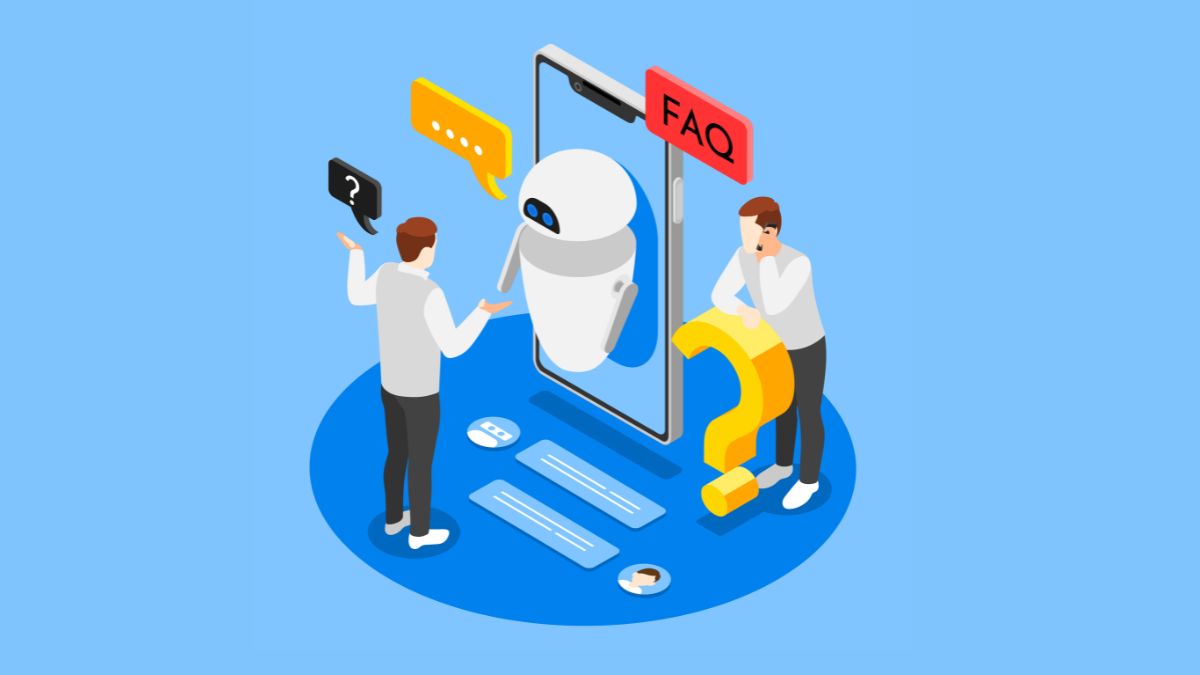
Rule-based agents: $10,000 to $30,000
Rule-based agents follow predefined decision paths and return scripted responses. They do not use large language models for reasoning, which makes them faster and less expensive to build. However, they cannot reliably handle requests outside their programmed scope.
Principle: Check condition → apply rule → take action
Use cases: FAQ bots, step-by-step guidance systems, simple workflow automation.
Pros:
- Work effectively in predictable environments with clearly defined rules.
- Provide transparent logic that is easier to understand and debug.
- Require fewer computing resources, helping keep development and operating costs lower.
Cons:
- Cannot handle situations that depend on memory, learning, or advanced NLP.
- May repeat the same errors when existing rules do not cover new situations.
- Become harder to maintain as growing complexity requires more rules.
A rule-based AI agent typically costs $10,000–$30,000+, with additional spending required for hosting, integrations, and ongoing support.
Contextual / Model-based reflex agents: $40,000 to $80,000
Model-based reflex agents extend rule-based systems by combining current inputs with stored information about previous states. This memory allows them to interpret context and adapt decisions based on what has already happened.
Principle: Current input → stored state → action
Use cases: Climate control, fraud detection, autonomous driving, tracking systems, and energy management.
Pros:
- Remember previous states and can adapt based on historical information.
- Perform better than simple reflex agents in changing environments.
- Use memory to reduce repeated incorrect actions.
Cons:
- Still lack the advanced reasoning and learning needed for highly complex problems.
- Maintaining the internal model can slow decisions in time-sensitive scenarios.
- Poor data or incorrect assumptions may lead to wrong actions.
A model-based reflex agent usually costs $40,000–$80,000+. Additional expenses can include $20–$5,000+ per month for cloud services, $10–$3,000+ per month for data storage, and regular maintenance.
Goal-based agents: $40,000 to $150,000
Goal-based agents evaluate several possible actions and choose the one most likely to achieve a predefined objective. Unlike reflex agents, they use planning and reasoning to consider future outcomes before acting.
Principle: Goal → evaluate possible actions → select action
Use cases: Traffic management, resource allocation, robotics, diagnostic assistance, treatment planning, and patient monitoring.
Pros:
- Support complex environments where flexibility and adaptation are important.
- Can use search, planning, and future-state prediction rather than responding only to current conditions.
- Evaluate multiple alternatives before choosing an action.
Cons:
- Can require substantial computing resources for complex decisions.
- Are more difficult to design and implement than reflex-based agents.
- Performance may decline in highly uncertain or rapidly changing environments.
A goal-based AI agent generally costs $40,000–$150,000+, with the final price driven primarily by autonomy, complexity, and ongoing maintenance requirements.
Utility-based agents: $80,000 to $200,000
Utility-based agents use utility functions, which is a scoring system that ranks possible outcomes, to set priorities and guide decisions. Rather than simply following fixed rules or choosing any action that reaches a predefined goal, they compare multiple possible outcomes against factors such as safety and efficiency.
The agent then selects the action with the highest overall utility, allowing it to choose between several viable options based on which delivers the greatest combined benefit.
Principle: Evaluate outcomes → assign utility → select highest-value option → act
Use cases: Smart energy management, robotics, personalized medicine, autonomous vehicles, logistics, supply chain automation, recommendation systems, and pricing engines.
Pros:
- Operate effectively in complex environments where outcomes may be uncertain.
- Can adapt decisions when business or operational priorities change.
- Help distinguish between multiple options that may all appear acceptable.
Cons:
- Require extensive computation to compare possible outcomes.
- Poorly designed utility criteria can produce flawed decisions.
- Decision-making may take longer because several alternatives must be evaluated.
A utility-based agent typically costs $80,000–$200,000, mainly because of advanced mathematical modeling and complex integration requirements.
Learning agents: $100,000 to $300,000
Learning agents improve their behavior through continuous interaction and feedback rather than relying solely on fixed rules. They may use reinforcement learning, supervised learning, or unsupervised learning to adjust decisions over time.
Principle: Action → feedback → correction → improvement
Use cases: Autonomous robots, personalized recommendation systems, financial trading applications, and customer service chatbots.
Pros:
- Adapt autonomously as environmental conditions change.
- Can respond to dynamic patterns such as evolving customer preferences.
- Reduce the need for continuous manual rule updates.
Cons:
- Low-quality training data can reinforce incorrect decisions over time.
- Require monitoring to prevent undesirable patterns or bias.
- Initial training can consume substantial resources before performance reaches the required level.
The cost of developing a learning agent starts at about $100,000 and can exceed $300,000 for complex systems with advanced machine learning capabilities.
Retrieval-augmented generation (RAG) agents: $100,000–$300,000
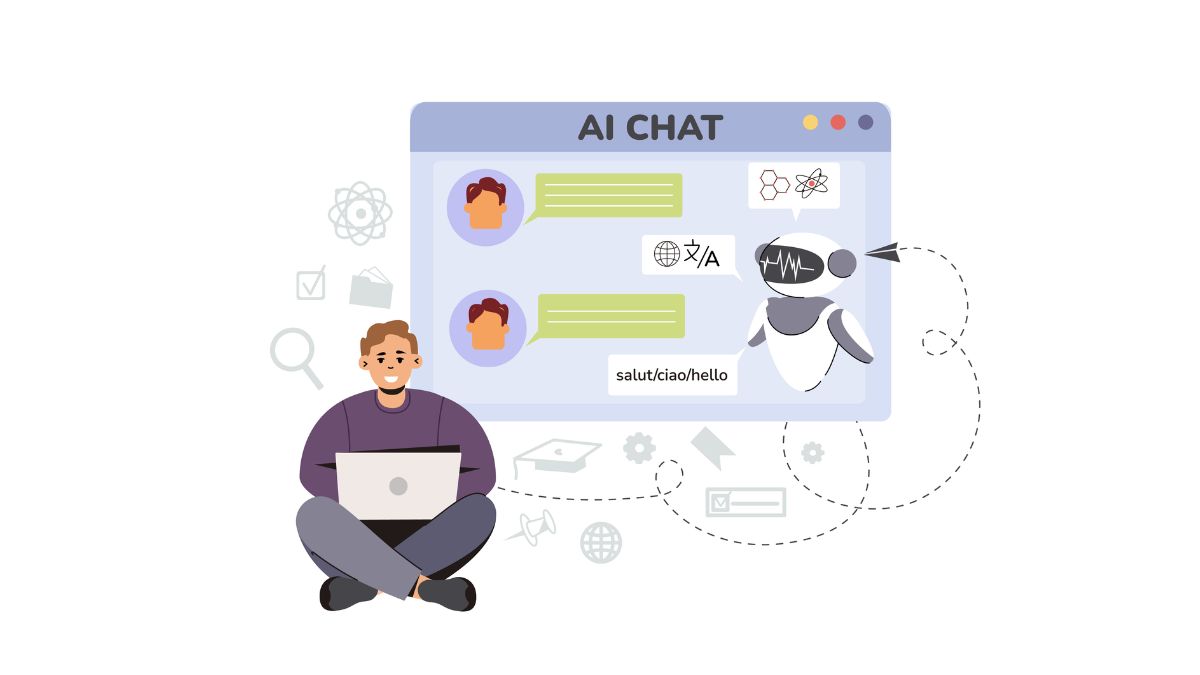
A retrieval-augmented generation (RAG) agent is an AI system that retrieves relevant information from external data sources and combines it with generative AI to produce more accurate responses. By adding retrieved information to the model’s context, it can improve performance on domain-specific queries without requiring the underlying model to be fine-tuned.
Principle: Query → retrieve information → augment context → generate response
Use cases: Real-time question answering, automated customer support, data management, and document analysis.
Pros:
- Retrieve information from external sources in real time.
- Reduce reliance on large, heavily fine-tuned models by combining retrieval with generation.
- Can improve contextual accuracy and reduce hallucinations.
Cons:
- Response quality depends heavily on the quality of retrieved data.
- Retrieval from large or external sources can increase response time.
- Large knowledge bases require additional storage, memory, and computing resources.
A RAG agent typically costs $100,000–$300,000, with cost driven largely by the complexity of combining retrieval infrastructure with generative AI components.
Multi-agent systems (MAS): $200,000–$500,000+
A multi-agent system coordinates several AI agents that work together in a shared environment. Individual agents can take different roles. For example, one may plan, another retrieve information, and another execute actions.
Principle: Perception → reasoning → action → interaction → orchestration
Use cases: Supply chain management, customer service, software development, transportation management, smart grids, and swarm robotics.
Pros:
- Solve complex problems by coordinating specialized agents.
- Allow additional agents to be added as system requirements expand.
- Can adjust behavior when new information or unexpected conditions emerge without constant human intervention.
Cons:
- Become increasingly difficult to manage as more agents are introduced.
- Interactions between agents can create unexpected outcomes that are difficult to test exhaustively.
- Require careful architecture, orchestration, and substantial infrastructure.
A multi-agent system generally costs $200,000–$500,000+, depending on system complexity, the number of agents, computing requirements, licensing costs, and orchestration needs.
Hierarchical agents: $100,000–$400,000+
A hierarchical agent is an AI system organized into multiple levels, where higher-level agents coordinate and delegate work to mid- and lower-level agents. By breaking complex objectives into smaller tasks, this structure supports more organized control, clearer decision-making, and scalable execution across the system.
Principle: High-level planning → task distribution → coordination → action
Use cases: Autonomous systems, manufacturing and logistics robotics, and game development.
Pros:
- Assign tasks to agents based on their roles and capabilities.
- Support large systems where coordination between multiple components is essential.
- Separate strategic planning from tactical execution, allowing different levels to be optimized independently.
Cons:
- Training and designing a hierarchy is more complex than developing a single agent.
- Failure at the top level can affect the performance of the entire system.
- Lower-level agents may struggle with unexpected situations without sufficient design and planning.
Developing hierarchical agents typically costs $100,000–$400,000+, driven by sophisticated system architecture, enterprise integration, scalability, security, and coordination across multiple agent levels.
AI Agent Development Cost by Industry
AI agent development cost varies by industry because each sector has different requirements for compliance, system integration, accuracy, scalability, and deployment. Here’s the breakdown of popular AI agents and their cost across different industries.
|
Industry |
Typical use cases | Average cost range |
Key cost drivers |
|
Financial services |
Fraud monitoring, compliance tasks, trading support | $120,000 to $500,000+ | Strict regulatory compliance requirements (SOC 2, GDPR, SEC, etc), real-time streaming of financial data, high auditability and traceability needs |
|
Healthcare |
Patient intake, clinical records, prior authorization | $100,000 to $400,000 | HIPAA compliance requirements, PHI handling workflows, integration with EHR/EMR systems, high clinical accuracy and validation needs |
|
Manufacturing |
Predictive maintenance, quality checks, supply monitoring | $80,000 to $300,000 | IoT sensor connectivity and data ingestion, edge computing infrastructure setup, integration with OT/SCADA systems |
|
Retail and e-commerce |
Recommendations, customer support, inventory tasks | $50,000 to $200,000 | Personalization, integration with product catalogs and CRM systems |
|
Professional services |
Research, document review, proposal support | $60,000 to $250,000 | Enterprise knowledge base access, document processing accuracy requirements, integration with internal data sources, citation and source traceability needs |
Financial services AI agent cost
Real-time financial data and strict traceability requirements make financial services agents particularly complex to develop. Systems used for fraud monitoring, compliance reporting, or trading support must record and explain their decisions while meeting requirements such as AML/KYC, SOC 2, GDPR, SEC, FINRA, and Basel III. For a production-ready fintech agent, compliance infrastructure alone may cost between $50,000 and $100,000.
Healthcare AI agent development cost
Clinical accuracy and sensitive data protection are major cost drivers for healthcare AI agents. Beyond standard security controls, projects may require HIPAA-specific compliance design, stricter PHI handling workflows, and formal processes for testing whether AI outputs meet expected levels of clinical accuracy and reliability before deployment. These requirements can add work for documentation, review, monitoring, and risk mitigation throughout development.
Integration is another major cost factor: connecting the agent with EHR platforms such as Epic, Cerner, or Meditech often requires additional interface development, testing, and coordination, which can extend the project timeline by 6–12 weeks.

Manufacturing AI agent cost
Many manufacturing agents must exchange data with PLCs, SCADA platforms, industrial IoT sensors, and other operational technology systems, which can require additional engineering. Some projects also need on-premises edge deployment to meet security or response-time requirements, which increases infrastructure costs.
Retail and e-commerce AI agent cost
The cost of retail and e-commerce agents is largely shaped by transaction volume, product data, and personalization requirements. Applications such as recommendation engines, customer service agents, and inventory assistants may need to connect with product catalogs and support real-time interactions at scale.

Professional services AI agent cost
Professional services agents often rely on information from multiple documents, databases, and internal knowledge sources. Costs increase when research, document review, or proposal workflows require high retrieval accuracy and consistent access to several data systems
How Much Does Custom AI Agent Development Cost?
Custom AI agent development does not have a fixed price. The final budget depends on the work required across planning, data preparation, model implementation, integrations, testing, deployment, and long-term maintenance.
|
Phase |
Estimated cost | Complexity |
Key deliverables |
| Research and planning | $5,000 to $15,000 | Low | Project scope, agent requirements, architecture, data sources, success metrics |
| Data collection and preparation | $10,000 to $70,000+ | Low | Data sourcing, cleaning, labeling, preprocessing, compliance preparation |
| ML model setup and training | $15,000 to $100,000+ | Medium | Model selection, training approach, fine-tuning, accuracy optimization |
| Model development | $20,000 to $200,000+ | High | LLM setup, deployment method, vector database, agent pipeline, business logic |
| Integration and workflow orchestration | $20,000 to $50,000+ | High | System connections, API setup, workflow automation, multi-agent coordination |
| Testing and validation | $5,000 to $50,000+ | High | Unit, integration, workflow, regression, security, and human-led testing |
| Deployment and monitoring | $10,000 to $30,000 | Medium | Production infrastructure, deployment architecture, CI/CD, monitoring |
| Maintenance and scaling | $5,000 to $50,000+ annually | High | Bug fixes, retraining, feature updates, performance tuning, scaling |
Research and planning: $5,000 to $15,000
This phase typically costs $5,000–$15,000, with the final amount largely determined by how clearly the project is defined and how much discovery work is needed to shape the data and technical approach.
This phase defines what the agent should accomplish before development begins: its purpose, tasks, expected outcomes, required data, human intervention points, and regulatory obligations. Teams also assess whether the available data is sufficient and usable, then establish the initial architecture, data sources, system requirements, and performance metrics.
Clear requirements at this stage can reduce expensive rework later. Conversely, unclear objectives, missing data, or frequent scope changes can increase discovery effort and carry additional costs into subsequent phases.
Data collection and preparation: $10,000 to $70,000+
Data preparation typically costs $10,000–$70,000+, with the final amount shaped by the volume of data, its quality, and the complexity of pre-processing and labeling.
During this stage, teams first determine which structured, unstructured, or real-time data the agent requires and whether it comes from internal or external sources. Existing datasets must then be assessed to identify usable records, inconsistencies, missing values, and other quality issues before the data is cleaned, labeled, transformed, and organized for model use.
Poor-quality or fragmented datasets require more engineering and preprocessing effort, while large labeled datasets and synthetic data can further increase costs. Sensitive or regulated data may also introduce additional work for standards such as GDPR or HIPAA, along with higher storage and data-pipeline requirements.
Model setup and training: $15,000 to $100,000+
Costs usually range from $15,000–$100,000+, depending on how demanding the AI task is and how much data, computing power, model optimization, required accuracy, and ML expertise are required.
One of the main cost decisions is whether to develop a model from scratch or adapt an existing model. In many projects, teams use pre-trained large language models and fine-tune them with domain-specific examples rather than training the underlying model from the beginning.
This approach can reduce development time and infrastructure requirements, although proprietary or regulated datasets may require more extensive fine-tuning and validation. Training frequency also matters: repeated retraining increases both engineering effort and infrastructure consumption
Model development: $20,000 to $200,000+
The cost of the model development stage starts from $20,000 to $200,000+ and depends on the architecture you chose. During this phase, specialists select an LLM based on quality, speed, price, memory, processing needs, budget, and compliance constraints. They also determine whether to use third-party APIs or open-source models and whether to deploy the system in the cloud or on-premises.
This phase can also include model fine-tuning, embedding optimization, vector database deployment, search configuration, and agent pipeline development through frameworks such as LangGraph, n8n, or Langflow. Teams then add business rules, request routing, monitoring, tools, and human-in-the-loop checkpoints where manual intervention is required.
Integration and workflow orchestration: $20,000 to $50,000+
Integration and orchestration generally cost $20,000–$50,000+, depending on the number of systems, task complexity, the level of automation, and the chosen orchestration method.
AI agents often need to connect with databases, CRMs, ecommerce systems, marketing platforms, enterprise applications, and other services before they can perform useful actions. Every additional connection introduces development and testing work, while complex or rate-limited APIs can create additional engineering constraints.
Common integration approaches include:
- Native integrations: Developers directly build and maintain each system connection, offering high control but requiring significant engineering effort.
- Embedded iPaaS: Uses prebuilt connectors and workflow tools to speed up and simplify integration development.
- Model context protocol (MCP): Enables agents to access client data and choose tools dynamically through a dedicated server interface.
- Unified API platforms: Provides a single integration layer to connect multiple applications and services efficiently.
When several AI agents operate within the same workflow, orchestration defines how they communicate, divide tasks, and make decisions. Common structures include:
- Centralized orchestration: One orchestrator manages the other agents, distributes tasks, and makes final decisions.
- Decentralized orchestration: Agents communicate directly and make decisions independently without a single controller.
- Hierarchical orchestration: Agents are organized into layers, with each layer responsible for a specific task.
- Federated orchestration: Independent agents or organizations collaborate without fully sharing their data or surrendering control of their individual systems.
Testing and validation: $5,000 to $50,000+
Testing and validation can cost $5,000–$50,000+, primarily depending on agent complexity, the diversity and number of test scenarios, test methods and frequency, automation level, and ongoing support requirements.
Testing an AI agent goes beyond conventional code QA because agents may retain memory, call external tools, make decisions, schedule activities, and execute multi-step workflows. Validation therefore needs to examine not only software functionality but also behavior, accuracy, fairness, reasoning, tool interactions, and complete workflow performance.
Popular types of AI agent testing include:
- Unit tests check individual parts of an AI agent, including prompts, logic, and decision-making functions.
- Integration tests validate how the agent works with external tools, correct API usage, and error handling.
- Trajectory evaluation measures multi-step reasoning and the ability to solve complex tasks step by step.
- End-to-end tests replicate full user workflows and track success rate, speed, and failure cases.
- Regression tests ensure new updates don’t break existing features by rerunning previous scenarios.
- Security testing verifies that the agent avoids unsafe actions and harmful outputs.
- Human-in-the-loop review has QA specialists evaluate conversation quality, usefulness, and ethical behavior.
Deployment and monitoring: $10,000 to $30,000
Deployment focuses on moving the AI agent from development into a reliable production environment. Costs can range from $10,000 to $30,000, depend on scalability, memory requirements, task complexity, budget, and team experience.
The first decision is how the agent will operate:
- Stateless: Each request is processed independently, without remembering previous interactions. This setup can support tasks such as document analysis.
- Stateful: The agent retains information from earlier interactions, which is useful for chatbots and virtual assistants.
- Event-driven: The agent reacts to specific events and can complete longer tasks asynchronously in the background.
Production infrastructure typically covers computing, data storage, communication, observability, and security. The system must also be organized according to task complexity and expected workload:
- Single-agent deployment: One agent performs a defined task.
- Distributed multi-agent system: Several agents divide and coordinate tasks across the workflow.
- Agent pool with load balancing: Multiple agents share high-volume workloads to maintain stable performance.
The final steps may include containerization, cloud deployment, CI/CD setup, and continuous monitoring. Monitoring helps maintain reliable and secure operation while identifying bottlenecks and unexpected costs.
Maintenance and scaling: $5,000 to $50,000+ annually
Maintenance cost can vary significantly from $5,000 to $50,000+ annually, depending on system usage, complexity, and regulatory requirements. This ongoing budget covers bug fixes, performance tuning, model updates, and periodic retraining. It also includes enhancements as new features are added or as user demands evolve.
As the system scales, infrastructure needs typically increase as well. Organizations may scale vertically (adding more resources to existing infrastructure), scale horizontally (adding additional servers to distribute workloads), or use load balancing to evenly route traffic across servers and maintain performance.
Key Factors Influencing AI Agent Development Cost
AI agent development expenses depend on more than the agent’s core functionality. Scope, model usage, business integrations, data quality, security, testing, and post-launch support all affect the effort required to build and operate the system.
Agent complexity and scope
Scope is the main factor driving AI agent costs. A tightly focused agent with a single clear function is usually about 3–5x cheaper to develop than a broad, autonomous system that handles multiple workflows and tools. The most cost-effective approach is to start with a narrow use case and expand its capabilities over time.
Functionalities and customization
Feature scope directly affects both development cost and technical complexity. Adding capabilities such as chat, recommendations, automation, tool use, or document understanding increases computing requirements, integration work, testing effort, and delivery time.
Implementing AI agent features can cost approximately $10,000 to $100,000+, depending on the number of capabilities, their complexity, and the amount of customization required. For tighter budget control, core functions can be prioritized first and expanded later.
AI model selection and API cost
The underlying LLM affects both development and operating expenses. Proprietary models are accessed through paid APIs, while open-source models can be customized and hosted independently. Costs vary based on model capability, token usage, model size, and deployment method.
Examples of API-based pricing include:
- GPT-5.2: $2.50 per 1 million input tokens and $15 per 1 million output tokens. It supports complex agents, mathematical reasoning, and advanced tool use.
- Claude 4.6 Sonnet: $3 per 1 million input tokens and $15 per 1 million output tokens. It is designed for coding and large codebase analysis.
- Gemini 2.5 Pro: $1.25 per 1 million input tokens and $10 per 1 million output tokens. It supports long-context research and native video or audio processing.
Open-source options such as LLaMA 3, Gemma, and Qwen do not charge API usage fees. However, self-hosting requires cloud or on-premises infrastructure, computing resources, and ML engineering expertise. API models therefore create ongoing usage costs, while self-hosted models shift more spending toward infrastructure and technical management.
Infrastructure and computing resources
AI agents can require substantial compute, particularly for larger models or high-volume workloads. Infrastructure spending can include:
- Cloud or on-premises services
- GPU or AI accelerator resources
- Networking
- Software and licensing
- Data storage
- Real-time processing frameworks
- Monitoring and logging
Infrastructure typically costs around $10,000 to $100,000+ per year, depending on system complexity and scalability needs. As users, tasks, or model workloads increase, infrastructure must scale accordingly to maintain performance.
System integrations
Connecting an AI agent to external platforms such as CRM, ERP, enterprise databases, or legacy systems increases development cost. Each system may use different data formats, communication protocols, and security requirements, so the integration must support secure data exchange, synchronization, and compatibility with the existing infrastructure.
A standard API connection involving one or two systems typically costs $1,800 to $4,300. More complex or legacy integrations across three or more systems may cost $4,000 to $8,500 or more.
Compliance and security requirements
Agents handling sensitive or regulated data require enhanced security and compliance, including role-based access control, encryption at rest and in transit, audit logging, system monitoring, and adherence to frameworks such as GDPR, CCPA, HIPAA, or SOC 2. This adds significant lifecycle effort, including data isolation, vendor agreements, and documentation.
In regulated environments, achieving SOC 2 Type II certification alone can extend timelines by 3–4 months and add approximately $30,000–$60,000 to a project.

Memory and context management
Advanced agents often need persistent memory so they can preserve context across conversations or multi-step tasks. This usually requires additional architecture such as embedding models, retrieval pipelines, vector stores, and secure data storage.
Retrieval-augmented generation is a common approach, but it adds both implementation and maintenance complexity. Developing and integrating a RAG system can cost approximately $50,000 to $500,000, depending on scale.
User interface and experience (UI/UX)
The interface determines how users communicate with the agent. A basic text-based chat is generally less expensive than an interface that supports voice, image recognition, document understanding, or dashboards.
A web or application text chat may cost $1,500 to $3,500. Voice chat may cost $2,600 to $6,900, while a chat interface with image recognition and document understanding may range from $3,500 to $8,600.
Development team expertise
AI agent projects may require AI or ML engineers, data engineers, backend engineers, DevOps or MLOps specialists, QA engineers, UI/UX designers, and product managers. Team size, seniority, location, and industry knowledge directly affect labor costs.
Hourly rates for senior AI engineers in the US typically range from $150 to $250, while nearshore teams (Latin America, Eastern Europe) generally range from $60 to $100 per hour and offshore teams (India and Southeast Asia) from $30 to $70 per hour.
Development timeline
Cost and timeline are closely connected because more complex agents require longer periods for architecture, model configuration, integrations, testing, and deployment.
|
Development stage |
Typical cost |
Timeline |
| Prototype / POC | $10,000–$30,000 | 4–6 weeks |
| MVP | $20,000–$60,000 | 6–10 weeks |
| Simple AI agent | $20,000–$80,000 | 8–12 weeks |
| Complex AI agent | $100,000–$500,000+ | 12–20 weeks |
A POC can be used to validate the concept at a lower cost, while a production-grade agent with advanced capabilities, multiple integrations, and stronger security requirements requires a much larger investment.
Hidden Factors Driving the Cost of Building an AI Agent
Some AI agent expenses emerge only after deployment, when the system begins handling real users, larger workloads, and changing data. These hidden costs often come from factors like performance optimization, accuracy controls, and the infrastructure needed to keep the agent reliable at scale.
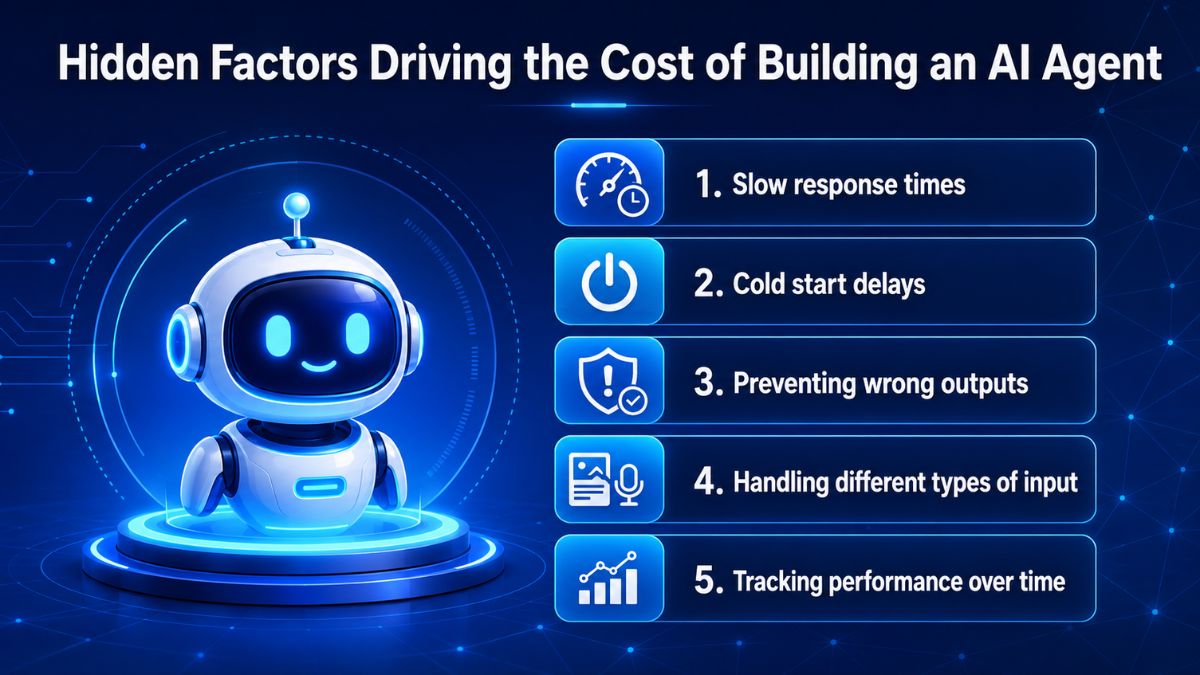
Slow response times
If an AI agent responds too slowly, developers may need to improve how it loads, processes requests, and generates answers. Techniques such as response caching or keeping parts of the model continuously active can reduce delays, but they may increase GPU usage and hosting costs.
Cold start delays
Some agents experience a delay when processing users’ first request. Reducing this delay may require warm-start infrastructure or low-latency containers that continue running in the background, adding to monthly cloud expenses.
Preventing wrong outputs
AI agents can produce answers that sound confident but are incorrect. Reducing this risk may require output validation rules, fallback systems, and model retraining. These controls add development, testing, and maintenance work after launch.
Handling different types of input
An agent that processes voice, images, or documents in addition to text requires extra models and processing workflows. Each new input format adds integration requirements and expands the scope of testing.
Tracking performance over time
Changes in business data may gradually reduce model accuracy. Maintaining performance requires continuous monitoring, custom tracking pipelines, and, in some cases, model retraining. These activities require ongoing tools and developer support.
Beyond these technical factors, several operating expenses may continue to accumulate each month:
|
Operational factor |
Typical monthly cost |
What it covers |
| LLM and API usage | $1,000 to $5,000+ | Per-token fees for prompts and responses processed through providers such as OpenAI, Cohere, or Anthropic |
| Cloud infrastructure | $500 to $3,000 | Hosting, autoscaling, GPUs, and persistent storage |
| Monitoring and observability | $200 to $1,000 | Uptime monitoring, performance tracking, and model drift detection |
| Security and access control | $300 to $2,000 | Role-based access, encryption, and audit logging |
| Data storage | $50 to $500 per TB | Storage for interactions, training logs, and generated outputs |
| Technical support | $200 to $2,000 | Ongoing engineering support from internal teams or external providers |
| Prompt tuning and model updates | $500 to $3,000 monthly or quarterly | Accuracy improvements, feature updates, and adaptation to changing data |
How to Cut Down AI Agent Development Costs Without Losing Quality
A cost-effective AI agent strategy is not about minimizing spending at every stage. It is about allocating the budget to the components that deliver the most value while avoiding unnecessary development, infrastructure, and maintenance work.
- Start with a lean MVP pilot: Build a focused agent with essential capabilities first, then add more features after the MVP proves its effectiveness.
- Choose pre-trained or open-source models: Adapting an existing model to business data can lower GPU costs, shorten setup time, and accelerate deployment compared with training from scratch.
- Automate testing and deployment: Automated workflows reduce the risk of manual errors, costly rollbacks, and emergency fixes while supporting more reliable scaling.
- Use Model Context Protocol for integration: MCP provides a standardized interface for connecting agents with data sources, reducing the need to build and maintain separate custom connectors.
- Use open-source frameworks and architecture: Open-source frameworks such as LangChain, AutoGen, and Haystack, together with shared components for memory, retrieval, scheduling, and execution, can reduce development and maintenance effort.
- Choose the right LLM for each task: A hybrid approach can reserve more powerful models for critical work while assigning simpler tasks to lower-cost models.
- Select the right cloud strategy: Autoscaling, caching, and hybrid deployment can help control cloud spending while maintaining the required level of performance.
- Optimize model size: Smaller models can reduce computing and memory requirements when the task does not require the highest level of accuracy.
- Manage token usage: Shorter prompts, limited context, and reduced input data can lower API costs by decreasing the number of tokens processed.
- Work with skilled AI partners: Experienced engineers can select suitable models, frameworks, and integration methods while reducing rework and avoidable implementation issues.
AI Agent Development Costs with Real-World Examples
The examples below show how different product capabilities can lead to very different development budgets.
ChatGPT by OpenAI
ChatGPT is a large language model assistant designed to answer open-ended questions, generate code, and support customer service use cases.
- Estimated cost: $500,000 to several million dollars
- Key cost drivers: Large-scale model training, high-performance computing, safety controls, and infrastructure for millions of users
GitHub Copilot
GitHub Copilot assists developers by completing code, suggesting functions, and explaining code within development environments such as Visual Studio Code.
- Estimated cost: $50,000 for an MVP to $500,000
- Key cost drivers: Training data volume, programming language coverage, and integration with coding tools
Google Assistant
Google Assistant is a voice-based agent that answers questions, controls devices, and performs tasks across phones, speakers, cars, and watches.
- Estimated cost: $100,000 to $500,000+
- Key cost drivers: Voice recognition, natural language processing, and integration across multiple device types
Claude by Anthropic
Claude is a conversational AI used for writing, coding, research, and general-purpose assistance, with an emphasis on safe and reliable responses.
- Estimated cost: $100,000 to $400,000+
- Key cost drivers: Large-model training, safety alignment, and cloud infrastructure for broad usage
Build vs Buy an AI Agent Model: Which Option Fits You Better?
Choosing between a custom AI agent and a pre-built platform depends on the complexity of the use case, required level of control, implementation speed, and long-term business priorities. Follow the key factors below to decide which is the best fit for you:
|
Criteria |
Custom AI Agent |
Pre-built tool or platform |
| Use case fit | Better suited to complex or evolving workflows that require flexibility | Suitable for basic to mid-level tasks with predefined processes |
| Time to market | Usually takes 3 to 6 months or longer, depending on requirements | Typically takes 2 to 6 weeks, depending on setup |
| Initial investment | $40,000 to $400,000 based on features, integrations, and complexity | $10,000 to $100,000 per year through licensing or subscriptions |
| Ongoing costs | Maintenance, infrastructure, model updates, and token usage may cost $10,000 to $50,000 annually | Subscription renewals and optional premium support |
| Customization | Can be tailored to specific logic, workflows, and data sources | Limited to the features and configurations provided by the vendor |
| Integration capability | Can connect deeply with CRM, ERP, HRMS, and proprietary systems | Usually relies on standard APIs and pre-built connectors |
| Data privacy | Provides control over where and how data is processed | Data handling is often managed by the platform provider |
| Scalability | Can evolve with new workflows and business requirements | Depends on the vendor’s infrastructure and product roadmap |
| Support and maintenance | Managed internally or through an AI development partner | Managed by the vendor under the license or subscription |
| IP ownership | The business owns the source code, workflows, and system logic | The vendor retains ownership of the platform and core functions |
What to Ask an AI Agent Development Vendor
Choosing an AI agent development vendor requires looking beyond a polished demo to understand how the solution will perform in your actual environment. Before committing, evaluate the vendor across five areas: integration, control and safety, data and compliance, total cost, and the vendor’s production experience.
1. Fit and integration
First, determine whether the AI agent can work with your existing systems and workflows without creating unexpected implementation complexity.
- Does the solution integrate with the specific systems we already use, and what work will that require?
- Can we test the agent using our actual workflows before signing a contract?
- What does implementation involve in practice, and which responsibilities belong to the vendor versus our team?
2. Control and safety
Understand how much control your organization retains once the agent starts taking actions, particularly when intervention becomes necessary.
- Can our team configure permissions, spending limits, and approval checkpoints?
- Does the system maintain a complete audit trail of the agent’s actions?
- How quickly can we stop or disable the agent if something goes wrong?
3. Data and compliance
Clarify how business data is handled throughout the relationship and whether the solution can meet your industry-specific compliance obligations.
- Where will our data be processed and stored?
- Will our data be used to train the vendor’s models?
- What happens to our data if we terminate the service?
- Can the vendor support the regulatory and compliance requirements relevant to our sector?
4. Cost and contract commitment
Look beyond the headline price to understand the complete financial commitment and the resources required after implementation.
- What is the total cost when licensing, setup, integration, and support are included?
- What ongoing maintenance will our internal team need to handle?
- How long does the contract run, and what is the process for exiting it?
5. Vendor experience and support
Finally, assess whether the provider has real production experience and can respond effectively when the AI agent encounters problems after deployment.
- How long has the vendor been developing or operating AI agents?
- Which other organizations currently run its agents in production?
- What level of support and response can we expect when an agent behaves unexpectedly?
Why Partner with Newwave Solutions for AI Agent Development?
Newwave Solutions provides custom AI agent development services for businesses seeking to automate workflows, improve decision-making, and build more intelligent customer and internal operations.
From virtual assistants and task automation agents to advanced systems connected with enterprise platforms, each solution is designed around specific business requirements, industry-specific challenges, and long-term operational goals.
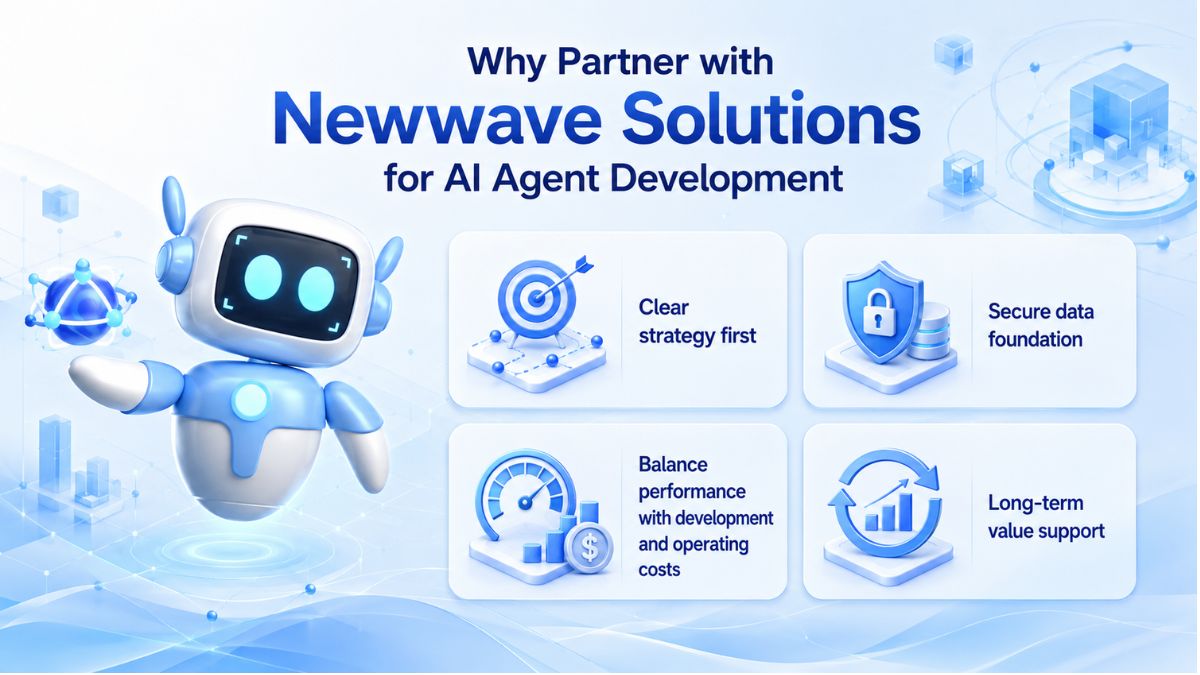
How we support your AI agent success
- Clear strategy first: Our strategic consulting approach helps clarify business requirements, technical needs, user flows, system logic, and the most suitable architecture before development begins.
- Secure data foundation: Our team supports data collection, preparation, system integration, access control, and compliance planning. We also adhere to ISO 9001 standards to maintain quality and reliability throughout development.
- Balance performance with development and operating costs: We use appropriate pre-trained models, cloud strategies, reusable components, and efficient integration approaches to control costs without weakening system performance.
- Long-term value support: Our support can extend beyond launch through monitoring, model updates, performance optimization, maintenance, and further system scaling.
Turn your AI agent idea into a secure, scalable, and business-ready solution. Book a consultation with us to discuss your requirements, technical approach, and estimated development cost.
Turning AI Agent Costs into Business Value
AI agent development cost is only one part of the investment decision. A well-designed agent can support faster operations, reduce manual effort, improve service availability, and help teams manage greater demand without proportional increases in resources.
To achieve meaningful value, the solution must align with the right workflow, data environment, integration needs, and long-term growth plan. Newwave Solutions combines strategic consulting, AI engineering, and ongoing optimization to help businesses build AI agents that balance cost, performance, security, and scalability.
If you are ready to explore how AI agents can support your business, contact us today to get expert guidance and a tailored solution.
FAQs
1. How much does it cost to build an AI agent?
The cost to build an AI agent can range from $15,000 for a basic rule-based system to more than $800,000 for an enterprise agentic platform. The final budget depends on the agent type, data readiness, integrations, security requirements, testing scope, deployment model, and ongoing operating needs.
2. How long does it take to build an AI agent?
A basic AI agent may take several weeks to develop, while a complex enterprise system can require several months. The timeline depends on project scope, data readiness, integrations, testing requirements, and the level of autonomy involved.
3. Is creating a custom AI agent more expensive than using pre-build one?
Yes, custom development usually requires a higher upfront investment than a pre-built platform. However, it provides greater flexibility, deeper integrations, stronger data control, and full ownership of the system logic and workflows.
4. What are the benefits of developing AI agents for business?
AI agents can automate repetitive tasks, improve response times, support more consistent decisions, and operate continuously. They can also help businesses handle higher workloads without increasing resources at the same rate.
5. What are the fundamental components of an AI agent?
An AI agent typically includes an underlying model, data or knowledge sources, memory, reasoning logic, and tools for interacting with external systems. Production systems may also require orchestration, security controls, monitoring, and human approval checkpoints.
To Quang Duy is the CEO of Newwave Solutions, a leading Vietnamese software company. He is recognized as a standout technology consultant. Connect with him on LinkedIn and Twitter.



Read More Guides
Get stories in your inbox twice a month.
Let’s Build Something Extraordinary
Sign up for a 30 min no-obligation strategic session with us. Transform your Ideas into scalable reality.
Leave a Reply