


AI in Fintech: A Business Guide to Use Cases and Risks
AI in fintech is moving beyond prediction. Systems that once focused on scoring transactions or flagging anomalies are now being used for customer service, compliance workflows, financial analysis, and increasingly, multi-step actions. That wider role creates more opportunity, but it also raises questions around data quality, security, governance, and return on investment.
Understanding where AI creates practical value, and what it takes to use it responsibly, is becoming increasingly important for fintech businesses. In this article, we’ll discuss how AI works in fintech, its major use cases and business benefits, common implementation challenges, and the steps companies can take to adopt it effectively.
Key Takeaways
|
What is AI in Fintech?
AI in fintech describes the use of AI systems to interpret financial data and support tasks that would otherwise depend on fixed rules or manual review. These systems can be applied to activities such as evaluating transaction behavior, assessing credit risk, processing financial documents, responding to customer requests, and forecasting future outcomes.
The underlying technologies vary by use case. Machine learning can be used to classify or score financial events, natural language processing can work with text and conversations, while predictive models estimate likely outcomes from historical data. Unlike conventional automation, which executes predefined logic, AI can adjust its outputs as it is exposed to new data and changing patterns.

How Does AI Work in Fintech?
AI in fintech typically works by turning financial data into an output that can support a decision or trigger the next step in a workflow. The exact process depends on the application, but it can be understood through three stages: collecting relevant signals, processing them with an AI model, and using the result to determine what happens next.
Data and financial signals
The process starts with the information available for a specific task. Depending on the use case, this might include transaction activity, account history, borrower information, user behavior, or financial documents.
The useful signals are not the same for every application. A fraud system may examine how a transaction compares with previous account behavior, while a lending model may use credit and banking information to assess repayment risk. Text-based applications can instead work with documents, customer messages, claims, or regulatory filings.
Model prediction or generation
Once the relevant data is available, the AI model processes it according to the task it was built for.
Machine learning models often produce a score or prediction. Machine learning models often produce a score or prediction. In investment analysis, for example, a model might estimate the probability of a price movement based on historical and current market data. In customer operations, it could predict which service requests are more likely to require escalation so teams can prioritize them earlier.
Generative AI works differently. Large language models can read, summarize, classify, or generate text, making them suitable for workflows involving documents, customer conversations, and internal research. Their outputs are probabilistic, however, which can make them harder to verify than deterministic rule-based results.
Decision, action or human review
The model output only becomes useful when it is connected to a business process. A fintech system can use a risk score or prediction to determine the next action, such as approving a request, declining it, adjusting pricing, or sending the case for additional review.
Not every AI output should lead directly to an automated decision. Where errors carry greater financial, compliance, or customer consequences, the system can route uncertain cases to a human reviewer. This creates a workflow in which AI handles analysis or initial processing while people retain control over decisions that require additional judgment or accountability.

Top Use Cases of AI Across the Fintech Industry
AI in fintech is used across both customer-facing services and internal financial operations. The strongest use cases tend to appear where teams need to review large volumes of data, detect patterns quickly, or make repeated decisions under defined rules and risk controls.
Risk, fraud and financial decisioning
Fraud detection is a common use of AI in fintech. Machine learning models compare current transactions with historical activity and customer behavior to spot unusual patterns and flag suspicious cases for review. This can also reduce unnecessary alerts: banks using AI for fraud detection have reported 40% to 60% fewer false positives, according to Gitnux.
The same approach is useful in credit assessment. AI-based scoring models can combine credit history, income, transaction behavior, and other available signals to build a broader view of an applicant’s risk profile. The resulting score can inform lending decisions and interest-rate calculations.
AI can also support regulatory risk management. Machine learning can monitor transactions for unusual behavior, assist with KYC and AML checks, and organize records used for compliance reporting. For a deeper look at how these systems evaluate and respond to financial risk, see our guide to AI in risk management.

Customer service and digital financial advisory
AI chatbots and virtual assistants can handle routine customer requests, explain financial products, and guide users through common service processes. This reduces pressure on support teams, especially when demand spikes. According to Zipdo, AI virtual assistants have reduced customer wait times by around 60% to 70% during peak hours.
AI can also support more personalized financial guidance. For example, a digital banking platform can analyze a customer’s income, spending patterns, and recurring expenses to suggest budgeting actions or relevant savings options. As the customer’s financial activity changes, the recommendations can be updated to reflect their current situation.
These two applications serve different purposes. Chatbots mainly improve how customers access information and support, while robo-advisors focus on investment planning and portfolio management. Our article on AI chatbots in banking looks more closely at how conversational AI works across banking service workflows.
Trading, investment and financial forecasting
In trading environments, AI can process historical and real-time market data to identify patterns that may influence a trading strategy. For example, a model may estimate expected volatility and adjust the size of a position when market conditions become less stable. AI can also incorporate signals from news, earnings commentary, or other text sources to assess market sentiment and support short-term forecasting. These outputs can then inform trading decisions while risk limits and execution rules remain separately controlled.
Financial forecasting uses a similar predictive principle but addresses a different question. Instead of deciding when to trade, models examine historical financial results, cash-flow patterns, and market trends to estimate possible future conditions. These forecasts can support revenue planning, liquidity management, risk assessment, or investment recommendations
AI can therefore contribute at several stages of the investment process: interpreting market data, producing forecasts, supporting portfolio decisions, and, where appropriate, triggering predefined trading actions.

Accounting and financial operations
AI also has a practical role in back-office finance, where large volumes of documents and repetitive transactions create significant manual work.
Combined with robotic process automation, AI can support workflows such as bank reconciliation, expense categorization, cash application, and transaction matching. RPA handles predefined steps, while AI can interpret less structured inputs or assess cases that do not fit standard rules.
A reconciliation system, for instance, can flag unusual transaction patterns or unmatched entries and send those cases to finance staff for review before the records are finalized.
Business Benefits of AI in Fintech
The value of AI in fintech comes from what it changes in day-to-day financial operations. When connected to the right use case, AI can improve how firms make decisions, control risk, serve customers, and handle repetitive work at scale.
Faster and better-supported decisions
Financial decisions often depend on more data than teams can review manually within practical timeframes. AI models can process large datasets, identify relationships across multiple variables, and turn those findings into forecasts, scores, or recommendations.
This is useful in areas such as lending, trading, investment planning, and budgeting, where decisions depend on changing financial signals. The main benefit is not simply faster analysis, but giving decision-makers a broader evidence base before they act.

Lower manual work and operating costs
Traditional automation works well when a process follows predictable rules. AI extends automation into workflows that require interpretation, prioritization, or handling of less structured inputs.
In practice, this can reduce manual effort across customer support, document processing, reporting, and other recurring financial operations. Staff can spend less time on routine processing and focus more attention on cases that require review or judgment, which can improve operating efficiency and reduce the cost of repetitive work.
Stronger risk detection and response
AI can continuously evaluate transactions, customer behavior, credit signals, and market data to identify activity that falls outside expected patterns. The same analytical approach can support fraud monitoring, credit assessment, and investment risk analysis.
Earlier detection gives financial teams more time to respond. Suspicious transactions can be investigated, higher-risk credit applications can receive additional review, and changes in market or customer behavior can be factored into risk decisions before they become larger problems.
More personalized customer experiences
AI can make financial services more relevant to each customer by using their current financial context and behavior. For example, if a customer frequently makes international transfers, a financial platform could surface products or service options that better match that usage pattern.
This reduces the need for customers to search through generic offers and makes digital interactions more closely aligned with their actual needs.

Real-World Examples of AI in Fintech
AI is already being used across fintech for investment analysis, customer service, fraud and AML monitoring, and financial product development. The following examples of AI in finance show how different companies apply AI to specific operational and customer-facing problems.
TradeSmith: Investment and portfolio analytics
TradeSmith applies predictive analytics to investment monitoring and portfolio risk management. Its platform analyzes stock behavior and market trends to generate signals that investors can use when reviewing positions. It can also alert users when price movements reach certain conditions, giving them another data point for deciding whether to hold or exit a position.

Bank of America Erica: conversational financial assistance
Bank of America uses inside its mobile banking app to make common banking tasks easier to access through conversation. Erica uses natural language processing grounded in machine learning, rather than generative AI, to interpret user intent and select appropriate responses.
Customers can search transactions, monitor recurring charges, manage cards, track spending, receive bill reminders, and access Merrill investment information. When Erica cannot resolve a request, it can connect the customer with a specialist.
ComplyAdvantage: Fraud and AML detection
Financial crime teams often face large volumes of alerts, many of which do not carry the same level of risk. ComplyAdvantage uses AI and machine learning to assess monetary and non-monetary activity, while identity clustering can reveal connections between accounts that may belong to the same operator.
Digital bank Holvi applies ComplyAdvantage’s Smart Alerts to rank transaction-monitoring alerts by risk, allowing investigators to focus first on cases that warrant closer review.
Temenos Product Manager Copilot: AI-Assisted financial product work
Designing a new banking product can require teams to work across customer data, regulatory requirements, product rules, and testing scenarios. Temenos introduced Product Manager Copilot in 2025 to bring more of this work into a natural-language interface within Temenos Retail core banking.
Built with Microsoft Azure OpenAI Service, the assistant can retrieve relevant information, explore product scenarios, and generate test cases before configuration and launch.

Risks and Challenges of AI in Fintech
AI in fintech can produce useful results only when the data, controls, infrastructure, and people around the model are strong enough to support it. The following issues can limit performance or make an AI project difficult to scale.
Data quality and availability
Financial data may sit across core systems, payment platforms, CRM tools, and other repositories with different formats or definitions. Missing, outdated, or inconsistent records can weaken model training and make outputs less reliable. Deloitte found that only about one-quarter of surveyed banking respondents considered their data management platforms highly prepared for generative AI.
How to address it: Begin by mapping which data sources are actually required for the selected AI use case and checking them for gaps, duplication, and inconsistent formats. Teams can then standardize key fields, introduce validation rules at the point of data entry, and create a reliable dataset for training and evaluation.
Data security and privacy risks
AI for fintech may require access to transaction histories, identity information, account data, and other sensitive records. Connecting these datasets to models, cloud environments, or third-party services can introduce additional access points that need protection. NIST also identifies privacy, security, and resilience as core characteristics to manage throughout the AI lifecycle.
How to address it: Separate sensitive data from information the model does not need, apply masking or tokenization where appropriate, and restrict access according to the sensitivity of each dataset. Organizations should also review how data moves between internal systems, external APIs, and AI providers.

Cost and ROI uncertainty
The cost of AI does not stop at model development. Data preparation, integration, infrastructure, specialist talent, evaluation, monitoring, and model maintenance all contribute to the investment. At the same time, benefits such as faster decisions or reduced manual work can be difficult to translate into financial returns without a clear baseline.
How to address it: Start with a narrow workflow and define measurable outcomes before development. Deloitte recommends linking AI value to operational and financial KPIs; teams can compare results against historical baselines and expand only when the pilot demonstrates both business value and acceptable risk.
Skills and resource gaps
Financial institutions need more than data scientists to run AI effectively. Projects may require engineering, financial-domain knowledge, security, compliance, model evaluation, and ongoing operations. In a Deloitte survey of financial institutions, 39% of respondents identified internal skills and capabilities as a barrier to AI implementation.
How to address it: Identify which capabilities need to remain internal and which can be supplemented through external expertise. A fintech team might retain ownership of product rules, compliance requirements, and model acceptance criteria while working with external engineers on model development or integration.
Ethical, legal and model governance risks
Models can produce biased, inaccurate, or difficult-to-explain outputs, especially when the underlying data changes or does not represent the population being evaluated. These issues matter more when AI influences lending, fraud investigation, compliance, or other decisions with financial consequences.
How to address it:
Apply stronger controls as the consequence of an AI decision increases. High-risk uses such as lending, fraud investigation, or fund transfers may require human approval, clear escalation rules, and regular model review. Model changes and evaluation results should also be documented for later review.
How to Implement AI in Fintech Effectively
Successful AI in fintech implementation starts with a business problem, not the technology itself. The objective is to connect AI to a process where better decisions, faster execution, or stronger controls can create measurable value.
Step 1: Start with a narrow business problem
Begin with a focused use case that can be evaluated across three dimensions: business value, implementation difficulty, and risk. The best starting point is usually a process with clear operational impact, usable historical data, measurable outcomes, and limited consequences if the model makes an error.
For example, document classification or support-ticket routing may offer moderate value with relatively low complexity and risk, while credit approval or fraud blocking can deliver higher value but require stronger data quality, governance, and human oversight. This makes it easier to prioritize use cases that are realistic for an initial deployment.
The model can first run alongside the existing workflow to compare results, identify where human review is still needed, and validate performance before production changes are made.

Step 2: Assess data and integration readiness
Data quality should be assessed before model development begins. Incomplete repayment histories, outdated account information, or inconsistent risk classifications can make model outputs less reliable. The organization therefore needs to understand whether the required data is available and whether it can be connected to the systems involved in the target process.
Integration readiness matters because AI needs reliable access to the systems and information involved in the target process. For example, a digital lending platform could connect an AI model with its application system, customer records, and credit assessment workflow so that relevant information is available when an application is reviewed.
Step 3: Establish governance, security and human oversight
Governance should be designed alongside the AI system rather than added after implementation. Clear ownership is needed for monitoring model performance, evaluating unexpected behavior, and deciding what happens when the system does not perform as expected. This becomes particularly important when AI influences financial processes or customer decisions.
Human oversight provides an additional control when automated outputs require review. Teams should define where human intervention is necessary and how exceptions are handled. The goal is not simply to automate a process, but to establish a workflow in which AI operates within clearly defined boundaries.
Step 4: Decide whether to build or buy
The build vs. buy AI decision should reflect the uniqueness of the business problem. A business with distinctive data or specialized requirements may need a tailored system, while a proven solution can be more practical when the underlying problem is already well established.
This choice also shapes the level of customization and control available later. For example, a fintech company developing an AI system for a highly specialized risk assessment process may need greater control over how the model works with its proprietary data. For a standard customer service function, an existing AI solution may reduce development effort and allow the team to move toward deployment sooner.

Step 5: Pilot, measure and scale
A pilot provides a controlled way to test whether AI performs as expected before expanding its role. The initial implementation should use clearly defined success measures and be evaluated against the existing workflow.
Scaling should follow demonstrated performance rather than assumptions about what the technology can achieve. As the system is used, teams can identify weaknesses, refine the implementation, and determine whether additional use cases justify further investment. This creates a more measured path from experimentation to broader adoption of artificial intelligence in fintech.
For teams that want to validate an AI use case before committing to full-scale development, our guide to AI MVP development explains how to test core functionality, data assumptions, and business value with a smaller initial scope.
Future of AI in Fintech: From Prediction to Agentic Workflows
The next stage of AI in fintech is moving from prediction and recommendation toward systems that can coordinate actions. Agentic AI can connect reasoning with execution, allowing a financial workflow to continue across different systems instead of stopping after an AI-generated insight. This creates opportunities to automate more complex processes while improving responsiveness to changing customer needs and business conditions.
The shift also changes what financial institutions need to prepare. AI must be connected to the right processes, data, automation tools, and human decision-makers so that actions remain controlled and traceable. Governance becomes especially important as AI takes on more responsibility, with clear boundaries needed for when an agent can act and when human review is required.
For businesses, this means the value of AI for fintech will increasingly depend on orchestration rather than the intelligence of a model alone. An agent may analyze information, determine the next step, trigger an automated action, and involve a human when an exception occurs.
Preparing systems around these workflows can help organizations move from isolated AI capabilities toward more connected and scalable financial operations.
How Newwave Solutions Can Help Build AI for Fintech
At Newwave Solutions, we help fintech companies turn AI opportunities into production-ready solutions that fit their existing technology environment. Our experience across AI development and software engineering allows us to address the technical requirements behind real financial applications, including system integration, data connectivity, scalability, security, and long-term reliability.
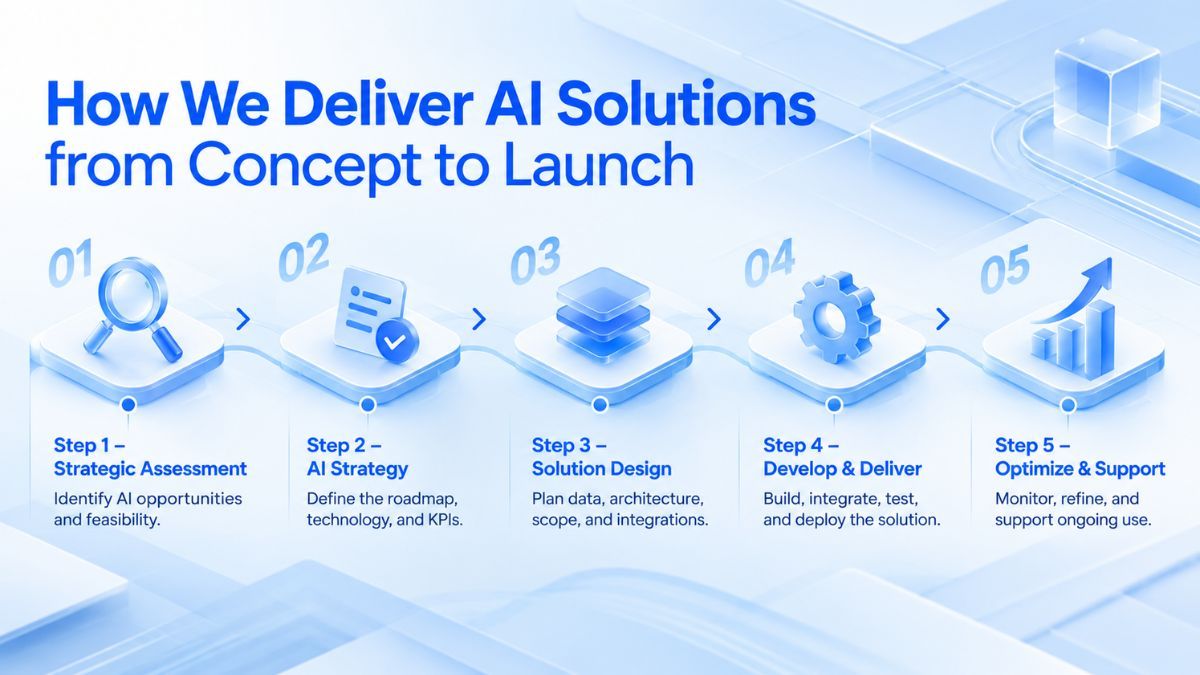
AI use cases in fintech we can support with our AI development service include:
- Fraud detection: AI solutions that identify suspicious transaction patterns and support faster fraud-related decisions.
- Risk assessment: Apply AI to financial data to support risk evaluation across financial workflows.
- Document processing: AI-powered solutions that automate the analysis and handling of financial documents.
- Financial analysis: AI applications that turn financial and business data into useful insights for decision-making.
- AI agents and workflow automation: AI agents that can coordinate tasks across systems and support more complex financial workflows.
- RAG-powered applications: Connect generative AI with enterprise knowledge and data to provide responses grounded in relevant business information.
We also focus on how AI fits into the way a business actually operates. This allows us to develop solutions that support practical financial workflows and create measurable value beyond the initial AI implementation.
If you have a fintech use case in mind, share your current workflow, data environment, and target outcome with our team to discuss the right AI development approach.
Final Thoughts
AI is reshaping fintech by changing how financial businesses make decisions, manage operations, interact with customers, and respond to risk. The value of AI in fintech depends not only on the technology itself, but also on having the right data, governance, security measures, and implementation strategy to turn AI capabilities into reliable business outcomes.
Newwave Solutions can help translate these opportunities into practical AI solutions aligned with specific business requirements. Let’s discuss your AI strategy and explore the right approach with our experts.
FAQs
1. What is the role of AI in fintech?
AI is used across fintech to analyze financial data, detect fraud and risk, automate repetitive operations, support forecasting, and improve customer services. Its role is expanding from generating predictions or recommendations to coordinating actions across financial workflows, with human review remaining important for higher-risk decisions.
2. Which fintech companies are using AI?
Examples include TradeSmith for investment and portfolio analytics, ComplyAdvantage for fraud and AML monitoring, and Temenos for AI-assisted financial product development. Bank of America also uses Erica for conversational banking services, while Mastercard and Santander have tested AI agents that can execute payments within predefined limits and permissions.
3. Is AI taking over fintech?
AI is becoming deeply integrated into fintech, but it is not simply replacing human teams across the industry. Its current role is more often to augment analysis, automate defined activities, and support decisions, while people remain responsible for exceptions and higher-risk judgments.
4. What does it cost to implement AI in fintech?
There is no single implementation price because the investment depends on the use case, data requirements, integration complexity, infrastructure, specialist skills, testing, monitoring, and ongoing model maintenance. A practical approach is to start with a focused workflow, define measurable business outcomes, and expand only when the pilot shows sufficient value and acceptable risk.
5. Are AI-driven fintech automation solutions regulated by financial authorities?
Yes, AI used in financial services can fall under financial-sector rules and AI-specific regulation, but the requirements depend on the jurisdiction and use case. For example, the EU AI Act treats certain creditworthiness and insurance risk-assessment applications as high-risk, while the Financial Stability Board has proposed 12 practices covering AI governance and the AI development and deployment lifecycle for financial institutions.
To Quang Duy is the CEO of Newwave Solutions, a leading Vietnamese software company. He is recognized as a standout technology consultant. Connect with him on LinkedIn and Twitter.



Read More Guides

Get stories in your inbox twice a month.
Let’s Build Something Extraordinary
Sign up for a 30 min no-obligation strategic session with us. Transform your Ideas into scalable reality.
Leave a Reply