


Top 10 AI Chatbots for Ecommerce to Boost Sales and Conversion
AI chatbots for ecommerce can answer questions, recommend products, and support checkout, but choosing the wrong tool can add cost without improving sales or customer experience. The real challenge is finding a solution that matches your store platform, customer journey, support volume, budget, and growth goals.
This guide compares the top ecommerce AI chatbots, outlines the key selection criteria, and shares practical implementation practices to help you choose the right solution for sustainable growth.
Why AI Chatbots Matter for eCommerce
AI e-commerce chatbots help businesses respond faster, personalize shopping journeys, and support more customers without adding the same level of operational cost. Key benefits include:
- 24/7 customer support: AI chatbots can manage many conversations at the same time. For example, a shopper asking about availability at 3 AM can receive an immediate response based on inventory data. Plus, they can resolve shipping questions, order tracking, and return processing autonomously; thereby eliminating wait times and reducing support costs.
- Personalized product discovery: AI chatbots can use purchase history, browsing behavior, and current context to surface products that better match individual preferences and buying patterns. This makes recommendations more relevant to category interests and price sensitivity.
- Faster cart recovery: Chatbots can detect signs of hesitation or exit intent and intervene within 60 to 90 seconds. They can address specific concerns such as shipping costs, sizing uncertainty, or payment questions before the shopper leaves checkout.
- Higher average order value: AI chatbots can support contextual upselling and cross-selling by suggesting complementary products based on cart contents and purchase patterns. For example, a customer buying a smartphone may be shown related items such as a protective case or wireless earbud.
- Scalability during traffic peaks: During Black Friday, flash sales, or product launches, AI chatbots can manage thousands of concurrent conversations while maintaining response times below five seconds. This helps reduce the bottlenecks that can occur when human support queues stretch to 30 to 45 minutes during high-demand periods.
- Stronger market insight from customer conversations: Each interaction generates zero-party data on preferences, intent, and unmet needs. If 800+ customers request an out-of-stock item (e.g., eco-friendly stainless steel water bottles), it signals demand for future inventory decisions.
- More timely retention engagement: AI chatbots use purchase timing and behavior to trigger reorder reminders or win-back offers. For example, chatbots can remind a coffee buyer on day 28 of a 30-day cycle, or re-engaging users whose activity has dropped.
How We Evaluate Top AI Chatbots for E-commerce
We evaluate AI chatbots for e-commerce based on how well it performs in real buying and support scenarios, not only on the features listed by the vendor. The review focuses on long-term user experience, practical deployment, integration reliability, and overall value.
- User reviews and ratings: We assess recent feedback from G2, Capterra, and Gartner, with particular attention to recurring strengths and complaints from users with at least six months of experience.
- Core ecommerce features: Whether the ai e-commerce chatbot product FAQ handling, order-related responses, cart recovery, human handoff, and CRM integration.
- Ease of deployment: Whether a non-technical team can launch and train the chatbot without developer support or a sales-assisted setup.
- Integration quality: How reliably native connections with Shopify, WooCommerce, Salesforce, HubSpot, and help desk tools work in practice.
- Customer support quality: How vendors handle setup issues and whether ongoing support feels collaborative or limited to ticket-based assistance.
- Value for money: We compare pricing with actual feature depth to determine whether the platform delivers enough practical capability for its cost.
AI Chatbots for Ecommerce: Quick Comparison
To help you get an overview, we provide a comparison highlighting the primary focus, ideal use case, starting price, and published rating for each AI e-commerce chatbot.
|
E-commerce AI chatbot |
Main channels | Core strengths | Pricing |
Best for |
|
ShopMate AI |
E-commerce websites | Product recommendations, product comparison, checkout guidance, contextual shopping assistance | Contact us | Guided ecommerce sales and checkout support |
|
Intercom |
Website, social channels | AI agent, ticketing, workflow automation, knowledge base integration | From $74/month | Complex customer support automation |
|
Chatfuel |
Website, social channels | No-code chatbot builder, comment automation, social engagement | From $29/month | Social commerce on Facebook and Instagram |
|
Engati |
Website live chat, social channels | Unified inbox, AI intent recognition, live agent handoff | From $5/day | Omnichannel customer conversations |
|
Pandorabots |
Website, mobile apps, messaging platforms | AIML scripting, custom NLP, API integrations, detailed analytics | Free plan; paid from $19/month | Highly customized conversational workflows |
|
ManyChat |
Messaging and communication channels | Social selling, lead capture, promotional automation | Free plan; paid from $15/month | Social selling and lead capture |
|
GetMyAI |
Websites, apps, and platforms | Website content training, fast deployment, automated product Q&A | Free plan; paid from $29/month | Fast FAQ automation from website content |
|
Tidio |
Website live chat widgets, social messaging apps | Live chat, cart recovery, product recommendations, AI support | Free plan; paid from $29/month | Ecommerce support and cart recovery |
|
Drift |
Website chat | Lead qualification, account-based engagement, meeting booking | Custom pricing (typically from $2,500/month) | B2B lead qualification and sales conversations |
|
Botsify |
Website chat, social messaging apps | Conditional lead qualification, multilingual support, live agent handoff | From $49/month | Conversational lead generation and qualification |
Top 10 AI Chatbots for E-commerce Growth in 2026
The best AI ecommerce chatbot depends on your channels, customer journey needs, and system integrations. To support your decision, we outline 10 best tools covering key use cases like sales assistance, support, social commerce, lead capture, and automation.
ShopMate AI
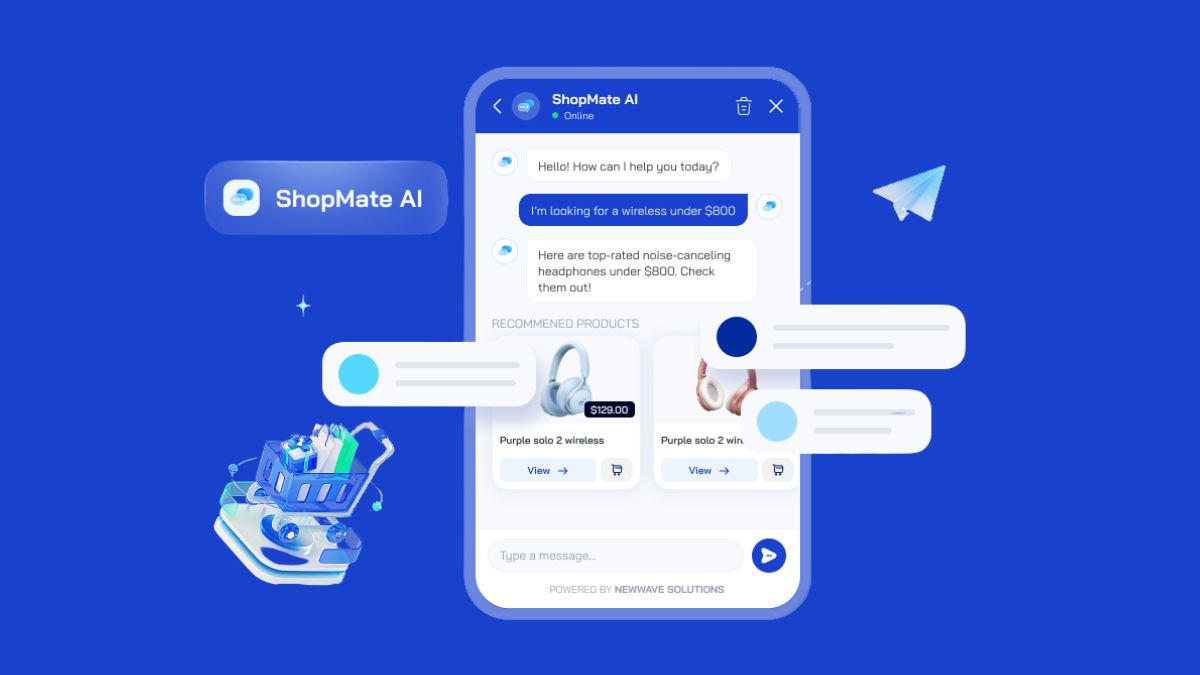
ShopMate AI is an AI-powered sales assistant integrated inside an existing online store to answer product questions, compare options, recommend relevant items, and guide customers from product discovery to checkout.
Unlike rule-based chatbots that depend on fixed menus, predefined scripts, or exact keywords, ShopMate AI interprets natural questions and customer intent. It analyzes product data and maintains conversational context to provide guidance based on what the shopper is trying to find.
With the capability of understanding up to 90% customer intent, 24/7 availability, and an average response time of 6 seconds, it helps shoppers receive relevant support throughout the buying journey while reducing support workload by up to 60%.
Why choose ShopeMate AI for e-commerce online stores:
- Designed for real shopping journeys: ShopMate AI supports product questions, comparisons, recommendations, and purchase guidance across common ecommerce scenarios.
- Connected to your commerce ecosystem: It works with existing product catalogs and store systems to provide accurate, relevant information during customer conversations.
- Integrated without major system changes: ShopMate AI can be added to existing ecommerce platforms without requiring a complex rebuild or major disruption to current operations.
- Built to strengthen customer-facing teams: It handles repetitive inquiries so human teams can focus on complex requests and higher-value customer conversations.
Intercom
Intercom combines its customer service platform with Fin, an AI agent that generates answers from existing help content. It is positioned for mid-market ecommerce businesses with substantial knowledge bases and customer journeys that involve multi-step support requests.
Fin can manage contextual conversations involving return eligibility, warranties, and account-specific questions. Intercom also connects AI support with ticketing, customer data, proactive messaging, workflow automation, and reporting in a unified environment.
Pros:
- Handles multi-turn support conversations using existing help center content.
- Integrates with Intercom’s inbox, ticketing, CRM, and messaging capabilities.
- Uses proactive messages and behavioral triggers to engage high-intent visitors.
- Includes templates for common ecommerce support workflows.
- Tracks resolution performance across support channels.
Cons:
- Pricing can rise quickly as usage and team size increase.
- Advanced automation and workflow configuration involve a steeper learning curve.
Pricing: From $74/month
Rating: 4.5/5 on G2
Best for: Mid-market ecommerce businesses with complex customer support journeys and established knowledge bases.
Chatfuel
Chatfuel is built for ecommerce conversations on Facebook, Instagram, and Telegram. It allows teams to create chatbot flows without coding, automate direct-message responses, respond to common questions, and engage users who comment on social posts.
The platform is particularly relevant to stores that rely on social channels for product discovery, promotions, and customer communication. Keyword rules trigger predefined responses, while built-in analytics show how individual chatbot flows perform.
Its narrower channel coverage makes it less suitable as a complete website and omnichannel support platform.
Pros:
- Offers native support for Facebook, Instagram, and Telegram.
- Provides no-code chatbot deployment.
- Uses keyword triggers to automate responses to recurring questions.
- Includes comment autoreplies for social engagement.
- Provides flow-level performance analytics.
Cons:
- Advanced analytics and capabilities require higher-tier plans.
- Multilingual support is limited for stores serving multiple markets.
- Businesses requiring wider channel coverage may need additional tools.
Pricing: From $29/month
Rating: 4.5/5 on G2
Best for: Stores selling through Facebook, Instagram, and Telegram that rely on social commerce.
Engati
Engati is a conversational AI chatbot platform for ecommerce teams managing conversations across several channels. Its OneView Inbox consolidates website chat, WhatsApp, Facebook, Instagram, and other interactions into one dashboard.
The platform includes a drag-and-drop builder, pre-built templates, intent recognition, AI-led customer interactions, and live agent handoff. This can simplify operations for stores that support customers through both their website and social channels. However, context retention and nuanced intent recognition can become less reliable during longer or more complicated conversations.
Pros:
- Consolidates several communication channels into one inbox.
- Provides AI-based intent recognition.
- Includes templates and a no-code bot builder.
- Preserves conversation context during live agent transfers.
- Supports automated lead generation and personalized interactions.
Cons:
- May lose context during extended, multi-step conversations.
- Can misinterpret nuanced or ambiguous customer requests.
Pricing: From $5/day
Rating: 4.4/5 on G2
Best for: Ecommerce teams managing website and social media conversations from a unified inbox.
Pandorabots
Pandorabots is a chatbot development platform for teams that need detailed control over conversational logic. It combines AIML scripting with machine learning, enabling developers to create customized responses and interaction patterns beyond the options available in standard visual chatbot builders.
For ecommerce businesses with technical resources, Pandorabots can connect to custom back-end systems and product catalogs through external APIs. It also supports rich media and cross-platform deployment. This flexibility comes with longer implementation time and fewer ready-made ecommerce templates.
Pros:
- Combines AIML scripting and machine learning for customized conversations.
- Supports rich media and product cards within chat.
- Can deploy across websites, mobile applications, and messaging platforms.
- Provides detailed analytics for identifying failed conversation paths.
- Supports external API connections to custom systems and catalogs.
Cons:
- Complex conversational flows require more development time.
- Offers fewer pre-built ecommerce templates than faster-deployment platforms.
Pricing: Free plan available; paid plans from $19/month
Rating: 4.2/5 on G2
Best for: Development teams requiring advanced NLP customization, analytics, and backend integrations.
ManyChat
ManyChat focuses on automating ecommerce interactions through Instagram DMs, Facebook Messenger, and SMS. It is designed for stores running social-selling campaigns, influencer promotions, product launches, and comment-to-message flows.
A conversation can be triggered when someone comments with a keyword, sends a direct message, or clicks on a Story link. The chatbot can then provide product links, answer FAQs, collect contact information, and send lead data to platforms such as Mailchimp, ActiveCampaign, Shopify, and Zapier. It is less suitable for businesses seeking a native AI chatbot for e-commerce website or unified omnichannel support.
Pros:
- Converts social comments into automated direct-message conversations.
- Supports Instagram, Facebook, and SMS from one dashboard.
- Integrates with Shopify, Mailchimp, ActiveCampaign, and Zapier.
- Offers an accessible interface for non-technical teams.
- Supports keyword and Story-based triggers for promotions and product launches.
Cons:
- Does not provide a native website chat widget.
- Advanced chatbot flows and analytics require paid plans.
- Businesses needing broader support coverage may require another platform.
Pricing: Free plan available; paid plans from $15/month
Rating: 4.6/5 on G2
Best for: Ecommerce brands using Instagram and Facebook for promotions, lead generation, and social selling.
GetMyAI
GetMyAI is a lightweight AI chatbot solution for ecommerce websites with large catalogs, detailed product specifications, or complex pricing information. It trains on existing website content and uses that information to answer visitor questions without requiring teams to enter each FAQ manually.
The platform is positioned as an accessible starting point for smaller stores testing AI automation. Its simpler deployment reduces setup requirements, but the source describes it as less feature-rich than more established platforms, particularly for CRM integration, omnichannel support, and advanced conversation logic.
Pros:
- Generates answers from existing website content.
- Requires limited technical setup.
- Can be deployed within hours for many stores.
- Handles multiple product and FAQ inquiries simultaneously.
- Provides a lightweight option for early-stage AI adoption.
Cons:
- Has a smaller integration ecosystem than more mature platforms.
- Offers limited lead qualification, CRM synchronization, and omnichannel capabilities.
- May not support businesses that later require sophisticated branching logic.
Pricing: Free plan available; paid plans from $29/month
Rating: 4.3/5 on G2
Best for: Product-heavy ecommerce websites looking for a lightweight AI chatbot with simple deployment.
Tidio
Tidio combines live chat, ecommerce automation, and an AI agent called Lyro. Lyro answers support questions using FAQ content, while the Flows builder allows teams to create cart recovery, lead capture, product recommendation, and post-purchase sequences without coding.
This AI chatbot platform for ecommerce offers native integrations for Shopify, WooCommerce, and Magento. Through these connections, it can retrieve order information, recommend products, and trigger follow-up interactions. Tidio provides a broad ecommerce feature set, although Lyro’s conversation limits can increase costs as support volume grows.
Pros:
- Answers support questions from existing FAQ content.
- Integrates natively with Shopify, WooCommerce, and Magento.
- Provides ecommerce flows for cart recovery and product recommendations.
- Offers a straightforward interface for non-technical teams.
- Supports lead capture and post-purchase automation without code.
Cons:
- Conversation caps on lower Lyro plans may raise costs at higher volumes.
- Provides less flexibility for complex B2B or non-ecommerce workflows.
Pricing: Free plan available; paid plans from $29/month
Rating: 4.7/5 on Capterra
Best for: Shopify and WooCommerce stores needing AI support, cart recovery, and product recommendations.
Drift
Drift is a revenue-focused conversational AI platform aimed primarily at B2B ecommerce and wholesale businesses. It identifies high-intent visitors, personalizes conversations using company information, qualifies accounts, and allows prospects to book meetings within the chat experience.
The platform provides buying-intent signals and connects qualified conversation data with Salesforce and HubSpot. These capabilities suit businesses with longer sales cycles and high-value accounts. However, Drift is less focused on consumer support automation and requires significant configuration before the AI can perform reliably.
Pros:
- Uses account-based targeting to engage high-value B2B visitors.
- Supports lead qualification and meeting booking within conversations.
- Provides real-time intent and firmographic information.
- Integrates conversation data with Salesforce and HubSpot.
- Personalizes messaging using account and engagement context.
Cons:
- Customer support and post-purchase use cases are secondary to sales.
- Requires substantial configuration.
- Its pricing may not be suitable for consumer stores focused primarily on support deflection.
Pricing: Custom pricing; typically from $2,500/month
Rating: 4.4/5 on G2
Best for: B2B ecommerce and wholesale businesses with high-value accounts and longer sales cycles.
Botsify
Botsify replaces static lead forms with conversational qualification flows. It can ask visitors about product interest, budget, and purchase timing, then store their answers as structured lead information before directing them to a sales representative or relevant product page.
The platform includes a drag-and-drop builder, conditional logic, multilingual support, and live agent fallback. These capabilities make it accessible to non-technical teams and suitable for businesses operating across several markets. Its main limitations concern visual customization and the time required for knowledge base updates to appear in live responses.
Pros:
- Replaces static forms with interactive lead-capture conversations.
- Uses conditional questions to qualify visitors by intent, budget, and timeline.
- Supports multilingual chatbot deployment.
- Provides no-code conditional flow building.
- Transfers qualified leads to human agents when necessary.
Cons:
- Provides limited visual customization for strict brand requirements.
- Knowledge base changes may take time to appear in active chatbot answers.
Pricing: From $49/month
Rating: 4.3/5 on G2
Best for: Ecommerce businesses looking to qualify leads through conversational question flows.
How to Choose the Right AI Chatbot for Your E-commerce Business
The right chatbot should match your business size, customer journey, technical environment, and primary goal. Comparing platforms against these factors helps you avoid paying for capabilities that do not support your actual ecommerce needs.
Start With business fit and primary use case
Before comparing technical capabilities, determine what role the chatbot needs to play and how much complexity your operation requires.
- Match the platform to your business size: Smaller stores may prioritize affordable, easy-to-use tools such as Tidio or ManyChat, while larger businesses may need more scalable platforms such as Drift or Ada.
- Choose based on the primary business goal: If the priority is lead qualification and sales acceleration, platforms such as Drift and Intercom are better aligned with conversational marketing. If the focus is improving customer support, chatbots like Gorgias is a better choice.
- Assess support complexity: For simple FAQs, a rule-based bot with predefined responses may be enough. If your customer queries require context and more flexible understanding, choose a chatbot with stronger NLP capabilities like Pandorabots.
Evaluate technical fit and customer reach
A capable chatbot still needs to work with the systems and channels already supporting your ecommerce customer journey.
- Check integration compatibility: Confirm that the platform connects with your ecommerce system, such as Shopify or Magento, as well as existing CRM, marketing, and customer support tools.
- Review channel coverage: Prioritize the channels customers already use, whether that means website chat, messaging applications, social media, or a combination of them.
- Evaluate AI capability and customization: Consider how effectively the chatbot handles nuanced conversations and whether workflows can be adapted to your brand voice and existing business processes.
Balance cost with measurable long-term value
Price alone does not show whether a chatbot is a good investment. The stronger comparison is between what the platform costs and what it can realistically contribute to your operation.
- Compare cost with expected ROI: Consider the potential level of automation, operational value, and customer experience improvements when evaluating different pricing models.
- Prioritize actionable analytics: Look for reporting capabilities that help teams monitor performance, understand customer engagement, and continuously refine conversation strategies rather than simply collecting usage data.
Best Practices for Implementing AI Chatbots in E-Commerce
Choosing the right AI chatbots for e-commerce only the start. Follow these practices to ensure your chatbot supports measurable business outcomes rather than becoming an isolated automation tool.
- Set specific business goals: Define what the chatbot should improve, such as reducing average response time by 40% or increasing subscription sign-ups by 15%. Track 2 or 3 relevant KPIs, such as average response time, retention rate, upsell rate, or ticket deflection rate.
- Train the chatbot on complete, accurate data: Use detailed product catalogs, including specifications, inventory, and pricing, together with thousands of support conversations, policy documents, and customer data from CRM or CDP systems.
- Align responses with your brand voice: Train the AI using real customer service transcripts, marketing content, and social media posts so its tone reflects existing brand communication.
- Continuously monitor and improve performance: Track key metrics weekly (resolution rate, escalation triggers), optimize issues monthly (unresolved queries, uncertain responses, conversion funnels), and review ROI and benchmarks quarterly.
- Ensure privacy and security compliance: Protect customer data by aligning the eCommerce chatbot with GDPR (consent, access rights, data minimization), CCPA (disclosure, opt-outs), and PCI-DSS requirements (encryption and secure payment-data handling). To protect sensitive data, redact PII from logs, keep conversation records for no more than 90 days, use encrypted APIs, and route payment or security-related cases to human review.
Choose the Right AI Chatbot for E-commerce
AI chatbots for ecommerce can support more than routine customer service. When aligned with clear business goals, reliable data, and the right integrations, they can improve product discovery, guide purchase decisions, reduce repetitive inquiries, and create a more responsive shopping experience.
ShopMate AI brings these capabilities directly into the existing ecommerce sales flow. It understands customer intent, recommends relevant products, and supports shoppers from initial questions to add-to-cart and checkout. Explore ShopMate AI to turn more customer conversations into guided buying journeys and reduce the support burden on your team.
FAQs
1. Which AI chatbot is best for e-commerce?
The best chatbot depends on the store’s primary goal, platform, budget, support volume, and integration requirements. Some tools focus on customer service or social messaging, while solutions such as ShopMate AI support product discovery, recommendations, add-to-cart, and checkout guidance.
2. How long does it take to set up an eCommerce chatbot?
Setup time depends on the chatbot’s complexity, data requirements, integrations, and level of customization. A simple platform using existing website content may launch quickly in hours, while a custom solution connected to product, CRM, inventory, and order systems may require several weeks.
3. Can an eCommerce chatbot help increase conversions?
Yes, an ecommerce chatbot can support conversions by answering product questions, recommending relevant items, recovering abandoned carts, and reducing friction during checkout. Results depend on the quality of its product data, conversational design, integrations, and ongoing optimization.
4. How does AI chatbot improve customer experience in e-commerce?
An AI chatbot provides immediate assistance, personalized recommendations, and continuous support across the buying journey. It can help customers find suitable products, track orders, resolve common issues, and move to a human agent when more complex support is required.
5. Do eCommerce chatbots work on mobile?
Yes, ecommerce chatbots can operate on mobile-friendly websites, applications, social media, and messaging channels when the selected platform supports them. Businesses should confirm channel compatibility and test the conversation experience across different screen sizes before deployment.
6. What are the differences between AI chatbot for ecommerce vs basic live chat?
Basic live chat usually connects customers with human agents and depends on staff availability. An AI chatbot can respond automatically at any time, manage multiple conversations simultaneously, use business data to personalize answers, and complete routine sales or support workflows without waiting for an agent.
To Quang Duy is the CEO of Newwave Solutions, a leading Vietnamese software company. He is recognized as a standout technology consultant. Connect with him on LinkedIn and Twitter.



Read More Guides
Get stories in your inbox twice a month.
Let’s Build Something Extraordinary
Sign up for a 30 min no-obligation strategic session with us. Transform your Ideas into scalable reality.
Leave a Reply