


Top 12 High-rated AI Development Platforms in 2026
AI development platforms can accelerate AI adoption, but how do you know which one is the right fit for your business? With options ranging from low-code builders to enterprise AI ecosystems, selecting a platform without evaluating integration, scalability, governance, and long-term costs can create expensive technical debt and limit future growth.
This guide reviews the best AI development platforms in 2026, highlights the essential capabilities to look for, and provides a practical framework for selecting and implementing the right platform with confidence.
12 AI development platform shortlist
|
How We Evaluate AI Development Platforms?
To make platform comparisons more practical and consistent, we assess each AI development platform against the capabilities that have the greatest impact on implementation, adoption, and long-term value. Rather than relying on feature counts alone, we focus on the criteria below.
- Core features and functionality: We evaluate whether the platform provides the capabilities required to support its intended AI development use cases and how effectively those capabilities perform in practice.
- Ease of use and onboarding: We consider how quickly teams can learn the platform, navigate key workflows, and begin building AI solutions without unnecessary complexity.
- Integration capabilities: We assess how well the platform connects with existing tools, systems, and technology stacks, particularly where integrations are important to the intended use case.
- Customer support: We review the availability and quality of vendor support, including how easy it is to get assistance and whether the support provided is genuinely helpful.
- Pricing and overall value: We compare pricing against the functionality and long-term value the platform delivers rather than evaluating cost in isolation.
- Real-world suitability: We prioritize platforms based on practical usability, real-world performance, and relevance to common implementation scenarios instead of relying solely on vendor marketing claims or lengthy feature lists.
Top 12 Best AI Development Platforms to Consider in 2026
The AI development platforms below vary in scope, technical depth, and deployment approach. Choosing the right one depends on how well it fits your existing systems, development capabilities, budget, and long-term AI goals.
|
Platform |
Pricing model | Key model or model support |
Gartner rating |
| Amazon Bedrock | Usage-based | Multiple commercial and open foundation models | 4.5/5 |
| OpenAI API | Usage-based | GPT and multimodal models | 4.5/5 |
| Google Vertex AI | Usage-based | Gemini, partner, open, and custom models | 4.5/5 |
| Microsoft Foundry | Usage-based | Model catalog and custom models | 4.3/5 |
| Amazon SageMaker AI | Usage-based compute | Custom ML and foundation models | 4.4/5 |
| IBM watsonx.ai | Usage-based or contracted plans | IBM Granite and third-party models | 4.4/5 |
| LangSmith | Free tier available | Model-agnostic LLM application tooling | 4.6/5 |
| Alibaba Cloud Model Studio | Usage-based | Multiple foundation models and ML frameworks | 4.6/5 |
| Palantir AIP | Custom pricing | External and custom AI models | 4.5/5 |
| Clarifai Platform | Free tier and usage-based plans | Vision, language, and audio models | 4.4/5 |
| OutSystems | Custom pricing | AI-assisted low-code application development | 4.4/5 |
| Tencent Cloud Agent Development Platform | Custom pricing | Conversational AI and agent models | 4.8/5 |
Amazon Bedrock
Amazon Bedrock provides API-based access to foundation models for building and scaling generative AI applications. It supports experimentation, model customization, and deployment across workflows, with integration options for prebuilt and custom language models, image generators, orchestration tools, monitoring, and security controls.
By managing the underlying infrastructure, Bedrock can reduce the hardware setup and machine learning expertise required to operationalize generative AI.
Key features:
- API access to multiple foundation models
- Model customization and orchestration tools
- Monitoring, security, and managed infrastructure
- Integration with AWS services and workflows
Pros:
- Offers access to models from multiple providers
- Reduces the need to manage underlying infrastructure
- Fits naturally into existing AWS environments
Cons:
- Costs may become difficult to forecast at scale
- Broader deployments can increase dependence on AWS services
Pricing: Usage-based, depending on the selected model, processing volume, and supporting AWS services.
Best for: Organizations already using AWS that want to build generative AI applications without managing model infrastructure directly.
OpenAI API
Designed for embedding AI directly into applications, the OpenAI API gives developers access to language and image models through programmable endpoints. It supports capabilities such as natural language processing, text and code generation, translation, summarization, search, and semantic analysis.
This platform allows businesses to integrate AI into content workflows, support systems, and other processes that depend on understanding or generating language.
Key features:
- Text and code generation
- Summarization, translation, and semantic analysis
- Search and conversational AI capabilities
- Image and multimodal model access
- API integration with applications and internal systems
Pros:
- Supports a broad range of language and multimodal use cases
- Offers a relatively direct API-based implementation path
- Can be embedded into existing digital products and workflows
Cons:
- High-volume usage requires close cost control
- Provides less infrastructure control than self-hosted models
Pricing: Usage-based, with costs varying by model, token volume, modality, and additional tools.
Best for: Teams that need to add language, coding, search, automation, or multimodal functions to existing products.
Google Vertex AI
Google Vertex AI brings data preparation, model development, deployment, and lifecycle management into a unified cloud environment. Teams can work with custom or pretrained models using integrated tools for data labeling, training, hyperparameter tuning, evaluation, automated deployment, and monitoring.
Its collaborative and version-control capabilities help simplify machine learning workflows while reducing the operational complexity of maintaining separate development tools.
Key features:
- Data preparation and labeling
- Custom model training and AutoML
- Hyperparameter tuning and evaluation
- Model deployment and monitoring
- MLOps pipelines and lifecycle management
- Integration with BigQuery, Dataflow, and Cloud Storage
Pros:
- Covers the complete machine learning lifecycle
- Supports pretrained, partner, and custom models
- Integrates closely with Google Cloud data services
Cons:
- Can require substantial cloud and machine learning expertise
- Compute and inference costs may rise with workload size
Pricing: Usage-based, depending on models, compute resources, storage, and processing volume.
Best for: Organizations using Google Cloud that need to train, deploy, and manage production AI models at scale.
Microsoft Foundry
Microsoft Foundry supports the development and operationalization of enterprise AI solutions at scale. Alongside tools for rapid experimentation, custom model training, and deployment, it integrates AI projects with existing organizational data and business processes.
The platform also addresses governance, compliance, and cross-team collaboration, making these controls part of the development workflow rather than separate implementation tasks.
Key features:
- Model experimentation and development
- Access to model catalogs
- Custom model training and deployment
- Governance and compliance controls
- Collaboration and lifecycle management
- Integration with Azure data, security, and application services
Pros:
- Strong integration with Microsoft enterprise environments
- Supports governed AI development and deployment
- Connects AI projects with organizational data and workflows
Cons:
- The breadth of the Azure ecosystem can create complexity
- Implementation may involve a steep learning curve
Pricing: Usage-based, with costs tied to selected models, compute, storage, and connected Azure services.
Best for: Enterprises invested in Microsoft technologies that require governed AI development across Azure environments.

Amazon SageMaker AI
Amazon SageMaker AI offers a managed environment for building, training, tuning, and deploying machine learning models at scale. It combines data preparation and labeling tools with integrated Jupyter notebooks, distributed training infrastructure, model hosting, and support for real-time and batch inference.
The platform works with multiple machine learning frameworks and can deploy models across cloud and edge environments, helping teams standardize the path from experimentation to production.
Key features:
- Data preparation and labeling
- Managed notebooks
- Model training and hyperparameter tuning
- Distributed training
- Real-time and batch inference
- Model hosting and deployment
- Support for multiple machine learning frameworks
Pros:
- Supports the end-to-end machine learning lifecycle
- Scales training and deployment through AWS infrastructure
- Works with multiple frameworks and deployment patterns
Cons:
- Requires teams to manage several technical configuration choices
- Resource costs can increase as experiments and workloads expand
Pricing: Usage-based, according to compute instances, storage, training jobs, endpoints, and related AWS resources.
Best for: Data science and engineering teams that need to build, train, and deploy custom machine learning models.
IBM watsonx.ai
IBM watsonx.ai is an enterprise AI development studio that supports projects from data preparation through deployment. It combines IBM Granite and third-party foundation models with a Prompt Lab, APIs and SDKs, visual pipelines, automated machine learning tools, and synthetic data generation.
Teams can use these capabilities to develop agentic and retrieval-augmented generation applications with or without code, while running workloads on scalable hybrid AI infrastructure.
Key features:
- Access to IBM Granite and third-party models
- Prompt Lab for generative AI experimentation
- APIs and SDKs
- Visual development pipelines
- Automated machine learning
- RAG and agent development
- Synthetic data generation
- Hybrid infrastructure support
Pros:
- Supports both code-based and visual development
- Offers access to IBM and third-party models
- Can operate across hybrid environments
Cons:
- The broader platform may require significant implementation expertise
- Solution architecture can become complex for large deployments
Pricing: Usage-based and contract-based options may apply, depending on deployment and enterprise requirements.
Best for: Enterprises that need model choice, hybrid deployment, visual tools, and governance-oriented AI development.
LangSmith
Rather than supplying its own foundation model, LangSmith focuses on improving how language-model applications are developed, tested, and operated.
Its instrumentation, evaluation, and debugging tools let teams inspect model outputs, trace application behavior, identify errors, and analyze data flows. This makes the platform particularly relevant when reliability and application quality must be managed across an integrated LLM stack.
Key features:
- Application tracing
- Output inspection and debugging
- LLM evaluation
- Dataset management
- Performance monitoring
- Analysis of model and workflow behavior
Pros:
- Works across different models and LLM providers
- Helps teams evaluate and debug complex AI workflows
- Adds observability to production LLM applications
Cons:
- Does not provide its own foundation model
- Must be combined with separate hosting, storage, and model services
Pricing: A free tier is available, with paid plans offering higher usage and collaboration limits.
Best for: Engineering teams that need stronger testing, tracing, and monitoring for production LLM applications.
Alibaba Cloud Model Studio
Alibaba Cloud Model Studio provides a collaborative environment for managing the complete AI model lifecycle, including data processing, training, evaluation, and deployment.
It combines automated machine learning pipelines with experiment tracking, resource allocation, version control, and performance visualization. Integrated workflows and scalable infrastructure allow teams to operationalize models without managing each underlying resource separately.
Key features:
- Data processing and model development
- Automated machine learning pipelines
- Model training and evaluation
- Experiment tracking
- Resource allocation
- Version control
- Deployment and lifecycle management
- Integration with Alibaba Cloud infrastructure
Pros:
- Provides an integrated model-development workflow
- Reduces the need to manage each infrastructure component separately
- Supports collaborative model lifecycle management
Cons:
- Best suited to organizations already using Alibaba Cloud
- May be less attractive for teams standardized on another cloud provider
Pricing: Usage-based, depending on model services and cloud resources consumed.
Best for: Organizations using Alibaba Cloud that need a managed environment for training and deploying AI models.
Palantir AIP
Palantir AIP is built to operationalize AI within complex enterprise data environments. It integrates with existing systems and brings together model development, deployment, monitoring, data ingestion, governance, and visualization while maintaining security and compliance controls.
The platform is intended to help organizations turn large datasets into actionable workflows, automate processes, and manage AI models throughout their lifecycle.
Key features:
- Data ingestion and integration
- Model integration and deployment
- Workflow automation
- Governance and access controls
- Monitoring and visualization
- Security and compliance management
- AI lifecycle management
Pros:
- Connects AI models with operational data and workflows
- Emphasizes governance and controlled deployment
- Supports complex enterprise data environments
Cons:
- Implementation may be extensive
- The platform may be too complex or costly for smaller projects
Pricing: Custom pricing based on deployment scope and enterprise requirements.
Best for: Large organizations with complex, regulated, or operationally sensitive data and workflows.
Clarifai Platform
Clarifai Platform supports AI workflows involving computer vision, natural language processing, audio, and other forms of unstructured data. Its environment includes tools for model creation, training, inference, data labeling, annotation, and workflow automation, with connections to external data sources and operational systems.
These capabilities can be applied to use cases such as image and video analysis, content moderation, and document classification.
Key features:
- Computer vision and image analysis
- Natural language and audio processing
- Data labeling and annotation
- Model training and inference
- Workflow automation
- Support for image, video, text, and audio data
- Integration with external data sources and systems
Pros:
- Supports multiple unstructured data types
- Combines data preparation, model development, and deployment
- Suitable for visual and multimodal AI use cases
Cons:
- May provide more functionality than needed for language-only projects
- Some teams may require separate tools for broader enterprise AI workflows
Pricing: A free tier and usage-based paid plans are available.
Best for: Organizations building image, video, document, moderation, or multimodal AI applications.
OutSystems
OutSystems takes a visual, low-code approach to developing, deploying, and maintaining web and mobile applications. It combines workflow automation, real-time performance monitoring, and scalable deployment with integration capabilities for legacy platforms and other existing systems.
By reducing the amount of manual coding required, it is designed to accelerate custom application delivery and help teams respond more efficiently to changing business requirements.
Key features:
- Visual low-code application development
- Workflow automation
- Web and mobile application delivery
- Performance monitoring
- Cloud, hybrid, and on-premises deployment
- Integration with APIs, legacy systems, and enterprise applications
Pros:
- Accelerates the delivery of business applications
- Reduces the amount of manual coding required
- Connects new applications with existing enterprise systems
Cons:
- Offers less low-level control than code-first platforms
- Can create dependence on a proprietary development environment
Pricing: Custom pricing based on application capacity, users, environments, and enterprise requirements.
Best for: Organizations that want to build AI-enabled business applications quickly through a low-code approach.
Tencent Cloud Agent Development Platform
Tencent Cloud Agent Development Platform is centered on building and managing intelligent customer-service agents. It supports conversational bot development across multiple channels through natural language processing, multilingual understanding, dialogue management, and configurable scenario modules.
Integrations with third-party systems connect these agents to existing operations, while analytics help organizations monitor performance and user satisfaction.
Key features:
- Conversational agent development
- Multilingual natural language processing
- Dialogue management
- Configurable scenario modules
- Multi-channel deployment
- Performance analytics
- Integration with third-party business and support systems
Pros:
- Combines agent development, deployment, and analytics
- Supports multilingual customer interactions
- Connects conversational agents with existing operational systems
Cons:
- Primarily focused on conversational and customer-service use cases
- Less suitable for teams that need broad custom model training capabilities
Pricing: Public starting pricing was not specified in the reviewed source.
Best for: Organizations developing multilingual customer-service bots or conversational agents connected to existing support systems.
Key Features an AI Development Platform Should Have
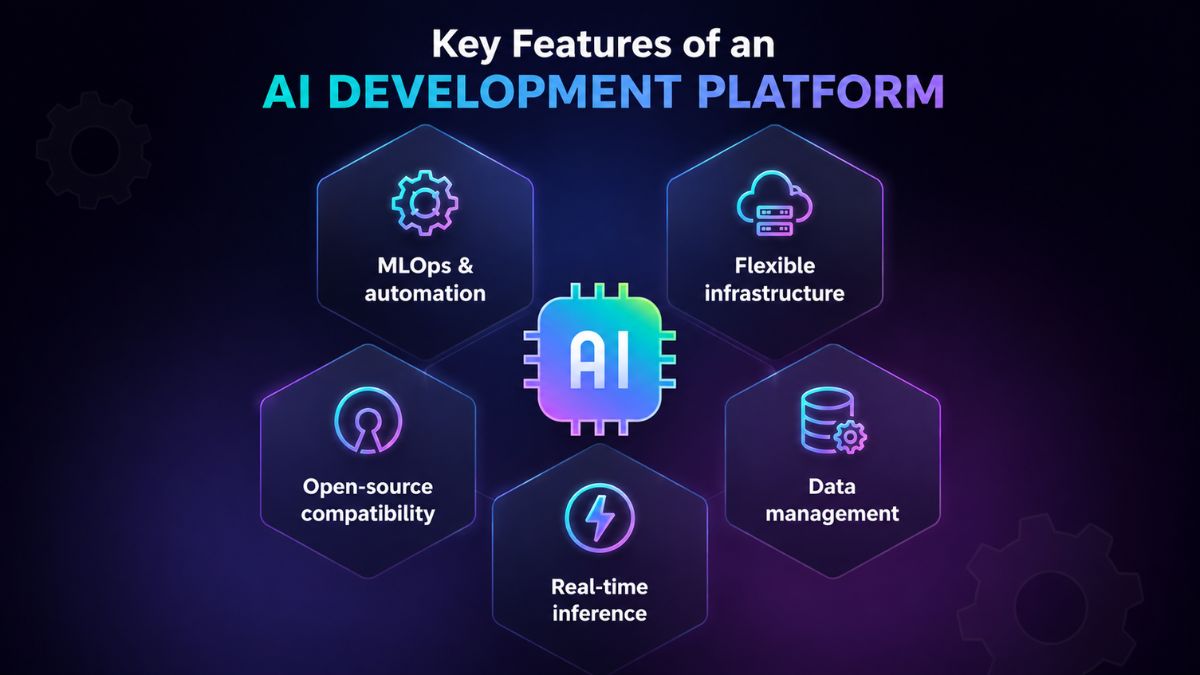
AI development platforms should combine the tools and infrastructure required to build, deploy, and manage AI projects at scale. For enterprise use, it should simplify model operations, support flexible infrastructure, and help teams maintain reliable AI applications across different environments.
- MLOps & automation: Automated pipelines for training, testing, and deployment reduce manual effort and keep workflows consistent as projects grow.
- Flexible infrastructure: Cloud, on-prem, and hybrid support lets teams choose where workloads run, with scaling that adjusts to demand.
- Open-source compatibility: Support for open-source tools and code enables customization and reduces reliance on a single vendor.
- Data management: Tools for collecting, cleaning, labeling, and tracking data help maintain quality and consistency across model updates.
- Security & governance: Access controls, compliance features, and secure deployment options protect data and meet regulatory needs.
- Real-time inference: Fast model output generation ensures reliable performance for applications that require immediate responses.
How to Choose the Right AI Platform for Your Business
Choosing among AI development platforms requires more than comparing individual features. The platform should fit current workloads while providing enough flexibility, automation, security, and infrastructure capacity to support future AI projects without creating unnecessary cost or operational constraints.
Evaluate scalability and infrastructure flexibility
Start by assessing whether the platform can handle increasing data volumes, users, model sizes, and workloads without requiring major infrastructure changes.
Look for:
- Automatic scaling of compute and storage resources
- Support for cloud, on-premises, and hybrid environments
- Elastic infrastructure that maintains performance as workloads grow
- Capacity-planning and cost-control capabilities
Check open-source compatibility
Open-source support gives teams more flexibility to customize their AI stack and reduces dependence on a single vendor ecosystem. It also provides access to established AI libraries and ongoing community development.
Consider whether the platform offers:
- Integration with widely used open-source AI software and libraries
- Support for extending platform capabilities with community-developed code
- Licensing terms that permit commercial use without restrictive conditions
Assess MLOps and automation capabilities
MLOps capabilities help move models from experimentation into production through more consistent and automated workflows. Strong automation can also reduce repetitive manual work across model development and release cycles.
Evaluate whether the platform includes:
- Automated pipelines for model training, testing, and deployment
- Model monitoring, version control, and rollback
- Continuous integration and continuous delivery (CI/CD) support
- Scheduling tools for recurring AI workflows
Review security and compliance requirements
Because AI platforms may process sensitive or regulated information, security should be evaluated against the organization’s data and compliance requirements before adoption.
Key areas to review include:
- Encryption for data at rest and in transit
- Role-based access control for managing permissions
- Audit logging for compliance and regulatory reporting
- Support for standards or regulations such as GDPR or HIPAA
- Data sovereignty controls for determining where information is stored and processed
From Platform Selection to Successful AI Implementation
Choosing among AI development platforms is only the starting point. The value of an AI solution ultimately depends on what happens next: preparing reliable data, configuring the right models, integrating them with existing systems, and maintaining performance after deployment. Without these foundations, even a capable platform may struggle to deliver meaningful business results.
Newwave Solutions supports the full AI development lifecycle, from solution planning and data preparation to model development, system integration, deployment, and ongoing optimization. Work with our AI development team to turn the platform you choose into a scalable solution aligned with your technical requirements and business goals.
FAQs
1. Which are the top 5 AI platforms?
There is no single “best” AI platform for every use case, but several platforms consistently stand out for enterprise AI development. Popular options include Amazon Bedrock, Google Vertex AI, Microsoft Foundry, Amazon SageMaker AI, and IBM watsonx.ai. Each offers different strengths in areas such as foundation model access, machine learning lifecycle management, infrastructure integration, and enterprise governance.
2. How do you set up an AI platform?
Setting up an AI platform typically starts with defining your business objectives and preparing high-quality data. From there, you configure the infrastructure, connect data sources, select or train AI models, integrate them with existing applications, and establish monitoring, security, and MLOps processes to support reliable production deployment.
3. What is the future of an AI platform?
AI development platforms are evolving beyond model development into end-to-end environments that support the entire AI lifecycle. Future platforms are expected to place greater emphasis on automation, AI agents, governance, hybrid deployment, and seamless integration with enterprise systems to simplify large-scale AI adoption.
4. What are the advantages of an AI platform?
AI development platforms help organizations accelerate application development while reducing operational complexity. They centralize data management, model development, deployment, monitoring, and MLOps, making it easier to build, scale, and maintain AI solutions across different environments while improving collaboration and governance.
5. How much does an AI development platform cost?
The cost of AI development platforms varies widely depending on the deployment model, infrastructure, and features. Many cloud platforms use usage-based pricing based on compute resources, model inference, storage, or API consumption. Meanwhile, enterprise platforms often offer custom pricing based on business requirements, users, or deployment scale.
To Quang Duy is the CEO of Newwave Solutions, a leading Vietnamese software company. He is recognized as a standout technology consultant. Connect with him on LinkedIn and Twitter.



Read More Guides
Get stories in your inbox twice a month.
Let’s Build Something Extraordinary
Sign up for a 30 min no-obligation strategic session with us. Transform your Ideas into scalable reality.
Leave a Reply