


AI in Medical Billing: A Practical Guide for Healthcare Organizations

Medical billing teams often spend hours correcting coding errors, checking eligibility, and chasing denied claims. AI in medical billing is gaining attention because it can reduce this manual work while helping providers catch issues earlier in the revenue cycle.
Beyond automation, AI is changing how providers approach coding, claim validation, denial prevention, revenue forecasting, and patient billing. Let’s look at use cases, benefits, risks, and adoption steps below to clarify where AI fits into your medical billing workflow and how its role may develop next.
Key Takeaways
|
What is AI in Medical Billing?
AI in medical billing is the use of machine learning, natural language processing (NLP), predictive analytics, and other AI systems to handle or assist with tasks across the healthcare revenue cycle.
For example, a billing system could verify insurance information, compare coding details against the available documentation, and alert the team when required information is missing.
Compared with traditional billing, which depends more heavily on manual checks and fixed rules, AI-supported billing can automate routine review, detect patterns in past claims, and flag potential issues earlier. This shifts billing teams away from repetitive processing toward exception handling, verification, and more complex cases.

Key AI Technologies Used in Medical Billing
AI in medical billing is not based on a single technology. Different AI methods handle different parts of the billing workflow, from reading clinical notes to checking claims for inconsistencies. The value comes from applying each technology to the task it is best suited to.
Machine learning
Machine learning can use historical claims and payment data to identify recurring signals that may be difficult to catch through individual claim reviews. For medical billing teams, this is useful when screening claims for missing information, suspicious activity, or patterns associated with past payment outcomes.
A practical application is pre-submission claim review. Rather than checking each claim only against fixed rules, a machine learning model can draw on previous claim patterns to flag cases that deserve closer attention before they move forward.

Natural language processing (NLP)
Much of the information needed for billing sits inside clinical notes and other text-based records. NLP helps make that information usable by extracting relevant details from physician notes, patient records, and insurance forms.
In medical coding, for instance, NLP can pull information from clinical documentation that billing teams can use when checking whether the selected codes are supported by the record. This reduces the need to search through lengthy text manually before a claim is prepared.
Generative AI
Generative AI is useful when billing teams need to reorganize or condense information. It can take free-text clinical content and produce structured billing information, or create concise summaries from larger sets of claim-related records.
During claim preparation, for example, free-text physician notes can be converted into a structured format that is easier for billing staff to review. The same capability can summarize supporting information when a case contains multiple records that would otherwise need to be read separately.

Assistive AI
Assistive AI provides billing staff with information and recommendations while keeping people involved in the workflow. Instead of completing every task autonomously, an AI assistant can examine a claim, identify inconsistencies, and help staff determine what needs further review.
This is particularly relevant for claim disputes and exceptions. When a payer raises an issue, the assistant can bring relevant claim information together and surface inconsistencies, while billing staff remain responsible for interpreting the case and deciding how to respond.
Robotic Process Automation
Robotic Process Automation (RPA) handles repetitive, rule-based billing tasks that would otherwise require manual input. In medical billing, it can automate activities such as data entry, claim submission, and payment posting, reducing the time staff spend on routine processing and leaving more capacity for exceptions and complicated billing cases.
Predictive Analytics
Predictive analytics uses billing data to estimate how a claim is likely to perform before it is submitted. A specific use case is denial risk prediction: the system can flag claims with a higher likelihood of rejection so billing teams can review and correct potential issues before sending them to the payer.
To see how these technologies fit into the wider healthcare IT ecosystem, explore our overview of types of healthcare software and the systems commonly used across clinical, administrative, and financial workflows.
Real-world Benefits Of Integrating AI in Medical Billing Systems
AI in medical billing can make revenue cycle work more proactive. By checking information earlier and handling routine steps automatically, it helps teams catch issues before they turn into rework, denials, or payment delays.
| Billing Area | Without AI | With AI |
|---|---|---|
| Claim review | Staff manually check patient, insurance, and coding details. | AI can flag missing or inconsistent information before submission. |
| Insurance verification | Eligibility and coverage checks require more manual review. | AI can assist with checking coverage, payer requirements, and patient responsibility. |
| Denial management | Teams investigate denials after receiving payer responses. | AI can organize denial reasons and identify recurring patterns for earlier follow-up. |
| Routine billing work | Data entry, claim checks, and reminders take staff time. | Repetitive tasks can be automated so staff can focus on exceptions and appeals. |
| Revenue cycle monitoring | Billing status and payment issues may be reviewed across separate workflows. | AI can help track claims, payment patterns, and denial trends more systematically. |
| Patient billing | Staff handle balances, reminders, and billing questions manually. | AI-supported workflows can organize account updates, reminders, and billing inquiries. |
Fewer claim errors
AI can act as an extra quality check before a claim leaves the billing team. Instead of reviewing every field the same way, the system can focus attention on inconsistencies between documentation, coding, and claim data that may otherwise be missed.
Catching those issues before submission gives staff time to correct them while the claim is still in-house, which can reduce avoidable rework later in the cycle.

Faster insurance eligibility checks
When coverage issues are found too late, they can slow down everything that follows. AI-supported verification can review eligibility information earlier in the process and bring potential gaps to the billing team’s attention before the claim is prepared.
That shortens the back-and-forth needed to confirm insurance details and gives staff a clearer starting point for the rest of the billing workflow.
Lower denial risk
AI can help teams spot patterns behind denials and see when the same problems keep appearing across different claims. By grouping recurring issues and comparing them with previous payer responses, the system can point to areas that may need correction.
This gives billing teams a better basis for fixing workflow weaknesses, deciding which denials need faster follow-up, and reducing repeated submission problems.
Less manual billing work
Medical billing includes a large number of repetitive tasks, from data entry and claim-status checks to payment matching and follow-up reminders. Automating part of this workload gives staff more time for complex claims, appeals, documentation review, and payer communication.
This is also where broader applications such as AI agents in healthcare can become relevant, particularly when organizations want to coordinate multiple repetitive tasks rather than automate a single step.
Better revenue cycle control
AI can bring claim status, payment trends, denial rates, and other billing activity into a more visible workflow. This helps teams identify where claims are slowing down, which accounts need attention, and where repeated billing issues are affecting the revenue cycle.
Better visibility does not remove the need for billing oversight, but it gives teams more information to decide where to intervene.
Better patient experience
AI-supported billing workflows can also help organize patient balances, payment reminders, billing inquiries, and account updates. When information is easier to retrieve and routine communication is handled more consistently, administrative teams can respond to billing questions more efficiently.
For patients, that can mean clearer communication around what is owed and fewer delays caused by disorganized account handling.

Key Use Cases of AI in Medical Billing
AI in medical billing is most useful when it is applied to a specific revenue-cycle task rather than treated as a general automation layer. From reviewing claims before submission to identifying unusual billing activity, different AI capabilities can help teams act earlier and spend less time on repetitive review.
Claim validation and denial prevention
AI can use past claims and payment patterns to identify submissions that may be more likely to face denial. This gives billing teams a chance to review documentation, coding, or other claim details before sending the claim to the payer.
For example, if a new claim resembles previously denied cases, the system can flag it for additional review instead of allowing it to move through the workflow unchecked.
AI-assisted medical coding
AI can analyze clinical information and suggest medical codes, helping speed up routine coding work while giving staff more time for complicated cases. This can also help identify documentation gaps before a claim moves forward.
At UMass Memorial Medical Center, AI-supported coding was used to automate simpler coding cases while human coders focused on more complex work. According to HFMA, the approach reduced coding backlogs and eliminated the need for coder overtime, showing how AI can increase coding capacity without removing human review.

Smarter provider network management
Billing teams often lose time when provider details are stored in different places or are difficult to verify during claim review. AI can consolidate provider records and match them through identifiers such as NPI or internal IDs, then linking them to the relevant claim activity for faster review.
For example, when a claim needs provider verification, staff can pull up the necessary details from a unified record without searching across multiple systems or documents.
AI-powered fraud detection
AI can screen billing activity for signs that deserve a closer look. That may include repeated submissions, billing behavior that falls outside normal patterns, or other anomalies that could point to potential fraud. This matters because the National Health Care Anti-Fraud Association (NHCAA) estimates that health care fraud causes tens of billions of dollars in financial losses each year.
For instance, if several claims show an unexpected pattern that differs from typical billing activity, an AI system can flag them for further review before they move deeper into the payment process. This allows billing teams to investigate suspicious cases earlier rather than relying only on manual checks.

Predictive revenue forecasting
AI can use past claims and payment records to give providers a clearer view of what may happen across the revenue cycle. Patterns in previous denials and collections can help teams estimate where revenue pressure may emerge and plan around it.
For example, if forecast data shows that more claims are likely to be delayed or unpaid, the provider can adjust collection priorities or budgeting before the impact becomes more visible.
How Healthcare Providers Can Implement AI in Medical Billing
Adopting AI in medical billing works best as a controlled operational change rather than a full replacement of the existing revenue cycle process. Providers should start with a clearly defined billing problem, establish how current workflows perform, and expand automation only after the results can be measured.
Define the billing problems to solve
Start by identifying where the current billing process creates the most operational or financial pressure. That may be recurring denials, slow accounts receivable, coding backlogs, or repetitive tasks that consume staff time without adding much value.
The goal is to narrow the scope before selecting any technology. A denial-management problem, for example, requires a different AI capability from a coding-capacity problem.
Key Action: Select one priority billing issue and define the measurable outcome that would make the implementation worthwhile.

Assess current revenue cycle performance
Before introducing AI, document how the existing workflow performs. Metrics such as denial rate, payment posting time, and cash-flow gaps can reveal where the process is losing time or creating unnecessary follow-up work.
This baseline also prevents teams from attributing every later improvement to AI. Without a clear starting point, it becomes difficult to separate real performance gains from normal variation in billing activity.
Key Action: Capture baseline metrics for the targeted workflow and use them as the benchmark for post-implementation evaluation.
Select the right AI solution or partner
The right solution should match the billing problem already identified, rather than simply offering the largest set of AI features. For example, a provider trying to improve coding accuracy should evaluate coding-specific capabilities, while a team focused on denials should prioritize claim review and denial-management functions.
Compliance and measurement also matter. Healthcare organizations should look for HIPAA-compliant platforms and clear performance measures so teams can evaluate whether the system is working as intended.
Key Action: Screen potential solutions against three criteria: use-case fit, compliance requirements, and the ability to measure results.
Train billing and coding teams
AI changes how billing staff work rather than removing the need for oversight. Teams still need to review AI-coded claims, investigate exceptions, and decide when an automated recommendation should not be accepted.
Training should therefore focus on judgment as much as tool usage. Staff need to know what the system can handle independently, what requires review, and how sensitive patient information should be managed within the new workflow.
Key Action: Create clear review rules that specify which outputs staff must validate and who owns unresolved exceptions.
Monitor performance after implementation
Once the system is in use, evaluate whether it is improving billing outcomes rather than simply increasing automation. Relevant indicators may include aged denials, cost per claim, or patient billing satisfaction, depending on the original objective.
Performance should also be reviewed over time. A workflow that works well at launch may still require adjustment if staff behavior, payer responses, or billing patterns change.
Key Action: Compare post-launch KPIs with the original baseline and identify where the workflow or AI configuration needs refinement.
Evaluate cost and scalability
AI implementation costs should be assessed against the value of the billing problem being addressed. Upfront setup is only part of the picture; providers also need to consider recurring pricing, operational use, and how costs change as claim volume grows.
Some cloud-based systems use per-claim or per-provider pricing. That can lower the barrier to adoption, but providers still need to check whether the model remains financially practical as usage expands.
Key Action: Model both current and higher-volume scenarios to see whether expected efficiency gains continue to justify total AI costs.
Maintain security and regulatory compliance
Compliance does not end once the AI system goes live. Billing workflows may need to adapt as CMS guidance, payer policies, and HIPAA-related data-security requirements change.
Ongoing control is especially important because AI systems interact with sensitive billing and patient information. Regular reviews help confirm that system access, data handling, and automated workflows continue to meet internal and external requirements.
Key Action: Establish a recurring review process for regulatory updates, system permissions, data security, and billing compliance controls.
Because AI billing workflows often depend on data from clinical systems, implementation planning should also consider how those systems connect with the wider healthcare technology stack. Our guide to EHR software development explains how EHR architecture and integration can affect connected healthcare applications.
Challenges and Risks of Implementing AI in Medical Billing
AI in medical billing can reduce repetitive work and surface billing issues earlier, but implementation also introduces new operational, security, and governance risks. These risks are manageable, but they need to be addressed from the start rather than after the system is already in production.
Data security and cybersecurity risks
AI billing systems process sensitive patient and financial information, which makes security a major concern. Unauthorized access or a breach could expose protected data and create compliance problems under HIPAA, HITECH, or applicable state requirements.
Healthcare organizations should apply controls such as encryption, access management, multi-factor authentication, and ongoing threat monitoring around the systems that handle billing data.

Insufficient staff awareness of AI security
Security controls are less effective if employees do not understand how to use AI systems safely. Weak passwords, phishing, inappropriate data access, or careless handling of patient information can create vulnerabilities even when the technology itself is properly configured.
Training should therefore cover both basic security practices and responsible AI use, including when staff should question an output rather than accept it automatically.
Limited AI decision transparency and auditability
Billing teams need to understand how AI-generated recommendations are being used, especially when those recommendations affect claims or compliance-sensitive decisions. Without clear records, it becomes harder to investigate why a claim was flagged, identify unexpected model behavior, or trace errors after they occur.
Audit trails can provide a record of AI activity and give teams a basis for troubleshooting, compliance review, and performance monitoring.

Poor data quality and bias
AI systems learn from historical data. If that data is incomplete, outdated, inconsistent, or skewed toward certain patterns, the resulting recommendations may also be unreliable.
For medical billing, this could affect how the system interprets claims or identifies potential issues. Standardizing data across systems and checking for missing or unbalanced information can reduce this risk before AI outputs become part of routine billing decisions.
Lack of human oversight and compliance control
AI can assist with claim review, coding checks, and other billing tasks, but it should not remove human judgment from the process. Errors still need to be caught, unusual cases require context, and billing rules may change over time.
Human review, recurring compliance checks, and clear escalation rules help keep automated decisions aligned with legal, ethical, and operational requirements.
High upfront implementation costs
Introducing AI-powered billing software can require investment in technology, infrastructure, system configuration, and staff training. For some providers, these costs may create a barrier even when the expected long-term efficiency gains are attractive.
The business case therefore needs to look beyond software pricing alone and consider the resources required to deploy, operate, and maintain the system.

Legacy system integration
Many healthcare organizations still depend on older billing, clinical, or administrative systems that were not designed to connect easily with newer AI tools. Compatibility problems can interrupt data flow, create duplicate work, or make the implementation more difficult than expected.
Integration planning should therefore assess how the AI system will exchange data with existing platforms before deployment. A technically capable AI solution may still deliver limited value if it cannot fit reliably into the current billing workflow.
Will AI Replace Medical Billers and Coders?
AI is unlikely to remove the need for medical coders entirely. AAPC explained that AI can automate some coding work, particularly in less complex cases, but it still cannot handle every case without human involvement. More complicated documentation and coding scenarios continue to require greater human oversight.
As AI takes on more routine work, coders are likely to spend more time on complex cases, exception handling, and quality review, where human interpretation still matters most. In practice, the role shifts away from repetitive processing and toward checking AI output, resolving ambiguous cases, and maintaining coding accuracy.
Future of AI in Medical Billing
AI in medical billing is moving toward systems that do more than automate isolated tasks. The next shift is toward billing workflows that respond faster to new information and fit more naturally into clinical and patient-facing processes.
Personalized patient billing
AI could make billing more responsive to individual patient circumstances. By analyzing payment history, financial information, and billing behavior, systems may tailor payment plans, communication methods, or financial guidance.
This could move patient billing away from a single standard process for every account. Healthcare organizations will need to think carefully about how patient financial data is collected, connected, and used before introducing this level of personalization.
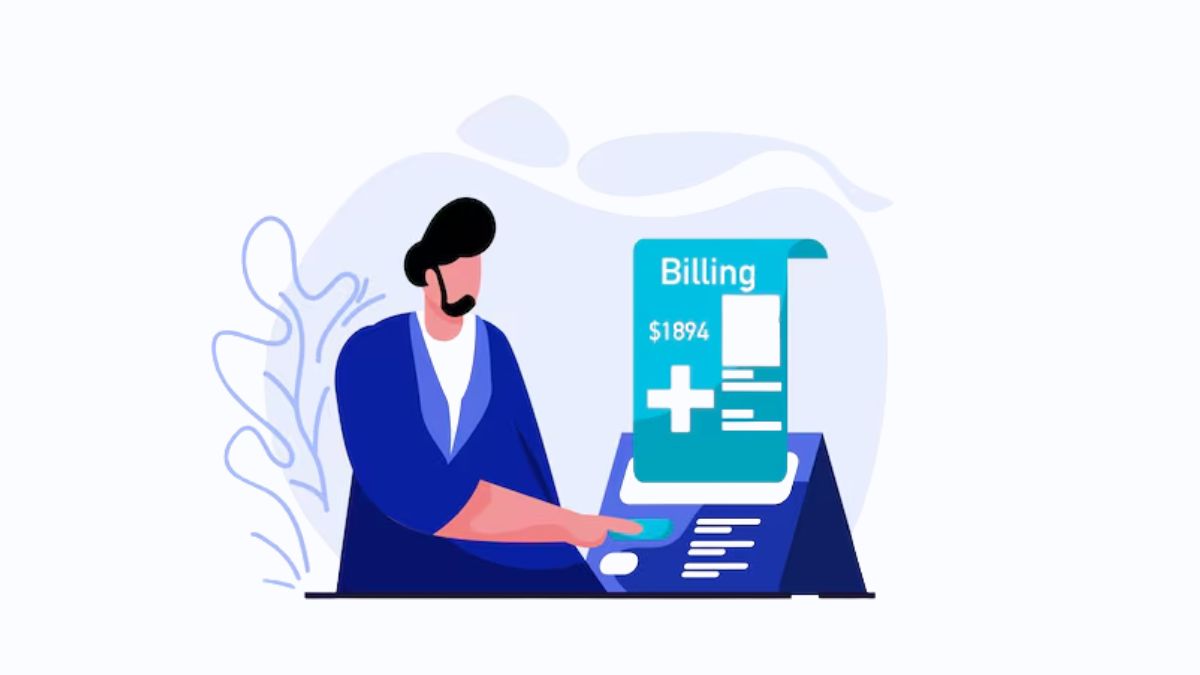
Real-time data integration across systems
Billing workflows often depend on information stored across EHRs, billing platforms, and payer systems. Real-time synchronization could allow updates in one system to flow into connected processes without repeated manual entry.
This may reduce problems caused by outdated or inconsistent information during claim processing. Organizations should therefore assess current integration gaps and whether their systems can exchange data reliably enough to support more automated workflows.
More interactive patient billing portals
Patient portals could become more active parts of the billing process rather than simple places to view balances. Future portals may provide current cost estimates, insurance verification, and AI-assisted financial guidance.
That could give patients clearer information about what they may owe and why. Healthcare organizations should consider how billing data, insurance information, and patient communication can be presented consistently through one digital experience.

Voice-enabled billing documentation
Voice AI could reduce the need to enter billing-related information manually after a patient encounter. Spoken notes may be converted into structured billing data that can move into downstream workflows.
This could make documentation feel less separate from the clinical process. However, providers will still need to define where transcription can proceed automatically and where staff should verify the information before it affects billing.
Generative AI for patient billing support
Generative AI could make billing communication easier to understand. It may simplify complex billing language, adapt explanations to different literacy levels, and assist with common billing questions.
It may also help prepare appeal drafts or other communication-heavy content. In this case, healthcare organizations should set clear review rules for patient-facing and compliance-sensitive outputs so AI assistance does not remove human accountability.
How Newwave Solutions Helps You Bring AI into Medical Billing Workflows
Bringing AI into medical billing starts with understanding where the current process is slowing teams down or creating avoidable manual work. Newwave Solutions can help healthcare organizations translate those workflow problems into focused AI use cases that fit their data, operating model, and existing technology environment.
Through our AI development services, we can build capabilities such as intelligent document processing, predictive analytics, and AI-assisted workflow automation. Applied to medical billing, these solutions can help teams process information faster, identify cases that need attention earlier, and spend more time on exceptions that require human judgment.
Organizations can begin with one high-impact workflow, measure the result, and expand only when the use case proves its value. Talk to our team to explore where custom AI could make the biggest difference in your medical billing process.

Final Thought
AI in medical billing can make revenue-cycle operations more responsive, but successful adoption still depends on how well the technology fits existing workflows. Providers should treat AI as an added layer of automation and decision support, then validate whether it solves the original billing problem before increasing its scope.
That integration-first approach also shapes how Newwave Solutions develops custom AI systems for healthcare and other operational environments. In one AI-powered chatbot integration platform, Newwave Solutions connected knowledge-grounded AI with human consultant fallback on a production platform serving 10K+ daily accesses. Read the full case study to see how the AI chatbot was incorporated into an existing system and workflow.
FAQs
1. Is AI replacing medical billing?
AI is not replacing medical billing professionals but is changing how they work. AI can automate repetitive tasks such as claim checks, coding assistance, eligibility verification, and denial analysis, while human experts remain responsible for complex cases, compliance decisions, and quality review.
2. How is AI being used in medical billing?
AI is used in medical billing to automate and improve key revenue cycle processes, including claim validation, medical coding assistance, insurance verification, denial prevention, fraud detection, and revenue forecasting. Technologies such as machine learning, natural language processing (NLP), and predictive analytics help identify errors, extract information from clinical notes, and detect potential issues before claims are submitted.
3. What is the role of AI in billing?
The main role of AI in billing is to support automation and decision-making across the healthcare revenue cycle. It helps billing teams reduce manual work, improve claim accuracy, identify denial risks earlier, and gain better visibility into payment trends while keeping human oversight for judgment-based decisions.
4. What are some challenges of implementing AI in medical billing?
Common challenges include protecting sensitive patient data, ensuring regulatory compliance, maintaining data quality, integrating AI with legacy systems, and training staff to use AI effectively. Healthcare organizations also need strong governance and human review processes because AI recommendations may require validation in complex billing situations.
5. How does AI integrate with EHR and medical billing software?
AI integrates with EHR and medical billing systems by connecting clinical, administrative, and financial data to automate workflows and improve information accuracy. For example, AI can extract relevant details from EHR documentation, match them with billing requirements, and support claim preparation, while real-time data integration helps reduce duplicate entry and outdated information across systems.
Source
- Healthcare Financial Management Association. (2026, May 26). Healthcare cost containment strategies shift: 3 proven ways hospitals can reduce costs. HFMA. https://www.hfma.org/reference/healthcare-cost-containment-strategies-shift-3-proven-ways-hospitals-can-reduce-costs/
- National Health Care Anti-Fraud Association. (n.d.). The challenge of health care fraud. NHCAA. https://www.nhcaa.org/tools-insights/about-health-care-fraud/the-challenge-of-health-care-fraud/
- Dorrell, R. (2025, April 28). Navigate new era of coding with this foundation. AAPC. https://www.aapc.com/codes/coding-newsletters/my-general-surgery-coding-alert/general-coding-navigate-new-era-of-coding-with-this-foundation-179323-article
To Quang Duy is the CEO of Newwave Solutions, a leading Vietnamese software company. He is recognized as a standout technology consultant. Connect with him on LinkedIn and Twitter.



Read More Guides

Get stories in your inbox twice a month.
Let’s Build Something Extraordinary
Sign up for a 30 min no-obligation strategic session with us. Transform your Ideas into scalable reality.
Leave a Reply