


How to hire Blockchain Developers? Complete Guide for Choosing in the Right Way
The demand for Blockchain developers continues to rise as organizations move from experimentation to real world blockchain products. Before you decide how to hire blockchain developers? you need to understand how the right talent can reduce blockchain cost, risk, and time to market. This guide gives you a clear and practical way to approach hiring. It explains what these specialists do, the primary types of roles, what to look for in candidates, when to build an in house team versus work with partners, and how to structure an effective hiring process.
What is Blockchain Developer?
A blockchain developer is a specialized software engineer who designs and builds systems based on decentralized technology. While many people still search for “what is blockchain” when entering this field, companies today demand developers who can translate this technology into real business value. Blockchain developers combine software engineering fundamentals with deep understanding of distributed ledgers, cryptography, consensus methods, smart contracts, and the wide range of blockchain development platforms used in modern Web3 applications.
These developers work on decentralized systems that do not rely on a central authority. They create secure and transparent environments where transactions or digital interactions can occur without intermediaries. Their work influences areas such as finance, gaming, identity management, supply chain, and enterprise automation. For companies exploring blockchain development companies or evaluating blockchain cost, the blockchain developer is the foundation of successful delivery.
What Blockchain Developers Do?
A blockchain developer is responsible for transforming technical concepts into fully functioning decentralized applications and infrastructures. Their daily responsibilities combine engineering logic, business understanding, and security leadership.
Key tasks include:
- Designing the architecture of blockchain systems and building core modules
- Creating smart contracts and on chain logic that automate operations without central control
- Developing advanced decentralized applications with front end and back end work that interacts with the blockchain
- Ensuring end to end security using cryptography, audit procedures, and secure coding standards
- Optimizing applications to reduce gas usage, improve speed, and enhance reliability
- Working with cross functional teams to analyze use cases and translate them into technical solutions
- Continuously updating systems to stay aligned with new protocol upgrades and ecosystem developments
In simple terms, if you ask “what does a blockchain developer do,” the answer is that they build the secure backbone of decentralized digital products.
How Many Primary Types of Blockchain Developers?
The blockchain ecosystem has evolved into several specialized roles. Before diving into these roles, it is important to recognize why specialization exists. Blockchain applications are becoming more complex. Some use cases require custom blockchain development solutions. Others rely on smart contracts, game mechanics, token economics, or enterprise grade integrations. Because of this, companies hiring blockchain developers must understand the difference between core infrastructure engineering, decentralized application building, and contract layer development.
Below are the three primary types of blockchain developers:
Core Blockchain Developer
Core blockchain developers focus on the underlying blockchain protocol. They design and maintain the foundation on which others build. This includes consensus mechanisms, transaction validation, peer to peer networking, and low level performance tuning.
A core developer works close to the level of the node software. They may create new chains, extend existing protocols, or contribute to open source clients. They need deep knowledge of distributed systems, cryptography, and performance engineering.
Typical responsibilities include:
- Designing or improving consensus algorithms and validation rules
- Implementing changes to core node clients
- Handling forks, upgrades, and governance related code changes
- Ensuring network security and resilience under attack or heavy load
Core blockchain developers are essential when the blockchain itself is your product, for example a new Layer 1 network or a permissioned ledger for an enterprise consortium.
Blockchain Software Developer or Application Developer
A blockchain software developer, sometimes called an application developer, builds products on top of existing blockchains. They use smart contracts, indexers, APIs, and external services to create full user experiences.
Their work combines backend, frontend, and integration tasks. They often act as the bridge between on chain logic and off chain systems such as web interfaces, mobile apps, or enterprise software.
Typical responsibilities include:
- Designing the architecture of a decentralized application
- Integrating smart contracts with web or mobile frontends
- Building backend services and indexers to query on chain data
- Managing wallets, user flows, and connectivity to node providers
- Integrating third party services such as payments, analytics, or identity
These developers are key to any project where users interact with the blockchain through applications, dashboards, or services.
Smart Contract Developer
Smart contract developers specialize in writing, testing, and deploying the on chain programs that control assets and logic. They work with languages such as Solidity, Rust, or Move, depending on the target chain.
Because smart contracts often hold large amounts of value, security is critical in this role. One mistake can cause permanent loss of funds. Smart contract developers must understand common vulnerabilities and best practices for safe design.
Typical responsibilities include:
- Designing smart contract architectures for tokens, DeFi protocols, NFT platforms, and other use cases
- Implementing contracts with attention to gas efficiency and upgradeability
- Writing unit tests and property based tests for on chain logic
- Using tools such as Hardhat, Foundry, Truffle, or Remix for development and deployment
- Working with auditors and fixing issues found in security reviews
If your product involves tokens, lending, staking, gaming assets, or any other on chain logic, smart contract developers are central to its success.
What Need to Seek When Hiring a Blockchain Developer?
Hiring the right blockchain developer requires more than checking technical ability. Because blockchain interacts with financial value, security risks, user trust, and compliance needs, companies must evaluate both technical foundation and the mindset required to thrive in decentralized environments.
Essential Technical Skills and Knowledge
A qualified blockchain developer must demonstrate strong engineering knowledge combined with blockchain specific skills. The evaluation should include both deep technical understanding and practical experience building real projects.
A capable developer should master core programming skills, understand distributed systems, and demonstrate hands on experience with smart contracts, data structures, and cryptography. The ideal candidate also understands the SDLC as it applies to blockchain from research and design through deployment and optimization.
Key technical criteria include:
- Strong proficiency in languages such as Solidity, Rust, Go, Python, or JavaScript
- Deep understanding of distributed ledger technology and networking logic
- Knowledge of consensus models such as proof of stake or proof of authority
- Experience building and testing smart contracts
- Familiarity with leading blockchain development platforms
- Clear understanding of cryptographic methods
- Ability to write gas efficient, secure, and scalable code
- Experience with test tools like Truffle, Hardhat, or Foundry
- Knowledge of multi chain development and cross chain communication
Critical Soft Skills and Mindset
Blockchain projects often operate with uncertainty, evolving regulation, and strong community expectations. Developers must be prepared for this environment.
Decentralized ecosystems reward developers who have ownership thinking, strong communication, and the ability to solve new problems without relying on established patterns. The right developer should demonstrate curiosity, persistence, and a willingness to explore emerging technologies and frameworks.
Key soft skills include:
- Strong problem solving and analytical approach
- Ability to work independently and take responsibility
- Clear communication for explaining complex technical ideas
- Continuous learning habit to stay updated with fast changing ecosystems
- Collaboration skills for cross functional coordination
- Understanding of Web3 culture and community driven development
- High attention to detail, especially in security sensitive work
Should I Hire In House or Outsourced Blockchain Developer?
The decision between building an internal blockchain team or partnering with external experts affects cost structure, delivery quality, and long term scalability. Because blockchain is a specialized field, both models can work well depending on your goals, skill availability, budget, and timeline. Many companies also combine both models to achieve the right balance.
When to Choose an In House Blockchain Development Team?
An in house team suits companies with long term blockchain strategy. These teams maintain deep understanding of internal systems and provide full alignment with company culture and product vision. This model provides direct oversight, immediate communication, and long term control over intellectual property. It also reduces dependency on external partners and allows custom training and development.
Pros and Cons:
| Pros | Cons |
|---|---|
| Full control over development and security | Higher cost for salaries and benefits |
| Strong alignment with the product vision | Long time required for hiring |
| Better in house knowledge retention | Skill shortages in the local market |
| Easier communication and collaboration | Difficulty scaling quickly |
Ideal for:
- Companies building blockchain as a core business model
- Startups with strong funding and long term roadmaps
- Enterprises managing sensitive data or compliance related operations
- Projects requiring constant iteration and feature growth
When to Choose an Outsourcing Blockchain Development Team?
Outsourcing is ideal when speed, talent diversity, and scalability matter more than building long term internal teams. Many companies choose offshore outsourcing to access global expertise and reduce development cost. This model provides immediate access to experienced blockchain engineers without recruitment delays. It is cost effective and flexible, especially for MVPs and early stage projects.
Pros and Cons:
| Pros | Cons |
|---|---|
| Faster time to market | Possible communication challenges |
| Access to global talent and niche skills | Less direct control over daily operations |
| Lower overall development cost | Risk of inconsistency if partner is inexperienced |
| Easy to scale up or down | Requires strong project management |
Ideal for:
- MVP development solutions and proof of concept testing
- Startups validating product ideas
- Companies needing temporary or highly specialized skills
- Organizations working with limited budget or short timelines
The Hybrid Model
The hybrid approach blends the strengths of both models. A small internal team handles product direction, while external specialists manage execution, optimization, or specific features. This model offers flexibility, access to specialized knowledge, and strong control over core technology. It reduces risk while allowing rapid scaling during peak development cycles.
Pros and Cons:
| Pros | Cons |
|---|---|
| Strong control plus flexible scaling | Requires coordination between teams |
| Best access to multiple skill sets | More complex management structure |
| Cost balanced with expertise | Need clear documentation and process alignment |
| Faster delivery with lower risk | Requires structured governance |
Ideal for:
- Companies building long term blockchain products
- Teams that already have senior engineers but need support
- Organizations with fluctuating workloads
- Businesses requiring the best balance of cost, quality, and speed
How to Hire Blockchain Developers with the Right Skills?
Hiring blockchain developers requires a structured and precise process. Candidates must be evaluated on technical expertise, real world experience, mindset, and ability to deliver secure decentralized systems. A good hiring strategy reduces risk, accelerates delivery, and protects your investment in blockchain technology:
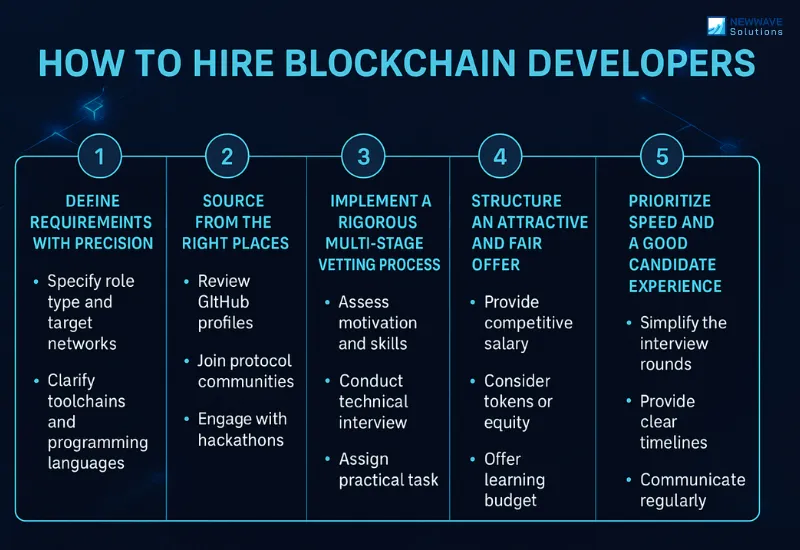
Step 1: Define Requirements with Precision
Avoid generic job titles that say only blockchain developer. Instead, specify whether you need a protocol engineer, a smart contract specialist, or a full stack Web3 developer. Describe your target blockchain networks, toolchains, and programming languages.
Clarify:
- What parts of the system the developer will own
- Which blockchain development platforms and tools they must already know
- How their work ties to business outcomes
A precise role description attracts people who truly fit the position and saves time for everyone involved.
Step 2: Source from the Right Places
Traditional job boards are not enough for this talent pool. Many blockchain developers are active in open source repositories and online communities.
You can increase your reach by:
- Reviewing GitHub profiles and contributions to relevant projects
- Participating in protocol communities, events, and online forums
- Engaging with hackathons and grant programs
- Using specialized talent networks or agencies that focus on Web3
Look for a mix of code, communication, and community engagement when evaluating potential candidates.
Step 3: Implement a Rigorous Multi Stage Vetting Process
A good hiring process checks motivation, skills, and behavior in real project scenarios. It goes beyond algorithm puzzles and whiteboard questions.
An effective structure might include:
- An initial conversation about motivation, interests, and alignment with your mission
- A technical interview focused on blockchain concepts, vulnerabilities, and architecture decisions
- A practical task such as reviewing or extending a small smart contract or designing a simple system
- A paid pilot project where the candidate works with your team on a real but limited task
This approach lets you observe how candidates think, communicate, and deliver under realistic conditions.
Step 4: Structure an Attractive and Fair Offer
The market for Blockchain developers is competitive. A strong offer combines financial stability with long term incentives.
Elements to consider include:
- Base salary adjusted for experience and location
- Tokens or similar instruments when relevant to your network
- Equity or stock options if your company follows that model
- Learning and development budget
- Flexible work conditions that match the global nature of the ecosystem
The right mix signals that you value both stability and shared upside.
Step 5: Prioritize Speed and a Good Candidate Experience
The best developers receive several offers. Keeping the process fast and transparent increases your chance of hiring top talent. Simplify interviews, provide clear timelines, and maintain professional communication throughout the process.
Make sure candidates know:
- What the next steps are
- Who they will talk to and why
- How long each stage will take
Respect for their time and clarity in communication creates a positive impression even before they join.
Never Compromise on Non Negotiables
Regardless of whether you build internally or work with partners, there are basic standards you should never compromise on.
These include:
- A strong security mindset and willingness to follow best practices
- Clear agreement on code ownership, documentation, and handover expectations
- Reliable communication routines and transparent reporting
- Commitment to testing, peer review, and external audits where appropriate
These checks protect your users, your reputation, and your investment in custom blockchain development solutions.
What Newwave Solutions can offer for you?
Choosing, hiring, and working with Blockchain developers is not only a technical problem. It is a strategic business decision that affects how you compete, how you manage risk, and how you invest in the future. Now that you have a clearer picture of what is blockchain developer, how the different roles contribute to a project, and how to structure your hiring process, the next question is execution.
Newwave Solutions is a Vietnam based technology partner that provides end to end blockchain development services and hire developer services for clients worldwide. We help you move from concept to production through a clear and disciplined approach to architecture, design, development, and operations.
Our team has experience across multiple use cases and blockchain development platforms. In our portfolio, we have delivered work such as multi chain wallets, digital payment experiences, and gaming solutions. Projects include Blockchain App Wallet for Multi Chain Success, Multi Chain Cryptocurrency Wallet App, Blockchain PoC Application, Digital Wallet App Powered by Blockchain, NFT Game Development with Blockchain Integration for Engaging Battles and Earning, and a blockchain powered casino game for Telegram. Together they show that we can support a wide range of applications, from financial tools to entertainment products.

When you work with us, you can expect:
- Advice on selecting the right chain, architecture, and technology stack based on your goals and acceptable blockchain cost
- Full life cycle delivery from discovery to deployment, guided by proven SDLC practices
- Support for experiments and pilots as well as large scale rollouts
- Flexible engagement models, including dedicated teams through offshore outsourcing, that align with your budget and timelines
- Strong attention to security, performance, maintainability, and documentation
We can provide complete teams or specific Blockchain developers to augment your current resources. Whether you need protocol level work, smart contracts for DeFi or NFTs, or integration with your existing systems, we help you design and implement solutions that are practical, secure, and ready to grow.
If you are evaluating different blockchain development companies or planning your next initiative, we are ready to discuss your ideas and share what we have learned from building real products. Together we can turn your concept into a robust solution that uses blockchain in a way that makes sense for your business.
To Quang Duy is the CEO of Newwave Solutions, a leading Vietnamese software company. He is recognized as a standout technology consultant. Connect with him on LinkedIn and Twitter.



Read More Guides
Get stories in your inbox twice a month.
Let’s Connect
Let us know what you need, and out professionals will collaborate with you to find a solution that enables growth.
Leave a Reply