


Top 12 Healthcare Software Development Companies to Consider in 2026
Choosing among healthcare software development companies can be difficult when many vendors claim similar technical expertise but differ widely in healthcare experience, compliance readiness, integration capability, and delivery quality. The wrong choice can lead to costly rework, security gaps, poor interoperability, or software that fails to fit clinical and operational workflows.
That makes vendor comparison an important part of reducing project risk. In this guide, we compare 12 leading companies, including their healthcare expertise, integration, compliance capabilities, and engagement models to help you choose the best fit.
How We Evaluated Healthcare Software Development Companies
To compare top healthcare software companies consistently, we assessed each provider against the same set of practical criteria. The goal was to distinguish between firms that look similar at a service-list level and those with clearer evidence around delivery model, healthcare integrations, pricing, case studies, and compliance.
- Engagement model: We identified whether each company mainly provides custom software development, staff augmentation, or product/device services, since these models involve different delivery structures and risk profiles.
- Verified integration experience: We looked for named EHR or healthcare platform experience rather than general claims around HL7 or FHIR, with specific integrations such as Epic, Cerner/Oracle Health, or other identified platforms carrying more weight.
- Pricing transparency: We checked whether project or rate information came directly from the vendor or from independently verified sources such as Clutch, and noted the source of the figure where available.
- Case study evidence: We prioritised companies with named clients and measurable project results over providers supported only by anonymous testimonials.
- Compliance credentials: We reviewed documented certifications and standards beyond basic HIPAA references, including HITRUST, ISO 13485, ISO 27001, and SOC 2 where available.
Quick Comparison of Custom Healthcare Software Development Companies
The table below provides a side-by-side view of custom healthcare software development companies, helping you quickly narrow your shortlist before reviewing each provider in more detail.
| Company | Healthcare expertise | Integration depth | Engagement model | Best for | Certifications / Compliance |
| ELEKS | Enterprise healthcare software, EHR/EMR, IoMT, medical imaging, AI/ML, and connected devices | Very high – HL7, FHIR, CDA, DICOM, ICD, ICPC-2; EHR/EMR and medical-device integrations | Dedicated teams, staff augmentation | Complex healthcare software and system integration | HITRUST, ISO 27001, SOC 2 |
| ScienceSoft | 20+ years in healthcare IT; EHR, telemedicine, SaMD, medical devices, clinical and diagnostic software | Very high – FHIR, HL7 v2/v3, CCDA, NCPDP; documented athenahealth integration | Fixed-price, T&M, dedicated teams | Regulated healthcare and medical device software | ISO 13485, ISO 27001, ISO 9001 |
| Itransition | 25+ years in healthcare IT; medical devices, EHR, telemedicine, healthcare analytics, hospital systems | High – FHIR, DICOM, ICD-10, CPT; connected medical equipment and healthcare systems | Dedicated teams, staff augmentation | Medical device software and large-scale healthcare analytics | ISO 9001, ISO 27001, HIPAA |
| Newwave Solutions | Healthcare software covering cross-platform apps, EHR/EMR, telemedicine, medical data handling, and modernization | High – HL7, FHIR, DICOM; EHR/EMR, pharmacy, PACS, wearable and IoT integrations | Fixed-price, T&M, Dedicated teams | Cost-competitive cross-platform healthcare apps and medical software modernization | ISO 9001:2015, ISO/IEC 27001:2022, HIPAA compliance |
| TechMagic | Secure HealthTech products with emphasis on HIPAA readiness, cybersecurity, interoperability, and regulated data | High – HL7/FHIR, Medplum, Health Gorilla, EHR and third-party integrations | T&M, dedicated teams, staff augmentation | HIPAA-ready SaaS, EHR, and digital health products | ISO 27001, HIPAA, GDPR |
| Leobit | HealthTech platforms combining AI/ML, cloud modernization, patient-facing software, and connected medical systems | High – HL7/FHIR, EHR/HIE, medical equipment, telemedicine and third-party systems | Dedicated teams, T&M, fixed-price | AI-enabled healthcare platforms and connected medical software | ISO 27001:2022, ISO 9001:2015, HIPAA |
| Glorium Technologies | Healthcare platforms across telemedicine, EHR, medical imaging, RPM, IoT, and patient applications | Very high – FHIR, HL7, DICOM, ICD-10, CPT, IHE | Dedicated teams, staff augmentation, project outsourcing | Interoperability-heavy healthcare platforms | ISO 13485, ISO 27001, ISO 9001 |
| Appinventiv | Patient-facing and enterprise digital health products with strong UX, AI, telemedicine, and healthcare IoT experience | Very high – HL7, FHIR, ICD-10, LOINC, CPT, SNOMED CT; Epic/Cerner experience | Fixed-price, T&M, dedicated teams | Patient-facing healthcare apps and enterprise digital health platforms | ISO 27001, ISO 9001, SOC 2 |
| Vention | HealthTech engineering for startups and established companies, backed by senior-heavy distributed teams | High – HL7 plus EHR/EMR, telemedicine, CRM, analytics, and API integrations | Dedicated teams, staff augmentation, project outsourcing | Scaling HealthTech products and engineering capacity | HIPAA, GDPR, FDA/CE |
| Pi Tech | Senior-only healthcare engineering with a Specless Engineering approach for evolving and regulated products | High – HL7, FHIR, EHR, medical device and clinical system integrations | Project-based, staff augmentation | Healthcare projects with evolving requirements and medical-device connectivity | HIPAA, FDA, ISO 13485-related QMS |
| Arkenea | Healthcare-only development since 2011 across EHR, telemedicine, medical devices, and patient applications | Very high – HL7, FHIR, SMART on FHIR, DICOM, ICD-10, LOINC; Epic, Cerner and athenahealth | Custom product development, dedicated teams | Healthcare-only and device-adjacent software projects | HIPAA, HITRUST, IEC 62304 |
| Techstack | Product-led healthcare engineering spanning AI diagnostics, monitoring apps, medical devices, and hospital systems | Moderate–high – HL7 and existing healthcare/EMR, wearable, device, and API integrations | Time & Materials | HealthTech startups and MedTech companies seeking product-engineering capabilities | ISO 27001, ISO 27701, HIPAA-related delivery |
Top 12 Healthcare Software Development Companies
ELEKS for complex healthcare software and system integration
- Founded: 1991
- Location: Tallinn, Estonia; ELEKS operates additional offices across Europe, North America, the Middle East, Japan, and Latin America.
- Team size: 2,000+ employees .
- Rate/ Project size: $50–$99/hour; $25,000+ minimum project size
- Rating: 4.8/5 on Clutch
Healthcare expertise: ELEKS provides custom healthcare software for medical providers and healthcare organisations, covering patient-facing products, clinical and operational systems, connected medical devices, data analytics, and healthcare cybersecurity. Its healthcare practice also spans EHR/EMR, telemedicine, medical imaging, IoMT, AI/ML, and revenue-cycle applications, backed by more than 30 years in software engineering.

Core healthcare capabilities
- Custom healthcare software and mobile health apps
- EHR/EMR and patient engagement platforms
- Telemedicine and remote patient monitoring
- Healthcare data analytics and AI/ML
- Medical imaging software
- IoMT and connected medical device software
- HIS and practice management systems
- Revenue cycle and claims management software
- Healthcare cybersecurity and QA
Relevant healthcare evidence: ELEKS helped Fleming improve a healthcare application by expanding the team and accelerating a major product update from an estimated four months to four weeks. The engagement also delivered up to 80% savings on development costs, while giving Fleming access to ELEKS specialists across multiple technical areas.
Integration & compliance capabilities
- Healthcare integrations: EHR/EMR systems, insurance databases, telemedicine platforms, cloud systems, analytics tools, and third-party technologies.
- Healthcare standards: HL7, FHIR, CDA, DICOM, ICD, and ICPC-2.
- Security & compliance: HIPAA, HITECH, GDPR, HITRUST, ISO 9001, ISO 27001, and SOC 2.
Best for: Mid-sized and enterprise healthcare organisations that need a larger engineering partner for regulated, integration-heavy projects involving EHR interoperability, data platforms, AI, IoMT, connected devices, or long-term product engineering.
Considerations: ELEKS sits toward the higher end of outsourced development budgets: Clutch shows a $25,000 minimum engagement, while $200,000–$999,999 is the most common reviewed project range.
ScienceSoft for regulated healthcare and medical device software
- Founded: 1989
- Location: McKinney, Texas, US.
- Team size: 750+ IT professionals, with more than 50% at senior level.
- Rate/Project size: $50–$99/hour; $5,000+ minimum project size on Clutch. The most common reviewed engagement is $50,000–$199,999.
- Rating: 4.8/5 on Clutch.
Healthcare expertise: ScienceSoft has worked in healthcare IT since 2005 and reports more than 150 healthcare projects. Their portfolio covers clinical systems, patient-facing applications, telemedicine, diagnostics, healthcare analytics, medical device software, and SaMD, with ISO 13485 certification giving them a particularly strong fit for regulated medical software projects.

Core healthcare capabilities
- EHR/EMR, HIE, and healthcare information systems
- Telemedicine and remote patient monitoring
- Patient portals and mobile health applications
- Medical device software and SaMD
- Medical imaging, PACS, RIS, LIS, and LIMS
- Healthcare data analytics and AI
- Clinical decision support and diagnostic software
- Practice, hospital, and revenue cycle management
- Healthcare software modernization, integration, testing, and cybersecurity
Relevant healthcare evidence: ScienceSoft developed a web and mobile patient portal with telemedicine functionality for a healthcare provider operating several medical practices in New York. The platform was integrated with the client’s athenahealth EHR and attracted more than 1,500 patients within three months of launch, with around 10 new patients joining each day.
Integration & compliance capabilities
- Healthcare integrations: EHR/EMR systems, HIE platforms, medical devices, partner systems, legacy software, and third-party healthcare applications. ScienceSoft has documented integration work with athenahealth EHR.
- Security & compliance: FHIR (open APIs and USCDI data sets), HL7 v.2/v.3, CCDA, HIPAA X12 (837/835), NCPDP SCRIPT, and other uniform standards.
Best for: Healthcare providers, healthtech companies, and medical device manufacturers that need documented compliance processes, healthcare interoperability, or regulated medical software development.
Considerations: ScienceSoft’s delivery model appears better suited to buyers that can provide clear requirements, formal documentation, and defined project goals
Itransition for medical device software and large-scale healthcare analytics
- Founded: 1998
- Location: Decatur, Georgia, US
- Team size: 3,000+ employees.
- Rate/Project size: $25–$49/hour; $25,000+ minimum project size on Clutch.
- Rating: 4.9/5 on Clutch.
Healthcare expertise: Itransition has more than 25 years of healthcare IT experience, serving hospitals, diagnostic and research centres, pharmaceutical companies, medical device manufacturers, and healthtech businesses.
Core healthcare capabilities
- EHR/EMR and healthcare information systems
- Telemedicine and patient engagement solutions
- Healthcare mobile apps and patient portals
- Medical device software and SaMD
- Remote patient monitoring and medical IoT
- Healthcare data analytics and BI
- Hospital and practice management software
- Pharmacy management solutions
- LIMS and healthcare CRM
- Healthcare software integration and modernization
Integration & compliance capabilities
- Healthcare integrations: EHR/EMR systems, medical devices, wearables, hospital management systems, pharmacy software, telehealth platforms, LIMS, and other healthcare applications.
- Healthcare standards: FHIR, DICOM, ICD-10, and CPT, alongside experience with medical device interoperability and healthcare data exchange.
- Security & compliance: HIPAA, HITECH, FDA Classes II and III, IEC 62304 Classes A, B, and C, OWASP, IEC 62443, and GDPR-related requirements.
Best for: Organizations seeking FDA-certified medical software or comprehensive healthcare analytics solutions.
Considerations: With 3,000+ employees and experience on long-running, regulated programs, Itransition may be a better fit for larger or more structured engagements than very small, lightweight healthcare projects.
Newwave Solutions for for custom healthcare applications and medical software modernization
- Founded: 2011
- Location: Hanoi, Vietnam.
- Team size: 300+ employees.
- Rate/Project size: Contact us
- Rating: 4.8/5 on Clutch.
Healthcare expertise: Newwave Solutions has 15+ years of healthcare IT experience, providing custom healthcare software solutions for hospitals, clinics, medical startups, and pharmaceutical businesses. Our team has built HIPAA-compliant platforms that process and store sensitive Protected Health Information (PHI), supported by ISO 9001:2015 and ISO/IEC 27001:2022 certifications.
By combining secure data handling, system integration, and cross-platform engineering, Newwave helps healthcare organizations reduce operational friction, protect patient data, and launch reliable digital products that can scale with changing clinical and business needs.
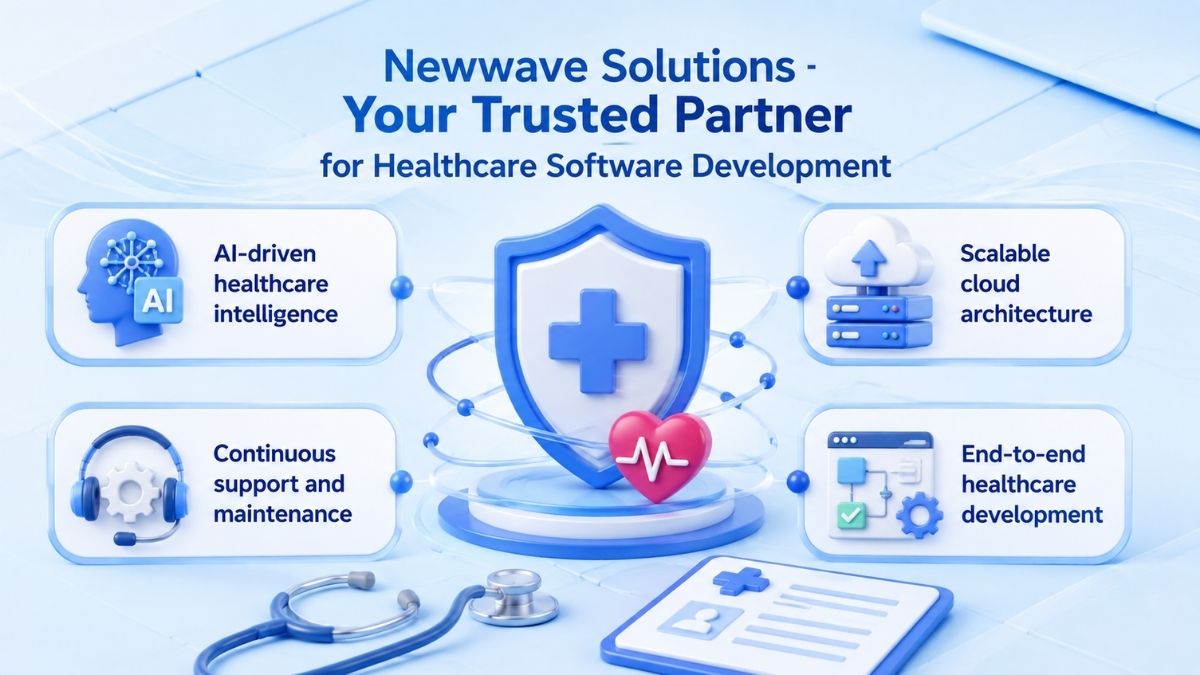
What makes Newwave Solutions different
- AI-driven healthcare intelligence: Newwave Solutions applies AI and predictive analytics to healthcare workflows, helping teams extract more value from medical data, identify risks earlier, and support more informed clinical and operational decisions.
- Scalable cloud architecture: Cloud-native healthcare systems are designed to handle growing user volumes, expanding data needs, and multi-location operations while maintaining performance, availability, and flexibility.
- Continuous support and maintenance: Ongoing monitoring, upgrades, security patches, and compliance-focused updates help healthcare software remain reliable as regulations, technologies, and business requirements change.
- End-to-end healthcare development: We cover the full software lifecycle so clients can work with one delivery partner from concept to scale.
Core healthcare capabilities
- EHR and EMR software
- Hospital management systems
- Telemedicine
- Patient engagement apps
- Billing & claims systems
- Healthcare analytics platforms
- mHealth applications
- Integration solutions
- Support & maintenance
Relevant healthcare evidence: Newwave Solutions developed a cross-platform pharmaceutical app for a Japan-based client to make medication search, prescription refills, and order tracking easier across Android and iOS. The app gives users access to more than 34,500 drug records, adds barcode and QR scanning, refill and auto-refill workflows, and real-time order tracking, and has reached 500,000+ installs across platforms.
Integration & compliance capabilities
- Healthcare integrations: EHR/EMR platforms, pharmacy systems, payment gateways, wearable and IoT devices, insurance systems, PACS, and other third-party healthcare services.
- Healthcare standards: HL7, FHIR, and DICOM
- Security & compliance: HIPAA, GDPR, MDR, and FDA-related requirements depending on product scope and market, supported by ISO 9001:2015 and ISO/IEC 27001:2022 certifications.
Best for: Healthcare providers, pharmaceutical companies, and HealthTech businesses seeking a long-term engineering partner for cross-platform healthcare apps, telemedicine, EHR-connected systems, or medical software modernization.
TechMagic for HIPAA-ready healthcare products and secure digital health platforms
- Founded: 2014
- Location: Kraków, Poland
- Team size: 350+ employees.
- Rate/Project size: $50–$99/hour; $25,000+ minimum project size on Clutch.
- Rating: 4.8/5 on Clutch.
Healthcare expertise: TechMagic has experience delivering healthcare software for startups, scale-ups, and established organizations, with particular strength in secure digital health environments. Its healthcare work shows a strong focus on HIPAA readiness, cybersecurity, interoperability, and building systems that can handle sensitive health data within regulated settings.
Core healthcare capabilities
- Custom healthcare software and SaaS platforms
- EHR/EMR systems and Medplum-based solutions
- Telemedicine and remote patient monitoring
- Patient portals and mobile healthcare apps
- Clinical trial software
- Healthcare cloud services and modernization
- AI and LLM features for clinical and research workflows
- Healthcare integrations and interoperability
- Healthcare cybersecurity, penetration testing, and HIPAA consulting
Relevant healthcare evidence: TechMagic developed a HIPAA-compliant EMR portal for MHC HealthCare to manage sensitive medical records and enable secure data exchange between physicians and attorneys.
Integration & compliance capabilities
- Healthcare integrations: EHR systems, labs, pharmacies, payment providers, third-party APIs, Medplum, and Health Gorilla.
- Healthcare standards: HL7 and FHIR, including FHIR-native interoperability through Medplum and Health Gorilla.
- Security & compliance: HIPAA-ready engineering, BAA availability, encryption at rest and in transit, role-based access with MFA, audit logging, secure SDLC, penetration testing, and continuous vulnerability management.
Best for: Healthtech startups and growing healthcare businesses that need to launch or scale HIPAA-ready SaaS, telemedicine, EHR/EMR, or patient-facing products while keeping cybersecurity and interoperability part of the engineering process from the start.
Considerations: TechMagic is smaller than some enterprise-scale vendors in this comparison, with 350+ employees, so buyers planning very large multi-vendor transformation programs may want to confirm resource capacity and specialist availability.
Leobit for AI-enabled healthcare platforms and connected medical software
- Founded: 2014
- Location: Lviv, Ukraine
- Team size: 50–249 employees.
- Rate/Project size: $25–$49/hour; $25,000+ minimum project size.
- Rating: 4.9/5 on Clutch.
Healthcare expertise: Leobit has more than 10 years of healthcare software experience and has delivered 150+ software solutions across its wider portfolio. They deliver healthcare solutions with innovative UI/UX, architecture modernization and AI technologies.
Core healthcare capabilities
- EHR, HIE, and clinical software
- Telemedicine and patient engagement platforms
- Clinical decision support systems
- Practice and hospital management software
- Medical imaging and PACS
- Healthcare analytics and AI/ML
- Healthcare marketplaces and appointment platforms
- Medical billing and insurance software
- Embedded software for connected medical devices
- Healthcare software modernization and cloud migration
Relevant healthcare evidence: Leobit modernized a virtual practice management platform used by more than 7,500 healthcare providers and 150,000 patients, migrating its architecture to AWS-based containerized infrastructure and improving telehealth, scheduling, deployment, and data handling.
Integration & compliance capabilities
- Healthcare integrations: EHR/HIE environments, medical equipment, telemedicine functionality, payment platforms, cloud infrastructure, and other third-party systems.
- Healthcare standards: HL7 and FHIR requirements.
- Security & compliance: HIPAA, GDPR, CCPA, and OWASP practices, backed by ISO 9001:2015 and ISO 27001:2022 certifications.
Best for: Healthcare providers, HealthTech companies, startups, and pharmaceutical businesses looking for a mid-sized engineering partner for healthcare platforms involving AI, cloud modernization, telemedicine, or connected medical software.
Considerations: Leobit is smaller than several enterprise-scale vendors in this comparison, so organizations planning very large programs may want to confirm available team capacity and specialist coverage.
Glorium Technologies for healthcare platforms and interoperability-focused software
- Founded: 2010
- Location: Houston, Texas, US
- Team size: 50–249 employees.
- Rate/Project size: $50–$99/hour; $25,000+ minimum project size.
Healthcare expertise: Glorium Technologies reports 14+ years of healthcare software experience, with developers who have worked across web, mobile, wearable, cloud, and API-based healthcare products. Their healthcare work places particular emphasis on interoperability, secure health-data handling, and fitting software into existing clinical and operational environments.
Core healthcare capabilities
- EHR/EMR and health information exchange
- Telemedicine and remote patient monitoring
- Patient portals and mHealth applications
- Hospital and pharmacy management software
- Medical imaging and PACS/DICOM systems
- Medical device and healthcare IoT software
- Medical billing solutions
- Mental health and wellness applications
- Healthcare AI and data analytics
- HL7/FHIR integration
Relevant healthcare evidence: Glorium Technologies worked with Turtle Health on a remote fertility testing platform that combines patient questionnaires, ultrasound scans, blood-test data, and clinician review in one workflow. The resulting system doubled operational efficiency while centralizing patient data and improving access to test information.
Rating: 4.8/5 on Clutch.
Integration & compliance capabilities
- Healthcare integrations: EHR systems, practice management software, medical devices, wearables, billing systems, telemedicine platforms, and other healthcare applications.
- Healthcare standards: FHIR, HL7, DICOM, ICD-10, CPT, and IHE interoperability standards.
- Security & compliance: HIPAA, HITECH, GDPR, FDA, IEC, CCPA, PIPEDA, NHS DSPT, and ISO/IEC 27701:2019, with security practices aligned to NIST, HITRUST, and OWASP guidelines.
Best for: Healthcare providers and HealthTech companies that need custom platforms involving EHR interoperability, telemedicine, remote monitoring, patient-facing applications, or connected healthcare devices.
Considerations: Glorium Technologies shows broad healthcare experience, but buyers should verify depth in the exact solution area and regulatory scope required for their project. Its independent review base is also less healthcare-heavy than its published portfolio, and healthcare-specific pricing is not publicly detailed.
Appinventiv for patient-facing healthcare apps and enterprise digital health platforms
- Founded: 2015
- Location: Noida, India; Appinventiv also has offices in the US, UK, UAE, Australia, and Canada.
- Team size: 1,600+ technology professionals.
- Rate/Project size: $25–$49/hour; $50,000+ minimum project size.
- Rating: 4.6/5 on Clutch.
Healthcare expertise: Appinventiv has more than a decade of digital product experience and reports 500+ healthcare platforms delivered globally. Its healthcare work is strongest in patient-facing and enterprise digital health products.
Core healthcare capabilities
- EHR/EMR and healthcare information systems
- Telemedicine and remote patient monitoring
- Patient portals and healthcare mobile apps
- Healthcare CRM and patient engagement software
- Medical device and IoMT software
- Hospital and pharmacy management systems
- Healthcare analytics and AI-enabled applications
- LIMS and diagnostic software
- Healthcare ecommerce platforms
- Software modernization and system integration
Relevant healthcare evidence: Appinventiv developed YouCOMM, a hospital communication platform that allows patients to request assistance through touch, voice, or head gestures. The solution has been adopted by 5+ US hospital chains and improved nurse response time by 60%.
- Healthcare integrations: EHR/EMR platforms, IoMT and wearable systems, billing tools, medical data sources, and third-party healthcare systems
- Healthcare standards: HL7, FHIR, ICD-10, LOINC, CPT, and SNOMED CT.
- Security & compliance: HIPAA, HITECH, FDA, EU MDR, SAMHSA
Best for: Healthcare organizations that need patient-facing applications, telemedicine systems, EHR-connected products, or enterprise digital health platforms with strong UX requirements.
Considerations: Clutch notes recurring feedback around delivery delays, project manager changes, and occasional miscommunication, so buyers should clarify project governance, PM continuity, and escalation processes before kickoff.
Vention for scalable HealthTech products and dedicated engineering teams
- Founded: 2002
- Location: New York, US
- Team size: 3,000+ engineers worldwide.
- Rate/Project size: $50–$99/hour; $50,000+ minimum project size.
- Rating: 4.9/5 on Clutch
Healthcare expertise: Vention brings 20+ years of software development experience and has served more than 500 startups and businesses, including healthcare clients such as Mount Sinai, Dialogue, and Thirty Madison. Its delivery model is built around experienced engineering teams, with 71% of developers at senior or team-lead level and distributed teams designed to collaborate across time zones.
Core healthcare capabilities
- EHR/EMR and healthcare information systems
- Telemedicine and virtual clinic platforms
- Remote patient monitoring
- Mobile health and wellness apps
- Medical device software
- Chronic disease management solutions
- Medical imaging and radiology software
- Prescription and pharmacy platforms
- Healthcare AI/ML, IoT, AR/VR, and blockchain
- Healthcare software modernization and cloud migration
Relevant healthcare evidence: Vention worked with UK-based Healthera to develop and improve a prescription management app connected to the NHS, including UX redesign, architecture changes, QA automation, and infrastructure modernization. Vention states that the platform now serves 1,500 pharmaceutical partners and helped Healthera capture 10% of the UK market.
Integration & compliance capabilities
- Healthcare integrations: EHR/EMR systems, telemedicine platforms, payment systems, CRM, medical analytics tools, APIs, POS software, and delivery or shipping systems.
- Healthcare standards and regulatory frameworks: HL7, HIPAA, GDPR, PHIPA, FDA/CE, and EMA/DiGa
Best for: HealthTech startups and established healthcare companies that need to scale engineering capacity quickly, especially for telemedicine, EHR-connected products, patient-facing platforms, or cloud-based healthcare systems.
Considerations: Vention’s healthcare model relies heavily on dedicated teams and staff augmentation alongside full project outsourcing, so buyers seeking a fully vendor-owned fixed-scope delivery model should confirm the preferred engagement structure upfront.
Pi Tech for flexible healthcare engineering and regulated medical software
- Founded: 2021
- Location: Austin, Texas, US.
- Team size: 10–49 employees.
- Rate/Project size: $50–$99/hour; $25,000+ minimum project size on Clutch.
- Rating: 5.0/5 on Clutch
Healthcare expertise: Pi Tech focuses on healthcare and regulated software, with a senior-only engineering model and its proprietary Specless Engineering™ approach. Its healthcare work centers on projects where requirements may change during delivery, while still accounting for clinical workflows, interoperability, security, and FDA or HIPAA requirements.
Core healthcare capabilities
- Custom healthcare software
- Telehealth and digital health platforms
- Remote patient monitoring systems
- EHR integration and interoperability
- Medical device software and SaMD
- Healthcare data platforms
- Mobile and web healthcare applications
- Healthcare APIs and backend systems
- Automated testing for regulated software
- Healthcare MVP development
Relevant healthcare evidence: Pi Tech worked with Xenter on software for its TAVR SmartWire, a dual-sensor guidewire used during cardiac procedures. The team built a real-time platform that streams pressure data from the device to mobile and web interfaces, connects with hospital EHR environments, and was designed around FDA and HIPAA requirements.
Integration & compliance capabilities
- Healthcare integrations: EHR systems, laboratories, pharmacies, insurers, medical devices, and other clinical systems through secure APIs.
- Healthcare standards: FHIR and HL7 for healthcare data exchange and interoperability.
- Security & compliance: HIPAA, FDA, HITRUST, ISO 13485 (QMS) certified processes
Best for: Pi Tech is particularly relevant for regulated products where EHR interoperability, medical-device connectivity, or FDA requirements need to be addressed while the product is still being refined.
Considerations: Pi Tech is a small boutique, so buyers planning large-scale or multi-team programs should confirm available delivery capacity.
Arkenea for healthcare-only software development and regulated medical products
- Founded: 2011
- Location: Carolina, USA
- Team size: 11-50 employees
- Rate/Project size: $50–$99/hour; $50,000+ minimum project size on Clutch.
- Rating: 4.9/5 on Clutch
Healthcare expertise: Arkenea has 15+ years of healthcare software development experience. They build HIPAA-compliant web and mobile applications, custom EHR systems, and AI-powered healthcare software for HealthTech companies, physician-led ventures, and medical practices. The company was named Best Custom Healthcare Software Development Company at the GHP Global Excellence Awards in 2024, 2025, and 2026.
Core healthcare capabilities
- EHR/EMR and healthcare interoperability
- Telemedicine and mHealth applications
- Patient portals and engagement platforms
- Medical device and companion software
- Hospital and care operations software
- Home care and post-acute platforms
- Pharmacy and medication software
- Healthcare CRM and communication systems
- Healthcare data analytics
- Life sciences and pharmaceutical software
Relevant healthcare evidence: Arkenea developed ORLink, a HIPAA-compliant cloud platform for surgical workflow management that began as an iPad application for operating rooms and later raised more than $1 million in venture funding.
Integration & compliance capabilities
- Healthcare integrations: EHR systems, lab networks, and medical devices
- Healthcare standards: HL7 FHIR, DICOM, ICD-10 & CPT, X12 (837/835), NCPDP SCRIPT
- Security & compliance: HIPAA & HITECH, ONC Certification, FDA Guidelines & IEC 62304, SOC 2 Type II
Best for: Healthcare organizations seeking a partner with an exclusive healthcare focus and profound regulatory knowledge.
Considerations: Arkenea’s specialization is a strength, but its smaller scale may be less suitable for very large transformation programs requiring hundreds of engineers across multiple workstreams.
Techstack for product-driven healthcare software and AI-enabled clinical solutions
- Founded: 2014
- Location: Wroclaw, Poland.
- Team size: 200 specialists.
- Rate/Project size: $50–$99/hour; $10,000+ minimum project size.
- Rating: 5.0/5 on Clutch
Healthcare expertise: Techstack combines more than 10 years of software engineering experience with a product-focused approach to healthcare, emphasizing user research, technical architecture, data security, and long-term scalability.
Core healthcare capabilities
- Health monitoring software
- Wearable and medical device applications
- Hospital management systems
- EMR-related workflows
- AI/ML integration for healthcare
- Patient-facing mobile applications
- Healthcare UX/UI design
- Healthcare data strategy
- Software audit and modernization
- QA and dedicated engineering teams
Relevant healthcare evidence: Techstack integrated an AI/ML model into an existing ECG analysis workflow for a US healthcare provider without downtime. The project added automated high-risk case prioritization, patient-data anonymization, and clinical validation processes, with the implementation completed in four months.
Integration & compliance capabilities
- Healthcare integrations: Existing healthcare infrastructure, EMR systems, third-party medical applications, devices, wearables, and backend APIs.
- Healthcare standards: HL7 and other healthcare industry protocols.
- Security & compliance: ISO 27001 and ISO 27701 certifications
Best for: HealthTech startups and MedTech companies seeking strong product-engineering capabilities for scalable healthcare software.
Considerations: Techstack primarily uses a Time & Materials model, with clients retaining responsibility for product vision, roadmap, budget governance, and active sprint participation.
How to Choose the Right Healthcare Software Development Companies
Choosing among top healthcare software development companies requires more than comparing rates or service lists. The right partner should match your healthcare domain, regulatory requirements, integration needs, technical roadmap, and preferred way of working.
Verify healthcare domain experience
Start with evidence that the company has delivered software in your specific healthcare segment, whether that involves telemedicine, EHR systems, patient portals, or medical devices. Review completed projects, case studies, and client testimonials rather than relying only on general healthcare claims.
Technical knowledge is another useful indicator. Ask about practical experience with standards such as FHIR, HL7, and DICOM, as well as clinical coding systems including ICD-10, CPT, and SNOMED CT.
Check compliance and regulatory capabilities
For US software that handles protected health information, verify the vendor’s HIPAA processes and willingness to sign a Business Associate Agreement (BAA). Their approach should cover areas such as encryption, access controls, audit logging, and breach notification.
Medical device and SaMD projects require additional scrutiny. Depending on the product, look for experience with FDA 21 CFR Part 820, IEC 62304, MDR, and quality management frameworks such as ISO 13485.
Evaluate architecture and integration skills
Your healthcare software may need to exchange data with EHRs, medical devices, or other existing systems, so assess how each vendor approaches APIs and interoperability.
Architecture should also account for future requirements. If you expect to add EHR integrations, process real-time device data, or expand across multiple facilities, discuss these plans before development to avoid an architecture that later requires extensive rebuilding.
Review communication and project management
Healthcare projects can involve clinical teams, IT specialists, compliance staff, and executive stakeholders. Ask how the vendor keeps these groups informed, defines milestones, reports progress, and manages decisions throughout the project.
Also review whether the company uses Agile, hybrid, or another delivery approach and how it handles scope changes. This matters because requirements can evolve as teams gain a clearer understanding of clinical workflows during development.
Compare cost alongside healthcare expertise
Healthcare development software costs can vary considerably. It can range from around $40,000 for a basic MVP to $500,000+ for a comprehensive enterprise platform, depending on feature scope, integrations, compliance requirements, and team location.
Hourly rates also differ by region, with the supplied estimates placing US developers at $100–$200/hour, Eastern European teams at $50–$100/hour, and Asian teams at $25–$50/hour. However, price should be assessed alongside relevant healthcare experience, since choosing a lower-cost team without the required expertise may result in rework or compliance problems.
Conclusion
Choosing among healthcare software development companies comes down to fit, not just size, rate, or service breadth. The strongest choice is the one that can prove relevant healthcare experience, handle required integrations and compliance needs, and match your preferred delivery model without creating unnecessary project risk.
Newwave Solutions can support teams that need custom healthcare software, cross-platform applications, system integration, and secure handling of sensitive health data. If you are evaluating development partners, talk to our team about your project scope, integration needs, and compliance requirements.
FAQs
How much does healthcare software development cost?
Healthcare software development can range from around $40,000 for a basic MVP to $500,000+ for a complex enterprise platform. Cost depends on feature scope, compliance requirements, integrations, architecture, and team location; medical device software, advanced analytics, or multi-system integrations typically require larger budgets.
How long does it take to develop healthcare software?
The timeline depends on scope and regulatory complexity. A smaller healthcare MVP may take a few months, while enterprise platforms, EHR integrations, or regulated medical software can take much longer due to architecture, testing, validation, and compliance work.
What compliance standards apply to healthcare software?
Requirements depend on the market and product type. Common standards and frameworks include HIPAA and HITECH for US health data, GDPR for EU personal data, and FDA, IEC 62304, MDR, and ISO 13485 for applicable medical device or SaMD projects. Interoperability may also involve FHIR, HL7, DICOM, and clinical coding standards.
What are the primary challenges in healthcare software development services?
The main challenges include protecting sensitive health data, meeting regulatory requirements, integrating with legacy EHR and clinical systems, maintaining interoperability, and translating clinical workflows into usable software. Evolving requirements can also affect scope, architecture, timelines, and testing.
What ongoing support do healthcare software systems require?
Healthcare software typically needs ongoing monitoring, bug fixes, security patches, performance optimization, infrastructure updates, and compatibility maintenance for connected systems and APIs. Teams may also need to update the software as compliance requirements, clinical workflows, integrations, or business needs change.
Source:
- U.S. Department of Health and Human Services. (n.d.). Summary of the HIPAA Security Rule. HHS.gov. https://www.hhs.gov/hipaa/for-professionals/security/laws-regulations/index.html
- Office of the National Coordinator for Health Information Technology. (n.d.). FHIR. HealthIT.gov. https://healthit.gov/interoperability/investments/fhir/
- Office of the National Coordinator for Health Information Technology. (2026). 2026 Interoperability Standards Advisory Reference Edition. HealthIT.gov. https://healthit.gov/news/2026-interoperability-standards-advisory-reference-edition/
- U.S. Food and Drug Administration. (n.d.). Recognized Consensus Standards: IEC 62304 – Medical device software — Software life cycle processes. FDA. https://healthit.gov/news/2026-interoperability-standards-advisory-reference-edition/
- U.S. Food and Drug Administration. (n.d.). Recognized Consensus Standards: ISO 14971 – Medical devices — Application of risk management to medical devices. FDA. https://www.accessdata.fda.gov/scripts/cdrh/cfdocs/cfstandards/detail.cfm?standard__identification_no=30596
- Centers for Medicare & Medicaid Services. (n.d.). Code sets overview. CMS.gov. https://www.cms.gov/priorities/key-initiatives/burden-reduction/administrative-simplification/code-sets
- National Institute of Standards and Technology. (n.d.). Security for health information technology. NIST. https://www.nist.gov/programs-projects/security-health-information-technology
To Quang Duy is the CEO of Newwave Solutions, a leading Vietnamese software company. He is recognized as a standout technology consultant. Connect with him on LinkedIn and Twitter.



Read More Guides
Get stories in your inbox twice a month.
Let’s Build Something Extraordinary
Sign up for a 30 min no-obligation strategic session with us. Transform your Ideas into scalable reality.
Leave a Reply