


Offshore App Development Guide: From Strategy to Successful Launch
Offshore app development has become one of the most reliable ways for businesses to speed up digital product delivery while controlling cost and increasing access to global talent. By collaborating with established offshore development companies, businesses gain access to specialized talent, streamlined workflows, and flexible scaling that align closely with the SDLC and the rising demand for mobile innovation.
This guide is all you need before beginning offshore app development, from the process of offshore mobile app development process to how to choose the right partner.
What is Offshore App Development?
Offshore app development is the practice of working with an external team located in another country to design, develop, test, and maintain mobile applications. These teams take responsibility for building full mobile solutions or specific parts of a product. The model helps companies reduce cost, shorten development cycles, and access a larger talent pool.
Offshore app development allows businesses to work with engineers who are already experienced in complex mobile architectures. This includes:
- Cross-platform frameworks
- Native iOS or Android development
- Backend engineering
- Cloud integration
- API development
- QA testing, and DevOps for mobile.

Why You Should Choose Offshore App Development?
Offshore app development offers a range of significant benefits for businesses of all sizes, from startups to established enterprises. Here are some key advantages, along with real-world examples, to illustrate the impact of offshore cross-platform app developing services and the advantages of choosing offshore app development:
- Flexible Resource Scaling: Offshore teams allow businesses to quickly scale developers, designers, QA engineers, and DevOps specialists up or down based on project needs. This flexibility helps optimize costs throughout the product lifecycle.
- Access to Specialized Mobile Expertise: Offshore partners provide access to experienced iOS, Android, Flutter, React Native, backend, cloud, and emerging technology specialists. This enables faster problem-solving and higher-quality app development.
- Accelerated Time to Market: Dedicated offshore teams can execute design, development, testing, and deployment activities in parallel. This streamlined workflow helps businesses launch products faster and respond quickly to market opportunities.
- Cost Efficiency for Sustainable Growth: Offshore app development offers significant cost advantages compared to hiring local teams. According to Clutch, mobile app development rates in the United States typically range from $100–$149 per hour, while offshore development rates often range from $25–$49 per hour.
- 24/7 Development Progress: Working across multiple time zones creates opportunities for continuous progress. Tasks completed by one team can be reviewed and advanced by another, reducing overall project timelines.
- End-to-End Mobile Lifecycle Support: Many offshore partners provide services beyond coding, including product discovery, UI/UX design, QA testing, app store deployment, maintenance, performance optimization, and feature expansion.
- Lower Recruitment and Operational Overhead: Avoid the time and cost associated with sourcing, onboarding, training, and retaining an in-house mobile development team. Your partner handles talent management while you focus on product strategy.
How Offshore Mobile App Development Works: Step-by-Step Process
Offshore app development follows the same SDLC (Software development life cycle) stages but with a distributed team structure. The typical workflow includes:
Step 1: Define the app vision and project scope
The project starts with understanding business objectives, target users, core features, and technical constraints. During this stage, the offshore team conducts discovery sessions, evaluates technical feasibility, and identifies the most suitable technologies, integrations, and development approach.
Key deliverables:
- A documented feature list separated into must-have, should-have, and future release items.
- User personas, main app flows, and business rules for key actions such as login, payment, booking, ordering, or approval.
- Technical feasibility notes covering native vs. cross-platform development, third-party APIs, backend needs, and security constraints.
- Initial cost and timeline estimate based on feature complexity, team size, and expected delivery milestones.
Step 2: Evaluate and choose offshore partner
Once the project vision is clear, the next step is selecting a development partner that matches your technical, operational, and business requirements.
Key evaluation areas:
- Case studies in similar industries such as fintech, healthcare, logistics, eCommerce, or SaaS.
- Proven experience with relevant technologies such as Flutter, React Native, Swift, Kotlin, Node.js, Java, .NET, or cloud platforms.
- Clear development process with sprint planning, demo sessions, code reviews, QA checkpoints, and reporting cadence.
- Security practices such as NDA, IP ownership terms, ISO 27001, access control, and data protection policies.
Step 3: Set up the delivery team and working environment
After onboarding, the vendor assembles a dedicated team based on project complexity and delivery goals. Typical roles include project managers, developers, UI/UX designers, QA engineers, and DevOps specialists.
Key activities:
- Assign a clear delivery team, including PM, BA, Tech Lead, mobile developers, backend developers, QA engineers, UI/UX designers, and DevOps if needed.
- Set up Jira, Trello, Slack, Teams, GitHub, GitLab, Figma, and documentation spaces before development starts.
- Define meeting rhythm, such as daily standups, weekly sprint reviews, backlog grooming, and monthly steering meetings.
- Configure development, staging, and production environments with access control, repositories, CI/CD, and testing tools.
Step 4: Translate requirements into UX flows and prototypes
Before coding starts, designers transform requirements into wireframes, user flows, and interactive prototypes. This allows stakeholders to validate the user experience before investing in development.
Key activities:
- Create user flows for critical journeys such as onboarding, search, checkout, payment, booking, profile management, or admin approval.
- Build wireframes first to validate screen structure before investing in polished visual design.
- Develop high-fidelity mockups and clickable prototypes in Figma for stakeholder review.
- Prepare a design system with reusable components, colors, typography, buttons, forms, and interaction states.
Step 5: Build the app through Agile development sprint
Development is typically organized into short Agile sprints, with working features delivered incrementally rather than waiting for a single final release.
Key activities:
- Break features into sprint-ready user stories with acceptance criteria, dependencies, and priority levels.
- Develop app modules such as authentication, user profile, payment, notifications, chat, maps, dashboard, or admin panel.
- Integrate APIs, databases, payment gateways, analytics tools, push notifications, and third-party services.
- Run code reviews, pull requests, architecture checks, and sprint demos to keep quality and visibility high.
Step 6: Validate quality, performance, and security before launch
Quality assurance runs throughout the project, ensuring the application is reliable, secure, and ready for real-world usage.
Key activities:
- Test key user flows such as registration, login, checkout, payment, booking, content upload, search, and account management.
- Validate API responses, database accuracy, third-party integrations, and error handling across different scenarios.
- Test across device types, screen sizes, operating system versions, browsers, and network conditions.
- Run security, performance, regression, and UAT cycles before final release approval.
Step 7: Launch, monitor, and scale the product after release
After approval, the application is deployed to production and monitored closely. The offshore team continues supporting the product through updates, performance optimization, and infrastructure scaling.
Key activities:
- Prepare App Store and Google Play submissions, including app signing, metadata, screenshots, release notes, and compliance checks.
- Set up monitoring tools for crashes, API errors, server load, app performance, and user behavior analytics.
- Handle post-launch bug fixes, OS updates, library upgrades, security patches, and compatibility issues.
- Plan future releases based on user feedback, analytics data, infrastructure needs, and business priorities.
Challenges May Face With Offshore App Development
Offshore app development brings strong benefits, but it also introduces challenges related to communication, expectations, quality, and security. These issues do not come from the offshore model itself, but from differences in culture, processes, and collaboration styles between teams.
Below are the core challenges you may encounter and the recommended solutions to address each one effectively:
Communication Barriers and Requirement Gaps
Mobile applications include many visual and interactive elements. Small misunderstandings can lead to incorrect features or UI inconsistencies. Miscommunication also affects timeline updates, sprint priorities, and acceptance criteria.
How to face?
- Use visual materials such as wireframes, UI flow diagrams, and prototypes
- Maintain a single communication channel and a single source of truth
- Require daily or weekly standups to clarify tasks
- Document every feature with clear acceptance criteria
- Choose a partner with demonstrated communication skills, not just technical skills
Cultural Differences and Workflow Misalignment
Different cultures approach feedback, problem solving, and deadlines differently. This becomes more visible in mobile projects where rapid iterations and real time decisions are required.
How to face?
- Align expectations on delivery, ownership, and response time
- Clearly explain how your team makes decisions and handles feedback
- Establish a two to four hour daily overlap for real time discussions
- Request cultural alignment workshops if needed
- Encourage direct and honest communication to avoid hidden issues
Quality Control and Mobile Technical Standards
Mobile apps demand rigorous quality assurance. They must perform consistently across device sizes, OS versions, networks, and hardware capabilities. Without strict quality control, you may face app crashes, slow rendering, battery drain, or app store rejection.
How to face?
- Require device lab testing across iOS and Android variations
- Enforce coding standards from the beginning
- Implement automated testing, CI pipelines, and code review rules
- Validate that the partner uses performance profiling tools
- Request proof of past apps that passed app store review without major issues
Project Coordination and Sprint Management Issues
App development includes multiple parallel tasks. Backend development, UI design, and mobile features often need to run at the same time. Without structured coordination, sprints become unbalanced and critical paths get blocked.
How to face?
- Use Agile with short sprints and weekly demos
- Assign one project manager from the offshore team and one product owner on your side
- Apply Kanban boards or sprint boards to track all tasks
- Define priority rules and decision-making channels
- Review progress through video demos instead of written updates only
Security Risks and IP Protection Concerns
Mobile apps handle user data, transactions, payments, and private content. Offshore development introduces risk if the partner does not follow proper security standards.
How to face?
- Request security policies, access controls, and compliance documents
- Sign NDAs and IP assignment agreements before any work begins
- Use secure repositories with role-based access
- Ensure data transfer follows encrypted communication standards
- Confirm that all code, assets, and research belong solely to your business
How to Choose the Right Partner for Offshore App Development?
Choosing a partner for offshore mobile app development requires a different evaluation process than selecting a general offshore software development vendor. Mobile apps are visually driven, device-dependent, and require fast iteration. The right partner must understand mobile-specific architecture, performance tuning, and long-term lifecycle management.
Below is a refined step-by-step guide with deeper insight designed specifically for offshore app development.
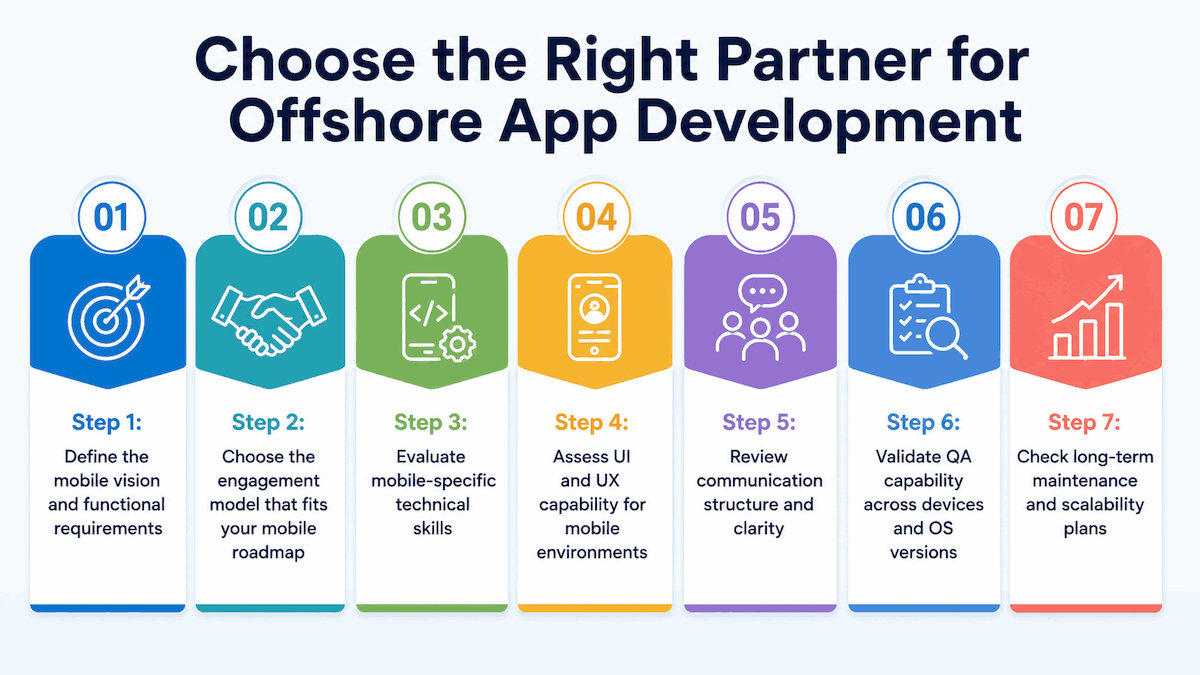
Step 1: Define the mobile vision and functional requirements
Before evaluating vendors, define what the app must achieve from a business and user perspective. A clear mobile vision helps offshore teams estimate accurately, identify delivery risks, and avoid building features that do not support the product roadmap.
- Clarify product goals: Identify the main business problem the app should solve, such as improving customer engagement, digitizing operations, or launching a new revenue channel. Add measurable targets like user retention, booking completion, response time, or revenue contribution.
- Define functional scope: List the core features, target users, platforms, and required integrations. For example, an on-demand delivery app may need user registration, real-time tracking, payment integration, push notifications, and admin dashboards.
- Map key user journeys: Document the most important flows, such as onboarding, search, checkout, booking, messaging, or account management. This allows the vendor to understand how features connect, not just what screens need to be built.
Step 2: Choose the engagement model that fits your mobile roadmap
Different mobile products require different delivery structures. The right engagement model depends on how stable your requirements are and how quickly you expect the roadmap to evolve.
How to choose the right model:
- Use Fixed Price when scope, features, and launch requirements are clearly defined.
- Choose Time & Materials if product requirements are likely to change during development.
- Consider a Dedicated Team for long-term products with continuous releases and feature expansion.
- Ask vendors how change requests are handled under each model before signing.
- Compare not only rates but also team continuity, flexibility, and scalability.
Step 3: Evaluate mobile-specific technical skills
A capable offshore app development partner should understand platform behavior, mobile performance, app store rules, and the technical trade-offs between native and cross-platform development.
- Review similar mobile projects: Ask for apps that match your complexity, industry, or feature requirements. Focus on projects with real-time features, payments, maps, offline mode, media processing, or complex backend integration if your app requires them.
- Check platform expertise: Evaluate experience with Swift, Kotlin, Flutter, React Native, backend APIs, cloud services, and mobile DevOps. Ask why they would recommend native or cross-platform development for your specific app.
- Assess production experience: Discuss how they handle crash monitoring, push notifications, app store submissions, performance optimization, and post-launch updates. These are practical indicators of real mobile delivery maturity.
Step 4: Assess UI and UX capability for mobile environments
Mobile UX directly affects retention, conversion, and user satisfaction. A strong partner should design for real user behavior, limited screen space, platform conventions, and fast interactions rather than only producing attractive screens.
- Review live product flows: Do not evaluate design capability only through screenshots. Test live apps or prototypes to see how onboarding, navigation, forms, search, checkout, and error states actually work.
- Check mobile design process: Ask whether the team creates wireframes, clickable prototypes, design systems, and usability feedback loops before development. This reduces redesign work once coding has already started.
- Validate platform fit: Confirm that the design approach respects iOS and Android interaction patterns. Small details such as navigation, gestures, permissions, and form behavior can affect usability and app store quality.
Step 5: Review communication structure and clarity
Offshore app development depends on structured communication, not constant meetings. Before signing, verify how information moves between your product owner, the offshore project manager, designers, developers, QA team, and technical leads.
- Confirm ownership and contact points: Identify who manages requirements, technical decisions, sprint updates, and issue escalation. A clear communication chain prevents delays when urgent product or technical questions appear.
- Review reporting formats: Ask for sample sprint reports, demo formats, Jira boards, or delivery dashboards. You should be able to track completed tasks, blockers, risks, bugs, and upcoming milestones without chasing updates.
- Define working rhythm: Agree on meeting frequency, response times, time-zone overlap, sprint demos, and approval timelines. This is especially important when business stakeholders and development teams work in different countries.
Step 6: Validate QA capability across devices and OS versions
Mobile QA requires more than checking whether features work. Apps must perform consistently across devices, screen sizes, OS versions, network conditions, permissions, and app store requirements.
- Request a device testing matrix: Ask which physical devices, emulators, and cloud testing platforms the vendor uses. The matrix should cover your target users’ common devices and both current and older OS versions.
- Review QA documentation: Request sample test cases, bug reports, regression checklists, and release readiness reports. These materials show whether testing is structured or handled informally at the end of development.
- Check performance and edge-case testing: Confirm how the team tests slow networks, offline mode, low battery, app interruptions, permissions, background activity, and crash recovery. These scenarios often create real user complaints after launch.
Step 7: Check long-term maintenance and scalability plans
A mobile app continues to evolve after launch as users, devices, operating systems, and business needs change. Evaluate whether the offshore partner can support both immediate release needs and long-term product growth.
- Define maintenance coverage: Clarify support hours, bug-fix response times, OS update handling, security patches, and app store update responsibilities. These terms should be included before launch, not negotiated after issues appear.
- Assess scaling capability: Ask how quickly the vendor can add developers, QA engineers, designers, or DevOps support when the roadmap expands. Also check how they onboard new team members without slowing delivery.
- Secure knowledge continuity: Review how documentation, architecture decisions, release notes, and handover materials are maintained. This protects the project if team members change or your internal team takes over later.
How Much Does It Cost to Outsource App Development Offshore?
The cost of offshore app development depends on app complexity, required skill sets, team size, and the region of the offshore outsourcing partner. Below is a combined table that shows the cost ranges across offshore development countries, complexity levels, and typical team sizes used in mobile app projects.
|
Category |
Cost Range / Details |
Notes |
| Region (per hour) |
|
Costs vary by seniority, specialization, and experience with mobile projects |
| App Complexity (fixed cost) |
|
Complexity includes UI depth, backend logic, API integrations, and advanced features |
| Team Size (per month) |
|
Larger teams accelerate delivery for enterprise or multi-platform apps |
If you’re considering offshore app development by regions, here is a simple guide to help you decide the best countries for offshore development for your mobile development projects:
- If cost is your primary driver: India and Vietnam offer some of the most competitive rates globally, alongside large talent pools.
- If you prioritize communication and cultural alignment: For US-based companies, the Philippines is renowned for its high English proficiency and Western business culture. For European companies, Poland and Romania are excellent choices due to high English scores and cultural compatibility.
- If time zone overlap is critical for collaboration: Latin American countries (like Brazil, Mexico, Colombia) offer convenient working hours for North American teams, while Eastern Europe aligns well with Western European business hours.
- If you need a balance of cost, quality, and stability: Poland stands out with its large, skilled workforce and stable economic environment, though at a higher cost than Asia.
Key Factors Affecting the Cost of Offshore App Development
The final budget of app development depends on how complex the app is, how many platforms it supports, what technologies are required, and how much post-launch support your business needs. Understanding these factors helps you estimate costs more accurately and avoid hidden expenses during development.
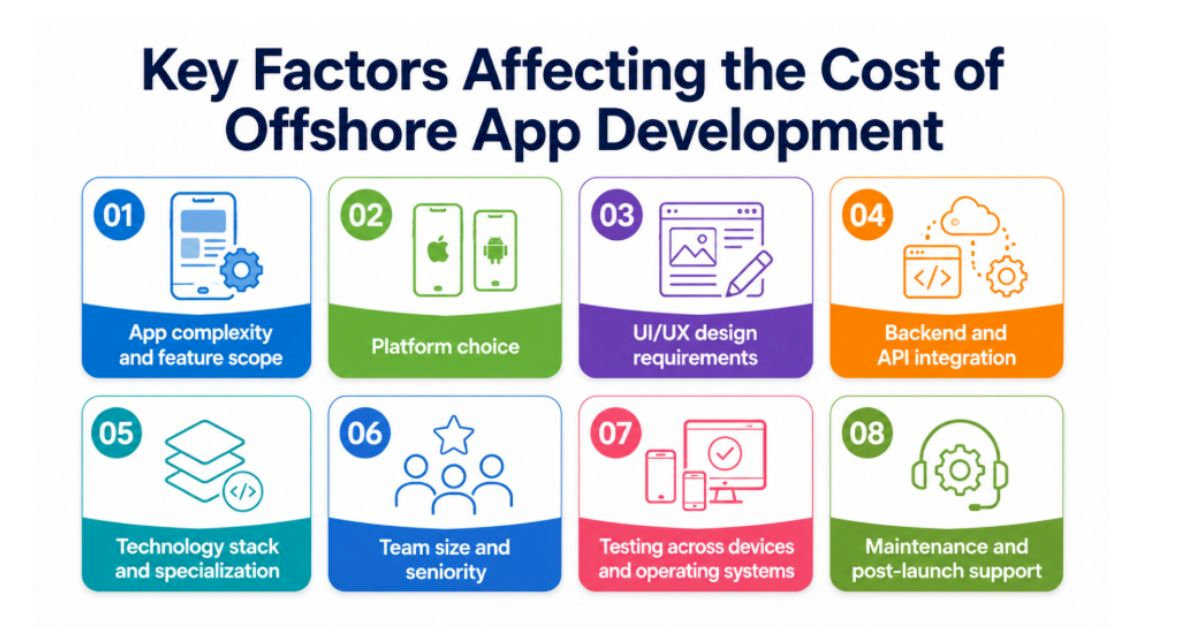
- App complexity and feature scope: A simple app with basic screens, login, and standard content management costs less than an app with real-time chat, AI recommendations, payment systems, booking flows, or advanced user roles.
- Platform choice: Developing for only iOS or Android is usually more cost-effective than building for both platforms separately. Cross-platform frameworks such as Flutter or React Native can reduce cost when the product does not require fully native performance.
- UI/UX design requirements: Apps with custom animations, complex user journeys, interactive dashboards, or highly branded interfaces require more design and front-end development effort.
- Backend and API integration: Apps that connect with CRMs, ERPs, payment gateways, third-party APIs, cloud services, or internal business systems need more backend planning, testing, and security review.
- Technology stack and specialization: Advanced capabilities such as AI, blockchain, IoT, AR/VR, geolocation, or real-time data processing require specialized offshore developers, which can increase the hourly rate and total project cost.
- Team size and seniority: A larger team can shorten delivery time, but it increases monthly spending. Senior mobile developers, solution architects, QA engineers, and DevOps specialists also cost more than junior resources.
- Testing across devices and operating systems: Mobile QA requires testing across different screen sizes, OS versions, devices, and network conditions. More testing coverage adds cost but helps reduce crashes, poor performance, and app store rejection risks.
- Maintenance and post-launch support: Offshore app development does not end after launch. Ongoing updates, bug fixes, OS compatibility checks, performance monitoring, and new feature releases should be included in the long-term budget.
How Newwave Solutions Get You in Offshore App Development?
Offshore app development delivers strong value when supported by the right partner. Newwave Solutions is headquartered in Vietnam, one of the most competitive offshore development countries known for quality engineering, cost efficiency, and stable project delivery.
With more than three hundred specialists, we deliver offshore software development services covering mobile, backend, UI and UX, cloud, and advanced technologies.
Newwave Solutions’ Mobile App Development Process
Our teams follow a disciplined SDLC and use Agile methods to ensure predictable, transparent, and collaborative development. From initial discovery to long-term support, each stage ensures your mobile application aligns with business goals, user expectations, and future growth plans.
- Discover – Understand business objectives, target users, market opportunities, and project requirements to define a clear development roadmap.
- Design – Create wireframes, prototypes, and user-centric UI/UX designs that deliver intuitive experiences and consistent branding.
- Plan – Establish project scope, agile sprint schedules, milestones, resources, and delivery timelines to ensure efficient execution.
- Build – Develop the application using the most suitable technologies while focusing on scalability, security, and performance.
- Test – Conduct comprehensive quality assurance, including functionality, usability, performance, compatibility, and security testing.
- Launch – Deploy the app to app stores or enterprise environments while managing publishing requirements and release readiness.
- Support – Provide ongoing maintenance, monitoring, updates, and feature enhancements to keep the application secure, stable, and aligned with evolving business needs.
Expertise Across Various Domains
Blockchain
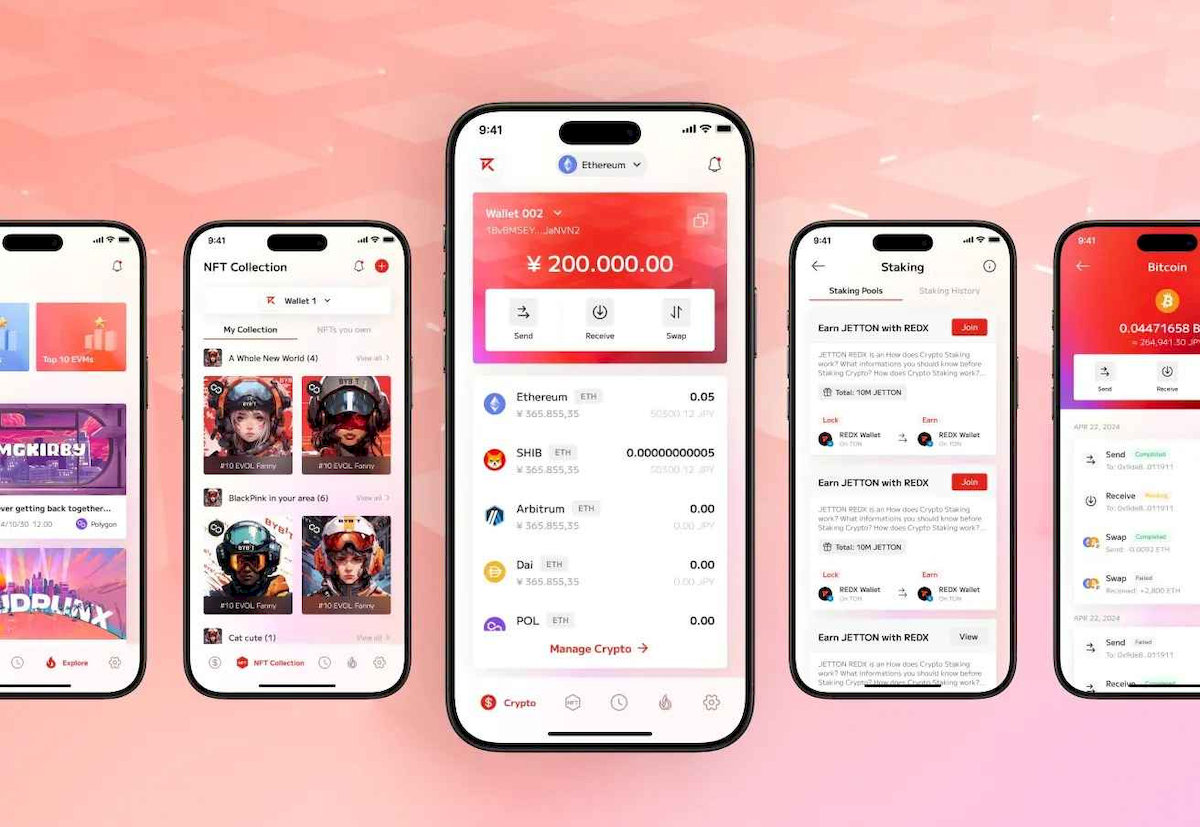
Newwave Solutions built a secure multi-chain wallet for managing coins, tokens, and NFTs across Ethereum, BNB Chain, Polygon, TON, and Bitcoin. The solution supports web, mobile, and Chrome Extension with self-custodial security, real-time transactions, cross-chain swaps, and NFT utilities.
Education
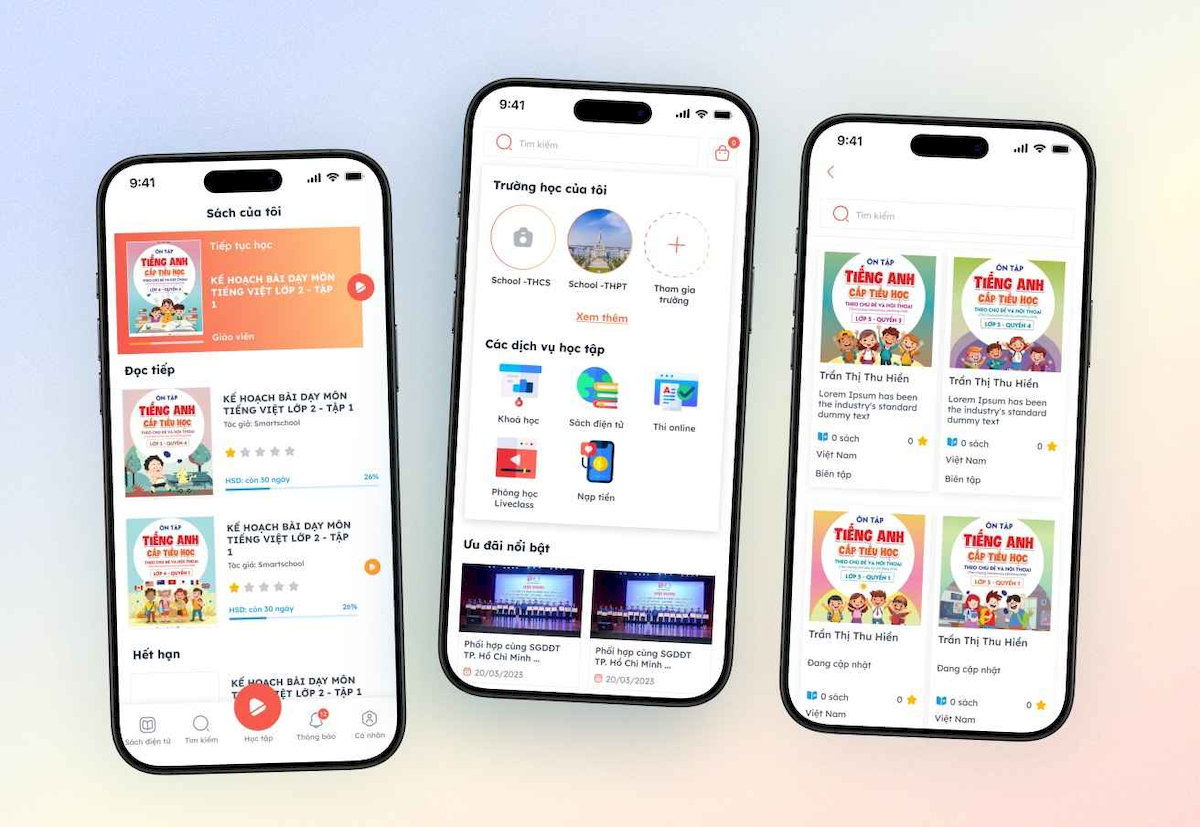
We developed an interactive online learning platform for K-12 students across web and mobile. The platform combines digital books, courses, quizzes, minigames, exams, and an admin CMS to create a scalable and engaging learning environment.
Real estate
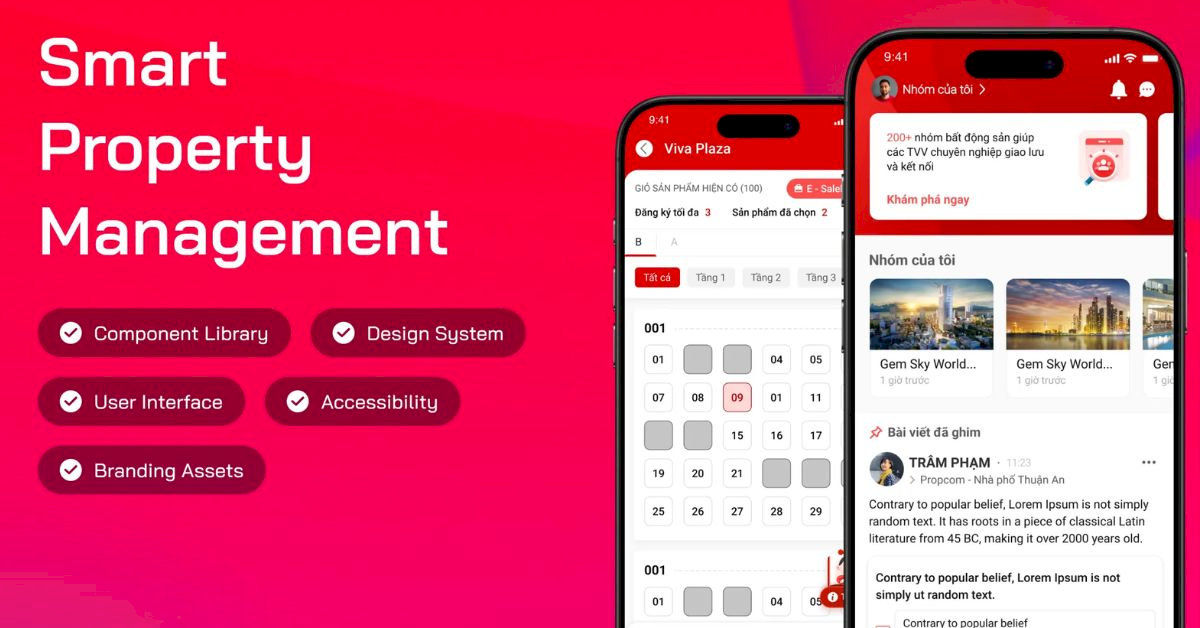
Our cross-platform real estate management system is designed for brokers, integrating CRM, digital transactions, LMS, messaging, gamification, and community features. The platform helped unify fragmented workflows and contributed to a reported 50% increase in turnover.
By choosing Newwave Solutions, you gain a trusted partner capable of delivering mobile innovation at speed, quality, and scale—while keeping your business goals at the center of every decision.
Final Thought
Offshore app development has evolved from a cost-saving tactic into a strategic growth model. By leveraging global talent, flexible engagement options, and specialized mobile expertise, businesses can accelerate product delivery, improve scalability, and focus internal resources on innovation.
If you are looking for a trusted offshore development partner, Newwave Solutions is the right choice. With 14+ years of experience, 300+ technology professionals, and expertise across iOS, Android, Flutter, React Native, AI, and cloud technologies, we help businesses build, launch, and scale high-quality mobile applications with confidence. Contact our team today to discuss your app development goals.
FAQs
1. What are the main risks of offshore app development?
Common risks include communication gaps, unclear requirements, weak quality control, data security issues, and limited code visibility.
2. How can I mitigate risks with remote app development teams?
Create a clear product brief, user stories, and acceptance criteria before each sprint so the team knows exactly what to build. Use shared project tools, weekly demos, repository access, code reviews, and QA reports to track progress closely. You should also sign NDA, IP ownership, and security agreements before development starts to protect your product and data.
3. Is offshore app development suitable for startups?
Yes. Startups often use offshore teams to build MVPs faster and control development costs. The model also allows them to scale resources as the product grows.
4.Can offshore teams build both iOS and Android apps?
Yes. Offshore app development teams can build native iOS and Android apps or use cross-platform frameworks like Flutter and React Native to support both platforms efficiently.
5.What are the typical engagement models for outsourced app development?
The most common engagement models include Dedicated Development Teams, Fixed-Price Projects, Time and Materials (T&M), Staff Augmentation, and Offshore Development Centers (ODCs).
To Quang Duy is the CEO of Newwave Solutions, a leading Vietnamese software company. He is recognized as a standout technology consultant. Connect with him on LinkedIn and Twitter.



Read More Guides


Get stories in your inbox twice a month.
Let’s Build Something Extraordinary
Sign up for a 30 min no-obligation strategic session with us. Transform your Ideas into scalable reality.
Leave a Reply