


What is difference between layer 1, 2 and 3 blockchain? A Complete Beginner’s Guide
Understanding the difference between layer 1 2 and 3 blockchain is essential to understanding how modern blockchain systems scale, evolve, and deliver real-world applications. Rather than competing directly, Layer 1, Layer 2, and Layer 3 form a stacked architecture, each solving a different part of the blockchain trilemma: security, decentralization, and scalability. This guide explains how each layer works, where it fits, and how they interact in practice.
Layer 1 (L1) – The Trust Foundation
Layer 1 blockchains represent the base layer of trust in the blockchain ecosystem. They are responsible for defining the fundamental rules of the network, validating transactions, maintaining consensus, and securing digital assets without depending on any external system.
Every higher layer, whether Layer 2 or Layer 3, ultimately relies on Layer 1 for final settlement, dispute resolution, and security guarantees. If Layer 1 fails, everything built on top of it inherits that risk.
In simple terms, Layer 1 is the constitutional layer of blockchain systems. It decides what is valid, what is final, and what can never be reversed.

Examples
Well known Layer 1 blockchains include:
- Bitcoin
- Ethereum
- Solana
- Cardano
- Avalanche
These networks are frequently compared in discussions such as SOL vs ETH and Bitcoin and Ethereum, where trade offs between decentralization, security, and performance become especially clear. Each Layer 1 makes deliberate architectural choices that shape the entire ecosystem above it.
How Does Layer 1 Work?
Layer 1 blockchains operate as fully independent and self contained networks. Every core function of the blockchain happens directly on the base layer.
At a high level, Layer 1 works through the following mechanisms:
- A distributed network of validators or miners that verify transactions
- A consensus mechanism such as Proof of Work or Proof of Stake that ensures agreement across the network
- On chain execution of Smart contracts and transaction logic
- Replication and permanent storage of transaction data across all participating nodes
Because every node independently verifies the same data, Layer 1 achieves strong security and censorship resistance. However, this design also means that every transaction competes for limited block space, which naturally constrains throughput and increases fees during periods of high demand.
Pros
Layer 1 is optimized for trust, neutrality, and long term security.
Key strengths include:
- Maximum decentralization and resistance to censorship
- Strong security guarantees backed by large and diverse validator sets
- Native asset issuance with irreversible settlement finality
- Full sovereignty without reliance on external execution layers
These properties make Layer 1 ideal for high value transactions, core protocol assets, and final settlement of complex financial activity.
Cons
The same features that give Layer 1 its strength also create structural limitations.
Key challenges include:
- Low transaction throughput relative to global demand
- High transaction fees during network congestion
- Slower confirmation times when block space is scarce
- Difficult, slow, and high risk protocol upgrades
These constraints are not implementation flaws. They are deliberate trade offs made to preserve decentralization and security. As a result, Layer 1 alone cannot support mass adoption without additional layers.
Layer 1 Trend
Today, Layer 1 blockchains are evolving from general purpose execution environments into specialized trust anchors for broader ecosystems.
Key trends shaping Layer 1 include:
- Ethereum focusing on settlement, consensus, and data availability rather than execution
- Solana pushing the limits of monolithic performance through hardware and parallel execution
- Bitcoin reinforcing its role as a secure store of value and settlement layer
- Reduced competition at the execution layer and increased collaboration with Layer 2 systems
Rather than trying to do everything, modern Layer 1 networks are concentrating on what they do best: providing a globally trusted, neutral foundation. Execution, customization, and user experience are increasingly pushed upward to Layer 2 and Layer 3.
Layer 1 is no longer the entire blockchain. It is the bedrock that makes the rest of the stack possible.
Layer 2 (L2) – The Growth Engine
Layer 2 blockchains are designed to scale Layer 1 without weakening its security or decentralization guarantees. Instead of replacing Layer 1, Layer 2 systems extend it by moving most transaction execution off the base chain while still anchoring final state and security back to Layer 1.
Today, the majority of user-facing activity in Web3, including DeFi trading, NFT minting, and social applications, happens on Layer 2. This shift reflects a broader architectural consensus: Layer 1 secures the system, while Layer 2 delivers usability and scale.
Examples
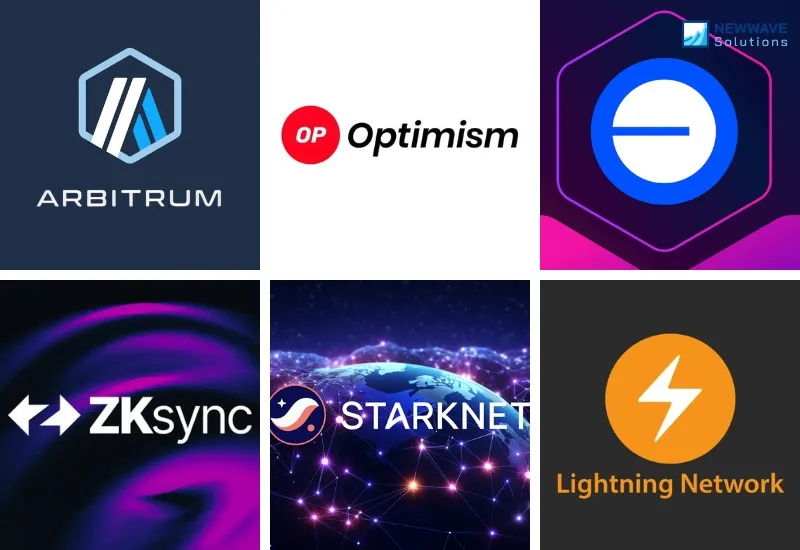
Widely adopted Layer 2 solutions include:
- Arbitrum
- Optimism
- Base
- zkSync
- StarkNet
- Lightning Network (built on Bitcoin)
These platforms play a central role in discussions around layer 1 vs layer 2 vs layer 3 blockchain, as they demonstrate how scalability can be achieved in practice without sacrificing trust.
How Does Layer 2 Work?
Layer 2 systems reduce the workload on Layer 1 by executing transactions elsewhere and submitting only compressed proofs or summaries back to the base chain.
A typical Layer 2 transaction flow looks like this:
- Users submit transactions to a Layer 2 network instead of directly to Layer 1
- The Layer 2 executes transactions rapidly and at low cost
- Many transactions are bundled together into batches
- Cryptographic proofs or state commitments are generated
- These proofs are posted to Layer 1 for verification and final settlement
Layer 1 acts as the ultimate verifier and judge, while Layer 2 handles speed and volume. This design allows Layer 2 to scale horizontally without compromising the security model established by Layer 1.
Pros
Layer 2 is optimized for real-world usage and application growth.
Key advantages include:
- Dramatically lower transaction fees compared to Layer 1
- Much higher throughput and faster confirmation times
- Security inherited from Layer 1 settlement guarantees
- Strong EVM compatibility, enabling existing DApp and Smart contracts to migrate easily
Because of these benefits, Layer 2 has become the preferred environment for dApp development solutions targeting mainstream adoption and frequent user interaction.
Cons
While powerful, Layer 2 introduces architectural and operational complexity.
Key limitations include:
- Dependence on Layer 1 availability and liveness
- Withdrawal delays in some rollup designs, especially optimistic rollups
- Fragmented liquidity and users across multiple Layer 2 networks
- Additional trust assumptions around bridges, sequencers, and upgrade keys
These challenges are not failures, but trade offs inherent in scaling decentralized systems. They remain active areas of innovation and competition.
Layer 2 Trend
Layer 2 is currently the primary growth engine for Web3 adoption. Several important trends are shaping its evolution:
Rollup Standardization
Optimistic and ZK rollups are converging toward shared tooling, better EVM compatibility, and more predictable developer experiences.
Superchain and Stack Models
Frameworks such as OP Stack, ZK Stack, and Polygon CDK allow teams to launch new Layer 2 networks quickly while sharing security assumptions and infrastructure.
Layer 2 as Full Ecosystems
Major Layer 2s are no longer just scaling solutions. They are evolving into independent application hubs with their own governance, communities, and economic incentives.
Layer 2 is rapidly becoming the default execution layer for blockchain applications, while Layer 1 increasingly serves as the security and settlement backbone that makes this expansion possible.
Layer 3 (L3) – The Boundary of Customization
Layer 3 blockchains represent the application-optimized layer of the blockchain stack. If Layer 1 establishes trust and Layer 2 delivers scalability, Layer 3 focuses on precision: tailoring performance, economics, and user experience to a specific product or domain.
Rather than serving as general-purpose networks, Layer 3 systems are typically built on top of Layer 2 or directly anchored to Layer 1, inheriting security while optimizing everything else for a narrowly defined use case. This design allows teams to push blockchain infrastructure closer to the expectations of Web2-grade applications.
Examples
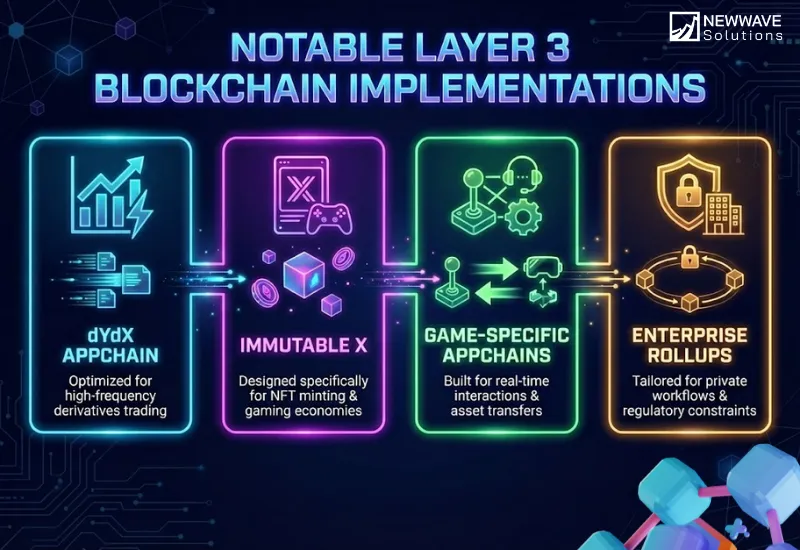
Notable Layer 3 implementations include:
- dYdX AppChain, optimized for high-frequency derivatives trading
- Immutable X, designed specifically for NFT minting and gaming economies
- Game-specific AppChains built for real-time interactions and asset transfers
- Enterprise rollups tailored for private workflows and regulatory constraints
These Layer 3 solutions commonly power high-performance trading platforms, large-scale games, and NFT ecosystems where generic blockchain environments are insufficient.
How Does Layer 3 Work?
Layer 3 systems specialize execution by narrowing scope and assumptions.
Typical Layer 3 characteristics include:
- Application-specific execution logic and transaction rules
- Custom fee models aligned with product economics rather than generic gas pricing
- Dedicated execution environments optimized for throughput or latency
- Settlement anchored to Layer 2 or Layer 1 for security and finality
- Blockchain complexity abstracted away from the end user
In practice, Layer 3 acts as a purpose-built execution layer. From the user’s perspective, interacting with a Layer 3 application often feels indistinguishable from using a traditional centralized app, even though blockchain guarantees still exist underneath.
Pros
Layer 3 is optimized for specialization and user experience.
Key benefits include:
- Ultra-low latency enabled by tightly controlled execution environments
- Custom performance tuning based on application behavior
- Tailored governance and economic models aligned with business goals
- Cleaner and more intuitive UX for non-crypto-native users
- Domain-specific scalability without competing for blockspace
These advantages make Layer 3 particularly attractive for gaming, trading, and enterprise-grade applications where experience and predictability matter more than generic composability.
Cons
However, Layer 3 introduces significant architectural trade offs.
Key drawbacks include:
- Liquidity and state fragmentation across multiple Layer 3 environments
- Higher operational and maintenance overhead
- Dependency on Layer 2 and Layer 1 availability and correctness
- Reduced composability compared to shared execution layers
- Lower standardization and limited battle-tested infrastructure
Layer 3 is powerful, but it is not a default choice. It is best suited for mature products with clear performance requirements and sufficient resources to manage complexity.
Layer 3 Trend
Layer 3 adoption is accelerating as blockchain infrastructure matures.
Key trends shaping Layer 3 include:
- App-specific rollups becoming the standard for large-scale applications
- Rollup-on-rollup architectures that reduce costs while preserving security
- Full abstraction of blockchain mechanics from end users
- Increased enterprise adoption for private, compliant workflows
- Tooling frameworks that simplify launching custom Layer 3 environments
Layer 3 increasingly represents the final user-facing layer of blockchain. It is where decentralized infrastructure disappears into the background, enabling applications that feel familiar to mainstream users while remaining anchored in trust-minimized systems.
What Is the Core Difference Between Layer 1, 2, and 3 Blockchain?
The core difference between layer 1, 2, and 3 blockchain lies in how responsibilities are distributed and how much complexity is abstracted away from users.
Rather than competing with each other, these layers work together as a stacked architecture, where each layer is optimized for a specific role. As you move up the stack, security remains anchored below, while performance, flexibility, and user experience improve above.
At a high level:
- Layer 1 establishes trust, consensus, and final settlement
- Layer 2 scales execution and reduces cost
- Layer 3 optimizes infrastructure for specific applications and users
Core Differences Table between L1, L2 and L3 Blockchain:
| Aspect | Layer 1 (L1) | Layer 2 (L2) | Layer 3 (L3) |
| Primary role | Trust, security, and final settlement | Scalability and cost reduction | Application-level optimization |
| Independence | Fully independent blockchain | Depends on Layer 1 for security | Depends on Layer 2 or Layer 1 |
| User interaction | Mostly indirect via DApps or wallets | Direct interaction for daily use | Most direct and abstracted |
| Performance | Low to moderate | High | Very high |
| Customization | Low | Medium | Very high |
Together, these layers form a modular blockchain stack that resolves the blockchain trilemma by separating concerns instead of forcing one network to do everything. This layered design is why modern discussions increasingly focus on layer 1 vs layer 2 vs layer 3 blockchain, rather than searching for a single “best” chain.
Typical Relationships and Data Flows
In practice, blockchain transactions rarely stay within a single layer. A real-world user action often flows across all three layers, with each layer handling the part it is best suited for.
A typical end-to-end flow looks like this:
- Users interact directly with a Layer 3 application, such as a trading platform, game, or NFT marketplace
- Layer 3 processes application-specific logic and batches results
- Layer 3 submits aggregated state changes to Layer 2
- Layer 2 compresses transactions, executes them efficiently, and generates proofs or commitments
- Layer 2 posts these proofs to Layer 1
- Layer 1 verifies correctness, finalizes settlement, and anchors security
From the user’s perspective, most of this complexity is invisible. They experience fast interactions and low fees, while Layer 1 silently guarantees correctness in the background.
Why This Layered Flow Matters?
This architecture enables several critical benefits:
- Scalability without sacrificing trust by keeping security at the base layer
- Cost efficiency by moving computation away from Layer 1
- Product-grade user experience through Layer 3 abstraction
- Parallel innovation where each layer can evolve independently
Rather than weakening blockchain security, this separation of responsibilities strengthens the entire system. Layer 1 focuses on being maximally secure, Layer 2 focuses on being fast and affordable, and Layer 3 focuses on being usable and specialized.
This is why the future of blockchain is not a single chain, but a stack of coordinated layers, each doing exactly what it does best.
Conclusion
The difference between layer 1, 2, and 3 blockchain is not about which layer wins.
It is about how they work together.
- Layer 1 establishes trust and final settlement
- Layer 2 delivers scalability and economic efficiency
- Layer 3 transforms infrastructure into real products people actually use
Together, these layers form the practical foundation of modern blockchain technology, where security, performance, and usability are no longer forced to compete.
For businesses and product teams, understanding this layered model is not a technical exercise. It is a strategic decision that directly impacts cost, user experience, scalability, and long-term viability. Whether you are comparing Bitcoin and Ethereum, evaluating SOL vs ETH, or planning your next decentralized product, choosing the right layer — and combining layers correctly — defines success far more than picking a trending chain.
At Newwave Solutions, we help teams turn this architectural understanding into execution. We work across the full blockchain stack, from infrastructure to application, with a focus on long-term sustainability rather than short-term experimentation.
Our blockchain capabilities include:
- Designing scalable DApp architectures aligned with Layer 1, Layer 2, and Layer 3 models
- Delivering production-ready dApp development solutions for DeFi, Web3, and enterprise use cases
- Building and integrating Layer 2 and Layer 3 systems for performance-critical applications
- Developing secure, audited Smart contracts tailored to real-world business logic
- Providing full-cycle NFT development services, from minting logic to marketplace integration
- Supporting custom protocol work, including blockchain programming language–level customization and self-hosted blockchain (Layer 0) design
Our team in Vietnam has delivered end-to-end blockchain platforms, including Fruit, a project recognized by clients for its robust wallet infrastructure and Layer 0 architecture. These experiences give us a practical understanding of how layered systems behave beyond whitepapers and testnets.
Blockchain adoption is no longer about experimenting with technology. It is about building systems that scale, integrate, and survive real users. The right layer choice is the first step. Executing it correctly is where most projects succeed or fail.
That is where Newwave Solutions comes in — helping you move from architectural clarity to production-ready blockchain systems, with confidence.
To Quang Duy is the CEO of Newwave Solutions, a leading Vietnamese software company. He is recognized as a standout technology consultant. Connect with him on LinkedIn and Twitter.



Read More Guides


Get stories in your inbox twice a month.
Let’s Build Something Extraordinary
Sign up for a 30 min no-obligation strategic session with us. Transform your Ideas into scalable reality.
Leave a Reply