


Blockchain in Fintech: Key Benefits, Use Cases & Challenges
The future of finance is being rebuilt on blockchain, a world of instant settlements, self-executing smart contracts, and sovereign digital identity. This convergence of blockchain and fintech is dismantling archaic systems, replacing them with transparent, efficient, and secure protocols. For forward-thinking leaders, grasping this shift is critical. This guide cuts through the complexity to provide the strategic insights you need to leverage blockchain in fintech and turn its disruptive potential into your next competitive advantage.
Key Takeaways
|
What Is Blockchain in Fintech?
Blockchain in fintech is the use of distributed ledger technology to securely record, verify, and share financial transactions across a decentralized network. Unlike traditional financial systems that rely on banks, clearing houses, or other central intermediaries, blockchain allows banks, fintech companies, and other authorized participants to access the same synchronized transaction record.
In the fintech industry, blockchain can be used in digital wallets, cross-border transfers, lending platforms, asset tokenization, identity verification, and other financial services where security, traceability, and operational efficiency are essential.
For example, a fintech lending platform can use blockchain to connect borrowers directly with lenders. A smart contract can automatically verify the loan terms, release funds, calculate repayments, and enforce the agreement without requiring a traditional intermediary to manage every step.
Key Benefits of Blockchain in the Fintech Industry
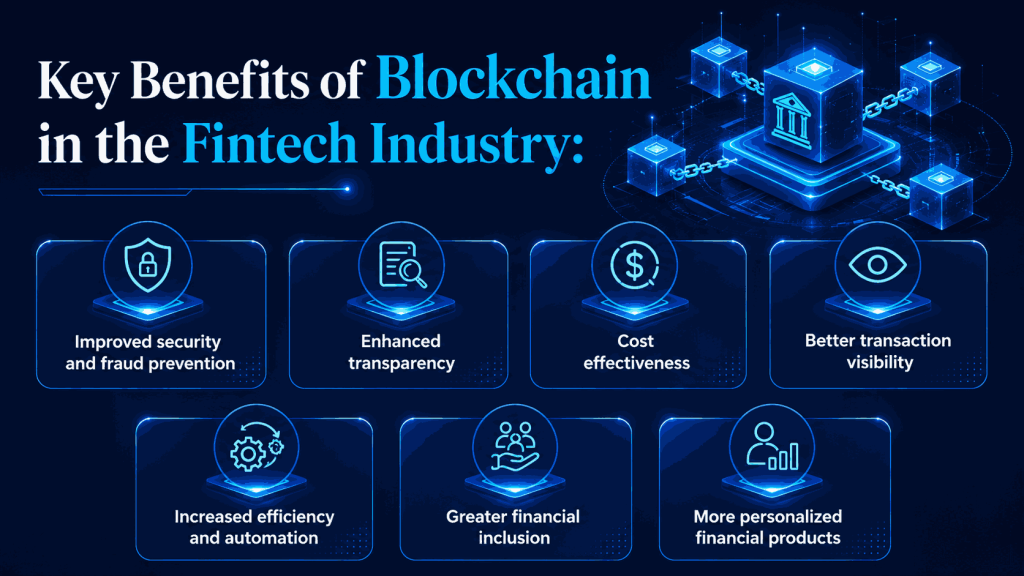
The key benefits of blockchain in fintech come from its ability to create secure, transparent and automated financial systems. By reducing dependence on centralized intermediaries, blockchain can help financial institutions lower operational risks, improve service delivery, and expand access to financial products.
Improved security and fraud prevention
Blockchain enhances financial security by storing transaction data across a decentralized network instead of a single system. Once verified, records are nearly impossible to alter without detection, reducing risks of tampering. This structure helps prevent fraud, unauthorized changes, and data manipulation.
Enhanced transparency
Blockchain offers a shared, tamper-resistant ledger that enables authorized users to view consistent transaction records. This improves the ability to track, verify, and audit financial activities in real time. Increased transparency strengthens accountability among financial institutions and fintech companies. It also supports regulatory compliance by creating clear, automated audit trails.
Cost effectiveness
Blockchain can reduce the cost of financial services by minimizing reliance on banks, clearing houses, and other intermediaries. Direct transactions and automated processes can lower processing fees, administrative expenses, and reconciliation costs for both fintech providers and their customers.
Better transaction visibility
Every validated blockchain transaction is recorded on a tamper-resistant ledger, creating a clear and consistent audit trail. This makes it easier for fintech companies to trace fund movements, verify asset ownership, detect suspicious activity, and demonstrate regulatory compliance.
Increased efficiency and automation
Blockchain improves efficiency by automating processes through smart contracts that execute actions when conditions are met. This reduces reliance on manual approvals and repetitive administrative tasks. As a result, transactions are completed faster with less paperwork and lower costs. Automation also minimizes human errors in areas like payments, loans, insurance, and reporting.
Greater financial inclusion
Blockchain expands access to financial services for individuals without traditional banking access. With just an internet connection and digital wallet, users can engage in financial activities. This includes sending payments, storing assets, and accessing decentralized financial services. Bockchain therefore helps make financial systems more inclusive across different regions and income levels.
More personalized financial products
Smart contracts allow fintech companies to design financial services around specific customer requirements and predefined conditions. Products such as loans, insurance policies, and investment plans can be customized and executed automatically, providing faster and more relevant user experiences.
Types of blockchain relevant to Fintech
Different types of blockchain support different fintech use cases, depending on access permissions, privacy requirements, transaction speed, and regulatory obligations. Financial institutions should choose a model based on who needs to participate in the network and how much control must be maintained.
Public blockchain
A public blockchain is an open network that anyone can join, view, and help validate transactions. Bitcoin and Ethereum are common examples used for cryptocurrency trading, decentralized finance, and cross-border payments. However, public networks may face slower transaction speeds, higher fees during peak periods, and more complex regulatory compliance.
Private blockchain
A private blockchain is a permissioned network managed by a single organization that decides who can access and validate data. JPMorgan, for example, uses blockchain-based systems to support institutional payments and internal financial operations.
Private blockchains provide faster processing, stronger privacy, and greater control over compliance. They are commonly used for internal settlements, identity verification, and transactions between trusted business partners.

Consortium blockchain
A consortium blockchain is controlled by a group of approved organizations rather than one company or the general public. Financial institutions can use platforms such as R3 Corda to share data and process settlements across participating banks.
This model combines controlled access with greater decentralization than a private blockchain. It is suitable for trade finance, insurance claims, interbank payments, and other processes that require industry collaboration.
Hybrid blockchain
A hybrid blockchain combines private access controls with selected features of a public network. Organizations can keep confidential customer and transaction data private while publishing certain records for public verification. This approach is useful for fintech applications that must protect sensitive information while maintaining traceability and accountability.
Key Features of a Blockchain-based Financial Solution
A blockchain-based financial solution should combine security, transparency, automation, and system connectivity. The following features help fintech platforms process transactions reliably, protect sensitive data, meet regulatory requirements, and integrate with wider financial ecosystems.
| Key Feature |
Description |
| Distributed Ledger | A distributed ledger stores synchronized transaction records across multiple nodes to improve transparency, reduce reliance on a single system, and prevent data loss. |
| Cryptographic Security | Cryptographic security uses encryption, digital signatures, and hashing to protect data, verify identities, and prevent unauthorized access or tampering. |
| Consensus Algorithms | Consensus algorithms enable network participants to agree on transaction validity, ensuring data accuracy and preventing fraud. |
| Smart Contracts | Smart contracts are automated blockchain programs that execute predefined rules to streamline processes like payments and settlements. |
| Peer-to-Peer Network (P2P) | A peer-to-peer network allows direct data or asset exchange between participants, reducing costs, delays, and reliance on intermediaries. |
| Cross-Chain Interoperability | Cross-chain interoperability enables data and asset exchange across different blockchain networks, improving flexibility and access. |
| Data Masking | Data masking protects sensitive information by hiding or replacing it while keeping it usable for authorized purposes. |
| Asset Tokenization | Asset tokenization converts ownership of assets into blockchain tokens, enabling easier division, transfer, and trading. |
| API Integrations | API integrations connect blockchain systems with external platforms, allowing seamless functionality without replacing existing infrastructure. |
What Are Challenges of Adapting Blockchain in Fintech
Blockchain can improve financial services, but implementation still involves technical, regulatory, and operational barriers. Fintech companies need to address these challenges early to build blockchain solutions that are scalable, compliant, secure, and compatible with existing financial infrastructure.
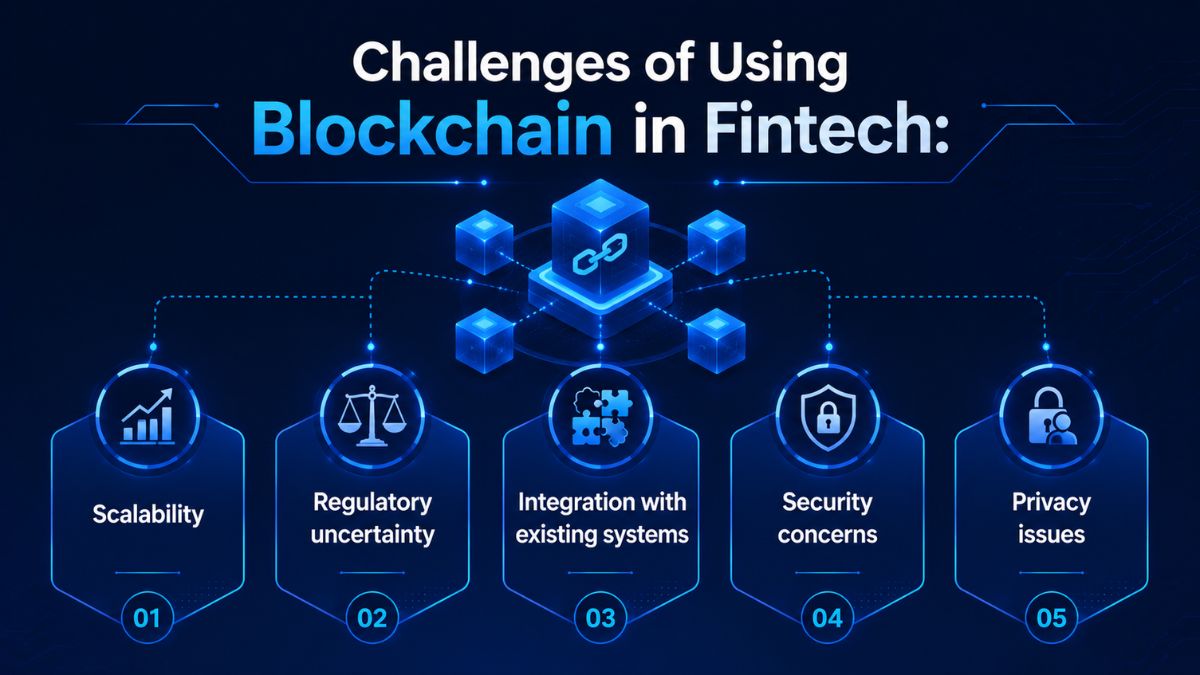
Scalability
Some blockchain networks, particularly those using Proof of Work, process transactions more slowly than traditional financial systems. Network congestion can also increase transaction fees, making these blockchains less suitable for payment platforms, trading systems, and other high-volume fintech applications.
Solution: Fintech companies can adopt faster consensus mechanisms such as Proof of Stake or use layer-2 scaling solutions, sidechains, and permissioned networks to increase transaction throughput while reducing processing time and costs.
Regulatory uncertainty
Blockchain regulations differ across countries and continue to evolve as governments respond to new digital assets and financial models. This uncertainty can make it difficult for fintech companies to determine licensing, reporting, taxation, and consumer protection requirements.
Solution: Businesses should work closely with legal experts, regulators, and industry associations throughout development. Regular compliance reviews and flexible system architecture can also help blockchain solutions adapt to changing regulations.
Integration with existing systems
Many financial institutions still rely on legacy systems that were not designed to communicate with blockchain networks. Connecting these systems can be technically complex, expensive, and disruptive to ongoing operations.
Solution: Middleware, APIs, and modular integration layers can connect blockchain platforms with existing banking, payment, and data systems. A phased implementation approach also allows companies to test compatibility before expanding blockchain across the organization.
Security concerns
Although blockchain records are difficult to alter, blockchain-based financial solutions can still be exposed to smart contract bugs, compromised private keys, insecure wallets, and endpoint attacks. A single vulnerability may result in financial loss or unauthorized access.
Solution: Companies should conduct regular smart contract audits, penetration testing, and security assessments before deployment. Secure key management, access controls, continuous monitoring, and employee security training further reduce potential risks.
Privacy issues
Blockchain transparency may conflict with financial privacy regulations because transaction data can remain permanently visible on the ledger. This creates concerns when platforms handle personal identities, account information, or confidential business data.
Solution: Privacy-enhancing technologies such as zero-knowledge proofs, data encryption, private channels, and permissioned blockchains can limit information exposure. Sensitive data can also be stored off-chain while only verification records are placed on the blockchain.
Applications of Blockchain in Fintech with Real Examples
Blockchain technology supports various fintech applications by improving transaction speed, transparency, security, and automation. Here are the most common ways fintech companies can leverage blockchain to simplify processes and create more accessible financial products.
Cross-border transactions
Blockchain enables financial institutions to transfer money across countries through a shared digital network. By reducing reliance on correspondent banks and other intermediaries, it can shorten settlement times, lower remittance fees, and give senders and recipients better visibility into transaction status.
For example, El Salvador introduced the Chivo Wallet, a government-supported Bitcoin wallet designed to facilitate digital payments and international remittances. Salvadorans living abroad could use the wallet to send money to recipients in the country without relying entirely on traditional remittance providers.
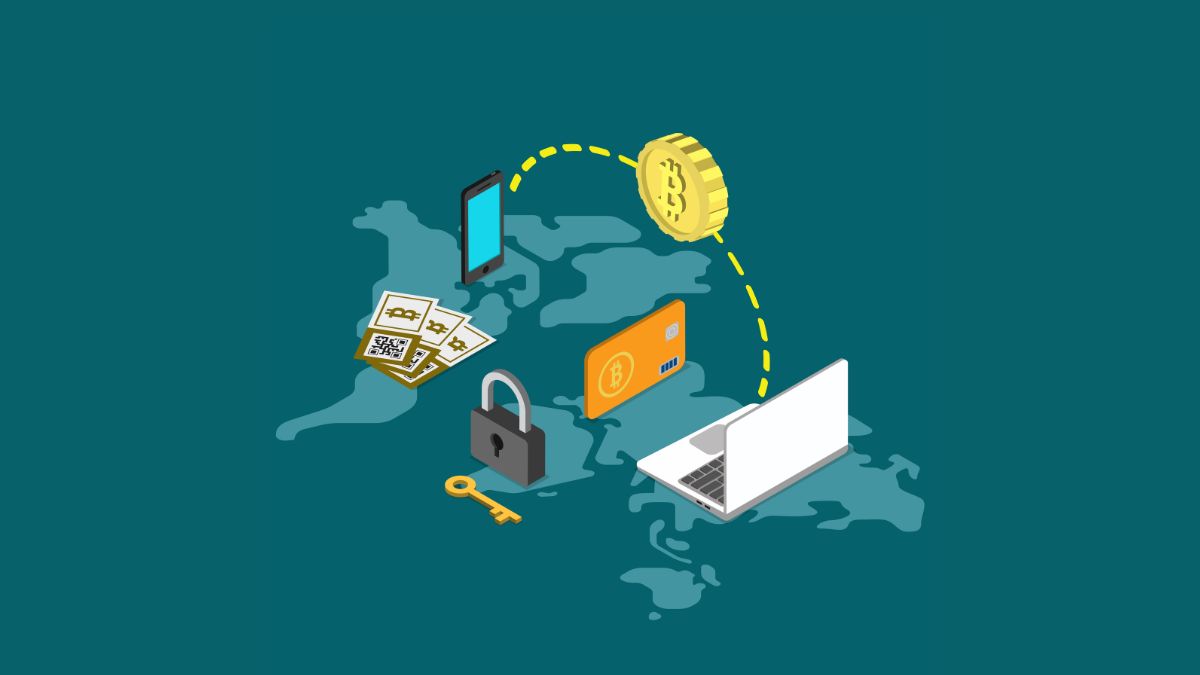
Cryptocurrency payments
Blockchain provides the infrastructure needed to create, transfer, and record cryptocurrency transactions. When users send assets such as Bitcoin, the network validates the payment and stores it on a distributed ledger, creating a traceable record without requiring a bank to process the transaction.
For example, Newwave Solutions developed a multi-chain cryptocurrency wallet allowing users to store, track, swap, and stake assets, as well as manage NFTs across multiple blockchains. It combines several networks into one platform while allowing users to retain full control of their private keys and funds.
Smart contracts and automated lending
Smart contracts are blockchain-based programs that automatically execute financial agreements when predefined conditions are met. Fintech lenders can use them to automate loan approvals, fund disbursement, interest calculations, collateral management, and repayments.
Decentralized lending platforms such as Aave use smart contracts to connect borrowers and lenders. Borrowers deposit eligible digital assets as collateral, and the protocol automatically manages the loan according to rules written into the smart contract.
Fraud reduction and transaction security
Blockchain creates a time-stamped transaction record that cannot be altered easily after validation. This makes unauthorized changes more visible and gives financial institutions a clearer audit trail for investigating suspicious activities, internal errors, and transaction disputes.
A notable example is J.P. Morgan’s Kinexys, which uses blockchain infrastructure for programmable payments, asset tokenization, and near-real-time settlement. Its shared ledger provides participating institutions with consistent transaction records and greater visibility into the movement of funds.
Trends and Innovations of Blockchain in Fintech
Blockchain in fintech is moving from isolated pilots toward integrated, regulated, and interoperable financial infrastructure. The following trends show how distributed ledger technology is converging with broader developments such as embedded finance, open banking, and artificial intelligence.
Tokenization of real-world assets
JP Morgan estimates tokenized real-world assets could reach USD 13 trillion by 2030. Tokenization is transforming assets such as real estate, bonds, and commodities into blockchain-based tokens, enabling fractional ownership and faster transactions. This innovation expands investor access and enhances efficiency across financial markets.
Blockchain consortia
Blockchain consortia bring banks, payment providers, insurers, and other institutions together with shared governance. These collaborative platforms help participants standardize data, reduce reconciliation work, and manage transactions through a common ledger.
Embedded finance
Embedded finance integrates payments, lending, insurance, or banking services directly into non-financial platforms such as e-commerce sites and SaaS applications. Blockchain can support this model by providing programmable payments, tokenized assets, and transparent transaction records behind the user experience. This allows businesses to offer financial services at the point of need while creating new revenue and customer-retention opportunities.
Peer-to-Peer financial networks
Blockchain-based peer-to-peer networks allow users to transfer funds or digital assets directly without routing every transaction through a central intermediary. This structure can reduce fees, improve settlement speed, and support round-the-clock financial services. P2P models are particularly relevant to remittances, digital asset trading, decentralized lending, and payments in underserved markets.
AI and blockchain integration
Artificial intelligence and blockchain are increasingly being combined to improve fraud detection, automated compliance, credit assessment, and financial decision-making. AI can analyze transaction patterns in real time, while blockchain provides traceable data and tamper-resistant records. Together, they can support more responsive financial systems, although institutions must still address model security, data quality, and governance risks.
Why Choose Newwave Solutions for Your Blockchain Fintech Project?
If you’re planning to build a blockchain product, partnering with an experienced development team can help you reduce technical risks and accelerate delivery. Newwave Solutions has over 14 years of delivering blockchain, fintech, and Web3 solutions for clients worldwide, combining strong engineering capabilities with practical business knowledge.
Our certified blockchain specialists help fintech companies build secure, compliant, and scalable financial products across smart contracts, decentralized applications, crypto wallets, and multi-chain ecosystems. We focus on enhancing transaction security, safeguarding customer assets and minimizing operational inefficiencies by applying blockchain where it delivers clear value for financial services.
What can you expect when you work with us?
- End-to-end development: From initial concept and strategy to deployment and maintenance, we guide you through every stage of your blockchain for fintech project.
- Security and compliance by design: We embed secure coding, access controls, and data protection into every stage. This helps reduce fraud risks, safeguard financial data, and support regulatory readiness.
- Financial and technical expertise: Our team blends blockchain engineering with fintech knowledge. We guide you in selecting the right network, scalability approach, and integrations for a reliable product.
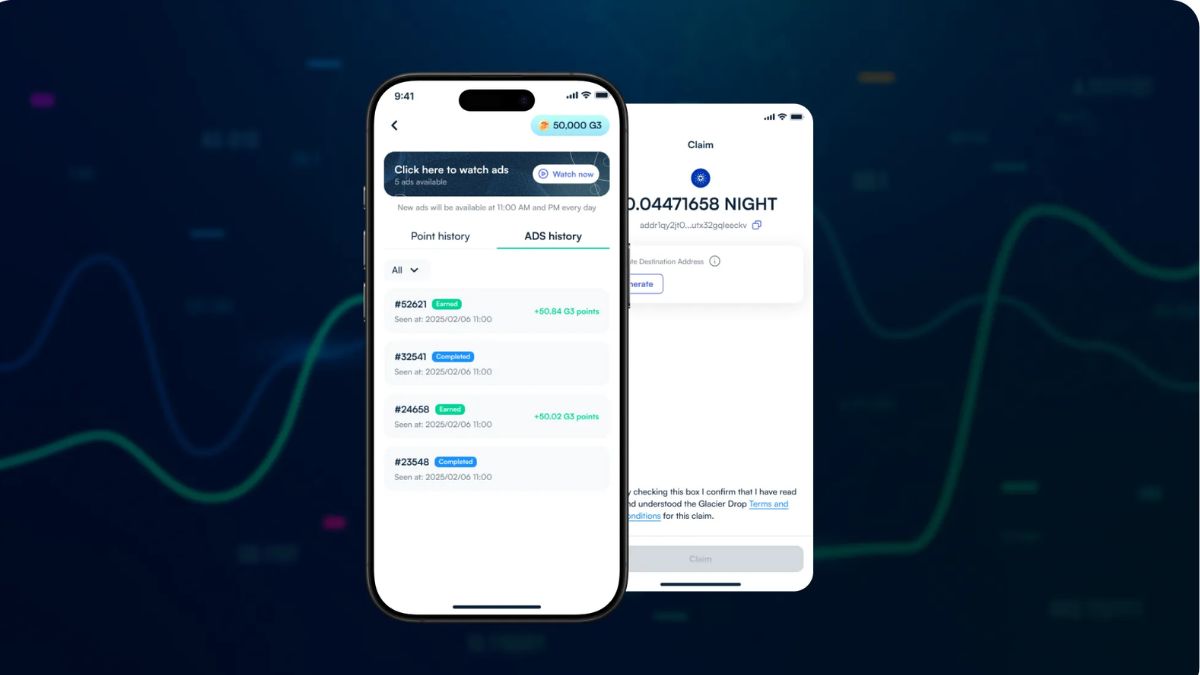
One of our outstanding projects is a multi-chain cryptocurrency wallet application that enables users to securely store, send, receive, and manage digital assets across multiple blockchain networks from a single platform. By combining multi-chain compatibility with a streamlined user experience, the solution simplifies digital asset management while maintaining strong security standards.
Contact Newwave Solutions to discuss your project with our blockchain experts and explore the right technical approach for your business goals.
Conclusion
Blockchain gives fintech companies new ways to improve trust, automate operations, and expand financial access without relying on traditional infrastructure alone. Success, however, depends on selecting the right use cases, addressing compliance requirements, and building on a secure technical foundation.
If you’re ready to explore what blockchain can do for your business, Newwave Solutions is here to help. Our blockchain specialists work closely with clients from strategy through deployment, delivering practical solutions that support long-term growth. Reach out to our experts to start planning your next blockchain project.
FAQs
1. What is the role of blockchain in FinTech?
Blockchain provides the infrastructure for secure, transparent, and decentralized financial transactions. It helps fintech companies automate processes, reduce reliance on intermediaries, improve fraud prevention, and support services such as cross-border payments, digital identity, and smart contract execution.
2. How is blockchain used in financial services?
Blockchain supports a wide range of financial services, including cross-border payments, digital asset management, lending, trade finance, fraud detection, and identity verification. It enables faster transactions while improving transparency and reducing manual processing.
3. What is the difference between fintech and blockchain?
Fintech refers to the broader use of technology to improve financial services, including mobile banking, digital payments, lending, and investment platforms. Blockchain is one technology that fintech companies can use to build secure, transparent, and decentralized financial applications.
4. What is the biggest problem with blockchain in fintech?
One of the biggest challenges is balancing innovation with regulatory compliance. Fintech companies must also address scalability, security risks such as smart contract vulnerabilities, and integration with existing financial systems before blockchain can be widely adopted.
5. Is blockchain secure for financial transactions?
Blockchain is considered highly secure because transactions are encrypted, distributed across multiple nodes, and difficult to alter after validation. However, wallets, smart contracts, and user credentials must also be properly secured to prevent cyberattacks and asset loss.
To Quang Duy is the CEO of Newwave Solutions, a leading Vietnamese software company. He is recognized as a standout technology consultant. Connect with him on LinkedIn and Twitter.



Read More Guides
Get stories in your inbox twice a month.
Let’s Build Something Extraordinary
Sign up for a 30 min no-obligation strategic session with us. Transform your Ideas into scalable reality.
Leave a Reply