


Stablecoin Development: What It Takes to Build a Reliable Digital Coin
Stablecoins have evolved into critical infrastructure for digital payments, liquidity management, and cross-border settlements. In 2025, stablecoin transactions reached approximately $33 trillion, reflecting growing demand for faster, programmable transfers that can settle contractor payments, marketplace transactions, and treasury movements within minutes rather than days.
Below, we’ll explores the stablecoin development process, including key infrastructure, token models, usability considerations, and regulatory challenges. At the end, you can better understand how to plan, build, and deploy stablecoin solutions effectively.
Key Takeways
|
What is Stablecoin Development?
Stablecoin development is the process of designing, building, and deploying a blockchain-based digital currency that maintains a stable value, usually by pegging it to a reserve asset such as the U.S. dollar. It typically involves smart contract development, collateral or reserve management, oracle integration, security testing, and regulatory compliance to support reliable issuance, transfers, and redemption.
Stablecoins function as programmable digital money across blockchain applications. They allow users and businesses to transfer funds, settle payments, trade digital assets, access lending markets, and manage liquidity without the sharp price fluctuations associated with cryptocurrencies.

Why Businesses Should Develop Stablecoin
Stablecoins offer businesses a practical way to use blockchain-based financial infrastructure without taking on the price volatility associated with traditional cryptocurrencies. By combining the stability of fiat currencies with the speed and accessibility of blockchain networks, they support more efficient everyday transactions and financial operations.
- Benefit from blockchain efficiency: Businesses can access instant settlement, always-on availability, and international reach while using an asset designed to maintain a stable value.
- Support practical business transactions: Stablecoins can be used for everyday commerce, treasury movements, marketplace settlements, and cross-border transfers.
- Enable instant global payments: Companies can send and receive payments across borders within minutes rather than relying on slower traditional payment systems.
- Simplify financial integration: Because stablecoins mirror familiar currencies such as the U.S. dollar or euro, businesses can more easily incorporate them into existing pricing, accounting, and financial workflows.
Technical Architecture Required for Stablecoin Development
A stablecoin requires more than a smart contract. Its technical architecture must support asset custody, token issuance, transaction settlement, governance, treasury operations, and ongoing monitoring throughout the stablecoin lifecycle.
Blockchain and smart contract infrastructure
The blockchain provides the network where the stablecoin is issued and transferred. Many projects begin on established networks such as Ethereum because they offer mature tools, broad wallet support, and strong developer ecosystems.
Smart contracts manage essential functions such as minting new tokens, burning redeemed tokens, and processing transfers. They may also include administrative controls that allow authorized teams to pause transactions, manage permissions, or meet compliance requirements.

Collateral Management
Collateral is the mechanism used to support the stablecoin’s value. The required system depends on whether the token is backed by fiat currency, cryptocurrencies, or algorithmic controls.
For fiat-backed stablecoins, the platform must connect bank deposits and withdrawals with the number of tokens in circulation. This requires secure reserve custody, accurate reconciliation, and automated minting and burning processes.
Crypto-backed models use onchain vaults, liquidation systems, and price oracles to manage volatile collateral. Reliable oracle feeds, backup data sources, and failover controls are essential because inaccurate prices can put the system’s solvency at risk.
Algorithmic models rely on treasury modules and automated supply adjustments. Their economic rules must be carefully tested to prevent unstable reactions during periods of market stress.
Security controls
Stablecoins can hold and transfer significant financial value, making them attractive targets for attackers. Key management is therefore one of the most important parts of the system.
Issuers commonly use hardware-secured keys, multiparty computation, multisignature approvals, and strict role-based access controls. Stablecoin platforms also need continuous monitoring, emergency procedures, and incident response plans so teams can react quickly to suspicious activity or system failures.
Integration systems
A stablecoin is useful only when users can easily acquire, transfer, trade, and redeem it. Issuers therefore need integrations with exchanges, wallets, market makers, and onramp and offramp providers.
Application programming interfaces (APIs) and software development kits (SDKs) allow businesses and developers to add stablecoin payments or transfers to their applications without managing every blockchain process themselves. Strong integration systems improve liquidity, support wider adoption, and make the stablecoin easier to use in real financial workflows.

How Many Types of Stablecoin Development?
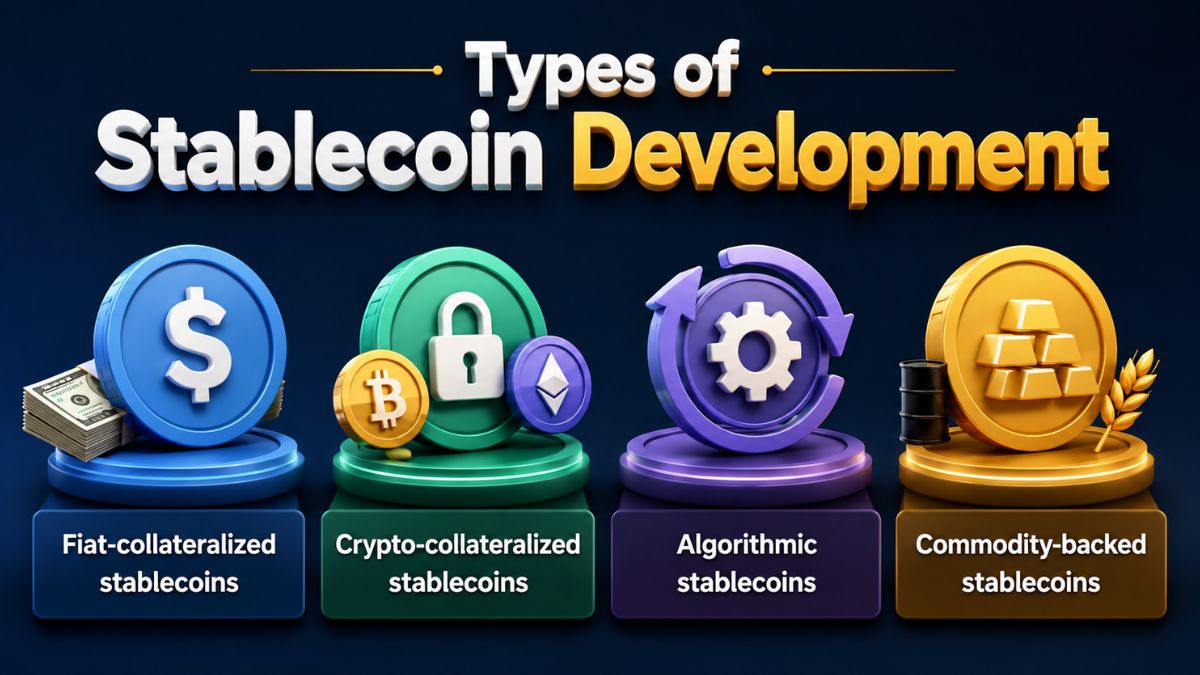
Stablecoins are generally classified by the method used to maintain their price. Each model offers a different balance of stability, transparency, capital efficiency, and risk.
Fiat-collateralized stablecoins
Fiat-collateralized stablecoins are backed by traditional currencies, such as the U.S. dollar, held in bank or custodial accounts. In most cases, one token represents one unit of the underlying currency.
This model provides strong price stability and is relatively easy for users to understand. However, issuers need regular audits or Proof of Reserve reporting to demonstrate that sufficient offchain assets exist to support the tokens in circulation.
Crypto-collateralized stablecoins
Crypto-collateralized stablecoins use cryptocurrencies or other digital assets as backing. Because these assets can change in value quickly, issuers usually require collateral worth more than the stablecoins created.
Smart contracts continuously monitor the collateral ratio and may automatically liquidate assets if their value falls too far to protect the stablecoin’s peg during market downturns.
Algorithmic stablecoins
Algorithmic stablecoins use smart contracts and predefined rules to adjust token supply according to market demand. When demand changes, the system may create or remove tokens to push the price back toward its target value.
These stablecoins often operate without full 1:1 collateral. As a result, they are more experimental and can be vulnerable to de-pegging when market confidence falls or the supply mechanism cannot respond effectively.
Commodity-backed stablecoins
Commodity-backed stablecoins maintain their value by linking each token to a physical asset, such as gold, oil, or government securities. The underlying assets are held by a custodian, while blockchain tokens represent ownership of a specific amount of that reserve.
Examples include Paxos Gold (PAXG) and Tether Gold (XAUT), which are backed by allocated physical gold.
Key Features of Stablecoin Affecting the Usability
Stablecoin design determines how easily users can transfer, redeem, store, and spend the token. A well-designed stablecoin should keep transactions fast and affordable, maintain reliable access to liquidity, provide clear reserve information, and integrate smoothly with familiar financial tools.
Transaction speed and costs
The blockchain network determines how fast transactions are confirmed and how much users pay in fees. On a slow or expensive network, small payments may not be practical because transaction costs can be too high. Faster and lower-cost networks make stablecoins more suitable for everyday payments, remittances, and frequent business transactions.
Many issuers use a multi-chain approach so users can choose between networks based on speed, cost, or DeFi liquidity. Good design keeps this technical complexity in the background and gives users a simple payment experience.
Liquidity and redemption access
Liquidity affects how easily users can buy, sell, or exchange a stablecoin without losing value. Strong exchange liquidity and reliable redemption channels help users convert the token back into its reference currency at or near the expected price.
Clear minting and burning processes also help keep supply aligned with deposits and withdrawals. When redemption is slow or liquidity is limited, users may struggle to exit their positions, which can weaken confidence in the stablecoin.
Transparency
Users need clear evidence that the stablecoin is supported by sufficient reserves or collateral. Regular reserve reports, third-party attestations, and consistent disclosures help users understand what backs the token and whether the issuer can meet redemption requests.
Greater transparency also makes the stablecoin easier for businesses, institutions, and regulators to evaluate. It also reduces uncertainty and strengthens trust in the token’s ability to maintain its value.
Users’ everyday experience
A stablecoin should be simple to acquire, store, send, receive, and redeem. Wallet compatibility, payment integrations, and reliable onramps and offramps determine how easily users can move between traditional currency and the stablecoin.
Usability improves when the token works with tools people already use, such as wallets, exchanges, marketplaces, and payment platforms. Users should not need advanced blockchain knowledge to complete basic transactions.
Common Challenges of Stablecoin Development
Developing a stablecoin requires careful planning across financial, security, regulatory, and operational domains. The following challenges highlight the key areas teams must address to ensure long-term stability and trust.
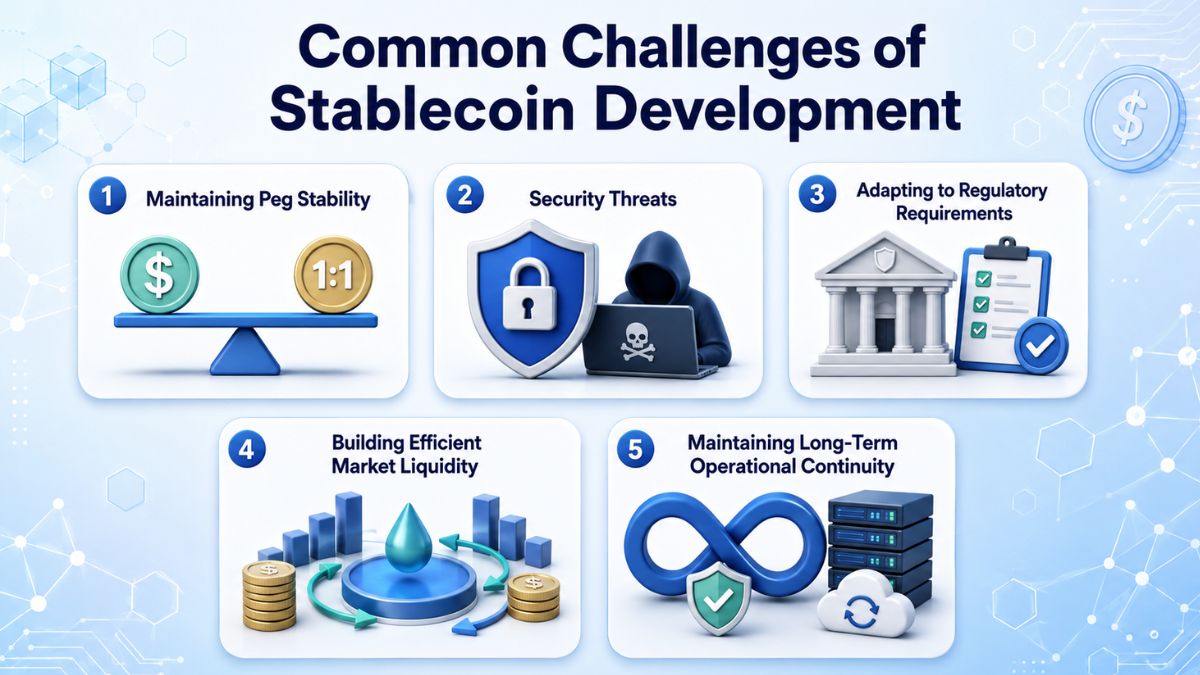
Maintaining peg stability
Keeping a stablecoin at its target value becomes difficult when markets move sharply or user confidence declines. Fiat-backed stablecoins depend on reserves that must remain liquid, accessible, and independently verifiable.
Crypto-collateralized models require sufficient collateral, reliable price oracles, and liquidation systems that can still operate during volatility and network congestion. Algorithmic stablecoins face an additional challenge because their stability relies heavily on continued market confidence in the underlying mechanism.
To reduce de-pegging risk, teams should maintain liquid reserves, use diversified collateral, test liquidation mechanisms under stress, and establish clear redemption procedures.
Security threats
Stablecoins concentrate significant value across smart contracts, wallets, oracles, and administrative controls, making them attractive targets for attackers. Vulnerabilities may appear in liquidation logic, price feeds, access permissions, or private-key management.
To protect it from security attacks, teams should use multisignature or MPC-based approvals, apply strict role-based permissions, conduct independent audits, and monitor transactions continuously.
Adapting to regulatory requirements
Stablecoin issuers must comply with different rules depending on where they operate. Markets in Crypto-Assets (MiCA) in the EU sets requirements for authorization, reserve management, redemption, disclosures, and governance, while the U.S. GENIUS Act establishes a federal framework for payment stablecoins.
To address this challenge, teams should identify target jurisdictions early and build compliance directly into the platform. This includes wallet screening, transaction monitoring, audit trails, reserve reporting, redemption controls, and configurable governance workflows that can adapt as regulatory obligations change.
Building efficient market liquidity
A technically reliable stablecoin may still struggle if users cannot easily buy, sell, or redeem it at its intended value. Limited exchange availability, weak market-maker support, and insufficient onramps or offramps can make the peg more vulnerable during periods of high demand.
As a result, ssuers should plan exchange integrations, liquidity partnerships, redemption channels, and real-world payment use cases before launching the token.
Maintaining long-term operational continuity
Stablecoin development does not end when the token is deployed. The system requires ongoing treasury coordination, reserve monitoring, governance decisions, security updates, incident response, and communication with users.
Teams should establish clear operational roles, automated monitoring, emergency procedures, and transparent reporting processes to keep the stablecoin reliable as transaction volume and market conditions change.
How Much Does Stablecoin Development Cost?
Stablecoin development costs vary based on the collateral model, smart contract complexity, supported blockchain networks, security requirements, and external integrations. These estimates below cover technical development and auditing but may not include legal, licensing, reserve management, or ongoing operational expenses.
|
Component |
Estimated Cost |
What It Covers |
| Smart contracts | $10,000–$50,000 | Token issuance, burning, redemption, collateral management, and peg mechanisms |
| Backend infrastructure | $5,000–$30,000 | APIs, databases, user flows, administrative controls, and external system connections |
| UI/UX design | $5,000–$20,000 | User dashboards, redemption portals, transaction interfaces, and administrative panels |
| Security audit | $8,000–$40,000 | Smart contract review, vulnerability testing, and remediation recommendations |
| Integrations | $5,000–$25,000 | Wallets, price oracles, payment systems, exchanges, and blockchain networks |
Future Trends and Innovations in Stablecoin Development
In 2026, some trends are shaping how businesses design and deploy stablecoins, including regulatory clarity, market concentration, and closer integration with tokenized assets
Expanding regulatory clarity
Regulation is making stablecoins easier for financial institutions and enterprises to evaluate. The U.S. GENIUS Act introduced a federal framework for payment stablecoins, including one-to-one reserve requirements.
In Europe, MiCA establishes rules covering authorization, reserve management, disclosures, governance, and redemption. Future stablecoin platforms will therefore need compliance capabilities built into their architecture from the beginning.
Continuing dollar and issuer dominance
The stablecoin market remains concentrated around U.S. dollar-backed assets and a small number of major issuers. The European Central Bank reported that approximately 99% of stablecoin supply is denominated in U.S. dollars, while USDT and USDC represented around 89% of the market examined.
This concentration gives established stablecoins strong liquidity advantages but may encourage businesses to explore regional currencies and specialized stablecoins for underserved markets.
Growing demand for yield-bearing stablecoins
Yield-bearing stablecoins combine price stability with returns generated through instruments such as Treasuries, repurchase agreements, tokenized real-world assets, or DeFi strategies. Research from 21Shares projected that this category could reach over $50 billion in 2026.
Conclusion
The stablecoin development is no longer a future prediction – it’s happening right now. With over $300 billion in circulation, trillions in annual transaction volume, and adoption accelerating across every sector of the economy, stablecoins have proven themselves as more than just another crypto trend. They represent nothing less than the evolution of money itself for the digital age.
Turning that opportunity into a secure and scalable product requires deep blockchain expertise at every development stage. With extensive experience in blockchain development, Newwave Solutions supports businesses with smart contract engineering, security audits and crypto wallet integration.
Contact our team to explore how we can support your stablecoin project.
FAQs
1. What is stablecoin development?
Stablecoin development is the process of designing, building, testing, and deploying a blockchain-based token that maintains a relatively stable value against a reference asset, such as the U.S. dollar. It includes smart contract development, reserve or collateral management, security auditing, compliance controls, wallet integration, and ongoing monitoring.
2. How are stablecoins built?
Stablecoins are built by first selecting a mechanism to maintain their value, such as fiat reserves, crypto collateral, or algorithmic supply controls. Developers then create smart contracts for issuance, transfers, redemption, and supply management before connecting them to custody systems, wallets, price oracles, and backend infrastructure. The final stages include security audits, compliance testing, and deployment across the selected blockchain networks.
3. What are the top 3 stablecoins?
The 3 largest stablecoins by market capitalization are Tether (USDT), USDC, and USDS. Rankings can change over time, so businesses should also evaluate liquidity, reserve transparency, regulatory status, network support, and redemption options rather than relying only on market size.
4. Is bitcoin a stablecoin?
No. Bitcoin is a decentralized cryptocurrency whose price is determined by market supply and demand, so its value can fluctuate significantly. Stablecoins are specifically designed to reduce volatility by tracking a reference asset or using collateral and stabilization mechanisms.
5. What are the downsides of stablecoins?
Stablecoins can face de-pegging, reserve, liquidity, smart contract, custody, and regulatory risks. Fiat-backed models also depend on centralized issuers and banking partners, while crypto-backed and algorithmic models may become unstable during sharp market downturns.
To Quang Duy is the CEO of Newwave Solutions, a leading Vietnamese software company. He is recognized as a standout technology consultant. Connect with him on LinkedIn and Twitter.



Read More Guides




Get stories in your inbox twice a month.
Let’s Build Something Extraordinary
Sign up for a 30 min no-obligation strategic session with us. Transform your Ideas into scalable reality.
Leave a Reply