


Modular vs Monolithic Blockchain: A Complete Guide to the Two Architectures Shaping the Future of Blockchain
The debate between modular vs monolithic blockchain is one of the most important architectural discussions in blockchain technology today. It determines how networks scale, how developers build applications, and how entire ecosystems evolve. At its core, this debate is not about speed alone. It is about how responsibilities are structured, where trust is placed, and how innovation is allowed to happen at scale. Modular and monolithic blockchains represent two fundamentally different answers to these questions.
What Is Modular Blockchain?
A modular blockchain is an architectural approach in which the core responsibilities of a blockchain are separated into specialized layers, each optimized for a specific task. Instead of relying on a single chain to execute transactions, reach consensus, and store data, modular systems distribute these functions across multiple components that work together.
This concept gained momentum as Ethereum encountered scalability constraints and the industry recognized a structural limitation: a single blockchain cannot efficiently serve as a global execution engine, settlement layer, and data availability network at the same time without significant trade-offs. Modular design emerged as a way to overcome this limitation through architectural separation rather than incremental optimization.
Today, modular blockchains are widely used to support rollups, appchains, and flexible application-specific environments. These systems allow developers to build scalable execution layers while inheriting security and trust guarantees from a shared base layer, most notably Ethereum.
How Does Modular Blockchain Work?
At a high level, modular blockchains follow a divide-and-specialize principle. Each layer focuses on a single responsibility and communicates with other layers through well-defined interfaces. This separation allows each component to scale, upgrade, and innovate independently.
Execution Layer
The execution layer is where transactions are processed and Smart contracts are executed. This is the layer that users and DApp developers interact with directly. In most modular systems, execution happens on rollups or app-specific chains that batch transactions off-chain for efficiency.
By isolating execution, modular systems can support multiple execution environments simultaneously, each optimized for different workloads such as DeFi, gaming, or payments.
Settlement Layer
The settlement layer acts as the final authority for dispute resolution and state finalization. It verifies proofs submitted by execution layers and ensures that state transitions are valid. Ethereum commonly serves as the settlement layer, providing strong security guarantees backed by a large validator set and significant economic value.
This layer is critical because it anchors trust across the entire modular system.
Consensus Layer
The consensus layer ensures agreement on the state of the network. In many modular designs, consensus is tightly coupled with the settlement layer rather than the execution layer. This allows execution environments to scale independently without fragmenting network consensus.
Data Availability Layer
The data availability layer guarantees that transaction data is publicly accessible so that anyone can independently verify state transitions. This prevents execution layers from withholding data and locking user funds. Data availability may be handled by Ethereum itself or by specialized networks such as Celestia or EigenDA.
Together, these layers allow modular systems to scale execution capacity while preserving decentralization and security.
Modular Blockchain Architecture
Modular architecture is horizontal rather than vertical. Each layer is responsible for a single function and can evolve without forcing changes across the entire system.
Key characteristics of modular blockchain architecture include:
- Independent execution environments that can be customized per application
- Shared security models inherited from trusted base layers
- Flexible virtual machine choices, enabling multiple programming paradigms
- Layer-specific optimization for performance, cost, or security
This architectural flexibility makes modular blockchains particularly well suited for ecosystems that prioritize innovation, experimentation, and long-term scalability over short-term simplicity.
Benefits of Modular Blockchain
Modular blockchains intentionally trade architectural simplicity for flexibility and scalability. This trade-off unlocks capabilities that are difficult or impossible to achieve in monolithic systems.
Key benefits include:
- Near-unlimited scalability by adding more execution layers without overloading the base chain
- High customization for DApps and appchains, including control over execution environments and fee models
- Shared security inherited from trusted base layers, reducing the need to bootstrap new validator sets
- Faster innovation cycles through independent upgrades of execution, settlement, or data layers
- Lower barriers for launching new blockchains or application-specific environments
This architecture explains why modular systems dominate discussions around Ethereum’s long-term roadmap and broader ecosystem comparisons such as SOL vs ETH.
Challenges of Modular Blockchain
The advantages of modularity come with real operational and conceptual complexity. Modular systems require careful coordination across multiple layers, each with its own assumptions and failure modes.
Key challenges include:
- Increased architectural complexity that raises the bar for system design and maintenance
- Fragmented user experience across rollups, requiring bridges and cross-layer tooling
- Liquidity fragmentation between execution environments, which can impact capital efficiency
- Dependence on base-layer security and data availability, creating systemic dependencies
- More difficult debugging and system-level reasoning due to cross-layer interactions
For teams without strong technical depth or long-term infrastructure plans, modular design can introduce significant overhead.
What Is Monolithic Blockchain?
A monolithic blockchain is an architectural model in which all core blockchain functions are handled by a single chain. Execution, consensus, and data availability are tightly integrated into one system and managed by the same network of validators.
This was the original blockchain model introduced by Bitcoin and later adopted by many Layer 1 networks that prioritize performance and simplicity. Monolithic design assumes that tighter integration leads to lower latency and more predictable execution.
Monolithic chains are commonly used where low latency, operational simplicity, and high throughput are critical requirements.
How Does Monolithic Blockchain Work?
In a monolithic system, every node participates in all aspects of the blockchain technology’s operation. There is no separation of concerns across layers.
Execution
All transactions are executed directly on the main chain. Every validator processes each transaction and computes state changes independently.
Consensus
Validators agree on transaction ordering and state transitions using a unified consensus mechanism. Execution and consensus are tightly coupled, reducing coordination overhead.
Data Availability
All transaction data is stored and distributed by the same network. Nodes must retain full access to transaction history to validate new blocks.
This integrated design minimizes cross-layer communication and enables fast finality.
Monolithic Blockchain Architecture
Monolithic architecture is vertically integrated, meaning that all components are designed to work together as a single system.
Key characteristics include:
- A single execution environment shared by all applications
- A unified security model governed by one validator set
- Tight coupling between execution, consensus, and data availability
- Simplified assumptions for developers building on the chain
Networks like Solana demonstrate how far this approach can be optimized through parallel execution and high-performance hardware.
Benefits of Monolithic Blockchain
Monolithic chains excel where performance and simplicity are the top priorities.
Key benefits include:
- Very low latency and fast transaction finality
- A simple user experience centered around one network
- Unified security assumptions that are easier to reason about
- A straightforward mental model for developers
- High efficiency for real-time applications
These properties make monolithic chains attractive for gaming, payments, and high-frequency transaction systems.
Challenges of Monolithic Blockchain
Despite their strengths, monolithic blockchains face inherent structural limits as usage grows.
Key challenges include:
- Difficulty scaling without sacrificing decentralization or security
- Network-wide congestion caused by popular applications
- Slower protocol upgrades and higher risk associated with hard forks
- Limited flexibility for application-specific optimization
- Increasing hardware requirements for validators, which can reduce decentralization
These constraints are central to ongoing discussions such as Is Solana monolithic or modular?, and why architectural choices matter at ecosystem scale.
Modular vs Monolithic Blockchain – Which Is the Core Difference?
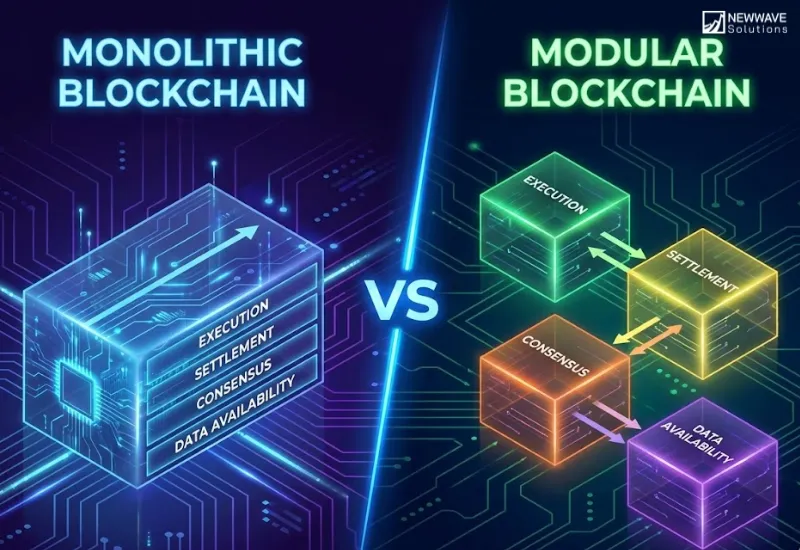
At its core, the difference between modular vs monolithic blockchain is a choice between integration and specialization.
Monolithic blockchains are designed as tightly integrated systems where execution, consensus, and data availability are handled within a single network. This integration simplifies coordination and reduces latency, but it also creates a single scaling bottleneck.
Modular blockchains deliberately separate these responsibilities into specialized layers. By decoupling execution from consensus and data availability, modular systems allow each layer to scale, upgrade, and innovate independently. This architectural separation is what enables long-term scalability and ecosystem diversity.
In other words:
- Monolithic optimizes for efficiency within one system
- Modular optimizes for flexibility across many systems
This distinction directly answers questions such as What is the difference between monolithic and modular?, which is fundamentally about how scaling and innovation are achieved.
Core Differences Table between Modular vs Monolithic Blockchain
| Aspect | Monolithic Blockchain | Modular Blockchain |
| Design philosophy | All-in-one integration | Specialized, layered architecture |
| Scalability | Limited by single-chain throughput | Horizontally scalable via multiple execution layers |
| Customization | Low, shared environment | Very high, per rollup or appchain |
| Security model | Self-contained validator set | Shared security inherited from base layers |
| System complexity | Simple to reason about | Architecturally complex |
| Examples | Solana, Bitcoin | Ethereum + Rollups |
This table highlights why the debate around modular vs monolithic blockchain is less about speed alone and more about how ecosystems evolve over time.
When to Choose Which One?
There is no universally correct blockchain architecture. The right choice depends on application requirements, team capabilities, and long-term growth expectations.
Some systems benefit from deep integration and simplicity. Others benefit from modularity and flexibility. Understanding where your project sits on this spectrum is critical.
When to Choose Modular?
Modular architecture is better suited for teams and projects that prioritize long-term scalability, customization, and ecosystem integration.
It is typically the right choice when:
- You need high customization for your DApp, including control over execution environments and upgrade paths
- You want to inherit security from Ethereum or another established base layer rather than bootstrapping your own validator set
- You plan to scale to millions of users and expect transaction volume to grow significantly over time
- You anticipate frequent upgrades, experimentation, or architectural evolution
- You are building infrastructure-level products, rollups, or complex DeFi systems that require composability
This directly answers What is the main advantage of a modular blockchain architecture compared to a monolithic? The answer is flexibility at scale, without sacrificing security.
When to Choose Monolithic?
Monolithic architecture remains a strong choice for applications where performance and simplicity outweigh the need for customization.
It is often the better option when:
- You need ultra-low latency and fast finality at the base layer
- User experience must be simple, with minimal cross-chain or cross-layer interaction
- Your application is performance-sensitive, such as gaming or real-time payments
- You want minimal architectural overhead and fewer moving parts
- Your team prefers a single-stack system with straightforward assumptions
This is why monolithic chains continue to attract builders despite the momentum behind modular design.
The Future of Modular and Monolithic Blockchain
The future of blockchain architecture is not a winner-takes-all scenario. Instead, it is defined by coexistence and specialization.
Key trends shaping the ecosystem include:
- Modular blockchains increasingly becoming default infrastructure layers for large ecosystems
- Monolithic chains specializing in performance-driven niches where latency is critical
- Growing interoperability between modular and monolithic architectures
- Rollups acting as bridges that connect modular ecosystems with high-performance Layer 1s
- Architectural lessons flowing across ecosystems such as Bitcoin and Ethereum, influencing design decisions on both sides
Rather than replacing monolithic systems entirely, modular architectures absorb their strengths while enabling broader innovation. The result is an ecosystem where different architectures coexist, interoperate, and serve different application needs.
Wrap Up
The debate around modular vs monolithic blockchain is ultimately about trade-offs, not ideology. Monolithic systems deliver speed and simplicity. Modular systems deliver flexibility and long-term scalability. Understanding this distinction is essential for anyone building serious products in blockchain technology.
At Newwave Solutions, we help teams navigate these architectural choices with clarity. Our work spans dApp development solutions, Smart contracts, custom token and coin creation, and full self-hosted blockchain (L0) design. Our engineers work across modern blockchain programming language stacks and support everything from DeFi platforms to NFT development services.
With delivery teams based in Vietnam and experience supporting global blockchain projects, Newwave Solutions partners with companies that want to build scalable, future-ready systems — not just fast prototypes.
If you are deciding between modular and monolithic architectures for your next DApp, we can help you design, build, and scale with confidence.
To Quang Duy is the CEO of Newwave Solutions, a leading Vietnamese software company. He is recognized as a standout technology consultant. Connect with him on LinkedIn and Twitter.



Read More Guides




Get stories in your inbox twice a month.
Let’s Build Something Extraordinary
Sign up for a 30 min no-obligation strategic session with us. Transform your Ideas into scalable reality.
Leave a Reply