


AI MVP Development: A Guide to Process, Cost & Timeline
More than 80% of AI projects fail often because teams start with the wrong problem, lack suitable data, or choose technology that does not fit the business need. AI MVP development offers a lower-risk way to test these assumptions before committing to a full product. The goal is not to build a smaller version of everything, but to prove that the core AI capability works, users find it useful, and the economics make sense.
This guide covers how to scope and build an AI MVP, choose the right technology approach, estimate cost and timeline, and address common development risks before scaling.
Key Takeaways
|
What is an AI MVP?
An AI MVP (Minimum Viable Product) is the simplest usable version of a product in which artificial intelligence delivers part of the core user value. The purpose of AI MVP development is to test whether an AI-powered idea works in practice before investing in a more complete product.
For example, instead of building a complete AI customer service platform, an initial MVP might handle one defined support workflow. The team can then observe whether users find the responses useful, where errors occur, and whether AI adds enough value to justify further development.
AI MVPs are most suitable when the product depends on capabilities such as natural language interaction, recommendations, classification, or prediction. They are less appropriate when simple rule-based automation can solve the problem adequately, or when the application requires highly predictable and explainable outputs from the start.
AI MVP vs. Traditional MVP
Traditional MVPs mainly test whether users need a product and whether its core features solve the intended problem. Their application logic is typically based on predefined rules and workflows.
AI MVPs add another layer of uncertainty because their outputs depend on models and data. Rather than relying only on fixed “if X, then Y” logic, the product may recognize patterns, generate responses, make recommendations, or predict outcomes.
| Aspect | Traditional MVP | AI MVP |
|---|---|---|
| Main validation goal | Test product features and user demand | Test user demand plus AI model performance |
| Application logic | Predetermined rules and workflows | AI-driven predictions, generation, or pattern recognition |
| Role of data | Supports product functions | Directly affects AI output and performance |
| Team requirements | Product, design, and software development | May also require AI/ML and data expertise |
| Success metrics | Adoption, conversion, task completion, usability | Product metrics plus accuracy, latency, error rates, and inference cost |
| Main risks | Low adoption and usability problems | Adds risks related to data quality, bias, security, compliance, and model performance |
To better understand how an MVP differs from a prototype and which approach fits your product stage, read our guide on Prototype vs. MVP.
Why Businesses Should Start with an AI MVP Development
AI products carry more uncertainty than traditional software because their performance depends on data, model behavior, and real user interaction. Starting with AI MVP development gives businesses a controlled way to test these variables before committing to a larger build.
Validate AI performance in real-world conditions
An AI model can perform well during development but behave differently once exposed to real inputs and workflows. An MVP allows teams to test whether outputs are accurate, relevant, and consistent enough for the intended use case.
This early validation also reveals where the model needs refinement. Instead of assuming the AI will work as expected at launch, teams can identify performance gaps while the product scope is still limited.
Test data quality and availability early
AI performance depends heavily on the data available to train, fine-tune, or operate the model. Problems such as incomplete records, bias, inconsistent formats, or insufficient coverage may only become obvious once the system starts processing real inputs.
An AI MVP helps test whether the available data is fit for the intended use case. If it is not, teams can adjust data sources, preprocessing methods, or even the AI approach before investing further.
Validate user needs and adoption
Technical performance alone does not make an AI product useful. Users may interact with the system differently from what the team expected, ignore certain features, or lose trust when outputs are irrelevant or inconsistent.
Testing a limited product with real users helps answer a more practical question: Does the AI solve the problem in a way people are willing to use? Feedback from early interactions can then guide changes to the model, workflow, and user experience.
Reduce development costs and time-to-market
Building a full AI product before testing its core assumptions can lead to wasted effort on features, infrastructure, or model work that users do not need.
An MVP narrows the initial scope to the functionality required for validation. This makes it easier to detect feasibility problems early, avoid unnecessary development, and decide where additional investment is justified. Teams can then expand the product based on evidence rather than assumptions.
Demonstrate product value to investors and stakeholders
A working AI MVP provides more than a concept or presentation. It gives stakeholders something they can evaluate through actual product behavior, early user feedback, and initial performance data.
This can help teams show whether the product addresses a real problem, whether users are willing to engage with it, and whether the AI performs well enough to justify further development. For businesses seeking additional funding or internal approval, that evidence can make the next investment decision more informed.
Key Features of an AI MVP
A strong AI MVP should be small enough to test quickly, but complete enough to show whether the product can deliver real value. In AI MVP development, that means validating not only the user experience, but also the model, data, integration, and performance metrics behind it.
1. Reliable data foundation
Data quality directly affects how well the AI performs. The MVP therefore needs suitable data sources, basic cleaning and preparation, privacy controls, and enough relevant data for the chosen model approach.
Testing this foundation early can reveal whether the available data is incomplete, biased, or unsuitable before the team invests more heavily in model development.
2. Clear problem definition and success metrics
An AI MVP should begin with a specific problem and measurable criteria for proving that the solution works. For example, an AI customer support assistant could use first-response time as its main business KPI, while tracking response accuracy, latency, and cost per inference as AI performance guardrails.
Defining these metrics upfront helps the team judge whether the AI creates practical business value instead of simply adding more AI functionality.

3. Minimal viable AI model
The first model does not need to be the most advanced option. It needs to be good enough to test the product hypothesis.
Depending on the use case, the team might start with an existing AI API, adapt an open-source model, or build a custom model. The goal is to choose the simplest option that can prove whether the AI delivers enough value for the product to move forward.
4. Lean model development and integration
The AI model must also work inside the product, not just in isolation. A lean integration connects the model to the relevant workflow while keeping the setup manageable.
This can include APIs, logging, and monitoring so teams can observe model behavior, make updates, and roll back changes when needed. At the MVP stage, the focus should be on proving the workflow rather than building a full production architecture.
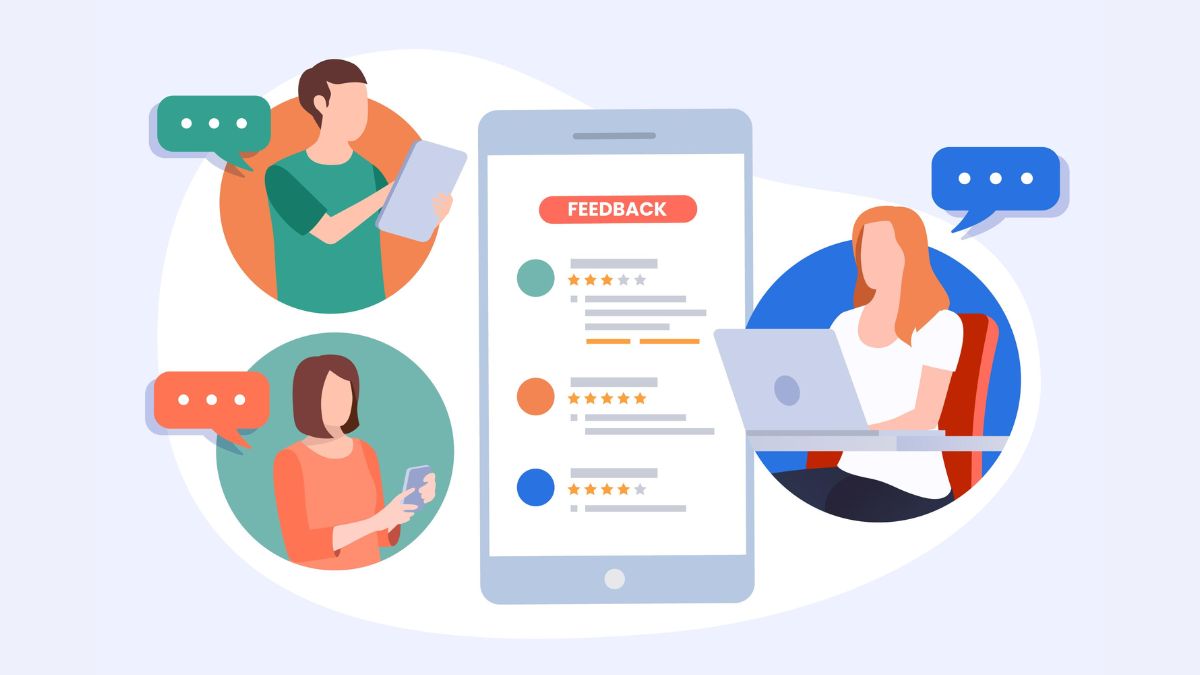
5. Monitoring and feedback loops
An AI MVP should start collecting feedback as soon as users interact with it. Teams need visibility into both user behavior and model performance.
Relevant signals can include response quality, latency, usage patterns, operating cost, user feedback, and human review where needed. These inputs help teams decide what should be refined, retrained, removed, or expanded in the next iteration.
6. Minimal user experience
The user experience should be built around a single core task that makes the AI’s contribution clear and easy to assess. For example, instead of building a full AI support platform, the MVP might focus on helping users complete one support task from input to response. A limited experience makes it easier to see where users succeed, hesitate, or abandon the flow.
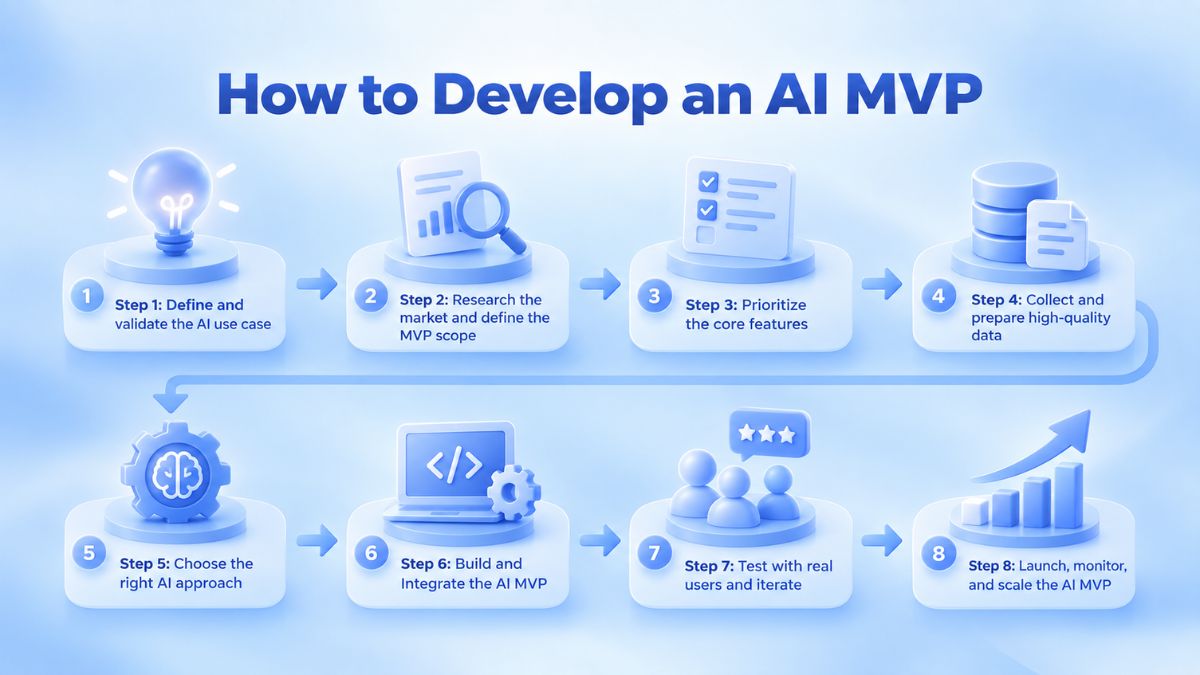
How to Develop an AI MVP: Step-by-Step Guide
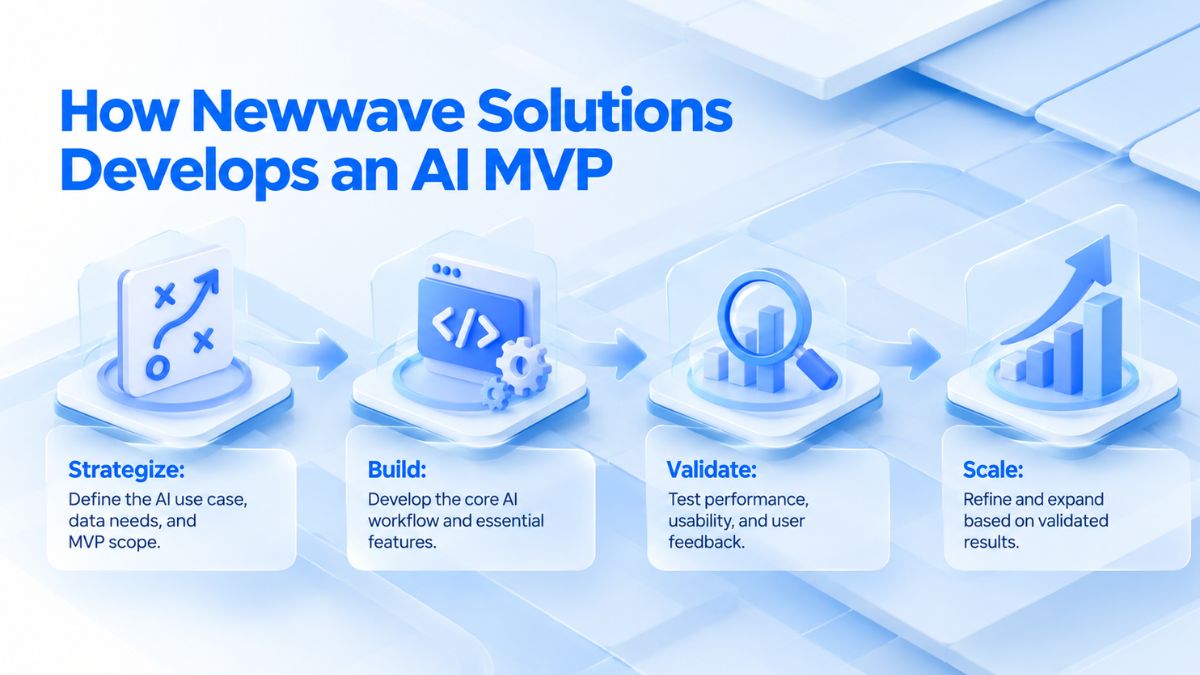
A practical AI MVP development process should reduce uncertainty in stages. Start by proving that the problem is worth solving, then test whether the data, AI approach, and user experience can support it. Only after those assumptions hold should the product move toward a wider release.
Step 1: Define and validate the AI use case
Start with the business problem, not the AI technology. Use customer research, existing product data, or operational feedback to identify where users struggle and whether an AI capability could address that issue.
Take one example. For the ecommerce assistant, the problem might be that support agents spend too much time handling repetitive questions about order status, return policies, and product details. The MVP should therefore test one clear assumption: whether AI can handle a portion of these routine queries without reducing response quality.
Set one primary business KPI and supporting AI metrics so the team knows what evidence would justify further investment. In this case, the main KPI could be reduced handling time, while response quality and latency act as supporting measures.
Step 2: Research the market and define the MVP scope
Next, examine existing alternatives and how users currently solve the problem. Competitor analysis can show where current products fall short, while user feedback can indicate which AI capability is actually worth testing.
For the support assistant, research may show that users mainly need fast answers to a limited set of recurring questions rather than a full conversational support platform. That insight helps narrow the MVP to one workflow: users ask common support questions and receive AI-generated answers based on approved business information.
Step 3: Prioritize the core features
Once the scope is clear, keep only the features needed to complete the target task. The initial product might include a chat interface, access to approved content, AI-generated responses, and a route to a human agent when the system cannot answer reliably. Multilingual support, sentiment analysis, and advanced personalization can wait.
This keeps the test focused on one question: can the AI handle routine support requests well enough to justify further investment?
Step 4: Collect and prepare high-quality data
Next, review the information the AI will rely on. That may include FAQs, product details, return policies, shipping rules, and historical support content.
Before using it, the team should remove outdated entries, standardize formats, fill obvious gaps, and define how sensitive information will be handled. If policies conflict or product data is incomplete, response quality may suffer. Finding those gaps at this stage gives the business a chance to fix the source material before expanding the product.
Step 5: Choose the right AI approach
Select the AI method based on what is needed to test the hypothesis, not on technical ambition.
For the ecommerce assistant, an existing language model connected to an approved knowledge source may be enough to test whether customers can get useful answers to common questions. A custom model would add effort before the team knows whether the concept is worth scaling.
Compare options based on cost, response time, privacy requirements, and future growth needs. More advanced model work can come later if early testing exposes limits that a simpler setup cannot address.
Step 6: Build and Integrate the AI MVP
Now connect the model, interface, and business workflow into a usable product. Here, a customer should be able to ask a question, receive an answer based on approved company content, and move to a human agent when needed. Logging should record interactions so the team can review weak responses and see where the system fails.
Manual review or override controls can also be added where the business wants tighter oversight during early testing.
Step 7: Test with real users and iterate
Release the MVP to a small, relevant group before opening it to everyone. The ecommerce business could begin with customers asking common post-purchase questions. From there, the team can see which requests the AI handles well, where users rephrase their questions, when they ask for an agent, and whether response times remain acceptable.
Product analytics, user feedback, and AI performance data should be reviewed together. A poor result may come from the model, source content, interface, or scope, so iteration should focus on the actual cause rather than simply changing the AI.
Step 8: Launch, monitor, and scale the AI MVP
If early testing shows that the product is meeting its business and technical targets, expand usage gradually.
The business might first add more support topics or allow a larger share of customers to use the assistant. During this phase, continue tracking the main KPI alongside response quality, latency, and operating cost.
Broader rollout should happen only when those measures stay within agreed limits. If performance falls as usage increases, the team can refine the product before committing to a full-scale release.
If you’re looking to understand the broader product development approach, explore our guide on how to build an MVP to learn the key steps, considerations, and best practices for turning an idea into a validated product.
How Do You Know If an AI MVP Is Successful?
An AI MVP is successful when it proves two things: the AI performs well enough for its intended task, and users gain enough benefit to keep using the product. Measuring only model accuracy can miss poor adoption, while strong engagement means little if the AI produces unreliable outputs. Evaluation should therefore combine AI performance, product usage, and business metrics.
| Metric | What It Measures | Why It Matters |
|---|---|---|
| Accuracy, Precision, and Recall | How well the model produces correct and relevant results | Shows whether the AI is technically capable of performing its intended task |
| Daily Active Users (DAU) | Number of users actively using the MVP each day | Indicates whether the product is attracting regular usage |
| User Retention Rate | Percentage of users who continue using the product over time | Helps determine whether the MVP delivers enough ongoing utility to bring users back |
| Conversion Rate | Percentage of users who complete a target action, such as signing up, subscribing, or purchasing | Connects product usage with the business outcome the MVP is meant to influence |
| Bounce Rate | Percentage of users who leave without taking the intended action | Can point to friction, unclear functionality, or weak perceived utility |
| Customer Acquisition Cost (CAC) | Cost required to acquire a new customer | Helps assess whether growth is financially practical |
| Net Promoter Score (NPS) | Users’ willingness to recommend the product | Provides an indication of satisfaction and loyalty |
| Customer Lifetime Value (CLV) | Revenue associated with a customer over their relationship with the product | Helps assess longer-term commercial potential |
| Annual Recurring Revenue (ARR) | Recurring revenue generated over a year | Relevant for evaluating the revenue trajectory of subscription-based MVPs |
The final decision should come back to the hypothesis defined before development. If the model performs reliably, users continue to engage, and the target business KPI moves in the expected direction, the MVP has stronger evidence for further investment. If one of these areas remains weak, the results can show whether the next step should be another iteration, a change in scope, or a different AI approach.
Choosing Tools and Technologies for AI MVP Development
The right stack for AI MVP development is not the most advanced one. It is the one that helps the team launch quickly, connect the AI to the product with minimal friction, and keep enough flexibility to scale if the concept proves viable.
| Area | Common Tools | Role in an AI MVP |
|---|---|---|
| Frontend | Next.js (React), Tailwind, shadcn/ui, React Native, Flutter | Builds the user-facing interface and makes it easier to test the core workflow across web or mobile |
| Backend | FastAPI, NestJS, Docker, GitHub Actions, LaunchDarkly, GrowthBook | Connects the interface with AI services, handles APIs, authentication, logging, deployment, and controlled releases |
| Database | PostgreSQL, JSONB, pgvector, Redis | Stores user data, logs, structured records, embeddings, and cached responses |
| AI Integration | OpenAI, Anthropic, Azure OpenAI, LlamaIndex, LangChain, Weights & Biases, MLflow | Connects models to the product, supports prompt or RAG workflows, and tracks AI behavior during testing |
Frontend
The frontend is the part users interact with, so the priority is speed and clarity. For an AI MVP, the interface only needs to support the main user task and make it easy to test whether the AI is actually useful.
Tools such as Next.js, React Native, or Flutter can help teams build web or mobile interfaces quickly, while UI libraries such as Tailwind or shadcn/ui can shorten design and development time.
Backend
The backend keeps the product running behind the scenes. It connects the user interface with the AI service, manages data, and handles basic functions such as login, tracking, and system requests. For an MVP, the main goal is to keep this setup simple enough to launch quickly, while still making it easy to adjust the product as testing progresses.
Database
The database stores the information the MVP needs to operate, such as user details, activity records, AI interactions, and supporting content.
A flexible setup is useful at this stage because the product may change as the team learns from testing. The database should be able to handle both normal product data and AI-related information without creating unnecessary system complexity.
AI Integration
This is where the AI capability is connected to the product. For most MVPs, the fastest route is to start with existing AI services rather than building a model from scratch.
The main question is whether the chosen AI can solve the intended user problem reliably enough. Once that has been proven, the team can decide whether more advanced options, such as fine-tuning or custom model development, are worth the extra time and investment.
AI MVP Development Cost Breakdown
The cost of AI MVP development depends largely on how much work is needed to turn the initial idea into a testable product. Projects that can reuse existing data, models, and infrastructure are generally less expensive than those that require more custom development or specialized expertise.
| Cost Area | Typical Price Range | Estimated Cost Breakdown |
|---|---|---|
| Data Collection and Preparation | $0–$50,000 |
|
| AI Model Development | $5,000–$1,500,000 |
|
| Cloud Infrastructure and Computing | $500–$30,000 |
|
| Frontend and Backend Development | $10,000–$50,000 |
|
| Team and Talent | $325–$670/hour |
|
AI MVP costs increase as the product requires more engineering to work reliably in real business conditions. Moving beyond a simple demo often means added effort for data, integrations, security, testing, and infrastructure.
For a deeper understanding of the factors that influence project budgets, explore our guide on AI development cost to learn how different technical requirements, data needs, and development scopes affect overall investment.
How Long Does It Take to Build an AI MVP?
The timeline for AI MVP development varies with the level of functionality being tested. A simple concept can be ready in a few weeks, while products that involve more workflows, integrations, or compliance checks need a longer build and validation cycle.
| AI MVP Scope | Estimated Timeline | What This Usually Includes | Suitable For |
|---|---|---|---|
| Concept Demo | 2–4 weeks | A limited AI interaction, basic interface, and enough functionality to demonstrate the idea | Internal buy-in, investor demos, early feasibility checks |
| Focused AI MVP | 6–8 weeks | One main user journey, a working AI capability, essential data connections, and basic testing | Startups or teams validating a single AI use case |
| Knowledge-Based AI MVP | 8–12 weeks | Document retrieval, knowledge access, user queries, and response testing | Internal knowledge assistants, document search, support tools |
| AI SaaS MVP | 10–16 weeks | AI functionality plus user accounts, dashboards, billing, administration, and analytics | Subscription-based AI products intended for external users |
| Enterprise or Regulated AI MVP | 12–20+ weeks | Broader integrations, access controls, security checks, compliance requirements, and more extensive testing | Healthcare, finance, enterprise workflows, and compliance-sensitive products |
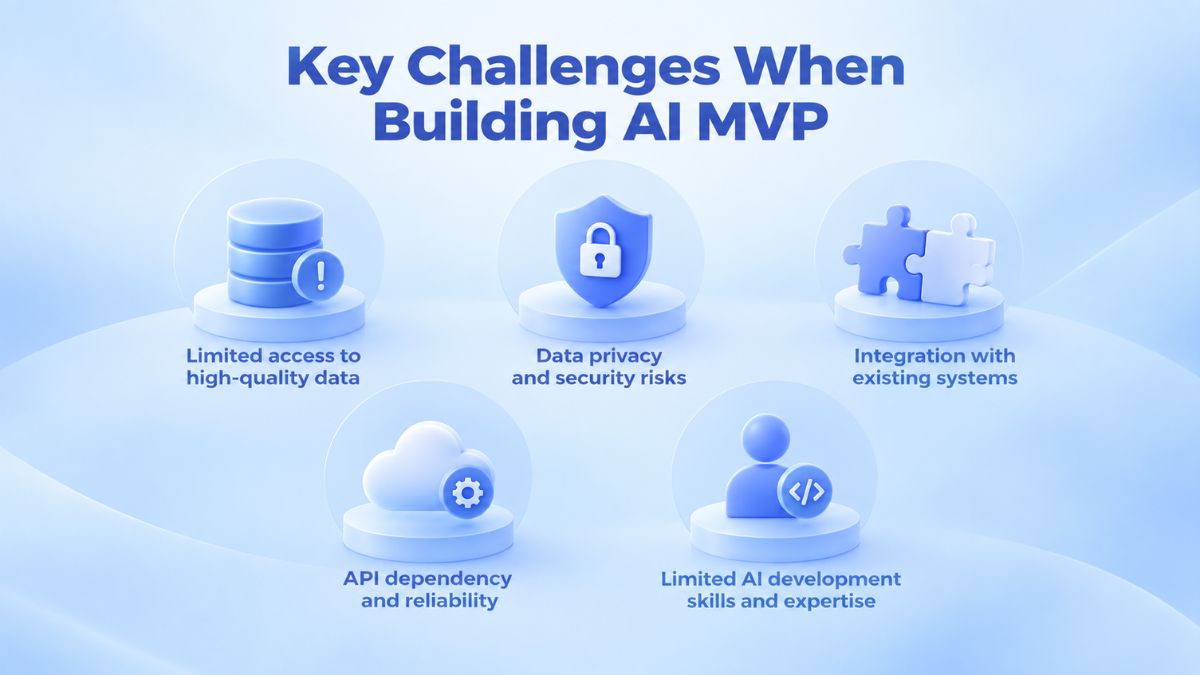
Key Challenges When Building AI MVP and How to Overcome
Building an AI MVP requires more than selecting an AI model and creating a user interface. Teams often face challenges related to data quality, system compatibility, technical expertise, and long-term reliability. Addressing these issues early helps create a stronger foundation for scaling the MVP into a production-ready solution.
1. Data privacy and security risks
Many AI MVPs handle business-sensitive information, customer data, or internal knowledge, creating potential risks around privacy, unauthorized access, and compliance requirements. Weak security practices during early development can create barriers when the product needs to scale.
Businesses can reduce these risks by building security into the MVP from the beginning:
- Minimize unnecessary data collection: Only use the information required for the AI functionality to reduce exposure risks.
- Protect data throughout the pipeline: Encryption, access controls, and audit records help safeguard information during storage and processing.
- Consider infrastructure requirements early: Selecting AI providers and platforms that support relevant security standards can prevent future limitations when expanding the solution.
2. Limited access to high-quality data
Data is one of the most critical factors affecting AI MVP development. Even advanced AI models may deliver unreliable results when the underlying data is incomplete, inconsistent, outdated, or poorly structured.
To overcome this challenge, businesses should approach data preparation as a core product activity rather than a one-time technical task. This includes:
- Establishing clear data standards: Define how data should be collected, formatted, updated, and maintained to ensure consistency throughout the AI workflow.
- Creating reliable evaluation datasets: A smaller dataset reviewed by domain experts can help teams measure AI performance and identify improvement areas before expanding usage.
- Assigning data ownership: Clear responsibility for data quality helps prevent issues caused by unclear processes or unmanaged information sources.
3. Integration with existing systems
An AI MVP delivers limited business value if it operates separately from the tools employees already use. Many organizations need AI solutions that connect with existing systems such as CRM platforms, enterprise applications, analytics tools, or internal databases.
To improve integration success, teams should:
- Start with a clearly defined workflow: Focus on one business process where AI can provide measurable value instead of attempting to automate everything at once.
- Plan integrations early: Mapping required APIs, data flows, and system interactions during development reduces compatibility issues later.
- Test safely before full deployment: Gradual testing approaches, such as limited releases or controlled environments, help identify workflow disruptions before wider adoption.
4. Limited AI development skills and expertise
Successful AI MVP development requires a combination of skills across product strategy, data management, machine learning, deployment, and operations. Teams without the right expertise may struggle with model selection, data pipelines, system architecture, or maintaining AI performance.
To address this challenge, businesses can:
- Combine internal product knowledge with external AI expertise: A hybrid approach allows companies to maintain business ownership while accessing specialized technical capabilities.
- Define clear success metrics early: Product teams, engineers, and data specialists need shared goals to avoid inefficient development cycles.
- Build internal capability over time: Knowledge transfer and collaboration during MVP development can help organizations gradually strengthen their own AI capabilities.
5. API dependency and reliability
Many AI MVPs rely on third-party AI APIs to accelerate development. While this approach can reduce initial complexity, it also introduces dependencies related to service availability, pricing changes, usage limits, and performance consistency.
Teams can improve reliability by:
- Building an abstraction layer between the product and AI providers: This allows developers to manage AI requests more flexibly and reduce dependence on a single service.
- Adding monitoring and control mechanisms: Tracking API performance, response quality, and failures helps teams detect issues quickly.
- Preparing fallback options where necessary: Backup logic or alternative providers can reduce disruption if the primary API experiences unexpected changes.
Turn Your AI Idea into a Market Ready MVP with Newwave Solutions
At Newwave Solutions, we help startups and enterprises transform AI concepts into functional MVPs that are designed for real-world validation. Our MVP development services focus on identifying the core AI use case, developing the essential features, and creating an MVP that allows businesses to test their ideas with actual users.
In our AI development service, we bring expertise across the key technologies required for AI-powered MVPs, including Large Language Model (LLM) integration, AI model implementation, data pipeline development, API connectivity, and scalable software architecture. We help businesses build MVPs that are not only functional but also designed with the technical foundation needed for future growth.
Beyond development, Newwave Solutions supports clients throughout the MVP journey by providing technical consultation and product insights. We help teams evaluate different implementation approaches, identify potential challenges early, and make informed decisions about how to evolve their AI solution into a more complete product.
See how this approach works in practice in our AI-Powered Chatbot Integration Platform case study, where AI capabilities were integrated into a real product workflow. It offers a practical example of how an AI solution can move from concept to usable implementation.
Final Thoughts
Building an AI product involves many uncertainties, from technology feasibility to user adoption. Starting with an MVP allows businesses to validate their idea, refine the solution, and invest in further development with greater confidence. Effective AI MVP development focuses on proving value first, then scaling based on what the market and users reveal.
Choosing the right development partner is an important step in turning an AI concept into a usable solution. Newwave Solutions supports businesses in building AI-powered MVPs with the necessary technical foundation, from AI model integration and data pipelines to scalable architecture. Contact our team to explore how we can help validate and develop your AI idea into a market-ready MVP.
FAQs
1. What is MVP in AI development?
An AI MVP (Minimum Viable Product) is the simplest usable version of a product where artificial intelligence delivers part of the core user value. The purpose of an AI MVP is to test whether the AI-powered idea works in practice, whether users find it useful, and whether it is worth further investment before building a full-scale product.
2. How much time does it take to build an MVP?
The timeline for building an AI MVP depends on the scope, complexity, integrations, and validation requirements. A simple concept demo may take a few weeks, while MVPs involving more workflows, data connections, security controls, or enterprise requirements typically require a longer development and testing cycle.
3. Why should businesses start with an AI MVP first?
Businesses should start with an AI MVP to test whether the use case, data, model performance, and user experience work in real conditions before committing to full-scale development. This reduces the risk of overspending on features or infrastructure that may not deliver enough business value.
4. What should be included in the first version of an AI MVP?
The first version of an AI MVP should focus on the core user problem rather than unnecessary features. It typically includes a clear use case, essential AI functionality, suitable data sources, a simple user experience, and basic monitoring or feedback mechanisms to evaluate performance and user response.
5. What kind of data is needed to train an AI MVP effectively?
An AI MVP needs relevant, reliable, and well-prepared data that matches the intended use case. This may include business documents, historical records, user interactions, or other domain-specific information, but the quality and consistency of the data are often more important than having a large volume of data.
To Quang Duy is the CEO of Newwave Solutions, a leading Vietnamese software company. He is recognized as a standout technology consultant. Connect with him on LinkedIn and Twitter.



Read More Guides

Get stories in your inbox twice a month.
Let’s Build Something Extraordinary
Sign up for a 30 min no-obligation strategic session with us. Transform your Ideas into scalable reality.
Leave a Reply