


Build vs Buy AI: Which Strategy Fits Your Business?
Should you build vs buy AI when adopting artificial intelligence for your organization? The decision can determine how quickly you create value, control costs, and manage long-term complexity. Choosing between developing AI internally and purchasing existing solutions is not only a technical choice; it affects customization, resources, scalability, and future flexibility.
The right approach depends on strategic goals, available expertise, data requirements, and investment expectations. This guide covers build vs buy trade-offs, cost and timeline comparisons, decision factors, and hybrid AI strategies to help teams evaluate the best path for successful AI adoption with lower risk and stronger business outcomes.
Key takeaways
|
Build vs. Buy AI: What It Means
When evaluating build vs buy AI, the decision comes down to whether an organization should create its own AI capabilities internally or adopt an existing solution from an external provider. Each approach changes how much control, responsibility, and flexibility an organization has throughout the AI lifecycle.
Building AI means developing a solution in-house, from designing the system architecture and selecting technologies to creating integrations and maintaining the platform over time.
This approach gives internal teams ownership of the code, product direction, and future improvements. However, it also requires managing the full development process, including technical resources, ongoing maintenance, and operational complexity.
Buying AI means deploying a ready-made AI platform, software, or solution provided by a vendor. Instead of developing everything from the ground up, organizations rely on the provider’s existing infrastructure, expertise, and product roadmap. This can reduce initial complexity and accelerate deployment, but it may limit customization and create dependency on the vendor’s capabilities and future updates.
Build vs Buy AI: Comparison at a Glance
The choice between building and buying AI depends on how an organization balances control, speed, investment, and long-term ownership. While building provides greater flexibility and control over the technology, buying an existing solution can reduce development effort and accelerate deployment.
| Dimension | Build AI | Buy AI |
|---|---|---|
| Initial investment | Higher upfront investment due to AI development, infrastructure setup, and internal resources required to create and maintain the solution. | Lower initial investment because organizations adopt an existing platform or solution instead of developing from scratch. |
| Time to first value | Longer deployment timeline as teams need to design, develop, test, and integrate the AI system. | Faster time to value since the core solution already exists and mainly requires configuration and integration. |
| Customization | Full customization based on specific business workflows, data requirements, and strategic objectives. | More limited customization depending on the capabilities and flexibility offered by the vendor. |
| IP ownership | The organization owns the underlying code, architecture, and future development direction of the AI solution. | The vendor typically owns the product, technology roadmap, and core platform capabilities. |
| Talent dependency | Requires strong internal AI expertise to build, operate, and continuously improve the system. | Requires less specialized internal AI talent because development and maintenance are managed by the provider. |
| Vendor lock-in risk | Lower risk because the organization controls the technology and development path. | Higher dependency on the vendor’s platform, pricing model, updates, and product roadmap. |
| Compliance control | Provides greater control over data handling, system design, and governance processes. | Control depends on the vendor’s security, compliance capabilities, and operational policies. |
| Best suited for | Organizations with strong AI capabilities that need highly specialized solutions or want to build proprietary AI assets. | Organizations prioritizing faster implementation and using AI for more standardized business needs. |
Build AI: More Control, More Complexity
Building AI in-house gives organizations full ownership over how their AI systems are designed, developed, and improved. However, this greater level of control also comes with increased complexity, requiring significant investment in technology, expertise, and long-term management.
Pros and cons of building AI in-house
Building AI internally gives organizations greater control over the technology, data, and development roadmap. However, this approach requires significant investment in talent, infrastructure, and ongoing maintenance, which can increase complexity and execution risk.
Pros of Building AI In-House
1. Greater control and customization
A custom-built AI system can be designed around specific business requirements, workflows, and proprietary data. Organizations are not limited by the features available in commercial platforms and can continuously adjust the solution as their needs evolve.
For example, a company with a unique decision-making process may need an AI model trained around internal data and specialized rules that cannot be easily replicated by an off-the-shelf product.
2. Ownership of AI assets and roadmap
With an in-house approach, the organization owns the underlying models, code, architecture, and development direction. This allows teams to decide when to introduce new capabilities, modify system behavior, or integrate AI more deeply into their operations without depending on a vendor’s priorities.
3. Continuous optimization and improvement
An in-house AI system gives organizations the ability to continuously refine models, update workflows, and improve performance based on internal feedback and changing business needs. Without depending on a vendor’s release cycle, teams can prioritize improvements that directly support their operational goals.
Cons of building AI in-house
1. Higher resource and talent requirements
Creating AI internally requires more than software development skills. Organizations typically need specialized roles such as data scientists, machine learning engineers, AI architects, and MLOps practitioners, along with the infrastructure needed to support development and deployment.
Without sufficient expertise, projects may take longer than expected or struggle to move from experimentation into production.
2. Greater complexity and maintenance responsibility
An internal AI system requires continuous management after launch. Teams must handle issues such as data quality, model performance changes, system updates, and expanding project scope over time. Without external accountability, it can be easier for AI initiatives to become more complex than originally planned.
3. Longer path to business value
Compared with adopting an existing AI solution, building from scratch usually requires more time for design, development, testing, and deployment. This approach may not be suitable when the business needs immediate results or lacks the resources for a long-term AI investment.
When building AI makes sense
Building AI is most suitable when the use case cannot be effectively addressed by existing solutions and the value of customization justifies the additional investment. Organizations should consider this approach when they have the right combination of strategic need, technical capability, and sufficient timeline.
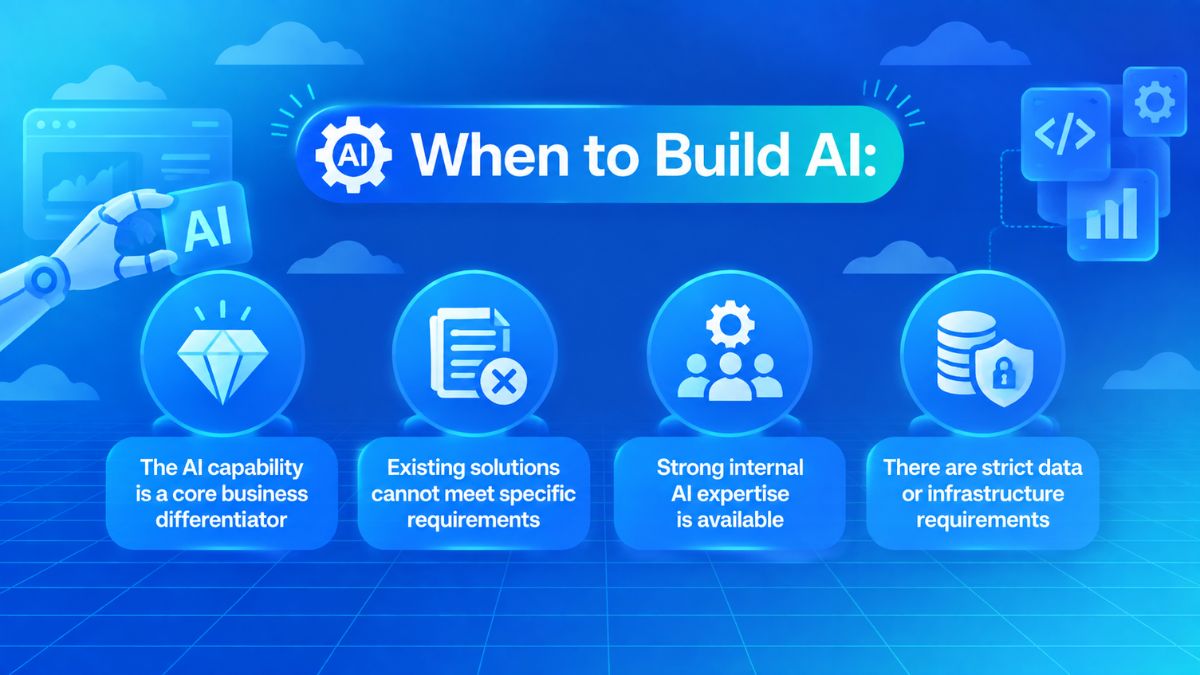
Building AI may be the right choice when:
- The AI capability is a core business differentiator: If the AI system itself creates competitive advantage, such as a proprietary model or specialized decision engine, owning the technology may be strategically important.
- There are strict data or infrastructure requirements: Some organizations may need greater control over where data is processed and how AI systems are deployed due to internal technical constraints or governance needs.
- Existing solutions cannot meet specific requirements: Unique workflows, specialized data, or technical constraints may require a custom architecture rather than a standard platform.
- Strong internal AI expertise is available: Organizations with experienced AI teams may have the capability to design, operate, and improve their own solutions effectively.
To understand the investment required for building AI solutions, explore our guide on AI agent development cost and the key factors that influence development expenses, resources, and long-term maintenance.
Buy AI: Faster Time to Value, More Long-term Trade Offs
Buying AI can include SaaS AI platforms, pre-built AI models accessed through APIs, or enterprise AI products designed for common business needs. By using an existing solution, organizations can reduce development effort and move from experimentation to deployment more quickly.
Pros and cons of buying AI in-house
Buying AI solutions allows organizations to deploy proven capabilities faster while reducing the need for extensive internal expertise and development resources. The trade-off is less control over customization, greater dependence on vendors, and potential challenges related to integration and long-term costs.
Pros of buying AI
1. Faster implementation and quicker business value
One of the biggest advantages of buying AI is speed. Since the core technology has already been developed and tested by the provider, organizations can focus on configuration, integration, and applying the solution to their workflows rather than building the entire system from the beginning.
This approach is particularly useful when the goal is to improve existing operations quickly. For example, businesses implementing customer service automation or document processing may benefit from adopting a proven AI platform instead of investing time in developing a custom system.
2. Lower technical complexity
Buying AI reduces the need to build and maintain a complete internal AI capability. Organizations do not need to assemble large teams of AI specialists or manage every stage of model development, infrastructure setup, and system maintenance.
The vendor takes responsibility for improving the platform, managing updates, and addressing many technical challenges associated with operating AI solutions in production.
3. Lower execution risk
Commercial AI solutions are typically designed around established use cases, allowing organizations to avoid some of the challenges involved in building a new system from scratch. The implementation process may be more predictable because the provider already has experience deploying and supporting the technology.
Cons of Buying AI
1. Limited customization and control
The main trade-off of buying AI is reduced control. Organizations must work within the capabilities, customization options, and product roadmap defined by the vendor. If a business requires highly specific functionality that the platform does not support, adapting the solution may become difficult.
2. Vendor dependency and lock-in risk
When relying on a third-party AI solution, organizations become dependent on the provider’s decisions, including product updates, pricing changes, and future development priorities. If a vendor changes direction, stops improving the platform, or is no longer available, it may affect the organization’s AI roadmap.
3. Long-term cost considerations
Although buying AI often reduces upfront investment, organizations need to consider ongoing costs such as licensing, subscriptions, integrations, and potential customization requirements. Over time, these expenses may become significant depending on how widely the solution is used.
4. Integration complexity with existing systems
Integrating pre-built AI solutions into existing business environments can require significant effort. Organizations often need to connect AI platforms with core enterprise systems such as CRM platforms (Salesforce, Microsoft Dynamics 365), ERP systems (SAP, Oracle NetSuite), data warehouses, and internal workflow applications to ensure AI can access the right information and trigger relevant actions.
Integration challenges often arise when AI solutions need to connect with fragmented data sources, legacy systems, limited APIs, or complex business workflows. Organizations may need custom middleware when data must be synchronized across multiple platforms, transformed before processing, or connected through complex authentication flows.
When buying AI is the right call
Buying AI is often the better option when speed, reliability, and operational efficiency matter more than building a unique AI capability. It is especially suitable for organizations adopting AI for standardized use cases or those that are still developing their internal AI maturity.
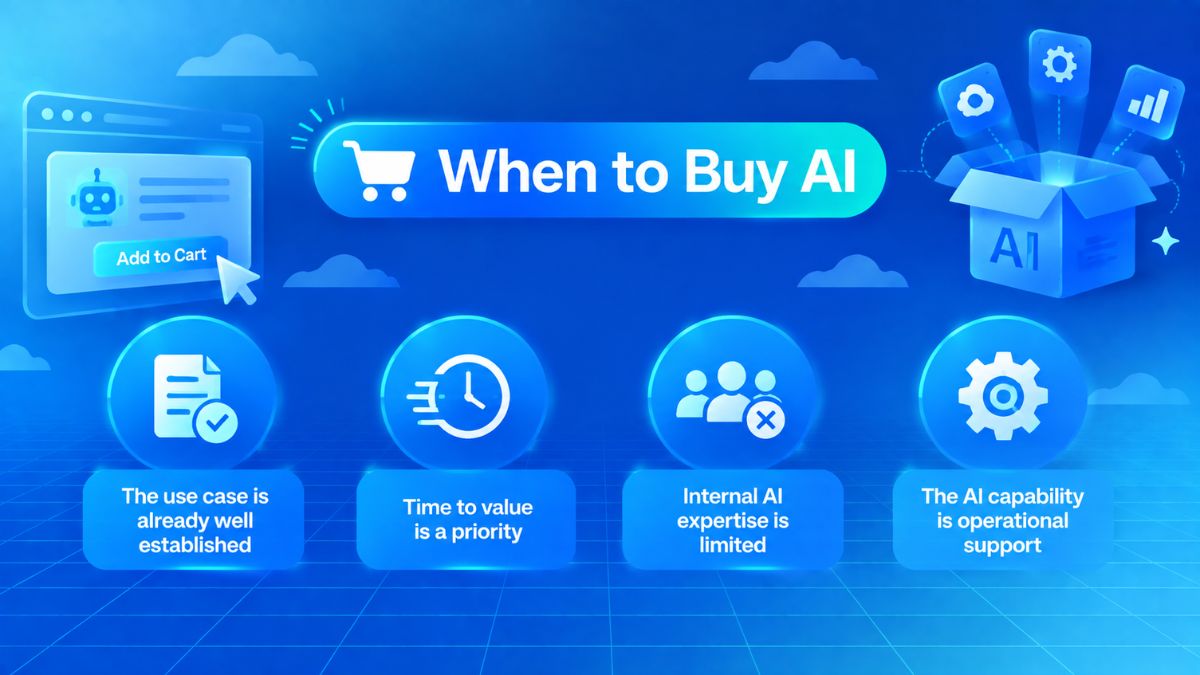
Buying AI may make sense when:
- The use case is already well established: Common applications such as customer support automation, HR document processing, or basic predictive analytics can often be addressed effectively through existing solutions.
- Time to value is a priority: When the business needs AI capabilities quickly, adopting a ready-made platform can shorten deployment compared with developing a custom system.
- Internal AI expertise is limited: Organizations without deep AI engineering resources can use commercial solutions to begin adoption without building a large technical team.
- The AI capability is operational support rather than a competitive advantage: If AI improves existing processes but is not the core product or differentiation strategy, purchasing an existing solution may provide better efficiency.
Build vs Buy AI: A Side-by-side Cost Comparison
Cost is a critical factor in the build vs buy AI decision, but the cheaper option upfront is not always the most cost-effective in the long run. Organizations need to consider the full investment required across development, operation, and scalability to understand the true financial impact of each approach.
Cost of building AI in-house
Building AI requires organizations to invest in the full lifecycle of AI development. The largest cost drivers are usually not only the initial build but also the resources required to operate and improve the system after launch.
| Cost Dimension | Estimated Cost Range/ Consideration |
|---|---|
| AI engineering team | According to Developer Salary Benchmarks 2026, data engineers cost around $100,000- $265,000/ year, while roles requiring AI expertise tend to pay nearly 25% higher wages. |
| Data preparation and engineering | Data preparation accounts for 20-40% of first-time AI projects. |
| Infrastructure and computing resources | PYMNTS reported a case of AI tool where cloud costs grew from around $200 per month during development to approximately $10,000 per month after user adoption increased |
| Model maintenance and optimization | Maintenance costs can range from $500 to over $20,000 per month, depending on the model complexity, usage scale, infrastructure requirements, and level of optimization needed. |
To understand the factors that influence custom AI investment, explore our guide on AI development cost and learn how development complexity, resources, infrastructure, and maintenance requirements shape the overall budget.
Cost of buying AI
Buying AI can reduce the upfront investment required to develop models, hire specialized AI talent, and maintain internal infrastructure. However, the actual cost of adopting commercial AI solutions is often more complex than the initial subscription price.
Enterprise AI expenses can change significantly based on usage volume, pricing models, number of users, integrations, and how deeply the solution is embedded into business workflows.
This example from Harvard Business Review used Oracle’s 2026 AI pricing model to illustrate how usage-based pricing can scale with adoption. A 10,000-employee company using a premium AI agent system could spend around $3,600 annually when only 10% of employees use the tool, but costs may increase to approximately $27,600 annually when adoption grows to 50% under the same usage assumptions.
Build vs Buy AI: How Long Does Each Approach Take?
Beyond cost, deployment speed is another major difference between building and buying AI. Developing a custom AI solution usually involves multiple stages, including requirement analysis, architecture design, development, testing, integration, and stabilization.
A typical in-house AI project may require several months before reaching production. Teams need time to define requirements, develop the system, connect it with existing workflows, and validate performance before full deployment.
Research on the AI lifecycle identifies 19 stages across three major phases: Design, Develop, and Deploy. These stages highlight that building AI involves a broader process beyond model creation, requiring careful planning and operational readiness before the solution can deliver value in production.
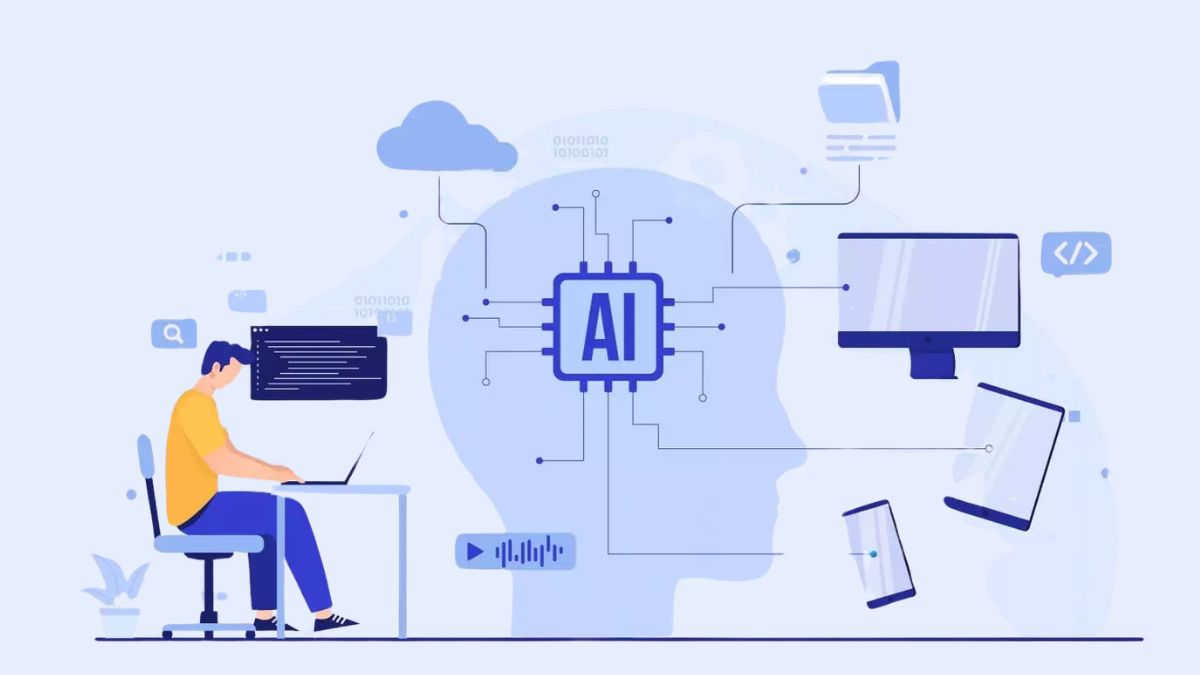
By comparison, buying an AI solution generally shortens the implementation timeline because the core technology already exists. The main activities involve selecting the right platform, configuring the solution, integrating it with existing systems, testing, and preparing for deployment.
| Deployment Stage | Build AI | Buy AI |
|---|---|---|
| Requirement analysis and planning | Requires detailed architecture decisions and technical planning before development begins. | Focuses on selecting a suitable vendor and configuring business requirements. |
| Development and customization | Requires building models, workflows, integrations, and supporting infrastructure. | Mostly involves configuration and adapting existing capabilities. |
| Testing | Requires validating model performance, reliability, and production readiness. | Testing focuses mainly on integration, usability, and workflow compatibility. |
| Deployment timeline | Often takes months depending on complexity, internal capability, and project scope. | Usually faster because the solution has already been developed and tested by the provider. |
| Long-term optimization | Internal teams manage improvements, updates, and system evolution. | Vendor manages platform updates, while organizations optimize usage and integrations. |
The 5-factor Framework to Choose the Right Route
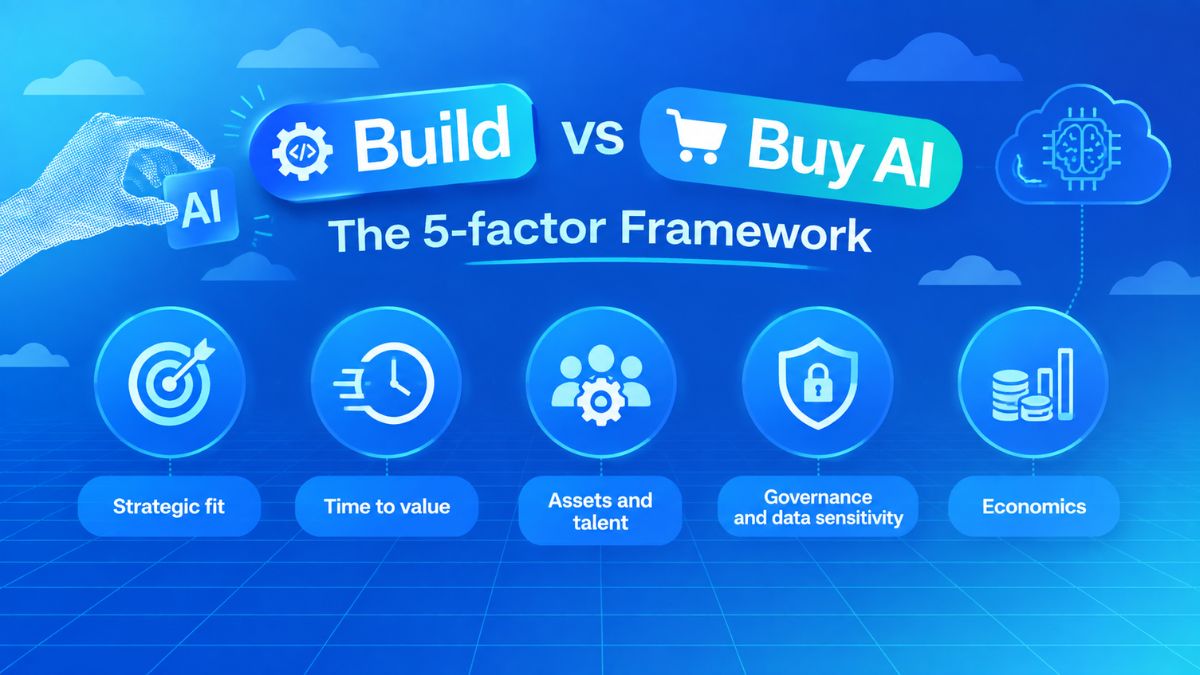
Choosing between building and buying AI requires a structured evaluation of business goals, technical capabilities, and long-term impact. Instead of asking which option is universally better, organizations should assess how each approach aligns with their specific requirements.
Strategic fit: Is AI a competitive advantage?
The first consideration is whether the AI capability directly contributes to business differentiation. If AI is part of the core product, customer experience, or a unique business process, building internally may provide greater control and create long-term strategic value.
For example, proprietary systems such as recommendation engines or dynamic pricing models can directly influence customer engagement and revenue generation. In these cases, owning the underlying AI capability may be more valuable than relying on a standard solution.
However, for operational use cases such as document processing, workflow automation, or general analytics, buying an existing AI solution may provide value faster without requiring significant internal development.
Time to value: How quickly is AI needed?
The required speed of deployment can significantly influence the decision. Buying AI usually enables faster adoption because organizations can configure and integrate existing solutions instead of developing models from the beginning.
Building AI requires additional time for data preparation, architecture design, model development, testing, deployment, and ongoing optimization. While this longer timeline may be acceptable for strategic initiatives, it may not fit situations where the business needs immediate operational improvements.
Economics: What is the total cost of ownership?
The final decision should consider the complete financial impact rather than only the initial investment. Buying AI often requires lower upfront spending but introduces recurring licensing, usage, and vendor-related costs. Building AI requires higher initial investment in talent and infrastructure but may provide greater ownership and flexibility over time.
Organizations should compare both short-term and long-term costs, including maintenance, scalability, integration, and potential switching costs.
Governance and data sensitivity: How much control is required?
Data requirements are another critical factor in the build vs buy AI decision. When AI systems rely on sensitive information, organizations may need greater control over data processing, security, compliance, and model behavior.
For industries handling sensitive data, such as financial information, healthcare records, or proprietary business knowledge, building internally may provide stronger control. For less sensitive use cases, a commercial AI solution with appropriate governance practices may be sufficient.
Assets and talent: Do internal capabilities exist?
AI development requires more than data scientists alone. Successful implementation often depends on a combination of machine learning expertise, software engineering, cloud infrastructure, MLOps capabilities, and domain knowledge.
Organizations with mature AI teams and strong technical infrastructure may benefit from building because they can customize solutions and maintain greater control. Those without sufficient expertise may face higher risks, longer timelines, and increased complexity when developing internally.
Score each factor from 1 to 5 based on your organization’s situation:
| Evaluation Factor | 1 Point | 3 Points | 5 Points |
|---|---|---|---|
| Strategic Fit | AI is mainly operational and standardized | AI supports important workflows | AI is a core competitive differentiator |
| Time to Value | Long timeline is acceptable | Value is needed within months | Immediate deployment is a priority |
| Assets and Talent | Limited AI expertise and infrastructure | Some internal capability exists | Strong AI team and technical foundation available |
| Governance and Data Sensitivity | Data is low-risk and suitable for external platforms | Moderate governance requirements | Sensitive data requires maximum control |
| Economics (TCO & ROI) | Short-term cost efficiency is the priority | Balance between cost and control | Long-term ownership justifies higher investment |
After scoring each factor, add up the total points to identify which approach is more aligned with your current business priorities:
- 21–25 points (Build AI is likely the stronger fit): Your organization has strong internal capabilities, requires high levels of customization, and views AI as a strategic asset rather than a supporting tool. Building internally may provide greater control, ownership, and long-term differentiation.
- 15–20 points (Consider a hybrid AI approach): Your requirements may involve both speed and customization. A combination of commercial AI solutions and internal development can help validate use cases quickly while gradually building proprietary capabilities where they create the most value.
- 5–14 points (Buy AI is likely the more practical option): Your priority is faster deployment, lower initial complexity, or accessing AI capabilities without significant internal investment. A proven vendor solution may help achieve business outcomes while reducing development and maintenance challenges.
Build, Buy, or Both? Understanding the Hybrid AI Approach
The decision between building and buying AI does not always require choosing one approach permanently. Many organizations adopt a hybrid AI strategy that combines commercial AI solutions with internal development to balance faster deployment, customization, governance, and long-term control.
Rather than replacing one approach with another, hybrid AI allows businesses to use external capabilities where they provide efficiency while developing proprietary solutions in areas that directly influence competitive advantage.
Validate AI value before making large investments
For organizations that are still building AI maturity, starting with commercial solutions can be an effective way to test ideas before committing significant internal resources.
Instead of developing a complete AI system from scratch, companies can use existing platforms, APIs, or pre-built models to address specific business problems. This allows teams to evaluate whether an AI application can improve operations, generate measurable value, and fit existing workflows.
Once the use case is proven and internal knowledge increases, organizations can selectively move certain capabilities in-house. They may customize models, improve data pipelines, or develop proprietary features where additional control creates meaningful business value. This approach reduces early investment risk while allowing organizations to gradually build internal AI expertise.
Build differentiating capabilities, buy standard AI functions
A hybrid strategy also allows organizations to separate AI capabilities into two categories: components that create competitive differentiation and components that are already available as commercial solutions.
Standard AI capabilities, such as speech recognition, general language processing, or image analysis, can often be sourced from external providers. Meanwhile, organizations can focus internal development efforts on business-specific logic, workflows, decision systems, or customer experiences that directly impact their competitive position.
This modular approach helps organizations maintain flexibility while avoiding unnecessary investment in technology that does not differentiate their business.
Maintain data control while leveraging external AI models
Data governance is another reason organizations choose a hybrid approach. Some businesses need strict control over how data is stored, processed, and managed but still want access to advanced AI capabilities.
In this model, organizations keep sensitive data and data management processes within their own environment while connecting to external AI services through controlled interfaces such as secure APIs or private deployment options.
This approach can help balance two competing priorities: protecting sensitive information while benefiting from advanced AI models that would require significant resources to develop internally.
Scale AI through a flexible long-term strategy
Hybrid AI should be viewed as an evolving strategy rather than a one-time technology decision. Organizations may begin with vendor solutions to accelerate adoption, gradually develop internal expertise, and eventually take ownership of the AI components that matter most.
By combining external innovation with internal capabilities, businesses can avoid the limitations of choosing only one path. They gain the speed of buying AI while preserving the flexibility and control of building AI where it matters.
If you want to develop custom AI solutions without building a full internal team, explore our guide on AI outsourcing to understand how external expertise can support faster and more scalable AI implementation.
Final Thought
The right build vs buy AI decision depends on whether an organization needs full ownership of a strategic capability or faster access to proven AI solutions. In many cases, the most effective approach is a hybrid strategy that combines internal development with external expertise to achieve the right balance between customization, speed, control, and long-term scalability.
Newwave Solutions provides AI development services that help businesses design, develop, and integrate custom AI solutions based on their specific operational needs. With expertise in AI application development, chatbot integration, and intelligent automation, Newwave Solutions supports organizations in turning AI ideas into practical solutions while reducing the complexity of building internal capabilities from scratch.
To learn more about how AI solutions can be applied in real-world scenarios, explore the AI-powered chatbot integration platform case study from Newwave Solutions. The platform was designed to support scalable customer interactions, handling 10,000+ user interactions while connecting conversational AI with existing business systems.
FAQs
1. When to build vs buy AI?
Build AI when the solution is strategically important, requires unique customization, involves sensitive data, or can create a competitive advantage that commercial tools cannot provide. Buying AI is often more suitable when the use case is standardized, speed is a priority, or the organization lacks the internal expertise to develop and maintain AI systems.
2. What are the main advantages of building AI in-house?
Building AI in-house provides greater control over the model, data, architecture, and future development roadmap. It also allows organizations to create customized solutions that are closely aligned with proprietary processes and business requirements.
3. Is building AI more expensive than buying AI?
Building AI usually requires higher upfront investment because organizations need to invest in AI talent, data preparation, infrastructure, development, and ongoing maintenance. Buying AI may reduce initial costs, but long-term expenses can increase through licensing fees, usage-based pricing, customization, and vendor dependency.
4. What are the pros and cons of buying an AI solution?
Buying an AI solution enables faster deployment, reduces development complexity, and allows organizations to access proven technologies without building a full internal team. However, it may limit customization, create vendor dependency, and increase long-term costs as usage grows or business requirements become more complex.
5. How long does it take to build AI compared with buying an existing solution?
Building AI typically takes longer because organizations need time for data preparation, model development, testing, integration, and deployment. Existing AI solutions can often be implemented within weeks or months, depending on customization and integration requirements, making them a faster option for organizations seeking quicker business value.
To Quang Duy is the CEO of Newwave Solutions, a leading Vietnamese software company. He is recognized as a standout technology consultant. Connect with him on LinkedIn and Twitter.



Read More Guides
Get stories in your inbox twice a month.
Let’s Build Something Extraordinary
Sign up for a 30 min no-obligation strategic session with us. Transform your Ideas into scalable reality.
Leave a Reply