


NFT Marketplace Development: A Complete Business Guide for 2026
What do a masterpiece, a digital collectible, and a virtual game item have in common? Each can become an NFT with verifiable ownership, tradable value, and global reach. As blockchain reshapes how digital and real-world assets are created, exchanged, and monetized, NFT marketplaces are becoming a key gateway into this new economy.
This shift is creating new opportunities for businesses to build platforms around digital collectibles, gaming assets, tokenized memberships, real-world assets, and creator economies. This guide explores what NFT marketplace development involves in 2026, covering marketplace types, technology stacks, security, development costs, and monetization strategies.
Key Takeaways
|
What is NFT Marketplace Development?
NFT marketplace development is the process of creating a blockchain-based platform where users can mint, buy, sell, and trade non-fungible tokens securely. It combines blockchain technology, smart contracts, digital wallets, storage systems, and user interfaces to support secure transactions, ownership management, and data handling.
As a result, such marketplaces enable creators and collectors to exchange unique digital assets (art, collectibles, virtual real estate, etc.) with transparent ownership and immutable transaction records.
Why NFT Marketplace Development Matters in 2026?
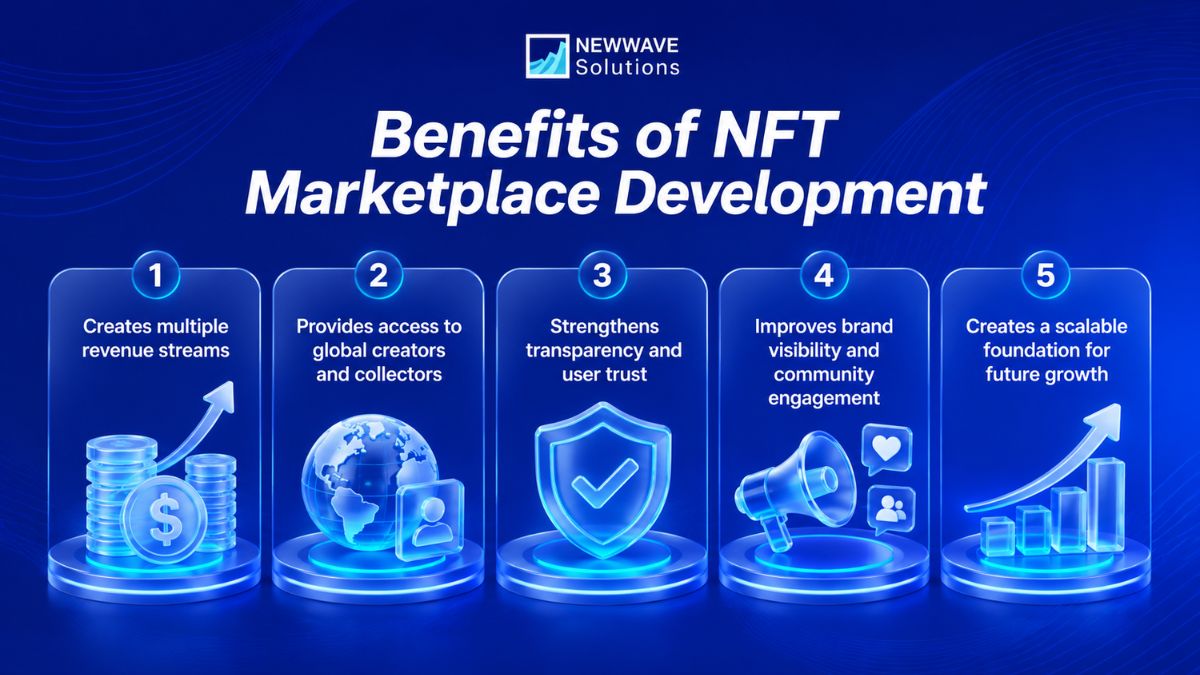
In 2026, NFT marketplaces can help businesses create new revenue streams, boost engagement, support tokenized assets, and reach global audiences. Therefore, investing in NFT marketplace development offers both immediate opportunities and long-term Web3 growth.
Creates multiple revenue streams
NFT marketplace development enables businesses to generate recurring revenue from a growing digital ecosystem. Marketplace owners can charge transaction fees on primary and secondary sales, offer paid listings, launch exclusive NFT drops, or provide subscription-based creator tools. Smart contracts can also automate royalty distribution, encouraging creators to remain active and bring more trading volume to the platform.
Provides access to global creators and collectors
An NFT marketplace helps businesses connect directly with creators and collectors worldwide. Artists, musicians, game developers, brands, and asset owners can tokenize and sell digital products without geographical limitations. Supporting multiple NFT categories also allows the platform to attract diverse communities, expand organically, and operate continuously across global markets.
Strengthens transparency and user trust
Blockchain-based marketplaces provide verifiable ownership records and transparent transaction histories. Smart contracts automate minting, sales, royalties, and asset transfers, reducing dependence on intermediaries and limiting manual errors. Combined with secure wallet integration, smart contract audits, encryption, and fraud prevention measures, these capabilities create a safer environment for valuable digital assets.
Improves brand visibility and community engagement
An NFT marketplace can transform passive customers into active community members. Businesses can use branded collectibles, token-based memberships, loyalty rewards, exclusive content, and limited drops to create more interactive customer experiences. These assets give users incentives to participate, share, collect, and trade, strengthening brand recognition and long-term loyalty.
Creates a scalable foundation for future growth
One of the key reasons for building an NFT marketplace is its long-term scalability. A well-designed platform can grow with increasing users and transaction volumes, unlike pre-built solutions that often become restrictive.
Modular architecture allows seamless expansion of features like minting, payments, listings, and analytics without rebuilding the system. It is also future-ready, supporting innovations such as layer-2 scaling, cross-chain interoperability, decentralized storage, dynamic NFTs, and utility-driven digital assets.
Different Types of NFT Marketplace
NFT marketplaces can be categorized by their accessibility, content validation process, and the assets they support. Let’s look at the most common types before choosing the one that matches your target users, community strategy, and monetization goals.
Open NFT marketplaces
Open NFT marketplaces allow anyone to register, mint assets, list NFTs, and participate in trading. Their low entry barriers make them accessible to a large community of creators and collectors. However, limited artist vetting and content moderation may increase the risk of copied, fraudulent, or low-quality NFTs.
Closed or premium NFT marketplaces
Closed NFT marketplaces restrict access to approved subscribers, invited users, or verified creators. This model helps businesses build an exclusive community where rare, premium, or high-value NFTs can be traded. Stronger access controls and creator selection can improve asset quality, user trust, and brand positioning.
Curated NFT marketplaces
Curated NFT marketplaces review creators and digital assets before allowing them to be listed. The validation process may assess originality, artistic value, authenticity, and alignment with the platform’s standards. Although this limits the number of listings, it helps maintain content quality and protects buyers from copied or misleading assets.
Non-curated NFT marketplaces
Non-curated marketplaces provide an open environment where creators can list NFTs without undergoing a formal approval process. This approach encourages wider participation and gives emerging artists more opportunities to monetize their work. However, marketplace operators need effective reporting, copyright protection, and fraud detection systems to manage content risks.
Collectibles NFT Marketplaces
Collectibles marketplaces focus on NFT collections built around a shared concept, character, theme, or visual style. These collections often contain multiple algorithmically generated assets with different traits and rarity levels. A well-known example is the Bored Ape Yacht Club NFT collection, which features a series of digital ape illustrations sharing a common theme of apes at a yacht club.

Gaming and metaverse NFT marketplaces
Gaming and metaverse marketplaces enable users to buy, sell, and trade digital items such as characters, skins, weapons, virtual land, and in-game assets. These NFTs can provide real utility within connected games or virtual environments. Developing this marketplace type requires close integration with game engines, blockchain infrastructure, token economies, and Web3 wallets.
How Does NFT Marketplaces Work?
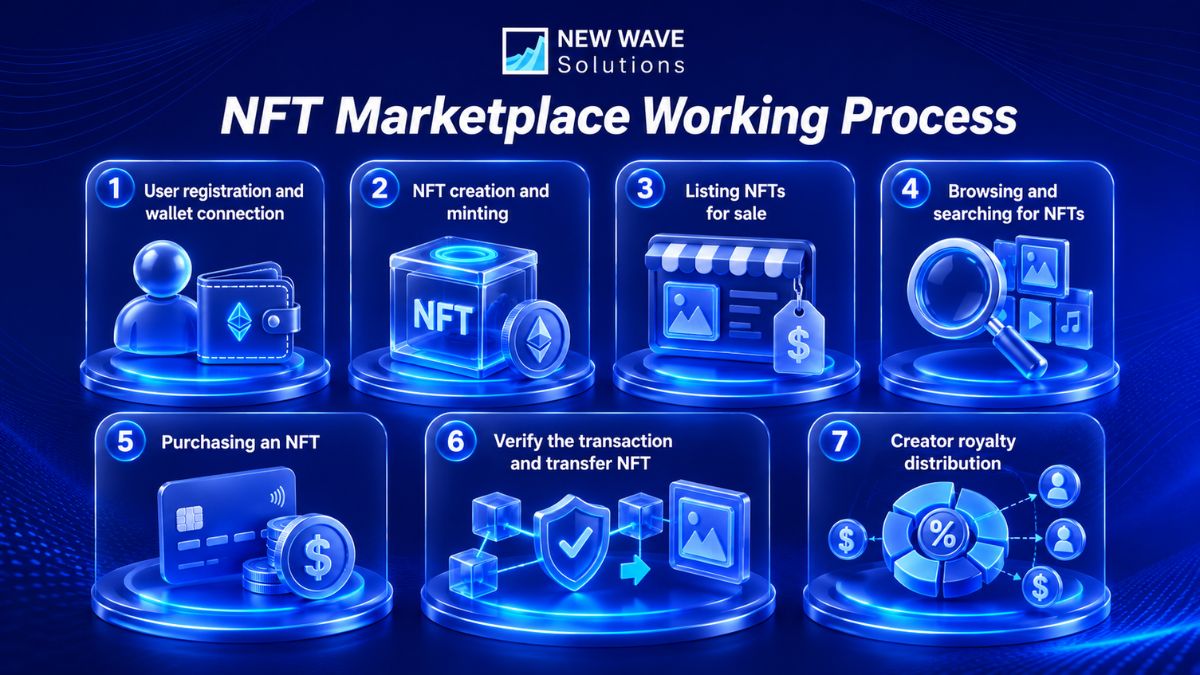
An NFT marketplace connects creators, collectors, crypto wallets, smart contracts, and blockchain networks within one trading platform. Here are the main steps in NFT marketplace working process:
User registration and wallet connection
Users begin by creating an account and connecting a cryptocurrency wallet, such as MetaMask or another supported wallet. The wallet acts as both their blockchain identity and the tool used to sign transactions, store NFTs, and make payments.
NFT creation and minting
Creators upload digital assets such as artwork, music, videos, or gaming items and enter relevant metadata. They then sign a blockchain transaction that sends the token information to a smart contract for minting. The marketplace should provide an intuitive minting interface, reliable metadata management, and support for suitable blockchain networks.
Listing NFTs for sale
After minting, creators can list their NFTs at a fixed price or through an auction. They may select the accepted cryptocurrency, listing duration, and royalty percentage. The marketplace uses smart contracts to manage the sale and should support flexible pricing, multiple currencies, timed listings, and automatic delisting.
Browsing and searching for NFTs
Buyers browse NFT collections and search for assets that match their interests. Categories, tags, filters, sorting options, and advanced search tools help users find relevant NFTs more efficiently. A clear discovery experience is essential for improving engagement and increasing the likelihood of successful transactions.
Purchasing an NFT
When a buyer chooses an NFT, they approve the purchase through their connected wallet. The payment is sent in cryptocurrency to the smart contract controlling the sale. Secure and audited smart contracts are required to process payments correctly, while real-time price conversion can support transactions involving different cryptocurrencies.
Verify the transaction and transfer NFT
The blockchain network verifies the payment before completing the transaction. Once confirmed, the smart contract transfers the NFT from the seller’s wallet to the buyer’s wallet and sends the payment to the seller. The ownership change and transaction details are permanently recorded on the blockchain.
Creator royalty distribution
NFT marketplaces can allow creators to earn royalties whenever their assets are resold. The creator defines a royalty percentage during the minting process, and the payment terms are encoded into the smart contract. When a secondary sale occurs, the contract automatically distributes the agreed percentage to the original creator.
NFT Marketplace Development: White-Label vs. Custom Solutions
A white-label NFT marketplace is a pre-built platform that can be customized with a company’s branding, selected features, and third-party integrations. In contrast, a custom NFT marketplace is designed and developed from the ground up around specific business requirements, user journeys, smart-contract logic, and monetization models.
|
Factor |
White-label NFT marketplace |
Custom NFT marketplace |
| Development approach | Uses an existing, pre-developed marketplace framework that can be configured and branded. | Built from scratch according to the company’s technical and business requirements. |
| Time to market | Can usually be launched faster because core functions are already available. | Requires more time for discovery, design, development, integration, testing, and deployment. |
| Initial investment | Generally requires a lower upfront investment because businesses mainly pay for customization and integration. | Typically involves a higher investment due to custom architecture, UI/UX, smart contracts, and security development. |
| Core features | Usually includes standard functions such as NFT minting, listings, wallet connections, auctions, and trading. | Allows businesses to define both essential and advanced features from the beginning. |
| Customization | Customization may be limited by the platform’s existing architecture and supported modules. | Provides extensive control over features, workflows, smart contracts, and user experiences. |
| Branding | Supports basic branding changes such as logos, colors, typography, and interface adjustments. | Enables a distinctive visual identity and fully customized marketplace experience. |
| Monetization | Commonly supports transaction fees, listing fees, subscriptions, and other standard revenue models. | Supports more flexible models, including premium memberships, exclusive drops, advertising, and custom commissions. |
| Scalability | Suitable for an initial launch, although future expansion may depend on the provider’s technical framework. | Can be architected for long-term growth, higher transaction volumes, and additional blockchain integrations. |
| Ownership and control | Businesses may depend on the solution provider for source code, updates, infrastructure, and platform changes. | Provides greater control over the source code, backend architecture, user data, and development roadmap. |
| Maintenance and updates | Maintenance, bug fixes, and standard updates are often managed by the white-label provider. | The marketplace owner is responsible for ongoing maintenance, upgrades, security, and technical support. |
| Security control | Security depends partly on the quality of the pre-built solution and the provider’s update practices. | Businesses can define their own security architecture, audit process, access controls, and compliance measures. |
When deciding between a white-label and a custom NFT marketplace, the choice mainly depends on your budget, timeline, and long-term business goals. Each option serves different stages of growth and levels of control.
- Choose a white-label NFT marketplace when speed, affordability, and lower initial risk are the main priorities. It is ideal for startups and SMEs looking to test market demand, launch a minimum viable product, or enter the NFT space quickly without building full infrastructure from scratch.
- Choose a custom NFT marketplace when you need a long-term strategic platform with unique features, flexible monetization, full ownership, and high scalability. It is best suited for enterprises, established brands, and Web3 businesses that require complete control over architecture, security, user data, and future development.
What Technology Stack Require for NFT Marketplace Development
A reliable NFT marketplace technology stack combines frontend tools, backend technologies, blockchain programming languages, databases, and smart contract frameworks.
Frontend frameworks
Frontend technologies determine how creators and collectors interact with the marketplace. They support responsive interfaces for minting NFTs, exploring collections, connecting wallets, and completing transactions across desktop and mobile devices.
- Next.js: Next.js is a React framework that supports server-side rendering, static generation, and faster page loading for scalable NFT marketplace interfaces.
- React: React is a JavaScript library used to build interactive user interfaces and dynamic single-page marketplace applications.
- Bootstrap: Bootstrap is an open-source framework that helps developers create responsive, mobile-first layouts using reusable interface components.
Backend frameworks and languages
The backend manages user profiles, NFT listings, marketplace data, APIs, notifications, and interactions between the interface and blockchain infrastructure. It must be secure and scalable enough to process growing user activity and transaction requests.
- PHP: PHP is an open-source server-side language used to build dynamic marketplace functions and connect the platform with databases and external APIs.
- Python: Python is a versatile object-oriented programming language suitable for backend services, data processing, automation, and blockchain integrations.
- Django: Django is a full-stack Python framework that accelerates development through built-in security tools, object-relational mapping, and reusable components.
Blockchain Development Languages
Blockchain programming languages are used to build decentralized functions and connect the marketplace with networks such as Ethereum, Solana, or other compatible ecosystems. The selected language generally depends on the platform’s chosen blockchain and smart contract requirements.
- Solidity: Solidity is the primary programming language for developing decentralized applications and smart contracts on Ethereum and other EVM-compatible networks.
- Rust: Rust provides strong memory safety, high performance, and low-level control, making it suitable for blockchain ecosystems such as Solana.
- Vyper: Vyper is a Python-inspired smart contract language for Ethereum that emphasizes simplicity, readability, and reduced security risks.
Data storage
NFT marketplaces require both on-chain and off-chain storage to manage user information, asset metadata, transaction records, and searchable marketplace content. Databases and query technologies help retrieve this information efficiently without placing all data directly on the blockchain.
- GraphQL: GraphQL is a query language that allows marketplace applications to request and retrieve specific data efficiently through APIs.
- PostgreSQL: PostgreSQL is an object-relational database management system suitable for structured data such as user accounts, listings, and transaction details.
- MongoDB: MongoDB is a NoSQL database that supports flexible storage for large volumes of structured and unstructured marketplace data.
- IPFS: IPFS is a decentralized storage system commonly used to store NFT images, videos, documents, and metadata outside the blockchain.
Smart contract
Smart contracts automate essential NFT marketplace processes, including minting, listings, auctions, payments, ownership transfers, and creator royalties. Their programming language must support the selected blockchain while providing sufficient security, performance, and maintainability.
- Solidity: Solidity enables developers to build EVM-based marketplace contracts and test them through development environments such as Remix.
- Rust: Rust supports secure, high-performance smart contracts and provides concurrency and cross-platform capabilities for complex marketplace applications.
- Vyper: Vyper uses a limited and simplified feature set to make Ethereum smart contracts easier to audit and less vulnerable to malicious behavior.
Key Features of a Successful NFT Marketplace
NFT marketplaces combine standard e-commerce functionality with blockchain-specific tools such as minting, wallet integration, auctions, and ownership verification. The features below provide a solid core foundation, while additional innovations can help distinguish the platform and enhance the overall NFT trading experience.
- NFT storefront: Presents listed NFTs with key information including creator details, price, ownership history, rarity level, category, and current listing status.
- NFT minting and uploading: Enables creators to upload digital files, add metadata, choose a blockchain network, set royalties, and mint NFTs through an intuitive process.
- Advanced search and filtering: Allows users to find NFTs using criteria such as name, creator, category, price range, rating, release date, rarity, and other relevant filters.
- Auction and bidding: Lets buyers place bids within a defined timeframe while sellers configure starting prices, bid increments, and auction duration settings.
- Crypto wallet integration: Connects users to digital wallets for authentication, transaction signing, NFT purchases, asset receipt, and withdrawal of earnings.
- User authentication and verification: Confirms the identity of creators and users to minimize fraud, impersonation, copyright issues, and other security risks.
- User profile management: Provides access to user collections, purchase history, active listings, bids, saved items, wallet information, and account preferences.
NFT Marketplace: Step-by-Step Development Guide
Developing an NFT marketplace requires careful planning across business strategy, blockchain infrastructure, smart contracts, user experience, payment integration, and cybersecurity. The following process outlines the key stages involved in building a secure, functional, and scalable NFT trading platform.
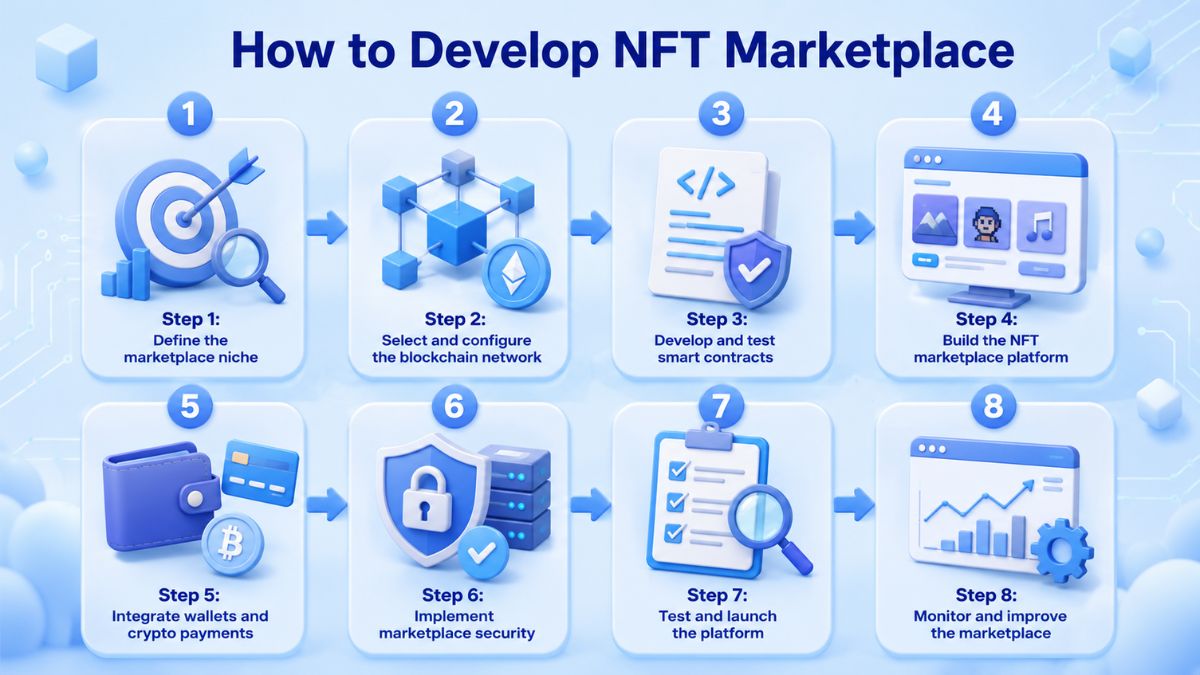
Step 1: Define the marketplace niche
Start by identifying the target audience, supported asset types, and competitive positioning of the marketplace. Popular niches include digital art, gaming assets, music, sports collectibles, virtual real estate, and tokenized physical assets. Competitor and market research can help reveal unmet user needs and opportunities for differentiation.
Step 2: Select and configure the blockchain network
Choose a blockchain based on transaction speed, network fees, scalability, security, wallet compatibility, and NFT standards. Ethereum, Polygon, Solana, and BNB Chain are common options for public marketplaces. A private blockchain may be more suitable when NFT distribution and trading must remain within a controlled group.
Step 3: Develop and test smart contracts
Create smart contracts to automate NFT minting, listings, auctions, purchases, ownership transfers, and creator royalties. The contract logic should reflect the marketplace’s transaction rules and monetization model. Before deployment, conduct comprehensive testing and security audits to identify vulnerabilities that attackers could exploit.
Step 4: Build the NFT marketplace platform
Develop the frontend and backend systems required to support creators, buyers, and administrators. The interface should make it easy to upload assets, mint NFTs, browse collections, connect wallets, place bids, and complete purchases. The backend must reliably manage user accounts, metadata, listings, notifications, and blockchain interactions.
Step 5: Integrate wallets and crypto payments
Connect the platform with compatible cryptocurrency wallets so users can authenticate, sign transactions, receive NFTs, and withdraw earnings. Crypto payment gateways such as BitPay, CoinGate, or Coinbase Commerce may also be integrated to simplify payments for NFT purchases and marketplace services.
Step 6: Implement marketplace security
Protect the marketplace through data encryption, secure API authorization, multi-factor authentication, fraud detection, and role-based access controls. Smart contracts should be independently audited, while sensitive off-chain data must be securely stored and regularly backed up. Clear cybersecurity guidance can also help users protect their wallets and accounts.
Step 7: Test and launch the platform
After setting up the blockchain and UI, implement core marketplace features using a suitable programming language. Once development is complete, thoroughly test functionality, usability, performance, and security across devices, wallets, and transaction flows.
Step 8: Monitor and improve the marketplace
After launch, continuously monitor transactions, smart contract activity, system performance, security alerts, and user behavior. Regular updates should address vulnerabilities, improve usability, and add features based on community feedback. Ongoing optimization helps the marketplace adapt to new NFT standards, blockchain networks, and market expectations.
Key Security Risks in NFT Marketplace Development
Ensuring robust security is a critical part of NFT platform development. Without safeguards, these marketplaces are vulnerable to cyberattacks, phishing schemes, and unauthorized entry.
Smart contract vulnerabilities
Errors such as reentrancy, integer overflow or underflow, uninitialized storage pointers, and insecure randomness can allow attackers to manipulate contract execution. These vulnerabilities may result in repeated withdrawals, incorrect transaction values, unauthorized data changes, or substantial losses of cryptocurrency and NFTs.
To reduce these risks, developers should follow secure coding standards, use established contract libraries, and conduct extensive unit, integration, and adversarial testing. Independent smart contract audits, formal verification, testnet deployment, and continuous on-chain monitoring should also be completed before and after launch.
Platform and API vulnerabilities
Insecure APIs, weak authentication, inadequate encryption, and misconfigured permissions can expose marketplace systems to unauthorized access. Attackers may steal user data, manipulate listings, access administrative functions, or interfere with transactions through compromised backend services.
Marketplace operators should implement multi-factor authentication, role-based access controls, encrypted data transmission, and strict API authorization policies. Regular penetration testing, security patching, access-log monitoring, rate limiting, and secure data storage can further reduce platform-level threats.
User and wallet security risks
Phishing, man-in-the-middle attacks, and wallet breaches target users rather than the marketplace’s underlying infrastructure. Fraudulent websites, deceptive messages, or intercepted communications may trick users into revealing private keys, approving malicious contracts, or transferring valuable assets.
The platform should provide verified links, transaction previews, suspicious-activity alerts, and clear wallet security guidance. HTTPS encryption, anti-phishing mechanisms, wallet risk screening, session protection, and optional hardware or multi-signature wallet support can help users avoid fraudulent transactions.
The Complete Cost Breakdown of NFT Marketplace Development
NFT marketplace development costs depend on features, technical complexity, and the level of security and testing required. Key factors include the chosen blockchain, technology stack, smart contract approach, UI design, scalability needs, and third-party integrations.
Basic MVP features
A typical NFT marketplace MVP costs approximately $30,000–$120,000 and takes around 8–16 weeks to develop.
| Feature | Estimated cost |
Estimated timeline |
| User accounts and profiles | $2,000–$8,000 | 1–2 weeks |
| Wallet login and authentication | $3,000–$12,000 | 1–3 weeks |
| NFT minting module | $6,000–$25,000 | 2–5 weeks |
| Fixed-price marketplace listings | $6,000–$20,000 | 2–4 weeks |
| Search, filters, and discovery | $4,000–$15,000 | 2–4 weeks |
| NFT detail page and activity history | $3,000–$10,000 | 1–2 weeks |
| Creator royalties and platform fees | $4,000–$18,000 | 2–4 weeks |
| Basic admin dashboard | $5,000–$20,000 | 2–5 weeks |
| Email and in-app notifications | $2,000–$8,000 | 1–2 weeks |
Growth features
Growth features expand an MVP with more advanced trading, compliance, analytics, and monetization capabilities as the marketplace gains users and transaction volume.
|
Feature |
Estimated cost |
Estimated timeline |
| Auctions, bidding, and reserve prices | $10,000–$40,000 | 3–6 weeks |
| Make-offer and accept-offer functions | $8,000–$30,000 | 2–5 weeks |
| Multi-chain or cross-chain listings | $20,000–$80,000 | 6–12 weeks |
| Fiat on-ramp integration | $10,000–$50,000 | 4–8 weeks |
| KYC and AML integration | $15,000–$80,000 | 4–10 weeks |
| Moderation, reporting, and anti-fraud rules | $10,000–$60,000 | 4–10 weeks |
| Creator and admin analytics dashboards | $8,000–$35,000 | 3–6 weeks |
Security and reliability features
Security and reliability features strengthen smart contract safety and platform performance.
|
Feature |
Estimated cost |
Estimated timeline |
| Smart contract audit readiness | $15,000–$70,000 | 4–8 weeks |
| Infrastructure scalability and performance | $10,000–$80,000 | 4–10 weeks |
5 Popular Examples of NFT Marketplace
Below are some of the most popular examples that have shaped the NFT ecosystem.
OpenSea
Launched in 2017, OpenSea is one of the earliest and most widely recognized NFT marketplaces. The platform supports multiple blockchain networks and a broad range of assets, including digital art, music, domain names, gaming items, trading cards, and collectibles.
AtomicHub
AtomicHub is an NFT marketplace developed by blockchain company pink.gg. It allows users to create, buy, sell, and trade NFTs across categories such as digital collectibles, gaming assets, and virtual items. The platform is particularly known for supporting NFT projects within the WAX blockchain ecosystem.
SuperRare
Founded in 2017, SuperRare focuses on exclusive, single-edition digital artworks from selected artists. Its curated model emphasizes originality, scarcity, and artistic quality rather than high-volume NFT listings. Collectors can purchase and resell tokenized artworks through blockchain-based transactions.
Rarible
Founded in 2020 by Alexei Falin, Rarible enables creators to mint and sell digital artworks, memes, collectibles, and virtual assets. Its accessible interface supports both creators and collectors throughout the NFT trading process. The platform also offers multi-chain functionality and community-oriented marketplace tools.
Binance NFT
Binance launched its NFT marketplace in June 2021 as an extension of its established cryptocurrency ecosystem. The platform allows users to create, buy, and trade digital art, gaming items, collectibles, and mystery boxes. Its integration with Binance services offers convenient access to crypto payments and a large user base.
How to Make Money With Your NFT Marketplace
An NFT marketplace can generate revenue from trading activity, platform services, premium tools, and strategic partnerships. However, the most suitable monetization model depends on the marketplace niche, target users, transaction volume, and value offered to creators and collectors.
- Transaction fees: Charge a percentage of each NFT sale completed on the platform, commonly ranging from 1% to 10%. This creates recurring revenue as marketplace trading volume grows.
- Listing fees: Require creators or sellers to pay a fixed fee when publishing NFTs for sale. This model generates upfront income and can help reduce low-quality or spam listings.
- Minting fees: Charge creators for converting digital assets into blockchain-based tokens. The fee may cover blockchain gas costs, platform infrastructure, or additional minting services.
- Premium features and subscriptions: Offer paid tools such as featured listings, promoted NFTs, advanced analytics, exclusive drops, or reduced transaction fees. Subscription plans can provide more predictable recurring revenue.
- Secondary-sale revenue: Collect transaction fees whenever NFTs are resold on the marketplace. Creators may also receive automated royalties, typically defined during minting and distributed through smart contracts.
- Launchpad and token-sale services: Help NFT projects launch collections, Initial NFT Offerings, or other token sales in exchange for service fees or a percentage of total sales. These services can also attract new users and trading activity.
- Partnerships and sponsorships: Collaborate with artists, creators, gaming companies, or brands to release exclusive NFT collections and sponsored campaigns. The marketplace can earn through partnership fees, commissions, promotions, and special events.
Future Trends in NFT Marketplace
In 2026, NFT marketplaces are evolving toward smarter, more interoperable, utility-focused, and secure ecosystems that connect digital assets with broader business and real-world applications.
AI-powered NFT marketplaces
Artificial intelligence will improve personalization, automation, and security across NFT marketplaces. AI can recommend relevant collections, detect suspicious activity, support dynamic pricing, automate content moderation, and help creators generate unique digital assets.
Real-world asset tokenization
More marketplaces will support NFTs backed by real-world assets such as real estate, artwork, luxury goods, intellectual property, and collectibles. Tokenization can improve transparency, enable fractional ownership, and make traditionally illiquid assets easier to trade. However, these platforms will also require stronger compliance and asset-verification processes.
Multi-chain marketplace integration
Future NFT marketplaces will increasingly connect with multiple networks, including Ethereum, Polygon, Solana, BNB Chain, and Avalanche. Multi-chain support gives users more choices regarding transaction fees, processing speed, liquidity, and wallet compatibility.
Gaming and metaverse NFT ecosystems
Gaming and metaverse marketplaces will support the ownership and trading of characters, skins, weapons, virtual land, and other in-world assets. Greater interoperability may allow users to transfer or use selected assets across connected digital environments. This trend can create new revenue models for game developers, players, and virtual-world operators.
How Newwave Support Businesses with NFT Marketplace Development
With more than 10 years of software development experience, Newwave Solutions has delivered 800+ projects for over 500 clients worldwide. Whether it’s fully custom NFT marketplaces or white-label solutions, our team combines blockchain engineering, product strategy, UI/UX design, security, and scalable architecture to help startups and enterprises turn NFT concepts into reliable digital platforms.
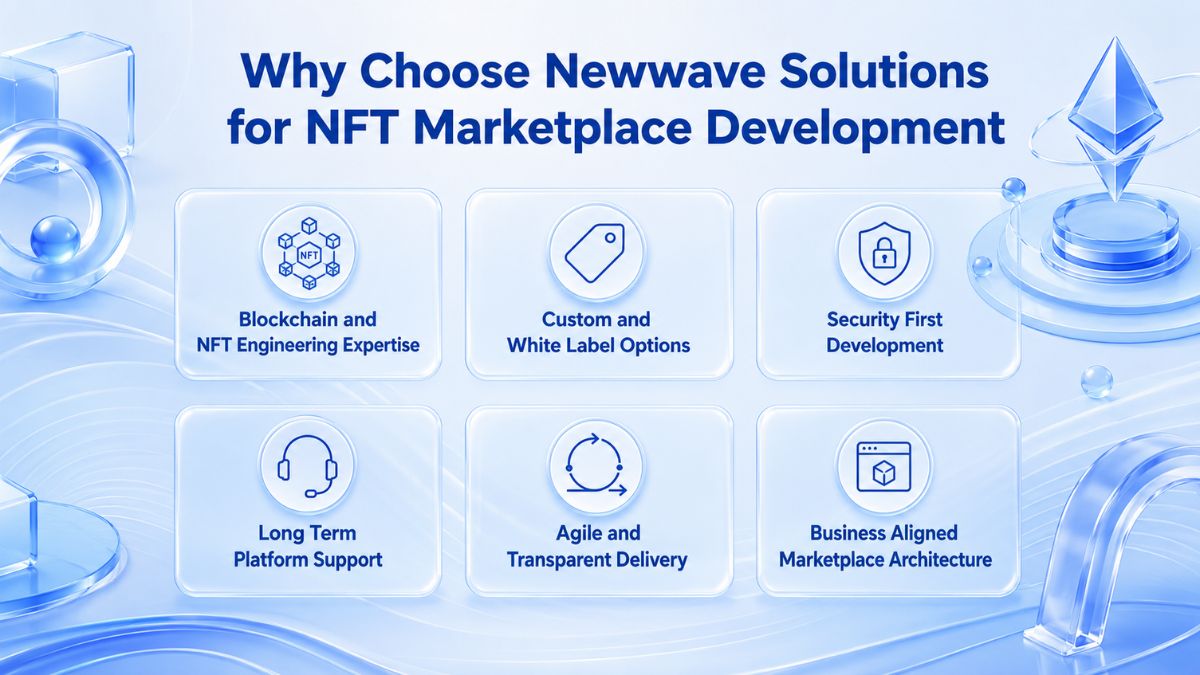
For NFT marketplace development, our priorities focus on:
- Security: Protecting smart contracts, crypto wallets, transactions, APIs, and user data through ISO/IEC 27001-aligned development practices.
- Scalability: Building flexible architectures that can support growing user bases, higher transaction volumes, and future blockchain integrations.
- User experience: Creating intuitive journeys for minting, listing, discovering, buying, selling, auctioning, and managing digital assets.
- Business value: Aligning platform features, revenue models, and technical decisions with your target audience and long-term Web3 strategy.
Technology is only one part of building a successful NFT marketplace. With Newwave Solutions, you gain a multidisciplinary team that can guide product features, security decisions, platform scalability, and long-term development.
Contact us to transform your NFT marketplace idea into a secure, user-focused platform built for sustainable growth.
Final Thought
Building an NFT marketplace in 2026 can be worthwhile when the platform addresses a clear market need and offers value beyond speculative trading. Successful NFT marketplace development requires a defined niche, practical asset utility, secure smart contracts, intuitive user journeys, and a sustainable monetization strategy.
Turning that opportunity into a reliable product also requires the right technical partner. Newwave Solutions supports businesses from product planning and blockchain architecture to development, security testing, launch, and long-term optimization. Contact our team to build a secure, scalable NFT marketplace aligned with your users and business goals.
FAQ
1. Why do you need to develop a NFT marketplace?
An NFT marketplace allows creators and businesses to mint, showcase, sell, and trade unique digital assets through a dedicated platform. It can also create new revenue streams, strengthen community engagement, and give buyers access to verified NFT collections.
2. Which blockchains can be used for NFT marketplace development?
NFT marketplaces can be built on Ethereum, Polygon, Solana, BNB Chain, Avalanche, Flow, and other blockchain networks. The right choice depends on transaction fees, processing speed, scalability, smart contract support, security, and target users.
3. How can I secure an NFT marketplace?
Security measures should include audited smart contracts, data encryption, multi-factor authentication, secure API authorization, fraud detection, and role-based access controls. Regular penetration testing, system monitoring, backups, and security updates are also essential.
4. Can creators mint and sell their own NFTs?
Yes, creators can upload digital assets, add metadata, define royalties, mint NFTs, and list them for sale directly through the marketplace. Platforms should also implement creator verification and copyright controls to reduce fraudulent or unauthorized content.
5. What legal considerations apply to NFT marketplace development?
Businesses should consider intellectual property rights, KYC and AML requirements, consumer protection, data privacy, taxation, securities regulations, and marketplace terms of service. Requirements vary by jurisdiction and asset type, so professional legal guidance is recommended before launch.
To Quang Duy is the CEO of Newwave Solutions, a leading Vietnamese software company. He is recognized as a standout technology consultant. Connect with him on LinkedIn and Twitter.



Read More Guides
Get stories in your inbox twice a month.
Let’s Build Something Extraordinary
Sign up for a 30 min no-obligation strategic session with us. Transform your Ideas into scalable reality.
Leave a Reply